
Quick Answer
Freelance mediation adds a neutral facilitator when direct talks stall; the mediator cannot impose a settlement. Agree the issues, document exchange, neutral, cost limit and review date. Track filing deadlines separately. Record approved settlement terms for payment, delivery, rights, release timing and default, then verify performance rather than treating a transfer instruction as payment.
Freelance mediation gives you a defensible way to resolve client disputes without defaulting to court#
When direct negotiation stalls, consider mediation if both parties can participate safely and make informed choices. Set the issues, documents, cost limit and review date before booking. Track claim deadlines separately: an invitation, scheduled session or continuing conversation does not automatically stop a filing clock.
For covered New York City work, DCWP freelancer guidance explains written-contract, timely-payment and retaliation protections. Mediation is a possible settlement route alongside the available complaint and court processes. Do not make agreement to mediate a new condition for paying earned invoices or assume it replaces statutory rights.
By the end, you should have:
- A clear go or no-go rule for direct negotiation, negotiated settlement, or another option besides going to court.
- A first-contact script that invites a settlement conversation without conceding your position.
- A focused evidence checklist for the disputed facts and payment timeline.
- A session checklist so key assumptions are explicit before you close.
Do not treat a verbal understanding as the finish line. The real standard is a signed Settlement Agreement with specific obligations, dates, and triggers that both sides can execute and verify. If the dispute reopens, you should be able to rely on one clear record instead of scattered messages.
If one party refuses basic document exchange, keeps changing core facts, or avoids concrete terms, treat that as a red flag and move to the next path you documented.
A simple sequence keeps this manageable when tensions are high. Start by naming the exact disputed issue in one sentence. Match that issue to the clause that governs it. Pick the current path and define the trigger that moves the case to the next path if progress stalls. Then capture each decision in writing as you go. That habit turns a stressful dispute into a series of choices you can defend later.
Check the Mediator’s Role and Process#
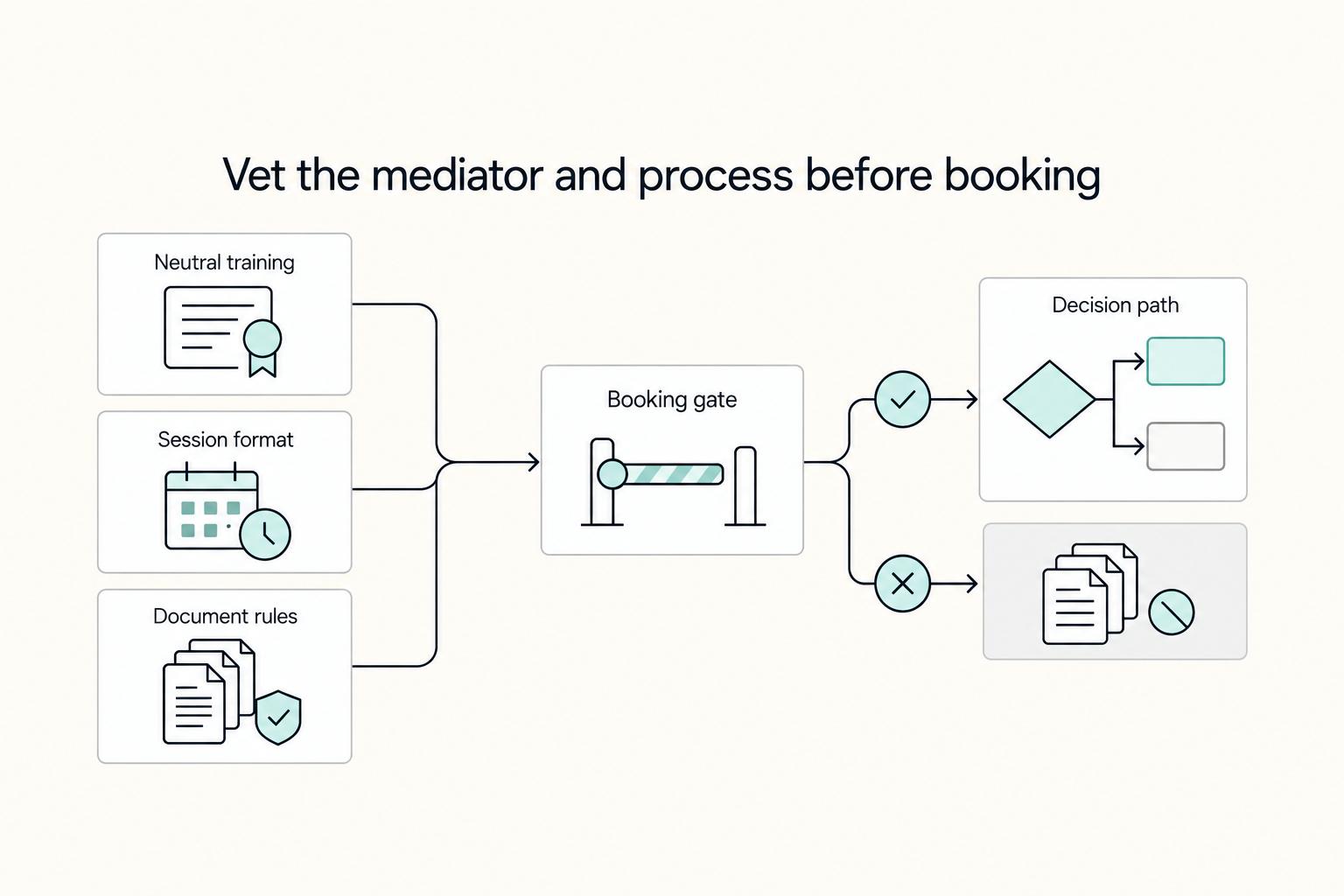
A mediator helps the parties explore a voluntary settlement; the mediator does not issue a binding ruling. Arbitration ordinarily involves a decision by an arbitrator under the applicable agreement and rules. Check the neutral’s role, conflicts and process before booking, especially if a proposed arrangement could move from mediation into arbitration.
| Screening point | What to verify |
|---|---|
| Training | What training the mediator or facilitator has completed |
| Neutral format | Whether the session uses one neutral or a multi-neutral format |
| Comparable experience | Background details that show experience with comparable disputes |
| Process design | Session flow, how terms are documented, who controls agenda order, who drafts terms during the session, and how disputed edits are handled in real time |
Ask which training is relevant to your dispute, how recent comparable matters were handled and whether one or more neutrals will attend. There is no universal 40-hour requirement or need for two mediators for every freelance claim. Request the actual fee schedule, minimum booking, preparation charges and cancellation terms; a long biography is not a substitute for those answers.
Use this screen before you book:
- Ask what training the mediator or facilitator has completed.
- Confirm whether the session uses one neutral or a multi-neutral format.
- Request background details that show experience with comparable disputes.
- Get a clear explanation of session flow and how terms are documented.
Get plain answers before you schedule. Who controls agenda order? Who drafts terms during the session? How are disputed edits handled in real time? Those are not side issues. They show whether the session is built for clear decisions or just conversation. If the neutral cannot explain these points clearly, pause and keep screening.
Compare the proposed cost with the amount and nonfinancial issues at stake. For an assumed two-hour session at $200 per hour, the session costs $400 before any administration or preparation charges. A 50/50 split would be $200 each if both parties agree. This is a budget example, not a provider quote; ask what happens if the session runs longer.
Use a decision tree to choose mediation, negotiation, arbitration, or litigation#
Read the operative dispute and notice clauses, then check applicable law, any court order and filing deadlines. If the contract is silent, the parties can explore an agreed mediation process; silence does not require freezing the dispute indefinitely. Mandatory payment or court rules may affect the route even when the agreement lists a sequence.
Keep negotiation, mediation and adjudication distinct. Negotiation is direct agreement-seeking; mediation adds a neutral facilitator; arbitration and litigation can produce an imposed decision. A required attempt to mediate does not require you to accept a settlement. Identify the lawful next forum rather than treating every unsuccessful conversation as permission to file anywhere.
Keep the tree tied to decisions you can verify in writing, then follow the next step for each trigger:
| Decision checkpoint | Go path | No-go path |
|---|---|---|
| Does an operative clause or court order define the process? | Follow the applicable requirements and preserve claim deadlines. | Propose a written mediation arrangement and identify the lawful filing route; obtain advice for material uncertainty. |
| Can both parties participate safely and authorize settlement? | Agree the issues, neutral, process and a review date. | Address accessibility/authority gaps or choose an appropriate alternative; do not force unsafe participation. |
| Has the agreed review date passed without progress, or is a filing deadline approaching? | Assess the next permitted step and any protective filing promptly. | Continue only within the agreed cost/time limit; discussions do not automatically toll deadlines. |
Create a one-page go or no-go tracker beside this table with governing document, clause reference, owner, deadline, and next notice template. That keeps each move dated, traceable, and tied to the right source.
Clarity on ownership keeps this tool useful. If no one owns a trigger, timelines drift and both sides can dispute whether the matter is still in negotiation or already in escalation. Name the owner for each branch, state what document proves the trigger, and define where that proof is stored. With that discipline, your decision tree becomes a control sheet instead of a slide no one uses. Want a quick next step for your freelance contract workflow? Try the SOW generator.
Align the Contract Terms Before a Dispute#
Clear terms reduce arguments about what was agreed. For an existing dispute, use the operative contract and authorized changes; a corrected template for future clients does not rewrite this client’s rights.
Set clauses so each one answers a different decision point, then test whether they still work together under a real dispute scenario:
| Clause | Define now | If vague |
|---|---|---|
| Dispute Resolution Clause | Step order, forum, and whether arbitration is used in a defined jurisdiction | You can end up arguing about process before resolving the dispute |
| Scope of Work | What is included, excluded, and what counts as completion | Scope disagreements can reopen after work starts |
| Payment Terms | Amounts, invoice timing, and when payments are due | Payment disputes become more likely |
| Deliverables + Deadlines | What will be delivered and by when | Missed deadlines and misunderstandings increase |
| Intellectual Property Clause | Ownership and handoff point for work product | Ownership disputes can surface after partial or final delivery |
Coordinate payment triggers, deliverable acceptance and IP terms, but do not assume they must all occur simultaneously. Rights may already have transferred or a licence may already exist. A settlement can specify valid new arrangements with the required formalities; do not create a blanket withholding right over client materials or personal data.
Before you sign, run this verification checkpoint:
- Confirm the Dispute Resolution Clause clearly defines step order and forum.
- Confirm Scope of Work, Payment Terms, Deliverables/Deadlines, and Intellectual Property terms do not conflict.
- Confirm due dates, acceptance points, and ownership handoff are stated in plain language.
- Confirm clause language is internally consistent across all contract templates in the deal set.
Test a realistic dispute before signing: the deliverable is sent, the client disputes one acceptance criterion, and an installment is already due. Specify how the disputed issue is reviewed and how undisputed amounts are handled. Keep acceptance, payment and ownership questions separate unless the actual terms connect them.
Pick the mediator channel based on dispute size and complexity#
Choose a channel for intake and administration, not as a shortcut for quality. In freelancer-client disputes, different channel types can be useful starting points, but none replaces screening.
Small disputes can escalate quickly when process terms are unclear. Get written confirmation of conflict checks, session format, and document handling before the first session.
| Channel | Role | What to confirm in writing |
|---|---|---|
| Marketplace dispute or mediation intake | Intake and administration path | Whether the process is actually mediation, who selects the neutral, applicable marketplace deadlines, fee split and available remedies |
| Private provider intake | Provider-run intake path | Intake steps, case administration process, document submission rules, and settlement-drafting process |
| Mediator directory | Candidate discovery path | Relevant case experience, conflict-screening method, and session structure |
Use one screening checklist for every candidate so your comparisons stay consistent.
- Mediator background and dispute-type fit
- Conflict checks and written disclosures
- Process format, including joint sessions, caucuses, and expected flow
- Document handling rules and deadlines
- Session structure and settlement drafting approach
Keep your intake request consistent across channels. Ask the same questions in the same order, then compare responses side by side. This removes guesswork and makes weak process design easier to spot. If one option gives clear written answers and another stays vague, choose clarity even if the vague option feels easier to start.
For higher-risk matters, you can add a court-roster check, such as whether a mediator appears in a court mediation program list. Roster status is a process signal, not an outcome guarantee.
Prepare the evidence pack before you book the session#
Build the evidence pack before you schedule. If you assemble files during the session, the call becomes document hunting instead of decisions.
Keep two documents separate from day one:
- An evidence brief with records only.
- A resolution sheet with proposed outcomes, fallback terms, and must-haves.
Create an issue map: the disputed item, the clause or legal rule involved, each party’s position and the supporting exhibit. Check venue, law, notice and deadlines as a separate routing task. Do not assume a platform’s intake form resolves jurisdiction or preserves a claim deadline.
Create one tight chronology page that states what was promised, what changed, what was delivered, what was paid, and what remains disputed. Then use this pre-share checklist:
| Evidence-pack artifact | Core docs for your dispute | Optional docs | Sensitive data to redact |
|---|---|---|---|
| Contract baseline | Contract, mediation clause, and current scope/payment terms tied to disputed issues | Prior draft versions | Personal identifiers not needed for issue review |
| Delivery and billing trail | Records tied to disputed delivery or payment issues | Revision history | Unrelated account or transaction details |
| Communication map | Short dated summary linked to each disputed issue | Full chat or call exports in appendix | Third-party details unrelated to the dispute |
Agree confidentiality, private-session rules, document access and signature arrangements before sharing. Ask what a mediator may pass from a private caucus to the other party. Under the applicable process, mediation statements or offers may have protections that underlying project records do not share. A “confidential” label is not a universal privilege; keep counsel’s advice and unrelated personal data out of shared bundles.
Use stable filenames and a dated exhibit index. Preserve the original contract, invoices and delivery records separately from mediation offers and private notes. When updating a shared item, identify the version and change. Check permission before recording, transcribing or circulating a virtual session. For example, AAA commercial mediation procedures set confidentiality and recording rules when they apply.
Run the virtual mediation with structure, not improvisation#
If you want a clear process, agree the key terms in writing before the session begins.
| Pre-session item | What to confirm in writing |
|---|---|
| Session scope | The session goal and disputed items |
| Document control | A shared document index and version-naming rule |
| Live drafting authority | Who drafts, who advises each party and who has authority to approve/sign; a mediator is not either party’s lawyer |
| Interruption fallback | Fallback communication if the call is interrupted |
| Logistics | Schedule and fees up front |
Put those points into a one-page pre-session note and get written confirmation from both sides and the mediator:
- Define the session goal and disputed items.
- Set a shared document index and version-naming rule.
- Confirm drafting roles and settlement authority; distinguish the mediator’s neutral role from each party’s legal advice.
- Confirm fallback communication if the call is interrupted.
- Confirm schedule and fees up front.
Improvisation under time pressure can create avoidable process disputes. Keeping issue labels, document names, and draft-term wording consistent keeps attention on decisions.
When the topic shifts, capture proposed terms and open items in a draft summary. Label whether terms are tentative and subject to final approval or execution. Reading a summary aloud can reveal misunderstandings, but do not assume every verbal discussion is legally ineffective; make the intended approval process explicit.
Manage cross-border risk where rules vary by country#
A clean virtual session is progress, but cross-border protection depends on what you can actually carry out after signing. Cross-border disputes can be harder to resolve, so treat enforceability as jurisdiction-specific from the start.
Review your written contract and dispute resolution clause against the settlement text before final signature. Do not assume one country's outcome applies everywhere. If a legal point is unclear, flag it and confirm with local counsel before finalizing. Surface practical constraints early so execution does not fail later:
| Risk area | What to confirm before signing |
|---|---|
| Contract and dispute terms | Settlement terms and contract terms are aligned, with a clear dispute resolution path |
| Time-zone coordination | Real approval windows are defined across time zones |
| Communication expectations | Working norms are explicit to reduce communication gaps across time zones and cultures |
| Signature method | The signing method is confirmed in advance, without assuming all jurisdictions treat e-signatures the same way |
| Payment execution | Payment steps are specific and verifiable, because payments may be delayed or not arrive at all |
Confirm the enforcement route before relying on a cross-border settlement. Ask which court or authority can enforce it and whether registration, local formalities or a relevant treaty is available. The parties’ signature and a chosen-law clause alone do not establish enforcement everywhere. Preserve the signed text and evidence of the mediation itself.
Create a pre-sign cross-border risk review and keep it with the final draft:
- Contract notes with scope, payment terms, and dispute resolution language.
- Communication notes with time-zone handoffs and response windows.
- Payment notes with currency, method, proof, and fee handling.
- Settlement installment and billing notes: exact amounts, dates, prior-payment credits and any expressly agreed dependencies; an upfront project deposit is not a universal settlement requirement.
- Signature notes with approved method and fallback path.
This checkpoint turns assumptions into explicit decisions and can help reduce post-signature disputes. Language and execution details deserve extra attention here. If a term can be read two ways, rewrite it before signature instead of planning to interpret it later. If payment proof depends on documents from more than one party, name that requirement in the settlement text. Cross-border issues often come from practical misses in drafting, timing, and handoff evidence that are easier to catch at review stage.
Draft settlement terms that close the dispute and prevent round two#
Draft the settlement so each obligation is specific, verifiable, and tied to a clear trigger. If you cannot verify a term, it may be disputed again.
Write obligations as executable actions, not intentions. Settlement templates commonly lock exact payment amount, due date, and payment method. Use the same precision for delivery, acceptance, and completion evidence.
| Term to lock | What to write | What proves completion |
|---|---|---|
| Payment | Exact amount, due date, payment method | Evidence of actual receipt in the designated account; a payer instruction alone does not prove settlement |
| Delivery handoff | File list, handoff date or trigger event, access method | Delivery receipt or signed acknowledgment |
| Acceptance | Objective acceptance criteria and response window | Written acceptance or agreed review-window expiry, only where the settlement gives expiry that effect |
| Closing record | Final obligation checklist | Completion records and acknowledgment if agreed; missing courtesy acknowledgment does not automatically prevent completion |
Specify missed-payment or missed-delivery consequences, notice and any cure period without double recovery. State which underlying terms are changed, which remain and how conflicts are resolved. Do not assume a breach automatically revives the original claim; define that remedy, if validly available, with appropriate drafting advice.
State the actual ownership and licences before drafting an IP term. Identify any new transfer, its trigger and required signed formalities. Returning client materials and required personal data is a separate duty, not automatically a concession that can be held until the settlement payment arrives.
Run one final draft-version checkpoint:
- Settlement Agreement is complete, including governing law, signature blocks, and defined obligations.
- Release scope, timing and exceptions identify the claims actually settled; do not assume a broad mutual release can waive every statutory right or future settlement breach.
- Confidentiality terms allow required legal disclosures and state whether unauthorized disclosure is a material breach.
- Dispute fallback path is defined if settlement execution fails.
A signed post-dispute agreement can support enforcement, but legal effect is not automatic everywhere. Keep jurisdiction details explicit and confirm local requirements before final signature.
For example, suppose a $2,000 invoice has $500 paid, leaving $1,500 disputed. A negotiated $1,200 settlement in two $600 installments reduces that remaining amount by $300; it is not another $1,200 added to the original balance. Define installment dates, treatment of the $500 already received, when any release takes effect and what happens on default. If a file delivery depends on payment, check that the agreement can validly create that dependency.
Spot red flags early and know when to skip mediation#
Pause or escalate when cooperation breaks down and key evidence is still missing. Waiting through repeated stalls can increase cost and dispute risk.
Before agreeing new terms, review vague language, uncapped liability, one-sided indemnity, missing termination terms, automatic renewal, unclear IP and poorly defined payment. Distinguish an unfavorable operative clause from a new concession proposed during mediation. Keep a rights question open for advice rather than quietly accepting a broader release or obligation to finish the session.
| Signal | Why it is a red flag | Escalation move |
|---|---|---|
| Refusal to share core contract and payment records | You cannot verify scope, pay, or expectations | Ask for the specific missing record and assess whether mediation can continue within deadlines |
| Facts keep changing without proof | The process can become competing stories instead of evidence review | Identify the disputed fact and missing evidence; set a bounded exchange or choose the next lawful step |
| Uncapped liability or one-sided indemnity appears in proposed terms | Exposure may exceed acceptable commercial risk | Seek legal review before further concessions |
| No movement on money, scope, or IP across repeated sessions | Time cost rises while outcomes stay unchanged | Trigger the Dispute Resolution Clause for next-step escalation |
Watch for fake progress. Long sessions can look productive while the same points remain unresolved, especially payment, scope boundaries, and IP rights. Set a checkpoint before each session: what must move, what document must be produced, and what happens if neither occurs. If checkpoints keep failing, close the session in writing and escalate.
If your Dispute Resolution Clause sets notice or response timelines, enforce them and document missed dates. This keeps the process tied to the contract and creates a clear record if the dispute escalates.
Keep a dated process log and preserve the underlying claim evidence. Check before forwarding mediation notes, offers or admissions to another forum. For US federal proceedings, Evidence Rule 408 restricts specified uses of compromise evidence and allows some other purposes; it is not a universal confidentiality privilege. Applicable mediation rules may impose additional restrictions.
- Dated chronology of requests, responses, and missed timelines.
- Document index showing what was requested, produced, or withheld.
- Private mediation notes stored separately; only material permitted by the applicable confidentiality and evidence rules included in a later filing
- Short escalation memo naming the clause that triggered the move.
When you pause mediation, keep the message neutral and precise. Name the missing document or unresolved issue, cite the relevant clause, and state what must happen before talks resume. This avoids emotional back-and-forth and preserves your record if the dispute moves forward. Mediation remains useful when both sides exchange evidence and negotiate in good faith. One warning sign is not an automatic reason to litigate, but multiple verified warnings are a strong signal to escalate deliberately.
Execute the settlement cleanly and keep an audit trail#
A settlement is more likely to hold when every agreed term is executed, dated, and documented. Once both sides choose mediation over escalation, turn each obligation into a concrete task with clear ownership and proof.
| Settlement obligation | Owner | Trigger | Evidence to file |
|---|---|---|---|
| Invoice issuance | Service provider | Date in settlement | Final invoice and send confirmation |
| Payment confirmation | Paying party | Payment due date | Receipt showing cleared payment |
| Deliverable release | Service provider | Cleared payment or agreed event | Delivery confirmation and file list |
| Closure notice | Both parties | All obligations marked complete | Written closeout acknowledgment |
Use the settlement’s actual dependency and notice rules. If payment is pending, verify receipt with the receiving account and trace it before proposing a replacement. Do not automatically pause independent duties or restart a statutory deadline because proof is incomplete. Record any permitted exception notice and its effect on the next step.
Treat the file as a formal dispute record, not routine admin. Keep the signed settlement, invoices, payment proof, delivery evidence, and closeout message in a dated archive. Limit sensitive account or tax details in working copies when those details are not needed.
This follow-through supports a core advantage of mediation: the parties shape the outcome rather than having terms imposed by a judge. Outcomes still vary by dispute, so weak execution can push the matter forward again.
Run a short post-mortem before final archive:
- Identify which clause created friction, such as payment terms, acceptance language, or IP boundaries.
- Check whether your mediation clause gave enough structure before escalation.
- Confirm whether your dispute-resolution timeline was realistic in practice.
- Record clear trigger points for when future disputes should escalate sooner.
Update the template for future engagements while preserving this client’s operative agreement and settlement. Store signed files separately from working drafts and link each completed obligation to its evidence. Keep private mediation material separate from the underlying claim records, so a later enforcement bundle does not casually disclose protected discussions.
Confirm the Next Action and Preserve the Right Records#
Start early and anchor each step in proof, because delay can close evidence windows and narrow your options. Consider mediation while there is still room to negotiate. If progress stalls, switch paths quickly and document why.
| Demand letter element | What to include or do |
|---|---|
| Issue summary | State what happened |
| Requested outcome | State what you want |
| Response timing | State when you need a response |
| Proof | Attach key proof or explicitly offer it |
| Delivery | Send it in a documentable way and keep a complete record |
A contract or court process may require a mediation attempt before another step. Check the current requirements that actually apply to your matter rather than relying on an old general rules excerpt. Keep court and agency deadlines on the tracker alongside the settlement timetable.
Example invitation: “Our $2,000 invoice shows $500 received and $1,500 outstanding. You dispute the final delivery; I rely on the attached SOW and delivery record. I propose discussing a mutually selected mediator, a document exchange and an agreed session budget. Please reply within five business days so we can confirm the process. This proposal does not itself change payment terms or filing deadlines.” The response period is an example; use your actual notices and deadlines.
Your contract helps only when core dispute terms work together in practice. Review dispute-resolution, notice, and forum terms, then confirm:
- What step happens first and who must be notified.
- What event ends settlement talks and triggers escalation.
- Which forum handles the next step if settlement fails.
For disputed calculations, prepare a balance schedule before the session. List the original charge, each receipt, credits and the amount still disputed, with exhibit references. Specialist financial support may be useful when the calculation warrants it; its cost should fit the claim rather than being an automatic requirement for a small invoice.
Close-out is stronger when obligations, deadlines, and proof of completion are written and stored. If deadlines are missed, document exchange breaks down, or facts keep shifting without evidence, escalate on record. Get legal guidance for higher-stakes steps because rules vary by state and situation.
If you want one practical closeout routine, keep it short and strict. Map each disputed issue to the relevant contract term. Keep one evidence index, define one active trigger, and record every transition in writing. Repeat that routine from first notice through final archive. It keeps decisions clear under pressure and gives you a defensible record if you need to escalate.
Frequently Asked Questions
What is freelance mediation, and how is it different from Arbitration?
Freelance mediation uses an impartial facilitator to help the parties seek a settlement they choose. The mediator does not impose a ruling. Arbitration generally gives an arbitrator authority to decide the dispute under the agreement and applicable rules; a required mediation attempt does not require accepting an offer.
How do I start mediation with a client without escalating conflict?
Send a factual invitation identifying the dispute, proposed process, neutral-selection method, cost limit and response date. State the intended approval process and preserve applicable rights and filing deadlines. The invitation itself does not automatically pause those deadlines or compel agreement.
Who should choose the mediator in a freelancer-client dispute?
Where possible, choose the mediator jointly so both sides agree on the neutral facilitator. Prioritize competency, objectivity, and reputation because those factors can increase trust in the process. If you cannot agree on a neutral, use your contract's escalation path.
Can online mediation work for a cross-border dispute?
Online mediation may be an option for cross-border disputes when both sides align on process logistics before sessions start. Confirm platform, time windows, and shared documents up front. Do not assume enforceability outcomes are the same across jurisdictions.
What documents should I prepare before the first session?
Prepare the key records that define the dispute and a short chronology of events. Include the documents each side will rely on so the session can focus on decisions instead of document hunting.
When should I skip mediation and escalate to formal legal action?
Consider another lawful route when participation is unsafe, authority or necessary records are missing, agreed cost/time limits are exhausted, or a filing deadline requires action. Follow applicable contract and court requirements; mediation discussions do not automatically toll a claim deadline.
Is a Settlement Agreement from mediation legally binding everywhere?
No. There is no universal rule that makes every mediated settlement automatically enforceable everywhere. Enforceability can vary by jurisdiction and agreement terms. For cross-border matters, verify legal effect before relying on enforcement assumptions.
Watch
Freelance Mediation: Build a Safer Practice
Try a related tool
Researched and edited by the Gruv editorial team. Gruv builds cross-border billing, payouts, and finance-operations software for global businesses.
Sources
Includes 2 external sources outside the trusted-domain allowlist.
- ilsd.uscourts.gov/approved-mediatorstrusted
- law.cornell.edu/rules/fre/rule_408trusted
- law.cornell.edu/uscode/text/17/204trusted
- nyc.gov/site/dca/workers/workersrights/freelancer-wo...trusted
- adr.org/news-and-insights/mediation-explainedexternal
- adr.org/rules-forms-and-fees/commercial/commercial-a...external
Educational content only. Not legal, tax, or financial advice.
Related Posts

The Freelance Payment Penalty: A Modeled Audit of Platform Fees, FX Spreads, and Payout Delays
The money rarely disappears through a single, easy-to-spot fee. The real loss is stacked. A marketplace takes its commission, a processor adds a charge for international cards, a bank or payment company converts the currency at a spread, a platform holds the funds before release, and a wire sheds a little to intermediaries on the way in. Each layer looks defensible on its own, but the worker feels the combined result as a smaller deposit and a later payday.

How to Respond to a Subpoena for Business Records
Move fast, but do not produce records on instinct. If you need to **respond to a subpoena for business records**, your immediate job is to control deadlines, preserve records, and make any later production defensible.

A US Expat's Guide to Investing in UCITS ETFs to Avoid PFIC Issues
The real problem is a two-system conflict. U.S. tax treatment can punish the wrong fund choice, while local product-access constraints can block the funds you want to buy in the first place. For **us expat ucits etfs**, the practical question is not "Which product is best?" It is "What can I access, report, and keep doing every year without guessing?" Use this four-part filter before any trade: