
Quick Answer
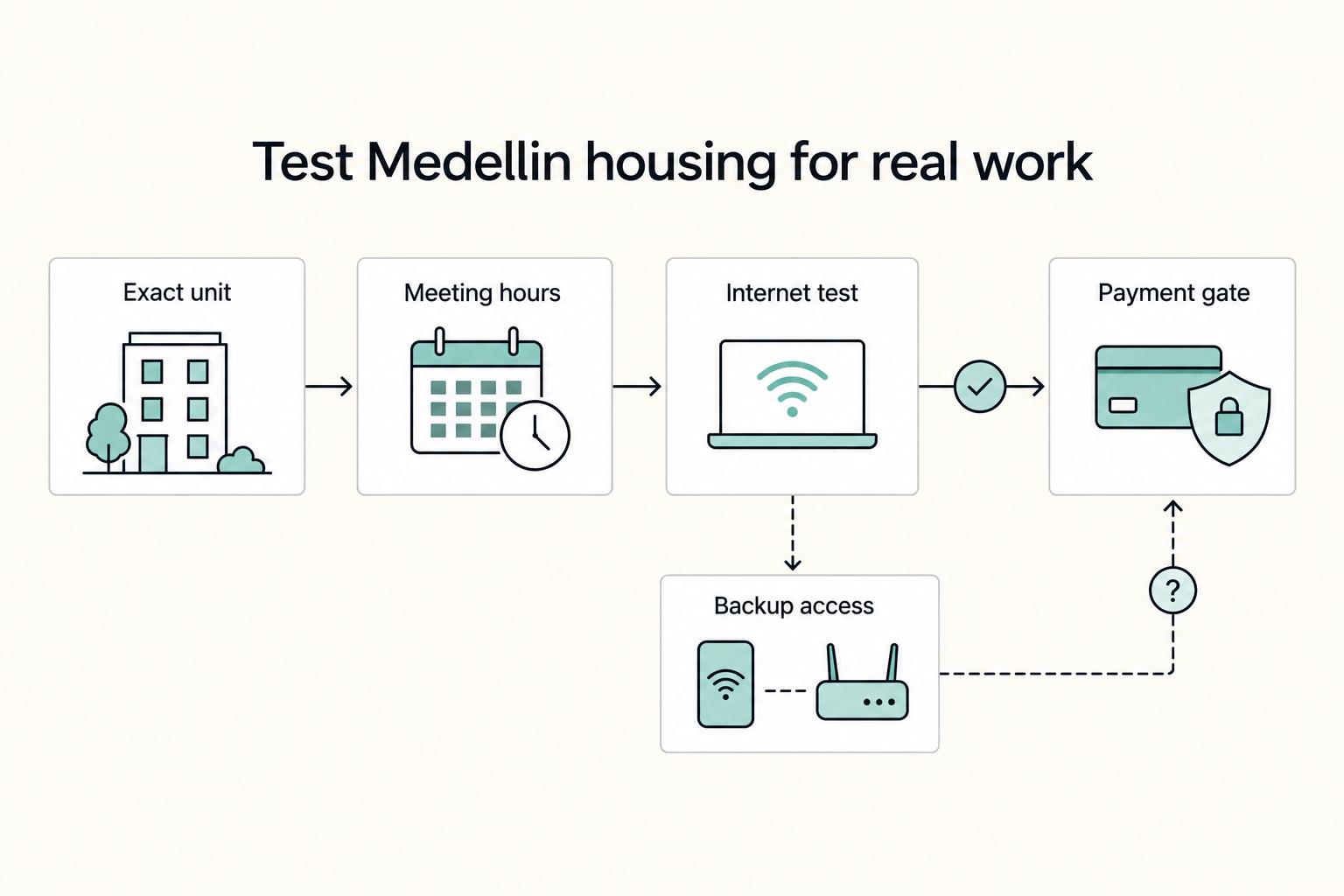
Decide your stay route before paying for flights: short stays often begin with a tourist permit stamp, while longer plans require a formal application path. Build one folder with identity, income/work, housing, and insurance files, then run name, passport, and date checks before submission. In Medellin, test the exact apartment during real call hours and confirm a backup workspace before signing a long lease.
Start Here if You Want Medellin to Work on the First Try#
If you want Medellin to work on the first try, make one written decision before anything else: are you testing a short stay, or trying to build a longer base in Colombia? The city can feel easy on the surface, but the move usually works when paperwork, timing, and housing line up in that order.
A lot of people casually say Colombia tourist visa for short stays, but that route is often a passport stamp rather than a formal visa. That may sound like semantics until you have to plan entry, extensions, or follow-up admin. If you assume you have one thing and you actually have another, every later choice gets harder to unwind.
| Stay intent | What the label usually means | First checkpoint | Main failure mode |
|---|---|---|---|
| Short stay | Tourist permit stamp, often called a Colombia tourist visa | At entry, verify the exact number of days written in your passport | Assuming you received a full period when earlier time in Colombia can reduce it |
| Longer remote-work stay | A formal visa route that requires an application | Confirm current requirements for your nationality before booking non-refundable plans | Treating it like a stamp process and discovering application requirements too late |
| Longer residency-style plan | Another formal visa route that requires an application | Compare this path against your intended duration and admin tolerance | Choosing it by name recognition instead of fit with your actual stay plan |
On the short-stay route, the stamp is often 90 days for eligible travelers, with a possible 90-day extension up to 180 days in a calendar year. Do not plan around the best-case version by default. If you already used time in Colombia earlier in the year, the officer can write a shorter period, and extension options may not be available. The practical rule is simple: verify what you actually received, not what you expected.
That first distinction shapes the rest of the move. If you are only testing the city, you want flexibility and a low-cost way to learn fast. If you are trying to build a longer base, you need more document discipline up front and less tolerance for guesswork. Medellin can reward both approaches, but it punishes people who blur them together.
Use this guide for four practical outputs you can work through in sequence:
- A pre-departure timeline so decisions happen in the right order
- A document checklist for the steps that usually create delays
- Neighborhood decision points based on work reality, not just reputation
- A week-by-week setup sequence for a stable first month
Keep one operating principle in mind as you read: settle the stay path first, then the timing, then the apartment. Reverse that order and Medellin can still be enjoyable, but it becomes a much more expensive place to learn lessons you could have handled at home.
If you are still comparing long-stay routes, start with Colombia's Digital Nomad Visa: The Complete Guide, then come back here to line up visa choice, housing timing, and arrival-week execution.
What Medellin Is Great For and Where People Get Burned#
Medellin can be a strong remote base, especially if you want community, usable work infrastructure, and a daily rhythm that does not feel isolated. Where people get burned usually is not the city itself. It is the habit of letting social momentum replace verification.
It often shows up early. A good first weekend, a few enthusiastic recommendations, or a lively group chat can make everything feel easier than it is. Community absolutely helps you settle faster, but it does not verify your paperwork timing, your bank access, your housing quality, or how your workday will actually run once the novelty wears off.
This is the real tradeoff. The city is approachable enough that it is easy to move from interest to commitment too quickly. The same things that make Medellin attractive also make it easy to skip due diligence. People hear that a neighborhood is good, a landlord is responsive, or a cafe is reliable, then start treating borrowed confidence as if it were proof.
Online communities work best as shortlist tools, not final decision tools. Forum threads can help you narrow neighborhoods and spot options you would not have found alone, but they cannot tell you what is true for your passport, your accounts, your call schedule, or your risk exposure in Colombia. Use them to generate questions, then answer those questions yourself.
Before you make long commitments, run these three checks first:
- Paperwork timing check: confirm your current stay status and next admin step before non-refundable bookings
- Account access check: confirm your phone can still receive 2FA SMS codes for banks and critical accounts
- Neighborhood reality check: shortlist areas, then verify fit on the ground in your first days
If your income depends on predictable client calls, treat schedule overlap as something to test, not assume. Medellin may line up well for some teams, but your real constraint is not a generic time zone claim. It is whether your actual meeting windows, deep-work blocks, and backup workspace options hold up in practice.
The expensive errors often start when the city feels easy in week one and people stop checking details. Risk conditions are not one-size-fits-all, and broad guidance still flags petty theft, traffic, and scams as live concerns. Keep source age in mind, and verify legal or tax exposure before you commit money. That verification habit is what turns Medellin from a promising idea into a workable base.
Once you see where the city helps and where it creates false confidence, the next move becomes obvious: choose the stay path that matches what you are actually trying to do.
Choose Your Stay Path Before You Book Anything#
Choose the stay path before you touch flights or housing. Booking first feels productive, but it often turns a simple mismatch into a rebooking cost, a timeline problem, or an avoidable scramble.
If your plan is short and flexible, start with a short-stay legal path. If you want a longer base, compare longer-stay visa options before locking dates. Treat exact eligibility rules, stay limits, fees, and processing timelines as open questions here, and confirm them with current official sources. You do not need to memorize categories. You need to make sure the legal path is not the last thing you sort out.
That sounds obvious, but many people still plan in reverse. They find a good fare, see an apartment they like, or get excited by a friend's setup and start building the move around those details. City convenience helps after arrival, but it does not reduce visa-planning risk. A neighborhood you like cannot rescue a paperwork timeline you failed to check.
| Scenario | What you optimize for | Document prep posture before booking | Main tradeoff |
|---|---|---|---|
| Test Medellin first | Flexibility and speed | Keep documents clean, current, and easy to update | You may need to revisit admin steps sooner if you decide to stay longer |
| Commit to a long stay in Colombia | Stability over a longer horizon | Prepare full evidence early and verify requirement details before payment | More upfront admin work and less room for last-minute changes |
Before any non-refundable purchase, use this checkpoint list to pressure-test your plan:
- Intended length: write your target stay window, not a best-case guess
- Client setup: confirm client locations, call windows, and what changes if timelines slip
- Admin tolerance: decide how much renewal and paperwork overhead you will accept
- Evidence freshness: check publication dates, then re-validate older planning sources
- Price realism: if you see figures like
$4.16for a meal or$1.02for a domestic beer from a 2021 table, treat them as historical context, not a live 2026 budget - Source quality: drop notes built from generic word-list pages with no visa guidance
That last point matters more than it looks. A lot of planning mistakes happen because people collect information without screening it. Old destination content can still help with orientation, but it should not drive a legal decision or a budget assumption on its own. If a page helps you picture the city, fine. If it is steering your money, your timeline, or your paperwork, it needs to be stronger than that.
A common failure mode is booking like a long-stay mover while preparing like a short-stay tester. That creates the worst mix of both approaches: big commitments with thin documentation. Keep one primary path on paper, one backup path in reserve, and one decision date to commit or reset. For a deeper route comparison, use Colombia's Digital Nomad Visa: The Complete Guide.
Once that path is clear, the next task is more mechanical: build the document pack that supports it before you buy the ticket.
Build Your Document Pack Before Flight Purchase#
Build your document pack before you buy flights. This is one of the easiest ways to reduce avoidable rebooking risk, especially if your route could involve a formal application or supporting records that take time to gather.
Colombia's visa structure changed effective October 20, 2022, and is organized into Visitor (V), Migrant (M), and Resident (R) categories, so requirements can vary by route. Nationality-specific requirements should be confirmed before you apply. In practice, get your evidence organized before money starts locking you into dates.
Build one reusable evidence pack instead of rebuilding files for each touchpoint. Set up one folder structure you can maintain and update as your plan becomes more concrete. At a minimum, keep space for:
- Identity records
- Income or work proof
- Housing backup documents
- Insurance records
Treat this as a working checklist, not an official required-document list. This is about consistency and speed, not guessing every possible requirement from memory. Clean file naming helps more than people expect. When dates shift or one document has to be replaced, a tidy folder structure saves time and lowers the chance of using the wrong version when you are under pressure.
The best sequence is straightforward. First gather and organize your core documents. Then choose your route inside the Visitor, Migrant, or Resident structure, whether that means a short stay or a longer-stay option. Only after route and evidence line up should you book even refundable logistics. That order keeps you from creating urgency around a file gap that could have been handled calmly.
Before submission, run a consistency check across all files. Look for the simple errors that create outsized problems:
- Names
- Passport details
- Relevant dates
This is a practical quality gate to catch preventable mismatches early. It is not a legal claim about rejection rules. It is a way to avoid the clerical slippage that is easy to miss when you are booking travel, handling work, and trying to move quickly at the same time.
At the top of your checklist, add a "must confirm for your nationality" note. Use it to force one last verification pass on the items that often vary:
- Which exact documents are required today for your passport and route
- Whether any item needs a specific format, translation, or recency window
- Which items are mandatory versus optional support
A common failure mode is discovering missing travel documents after booking. Once that happens, time pressure gets added to everything else. Use a written checklist, printable or offline, and mark each item complete with date and filename. That simple record is often what keeps a rushed final week from turning into document guesswork. For route-level detail, review Colombia's Digital Nomad Visa: The Complete Guide before paying for long commitments.
Before you book flights, run your visa and document assumptions through this quick planner so the checklist matches your intended stay path: Visa Cheatsheet for Digital Nomads.
With the paperwork staged, timing becomes much easier to manage. Instead of improvising, you can sequence the next 30 days on purpose.
Follow a 30-Day Pre-Departure Timeline#
Thirty days is enough time to remove a lot of preventable risk, but only if you use it to sequence decisions instead of cramming them into the final week. Think of this as a planning tool, not an official requirement from Colombia.
The legal anchor comes first: the Colombian Digital Nomad Visa was announced in 2022, and one cited legal reference is Resolution No. 5477 from July 22, 2022. Confirm the current requirements and process for your nationality before locking paid logistics. Once that baseline is checked, the rest of the month becomes much easier to organize.
Here is the sequence that usually keeps things clean:
- Week 4: lock route and evidence. Finalize your stay path and the files you may need to provide. Keep one versioned folder structure so updates stay manageable if requirements shift.
- Week 3: shortlist housing zones for real-life fit. Compare a few areas based on your commute and work-style needs. Use a transit-based test in planning, not map distance alone.
- Week 2: line up first-week workspace backups. If you plan to use coworking spaces, verify current access details directly and keep alternatives ready. The goal is to reduce first-week uncertainty, not commit to long terms early.
- Week 1: finalize arrival execution. Confirm airport transfer, first-night access, connectivity backup, and emergency contacts. Include an indoor fallback plan for days affected by environmental episodes.
What matters here is the order. Week 4 and Week 3 are where you remove uncertainty. Week 2 and Week 1 are where you reduce disruption. People often reverse that, then spend the final days solving problems that should have been handled earlier. They book transport, message hosts, and compare cafe photos while the actual route, evidence, and neighborhood fit are still unresolved.
A useful way to pressure-test your calendar is to ask what would hurt most if it slipped by a week. If the answer is visa or document related, that belongs earlier. If the answer is arrival convenience, that belongs later. This keeps the urgent-looking tasks from crowding out the important ones.
The common failure modes are simple: leaving location decisions to the last minute, or relying on old policy guidance without checking whether it still applies. If Week 4 or Week 3 items are still unresolved, keep everything refundable. Once those checkpoints are done, the final two weeks usually feel less like damage control and more like execution.
That matters because arrival week is when weak assumptions stop being abstract and start costing workdays.
Execute Arrival Week Without Losing Workdays#
Treat arrival week as an operational test, not a victory lap. Major Colombian cities can support remote routines, but what matters in practice is your exact setup and whether your backup actually works when you need it.
A lot of new arrivals lose time because they spend the first few days acting like tourists while also expecting their normal work output. That is understandable, but it is usually the wrong priority if client calls, deadlines, or account access matter. The first week should tell you whether your base is repeatable under normal stress, not whether the neighborhood felt pleasant for an afternoon.
Use the first seven days to pressure-test the basics in order:
- Day 1-2: verify your base setup. Test connectivity from your unit at the same times you normally take calls. Do a walk-through around your area during likely busy hours, and check practical details like building access and after-hours noise.
- Day 3-4: run two real work sessions. Complete two full sessions from your main setup, including calls, uploads, and focused work, then run one session from a prechecked fallback such as a coworking space or cafe.
- Day 5-7: decide to stay or relocate within Medellin. Review what worked repeatedly, what failed, and what required too much effort. Base the decision on repeated week-one performance, not one good day.
This week is about repeatability. A setup that works once under ideal conditions is not the same as a setup you can trust for client calls, uploads, and normal work stress. If the main option struggles during your actual meeting hours, count that as a real signal rather than an inconvenience you hope will disappear.
If possible, avoid long commitments until you have tested both your primary and backup setups under real use. That one rule prevents a surprising number of expensive fixes later. It also makes the next decision, where to live for the rest of the stay, much less theoretical.
Once you know how your first workweek actually felt, neighborhood choice gets sharper and easier.
Pick the Right Neighborhood for Your Working Style#
Pick the neighborhood that supports consistent workdays, not the one that looks best on a weekend. The right area is the one where your schedule holds, your travel friction stays manageable, and a backup workspace is easy to reach when something slips.
El Poblado, Laureles, Envigado, and Manila fit different routines, and there is no single best choice for everyone. One neighborhood guide frames El Poblado and Provenza as nightlife and nomad-oriented, Laureles and Estadio as a fit for food and family routines, and Envigado as a safer pick for families. Use those as starting signals only. Your own week-one tests should carry more weight than general reputation.
| Area | Commute friction | Noise profile | Housing cost pressure | Coworking density |
|---|---|---|---|---|
| El Poblado | Validate with your own peak-hour routes | Nightlife-oriented pockets can shift block by block | Check current listings for your exact dates and term length | Strong known options include Outsite El Poblado and NOI Coworking, plus WeWork locations across the city |
| Laureles | Test your real routes before committing | Confirm street-level day and evening conditions yourself | Check current listings for your exact dates and term length | Verify nearby options before signing |
| Envigado | Test full meeting-day travel from your base | Validate your exact street and building conditions | Check current listings for your exact dates and term length | Verify nearby backup desks before signing |
| Manila (Medellin) | Useful if you want home and workspace close together | Varies by street and building, so test day and evening | Check current listings for your exact dates and term length | Outsite Manila plus nearby Impact Hub Medellin can support backup coverage |
Read the table as a decision frame, not a winner board. Commute friction, noise, and fallback access matter more than broad labels like trendy or calm. A neighborhood can look ideal online and still be wrong for your call pattern, your tolerance for movement during the day, or the amount of walking you want to do between home and a reliable desk.
That is why block-level testing matters. In practice, a street that feels manageable at noon can feel very different in the evening, and a route that looks short on a map can become annoying if you need to do it before every meeting day. The farther your backup sits from your apartment, the less useful it becomes when you actually need it.
If immediate remote-work setup matters most, test Outsite El Poblado first, then reassess after your first week. Outsite lists both El Poblado and Manila locations for remote workers with dedicated workspaces and fast WiFi, and Manila is close to Impact Hub Medellin as an extra backup option. That does not make either area automatically right for you. It just means your first week can be easier if you start somewhere with a known work setup.
Once the neighborhood shortlist is grounded in your real routine, the next step is unit-level verification. This is where good relocation plans either tighten up or get expensive.
Verify Housing and Internet Before You Commit#
Do not send payment until the exact unit shows it can support your work during your real meeting hours. For remote workers, housing and internet are not separate decisions. If call stability fails, the unit is not a fit.
City guides are useful for orientation, but they stay at city level. Claims about strong internet and coworking do not confirm performance in one apartment, and at least one widely shared Medellin guide is dated March 15, 2021, so retesting in real time matters. A city can be well set up for remote work and still have individual units that are poor choices.
The practical issue is that landlords and listings usually sell the apartment you imagine using, not the one you experience on a real workday. Good photos, a nice building, and a convenient location can hide weak internet, shared service, after-hours noise, or access friction that only becomes obvious once you are trying to work normally. That is why you need the unit to prove itself.
Use this two-step check before any lease payment:
- Landlord claim check. Request current proof for the exact unit: provider, plan name, whether service is shared, and the most recent bill month.
- Live-call stress test with backup. Run a full call block from the unit at your normal work times, then run the same block from a fallback option such as a nearby coworking space after confirming access for your dates.
That second step is where a lot of people cut corners. They see a speed claim, a clean desk, or a good photo and assume the work setup is settled. It is not. The real test is whether your calls, uploads, and focused work hold up when you use the place the way you actually work.
A potential failure mode in areas like El Poblado is signing for photos and location, then discovering call instability after move-in. Desirability can hide this risk when unit-level testing is skipped. The fix is simple but not glamorous: ask for proof, test the place, and keep a fallback ready before you lock yourself in.
Complete this lease checkpoint list before payment:
- Contract and passport names match exactly
- Lease identifies the exact unit and move-in date
- Rent, deposit, utilities, and internet inclusion are written clearly
- Term length, renewal terms, and early-exit terms are written
- Payment method, currency, and refund timing are written
- You save an evidence pack with listing copy, landlord messages, internet proof, test notes, and receipts
If any checkpoint fails, pause and renegotiate or walk away. A short delay is usually cheaper than paying for a unit that cannot support your work. Good housing decisions in Medellin come from verification, not speed.
Once housing is stable, the next risk usually shifts from logistics to operations: money movement, payout timing, and recordkeeping.
Set Up Money Movement and Compliance Habits Early#
Cashflow issues are easiest to fix before they show up. Set your money routine weekly, not monthly, so invoice timing, payout timing, and conversions stay visible before they turn into pressure.
Start with invoicing rhythm. Bill in one strong currency, often USD or EUR, keep a consistent send day each week, and set a fixed payout review day so late transfers are visible early. That cadence makes runway easier to track and keeps records cleaner if you need to show income during long-stay permit checks. A weekly review is not overkill. It is how you catch small slips before they become a month-end problem.
The point here is not financial perfection. It is operational clarity. If you know when invoices go out, when money usually lands, and where it moves next, you can see problems while they are still small. If you only look at cashflow once a month, a delayed payout or a bad conversion rate can surprise you at the exact moment you need to pay for housing, a visa step, or travel.
For FX planning, treat multi-currency accounts as tools, not guarantees. They can help you receive one currency and convert into another, but terms, fees, and availability vary by provider and location. Keep a three month living buffer in the currency of your next base. That way, if one corridor is slow or one provider changes terms, you still have room to operate.
Where supported, Gruv can fit into this setup for invoicing, payout tracking, and exportable records for cross-border operations. Keep one caveat in mind: policy gates and coverage vary by market and program, so confirm account capabilities before relying on any single rail. If your corridor is only partly supported, split execution across providers and keep records consolidated in one monthly evidence pack.
Use one compact compliance log and update it weekly:
- Nights spent by country in a simple spreadsheet
- Invoices sent, payouts received, and outstanding amounts
- FX conversions with date, amount, and fee
- Stored monthly proof: invoices, receipts, account statements, and contract updates
The goal is not to build an elaborate admin machine. It is to keep enough clean evidence that you are not reconstructing months of activity later from scattered screenshots and partial statements. When your records are current, questions about income, timing, or location stay manageable. When they are not, even simple requests can turn into a time sink.
This habit helps prevent a common failure mode: weak residency and income records that can lead to back taxes and penalties. Many jurisdictions use a 183-day yardstick, while others also weigh ties such as family, property, or where your main client base sits.
Keep this section focused on setup and execution. For personal tax treatment and treaty interpretation, go deeper with Taxes in Colombia for Foreigners and Remote Workers before making filing decisions.
Once money and records are under control, the next step is less about optimization and more about avoiding the few mistakes that tend to cost the most.
Avoid the Most Expensive Mistakes New Arrivals Make#
The costliest mistakes usually share one trait: money gets committed on weak evidence. Most are not dramatic. They are ordinary planning errors that compound because no one stopped to verify the next detail.
The first mistake is treating early neighborhood content as a decision instead of a shortlist. Blog posts, reels, and group recommendations are useful for finding options, but they are not substitutes for a live fit check. Use them to narrow the field, then validate with your own tests and readable, current sources.
The second is mixing short-stay and long-stay planning without checking your active path. A lot of confusion comes from people talking about tourist entry, longer-stay visas, and later extensions as if they are one interchangeable process. They are not. Write down your current plan and recheck current official requirements before any major payment or contract.
The third is using forum threads as if they were case-specific evidence. They are often very good at surfacing the right questions, especially around neighborhoods and day-to-day logistics. They are not proof for your passport, your timeline, or your exact housing arrangement. Good forum use gives you a better checklist. It does not give you permission to skip verification.
Before you trust a claim, run this source-quality screen:
- Confirm the page is human-readable and has substantive text
- Do not rely on metadata-heavy or machine-readable pages as core evidence
- Reject pages dominated by booking CTAs or destination-shopping widgets for relocation decisions
- Keep decision notes tied to verifiable proof, such as your own tests, contract terms, and current policy checks
This is less about doubting everything and more about assigning information to the right job. Community content is good for orientation. Your own tests, written contract terms, and current policy checks should carry the decision. Once you separate those roles, a lot of confusion disappears.
A useful checkpoint is to ask what would happen if the claim turned out to be wrong. If the downside is small, community guidance may be enough. If the downside is a lease, a missed deadline, or a legal problem, you need stronger evidence. That habit alone filters out many of the expensive mistakes new arrivals make.
If evidence is thin, delay the commitment and verify one more layer before locking housing or timeline decisions. For a broader overview before finalizing a long-stay plan, use Colombia's Digital Nomad Visa: The Complete Guide, then confirm current official rules directly.
At that point, you are no longer just arriving. You are deciding whether the city can run smoothly for you over a full month.
Stabilize Your First Month in Medellin#
By the second week, stop treating everything as temporary. Use Weeks 2 to 4 to turn early experiments into a stable setup. Confirm what works, organize your records, and reassess your stay path against your actual timeline rather than the version you imagined before arrival.
Week 2 is about locking your base neighborhood and a primary plus backup workspace you have tested during real work hours. Medellin field research on nomad life describes co-spaces and local hubs as important for social and occupational links, so consistency usually beats novelty. At this point, you are not trying every option in the city. You are choosing the small set of places you can actually rely on.
That shift matters. The first week is for discovery, but the rest of the month should move toward repeatability. If you keep behaving as if every day is exploratory, small friction points never get fixed. A backup that is too far away stays too far away. A recordkeeping gap stays a gap. A weak housing arrangement keeps consuming attention. Stabilization means deciding what is good enough to keep and what needs to change while you still have time to act cheaply.
Use this month-one sequence:
- Week 2 objective: finalize your base area and confirm a primary and backup workspace pair through repeat real-work sessions
- Week 3 objective: complete a documentation audit for your stay admin needs, including visa-path notes, housing files, payment records, and supporting records from the month
- Week 4 objective: reassess whether your current stay path still fits, or whether you should evaluate a longer-stay route
Week 3 is where small documentation gaps can become larger problems. Keep one organized folder for housing, payment, and stay-path records, then check names, dates, and payment references for consistency. This is also a good time to make sure your evidence pack still reflects your current reality, not just the assumptions you left home with.
Run freshness checks throughout month one. One Medellin destination guide notes that some trip information is more than three years old and that local venues can close, so verify any coworking or cafe fallback before relying on it. That matters most for backup plans. A fallback that is outdated is not a fallback.
Week 4 is a strategy review, not an automatic legal switch. If your stay intent changed and records are organized, compare longer-stay options in detail. If not, keep your short-stay posture until your setup is stable. That approach keeps you from escalating admin complexity before the basics are working.
For next-step decisions, use Colombia's Digital Nomad Visa: The Complete Guide, Taxes in Colombia for Foreigners and Remote Workers, and The 2026 Global Digital Nomad Visa Index for 50+ Countries.
Once your base is stable, set up a simple payout rhythm while you operate from Colombia: Payouts.
Final Decision Checklist Before You Move#
Before you move, make one written go or no-go call before booking flights or long housing. If the stay plan, documents, and housing proof do not line up, do not let excitement fill the gap.
Start with stay intent in plain language: short-term stay or full relocation. That decision changes what you need to prepare and how much admin you should expect. If you plan to work while in Colombia, document your work-eligibility assumptions and confirm whether sponsorship may apply in your case.
Build your pre-flight document pack before starting any application. Core items commonly include a valid passport, proof of income, health insurance, and background check records, and some cases may also require apostilled documents. Before submission, run a strict consistency check across names, dates, and document versions.
Plan for later filings as new evaluations, not automatic extensions. If your stay could outlast your first approval window, prepare early for a subsequent application and keep records current. Choose housing cautiously before you commit long term, and do not treat listing claims as verified until you confirm them directly.
Use this checklist before departure:
- Your stay plan is written and tied to one visa path.
- Your work setup assumptions are documented, including sponsorship risk if relevant.
- Your document pack is complete: passport, income proof, health insurance, background check, and apostilled items where required.
- Names, dates, and file versions have passed a final line-by-line check.
- Later filings are planned as subsequent applications, not automatic extensions.
- Your housing decision is not based only on listing claims.
- You have one backup option if your first housing choice does not work out.
- If visa-route details are still unclear, resolve them before booking with Colombia's Digital Nomad Visa: The Complete Guide.
If you can confidently check the first seven items, you are moving from vague interest to a workable plan. If you cannot, item eight is the right next step.
Frequently Asked Questions
Is Medellin actually a good city for digital nomads in 2026?
For many remote workers, yes. Available research describes remote-work infrastructure, including WiFi-friendly cafes, coworking spaces, and widespread high-speed WiFi. Time alignment with US Eastern schedules for much of the year can also help teams that need overlap. The caveat is that Medellin is not plug-and-play, and too much conflicting advice can still create confusion.
Which visa path should I choose for a short stay versus a long stay in Colombia?
If you are visa-exempt, entry is typically a tourist permit for up to 90 days, with one extension up to 180 days per calendar year, but this is not a visa and does not allow long-term stay or work. For plans under two years, Type V is generally the path. For plans over two years, Type M is usually the better fit. On the digital nomad route, you cannot work for Colombian companies or clients. For route details, start with Colombia's Digital Nomad Visa: The Complete Guide.
What documents should I prepare before flying to Medellin?
Prepare one organized document set with consistent names and dates across files to help reduce avoidable delays. Core requirements include a passport with at least six months of validity and bank statements covering the last three to six months, plus visa-specific documents for your category. Before departure, confirm your phone is unlocked and your bank SMS 2FA works abroad.
How much should I budget monthly to live and work in Medellin?
There is no single monthly number that fits everyone. Build a conservative starting range, then adjust based on your real spending after arrival. Keep living-budget planning separate from visa eligibility thresholds, since the digital nomad visa floor is 3 SMLMV, or COP 5,252,715 per month in 2026.
Which neighborhood is better for remote work: El Poblado, Laureles, Envigado, or Manila?
There is no evidence-backed single winner across these neighborhoods for every remote worker. Choose based on your own work rhythm and day-to-day fit, not online consensus. What works for one person may not work for you.
How do I verify internet and housing quality before committing?
Treat apartment-level internet and housing performance as unverified until you test directly. Available research supports city-level remote-work infrastructure, but this guide does not establish unit-level reliability. Use short commitments first, then extend only after real work-hour testing.
What should I complete in my first week to avoid avoidable delays?
Keep first-week priorities simple and high impact. Confirm document readiness, phone access, and bank SMS 2FA continuity early. If your plan shifts from short stay to longer-term, recheck your visa path as soon as that change becomes clear.
Try a related tool
Researched and edited by the Gruv editorial team. Gruv builds cross-border billing, payouts, and finance-operations software for global businesses.
Sources
Includes 4 external sources outside the trusted-domain allowlist.
- sec.gov/Archives/edgar/data/1668717/0001193125200579...trusted
- amazon.com/Digital-Nomad-Guide-Medellin-Colombias-ebook...external
- lifeoffresh.com/medellin-digital-nomad-guideexternal
- machupicchu.org/medellin-budget-guide-2026-how-to-visit-on-a...external
- settlingin.com.co/settling-in-medellin-digital-nomad-guide-2026external
Educational content only. Not legal, tax, or financial advice.
Related Posts

Colombia Digital Nomad Visa Guide for Remote Workers in 2026
Treat this as a legal-stay decision first, and a city move second. The safest sequence is simple: start with what is stable, verify what can change, and do not lock in costs until your filing is truly ready. If you are thinking about Medellin, Bogota, or Cartagena, decide on your stay path before you commit to flights, leases, or a move date.

Taxes in Colombia for Foreigners and Remote Workers
Most avoidable filing mistakes happen because people do the right work in the wrong order. If you get the sequence right, the rest of the year becomes much easier to manage. Start with status, then define filing scope, then build the record set that supports your position.

The 2026 Global Digital Nomad Visa Index for 50+ Countries
Start with legal fit, not lifestyle filters. The practical order is simple: choose a route you can actually document, then decide where you want to live. That single change cuts a lot of wasted comparison work and stops you from falling in love with places that were never a real filing option.