
Quick Answer
Plan spending, reserve and collection access before departure, checking their shared dependencies. Keep a permitted backup for new invoices and enough available funds for an interruption. Reconcile each client payment separately from your own payout; a held payout should not trigger duplicate collection. Review ordinary activity weekly and act on urgent incidents immediately.
Why Most Travel Money Advice Breaks for Client-Funded Work#
If you are funding travel from live client payments, the real job is continuity, not chasing the lowest visible cost. You need spending access and incoming cashflow that can keep working through separate failures in separate systems.
A lot of travel money advice assumes your cash is already settled and available. That is not your setup. A card can still work while a payout is delayed, or a client can pay while your spending access is interrupted. Those are independent risks, so budget-only advice misses the operational problem.
| Plan type | Primary goal | Key risks | Control cadence | Fallback requirements |
|---|---|---|---|---|
| Vacation money plan | Control trip spending | Overspending, visible fees, poor exchange choices | Pre-trip planning and occasional spend checks | Often one backup card |
| Client-funded travel finance plan | Keep spend access and receivables running at the same time | Delayed settlement, payout review holds, dispute deductions, card interruption, weekend or holiday timing gaps | Weekly checks on expected invoices, settled funds, and spendable balance | More than one money-access rail, plus a separate fallback for incoming payments |
What breaks#
Transfers can take several days and a receiving bank may require suitable local account details. For a US-dollar Fedwire route, check both your bank’s customer cutoff and the Fedwire operating schedule. As checked on 5 October 2026, funds-transfer business days exclude weekends and Federal Reserve holidays; each business day opens at 9 p.m. Eastern on the preceding calendar day. That can include Sunday evening for Monday business, so “closed all weekend” is too simple. Your bank can set an earlier customer cutoff.
A successful client payment and usable bank cash are separate states. Stripe typically schedules an initial payout to complete within 7–14 days after the first live payment, depending on country, industry and risk. PayPal describes payment holds usually lasting up to 21 days, with other hold and reserve conditions possible. These are provider-specific examples, not universal clearance deadlines. A dispute or reversal may affect the balance and incur a fee under the actual account terms.
Why it breaks in client-funded travel#
The cheapest route on paper can be the most expensive route operationally. Intermediary institutions can set exchange rates or add fees, so the amount received can differ from what you expected.
For every client transfer, obtain a quote or advice showing amount, currency, fees, conversion and expected receipt. US consumer remittance protections are narrower than “all international transfers over USD 15”: the CFPB sender definition concerns a consumer in a US state requesting a transfer primarily for personal, family or household purposes. Business-purpose client payments should not be assumed to qualify.
What stable looks like before optimization#
Plan at least two usable spending options and a permitted alternative for future client receipts. Check the dependencies: two cards can share one issuer, and two balances can share a provider login or account-wide restriction. Separate labels alone do not create independent access.
Use this rule before you pick a rail. If a lower-cost option can strand you through a weekend or holiday window, a first-payout wait, or a review hold with no second rail, it is not cheaper for your operation.
Keep each invoice, transfer receipt, and processor notice together so you can resolve holds or deduction surprises quickly. Once that foundation is in place, pre-departure prep gets much simpler.
What to Prepare Before You Leave#
The time to prepare for a finance failure is before you leave, not when you are already dealing with one abroad. Your goal is simple: one issue should not freeze both your spending and your incoming payments.
Build an access kit you can trust#
Assume your usual payment habit may fail. Carry at least two means of payment, and do not rely on one method alone. If you usually pay by digital wallet, bring physical credit and ATM cards too, since wallet acceptance and payment technology vary by country.
| Check | What to confirm |
|---|---|
| International debit usage | Enable it if your issuer requires it |
| Issuer fees and limits | Ask about foreign transaction fees, international ATM withdrawal fees, ATM compatibility, and daily card limits |
| Login and security access | Confirm you will have wifi or cellular access for account logins and security checks |
| Backup verification | Set up a backup verification method, since some normal verification methods may not be available abroad |
| Lost or stolen card reporting | Save international numbers for lost or stolen card reporting for every card you carry |
| Foreign currency cash before arrival | Confirm availability, ordering lead time and pickup before arrival; timing varies by provider |
| Backup card ATM compatibility | Confirm your backup card's compatibility with international ATMs before departure if possible |
Test the backup before travel where practical: confirm its expiry, PIN, network acceptance, available funds or credit and contact path. A second card in the same wallet is vulnerable to the same loss, so arrange access separately.
Map every active client before you fly#
Do not leave your payment setup in your head. Create a one-page pre-departure payment matrix so you can switch quickly if a route is interrupted.
| Client | Primary method | Backup method | Wire enrollment checked (if needed) | Disputes/transfers contact | Escalation contact |
|---|---|---|---|---|---|
| Client A | |||||
| Client B | |||||
| Client C |
Complete this before travel, not during a delay. If wires are in scope, confirm whether your bank requires wire-transfer enrollment before travel.
Build an incident folder, not just a document folder#
A normal document folder is not enough when something breaks. Keep secure copies of the records you may need to recover access and resolve payment issues, even if your primary device or connection fails.
| Keep in folder | Use |
|---|---|
| Copies of key documents | Verification or card replacement |
| Important international phone numbers | Lost or stolen card reporting |
| Provider support contacts | Disputes/transfers path |
| Backup payment details | Cards and cash access |
Protect the folder so loss of your primary device does not expose every account or prevent recovery. Keep only needed verification records, international support paths and backup-access instructions. Verify that you can reach the issuer from abroad without relying entirely on a home SIM that may not receive messages.
Before departure, define your trigger actions:
- If a card is interrupted: report it through the saved international number, then switch to backup card and cash access.
- If verification fails abroad: use your backup verification method.
- If a transfer issue appears: open your disputes/transfers path and contact support promptly.
Build a Three-Layer Money Setup for Travel#
Give spending, reserve and income distinct jobs. You may use separate accounts where appropriate, with the correct legal owner and permitted business use. Your ledger should also distinguish business receipts, tax money and personal spending so transfers do not obscure the records.
Design for independent access where possible, then test the actual dependencies. A separate balance inside the same provider can still be affected by the same restriction or login failure. Keep an accessible reserve outside the collection provider when that fits your account terms; separation reduces concentration but cannot guarantee that every failure stays isolated.
Give each layer one clear job#
Use the spending layer for routine card and ATM access, the reserve layer for interruptions and the income layer for collecting and reconciling client payments. Choose permitted accounts and transfer rules for their actual legal owners. For US bank deposits, FDIC coverage is USD 250,000 per depositor, per insured bank, per ownership category. Deposits in the same category at the same bank are combined. A payment app is not automatically an insured bank account; nonbank access or insolvency risk is different from bank-failure insurance.
Ask each issuer whether a travel notice or international-use setting is required; policies differ. Check permitted country access and how to update address or residency information if it changes. Do not treat a holiday itinerary as proof that your existing business account remains eligible after a long-term move.
Before anything goes wrong, map each layer with this short framework:
- Owner: who legally holds the account and matches invoice and card records
- Primary instrument: the main card, account, or rail
- Fallback instrument: the tested backup card, second account, or alternate rail
- Allowed transfer direction: where funds may move next, and where they may not
Define switch triggers in advance#
Do not wait to decide when to switch. Set the trigger before you need it.
| Layer | Primary route | Fallback route | Typical failure mode | Immediate switch trigger |
|---|---|---|---|---|
| Spending | Primary card or debit for purchases and ATM | Backup physical card plus cash route | Lost or stolen card, fraud flag, unexplained decline | Confirmed loss or theft, or one unexplained decline on an essential purchase |
| Reserve | Separate reserve account | Secondary reserve access path, including a bank-partner withdrawal route | Access issue or transfer hold | Scheduled top-up cannot complete in your planned window |
| Income | Primary client collection method | Active, permitted route for new invoices | Collection failure or provider payout review | Investigate a missed estimate; use a backup for new collections only after separating existing paid or in-flight items |
ACH and Fedwire have different processing and exception behavior. Fedwire settlement is final at the participating-bank level; that is not proof that a beneficiary’s own account is already credited or that a fraudulent underlying transaction has no remedy. Recheck beneficiary, currency, bank cutoff and reference when changing a route. If the first payment is in flight, obtain its status before requesting another collection.
Move money by rule, not by mood#
Set transfers from available, reconciled funds. For a hypothetical two-week interruption plan, daily essentials of USD 50 × 14 days = USD 700, plus USD 300 of fixed commitments and USD 200 of recovery costs, require USD 1,200 accessible outside the collection path. If you have USD 900 available and a USD 600 invoice that is paid but awaiting payout, accessible coverage is still USD 900: a USD 300 gap. Reduce commitments or fund the gap before relying on that plan. Adjust the horizon to your actual provider and travel risks; two weeks is a planning scenario, not a guaranteed maximum delay. Keep tax and other earmarked money out of the spendable figure.
- Move income to reserve only after settlement is confirmed and reconciliation is recorded against invoice and net received.
- Move reserve to spending only on schedule or after a defined incident trigger.
- Keep routine spend, ATM withdrawals, and merchant charges out of the income layer.
Report a lost or stolen card promptly and preserve the report reference. The FTC’s US consumer ATM/debit-card guidance describes maximum exposure of USD 50 when reported within two business days of learning of loss or theft, and USD 500 when reported later but within 60 calendar days after the statement is sent. Waiting beyond that statement window can expose more funds. These are scoped consumer protections, not worldwide business-card limits; check your issuer and applicable account rules.
If you need help choosing the account mix, read The Best Multi-Currency Accounts for Digital Nomads and Freelancers. Before departure, check whether your fallback can still access funds if the collection provider or primary issuer is unavailable.
Choose the Right Client Payment Rail for Each Job#
Choose client payment rails in this order: reliability first, total cost second, speed third. A rail is the infrastructure that moves money between payer and payee. The point is not to pick the fastest-looking option. It is to pick the one most likely to settle cleanly for that client and job.
Start with what the client can use consistently and what your receiving setup can support. Then compare expected cost and processing behavior. Only after that should speed break a tie.
Compare rails by evidence, not preference#
Preference is a weak basis for a time-sensitive invoice. Use what the client can actually send and what you can actually receive.
Local bank transfer can fit a client that can send the required currency to supported receiving details. ACH and SEPA are different systems, so confirm the actual route rather than treating “local” as a promise of speed. SWIFT supports bank messaging for many international wires; it is not a single universal settlement clock. Card and wallet collection can simplify client payment while leaving separate payout and dispute risks.
| Rail option | Reliability signals | Cost components | Failure pattern | Best-fit use case |
|---|---|---|---|---|
| Local transfer (ACH/SEPA) | Supported currency, network and beneficiary details match the client’s sending bank | Actual sender, receiver and provider quote; do not assume every local transfer is cheapest | Delays can occur during verification or processing if details are wrong | Supported domestic or regional transfers, including eligible SEPA routes |
| SWIFT wire | SWIFT availability for both sides is confirmed | Fees and processing behavior vary by bank and provider | Delays can occur during verification or processing | Cross-border payments using a global rail |
| Card payment | Client can pay by card and your payout path is active | Fees and processing behavior vary by provider | Payments can pause during verification or processing checks | Workflows where both sides already use card payments |
| Digital wallet | Client and payee both use the same wallet flow | Fees and processing behavior vary by platform | Transfers can pause during verification or processing checks | Workflows already operating in that wallet |
If fee ownership, expected settlement behavior, or the fallback path is unclear, do not use that rail for a time-sensitive invoice.
Name a fallback trigger for every client#
For each client, document one primary method, one active fallback and a review trigger such as a missed transaction estimate. The trigger starts an investigation; it does not automatically justify charging again. Distinguish unpaid new invoices, incomplete in-flight collections, successful payments awaiting your own payout and actual reversals.
Use the fallback for new invoices when permitted. For an existing invoice, reconcile the original transaction and confirm any cancellation, failure or reversal before replacing the collection. Keep both references linked and explain the change so the client does not pay twice.
Put the rail policy in your invoice terms#
A short rail policy in your invoice terms prevents avoidable confusion later. Keep it tight and specific:
| Policy item | What to state |
|---|---|
| Accepted methods | Primary rail plus approved fallback |
| Fee responsibility | Who covers payment-related deductions |
| FX handling | Invoice currency and where conversion occurs |
| Short-pay or return workflow | What happens if funds arrive net, are returned, or are held |
Keep fee and FX terms with the invoice. Define how to investigate a short receipt or return and when a replacement payment is actually due. A fee deducted from your provider payout can reduce your net cash without making the client’s correctly paid invoice unpaid.
This can reduce disputes before they become cashflow problems.
Use a go/no-go gate before release#
Before you send payment instructions, stop and confirm four things:
- Beneficiary data matches the selected rail.
- Verification and processing expectations are understood by both sides.
- Fee ownership is confirmed in writing.
- One escalation owner is named on each side.
If any item is unclear, treat it as no-go until fixed.
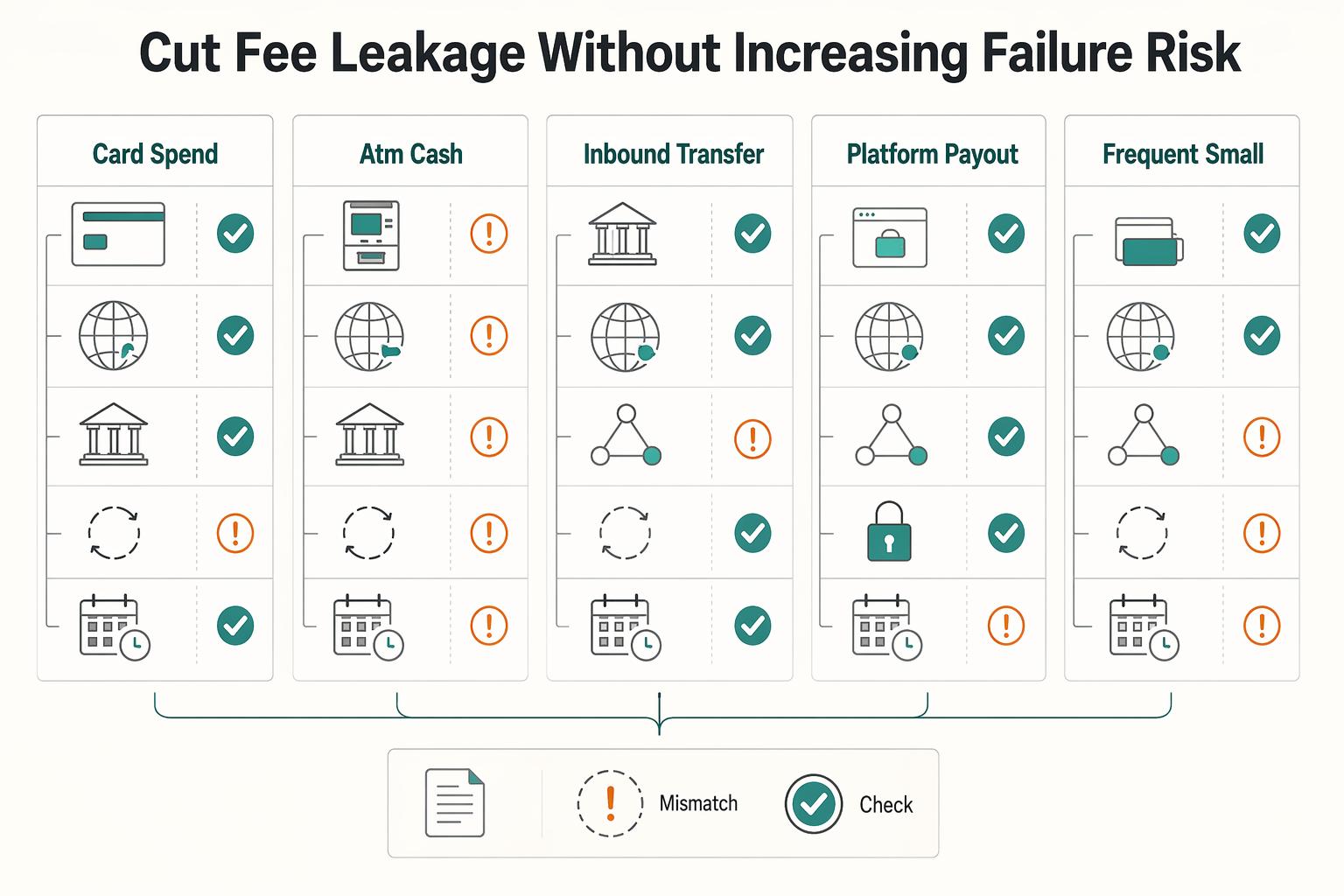
Cut Fee Leakage Without Increasing Failure Risk#
Cut costs only when continuity stays intact. A lower visible fee is a bad trade if it increases retries, holds, short-pay risk, or payout delays.
Map each payment path end to end before you optimize it: where money starts, who handles conversion, where deductions can happen, and what your fallback is if the first route fails. Then set an acceptable total cost for that path. Include visible fees, conversion spread, intermediary deductions, retry effort, and delay impact. Use that as your decision line.
| Path | Fee types to capture | Common failure mode | Control check before use | Use or avoid |
|---|---|---|---|---|
| Card spend | Issuer fees, merchant or terminal conversion spread | Merchant-side conversion changes the rate basis | Check the conversion offer and issuer fees; Mastercard says its rates do not apply if a merchant or ATM performs conversion | Use for routine spend; avoid when conversion terms are unclear |
| ATM cash | ATM operator fee, network fee, conversion spread | Frequent small withdrawals compound fees | Review the fee notice before you commit; proceed only after you confirm the terms | Plan withdrawals within safe cash and daily limits; compare fixed fees without carrying excessive cash |
| Inbound transfer | Sending fee, receiving fee, intermediary deductions, FX conversion | Beneficiary detail errors, reviews or delays, unexplained net shortfall | Reverify recipient account or institution details and confirm fee ownership in terms before invoicing | Use for larger client payments; avoid when details or fee handling are unresolved |
| Platform payout | Withdrawal fee, payout FX, receiving-bank fees | Holds or payout delays | Confirm withdrawal eligibility and the actual account estimate; initial Stripe timing and PayPal hold examples above are separate provider conditions | Use when funds originate on-platform; avoid using as your only spend-access path |
Compare the final quote with the issuer and network conversion basis before accepting a conversion offer. Mastercard says its converter is indicative, banks may add fees, and its rates do not apply when a merchant or ATM converts the transaction. Choosing local currency usually leaves conversion to the card path, but does not remove issuer or ATM charges.
Use leakage signals as immediate action triggers:
| Signal | Owner | Immediate action | Evidence to log |
|---|---|---|---|
| Frequent small ATM withdrawals | You | Review fixed fees and consolidate only within safe cash needs and withdrawal limits | ATM location, fee screen, receipt |
| Merchant or ATM conversion prompt | You | Compare the conversion offer; choose local-currency charging if appropriate and available | Prompt photo or screenshot and final receipt |
| Unexplained inbound deduction | You + sender contact | Request transfer trace details and provider breakdown | Remittance advice, expected vs settled amount, provider messages |
For a transfer that actually qualifies for US consumer remittance protections, the sender generally has up to 30 minutes after paying to cancel without charge, unless the funds have already been picked up or deposited. Error notice is generally due within 180 days of the disclosed availability date. Contact the provider promptly rather than waiting for that deadline. For business transfers, use the provider agreement and applicable law instead of importing those consumer windows.
This pairs well with our guide on Automating Freelance Finances Without Losing Cashflow Control.
Before you change rails, run your real invoice sizes through this payment fee comparison so you can weigh visible fees against FX and settlement timing.
Run a Short Weekly Finance Check#
Reserve a regular review slot; 20 minutes can be a planning target for a small account set, not a guarantee. Investigate a serious loss, unauthorized transaction or provider deadline immediately rather than waiting for the weekly review. Use the routine for matching ordinary activity and assigning unresolved items.
Reconcile from invoice to confirmed balance#
Track two connected chains: client invoice to confirmed payment, then provider balance to withdrawal and bank receipt. A delay in the second chain should remain visible without automatically reopening a correctly paid invoice.
For each open or recently paid invoice, match amount, currency, payer or authorized paying agent and payment ID. Record whether collection is initiated, confirmed, failed or reversed. Separately track pending or available provider balance, payout ID, expected bank date and the actual bank credit. Match bundled payouts to all included invoices and deductions.
Do not rely on a manually marked-paid invoice alone. Once successful payment is independently confirmed, record the invoice accordingly and track any pending withdrawal as your own cash-access issue. Close the review with each item confirmed, pending with evidence or requiring follow-up; do not label an unknown deduction as a fee just to force the totals to match.
Triage exceptions like real operations work#
The weekly review only works if mismatches get owned. Move every mismatch into exception review, classify what is unresolved, then assign an owner, define the next action, and set the next checkpoint date.
If a tracker item has no owner or no next review date, treat that as a risk. For unresolved items, attach evidence now: invoice, remittance details, transaction ID, provider messages, and the balance snapshot showing the gap.
Compare planned and actual in one control table#
Use one compact table to see whether each reconciliation step performed the way you expected.
| Reconciliation step | Planned outcome | Actual outcome to review | Decision note |
|---|---|---|---|
| Accuracy check | Invoice transactions match expected details | Mismatch or unresolved transaction | Move item to manual follow-up |
| Manual follow-up | Each unresolved item has an owner and next action | No owner, no date, or missing evidence | Assign ownership and set checkpoint |
| Close readiness | Items are either settled or documented as pending | Open items without documentation | Hold close until records are complete |
Record the review decision#
End with a justified process change if the review found a recurring problem. If the controls worked and nothing material changed, record that result rather than inventing a new rule each week.
Monthly, export statements and reconcile opening balances, receipts, fees, refunds, transfers and closing balances. Keep open exceptions with their evidence and next action. This is a proposed working routine, not a prescribed sequence for every formal reconciliation system.
Recover Fast When Something Breaks Abroad#
When a payment incident goes live, sequence matters. Restore spending access, protect receivables, build one incident file, and only then restart normal activity.
Restore access first#
Your first job is to keep daily spending working. Switch to a backup spend method immediately, then confirm at least one payment path works end to end. If login works but spending still fails, treat the incident as active and move to essentials-only spending until a full payment flow succeeds.
A small successful transaction tests one path at one amount. Also confirm ordinary spending, limits and reserve access before resuming discretionary commitments. Restore essential payments first; there is no need to keep them blocked solely because the original card remains unavailable if an authorized, adequately funded alternative is working.
Protect incoming cashflow next#
Separate upcoming unpaid invoices from existing transactions. Send authenticated, agreed routing instructions for new collections. For existing payments, reconcile and trace the original route first; a payout hold after confirmed collection should not create a request for the client to pay again.
Verify changed bank instructions with the client through an established contact channel, not only the new message carrying the details. Record the invoice, effective date, beneficiary and approver, and confirm which in-flight payments continue on the old route.
Build one incident file#
Scattered records slow everything down. Keep one incident file for the full event, with timeline notes, case IDs, failed-attempt evidence, communication history, and any ownership/control disclosures you may need for review. Assign one owner for escalation and use one directed contact path so follow-up stays consistent.
If contact or payment details change, send written notice and store that notice in the same file. Formal reviews usually move on documented records, not memory.
Contain risk before you restart#
Before restoring normal volume, preserve delivery evidence, approval history, invoices and transaction references. Identify the affected access path and remaining restrictions. Do not move funds through an alternative that the provider terms or account restrictions prohibit; use permitted routes for future activity and pursue the existing case separately.
Set restart conditions before normal volume resumes: a working spend path, a current next-action date for delayed receivables, and an incident file complete enough to escalate without rebuilding it.
Keep Tax and Audit Records Clean While You Move#
A practical standard is simple: each settled payment should be traceable as it lands. If you cannot show how a gross invoice became a net receipt with supporting records, audit and tax follow-up can slow down quickly.
Use one standard record bundle per payment#
Do not build records from scratch at month-end. For each payment, store one bundle by client and period:
- invoice
- payout confirmation
- fee detail
- exception note if anything is off
This bundle supports reconciliation and later questions. For US tax reporting, the IRS explains the burden of proof for entries and deductible expenses and notes additional evidence for travel expenses. A receipt does not by itself make personal travel deductible. Keep business purpose and personal allocations with relevant expense records.
For a hypothetical same-currency invoice of USD 1,000, suppose the provider confirms USD 30 of processing fees and the bank confirms USD 5 of receipt fees: USD 1,000 − USD 30 − USD 5 = USD 965 net cash. The matched client payment can be complete while your net receipt is USD 965. Check agreed fee responsibility before treating any shortfall as still due from the client. If a deduction is unexplained, log the difference, owner, date and next action instead of inventing a fee classification.
Keep a live tax artifact tracker with named ownership#
A tax tracker works best as an open-items register, not a year-end worksheet. Assign one owner, add reviewer or support fields, and track U.S.-specific items such as W-8 BEN/W-8 BEN-E, W-9, 1099-NEC, and FBAR only where they apply to your situation.
| Artifact | Who usually owns the action | Status fields to track | Red flag before close |
|---|---|---|---|
W-9 | US person provides it to a requester that needs taxpayer details; travel abroad alone does not select W-8 | requested date, sent date, legal name checked, TIN checked, accepted yes/no | Missing requested form, incorrect name/TIN or uncertain US-person status |
W-8 BEN or W-8 BEN-E | Foreign individual or entity provides the applicable certificate to the requester; confirm exceptions and actual status | form variant, requested date, sent date, accepted yes/no, recheck needed yes/no | Wrong form, material change in circumstances or uncertain validity |
1099-NEC | Payer usually handles filing when required; you track whether you expect one and from whom | expected yes/no, payer name, tax year, recipient copy received, mismatch noted, follow-up owner | Year-end arrives and expected forms are unclear |
FBAR FinCEN Form 114 | US person with reportable foreign-account interests or authority, subject to applicable exceptions | account location and ownership/authority, maximum value and exchange-rate evidence, calendar year, filing and relief status | Foreign account data is scattered with no peak-balance review |
Use the IRS W-8BEN instructions to distinguish foreign individuals, foreign entities and US persons: a US citizen abroad uses W-9 to document US status, not W-8BEN just because they are traveling. Some service-compensation and effectively connected income situations require another form. Provide the appropriate certificate to the requester; do not infer tax residence or a treaty exemption from the travel itinerary. Use the 1099-NEC instructions linked by the IRS for the relevant payment year and exceptions, and reconcile expected recipient copies with your own income records.
Write VAT assumptions before you issue the invoice#
For cross-border invoices, record the customer’s business or consumer status, the relevant establishments, the actual service or goods and your proposed tax treatment. The EU’s place-of-taxation guidance distinguishes B2B and B2C rules and service-specific exceptions. Your physical travel location alone does not resolve every VAT invoice.
For each client, record:
- Customer jurisdiction, business/consumer status and relevant tax identification
- Supplier establishment and service or goods classification
- Proposed place-of-taxation and invoicing treatment, with the source checked
- Status, reviewer and unresolved question before issuing the invoice
If uncertain, mark it clearly and route it to advisor review before issuing the invoice.
At month-end, assemble one evidence pack from records you already keep:
- bank and payment-platform exports for the period
- exception log for holds, disputes, returns, and manual adjustments
- record bundles for high-value or unusual settlements
- current tax artifact tracker with missing items highlighted
- VAT assumption notes for cross-border invoices issued that month
For US FBAR reporting, the general test concerns a US person with financial interest in or signature or other authority over foreign financial accounts whose aggregate value exceeds USD 10,000 at any time in the calendar year, subject to exceptions. It is not a USD 10,000-per-account or year-end-only test. The ordinary due date is 15 April of the following year, with an automatic extension to 15 October; check applicable relief and exceptions. Record actual institution locations and maximum balances rather than guessing from a displayed currency.
Your Copy-Paste Weekly Checklist#
Use this as your weekly closeout: prove what happened, then use the data to improve next week's decisions.
- Reconcile the next cycle of cashflow in one block.
Open invoices, confirmed payments, provider payouts, bank activity and card activity together. Track collection status separately from payout availability. For an unresolved item, record owner, amount, reference, next date, contact channel and evidence needed. A client’s “sent” message without confirmation remains pending evidence; an independently confirmed payment with a pending payout stays in the cash-access follow-up queue.
- Review planned travel commitments and confirm spending access.
Review the next travel leg and its cost commitments, then confirm primary and backup spending access: physical card, expiry, PIN, permitted use, limits, available funds and recovery path. Record ready or action needed, with an owner and deadline for anything missing. This is a travel-continuity check, not an employer approval requirement that all trips must satisfy.
- Review total costs and decide whether to change the future route.
Review visible fees, FX effects, ATM charges, transfer deductions, retries and delayed cash together. Compare a conversion-inclusive quote without adding its embedded fee again. Keep or change the future route based on that evidence. For deeper transfer-loss analysis, read Decoding International Wire Transfers: Why You’re Losing Money.
- Clear your unresolved queue while evidence is fresh.
List open holds, disputes, verification requests, payout mismatches, receipt gaps, and unusual declines. For each, keep only: issue, owner, next action, deadline. Save proof in the same week folder, including screenshots, emails, payout confirmations, receipts, and the incident note, so you can show the full sequence without rebuilding it later.
- Update tax and audit records with verified source checks, not guessed thresholds.
Refresh payment bundles, expense-purpose records and applicable tax trackers. Record the official source and payment or reporting year for each rule; confirm any unresolved filing question before its deadline. Do not let a recurring “unverified” label substitute for completing the required review.
- Record a justified improvement decision for the next review.
Use a bounded trigger: if a route repeatedly misses its estimate or has unexplained deductions, investigate and consider the pre-agreed fallback for new invoices. An incorrect destination, lost card or unauthorized transaction calls for immediate action rather than waiting for a repeat. Track existing paid and in-flight payments until resolved. For country-specific account availability, confirm the actual provider requirements before changing instructions.
Use the checklist in this order: reconcile collection and payouts, review travel commitments and spending access, compare costs, assign exceptions, update applicable records and decide whether the evidence supports a change.
You might also find this useful: How to Manage Your Finances Across Multiple Currencies.
If you want one workflow for invoicing, payout status visibility, and cleaner records while you travel, explore Merchant of Record for freelancers.
Frequently Asked Questions
What is the minimum setup you should leave with so one failure does not freeze you?
Prepare two usable spending options, some appropriate emergency cash and an active collection fallback. Check whether the issuer requires international-use settings, retain physical cards where needed and store international reporting and recovery contacts separately. Confirm that the backup does not depend entirely on the same issuer, provider account or primary device. Keep required travel identification accessible; names should match the relevant booking and identity records.
How many payment rails should you keep active, and which one should do what?
Use one primary collection route and one eligible, active fallback for future invoices, with spending and reserve access available independently where possible. Two cards on one issuer or two balances on one provider do not eliminate shared failure. Test ordinary spending and access before travel, and confirm any wire enrollment and beneficiary details. Keep modest cash for situations where electronic access is unavailable.
How do you reduce ATM and FX costs without increasing failure risk?
Compare issuer, network, merchant-conversion and ATM charges. Local-currency charging usually avoids accepting the merchant’s conversion offer, but issuer and ATM fees can remain. Consolidate withdrawals only within safe cash needs and daily limits. Check country restrictions on carrying or exchanging currency before departure rather than assuming unused cash can always be exported.
What should you do first if a client payout is delayed or your card stops working abroad?
Restore essential spending through an authorized, funded alternative and promptly report loss or unauthorized activity. For delayed client money, check whether collection is incomplete or a successful payment is awaiting your own payout. Trace the original transaction before retrying collection. Use the saved support and backup verification paths to resolve access, and record the case owner, deadline and next update.
How do you track travel spending and client income without making month-end painful?
Keep invoice/payment mapping, payout references, spending receipts, fee records and open exceptions together, then reconcile against statements monthly. Separately, for personal equipment taken from the US, check whether CBP Form 4457 is useful before departure. The form is an equipment-registration record, not income or payment evidence. Check its current instructions for the equipment you plan to carry.
Try a related tool
Researched and edited by the Gruv editorial team. Gruv builds cross-border billing, payouts, and finance-operations software for global businesses.
Sources
- cbp.gov/document/forms/form-4457-certificate-registr...trusted
- consumer.ftc.gov/articles/lost-or-stolen-credit-atm-and-debit...trusted
- consumerfinance.gov/rules-policy/regulations/1005/interp-30trusted
- consumerfinance.gov/ask-cfpb/what-is-a-remittance-transfer-and-w...trusted
- docs.stripe.com/payoutstrusted
- fdic.gov/resources/deposit-insurance/understanding-de...trusted
- fdic.gov/consumer-resource-center/2024-06/banking-thi...trusted
- irs.gov/businesses/small-businesses-self-employed/bu...trusted
Educational content only. Not legal, tax, or financial advice.
Related Posts
Multicurrency Business Accounts for UK Freelancers and Small Companies
A multicurrency account can let a freelance business receive foreign client payments, keep the original currency and convert only the portion needed for local bills. The important choice is the exact product and market. A personal travel account, a UK business account and a US business edition can share a brand while having different eligibility, fees and protections.

Why International Wire Transfers Arrive Short and How to Reduce Fee Leakage
Most money lost on cross-border payments does not disappear in one obvious charge. It leaks out in small deductions at different points along the route. The client may pay an outgoing fee at their bank. One or more correspondent banks may take a cut as the payment moves across SWIFT. Your own bank may charge to receive it. If a currency conversion happens anywhere along the way, that can add more drag. By the time the funds land, the amount credited can be lower than the amount invoiced even when the client is sure they paid in full.
The Best Travel Insurance for Digital Nomads in 2026
The **best travel insurance for digital nomads** in 2026 is not the plan that tops a roundup. It is the one that clears your paperwork and still works when your route changes. For long stays, keep the order simple: paperwork first, continuity second, price third. Eligibility is part of that first check, because a cheap plan you cannot actually use is not a bargain.