
Quick Answer
Madrid can be a strong 2026 base for remote workers if your visa path, document pack, housing, and work setup are verified in sequence before you commit. The guide recommends flexible bookings first, a short decision log for each checkpoint, separate handling of immigration and EU VAT questions, and neighborhood testing during your actual work hours before signing a lease.
How to structure your Madrid move before booking anything#
Madrid rewards sequence. People who settle cleanly usually make fewer early commitments, not faster ones. The practical move is to line up your file, validate your assumptions, and only then lock in spend.
Treat this as Spain relocation planning for 2026. Criteria can change, and filing paths can differ depending on whether you apply from abroad or while already in Spain. Tie each key decision to a current checkpoint before you pay a fee, sign housing, or choose non-changeable travel.
Use one hard gate before any irreversible step: your core records must match. Passport details, contract or client proof, income evidence, criminal-record certificate, insurance, and remote-work proof should tell the same story on names, dates, and identity details. A mismatch that feels minor at home can still matter once your move is in motion.
Plan in three phases:
- Before departure: build and verify records in the right order.
- First week in Madrid: complete tasks that remove daily friction and protect optionality.
- First 90 days: finish remaining admin items without locking into avoidable cost.
Add one operating rule from day one: no non-refundable spend until the previous checkpoint is complete and logged. That rule helps prevent rushed decisions because it forces evidence before commitment.
Keep a short decision log while you plan. For each checkpoint, note date checked, exact requirement wording, and what decision that requirement controls. When details conflict later, your notes help you avoid memory-based calls.
Give yourself buffer time. Processing speed can vary, and best-case assumptions are where many plans break. If your stay may run past 90 days, decide your legal-status path early. After residence approval, the TIE becomes your biometric proof for later setup steps.
Understand how a Madrid move works before you choose dates#
Choose dates after your checkpoints are clear, not before. Calendar choices should follow readiness, not drive it.
Use three working definitions so your decisions stay consistent:
- Digital nomad: shorthand here for someone earning remote income, not a legal label by itself.
- Relocation timeline: pre-departure, arrival, and stabilization.
- Verification checkpoint: a specific official page, required document, or authority response you confirm before you submit, pay, or sign.
For EU-level checks, confirm the source first. Official EU pages use the europa.eu domain. If your activities include cross-border B2C e-commerce, include the EU VAT change date of 1 July 2021 and the EU-wide EUR 10,000 threshold in your notes because those points can affect your tax path. If that activity is outside your plan, mark it out of scope and move on.
If OSS may apply, note the tradeoff in plain language. OSS is optional, but once you opt in, you must report all supplies covered by that scheme through OSS. Filing cadence matters and should be captured early: quarterly for Union and non-Union schemes, monthly for the import scheme. OSS returns are additional and do not replace regular VAT returns.
If VAT treatment gets complex, keep CBR on your list. Spain is listed among participating countries, and requests must follow national VAT-ruling conditions in the relevant EU country. That matters because the procedure follows national conditions, not generic internet guidance.
Use this sequence before you choose departure dates:
- Confirm whether your plan depends on a specific legal route.
- Confirm whether your income activity touches EU VAT scope.
- Confirm whether OSS is relevant or irrelevant to your case.
- Confirm what records each path requires.
- Confirm what can still change without penalty.
- Pick dates only after those answers are documented.
Those points support EU tax checkpoints. They do not answer city-level assumptions like commute speed, rent pressure by block, or setup speed by neighborhood. Keep city decisions separate and verify locally before you lock dates.
Decide if Madrid fits your work and life constraints#
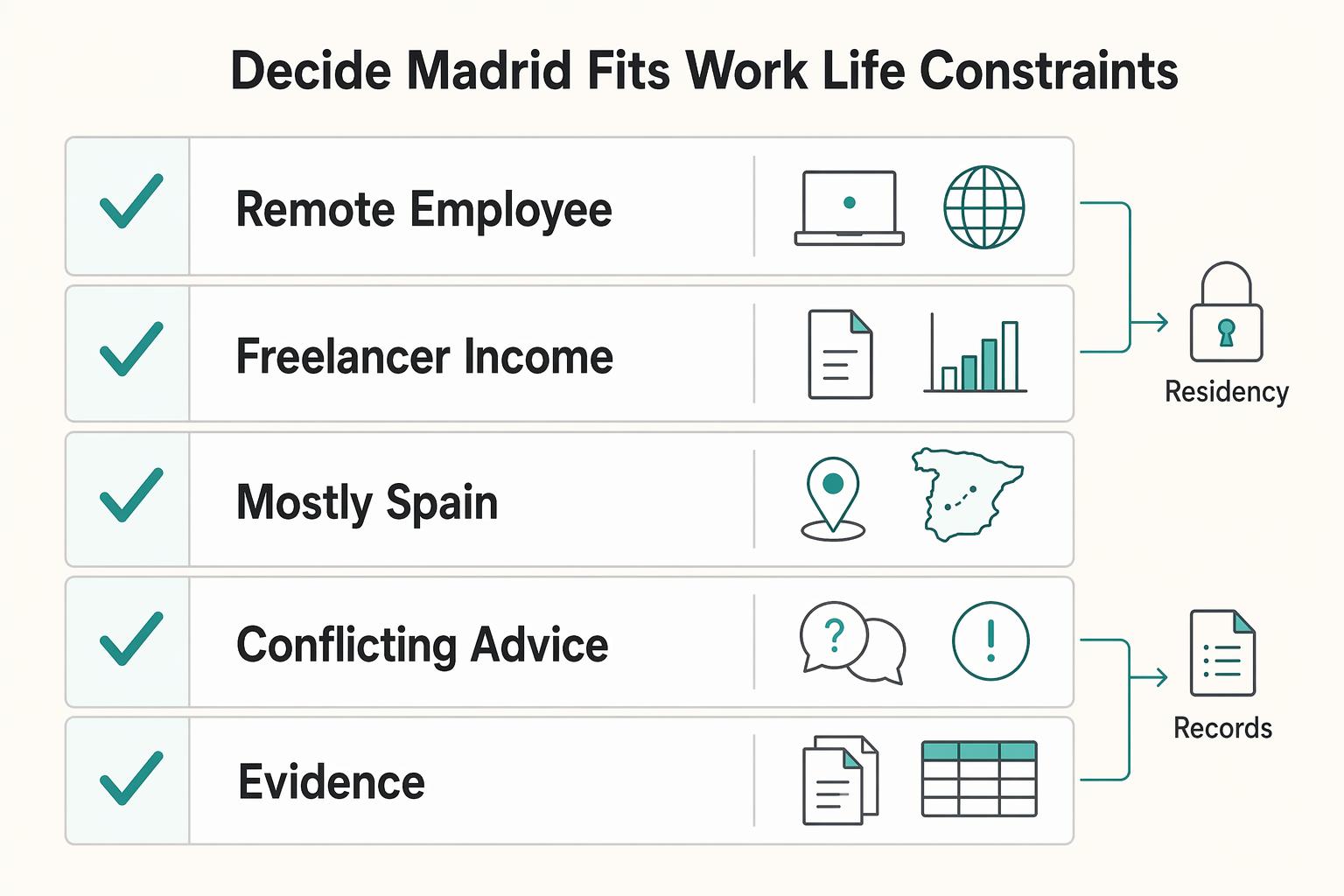
Run a constraints test before you commit to Madrid. Legal fit, income profile, and work reliability should pass first. Lifestyle preference matters, but it should not make the first go-or-no-go call.
Start with visa fit. The Spain Digital Nomad Visa is described for non-EU remote employees and freelancers working for foreign employers or clients. Before you book a one-way move, confirm you have the appropriate visa path. If your move depends on this route, treat it as an early gating item, not a later cleanup task.
Use this filter:
- Remote employee: confirm your contract is with a non-Spanish company.
- Freelancer: check income mix early; one cited cap says up to 20% may come from Spain.
- Mostly Spain-based income expected: do not assume this route fits; verify alternatives first.
- Published summaries can conflict on income thresholds, so treat any single figure as provisional and recheck current criteria before acting.
Conflicting figures can appear even within one source set. Handle that by keeping an evidence note per requirement with three lines: date checked, exact wording, and the decision affected. That note helps you avoid memory-based choices when details start to blur.
Use a simple contrast when you review your case:
- If you are a remote employee paid by a non-Spanish employer, your key risk is keeping contract and documentation consistent across your file.
- If you are a freelancer with mixed client geography, your key risk is misclassifying income mix or assuming eligibility from outdated thresholds.
Check work reliability in parallel. Spain is presented as having broad fiber coverage and strong coworking availability, so Madrid can stay on your shortlist. Final fit still depends on your exact location and routine. A city-level claim does not prove your building, your call window, or your daily transit pattern.
Run a short reliability screen before city commitment:
- Can you hold a stable call block in your likely work hours?
- Can you reach a backup work spot without heavy disruption?
- Does the neighborhood rhythm support your sleep and meeting overlap?
If you are deciding between Madrid and Barcelona, run the same checklist for both cities over the same time window. Score each city against the same constraints, then choose the one that survives your non-negotiables. Keep the criteria fixed during comparison so the tradeoffs stay visible.
You might also find this useful: our digital nomad visa index for 50+ countries.
Pick your legal route in Spain before booking housing#
Pick your legal route first, then decide how much housing risk you can take. Keep immigration and VAT on separate tracks so one question does not blur the other.
Verify Spain digital nomad visa eligibility criteria, required documents, income thresholds, processing timelines, and housing-timing rules directly before you file or set fixed move dates. Until you confirm the key points, keep housing reversible. That is planning protection, not a legal rule.
Use this general readiness check before major payments. It is not a Spain-specific legal checklist:
- Identity details are consistent across all records.
- Income records match how your work and payments are described.
- Names, dates, and signatures align across documents.
- You have a short decision log with what was verified and when.
What is clearly supported here on the EU VAT side:
- OSS is optional, with registration in one Member State of identification.
- If you use an OSS scheme, all supplies covered by that scheme must be declared through OSS.
- OSS returns are additional and do not replace the regular VAT return.
- Filing cadence differs by scheme: quarterly for Union and non-Union, monthly for import.
- For complex cross-border VAT treatment, a VAT Cross-border Ruling can be requested under national conditions in the participating country where you are VAT-registered, and Spain is listed as participating.
Keep a simple two-track note so decisions stay clean:
| Track | Confirm first | Commit only after |
|---|---|---|
| Immigration | Current eligibility and filing path (confirm with the relevant authority) | Core file consistency and submission readiness |
| VAT | Whether activity is in scope and whether OSS is relevant | Filing cadence and return overlap are clear |
Add these pause triggers before you commit to housing:
- Two sources disagree on a requirement that affects eligibility.
- A required document is pending correction.
- A payment deadline forces you to commit before verification is complete.
If any trigger appears, hold off on fixed housing and continue with flexible options. Recheck current criteria right before submission.
Related: Spain Digital Nomad Visa: Income Requirements and Application Process.
Build your pre-departure document pack in the right order#
Build your records carefully before you lock non-refundable travel. If core items are incomplete, keep flights and housing flexible.
| Stage | Focus | Grounded detail |
|---|---|---|
| Eligibility first | Align documents to your work model | Employed by a company outside Spain, or freelancer/self-employed |
| Income second | Organize income evidence | Supports the guide's stated threshold (€2,849 per month) |
| Supporting records third | Collect case-specific records | Bank statements, health insurance, CV and experience evidence, criminal-record status, and corporate documents |
| Additional formatted copies last | Prepare extras after the core checklist | Do this after core checklist items are complete |
Use that order to reduce avoidable rework.
Do one full consistency pass before finalizing plans. Check name spelling, birth date, document numbers, and expiry dates across the entire pack.
Keep one controlled folder for your Spain Digital Nomad Visa records:
01_identity02_income03_supporting04_submissions05_confirmations06_decision_notes
Inside 06_decision_notes, log each checkpoint in one short entry:
- Date checked
- Source type
- Exact requirement wording
- Your decision
Treat non-refundable booking as a readiness decision. If a core record is pending or under correction, choose flexible options and wait.
Run a final pre-departure gate shortly before departure:
- All checklist files are present in final format.
- No unresolved mismatch remains in key identity fields.
- You can retrieve every file quickly from one location.
- Payment confirmations and booking terms are saved.
- A backup copy exists in a second secure location.
Add a dry-run review before you leave. Open each folder as if you were responding to a request under time pressure. If you cannot find a file quickly, fix naming and structure before departure. That step takes little effort and can reduce stress once you are handling multiple tasks after arrival.
This approach does not make processing faster by itself. It can make your pack easier to review when questions come up.
If you want a deeper dive, read the Barcelona digital nomad guide for 2026.
Before you lock any non-refundable plans, run your documents through this digital nomad visa checklist to catch gaps early.
Execute your first seven days in Madrid without bottlenecks#
Week one should protect optionality. Your goal is to stabilize work continuity, verify neighborhood fit, and avoid locking into terms before your real routine is tested.
| Window | What to do |
|---|---|
| Day 1-2 | Arrive through Adolfo Suárez Madrid-Barajas Airport, move into a flexible short stay, and run your first connection test where you will actually work |
| Day 3-4 | Complete the tasks you can execute now, then visit shortlisted neighborhoods during your actual work hours |
| Day 5-7 | Run one full test day in each finalist area with your real sequence: work start, call block, errands, and evening return |
- Day 1-2: stabilize arrival and connectivity. Arrive through Adolfo Suárez Madrid-Barajas Airport, move into a flexible short stay, and run your first connection test from the place where you will actually work. One guide describes fiber as broad across Madrid and many cafes with Wi-Fi, but that does not replace an address-level test.
- Day 3-4: finish prepared setup tasks and walk target areas. Complete the tasks you can execute now, then visit shortlisted neighborhoods during your actual work hours. Chamberí is commonly framed as quieter with strong connectivity. Malasaña is often described as more energetic with many Wi-Fi-friendly cafes and nightlife. Arganzuela and Delicias are often presented as better connected with relatively lower rent pressure.
- Day 5-7: commit only after stress tests pass. Run one full test day in each finalist area with your real sequence: work start, call block, errands, and evening return. If the day repeatedly breaks down, stay flexible and keep screening.
Madrid's late rhythm can affect sleep and meeting overlap. Travel guidance often describes dinner around 9pm or 10pm with later social hours. If you need early starts or strict overlap with other time zones, check nighttime noise in person before signing.
Before you sign, run one pre-lease gate:
- One reliable call block from the exact unit or street.
- One commute test during busy hours.
- One written terms check against verbal promises.
If any item fails, pause.
Keep week-one evidence in date order:
- Booking confirmations
- Landlord messages
- Connection test notes
- Transit screenshots
- Short decision entries
One practical rule for week one: do not stack all critical tasks on one day. Leave room for issues like timing slips, unclear terms, or a failed connection test. A little scheduling slack can protect decision quality and keep you from committing under pressure.
That record helps you compare options with less emotion and fewer memory errors.
Choose housing with decision checkpoints, not listing hype#
Housing decisions should start with reversibility. If paperwork timing is still uncertain or early admin feels opaque, optimize flexibility first and price second.
Two paths to compare:
- Flexible short-stay option while timing is still moving.
- Longer-term lease after your timeline and weekly routine are stable.
| Housing path | Better fit when | Verify before payment | Main risk |
|---|---|---|---|
| Flexible option | Timeline is still moving | Total monthly cost, utility terms, extension or cancellation terms, written payment confirmation | Higher cost or variable terms |
| Longer-term lease | Timeline and routine are stable | Contract length, deposit and fees, utilities, move-in condition notes, exit wording | Harder to unwind if plans change |
Run this red-flag list before you sign:
- Terms like expenses included without a clear breakdown.
- Utility responsibility missing or vague.
- Long lock-ins before your routine has been tested.
- Verbal promises not present in written terms.
- Pressure to transfer funds before a final signed agreement.
Add one payment-protection step: before you transfer funds, save the exact terms version you agreed to, then save transfer proof in the same folder. If terms change later, you need a clear before-and-after record.
Use a quick viewing script to avoid missed checks:
- Ask what is included in writing, line by line.
- Ask when and how contract changes are confirmed.
- Ask how move-in condition is documented.
- Ask what happens if dates shift.
- Add a "getting there" check so daily access and transport logistics are workable before you commit.
For location tradeoffs, test your real routine rather than the listing language. Decide what matters more now: central convenience or more space and a different pace farther out. If a checkpoint fails, stay flexible and keep screening.
Pick the right Madrid neighborhood for your work rhythm#
No neighborhood is universally best. Fit depends on your work pattern, social preference, and budget ceiling.
Build your shortlist around how each area performs in real life:
- Work style: client-facing days or deep-focus blocks.
- Pace preference: networking and career access or a slower daily rhythm.
- Budget fit: areas that match your monthly ceiling.
- Reliability: stable internet from day one before you settle in.
Use one clear rule: prioritize the factor your week depends on most, then trade off the rest.
After a short trial, score each finalist on:
- Internet stability during your real meeting window.
- Fit for task-heavy focus blocks.
- Alignment with your preferred pace.
- Budget fit in practice.
If the same weak point keeps showing up, remove that area from your shortlist. A pretty listing does not compensate for repeated disruption.
If two areas score close, break the tie with the part of your week that cannot fail. Choose the area that protects that priority, then adjust social plans around it.
Build a realistic monthly budget and cash buffer#
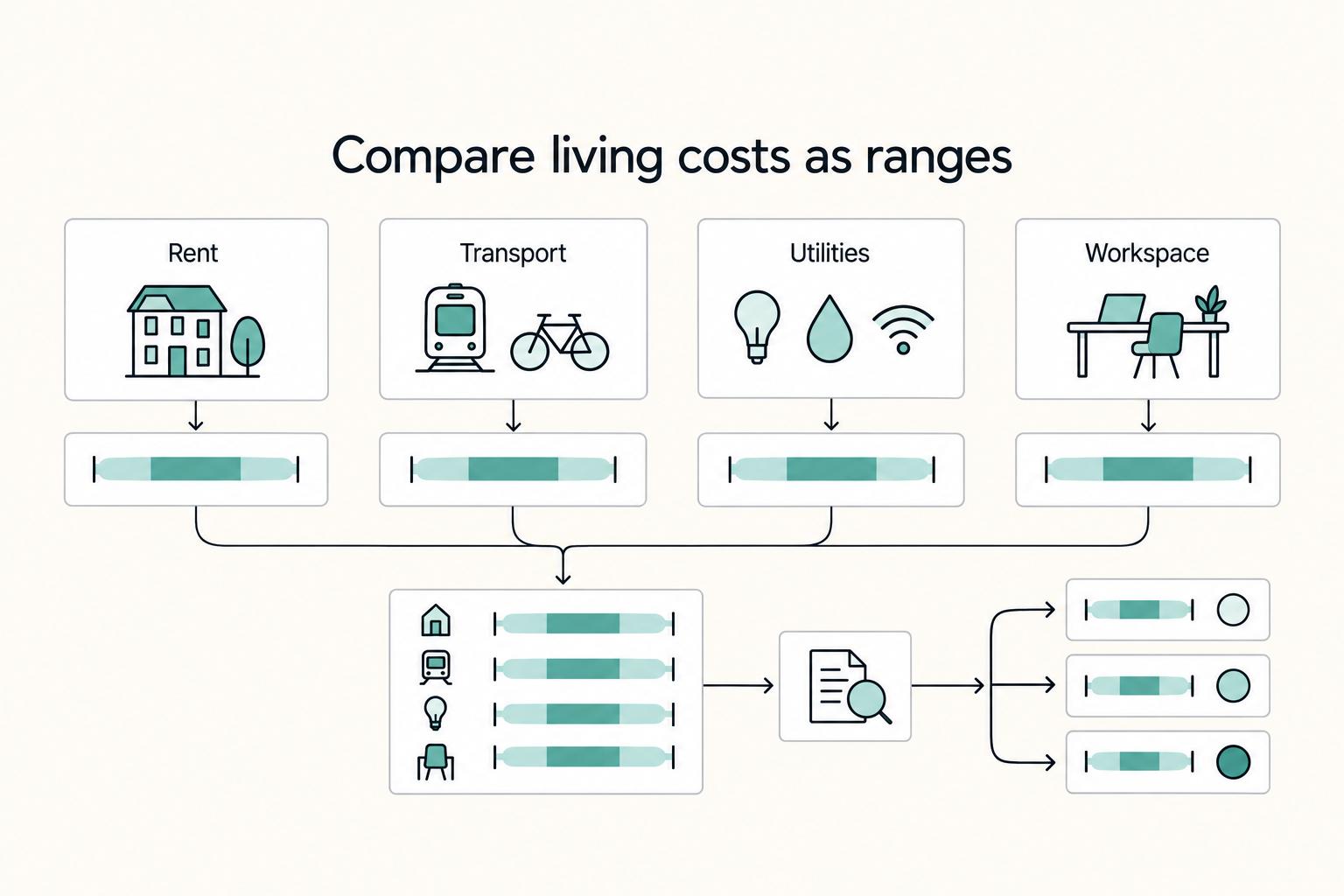
Use a category budget plus cash buffer, not one headline figure. There is no consistent, itemized method here for comparing Madrid costs, and one example is for a family of 4, so treat published figures as directional at best.
| Category | Included items |
|---|---|
| Housing | Rent, deposit timing, utility inclusion, move-in fees |
| Transport | Daily routes, airport runs, late-hour fallback rides |
| Workspace | Coworking, day passes, home-office setup |
| Food | Groceries, weekday meals, social spending at your normal pace |
| Contingency | Admin delays, rebooking costs, document surprises |
Start with these categories:
- Housing: rent, deposit timing, utility inclusion, move-in fees.
- Transport: daily routes, airport runs, late-hour fallback rides.
- Workspace: coworking, day passes, home-office setup.
- Food: groceries, weekday meals, social spending at your normal pace.
- Contingency: admin delays, rebooking costs, document surprises.
Then separate your plan into two budget modes:
| Budget mode | What it covers | Why it matters |
|---|---|---|
| Baseline month | Recurring spend once setup stabilizes | Shows whether ongoing life is sustainable |
| Launch month | One-off and timing-driven relocation costs | Prevents early cash shortfall during transition |
A specific EUR target or number of buffer months is not established, so set your buffer threshold from your own cash-flow pattern and risk tolerance.
If your income is variable, increase your buffer before taking fixed commitments. Keep optionality until your true spending pattern is visible, then recalibrate using real payment records.
A practical monthly review keeps the plan accurate:
- Compare planned versus actual by category.
- Mark one-time expenses so they do not distort baseline assumptions.
- Flag recurring items that were missing from your plan.
- Update next month before new commitments are signed.
Before each month starts, check your cash timing:
- Confirm when large housing payments are due.
- Confirm when your expected income usually arrives.
- Keep room for delays, rebooking, or admin surprises.
This keeps the budget useful under real conditions instead of going static after week one.
Set up a reliable remote work environment fast#
Set up work reliability before lifestyle extras. A primary coworking base plus a tested backup is often a fast path to predictable output in Madrid.
| Work mode | Best use | Main risk | Practical rule |
|---|---|---|---|
| Coworking, including ILCOWORKING | Structured days and meeting-heavy blocks | Commute friction if location is poor | Use as primary base first, keep one backup ready |
| Cafe rotation | Light tasks and social exposure | Conditions vary by venue and hour | Use as secondary locations, not for critical calls |
| Home office | Deep-focus blocks and schedule control | Isolation and apartment-dependent setup quality | Pair focus days with planned in-person sessions |
Madrid is often described as fiber-connected with many coworking options, but day-to-day reliability can still vary by location and meeting window. Treat listicles as a starting point, not proof. One DigitalNomads.world Madrid page is dated September 15, 2021, and even newer posts can be stale for 2026 decisions.
Run this reliability check before any client-facing week:
- Test a full video call with camera and screen share from your primary location.
- Repeat the same test from your backup location in your real meeting window.
- Confirm phone tethering works in both places if Wi-Fi drops.
- Verify opening hours and quieter time windows for the upcoming week.
Map your weekly movement as a triangle:
- Housing
- Main work location
- Recurring meeting zone
Then add one airport leg to Adolfo Suárez Madrid-Barajas Airport so schedule changes do not break your week.
Social density cuts both ways. It can help networking and hurt focus consistency. If production work dominates your schedule, anchor yourself in a quieter base and place social plans intentionally.
Avoid the delays that most guides skip#
Delay control is mostly sequencing discipline. Do not move to the next paid commitment until the previous checkpoint is verified.
If guidance conflicts, use official europa.eu pages as a tie-breaker for EU process questions. Lifestyle content can orient you, but regulated decisions need formal conditions and filing obligations.
Keep these as core risk controls:
- Confirm VAT scope and filing country before taking the next step.
- Avoid irreversible spend before legal and filing clarity.
- Identify declaration and return dependencies before spending.
What is clearly supported in the EU VAT context:
- Cross-border VAT ruling requests are filed in the participating EU country where you are VAT-registered, under that country's VAT-ruling conditions.
- Spain is listed among CBR participating countries.
- OSS is optional, but once used, all supplies under that scheme must be declared through that scheme.
- OSS returns are additional and do not replace regular Member State VAT returns.
- Filing cadence differs by scheme: quarterly for Union and non-Union, monthly for import.
Use this verification rhythm before each commitment:
- Label the decision: lifestyle choice or regulated process.
- If regulated, confirm the guidance is on
europa.eu. - Confirm scope: whether your activity is in VAT context and whether OSS is optional or already selected.
- Confirm filing cadence and return overlap before spend.
- Log checkpoint date and outcome, then approve or pause.
If a conflict appears, resolve it in sequence:
- Identify which statement controls a paid decision.
- Find the formal condition and filing obligation for that statement.
- Pause irreversible spend until the conflict is cleared.
- Update your decision log so the same conflict does not reopen later.
One concrete policy anchor remains useful: EU cross-border B2C VAT changes from 1 July 2021 include an EU-wide EUR 10,000 threshold in this area. If two sources disagree, prioritize the one with formal conditions and explicit filing obligations, then hold spend until the facts align.
Conclusion#
A smooth Madrid move is mostly a sequencing problem. Verify first, commit second. That logic is more dependable than copying generic city lists because source quality varies and no single page should be treated as complete.
The source mix here makes that limitation visible. One Madrid guide says it is personal and not complete. Another describes itself as complete but is dated July 2022. A checklist-style article dated 2025-11-03 can be useful, but it still needs re-verification for a 2026 move.
Close with one practical checklist:
- Verify current visa requirements for your nationality.
- Book short-term housing first while you explore neighborhoods.
- Plan first-week essentials such as bank account, SIM card, and transport card.
- Date every checkpoint note before any non-refundable spend.
If advice sounds certain but gives no verifiable checkpoint, pause. If your move includes cross-border client payments, include record quality and ease of later review in your decision criteria.
The core advantage is not speed. It is reducing avoidable reversals. When each commitment follows a verified checkpoint, your plan stays coherent even when timing shifts. That is how you protect budget, focus, and momentum during a Madrid relocation.
If your Madrid move includes getting paid by clients abroad, review Payouts alongside other options.
Frequently Asked Questions
Is Madrid actually a good base for digital nomads, or is Barcelona a better fit?
Madrid is presented here as a credible remote-work base, but there is no universal winner over Barcelona. Compare both cities with the same criteria, including call reliability, work rhythm, and non-negotiables. Madrid's support points in this material include broad fiber availability, coworking options, and Adolfo Suárez Madrid-Barajas Airport.
What should I prepare before moving to Madrid as a remote worker?
Prepare three checkpoints first: current Digital Nomad Visa requirements, where you can apply, and the current income requirement. Organize identity records, income evidence, supporting records, and decision notes with exact wording and dates. If a key item is unresolved, keep bookings flexible and run a quick file retrieval test before departure.
What are the first admin steps to complete after landing in Madrid?
An official government first-week sequence is not documented here. A cautious approach is to stabilize housing and internet first, complete tasks you already prepared, and validate neighborhoods during your real work hours. Delay non-refundable commitments until each checkpoint passes.
Which Madrid neighborhoods are best for quiet deep work versus social networking?
Chamberí is described as quieter and well connected, which can suit deep-focus work. Malasaña is described as more social, with cafes and nightlife, while Arganzuela and Delicias are presented as better-value areas with strong transport links. Use real test days to confirm call quality, sleep, and commute before choosing.
What cost categories should I budget for if exact local numbers are unclear?
Budget by category: housing, transport, workspace, food, and contingency. Run a launch-month budget for setup costs and a baseline-month budget for recurring spend. Then use actual payments to adjust both, and mark one-time expenses so they do not distort your baseline.
What delays happen most often with Spain digital nomad paperwork, and how can I reduce them?
There is no clear list of specific delay causes, so the safer approach is sequencing. Verify formal checkpoints in order, including requirements, filing location, and current income criteria, before you spend. If sources conflict, pause non-refundable commitments and track each requirement in a checkpoint log.
Try a related tool
Researched and edited by the Gruv editorial team. Gruv builds cross-border billing, payouts, and finance-operations software for global businesses.
Sources
Includes 4 external sources outside the trusted-domain allowlist.
- exteriores.gob.es/Consulados/londres/en/ServiciosConsulares/Pa...trusted
- taxation-customs.ec.europa.eu/archives/taxable-persons/vat-cross-border-ru...trusted
- vat-one-stop-shop.ec.europa.eu/guides_entrusted
- vat-one-stop-shop.ec.europa.eu/index_entrusted
- agmabogados.com/en/downloadable/frequently-asked-questions-a...external
- boe.es/buscar/act.phpexternal
- esmadrid.com/enexternal
- metromadrid.es/enexternal
Educational content only. Not legal, tax, or financial advice.
Related Posts
Barcelona, Spain: Digital Nomad Guide (2026)
**Use this guide to make one decision early: are you taking a short stay in Barcelona, or are you actually relocating?** That choice sets your legal pathway, paperwork timeline, housing options, and tax posture. Treat this as an operating plan, not vibes, and you will move faster by making fewer guesses.

Spain Digital Nomad Visa Guide: Requirements, Application & 2026 Updates
Stop collecting more PDFs. The lower-risk move is to lock your route, keep one control sheet, validate each evidence lane in order, and finish with a strict consistency check. If you cannot explain your file on one page, the pack is still too loose.

The 2026 Global Digital Nomad Visa Index for 50+ Countries
Start with legal fit, not lifestyle filters. The practical order is simple: choose a route you can actually document, then decide where you want to live. That single change cuts a lot of wasted comparison work and stops you from falling in love with places that were never a real filing option.