
Quick Answer
This Madeira digital nomad guide helps you plan a practical long or short stay in Funchal (or Ponta do Sol) by sequencing the key decisions first: choose your legal "bucket" (Schengen short stay vs D7/D8), build a clean document pack (income, accommodation, insurance), and use a gated relocation timeline from T-90 through your first 30-90 days. Then lock housing, NIF, connectivity redundancy, budgeting, and recordkeeping.
You're not looking for "things to do"-you need a practical relocation guide for Madeira#
This Madeira digital nomad guide is about planning and logistics you can actually use in real life and in your calendar. This isn't a sightseeing list. It's a way to stay organized.
Madeira is a group of Portuguese islands in the Atlantic Ocean. A long stay goes more smoothly when you plan ahead and keep decisions and documents organized.
Here's what "practical" means.
You can answer, quickly and consistently, where you'll live, how you'll structure your stay, what you'll need to prepare, and how you'll keep your money and records tidy without last-minute panic.
The mental shift#
You don't "arrive and figure it out." You sequence decisions so each step makes the next step easier.
- Choices that lock other choices: decide your stay approach before you book anything hard to change.
- Dates that drive everything else: work backwards from the commitments you can't easily move.
- Paperwork: keep one folder that stays current, not a pile of screenshots.
- Money setup: decide how you'll get paid, handle FX, and track things cleanly from day one.
Funchal (and why it comes up)#
Funchal is the capital city of Madeira. Whether it's the right base depends on what you prioritize day to day: work rhythm, budget, and how much "city" you want around you.
Decide fast: Is Madeira (and which town) right for your working style?#
Madeira can fit you when you want a stable base-and you're willing to plan around island logistics instead of improvising. Your goal is a base town that makes weekdays easier.
Use this Madeira digital nomad guide like a fast decision gate:
- Workday needs: Do you need lots of options for food, services, and getting things done quickly?
- Social needs: Do you want built-in community, or do you prefer to choose it intentionally?
- Travel needs: How often do you fly in/out, and how much do you care about being near the airport?
Funchal vs Ponta do Sol (the practical split)#
Funchal is the capital city and is described as having the best infrastructure (plus restaurants and nightlife). If you optimize for convenience and flexibility, start here.
Ponta do Sol is described as being nicknamed the "digital nomad village," and it has a big assortment of co-living spaces. If you optimize for community-first living, start here. Treat it as a deliberate choice, not the default.
| Choice | Best for | Watch-outs to pre-plan |
|---|---|---|
| Funchal | Infrastructure-first weekdays | Pick your neighborhood and building features early |
| Ponta do Sol | Community + co-living energy | Confirm your work setup and backup options upfront |
Satellite option: Santa Cruz for airport proximity#
If you expect frequent arrivals, departures, or visitors, Santa Cruz is described as being situated close to the airport. That can make your first week feel simpler.
Quick travel reality check#
When you see "FNC," that's the IATA code for Funchal Airport.
Arrival rule: land, sleep, set up your workspace, then start exploring.
If you want a sanity-check framework for "island base vs big-city base" without guessing, compare your criteria against Lisbon Digital Nomad Guide 2026 for Long-Stay Move Sequencing.
Don't wing legality: the simple mental model for staying and working in Madeira#
Treat "where you want to live" and "what you're allowed to do there" as two separate decisions-and lock the legal one first. Lifestyle comes after status and permissions.
Define the terms (so you stop mixing categories)#
- Schengen area is an area without internal borders, where EU citizens, non-EU residents, and visitors can travel safely and freely.
- Schengen 90/180-day rule means you're usually allowed to stay for a maximum of 90 days within any 180-day period.
- Madeira is an autonomous region of Portugal. Treat your stay as a Portugal stay, then verify which Portugal/Schengen rules apply to your passport.
Choose your "bucket" before you book#
Use this filter to avoid accidental non-compliance:
| Your reality | What you're deciding | What to do next |
|---|---|---|
| Short stay | How long you can remain | Map your days against the 90/180 limit |
| Long stay + remote income | A long-stay legal pathway | Review D8 vs D7 positioning and requirements |
A simple framing helps: D7 targets retirees and passive-income holders, while D8 is designed for digital nomads earning remote income.
D8, in plain operator language#
One D8 pathway is the Temporary Stay Digital Nomad Visa, which is stated as valid for up to one year.
If you're optimizing for a long stay in Madeira, treat it like a checklisted project with a timeline.
Build your safe default (avoid common refusals)#
A Portugal-based lawyer article lists refusal drivers you can control:
- Proof of accommodation (missing or weak)
- Proof of minimum income (missing)
- Poorly organized documentation (hard to evaluate)
For the detailed D8 decision tree and how to package documents cleanly, use Portugal Digital Nomad (D8) Visa: A Complete Guide.
The relocation timeline with gates (T-90 → Month 3) that helps prevent delays#
Use gates to turn "move to Madeira" into a sequence of small, checkable wins. The point is to avoid discovering a missing document after you've already rearranged your life.
This is a planning framework (not an official schedule). It's a useful way to make the work visible and reduce surprises.
Gate 1 (T-90 to T-60): Pick your pathway + define your evidence plan#
Write a one-page "proof story" you can defend: who pays you, how the money lands, and where it shows up in statements.
If you're staying under Schengen short-stay rules, keep the limit in view. Short visits in the Schengen area are described as up to 90 days in any 180-day period for non-EU nationals.
Gate 2 (T-60 to T-30): Build the document pack + schedule choke points#
This is the highest-leverage window. Remove delays you can control:
- Document formalities: An apostille is a certification of authenticity of public documents (a formality certifying signatures/seals/capacity). If any checklist you're using mentions an apostille, plan time for it.
- Organization: Keep one clean folder with stable filenames and a single "latest" PDF per item.
Gate 3 (T-30 to arrival): Book a landing stack that keeps options open#
Choose temporary housing you can document clearly. Depending on the pathway and checklist you're working from, you may be asked for proof of accommodation.
So don't treat your first booking like a throwaway detail.
Gate 4 (Early after arrival): Set up identity + address + connectivity fast#
Prioritize your NIF (Número de Identificação Fiscal).
It's Portugal's tax identification number for individuals. Portal das Finanças describes it as a nine-digit number and notes it's required for many everyday activities, including employment, contracts, and opening bank accounts.
Gate 5 (First 30-90 days): Stabilize housing + records#
Shift from "getting set up" to "staying renewal-ready." Keep a monthly routine that exports the same core records (bank statements, invoices, housing proof).
That keeps your paperwork current instead of turning into an end-of-stay scramble.
If you're weighing longer-stay options, use Portugal Digital Nomad (D8) Visa: A Complete Guide as your decision companion.
If you're still deciding between a short stay vs a long-stay pathway, use a side-by-side reference to sanity-check requirements and timelines before you book anything. Compare visa options for digital nomads.
Your document pack, operationalized: "minimum viable" vs "strong" (and where approvals fail)#
Your document pack should tell one consistent story across identity, income, accommodation, and insurance: no contradictions, no missing links. Your job isn't volume. Your job is internal consistency.
Document pack (as people use the term, in practice) is the complete set of identity + income + accommodation + insurance evidence a reviewing authority may use when assessing your Portugal pathway.
Minimum viable vs strong (use both on purpose)#
- Minimum viable pack (credible submission): typically includes a valid passport, relevant application forms, basic proof of income, basic proof of accommodation, and an insurance document you can understand.
- Strong pack (built for clarity): the same items, plus layered proof and a short "income narrative" that explains what the reviewer will see.
Proof-of-income patterns (by how you earn)#
- Employees: common pattern is employment contract + payslips + bank statements showing deposits that match. Watch for mismatched employer names.
- Freelancers: common pattern is client contracts + invoices + bank deposits. Use a simple mapping so a reviewer can reconcile fast.
- Founders: salary/dividend/distribution evidence plus company documentation; be ready to explain (clearly) how revenue gets generated outside Portugal.
Accommodation proof (where packs break)#
Portugal's digital nomad visa requirements include proof of accommodation, and examples often cited include a rental agreement, hotel reservation, or a host confirmation letter.
| Option | What it proves | Where it fails |
|---|---|---|
| Hotel booking | A place to land | Can be weaker "address proof" for later admin |
| Lease | A stable address | Harder to unwind if plans change |
| Hosted invitation / host letter | A real host relationship | Must be clear and credible |
Treat address proof as a dependency.
Portal das Finanças notes the NIF is required for everyday activities like contracts and opening bank accounts. Those workflows go smoother when your address story stays clean.
Insurance: turn "coverage" into a checklist#
If you're asked for Schengen travel medical insurance, an EU decision text states the minimum coverage amount is EUR 30000.
Regardless of product, audit your policy for: coverage period, geographic scope, and exclusions. Make sure the document you submit states them plainly.
Housing + address proof without getting trapped (Funchal-first, ethically)#
Consider using Funchal as a short-term base. Upgrade only after you've seen places in person and verified the paperwork chain. Housing affects comfort, admin momentum, and how cleanly your "where do you actually live?" story holds together.
Funchal vs Ponta do Sol (and other official community locations)#
Funchal can work well if you want a more "all-in-one" city base while you get oriented.
Ponta do Sol trades some of that for a smaller-town rhythm. Startup Madeira frames it as the Nomad Village within the digital nomad ecosystem.
Startup Madeira also lists other official community locations besides Ponta do Sol, including Funchal, Machico, Santa Cruz, Jardim do Mar, and Porto Santo.
| Area | Choose it if you want | Expect the trade-off |
|---|---|---|
| Funchal | A more "all-in-one" base | Your priorities (location, price, furnishings) may force quicker decisions or compromises |
| Ponta do Sol | Community-first pace | Fewer options can make "right place, right time" matter more |
Lease mechanics in Portugal (what landlords may ask)#
Ask upfront what the landlord requires. Examples commonly requested from foreigners include NIF, proof of income, a guarantor (fiador), and advance rent.
If you can't provide a fiador, some landlords ask for more money up front-sometimes 3-6 months of rent, and in some cases 6-12 months.
The address-proof chain reaction (why this isn't just "rent")#
Tax address (domicílio fiscal) is where you habitually reside, and Finanças sends official correspondence to the address registered in your tax file.
Separately, the NIF shows up everywhere operationally. People use it to open bank accounts and sign up for utilities.
Keep your address story consistent across contracts and admin, and you'll save yourself avoidable back-and-forth.
A safe, ethical housing workflow (anti-scam defaults)#
- Use short-term accommodation first; upgrade after local viewing.
- Never commit to a property you haven't seen.
- Be cautious with big upfront payments; keep everything in writing and keep records of what you paid and why.
- Treat "too good to be true" as a process failure, not a lucky break.
If you're coordinating housing with the D8 visa pathway, keep Portugal Digital Nomad (D8) Visa: A Complete Guide handy while you time your moves.
Work setup you can trust: internet, coworking, redundancy, and time zones#
Build a two-path connectivity setup (fixed internet + mobile hotspot) so one failure never becomes a missed deadline. Once housing is stable, lock your work layer.
The "two-path internet" rule (non-negotiable)#
A mobile hotspot is a portable device that broadcasts Wi-Fi using cellular data-your simplest backup when Wi-Fi drops.
Set the rule before you arrive:
- Primary: whatever fixed internet you get at home.
- Backup: hotspot-ready plan (or a second phone line) that can carry a client call.
- Test: run a real work simulation (video call + file upload) from the exact spot you'll work.
Coworking: choose for meetings, not vibes#
If your week includes calls, pick one dependable coworking option early so your work doesn't depend on your apartment's router.
For example, Cowork Funchal advertises a dedicated fiber internet line and desks priced at €12 +VAT/day or €130 +VAT/month.
If you split time across the island, treat Ponta do Sol's Nomad Village like a periodic community day.
Its program describes a free working space, plus events and community access. Keep your heavier "admin base" habits anchored where you can run errands and handle logistics predictably.
Café working caveats (operational)#
Cafés can work for light tasks, not for your whole system.
- Protect focus time: choose cafés for email and admin, not deep work.
- Respect the room: "They need table turnover to make tips, so if you're settling in for a long haul, you better be ordering like you mean it."
- Always have a fallback: coworking day pass, home desk, or hotspot-powered quiet spot.
Time zones: schedule like an operator#
Funchal runs on WET (UTC+0) and switches to WEST (UTC+1) during summer daylight saving time.
Operator rule: if you work with the United States, expect some late calls. If you work with the United Kingdom and EU teams, you'll feel the shifts around daylight saving time.
Arrival-week essentials (do these first)#
- Buy a SIM early: Madeira Airport lists a Vodafone shop with voice and data cards (listed hours 08h00 - 20h00).
- Bring valid ID: SIM signup commonly requires it.
- Don't assume a listing is work-ready-verify speed and stability where you'll live before you commit.
Cost of living in Madeira that's decision-grade (with a budget model you can reuse)#
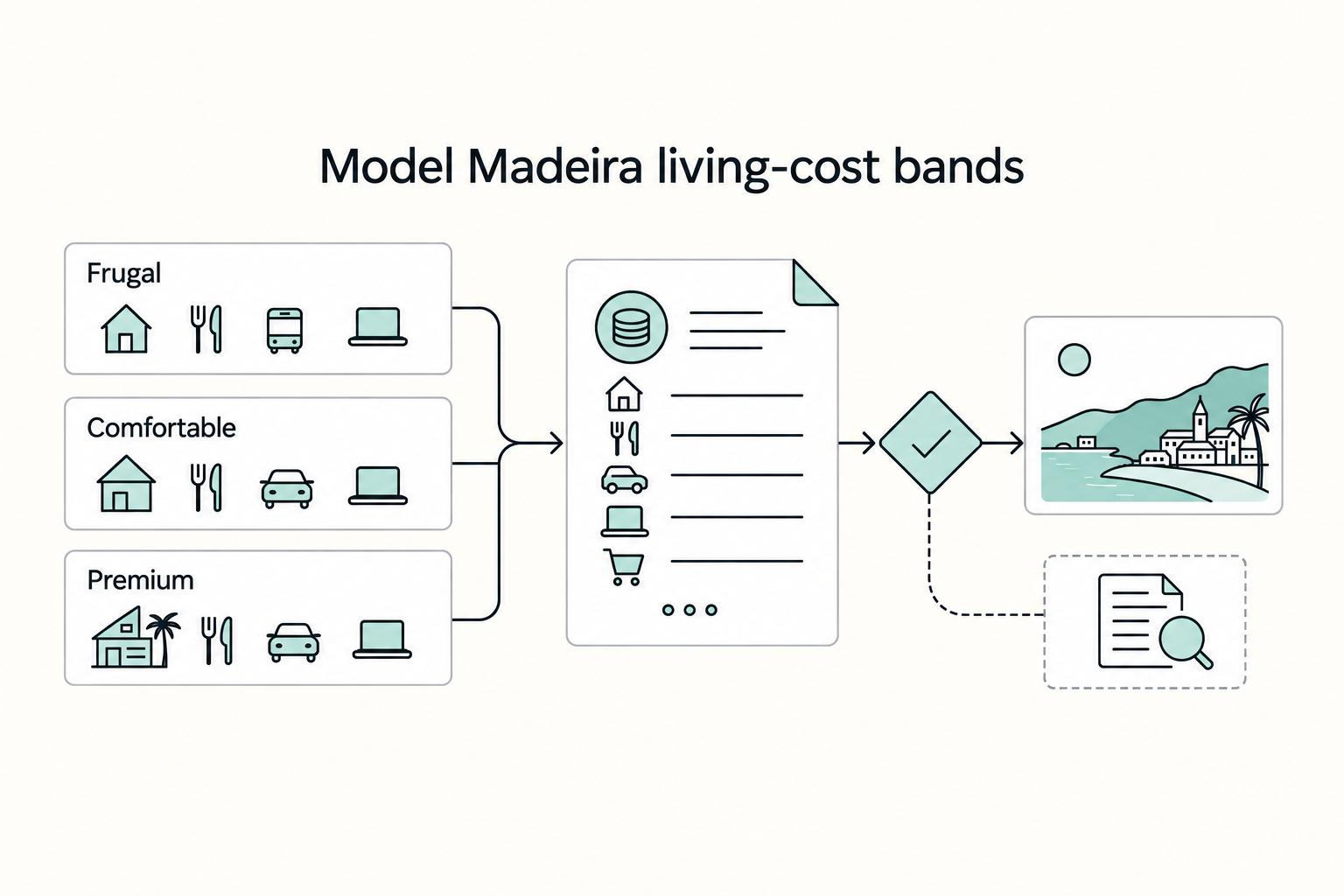
Use a tiered monthly budget (frugal / comfortable / premium) and one explicit rent ceiling to make your Madeira decision real. This turns "I think I can afford it" into "I can run this for months."
A monthly model you can reuse (start with what's knowable)#
Build your budget with line items you actually pay: rent, utilities, groceries, eating out, coworking, transportation, health insurance, leisure.
Then set three tiers by behavior (not vibes):
| Tier | What it means in practice | What you track weekly |
|---|---|---|
| Frugal | Home-heavy, fewer paid desks | groceries + transport |
| Comfortable | Regular coworking + eating out | coworking + dining |
| Premium | Convenience-first choices | taxis/parking + leisure |
For a reality anchor, Numbeo's Funchal page states estimated monthly costs for a single person are 717.4$ (616.0€), excluding rent.
Treat this as directional, not a guarantee.
Why "cheap listings" mislead#
Cheap can be expensive when the listing hides friction: utilities missing from the price, no practical desk setup, or a location that pushes you into paid transport.
Assume "headline rent" never tells the whole story.
One-time relocation costs people forget#
Plan a separate one-time bucket for:
- Deposit + any advance rent required by the contract.
- Overlap between temporary accommodation and the day your lease starts.
- Work setup: SIM and backup connectivity.
- Document formalities (translations/apostilles) for immigration/relocation prep, where applicable.
On rent paid up front: an Idealista explainer on Portugal renting states that advance rent payments can be allowed up to a maximum of 3 rents, as long as the contract expressly stipulates it.
Madeira vs Lisbon (use the right comparison)#
Numbeo's comparison states Lisbon's cost of living is 16.7% higher than Funchal's (excluding rent).
Its "same standard of life" example says you would need 4,621.7€ in Lisbon versus 3,900.0€ in Funchal (assuming you rent in both cities). This calculation uses Numbeo's Cost of Living Plus Rent Index.
Still, island logistics can change your lived cost-so keep your model honest with real flights, transport, and work habits.
The decision point: pick your rent ceiling first#
If your plan only works under a specific rent ceiling, decide that before you choose between Funchal, Ponta do Sol, Machico, or Santa Cruz.
That one constraint prevents most budget regret.
Getting around + healthcare/safety: the boring logistics that protect your week#
Treat transport and healthcare like uptime systems-set them once, then stop paying "friction tax" every day. This is how your calendar stays clean.
Transport model (pick based on your base)#
If you base yourself in Funchal, you can often handle day-to-day errands on foot.
But the city sits on hill slopes, so distance on a map rarely equals effort in real life.
Madeira's public transport includes city, urban, and interurban services. In and around Funchal you'll see Horários do Funchal as one way to get in and out of the city.
Outside Funchal, a car can become a productivity tool because it compresses commute + grocery + appointment time into predictable blocks.
If you're near Santa Cruz (or nearby), you also reduce travel-day friction because Cristiano Ronaldo International Airport (IATA: FNC) sits in Santa Cruz.
Car rental vs buying (don't postpone the decision)#
If your housing sits outside Funchal, decide this before you sign the lease.
| Option | When it fits | What to confirm upfront |
|---|---|---|
| Rent | Early on, uncertain base | Total cost, deposits, what insurance covers, what to do after an incident |
| Buy | You're committing to one area | Title/registration path, ongoing insurance costs, where you'll park and service it |
Keep paperwork expectations high-level: plan to have ID, a valid driving licence, and a payment method.
Read the insurance terms like an operator, not a tourist.
Healthcare + safety (how you handle routine vs emergency)#
For health questions in Portugal, save SNS 24: 808 24 24 24.
For medical emergencies, save 112 (the single European emergency number in the EU, available 24/7).
If you're eligible for it, EHIC helps with healthcare during a temporary stay in EU countries (and other listed countries).
Day 1 safety routine (10 minutes):
- Pin your nearest clinic/hospital in Maps.
- Save
112and808 24 24 24. - Screenshot your insurance policy number and keep ID + insurer contacts accessible.
Finally, tie this into compliance: keep receipts and policy documents organized.
That paper trail helps when you're dealing with insurance/admin. It also keeps you ready for whatever paperwork comes next, including visa paperwork (see Portugal Digital Nomad (D8) Visa: A Complete Guide).
The money + compliance system: get paid, reduce FX bleed, stay renewal-ready#
Build a simple "money stack" that produces clean records by default, because clean records buy you time. This is the reliability layer most people postpone.
Build your money stack before you arrive#
You're designing four parts, not downloading apps:
- Inflow: where client payments land, and how you track "paid / late / partial."
- Spend: how you pay daily expenses in EUR without guessing your real rate.
- Convert: your rule for when you convert USD/GBP into EUR.
- Recordkeeping: how you store proof so you never reconstruct history under pressure.
Payments + FX controls (decisions that prevent mystery costs)#
FX spread is the gap between the rate you get and the mid-market rate-the markup you're paying (often without realizing it) when you don't measure it.
Some providers also embed a hidden exchange-rate markup inside the rate and don't show it as a separate fee.
Make three decisions:
- Where you hold EUR vs convert: pick a "hold" place and a "convert" place.
- Conversion cadence: monthly works for many operators; choose a fixed day and stick to it.
- Reconciliation rule: only use providers that show the rate, fees, timestamps, and references you can match to statements.
If you want a neutral benchmark for sanity checks, note that published reference rates (like the ECB's) don't necessarily match real transaction rates.
Treat them as context, not your actual cost.
Audit-ready recordkeeping (the under-taught advantage)#
Consider creating a monthly export pack for your own records and keep it consistent:
- invoices sent + payment confirmations
- bank statements
- FX conversion confirmations
- rent receipts
- insurance proof
Use a folder structure by month → category (income, housing, insurance, travel).
Accounting workflows often depend on original supporting documents (bank statements, invoices, receipts, contracts), so don't "tidy up later."
Tax gates (high-signal, not legal advice)#
Portugal notes that residents typically pay tax on all income, whether from Portugal or abroad.
A core trigger for being considered tax resident includes spending more than 183 days (consecutive or interrupted) in a 12-month period.
On NHR: online advice runs behind reality.
A newer incentive called IFICI is described as replacing the former NHR regime and being in force as of January 1, 2024. Treat this as a verification checkpoint for your situation, not a promise.
If you're on the Portugal D8 Visa, this system can also help you keep your story consistent-without scrambling.
The "do this next" checklist: your first 7 moves to relocate to Funchal (or Ponta do Sol) confidently#
Turn your plan into seven irreversible moves. Each one creates proof, reduces risk, and keeps you calm.
This is the execution layer of the madeira digital nomad guide: one decision, one folder, one bottleneck, then arrival.
1) Lock your pathway + write your "proof story"#
Pick the lane you'll actually follow: a Schengen short stay vs a long-stay/residence visa route (rules vary by jurisdiction).
Then write a one-paragraph story you can prove with documents: who pays you, how consistently, and how you'll support yourself in Portugal.
2) Build your "strong pack" folder (before you need it)#
Create a single folder with consistent filenames and monthly subfolders for the paperwork you'll need for applications and your own recordkeeping. For example:
- contracts and/or client agreements
- invoices + payment confirmations
- bank statements (where relevant)
- accommodation proof (what's accepted can vary; a VFS checklist example for Schengen tourists lists confirmed hotel/holiday home reservations or tour vouchers)
3) Book the choke points early#
Expect the first real bottleneck to be getting a VFS Global appointment.
VFS collects your application and biometrics; Portuguese authorities make the decision. Treat appointment time as a critical path item, not a "later" task.
4) Choose your base deliberately#
Choose your first base based on the day-to-day you want while you set up: more city convenience vs a quieter, smaller-town rhythm.
You can always switch once your admin and routines are stable.
5) Arrive with redundancy (without inventing heroics)#
Consider arriving with a backup way to pay and a simple fallback plan for your first week's friction: deposits, transportation, and errands.
6) Run a first-week admin sprint#
Get your NIF early.
Portal das Finanças describes it as required for many everyday activities in Portugal-including contracts and opening bank accounts-and states it's a nine-digit number. Don't wait until you need to sign something.
7) Make your money trail traceable#
FX spread is the difference between the rate you get and the mid-market rate; some providers also hide markup inside the rate.
Keep a clean chain (invoice → payment → conversion → spend) and store supporting documents (invoices, receipts, deposit slips).
If you manage multi-currency income, consider tools that make reconciliation easier, then confirm coverage where supported before you commit.
If you want a deeper dive, read The 2026 Global Digital Nomad Visa Index for 50+ Countries.
Before you commit to dates, start tracking your days now-tax residency questions get easier when you have a clean log from day one. Use the tax residency tracker.
Madeira Relocation Budget and Ops Matrix for 2026#
Before relocating, align visa, tax, and housing decisions in one spreadsheet. Validate official steps through ePortugal service portals, AIMA migration guidance, and Portal das Financas operations. Use these links as your baseline reference when planning first-quarter setup tasks.
| Cost Bucket | Starter Estimate | Conservative Estimate | Control Note |
|---|---|---|---|
| Housing (monthly) | 900 EUR | 1400 EUR | Track seasonal increases before signing |
| Coworking + connectivity (monthly) | 120 EUR | 260 EUR | Lock business-grade internet SLA |
| Transport and local mobility (monthly) | 70 EUR | 180 EUR | Separate daily commute from weekend travel |
| Admin setup and legal docs (one-time) | 250 EUR | 750 EUR | Budget for translations and notarization |
Quarterly Risk Table for Remote Operators#
| Risk Area | Early Warning Signal | Mitigation |
|---|---|---|
| Residency timeline drift | Application status has no update for 30+ days | Escalate through official portal channel and track case IDs |
| Tax and invoicing mismatch | Invoice profile differs from tax registration data | Run monthly tax profile reconciliation |
| Housing contract mismatch | Utility terms or duration differ from expected use | Require written term sheet before deposit |
| Revenue concentration | Top client exceeds 40% of monthly income | Set diversification target in 90-day plan |
According to OECD tax and mobility publications, cross-border workers reduce compliance errors when they maintain one documented checklist for residency status, tax profile, and billing records. According to tourism and transport reports, seasonal demand cycles can materially affect monthly cost assumptions.
Use this guide with freelance revision controls so pricing and scope remain consistent during cross-border moves.
Frequently Asked Questions
Can I work remotely from Madeira on a tourist visa?
Treat a short Schengen stay as exactly that: a short stay capped at up to 90 days in any 180-day period. What you can do while you're there can vary by status and jurisdiction. If your plan looks like "move, sign leases, build stability," don't improvise-use a long-stay pathway instead.
Is Madeira part of Portugal?
Madeira is an autonomous region of Portugal. That matters operationally: for immigration and paperwork, you're generally dealing with Portugal's systems.
What is the Portugal D8 digital nomad visa and how does it work for Madeira?
The D8 visa is described as the "digital nomad visa" / "remote worker visa," and as an alternative route to obtain Portuguese residency. Practically: if you want to live in Madeira beyond a short stay, you plan around D8 (or another long-stay option), then execute the timeline and document pack.
What's the difference between the D8 temporary stay visa and the D8 residency visa?
A temporary stay visa is described as without the right to obtain a residence permit. A residence visa is described as with the right to obtain a residence permit. Choose based on whether you want a residency path or a defined temporary base.
How long can I stay in Madeira under the Schengen 90/180 rule?
The 90/180 rule describes the short-stay limit: up to 90 days in any 180-day period. Don't treat this as "three months per trip" if you plan multiple entries-count days like an operator.
What documents do I need for Portugal's digital nomad visa (D8), and what counts as strong proof of income?
Expect common categories like: passport, proof of income and remote work status, health insurance, criminal record check, and proof of Portuguese accommodation. "Strong" proof usually means it's consistent, legible, and easy to reconcile-think a clear invoice trail plus matching payment confirmations and statements.
Do I pay taxes in Portugal if I live in Madeira, and when do I become a tax resident?
Portugal notes that residents typically pay tax on all income, whether from Portugal or abroad. One stated trigger for tax residency is spending more than 183 days (consecutive or interrupted) in a 12-month period. Another described trigger involves having a home that indicates intent to maintain and occupy it as a habitual residence. Also: NHR changed. A tax administration document states the NHR regime was repealed as of 01/01/2024 and replaced by the Tax Incentive for Scientific Research and Innovation. Verify how that interacts with your situation before you commit.
Try a related tool
Researched and edited by the Gruv editorial team. Gruv builds cross-border billing, payouts, and finance-operations software for global businesses.
Sources
Includes 3 external sources outside the trusted-domain allowlist.
- aima.gov.pt/entrusted
- eportugal.gov.pt/entrusted
- irs.gov/businesses/small-businesses-self-employed/wh...trusted
- oecd.org/taxtrusted
- portaldasfinancas.gov.pttrusted
- amysuto.com/desk-of-amy-suto/working-remotely-in-madeira...external
- digitalnomads.world/city-guide/madeiraexternal
- iata.org/en/publications/economicsexternal
Educational content only. Not legal, tax, or financial advice.
Related Posts

Lisbon Digital Nomad Guide 2026 for Long-Stay Move Sequencing
Lisbon can still work well for remote professionals in 2026, but the smoother moves usually come from sequencing decisions well, not from moving fast. This is an execution guide, not a lifestyle brochure. The point is to help you avoid paying for the wrong apartment, booking the wrong timeline, or building your first month around assumptions that collapse on arrival.

Portugal Digital Nomad Visa Decisions That Prevent D8 Delays
Start with verification, not paperwork. In this research set, some material is useful only as EU VAT context, not as D8 instruction, and mixing those categories is one of the fastest ways to build the wrong plan. We use the same separation rule in [Global Digital Nomad Visa Index](/blog/global-digital-nomad-visa-index) comparisons.

The 2026 Global Digital Nomad Visa Index for 50+ Countries
Start with legal fit, not lifestyle filters. The practical order is simple: choose a route you can actually document, then decide where you want to live. That single change cuts a lot of wasted comparison work and stops you from falling in love with places that were never a real filing option.