
Quick Answer
Yes, legal use of client testimonials is possible when you clear four checks before publishing: authenticity, accuracy, relationship disclosure, and documented permission scope. The article ties this gate to the FTC Rule on the Use of Consumer Reviews and Testimonials under 16 CFR Part 465 and recommends hold status whenever consent lineage or edit history is unclear. For cross-border campaigns, begin with the FTC baseline and then validate local requirements before reuse.
When Client Testimonials Are Safe to Use Across Borders#
You can stand up a defensible testimonial process quickly if you make three calls upfront: what can be published now, what requires disclosure, and what stays private. Make those decisions before copy and design start so everyone checks against the same standard.
The risk is current, not hypothetical. The FTC states that the Rule on the Use of Consumer Reviews and Testimonials took effect on October 21, 2024, under 16 CFR Part 465. The rule addresses deceptive and unfair conduct tied to consumer reviews and testimonials, including fake consumer reviews or testimonials, and courts can impose civil penalties for knowing violations.
For freelancers and consultants working across borders, U.S. federal standards are often relevant but not always sufficient. If one testimonial will run in more than one market, start with the FTC rule and the Endorsement Guides, then check local requirements. If local treatment is unclear, hold publication or use anonymized copy until you have a clean approval path.
The fastest way to keep momentum is to treat testimonial publication as a controlled release, not a copy tweak. A quote can look harmless and still create exposure when context is stripped, disclosure is missing, or consent scope is vague. That is why your first pass should focus on records and permissions, not phrasing.
Use the following assets as a single release checklist across channels:
- Decision rules that force a clear choice: publish, disclose first, or hold.
- Contract checkpoints so reuse rights, channel limits, and removal obligations are clear before launch.
- Disclosure snippets for non-independent endorsements so relationship context is never left to guesswork.
- A publish checklist that keeps core records together: original client wording with date and channel, consent proof, disclosure text, and final approved version history.
Treat this as operational hygiene, not legal theater. If someone asks why a testimonial went live, you should be able to open one file and show the chain from source text to approved final version.
Keep one hard rule at the top of your checklist: do not publish from a screenshot, chat excerpt, or forwarded quote unless the consent lineage and edit history are clear. If you cannot produce that record quickly, it is not launch-ready.
For related context, read Germany Freelance Visa: A Step-by-Step Application Guide. For a quick next step, try the SOW generator.
Legal Terms You Must Define Before Drafting Any Testimonial Policy#
Lock your internal definitions first. Many testimonial failures start when teams use familiar words with different meanings, then approve content against different assumptions.
Use the FTC baseline for U.S.-facing work. The FTC says the Rule on the Use of Consumer Reviews and Testimonials took effect on October 21, 2024. It addresses deceptive and unfair conduct involving reviews and testimonials, and knowing violations can lead to civil penalties. FTC materials also point to related Endorsement Guides content. Use that baseline first, then apply stricter local rules where needed.
Create a short glossary every reviewer uses so classification stays consistent. The FTC language quoted above does not provide full legal definitions for these terms, so document internal working definitions your team can apply consistently:
- Endorsement (internal working term): define what your team classifies as an endorsement.
- Testimonial (internal working term): define what your team classifies as a testimonial.
- Consumer review (internal working term): define what your team classifies as a consumer review.
Definitions alone are not enough. Add a publish tag to each entry so reviewers know what proof is required. A clean format is term, internal definition, disclosure trigger, required proof, and reviewer sign-off. If a draft is not tagged, it does not move forward.
Before you publish, classify each item into risk buckets:
- Deception risk: edits change meaning, flatten nuance, or present unusual outcomes as ordinary.
- Disclosure risk: a relevant relationship exists but is not clear where readers will see the claim.
- Permission risk: use scope or naming rights are unclear.
Any item that triggers more than one bucket should move to hold status until records are complete. Multi-bucket items are where rushed approvals break down because copy pressure outruns documentation.
Use this review sequence to keep decisions consistent:
- Confirm what type of content this is under your internal glossary.
- Confirm the source channel and original wording.
- Confirm whether relationship disclosure is needed under your policy and related FTC guidance.
- Confirm whether permissions allow this exact use.
- Confirm which records prove those checks.
- Set status to publish, publish with disclosure, or hold.
This keeps disagreements short. Instead of debating tone, reviewers can point to missing proof and close the gap.
Use plain policy language. You are not drafting a law-school memo. People following the policy should know what to do if they find a quote in a DM, receive an edited version from a design teammate, or get a late request to add a client logo.
If you enforce one governance rule here, make it this: no tag and no reviewer sign-off means no publish. That gives the team permission to pause without turning every question into an escalation.
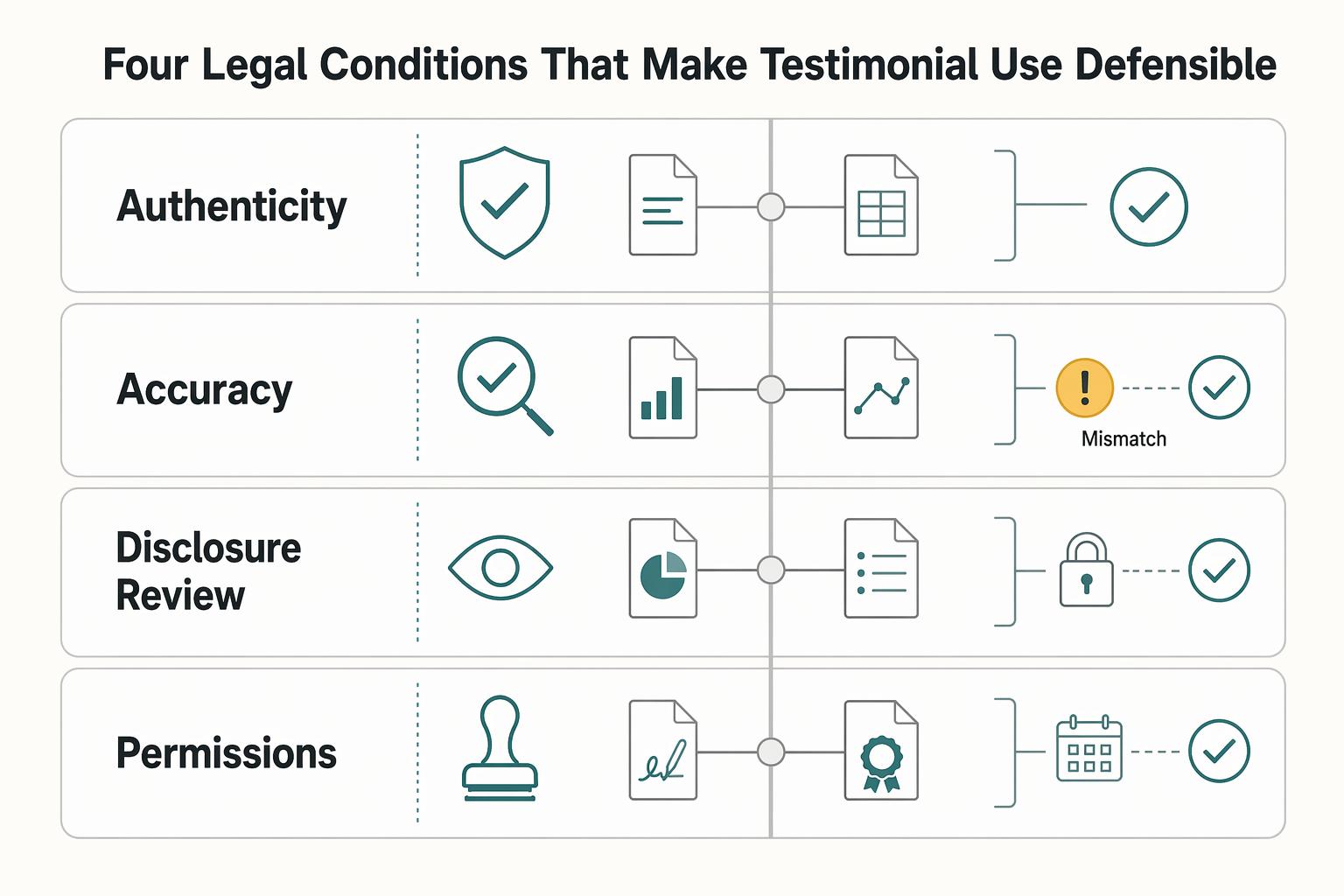
The Four Legal Conditions That Make Testimonial Use Defensible#
Use four internal checks as your release gate. This is not legal advice and does not by itself establish legal compliance, but it gives you a repeatable review that catches avoidable mistakes before publication.
| Check | What to confirm | Record note |
|---|---|---|
| Authenticity | Confirm the person and statement are real | Keep original text, received date, and source channel in one record |
| Accuracy | Compare final copy against the original wording and block edits that change meaning | If edits are substantial, keep both versions with reviewer notes |
| Disclosure review | Identify non-independent relationships | Route disclosure language for legal or compliance review in the same approval record |
| Permissions | Confirm documented consent for each planned reuse location | If channel scope is vague or missing, hold publication pending review |
Run the checks in order because each one depends on the one before it:
- Check 1, authenticity: confirm the person and statement are real. Keep original text, received date, and source channel in one record.
- Check 2, accuracy: compare final copy against the original wording and block edits that change meaning. If edits are substantial, keep both versions with reviewer notes.
- Check 3, disclosure review: identify non-independent relationships and route disclosure language for legal or compliance review in the same approval record.
- Check 4, permissions: confirm you have documented consent for each planned reuse location. If channel scope is vague or missing, hold publication pending review.
The order matters. If authenticity is weak, there is no point polishing disclosure language. If permissions are unclear, final copy quality does not fix that gap.
Track every item in one row with required fields: authenticity, accuracy, disclosure, permissions, reviewer name, and review date. Do not allow blank fields. An incomplete row is a hold, not a pending publish.
To reduce rework, add one line of reviewer reasoning for each field. Keep it short, but specific enough that another reviewer can understand the call without reopening every source artifact.
Watch for the common failure pattern: a quote starts clean, then changes across channels and loses fidelity to the original. The fix is version-control discipline. Keep a canonical approved copy and require channel variants to map back to it.
Another failure pattern is detached evidence. If your evidence set includes unrelated files or unlabeled screenshots, pause and escalate before release. The gate is strongest when records tie directly to the testimonial under review.
Once the records are organized, this gate can run quickly per item. Speed comes from structure, not skipped checks.
Build Your 30 Minute Testimonial Evidence Pack#
A testimonial is more defensible when a reviewer can confirm authenticity, accuracy, disclosure, and permission in minutes. Build one evidence pack per testimonial and keep it complete enough that someone outside the original project can validate it quickly.
| Pack part | What to include |
|---|---|
| Capture file | Original client language, date received, source channel, and whether it began as a consumer review or direct testimonial |
| Rights file | Signed testimonial release clause, approved name and logo scope, and any NDA reuse limits |
| Compliance file | Material connection disclosure text, incentive log for incentivized reviews, and final approved version history |
| Verification checkpoint | Owner sign-off that claims are current and aligned with disclosure and accuracy standards before publication |
Use a simple four-part pack:
- Capture file: original client language, date received, source channel, and whether it began as a consumer review or direct testimonial.
- Rights file: signed testimonial release clause, approved name and logo scope, and any NDA reuse limits.
- Compliance file: material connection disclosure text, incentive log for incentivized reviews, and final approved version history.
- Verification checkpoint: owner sign-off that claims are current and aligned with disclosure and accuracy standards before publication.
Treat retrieval speed as a control. If someone asks for proof, you should not have to search multiple inboxes or chat threads. Keep the pack where your team can access it under normal access controls, and use consistent naming so files are easy to locate.
Add a short index note at the top of each pack:
- What statement is being used.
- Where it will appear.
- Which version is approved.
- Who approved publication.
- Where disclosure text appears.
This index keeps handoffs clean when the original reviewer is unavailable.
Include legal anchors in the same pack so reviewers do not lose context: 16 CFR Part 465 for the FTC rule on consumer reviews and testimonials, and 16 CFR Part 255 for endorsement and testimonial guides. The guides are advisory, and proceedings can still be brought under the FTC Act for practices explained in the Guides.
Run a quick retrieval drill before launch. Ask someone who was not involved to find the original wording, permission proof, disclosure text, and final approved version. If they cannot do it quickly, the pack is not ready.
A common failure mode is publishing from a screenshot or DM with no clear consent chain. This happens when teams rush a campaign launch and assume a positive message equals permission. If consent lineage or version history is unclear, hold publication until the pack is complete.
A strong evidence pack does two jobs: it helps reduce legal risk and cuts review time on future reuse because the proof is already organized for the next channel.
Get Client Consent Without Breaching NDA or Confidentiality#
Check permission before you draft final promotional copy. Before you share testimonials or endorsements, confirm your legal agreements allow that use.
Start by confirming where confidentiality obligations live. They may appear in a separate NDA or in a confidentiality provision within an engagement letter. New confidentiality requests can also arise during an engagement, so treat them as new approval checkpoints even when earlier approvals exist.
| Consent level | Use when | Publish only if |
|---|---|---|
| Named testimonial | Client is comfortable being identified | Active NDA or engagement confidentiality terms permit identified public use |
| Anonymized testimonial | Client allows non-identifying use | Legal agreements permit testimonial use in non-identifying form |
| No testimonial | Terms are restrictive or unclear | You do not publish |
If testimonial use is expected, define the permitted use in the governing agreement. Keep it specific so you can match approval scope to the final copy.
When you ask for consent, keep the request concrete. Share the exact wording and planned use so you do not exceed approved scope.
Use this pre-publish check every time:
- Reconfirm that the latest NDA or engagement confidentiality language permits this use.
- Check whether any new mid-engagement confidentiality request changes what you can publish.
- Verify that final copy matches the approved scope.
- Hold publication if contract terms and approval scope do not align.
If identified publication is not permitted, do not publish identifying testimonial content.
In some professional contexts, existing confidentiality rules may already make separate NDA provisions unnecessary.
One practical discipline prevents many mistakes: keep consent artifacts next to the final copy, not in a separate contract archive. Reviewers should be able to verify approval scope and publish text in one place before launch.
Use Contract Clauses to Prevent Future Disputes#
Even after consent, disputes can start with unclear contract language. Tighten the contract before publication to reduce later conflict.
Set baseline rights in the MSA and, if you use SOWs, put campaign-specific permissions there. That split keeps recurring terms stable while letting each campaign define scope more precisely.
One sample MSA table of contents separates confidentiality, indemnification and insurance, limitation of liability, term and termination, and dispute resolution into distinct sections. That gives each risk topic a clear home.
| Clause area | Contract home | Decision to lock before publish |
|---|---|---|
| Confidentiality | Section 9 | What information is treated as confidential and how it can be used |
| Term and Termination | Section 14 | When the MSA term ends and how termination is handled |
| Limitation of Liability | Section 13 | How liability is limited if a publication dispute starts |
| Indemnification and Insurance | Section 12 | How indemnification and insurance responsibilities are allocated |
| Dispute Resolution | Section 15 | Which dispute-resolution process applies |
Use the table as a drafting checklist. If one row is vague, expect friction once a campaign is live and timeline pressure is high.
Pre-publish checkpoint:
- Confirm the active MSA includes confidentiality, limitation, indemnification, termination, and dispute-resolution sections.
- If used, confirm the current SOW grants permission for this campaign use.
- Confirm approved campaign wording matches what will be published.
- Hold publication if MSA terms and SOW permissions conflict.
Conflict handling should be explicit. If MSA language and SOW language point in different directions, freeze publication until the conflict is resolved in writing.
Keep contract and evidence records connected. A reviewer should be able to open one pack and trace the source text, approval scope, final copy, disclosure text, and channel use. Fragmented records increase the risk of missed follow-up actions when a dispute arises.
A small investment here can save expensive cleanup. The goal is not perfect paper; it is to prevent predictable disputes when facts, timelines, and channel pressure collide.
Handle Incentives Affiliations and Disclosures Correctly#
Incentives and affiliations raise the risk level immediately. Move those items to high scrutiny and resolve disclosure before publication.
The FTC Rule on the Use of Consumer Reviews and Testimonials under 16 CFR Part 465, effective October 21, 2024, addresses deceptive and unfair conduct involving reviews and testimonials. It prohibits selling or purchasing fake reviews or testimonials, including buying positive or negative reviews, and knowing violations can lead to civil penalties through court action.
| Scenario | Primary risk | Publish rule |
|---|---|---|
| Payment tied to a positive or negative outcome | Review buying | Do not publish and stop campaign setup |
| Reviewer is an employee, affiliate, or other insider | Hidden relationship | Publish only with clear relationship disclosure |
| Negative feedback is filtered out or blocked | Review suppression | Halt and escalate for legal review |
| Presentation around the quote could mislead readers | Deceptive presentation | Remove or correct misleading elements before publication |
Treat disclosure as a release condition. It is not design decoration or optional copy polish. If a relationship could matter to a reasonable reader, say it clearly so readers can understand the context.
Plain language works better than legal phrasing. The goal is reader understanding at the point of exposure, not a dense disclaimer that buries context.
Keep this non-negotiable rule: if disclosure hurts conversion, publish with disclosure anyway or do not publish at all. Weakening disclosure to protect performance creates avoidable risk and undermines trust in your own review process.
Use this checkpoint before launch:
- Confirm whether payment, affiliate status, employment, or insider ties exist.
- Confirm compensation is not structured as payment for positive or negative sentiment.
- Confirm disclosure text is attached to the final approved version.
- Confirm no review suppression behavior or other deceptive review practices exist in the publishing path.
Document who made the disclosure call and when. That small note matters later if questions arise about why one testimonial required disclosure language and another did not.
A truthful quote by itself is not enough. Relationship clarity, incentive boundaries, and documented approvals are what make testimonial use defensible under pressure.
Publish Controls for Website Proposals and Social Posts#
Keep one approval baseline across channels. A testimonial should not become a new legal object every time it moves from a website block to a proposal PDF or a social post.
The FTC final rule on consumer reviews and testimonials under 16 CFR Part 465 and RIN 3084-AB76 prohibits the sale or purchase of fake reviews and testimonials. The FTC says the rule allows the agency to seek civil penalties against knowing violators. The rule also prohibits creating company-controlled review websites that falsely appear independent, certain review suppression practices, and selling or purchasing fake indicators of social media influence.
| Channel | Control to enforce | Block publication when |
|---|---|---|
| Homepage testimonial module | Use final approved claim and disclosure text | Copy changes without approval |
| Proposal PDF | Keep claim language aligned with approved version | Claim language deviates in a way that could mislead |
| Social clip or post | Attach clear disclosure labels when incentives or affiliations exist | Disclosure is removed for brevity or design |
| Review-style landing page | Clearly state who controls the page and how content is curated | Presentation resembles an independent review site when it is company-controlled |
A practical execution rule is to keep one canonical approved version and derive channel variants from it. If a variant cannot map back cleanly, it needs review.
Use a pre-publish quality check for each channel package:
- Validate claim wording against the approved version.
- Validate disclosure placement and readability.
- Validate that context and formatting do not create a misleading impression.
- Validate that page presentation does not mimic an independent review venue when it is company-controlled.
These checks catch the edits most likely to slip through during launch pressure: trimmed disclosure, embellished results language, and presentation choices that change user interpretation.
Keep the final approved copy and disclosure records together so each channel can pull the current version.
If a tactic depends on suppressing critical feedback or inflating social influence signals, stop publication. Short-term lift is not worth downstream legal and reputation risk.
Cross Border Checks When Client Country Rules Conflict#
Cross-border publication is easier to manage when you track approvals by jurisdiction. One global approval line can miss differences between client location and audience location.
Start with the U.S. baseline file, then run two geographic checks for each launch: where the client is based and where your audience will see the claim. Keep those approvals in separate rows so assumptions do not get merged.
| Jurisdiction row | Baseline reference | Local check to complete | Recordkeeping note | Escalation contact |
|---|---|---|---|---|
| Client country | U.S. baseline file plus internal standard | Check for country-specific requirements or restrictions that affect approval scope | Record where final approval artifacts are stored | Named reviewer for that country |
| Target market country | Same baseline set | Check whether market-side requirements differ from client-country assumptions | Record how records stay retrievable under policy | Named regional contact |
| Program or sector overlay (if applicable) | Same baseline set | Check whether additional program-specific rules apply | Record document owner | Named specialist reviewer |
Set one conflict rule in policy language: when standards diverge, escalate for counsel review and document the approved route for that specific country and program. Treat this as a control decision, not a claim that one statute automatically overrides another.
Form 1116 is a useful administrative analogy. It requires separation by income category and separate country or territory lines instead of pooling everything into one entry. Your approval log can follow that structure.
Record location and retrieval ownership matter as much as the approval itself. DOJ testimony presented on February 25, 2016 emphasized the need for timely, lawful access to electronically stored information for criminal and civil enforcement. It also noted that providers increasingly store data outside the United States. If your records are stored in another country, assign an escalation owner who can retrieve them quickly.
Use an explicit reuse caveat in policy text: approval in one country, market, or program does not auto-approve reuse elsewhere. Teams remember this better when the rule appears directly in the checklist they use before launch.
Use this cross-border decision sequence:
- Confirm client-country requirements against baseline.
- Confirm target-market requirements against baseline.
- Confirm whether sector or program overlays apply.
- Escalate conflicts for counsel decision and document the approved route.
- Record owners, artifacts, and retrieval path.
That keeps the review practical while still respecting jurisdiction differences.
Red Flags That Trigger Legal Review Before Publication#
Some issues are not editing tasks. Treat them as hold triggers and escalate before launch.
| Red flag | Action |
|---|---|
| Outcome claims without enough context | If the presentation could mislead readers, revise framing or hold |
| Unverifiable or altered review identity | Hold publication until source integrity is clear |
| Unresolved permission or confidentiality concerns | Escalate before use |
| Pressure to suppress critical feedback | Treat this as immediate legal review |
| Incomplete evidence pack retrieval | Hold until records are complete and retrievable |
The FTC Rule on the Use of Consumer Reviews and Testimonials has been in effect since October 21, 2024. It authorizes courts to impose civil penalties for knowing violations. A red flag does not automatically prove a violation, but it does justify a pause and review.
Use this pre-publication sequence:
- Outcome claims without enough context: if a testimonial highlights exceptional results, check whether the presentation could mislead readers. If yes, revise framing or hold.
- Unverifiable or altered review identity: if identity cannot be verified, or if wording appears changed in a misleading way, hold publication until source integrity is clear.
- Unresolved permission or confidentiality concerns: if permission to use a testimonial is unclear or confidentiality risks are unresolved, escalate before use.
- Pressure to suppress critical feedback: treat this as immediate legal review. The FTC has stated that fake, false, or deceptive reviews and testimonials harm consumers and compliant competitors.
- Incomplete evidence pack retrieval: if you cannot produce a full evidence pack promptly, hold until records are complete and retrievable.
Add ownership to each red flag. Someone should be clearly responsible for closing it, with a target date and required proof. Undefined ownership can cause holds to linger and then get bypassed late.
Red-flag discipline should be visible to leadership. If teams know launch can proceed despite unresolved flags, the checklist becomes cosmetic. If teams see consistent holds until closure, behavior can change quickly.
The standard is simple: unresolved red flag means no publish. For adjacent messaging guidance, see The Best Tools for Public Relations (PR) for Freelancers.
Conclusion#
Safe testimonial use comes down to execution discipline. Publish only when the statement is authentic, accurate, clearly approved for the intended use, paired with relationship disclosure where required, and supported by records that are easy to retrieve.
Under the FTC final rule at 16 CFR Part 465 (RIN 3084-AB76), your controls should block prohibited conduct. That includes selling or purchasing fake consumer reviews or testimonials, buying positive or negative consumer reviews, certain insider testimonials without clear relationship disclosure, certain review suppression practices, and fake indicators of social media influence.
Treat approvals as a release gate, not late-stage copy polish. Put checklist-based controls in place now, then hold publication whenever records are incomplete or a red flag remains open.
Keep legal research disciplined. The FederalRegister.gov listing for the FTC Endorsement Guides (88 FR 48092, 07/26/2023) can help with tracking, but it is not an official legal edition. Verify against an official Federal Register edition and log that verification in your records.
Run one live-channel rollout this week with one checklist:
- Confirm authenticity and accuracy.
- Confirm relationship disclosure where needed.
- Confirm permission status and record completeness.
- Pause launch until unresolved issues are fixed.
After one clean cycle, apply the same controls to the rest of your channels and keep the same evidence standard everywhere.
Frequently Asked Questions
Is it legal to use client testimonials if they are true and approved?
Not always. Truth and client approval are important, but they do not fix presentation that could mislead readers. A testimonial can be accurate in wording and still create risk if layout, context, or selective framing suggests outcomes that the underlying statement does not support. Run a quick check before launch: can a reasonable reader distinguish one client outcome from a general promise? If not, revise framing or hold.
Do I need written consent or is verbal approval enough?
Verbal approval can be hard to verify later, so written permission is usually safer for publication decisions. Written records preserve what was approved, who approved it, and where it may appear. If you only have verbal approval, keep status at pending. Ask for written confirmation tied to exact wording and channels.
Can I pay for testimonials and still stay compliant?
Payment requires heightened scrutiny. The central risk is whether the resulting testimonial is false or otherwise deceptive. Because the FTC rule authorizes courts to impose civil penalties for knowing violations, treat paid or incentivized testimonials as high-risk items. If material details are unclear, hold publication until those points are resolved.
Can I publish exceptional client results without misleading readers?
Yes, if you present them as a specific client outcome rather than a promise of what everyone should expect. The risk appears when atypical outcomes are framed as standard performance. California Rule 7.1 commentary states that express guarantees of particular results are treated as false or misleading communication under that rule. Use that as a practical guardrail while still checking requirements in the jurisdictions where you publish.
Can I use testimonials from confidential or NDA-covered projects?
If NDA scope is ambiguous, pause and get explicit permission for the exact public use you intend. When permission remains uncertain, do not publish until scope is clear. If you publish, avoid details that could reasonably reveal identity.
What records should I keep for each testimonial?
Keep a complete file that can be retrieved quickly during review so you can verify the statement used, what was approved, and when approvals were made. As a practical baseline, keep the final approved copy, permission artifacts, and review history. If your team cannot produce that pack quickly, treat it as a launch risk and close the retrieval gap before publication.
How often should I review and refresh testimonial copy?
Review on a fixed schedule and whenever context changes. Recheck before reuse in a new campaign or channel, and recheck when claim language or permissions shift. If you cannot verify the current approved version quickly, retire the testimonial until reapproved.
Try a related tool
Researched and edited by the Gruv editorial team. Gruv builds cross-border billing, payouts, and finance-operations software for global businesses.
Sources
Educational content only. Not legal, tax, or financial advice.
Related Posts

Germany Freelance Visa Application Path for Freiberufler and Gewerbe
Choose your track before you collect documents. That first decision determines what your file needs to prove and which label should appear everywhere: `Freiberufler` for liberal-profession services, or `Selbständiger/Gewerbetreibender` for business and trade activity.
Best PR Tools for Freelancers Who Need a Lean Weekly System
Solo PR work can break down from execution drift, not just from having too few apps. Dropped leads, missed follow-ups, and patchy client updates are common failure points when your weekly routine gets too heavy.

The Freelance Payment Penalty: A Modeled Audit of Platform Fees, FX Spreads, and Payout Delays
The money rarely disappears through a single, easy-to-spot fee. The real loss is stacked. A marketplace takes its commission, a processor adds a charge for international cards, a bank or payment company converts the currency at a spread, a platform holds the funds before release, and a wire sheds a little to intermediaries on the way in. Each layer looks defensible on its own, but the worker feels the combined result as a smaller deposit and a later payday.