
Quick Answer
Start by treating a latin america remote work visa move as a verification workflow, not a regional one-size-fits-all route. Shortlist countries by what you can confirm in official channels, then lock your filing path, core documents, and timing gates before paying for non-refundable travel. In this current source set, Colombia has the clearest immediate checkpoints, while other options stay in a verify-first lane until key details are confirmed.
Working Remotely in Latin America Without Visa Guesswork#
Treat this move as a verification project, not a booking sprint. If you are planning a remote-work move in Latin America, the first practical step is to separate what is clearly supported now from what still needs direct government confirmation before you spend money or lock dates.
The region is not one visa system, and source quality varies a lot by country. Here, the strongest confirmed signals are concentrated in a few South America examples. Coverage in other markets is thinner, so those items belong in the unknown column until you verify them.
Start by using the core labels precisely:
- Remote Work Visa: a practical label for pathways tied to remote income, but not a universal legal title across countries.
- Digital Nomad Visa: a temporary permit to stay while working remotely, often described as 6 to 12 months and sometimes extendable.
- Tourist Visa: short-stay status with narrower permissions. In one Chile source, this includes remote work for foreign employers but not Chilean companies, with 90 days plus a possible 90-day extension and a 180-day yearly cap.
These terms are close, but not interchangeable. That same Chile material also says there is no in-country switch from tourist status to temporary residency. That is exactly the kind of detail that makes assumptions expensive.
A simple decision log will keep you honest as you compare options:
- Confirmed now: the pathway exists, the stated stay window is clear, and any local-work limits are stated.
- Must verify before booking: passport-specific eligibility, the current document list, renewal handling, and whether tourist-to-residency conversion is allowed.
Keep one more caution in view. Public counts of digital nomad destinations do not always match, and publication dates across sources are mixed. Broad totals can help you orient, but they are not decision-grade on their own. Use this guide for the higher-confidence comparisons that are actually supported here, and keep the open items visible until you close them through official channels.
The easiest way to use the rest of this article is to treat each section as a gate. Finish the gate, save the evidence in one place, then move to the next decision. That sequence matters because a common failure pattern is making housing, travel, or timing commitments before the legal details are locked.
That gate-by-gate approach also makes later changes easier to manage. If a consulate page updates, a filing channel shifts, or a document requirement turns out to be location-specific, you can revise the affected gate without rebuilding your whole plan from scratch. The goal is not to create more admin. The goal is to create a trail you can trust when the process becomes time-sensitive.
If you want a deeper dive, read The Global Digital Nomad Visa Index.
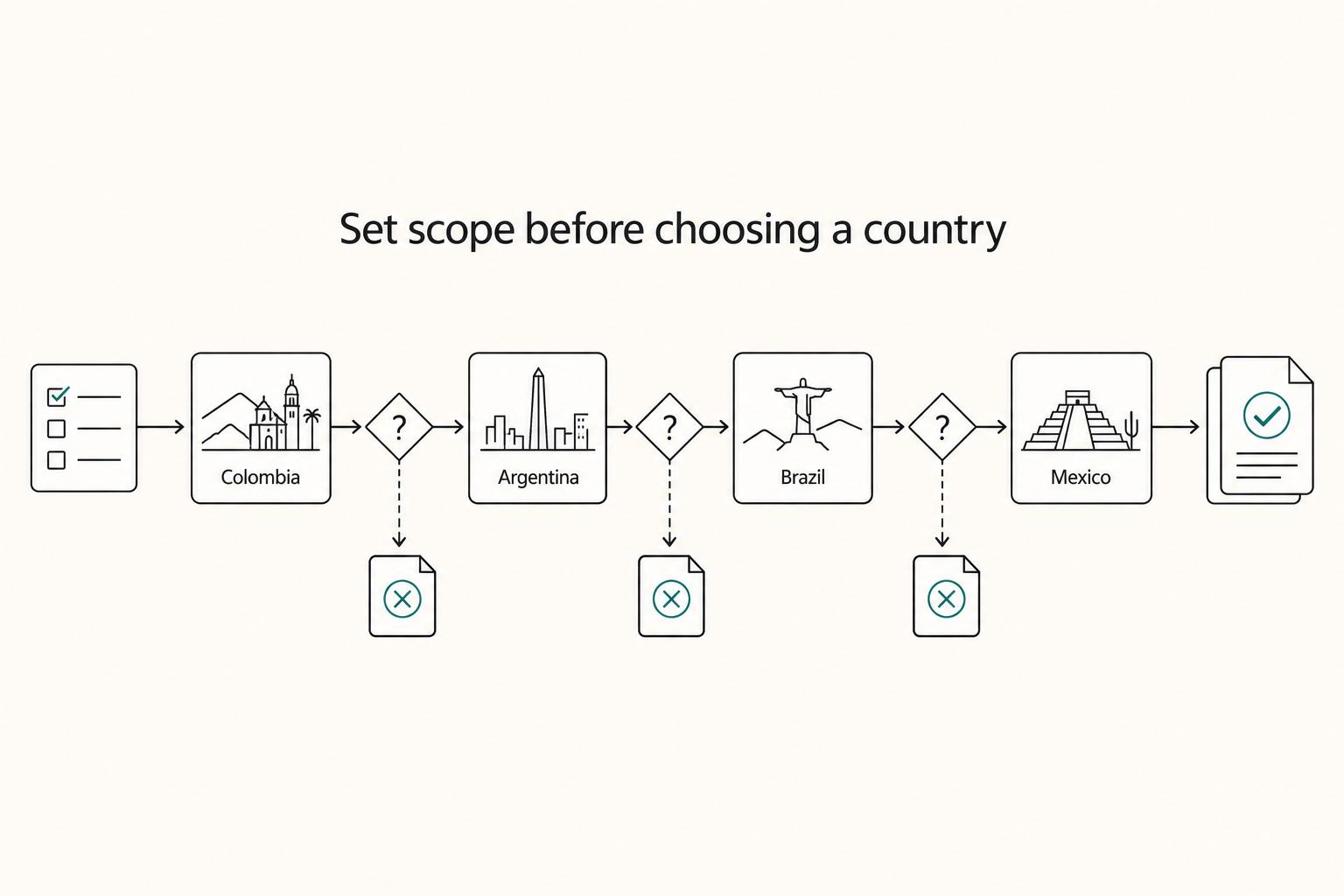
Set Scope Before You Pick a Country#
Start with country scope, not city preference. Legal clarity is the first filter because it controls every later decision.
Regional roundups are useful for orientation, but they are not enough for commitments. Use them to build a shortlist, then confirm the route country by country. If a market does not have a clearly confirmed path in your notes, put it in verify-first status and do not spend against it yet.
Use a scope log like this before you compare neighborhoods, costs, or lifestyle tradeoffs:
| Country | Status now | Why |
|---|---|---|
| Colombia | confirmed | Type V is described as a temporary residency permit, tied to work for foreign companies, and linked to Resolution 5477 of 2022. |
| Argentina | unknown | Confirm program details with the relevant authority. |
| Brazil | verify-first | A pathway is referenced here, but the full country-level detail still needs direct confirmation for your case. |
| Mexico | unknown | Confirm whether an official route exists for this use case with the relevant authority. |
Use one as-of date across your notes, such as 2026-03-14, so mixed update years do not quietly create planning errors. If a source predates that marker, treat it as a recheck trigger rather than a stable input.
This discipline matters because the expensive mistakes usually happen before filing. People often start with a city they want, then discover the route is unclear or more restrictive than expected. A tighter sequence works better: first legal fit, then timeline confidence, then lifestyle fit.
When two sources disagree, do not split the difference. Mark that field as unknown, save the conflicting wording, and move the issue to an official checkpoint. A short list of unresolved questions is much safer than false certainty that forces rework later.
A scope log also turns vague research into a usable decision record. If you come back after a few days and cannot tell why one country looked stronger than another, the research is not ready to support bookings. Write down the exact field that moved a country from unknown to verify-first or from verify-first to confirmed. That simple habit makes it much easier to defend your choice later when you are reviewing flights, lease terms, or filing instructions.
Once the country list is clean, the next question gets narrower and more practical: what does the visa actually let you do?
Know What This Visa Lets You Do and What It Does Not#
Treat this as a work-scope decision before a travel decision. A digital nomad visa or remote work visa is usually a temporary stay path tied to foreign-sourced work, not broad permission to work locally.
In the examples used here, the safer lane is work for an employer abroad or clients abroad. That sounds obvious, but many edge cases start there.
Use this lane test before you apply:
- Who pays you, and where are they based? Foreign employer or foreign clients is the safer fit.
- Who directs your day-to-day work? Some exemptions are framed around control being exercised from abroad.
- Does your employer have a local subsidiary? That can still raise local employment-rights and tax questions.
- Can you pass basic document checks now? Brazil guidance highlights early checkpoints like valid health insurance and a passport with at least six months of validity.
Tourist status is a separate lane. If your plan is a longer stay tied to remote work, entering as a tourist and trying to fix status later adds avoidable risk and rework.
The practical decision rule is simple: if any part of your income could be read as local work, stop and confirm the restriction before you file.
Do a quick self-audit here. Read your contract language, invoice language, and client descriptions together. If those documents describe your work in a way that could be interpreted as local employment, treat that as a blocker until you clean it up or get clarification.
This lane test also gives you a stable way to explain your situation. You want the same basic story to hold across forms, advisor conversations, and any consular contact. Consistency does not guarantee approval, but it does reduce confusion and prevent your own documents from arguing with each other.
It also helps to separate the operational facts from casual shorthand. Saying "I work remotely" may be accurate in normal conversation, but your packet should make clear whether that means salaried employment abroad, independent client work abroad, or another supported arrangement. The more plainly your records show foreign income and non-local work relationships, the easier it is to keep the application in the correct lane.
Compare Argentina Brazil and Colombia on Facts You Can Confirm#
Use a conservative comparison, and only move a country forward when the support is actually there. All three appear in one published roundup, but the depth of usable detail is not the same.
| Country | Visa existence | Base validity window | Renewal possibility | Local-work restriction |
|---|---|---|---|---|
| Argentina | Listed as active in one published roundup | Confirm with the relevant authority. | Confirm with the relevant authority. | General digital-nomad guidance points to foreign remote income and no local employment. Confirm exact wording in Argentine official government channels. |
| Brazil | Listed as active in one published roundup and tied here to VITEM XIV | Up to one year. | One additional year is reported. Confirm the current rule through official Brazilian channels. | General guidance says digital nomad visas do not allow local employment. Confirm exact wording in Brazilian official government channels. |
| Colombia | Has an official digital nomad route. | Confirm with the relevant authority. | Confirm with the relevant authority. | Treat foreign-income scope and local-employment limits as working assumptions until confirmed in Colombian official government channels. |
That table does one important job: it stops you from treating travel roundups like live legal text. High-level summaries are useful, but they are not the same thing as current country-specific rules.
Before you compare climate, rent, or city fit, run the same verification pass for each country:
- Log one official checkpoint per country.
- Confirm the same four fields: the visa exists, the base validity is clear, the renewal path is clear, and the local-work restriction is clearly worded.
- Mark each field as
confirmedorunknownusing one as-of date.
If renewal remains unknown, keep your housing and timeline commitments provisional. Unknowns are not just blanks in a spreadsheet. They are concrete planning risks.
A side-by-side table also protects you from recency bias. The last article you read should not outweigh a dated checkpoint in your own notes. Keep the table current, and treat any stale row as untrusted until it is checked again.
The comparison only works if you hold each country to the same standard. Do not give one country credit for detailed official wording while letting another pass on a broad roundup mention. A strict comparison can feel slower at the start, but it gives you a much cleaner basis for choosing where to apply and what backup plan to keep active.
Related: Moving to Medellin as a Digital Nomad in 2026.
Choose Your Country With Clear Decision Rules#
If you had to choose today, choose certainty first. Lifestyle fit matters, but only after the legal path is real enough to support the move.
Keep Argentina, Brazil, and Colombia in scope, but prioritize the option you can confirm on an official country site this week. That one rule cuts through a lot of noise.
Use this decision order:
| Decision rule | What it means in practice | Action |
|---|---|---|
| Certainty speed comes first | You need to decide quickly | Pick the country where an official source can confirm visa existence, validity, renewal path, and local-work limits in writing |
| Evidence depth beats popularity | A country appears in roundups, but details are thin | Keep it shortlisted, but do not make it your primary plan yet |
| Unclear path requires a backup | Your first choice still has uncertain visa rules, such as Mexico in this dataset | Keep a backup country with more confirmed checkpoints |
| Longer stay is not enough on its own | A country advertises a longer nominal duration | Compare document burden, renewal clarity, and timing risk before choosing |
Colombia has the clearest immediate operational checkpoints: a reported official Cancilleria application form path, bank statements from the last three months, and at least six months of passport validity at application. Argentina and Brazil can stay on the board, but they should remain verify-first choices until those same fields are confirmed directly for your case.
If you need a tie-breaker, check in this order: eligibility fit, whether renewal is reported as possible before expiry, then whether published processing windows are framed as typical rather than guaranteed. If different guides give different figures, treat them as planning ranges and lock decisions to official requirements on filing day.
Response burden is another useful filter. If one route is more likely to trigger follow-up questions for your profile, it may still be workable, but it deserves more time cushion and stricter document prep. Build that into the choice up front instead of discovering it halfway through review.
Your country choice should match your commitment posture too. If you need to move soon, pick the route with the fewest unresolved items. If your dates are flexible, keep a wider shortlist, but do not skip the same verification gates.
A good decision rule should survive stress. If your first-choice country still looks best only when you ignore missing renewal detail, uncertain local-work wording, or an unconfirmed filing path, it is not really your best option yet. The strongest choice is the one that still makes sense after you write the risks down plainly and decide what would happen if each open item stays unresolved longer than expected.
Build the Evidence Pack Before You Touch an Application#
Do the document work before you open the application. A clean evidence pack lowers the odds of delays, inconsistent submissions, and mid-process scrambling.
Build one consistent set of files around four questions: who you are, who you work for, how you are paid, and how you are covered. Country-specific items should stay provisional until the official consular channel for your filing location confirms them.
Set up two folders from day one:
Minimum required packet, for only what the authority explicitly asks for.Credibility packet, for supporting files you can provide if asked, such as documents that explain contract changes, client transitions, or income shifts.
Then assemble the core pack in this order:
- Identity (
Passport)
Keep a valid passport copy with enough remaining validity, and use one canonical version everywhere.
- Work relationship (
Foreign employerorIndependent contractor)
Show remote work for non-local entities through an employment contract, employer letter, client contracts, or business documentation.
- Earnings (
Foreign income)
Provide income proof that matches your work documents, not a separate story.
- Coverage (
Health insurance)
Include insurance evidence for the full period you are requesting.
- Records (
Clean record documents)
Prepare clean-record documents early so they do not become a last-minute blocker.
The common failure mode here is not one dramatic missing file. It is contradiction. Names differ slightly across forms, an employer is described one way in a letter and another way in a contract, or income evidence does not line up with what the application says. Those gaps create avoidable questions.
A simple operating rule helps: use one file-naming pattern, one date format, and one version-control habit across the entire packet. Reconcile entity name differences before you file, not after a reviewer notices them.
Track your verification status in one log tied to the actual filing location:
| Authority | Last check date | What you confirmed | Still open |
|---|---|---|---|
| Destination consulate | YYYY-MM-DD | Current checklist and filing steps confirmed in writing | Anything not confirmed in writing |
| Official Brazilian consular channel, if filing for Brazil | YYYY-MM-DD | Current requirements for your filing location | Any location-specific interpretation |
| Any additional destination authority | YYYY-MM-DD | Items and filing path confirmed in writing | Any unclear renewal or scope language |
Before you submit, run one full consistency pass across all core files in a single sitting. Check names, dates, role descriptions, payer identity, and document validity while the whole packet is in front of you. That is the easiest moment to catch conflicts.
Also treat the pack as a living record, not a one-time upload set. During review, you may need to clarify, resubmit, or explain a change. Good structure at the start makes follow-up faster and less error-prone.
Another useful test is to read the packet in the order a reviewer likely will: identity first, work basis next, then income, then coverage, then any supporting records. If the narrative gets less clear as you move through the file set, stop there and fix the break. A strong packet should feel like the documents were prepared to answer the same question from different angles, not collected from different months without reconciliation.
Keep short notes for any item that could otherwise look inconsistent. If a contract was updated, if a client changed names, or if the payer shown on statements differs from the brand name on your agreement, save the document that explains the relationship and keep it ready in the credibility packet. You do not need to overload the initial submission, but you do want the explanation ready before anyone asks for it.
Turn your country shortlist and document packet into an execution plan with the Digital Nomad Visa Planner.
Execute a 90-Day Timeline to Reduce Last-Minute Risk#
A 90-day plan helps because it forces sequence. It is not a processing-time guarantee, and it only works if each phase has a clear checkpoint before the next spend or commitment.
Use it as a control plan. Keep one clear owner for every file, response, and version so nothing drifts when follow-up starts.
| Window | What to do | Checkpoint before you move on |
|---|---|---|
| Days 90-61 | Confirm the Colombia Visa V Nomadas Digitales path and whether the SITAC Visa Application Portal is the filing channel you will use. Start collecting passport, health insurance, proof of employment or client work, and bank statements. | One filing path is selected, one filing channel is confirmed, and names and dates are consistent across documents. |
| Days 60-31 | Finalize and submit through your confirmed channel. Track every clarification request in one timeline: date received, exact request, what you sent, and current status. Resolve income-threshold conflicts before filing, since reported minimums in this research set do not match. | Submission proof is saved, and no contradiction remains between forms and attachments. |
| Days 30-8 | Keep plans refundable, not fixed. Maintain backup travel and housing dates while the case is open. If you receive an information request or inadmission notice, pause non-refundable payments until the issue is resolved. | A key legal-status checkpoint is confirmed in writing before you commit to non-refundable costs. |
| Days 7-0 | Re-check your document set: passport, health insurance, and remote-work proof. Carry approval documents and plan for the mandatory Visa Registration Form step with Migracion Colombia after approval. | One travel folder holds the final document set you will present. |
Version drift is a common source of delay once follow-up begins. Even when nothing major is missing, requirements can vary by reviewer, and an outdated attachment can create a new round of questions. Keep one canonical folder, archive anything you replace, and log exactly what you sent and when.
Tax timing belongs in the plan too. If your stay may exceed 183 days within a 365-day period, get tax advice before departure because that can trigger tax residency and materially change your tax position.
The timeline is also a handoff tool. If someone helps with legal review, document prep, or travel planning, write down who owns each task and what done means for that step. Quiet ambiguity is what turns a normal case into a last-minute scramble.
Used well, the timeline becomes more than a checklist. It becomes a record of what changed, why it changed, and which checkpoint unlocked the next action. That context is useful if the filing path shifts or another reviewer asks for clarification later.
One practical benefit of sequencing the move this way is that it protects your attention. When document collection, filing, travel planning, and arrival logistics all blend together, small legal tasks get buried under urgent life admin. The timeline creates separation: legal confirmation first, submission next, then travel commitments, then arrival steps. That order does not remove uncertainty, but it does keep uncertainty from spreading into every part of the move at once.
Avoid the Mistakes That Trigger Delays or Rejection#
Most avoidable delays start before you submit. They usually come from assumptions, inconsistent files, or commitments made too early.
The highest-risk assumption is entering on a Tourist Visa and planning to convert later. Do not rely on that path unless the relevant authority confirms it in writing for your exact case.
The distinction here is practical. Tourist status is short stay. The digital nomad route is meant for longer stays tied to foreign income. If your setup could be interpreted as local work, pause and confirm eligibility before you submit anything.
Run one pre-submit check in a single sitting:
- Passport validity: confirm at least six months remaining on the passport you will file.
- Income evidence: include three months of bank statements plus matching employment or freelance records.
- Consistency: names, amounts, and dates must align across forms and attachments.
- Document readiness: confirm whether foreign-issued documents need apostille or legalization.
- Payment records: keep fee receipts in your main folder in case review asks for them.
Once filed, response speed matters. A reported range is 10 to 30 business days, but it is not guaranteed, and follow-up requests can arrive while the case is under review. Reply quickly with exactly what was requested, and log what you sent and when.
Community posts can help you spot common questions, but they are not final authority. For final confirmation, use official government channels, then save the date and wording you relied on.
One small but useful habit is to keep a plain-language summary next to the formal documents. A short note for each request, action, and submission makes it easier to check that your narrative still matches your files when the process gets busy.
It also helps to separate delay risks from rejection risks. A missing receipt, stale upload, or mislabeled file can create delay even if your eligibility is otherwise fine. By contrast, unclear work scope, unsupported income evidence, or a mismatch between your stated visa basis and your documents can go deeper. If you know which issues are mainly administrative and which issues affect eligibility, you can prioritize fixes without panicking or overcorrecting.
Plan Your First 30 Days After Arrival#
Your first month should focus on compliance, not optimization. Get the legal record clean first, then work through housing, banking, and the rest of daily life.
Use one master folder from day one and update it whenever anything changes:
- Visa approval record and a clear copy of your Passport identification page
- Active Health insurance proof covering accidents, hospitalization, and repatriation
- Proof of remote employment or business activity for non-Colombian employers or clients
- Proof of Foreign income, including bank statements from the last three months showing consistency
- Supporting documents that match your submitted visa basis
Run two tracks in parallel during the first 30 days:
- Immigration compliance, meaning deadlines, registrations, and document quality checks
- Life setup, meaning housing, banking, and daily logistics
Keeping those tracks separate helps you avoid the common mistake of letting a housing or banking delay interfere with a legal requirement.
For Colombia, the key early checkpoint is within 15 days of arrival: register your visa and apply for the Cedula. Before each upload or appointment, do a quick document check so names match your passport, dates align across files, and resubmission is easy if requested.
If you are paid by overseas clients, keep a payer log with payer, country, amount, date, and contract or invoice reference. Review it regularly to make sure your actual work pattern still matches the visa basis you used.
Think of the first month as a stabilization period. You want your legal record and your working record to stay consistent while the rest of your setup comes together. A simple same-day update habit helps: whenever a document changes, update both the master folder and the verification log.
Another helpful arrival habit is to separate proof you submitted from proof you may need later. Keep one place for approval records, registration records, and the exact files that supported your visa basis. That way, if a later check asks you to restate your work setup or show continuity of foreign income, you are not reconstructing your record from email threads or old downloads.
Handle Unknowns Without Freezing Your Move#
Unknowns are not a reason to stop. They are a reason to quarantine risk so it does not leak into bookings, deadlines, and legal assumptions.
Use a two-column log for each country: what is known from official or high-confidence material, and what still needs verification.
| Decision item | Known from official or high-confidence source | Unknown and must verify |
|---|---|---|
| Legal text quality | Verified against an official Federal Register edition or the linked official PDF record on govinfo.gov | FederalRegister.gov web summary or XML view, social post, or private guide only |
| Freshness checkpoint | A clear current-date marker is captured in your notes | No current-date marker, or only an older update |
| Scope confidence | The source clearly supports the exact rule you plan around | The source is general, indirect, or outside your exact use case |
| Commitment risk | Refundable bookings and flexible timelines | Non-refundable spend tied to unverified assumptions |
Source quality is your hard filter. The authoritative excerpts are U.S.-immigration-focused, so many regional remote-work visa specifics still remain unconfirmed. If a claim is not clearly official and current, keep it in the unknown column.
Flag these items early:
- Complete fee schedules for your exact case
- Reliable processing timelines for travel planning
- Full tax consequences across your stay pattern
- Local-work limits and renewal conditions tied to status
Set a decision gate near departure. If major unknowns are still open, switch to the backup country where the route is clearer in authoritative materials. Keep the risk posture explicit: no major non-refundable commitments while core conditions remain unverified.
Unknowns become manageable when they have owners and deadlines. Assign each open item to a specific checkpoint, capture the response source, and close the loop in your log. The goal is not perfect certainty. The goal is to remove the ambiguity that can break legal status, filing viability, or major financial commitments.
A useful mindset here is to treat unknowns as inventory, not anxiety. Each unresolved item should sit in one place with a status, a source target, and a clear effect on your plan. Some unknowns only affect convenience. Others block filing or make a planned arrival date unsafe. Once you sort them by impact, you can keep moving on low-risk tasks without pretending the legal picture is clearer than it is.
Make the Next Move With Confidence#
The cleanest way to move forward is to verify first, then optimize. Choose the country you can confirm fastest, then compare cost, city fit, and quality of life once the legal path is stable enough to trust.
Keep tourist status and long-stay remote-work permission in separate lanes. Colombia stands out as the clearest starting point because the operational checkpoints are more usable right now. Argentina and Brazil can stay in scope, but keep them in verify-first mode until the remaining country-specific details are confirmed for your profile.
Use this closeout checklist before you lock travel:
- Confirm the exact program and filing channel.
For Colombia, applications are submitted online through the Cancilleria platform, with processing often cited as 10 to 30 business days. For Argentina and Brazil, do not rely on secondary summaries until the current route and terms are confirmed through official channels for your filing location.
- Build one consistent evidence pack.
Keep passport validity above six months and proof of foreign income ready. For Colombia, support can include the last three months of bank statements plus matching work records. Make sure names, dates, and amounts align across all files.
- Run your 90-day timeline around legal checkpoints.
Treat missing documents and unresolved eligibility questions as blockers early. Keep fee-payment receipts, and respond quickly if reviewers request more information.
- Lock flights and long-term housing only after the legal checkpoints clear.
Many avoidable delays come from documentation gaps or inconsistencies, not one dramatic issue.
One practical item to start early is document formatting and legalization. For Colombia, foreign-issued documents may require certified Spanish translation and apostille or legalization, so do not leave that step to the end.
If you manage cross-border income, keep a simple monthly recordkeeping routine with invoices, payment confirmations, contract updates, and tax documents in one dated folder. That makes renewals, clarification requests, and future country moves easier to support.
If you want one concrete next step today, update your log: mark each target country as confirmed, verify-first, or unknown; write the open legal questions in plain language; and tie each question to one official checkpoint. That one move turns uncertainty into a practical execution plan.
The article's core rule is simple: do not pay for certainty you do not have yet. Verify the route, build the packet, run the timeline, and only then convert research into commitments. That keeps your move grounded in documents you can support rather than assumptions you may have to unwind later.
You might also find this useful: Buenos Aires Digital Nomad Guide for Remote Professionals (2026).
Before you lock flights or housing, do one last route sanity check with the Digital Nomad Visa Cheatsheet.
Frequently Asked Questions
Does Latin America have one unified remote work visa?
No. There is no single region-wide remote work visa structure, and requirements vary by country. Treat each destination as its own legal process.
Which countries in South America currently have clear digital nomad visa pathways?
Brazil and Colombia are the clearest documented pathways. Brazil is tied to VITEM XIV, and Colombia has an official digital nomad route for remote workers. The same level of confirmed detail is not yet available for Argentina — verify directly before treating it as a clear pathway.
Is the Argentina digital nomad visa stay window confirmed?
No. A supported stay length or renewal rule for Argentina has not been confirmed. Verify current validity and renewal terms through official channels before making non-refundable commitments.
How long is the Brazil Digital Nomad Visa valid under VITEM XIV?
The supported window here is up to one year, with an option to renew for one additional year. Use that as a planning range, then confirm current eligibility and renewal conditions with official Brazilian immigration or embassy guidance before filing.
Can I work for local clients on a Digital Nomad Visa?
Do not assume one answer across the region. In the Brazil evidence, qualification is tied to foreign-sourced income, while local employment is described as a separate employer-sponsored work visa and residence route. If local client work is part of your plan, get written clarification for your exact country and status.
What documents are usually required before I apply?
Two recurring requirements are proof of income from outside the host country and valid health insurance. Start with those, then match your final checklist to the official requirements for your filing location. Because requirements can change, verify details on official embassy or immigration websites before applying.
What should I verify before I book flights or long-term housing?
Confirm the exact visa pathway and current document checklist first. Keep fee details, timing assumptions, and local-work limits in an open risk list until they are confirmed through official channels. Use refundable bookings until those unknowns are closed.
Try a related tool
Researched and edited by the Gruv editorial team. Gruv builds cross-border billing, payouts, and finance-operations software for global businesses.
Sources
Includes 2 external sources outside the trusted-domain allowlist.
- federalregister.gov/documents/2024/01/31/2024-01427/us-citizensh...trusted
- travel.state.gov/content/travel/en/international-travel/Inter...trusted
- uscis.gov/es/book/export/html/68600trusted
- eduwik.com/visa-rules-for-remote-work-in-latin-americaexternal
- lincolnglobalpartners.com/argentina-digital-nomad-visa-your-complete-g...external
Educational content only. Not legal, tax, or financial advice.
Related Posts

The 2026 Global Digital Nomad Visa Index for 50+ Countries
Start with legal fit, not lifestyle filters. The practical order is simple: choose a route you can actually document, then decide where you want to live. That single change cuts a lot of wasted comparison work and stops you from falling in love with places that were never a real filing option.
Moving to Medellin as a Digital Nomad in 2026
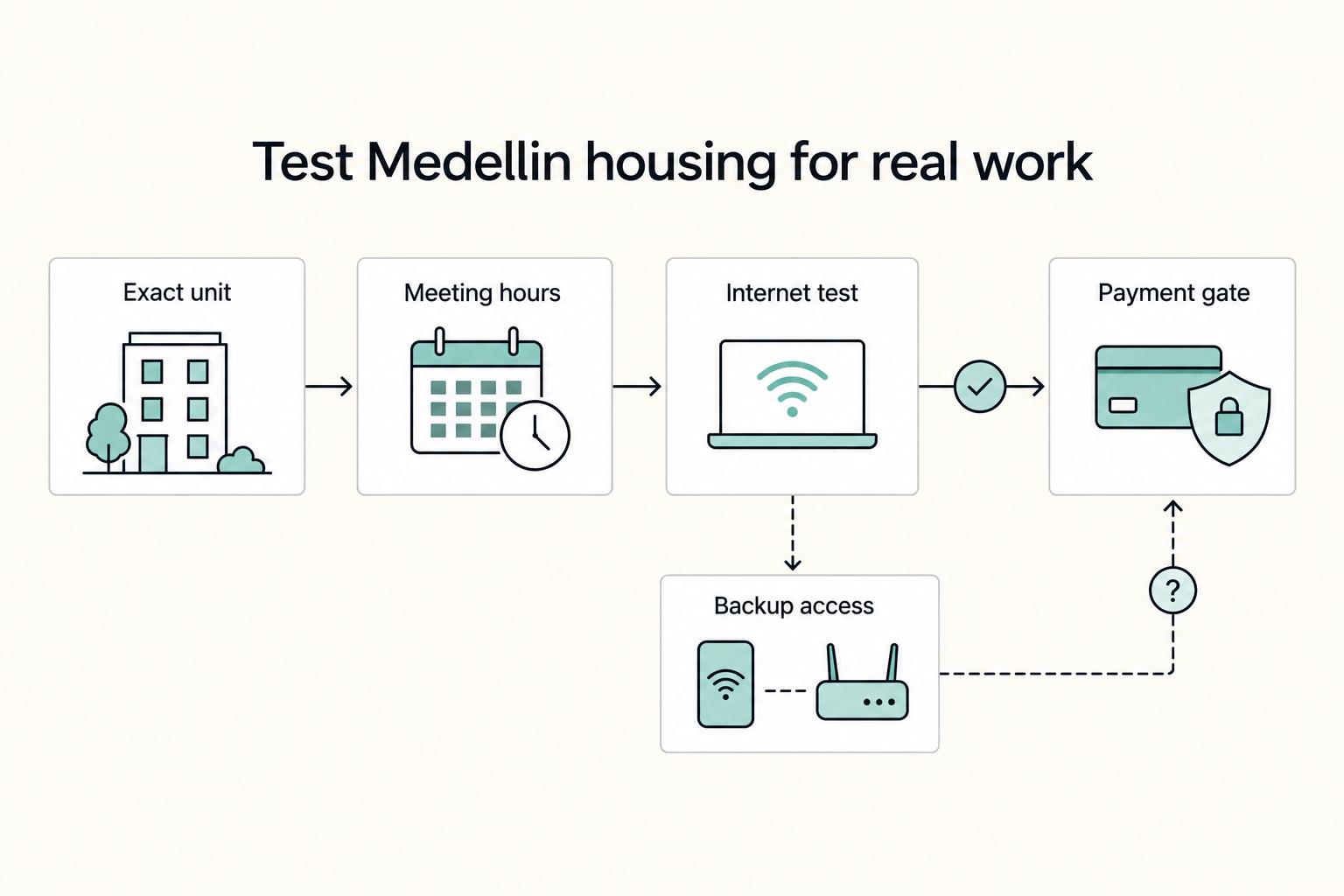
If you want Medellin to work on the first try, make one written decision before anything else: are you testing a short stay, or trying to build a longer base in Colombia? The city can feel easy on the surface, but the move usually works when paperwork, timing, and housing line up in that order.

Buenos Aires Digital Nomad Guide for Remote Professionals (2026)
You can make Buenos Aires work well if you treat the move as a verification phase first, not a lifestyle commitment. How well it works depends less on the city's reputation than on your execution. Confirm your entry path, keep your documents ready, and make sure your money access can survive a bad week.