
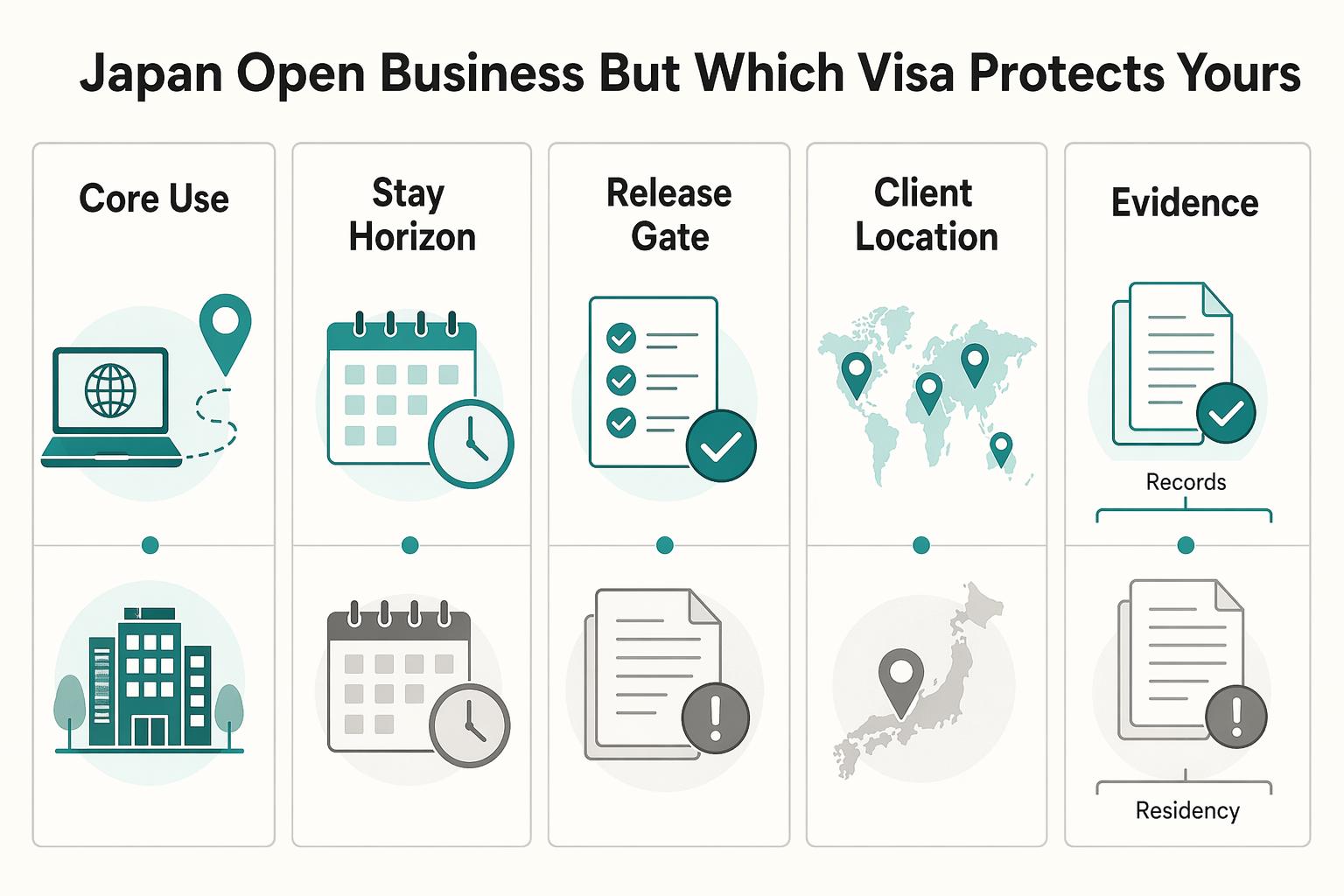
Quick Answer
Choose by where and how your business will run in Japan. Use the digital nomad path for a limited test period when income remains outside Japan, and assess Business Manager when local operations become central. The article recommends a sequence: define your 1-, 3-, and 5-year mission, verify hard gates, then build your document pack. For longer-stay planning, a Certificate of Eligibility is treated as a core checkpoint, while the digital nomad filing flow is framed through a Japanese embassy or consulate.
Japan Is Open for Business. But Which Visa Protects Yours?#
Treat this as an operating decision, not a travel decision. The right path usually becomes clear early. Check four things first: where your clients are, how long you want to stay, how much setup you are willing to take on, and where compliance risk starts to rise.
The Digital Nomad Visa is the short-term path for eligible remote workers earning from outside Japan. The Business Manager Visa is an alternative route that can fit longer-term plans, with a much heavier investment and documentation load.
A practical way to frame the choice: if Japan is a limited test window while your business stays based abroad, start by checking whether the digital nomad path fits. If Japan is where you plan to build a durable base, look at the business route early, even if the setup is more involved.
| Decision point | Digital Nomad Visa | Business Manager Visa |
|---|---|---|
| Core use case | Temporary stay while working remotely | Longer-term route with heavier investment setup |
| Stay horizon | Up to six months | Confirm the current stay period from the official source |
| Income / investment gate | 10 million JPY annual income appears in current non-official guidance | Confirm the current investment threshold from the official source |
| Client-location fit | Aligned with income from clients outside Japan | Review against your Japan operating plan and current rules |
| Setup burden | Evidence-heavy application flow | Higher investment and documentation burden |
| Key document signal | Application is typically filed via a Japanese embassy or consulate in your home country | COE is an important document for longer-term routes |
Two details matter from the start. Have prior-year bank statements and tax returns ready to show income stability. Also simplify your money trail where you can, because funds spread across too many accounts often make verification harder.
Keep that lens in mind. First, match the visa to your 1-, 3-, and 5-year plan. Then build the document set and filing approach that fits that decision.
For a step-by-step walkthrough, see Japan Digital Nomad Visa: A Guide to the New 2026 Program.
Before You Compare Visas, Define Your Mission: What's Your 1, 3, and 5-Year Japan Plan?#
Start with timeline, not paperwork. Visa details only help once you know what Japan is supposed to do for your business.
Use this section as a planning framework only. It does not confirm current visa eligibility, capital thresholds, renewal rules, tax outcomes, or status-change options.
Classify your mission in plain language#
Think of your 1-year plan as a short trial: a temporary stay while your core business setup remains outside Japan. Think of your 3-year plan as a build phase: local business setup may start to matter if Japan becomes part of how you deliver, sell, or operate. Think of your 5-year plan as a continuity plan: long-horizon residence and operating stability may matter more than short-term convenience.
Use this decision matrix before you compare visa details#
| Planning horizon | Your practical goal | Client location | Revenue model | Operational setup | Tax posture | Renewal/continuity need | DN vs BM direction |
|---|---|---|---|---|---|---|---|
| 1 year | Test day-to-day fit without rebuilding everything | Mostly outside Japan | Existing remote model | Minimal local footprint | Model with a Japan-qualified advisor before you move | Lower continuity pressure | Use DN as an initial comparison point, then verify current rules |
| 3 years | Build a repeatable Japan operating model | Mixed or increasingly Japan-linked | May require local contracts/entity alignment | Local structure may be needed | Model with a Japan-qualified advisor before you move | Medium continuity pressure | Compare DN and BM early against your actual operating design |
| 5 years | Support stable long-term life and operations | Japan likely central to plan | Durable, locally workable model | Stable local structure likely required | Model with a Japan-qualified advisor before you move | High continuity pressure | Pressure-test BM assumptions first, then verify current requirements |
Verify hard gates before committing#
Once you know your time horizon, check the hard eligibility points before you spend money or lock a move.
| Item to verify | DN lane | BM lane |
|---|---|---|
| Core eligibility gate | Confirm the current digital nomad eligibility requirement from the official source | Confirm the current Business Manager eligibility requirement from the official source |
| Capital or funding gate | Confirm the current financial requirement from the official source | Confirm the current capital requirement from the official source |
| Continuity rule | Confirm the current continuity rule from the official source | Confirm the current continuity rule from the official source |
Before you choose, map your next 12 months of contracts, invoice flows, and operating needs on one page. If that exercise comes out as a short trial, review the DN visa playbook next as a working hypothesis. If it comes out as build or continuity, review the Business Manager playbook first. In both cases, verify all visa-specific details before acting. Related: Taxes in Italy for Expats and Freelancers.
Use the digital nomad lane as a controlled test#
The digital nomad lane works best as a controlled test, not as a substitute for a long-term operating base in Japan. A Feb 2024 discussion linked to reporting on a six-month digital-nomad residency visa, but that thread did not confirm official eligibility details. Verify the current official rules before you apply.
That distinction matters because a commenter flagged a practical limit: 180 days may still be too short for a full relocation. The same discussion also included a commenter claim that the stay is non-renewable and requires a period outside Japan before reapplying, so treat both points as items to verify directly before you commit.
What to set up first after arrival#
Your first month should be about reducing avoidable friction. Short stays usually go better when housing, payments, connectivity, and records are stable from day one.
| Task | Why it matters | What to prepare |
|---|---|---|
| Short-term housing | A commenter noted that if this visa does not include a Residency Card, a traditional lease may be difficult. Monthly furnished housing reduces that risk. | Passport copy, arrival dates, payment method, backup lodging option |
| Payments access | Short stays get harder when routine payments fail. Keep a portable setup instead of assuming immediate local banking access. | Primary card, backup card, multi-currency option, landlord payment instructions, identity documents |
| Connectivity | Day-one phone/data access keeps housing, account access, and admin tasks moving. | Unlocked phone, eSIM or SIM plan, passport, backup account-auth method |
| Document readiness | Six months moves quickly. Scattered documents create delays you do not need. | Organized digital and offline copies of passport, visa documents, insurance records, and supporting work records |
Immigration limits and tax risk are not the same thing#
Keep these as two separate questions: what your status allows, and what your activity may trigger for tax purposes. Official tax treatment or permanent-establishment thresholds for this visa are not confirmed. Treat that as a tax-structure issue to model with a Japan-qualified adviser, not as something you infer from the visa label alone.
| Activity pattern | Illustrative lower-risk signal (not an official rule) | Illustrative higher-risk signal (not an official rule) |
|---|---|---|
| Client mix | Existing non-Japan client work continues | Japan-linked revenue becomes part of normal operations |
| Commercial activity | Routine delivery work | Regular contract negotiation/closing from Japan |
| Operating footprint | Temporary, light setup | Stable local base that resembles local operations |
If your plan starts to require local sales, local contracts, or continuity beyond a short test window, move to the Business Manager analysis early.
Dependents and your pre-application packet#
If current rules allow dependents, build that file the same way you would any other critical application pack. Verify each requirement from current official guidance, then make sure the documents match across the whole file.
Prepare:
- Relationship document(s): confirm the current document requirement from the official source
- Dependent identity document(s): confirm the current document requirement from the official source
- Insurance coverage document(s): confirm the current document requirement from the official source
- Any additional supporting item: confirm the current document requirement from the official source
Pre-application check:
- You have verified current DN eligibility rules from official sources
- Your six-month plan works with a short-stay housing model
- Your payment setup does not depend on immediate local banking access
- Your core documents are organized and ready for follow-up requests
- You have verified current rules on duration, renewal, and re-application timing
If you want a deeper dive, read The 2026 Global Digital Nomad Visa Index for 50+ Countries.
Treat the Business Manager route as a build process#
If your real plan is to operate in Japan over the long run, treat the Business Manager route as a build process, not a paperwork event. Under standards described as effective October 16, 2025, the listed requirements include at least 1 full-time employee, JPY 30 million in paid-in capital or total investment, a verified business plan, and a dedicated business office.
The review is also described as stricter on your substantive involvement in management and the stability of the business foundation. If your model depends on staying owner-only, using mixed home-office space, or patching gaps after filing, fix that before you apply.
Start with the entity, but do not overread the label#
Choose your structure with Japan-qualified legal and tax advice, then keep your company documents and visa file fully aligned.
Treat the company-law filing items below as pending until you verify the current rules directly:
- Confirm the current entity filing criteria from the official source
- Confirm the current incorporation document list from the official source
Pre-filing checklist (sequence matters)#
Sequence matters here because later documents depend on earlier choices. If you change core entity details, office details, or staffing assumptions halfway through, the file gets harder to defend.
| Step | Focus | Detail |
|---|---|---|
| 1 | Lock core filing details | Finalize company purpose, address, and representative details so they match across all documents. |
| 2 | Document capital and source of funds | If your case is assessed under the revised standards, prepare clear evidence for the JPY 30 million capital/investment requirement and how funds moved into the business. |
| 3 | Prepare a review-ready business plan | The plan must be verified by a Small and Medium Enterprise Management Consultant, CPA, or licensed tax accountant. |
| 4 | Prepare people-side evidence | The revised standards excerpt lists at least 1 full-time employee as mandatory, plus B2-equivalent Japanese proficiency (JLPT N2 or higher) for the applicant or a full-time employee, and 3+ years of management or managerial experience as one possible background criterion. |
| 5 | Secure office evidence early | A dedicated office of appropriate scale is required, and residential use combined with office use is, in principle, not permitted. |
If you are building the file now, work through those five steps in that order: lock the company details, document capital and source of funds, prepare the verified business plan, line up people-side evidence, and secure office proof early.
Office setup risk check#
Office proof is one of the easiest places to lose credibility, so be strict with yourself here. Keep the source-backed rules front and center:
| Setup | Practical read |
|---|---|
| Dedicated business office of appropriate scale | Required under the excerpt |
| Residential apartment used as both home and office | In principle, not permitted |
| Shared or virtual arrangements | Verify current treatment before relying on them |
Run compliance on an operating cadence#
This route only works if you treat compliance as part of the business from day one. For tax and residency specifics, confirm requirements directly with a Japan-qualified adviser.
| Stage | Action | Timing note |
|---|---|---|
| Renewal-readiness records | Maintain a dedicated folder with office documents, employee evidence, capital or investment proof, updated plan materials, and records showing real management involvement. | Ongoing |
| Internal cadence | Review and update this folder regularly so your renewal evidence stays current. | Ongoing |
| Before renewal | Confirm which standards apply. | Applications accepted before October 16, 2025 are generally reviewed under former standards. Some renewals submitted up to October 16, 2028 may still be assessed individually under former standards. After three years, later renewals must meet new standards. |
In practice, keep that renewal file live rather than trying to rebuild it at the end. Review it on a schedule, and before renewal confirm which standards apply to your case.
You might also find this useful: How to Create a Secure Backup Strategy for Your Freelance Business.
If you are ready to move from test stay to structured setup, map your visa path and paperwork in one place: Visa for Digital Nomads.
When your plan changes, control risk before you act#
When your plan changes, slow down and control risk before you act. The supported signals here are narrow but important: tax exposure, local employment-law exposure, and operational signals such as work hours, response times, and behavior that can reveal an undeclared location change.
This section is based on anecdotal commentary dated Sept 15, 2022, not current policy text. Use it to set your verification order, not to assume procedure.
If you pivot from short stay to long-term build#
Handle the pivot in sequence. Prepare what you can now, verify the gating rules, then set timing.
| Phase | Action | Detail |
|---|---|---|
| Prepare while abroad | Keep dated records of travel, contracts, and location disclosures. | If work patterns shift, expect changes in hours, response times, or behavior to be noticed. |
| Verify gating rules before irreversible spend | Confirm the current change-of-status rule from the official source | Confirm the current filing-location rule from the official source |
| Set timing and filing steps | Confirm the current processing window from the official source | Confirm the current document list, re-entry steps, and activation steps from the official source |
| Confirm location approval in writing | Pause if location approval is unclear. | The main risk areas are tax implications and local employment-law compliance. |
In practice, the order is simple: document your current facts while you are abroad, verify the change-of-status and filing-location rules before irreversible spend, then set timing and get location approval in writing. If approval is unclear, pause.
Compliance guardrails#
The point of guardrails is to avoid turning an already complex move into a credibility problem later.
| Scenario | Risk signal | Do | Avoid | Consequence |
|---|---|---|---|---|
| Undeclared relocation | Changes in work hours, response times, and behavior can reveal location changes. | Confirm and document actual work location early. | Assuming relocation will go unnoticed. | Questions escalate once pattern changes are visible. |
| Cross-border remote work | HR focus is often tax exposure when someone works from another country. | Treat tax exposure as an early checkpoint and verify obligations before commitments. | Deferring tax checks until after major decisions. | Tax exposure can become the first internal issue raised. |
| Local compliance | Not following local employment laws is described as a major company risk. | Verify local employment-law requirements before scaling the arrangement. | Treating local-law compliance as optional. | Company-level risk increases if rules are not followed. |
| Defense posture | "I didn't know my employee lived there" is described as a weak defense. | Keep dated records of disclosures and decisions. | Relying on undocumented assumptions about work location. | Harder defense once questioned. |
| External enforcement | The host-country government is framed as the main external risk. | Prioritize official verification before irreversible spend. | Building plans on unverified assumptions. | External enforcement risk can overtake internal planning. |
If you exit, separate practical cleanup from legal cleanup#
When you leave, split the work into two tracks: operational closeout and legal/tax verification. Legal steps require official or advisor verification before you act.
- Operational closeout: Keep a dated record of where work was performed, when location changes were disclosed, and what decisions were made.
- Legal and tax checks to verify before acting:
Confirm current host-country employment-law checks, tax filing and reporting checks, status and filing procedure steps, and closure requirements with an official source or advisor before acting.
If any step depends on an unverified status assumption, tax outcome, or undocumented location change, stop there and verify before proceeding. For a related walkthrough, see How to Use a Wise US Business Account to Satisfy Proof of Income for Spain's Digital Nomad Visa.
The Final Verdict: Choosing Control Over Chance#
The cleanest choice is usually the one that matches what you will actually do in Japan. If you are keeping a remote model with non-local income, the digital nomad route is the first route to evaluate. If you are building local operations, that usually points to a different path, and you should verify the current Business Manager requirements before committing.
That is the practical split at a high level, but Japan-specific details still need direct confirmation. A digital nomad visa is generally designed for people who live abroad while earning remotely from outside the host country. Common checkpoints include proof of remote income, salary-threshold compliance, and international health insurance. Any Japan-specific digital nomad versus Business Manager comparison should stay in the "unverified until confirmed" category until you check current official guidance.
| If your goal is X | Route to evaluate first | Why (general evidence only) |
|---|---|---|
| Test life in Japan while keeping your existing foreign-client remote model | Digital nomad route, with Japan-specific verification | Aligns with the standard purpose of digital nomad programs: legal stay plus remote work tied to external income |
| Start serving a Japan-based market or running local operations now | Business Manager route, with current Japan-specific verification | This is a local-activity plan, so rely on current Japan criteria before deciding |
| Keep commitment lower while you validate demand, lifestyle fit, and timing | Digital nomad route, with Japan-specific verification | Can align with a test phase when income remains external |
| Prioritize residence continuity or longer-term settlement planning | Do not assume either route without current Japan guidance | Continuity and settlement outcomes are Japan-specific and unverified here |
Run two checks before filing. First, confirm your real client market. If your revenue plan touches Japan, verify the current rules directly instead of relying on general remote-work assumptions. Second, tighten your evidence pack. A practical digital-nomad application checklist usually includes proof of remote income, salary-threshold compliance, and international health insurance.
If you want the shortest default: use the general digital-nomad model only when your income is external, and verify current Japan-specific requirements before choosing either route. Then follow through on the earlier steps: finalize documents, confirm current rules, and file for the route that matches your operating plan.
This pairs well with our guide on A Guide to the Malaysian Digital Nomad Visa (DE Rantau). Before finalizing your route, check your move timeline against likely tax-residency outcomes: Tax Residency Tracker.
Frequently Asked Questions
Can you move from the digital nomad route to Business Manager later?
Possibly, but the current legal path, filing location, and timing for a digital nomad to Business Manager move require official verification. Treat it as a verify-first transition, not an automatic switch. Confirm current change-of-status rules, filing-location requirements, and processing timing with the relevant authority.
What work is allowed on Japan’s digital nomad status, and what is not?
The clearest line is that this Designated Activities route is framed for remote work, not local jobs. Treat remote work as the intended use, and treat Japan-facing paid work as a verify-first area before you commit. If your plan includes local client revenue, get current official confirmation in writing before invoicing or delivering services.
Can you work with Japanese clients while on that status?
Do not assume yes. This guide says “Built For Remote Work, Not Local Jobs,” but it does not provide a full legal test for every contract or payment flow. If your services, payments, or deliverables connect to Japan, verify the current rule and keep that written guidance in your records.
What should you prepare if you apply for the digital nomad route?
Start with verifiable proof of travel intent that clearly shows your entry and exit plan. Onward or return travel proof can affect whether a file moves smoothly or stalls. Keep travel timing consistent across your application documents.
Can you open a bank account in Japan on the digital nomad route?
This guide does not establish bank-account eligibility or required documents. Confirm current bank policy and required-document rules with the bank before you rely on account access.
What tax exposure should you expect?
Tax residency triggers, filing thresholds, and treaty outcomes are fact-specific and should be assessed by a licensed adviser. Confirm current tax filing triggers and reporting duties with your adviser before filing.
Is the Business Manager path a fit if you are a solo consultant or freelancer?
The digital nomad route is framed for remote work, not local jobs. If you are evaluating Business Manager, verify current official requirements before planning a switch.
When should a solo professional move from the digital nomad route to Business Manager?
A practical checkpoint is when your plan no longer fits a remote-work route and you have current official confirmation of Business Manager requirements.
What happens if you overstay?
Verify current official guidance on overstay consequences for your case, and keep your status and travel dates organized so you can act before deadlines.
Try a related tool
Researched and edited by the Gruv editorial team. Gruv builds cross-border billing, payouts, and finance-operations software for global businesses.
Sources
Includes 5 external sources outside the trusted-domain allowlist.
- cs.ucf.edu/courses/cop3502/spr06/730/test4.txttrusted
- nyc.gov/assets/finance/downloads/pdf/04pdf/allocate_...trusted
- state.gov/report/custom/faba249190trusted
- archive.org/stream/bub_gb_18wFKrkDdM0C/bub_gb_18wFKrkDdM...external
- assets.kpmg.com/content/dam/kpmg/xx/pdf/2022/09/GMS-DigitalN...external
- bentonhomestead.com/archives/2161external
- blog.starryblu.com/japan-visa-guide-for-digital-nomads-freelancersexternal
- bookforvisa.com/blog/flight-ticket-for-japan-digital-nomad-v...external
Educational content only. Not legal, tax, or financial advice.
Related Posts

The 2026 Global Digital Nomad Visa Index for 50+ Countries
Start with legal fit, not lifestyle filters. The practical order is simple: choose a route you can actually document, then decide where you want to live. That single change cuts a lot of wasted comparison work and stops you from falling in love with places that were never a real filing option.
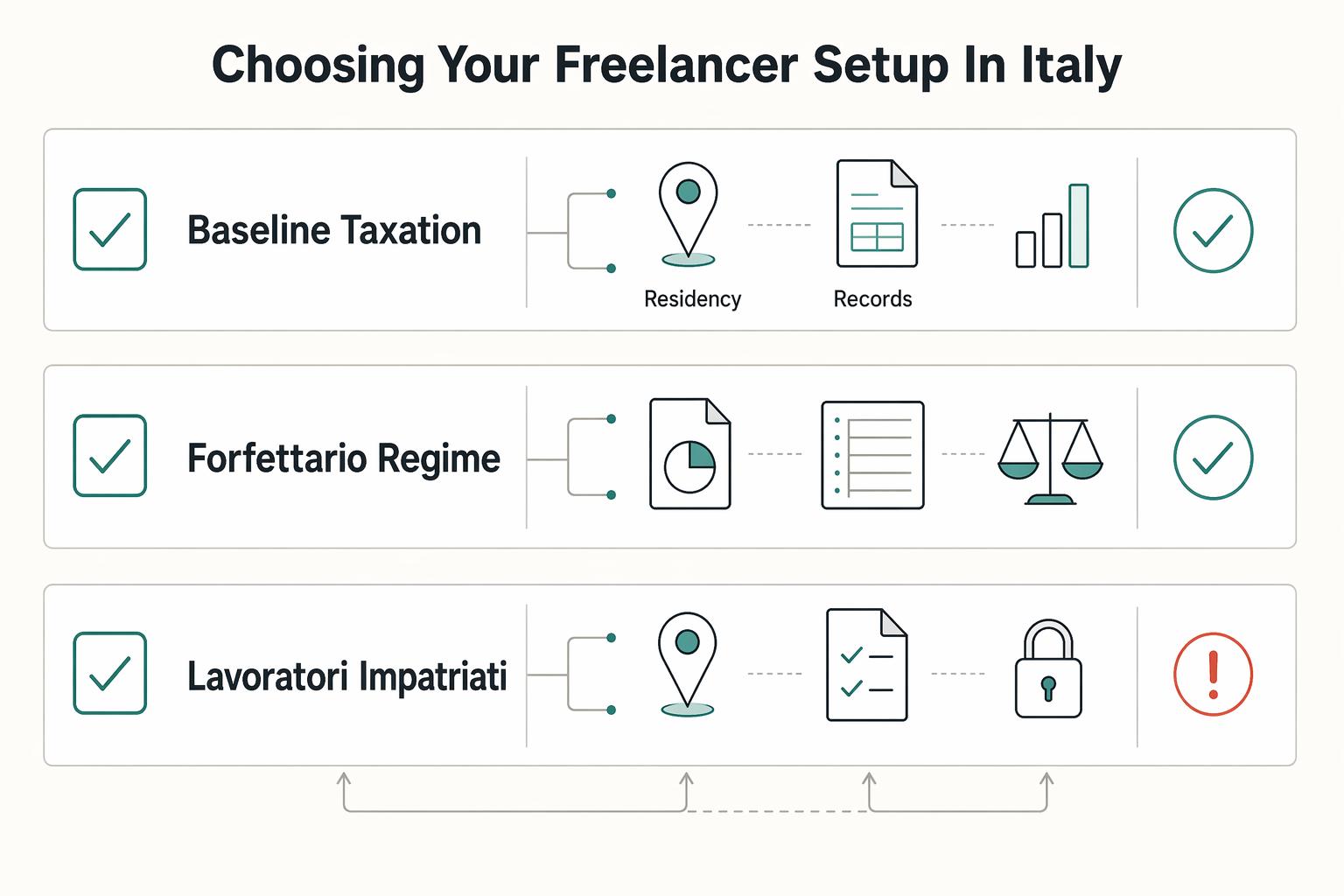
Taxes in Italy for Expats and Freelancers
Start with one objective: make filing choices you can defend with records, not assumptions. As a freelancer or consultant, you do not need to predict every line item on day one. You need a position that stays consistent from client onboarding to invoicing to return prep. The avoidable mistake is signing work or claiming a benefit first, then trying to explain the tax result later. You are aiming for a position that holds together all year, not a best-case assumption that falls apart when forms and bank records have to match.
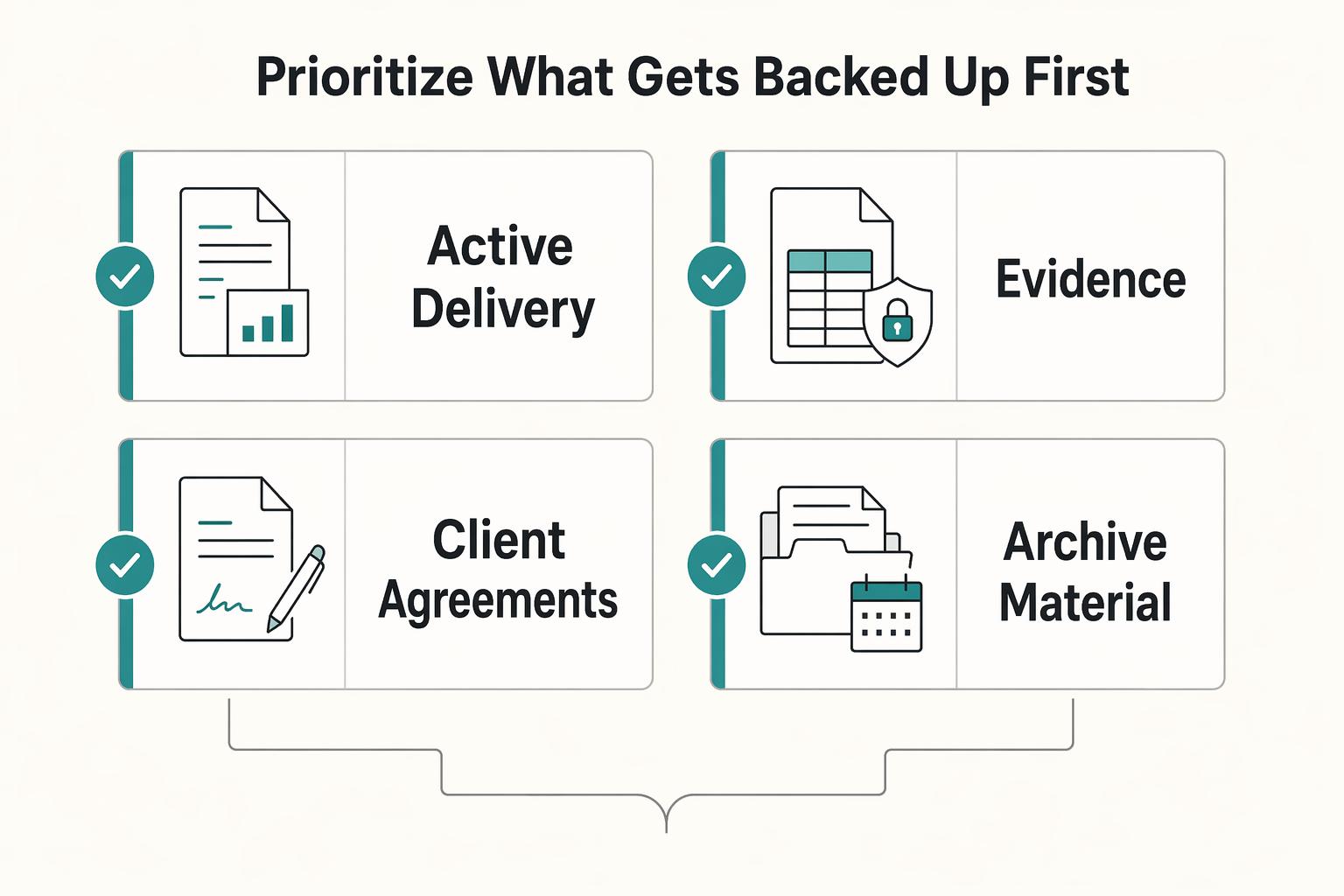
How to Create a Secure Backup Strategy for Your Freelance Business
Build backup for recovery speed, not storage volume. Your setup should let you keep delivering and getting paid after equipment failure, cyberattack, human error, natural disaster, or other data-loss events. A reliable baseline matters, but the real test is whether it stays usable when stress is high and decisions need to happen fast.