
Quick Answer
No. A 0% outcome in Isle of Man corporate tax is defensible only after four checks are documented: residence status, Article 5 PE exposure where relevant, line-level income bucket mapping, and accounting-period alignment. The standard rate does not override separate categories such as banking, retail above the listed threshold, land or property, or petroleum-related income. If any conclusion depends on assumption or stale guidance, place the return on hold until the file supports it.
Start Here What 0% Actually Means for a Solo Business#
Start with the hard rule: 0% is a filing conclusion, not a default. The table includes a standard 0% rate for resident and non-resident companies, but you rely on that only after four gates pass: residence, PE exposure, income classification, and period alignment.
Use these terms consistently:
- Resident company: a company treated as Isle of Man tax resident. Incorporation in the Island is a core rule, with specific statutory exceptions, and central management and control also matters. Resident corporate taxpayers are taxed on worldwide income.
- Non-resident company: taxed on Manx-source income only.
- Permanent establishment (PE): in treaty context, PE is defined in the relevant agreement, for example Article 5 in the UK-Isle of Man treaty context, and can create non-resident tax exposure when business is carried on through a PE in the Island.
- Income bucket: a working label for sorting each revenue line by taxed source or type before applying any rate.
- Defensible position: a filing position supported by records, not assumptions.
Treat the four gates as strict pass/fail checks. A "maybe" is a fail.
| Gate | What to verify | Minimum evidence | When to pause |
|---|---|---|---|
| Residence | Are you filing as resident or non-resident, and does that match incorporation and central management and control facts? | Incorporation record, decision-making summary, and management and control records | Pause if residence depends on assumption, or if management and control facts point both ways |
| PE exposure | If non-resident, could your Island activity create a PE under the relevant treaty PE test? | Contracts, work-location facts, delivery facts, and a written PE conclusion tied to those facts | Pause if your PE view is based on shorthand or generic summaries |
| Income classification | Is each material revenue line mapped to the correct rate category before you pick a rate? | Ledger split by revenue line, contracts, invoices, and an income map | Pause if lines are bundled, or if any line may fall into listed non-standard categories, for example banking, certain retail thresholds, land or property, or petroleum-related income |
| Period alignment | Does your accounting period mapping support the year-of-assessment treatment, including any required apportionment? | Accounting period dates, draft accounts, and a period map showing any split treatment | Pause if period mapping is incomplete, or if you have not verified the current filing window or deadline for your period before submission |
Before you calculate tax, create a one-page position note. Include the entity name, incorporation place, claimed residence status, PE conclusion if relevant, revenue lines and proposed bucket, accounting period dates, period-alignment conclusion, evidence links, open assumptions, and the named reviewer or decision-maker.
The rule is simple: go only when all four gates pass with linked evidence; stop when any gate is assumption-based. Do a trace test before filing. Another person should be able to follow your note to the same conclusion without extra explanation.
If you want the full breakdown, read Singapore Corporate Tax for Foreign Entrepreneurs Without Filing Surprises.
The tiered Manx income tax model in one page#
Read the rates table as a classification exercise first and a rate exercise second. A single company may need to classify different income lines into more than one bucket in the same return, so a single blended code is usually the wrong starting point. Residence affects scope, worldwide for resident corporate taxpayers and Manx-source for non-resident corporate taxpayers, but both are taxed under the same rate structure.
Use the official categories as your decision map#
Use current corporate rates and topic pages to classify first, then fill in rates. Practice Notes can be out of date, so verify current treatment before filing.
| Income category | When it applies | Common misclassification risk | Required evidence | Action if unclear |
|---|---|---|---|---|
| Standard trading profits \nConfirm the current rate with the Isle of Man Income Tax Division | Income that does not fall into a separately listed category | Using this as a catch-all for mixed or unclear lines | Contract terms, invoice line detail, ledger code, draft return mapping | Hold the line in review and test it against listed special categories first |
| Banking business income \nConfirm the current rate with the Isle of Man Income Tax Division | Income that fits the banking category on current official pages | Treating any finance-related activity as automatically banking, or not banking | Activity description, contracts, invoices, current guidance match | Pause and confirm against current guidance or the Income Tax Division |
| Retail business above the £500,000 threshold \nConfirm the current rate with the Isle of Man Income Tax Division | Retail business in the Isle of Man where taxable income from that business exceeds £500,000 | Blending retail and non-retail lines, or skipping the threshold test | Revenue split, threshold calculation, invoices, business facts | Keep in review until the threshold test is documented |
| Isle of Man land and property income \nConfirm the current rate with the Isle of Man Income Tax Division | Taxable income from Isle of Man land and property | Posting property-linked receipts into general services | Lease or licence terms, property schedule, invoices, separate ledger code | Split mixed contracts or invoices and classify each part separately |
| Other special categories, including petroleum extraction activities or rights from 6 April 2024 \nConfirm the current rate with the Isle of Man Income Tax Division | Income with separate treatment under current rules | Ignoring uncommon lines because they seem small | Rights or contract documents, invoices, current topic-page confirmation | Pause filing and escalate before applying any rate |
Keep the workflow simple#
A simple operating model works best here. Create separate ledger codes for each bucket, plus a temporary review code for uncertain lines. Split mixed invoices early so different income types are not bundled, and keep a file for each material line with the contract, invoice, classification note, and any supporting calculation.
Then tie the final ledger totals to return labels, for example Income from Trading Sources, Income from Land and Property, and Other Income and Double Taxation Relief. Before submission, verify current rates and period rules, and mark any unresolved rate or assessment-window item as pending official verification.
Timing still matters after classification. Rates are set by year of assessment and shown as 6 April to the following 5 April. Companies are assessed on an accounting-period basis, so check current period treatment instead of carrying forward old assumptions.
If you cannot classify a material line confidently from the records, pause filing and escalate. Online filing is compulsory for corporate taxpayers, and legal filing responsibility remains with the company even if an agent is appointed.
If you want a deeper dive, read the digital nomad tax guide.
Classify your income before you touch any tax rate#
The practical control is simple: classify each material income line before you choose any rate. That lets you explain, line by line, why each receipt sits in a specific bucket.
One company can have multiple income categories in the same accounting period. If you start from a target rate and work backward, you raise the risk of forcing mixed or unclear income into the wrong treatment.
Use only categories you can support from the records#
Start with the default bucket for income that does not fall into a listed exception, then test each line against the separate categories that can change treatment.
| Category | What to check |
|---|---|
| Standard corporate bucket | Income does not fit a listed exception |
| Banking business income | Facts match banking category treatment |
| Retail business profits above £500,000 | Activity and threshold fit published retail treatment |
| Isle of Man land and property income | Income is taxable land or property income in the Isle of Man |
| Special categories, including petroleum extraction activities or rights from 6 April 2024 | Line fits a specifically listed special treatment |
For retail, keep the goods versus services boundary explicit in your working notes. If your income is service provision, do not label it retail by default. Retail-in-Island classification can also depend on customer location. Treat Practice Notes as point-in-time guidance, not a live rate card.
Decide line status before filing#
Use a simple status model so clear items and ambiguous items do not get mixed.
| Line status | Action | What to keep in file |
|---|---|---|
| Fits one category | Assign bucket and post to matching ledger code | Contract wording, invoice line, short rationale |
| Mixed contract | Split components so each category is visible | Split logic and amount support |
| Overlap or unclear scope | Hold in review and escalate | Competing interpretations and exact ambiguous wording |
| Insufficient evidence | Do not assign yet | Missing contract, SOW, or invoice detail request trail |
Where mixed income includes a retail element, split computations so the retail element is shown separately. For ancillary-activity boundaries or other unclear scope, treat classification as case-by-case.
Keep a one-page memo for each material revenue stream#
Keep a short memo with the revenue stream, assigned bucket, reason tied to contract language, source documents, and the reviewer and date.
The key control is the reason sentence. If you cannot state the classification in plain English from the contract and invoice, the line is not ready to file.
Build controls into your ledger, then tie out to return labels#
Build the ledger around the filing positions you expect to defend. Use separate ledger codes by category plus a temporary review code for unresolved lines, and keep a change log when classification changes, including what changed and why.
Before submission, tie ledger mapping to return labels and verify current period and rate handling for your facts:
- Confirm the current rate with the Isle of Man Income Tax Division.
- Confirm the current filing deadline with the Isle of Man Income Tax Division.
- Confirm the current apportionment treatment with a qualified tax adviser.
Corporate returns for accounting periods ending on or after 5 April 2015 must be filed online, but filing method is not a reason to force a doubtful classification. If a material line is still ambiguous, treat it as a case-by-case issue and discuss it with the Assessor, with the contract, invoice, and memo attached.
We covered this in detail in Malta's Tax Refund System for Foreign Companies Without Guesswork.
Confirm residence and permanent establishment exposure#
Before you discuss any rate, confirm scope. Decide company residence first. Handle any PE analysis as a separate step. If the evidence is not clean, pause.
Start with the right entity and the right concepts#
First, confirm you are analyzing a company. HMRC's company-residence material distinguishes companies from partnerships, so do not substitute partnership or sole-trader logic here.
Use these terms precisely:
- Company residence: the company's tax-residence position, starting from a basic residence rule and then a fact-based analysis.
- Management and control: who has legal power to manage and control the company, and how that control is exercised in practice.
- Permanent establishment (PE): a separate scope question that may need analysis outside this guidance. The specific legal PE test is not provided here.
- Manx-attributable activity: a working file label, not a standalone legal test.
Do not use individual residence concepts as a shortcut. Personal residence logic does not replace company residence analysis.
Make the call in order#
Make the call in this order:
- Residence first. Start with company residence. Treat it as a question of fact, with explicit focus on legal power to manage and control and central management and control.
- PE second, if needed. If PE is in scope, run that analysis separately using source text that defines the PE test.
- File or escalate. File only when records clearly support the conclusion. If facts conflict or records are thin, stop and escalate before finalizing numbers.
Practical hard stop: if formal authority appears in one place but real strategic decisions appear elsewhere, treat residence as contested and escalate.
Build an evidence pack another reviewer can read cold#
| Document | What it must prove | Reviewer challenge |
|---|---|---|
| Incorporation and constitutional records | What the entity is and who formally holds management powers | Can someone identify the entity and governance structure without verbal context? |
| Board minutes and written resolutions | Where key decisions were made, by whom, and when | Do records show real decision-making rather than form-only approvals? |
| Decision logs, approval emails, sign-off trails | How management and control operated in practice | Can a reviewer trace a major decision from proposal to approval? |
| Contracts, SOWs, invoices, delivery records | Where activity occurred and which revenue lines tie to that location | Can location linkage be reconstructed from records alone? |
Your checkpoint is simple: another reviewer should be able to restate your residence conclusion, and whether separate PE analysis is needed, from the file alone.
Escalate on these facts#
Pause and escalate if you see:
- conflicting evidence on who actually managed and controlled the company
- minutes that conflict with email or approval trails
- unclear operational footprint relevant to your scope position
- revenue lines that cannot be tied to location from underlying records
- any attempt to substitute individual residence logic for company residence analysis
If residence remains arguable, or any follow-on PE analysis remains arguable, do not move to rate selection yet.
Check the temporary Pillar Two related changes without guessing#
Treat Pillar Two as a separate scope and timing review, not as a rate choice. You are validating treatment, not trying to fit partial information into a favorable outcome.
| Term | Key point |
|---|---|
| Pillar Two | OECD global minimum tax framework for large MNE groups, with a 15% minimum effective rate by jurisdiction. |
| Top-up tax | DTUT and MTUT, which are separate from normal Isle of Man income tax. |
| In-scope group | Broadly, a group with annual revenue of Euro 750 million or more in at least 2 of the last 4 fiscal years. |
| Temporary treatment | A date-limited rule that applies only for a stated period, such as the 2024/25 year of assessment only 15% treatment for certain banking and retail income. |
Use those labels consistently in your file.
| Question | Evidence required | Pass or fail outcome | Next action |
|---|---|---|---|
| Are you in scope? | Group chart, consolidated revenue support, and a lookback memo showing whether the Euro 750 million test is met in 2 of 4 fiscal years | Pass: Pillar Two stays in scope for review. Fail: do not force a Pillar Two position into the file. | File the ordinary position only if the scope memo is complete, otherwise hold |
| If in scope, what path applies? | Isle of Man Pillar Two guidance, entity map, and a note separating DTUT from MTUT | Pass: you identify the likely path and record that reporting can still apply even when no DTUT or MTUT liability arises. Fail: treatment is still label-based guesswork. | Escalate |
| Which date controls? | Fiscal year start date, article 29 timing note, registration-deadline update, and P1 form timing note | Pass: your memo reconciles 1 January 2025, "not earlier than 1 January 2026," the ordinary 12 months after the start of the first in-scope fiscal year rule, and the P1 18-month first-year / 15-month otherwise return timing. Fail: timing conflict remains open. | Hold or escalate |
| Are you applying a temporary rule correctly? | Saved official wording for the exact period plus the income line you want to treat under that rule | Pass: period and income match the official wording. Fail: you are extending a time-limited rule beyond its stated window. | Escalate |
Use a strict source hierarchy. Start with Isle of Man Government guidance and Isle of Man legal instruments. Use UK HMRC Pillar Two pages for context only, and treat third-party commentary as non-authoritative unless you can corroborate it against Isle of Man official material.
Before sign-off, add this checkpoint line to your file: assumption | status | owner | evidence link | escalation trigger. If any line is open, especially scope, deadline, or compulsory online Pillar 2 Service enrolment for a Domestic Filing Entity of an MNE Group, stop sign-off and escalate.
For a step-by-step walkthrough, see A Deep Dive into the UAE's Corporate Tax for Freelancers and LLCs.
Build your filing timeline around the year of assessment#
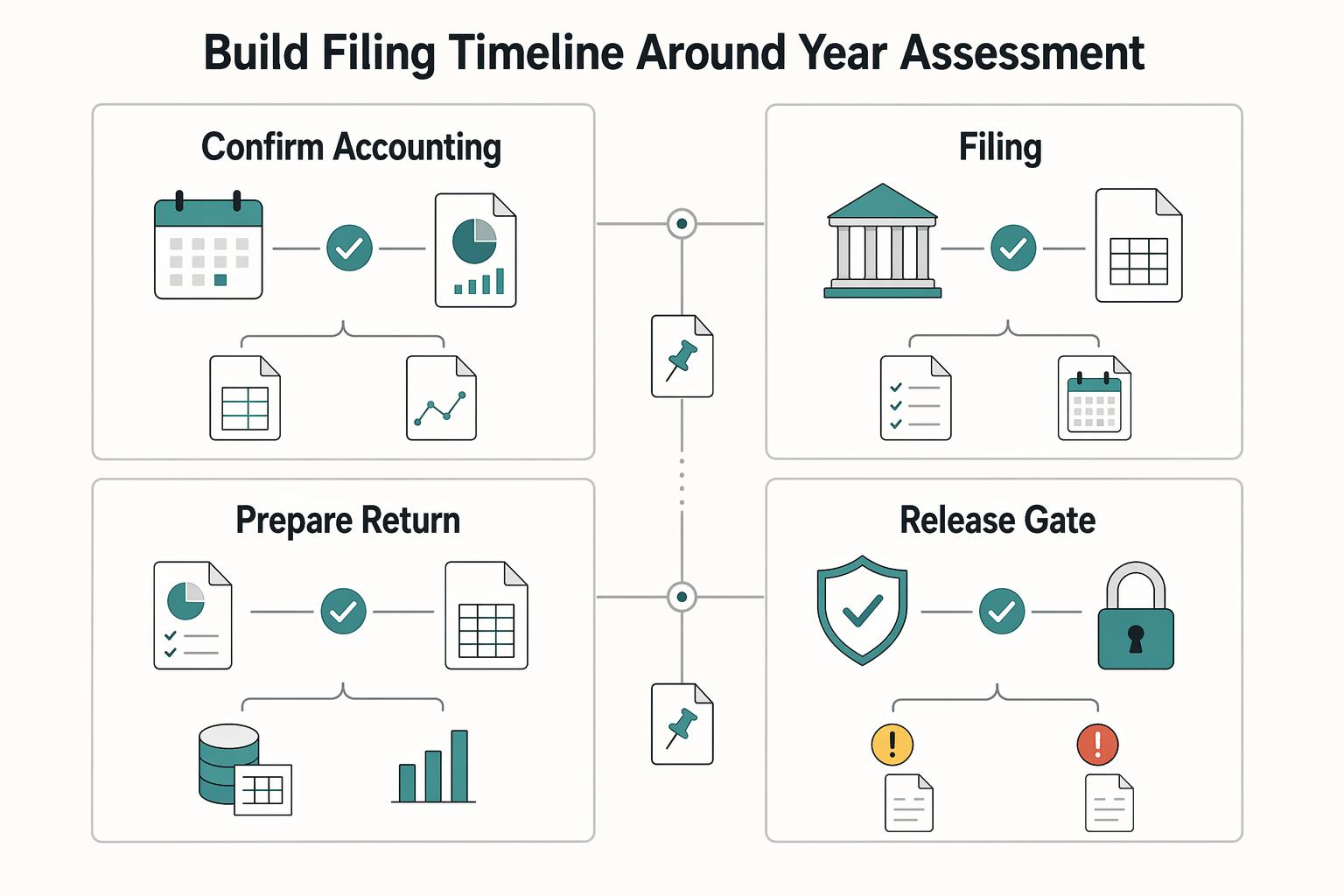
Build your timeline from the accounting period, then verify deadlines before you lock anything in. You file on an accounting-period basis, so your first move is to confirm current return and payment timing from official Isle of Man guidance. Record that source in your tracker.
Use a verification-first rule throughout. Treat the period-length control as 12 months maximum and verify that it is still current in official guidance before filing. Do the same for return and payment due dates. Commonly cited timing is one year and one day after the accounting period end for both return submission and tax payment, but use that as a prompt to check current guidance, not as a substitute for it.
If your reporting spans more than one filing period, split it into separate return workstreams from the start and assign separate review gates. Do not run one combined process and try to fix it late.
| Milestone | Owner | Evidence link | Dependency | Escalation trigger |
|---|---|---|---|---|
| Confirm accounting period start and end | Finance lead | Accounts pack and period-close file | Reporting dates finalized | Period appears to exceed 12 months |
| Verify current filing and payment timing | Tax owner | Current official guidance capture | Accounting period end confirmed | Timing cannot be tied to a current official source |
| Confirm online filing readiness | Filing owner | Portal access check and credential log | Entity access active | Access blocked, credentials expired, or filing role unclear |
| Prepare return for each period | Preparer | Working papers and source records | Key tax positions signed off | Any figure cannot be traced to evidence |
| File, pay, and archive sign-off pack | Approver | Return submission proof, payment proof, sign-off note | Period workstream approved | Any unresolved input is still open |
Use a binary pre-filing gate: file only when positions are documented, numbers are traceable to evidence, and no unresolved item is being assumed through. If any item is unresolved, move it to hold and escalate. This protects you from late-filing penalties, late-payment interest, and default-assessment risk if a return is not filed.
Keep an evidence pack that can survive questions#
Your evidence pack is ready only when an independent reviewer can trace each filing position from source fact to conclusion without any verbal context. Treat it as a stand-alone filing record, not a memory aid. If support is missing, unclear, or scattered, move that item to hold and escalate instead of filing through assumptions.
Build five defined modules#
Use a fixed structure so gaps are obvious during review:
| Module | What it covers |
|---|---|
| Residence status | Documents why you treated the company as resident or non-resident, using incorporation evidence and central management and control evidence. |
| Permanent establishment (contractor context) | Captures the facts used to assess whether contractor activity in the Island creates non-resident tax exposure. |
| Working papers | Ties source records to calculations, accounting-period splits, and return figures. |
| Return support | Stores submitted return materials, filing attachments, and filing/payment proof. |
| Governance note | Records key judgments, what you verified as current, and where you applied caution. |
Keep those five modules distinct in your folder structure.
For residence, keep the evidence behind the conclusion. Isle of Man guidance uses both place of incorporation and central management and control, and evidence can include board minutes or equivalent documentation. Where required evidence is missing, residence-status applications may not be processed.
For PE, separate facts from judgment. Contractor guidance states non-resident tax exposure can arise where a contractor operates through a permanent establishment in the Island. A site engagement of more than 12 months should be flagged clearly in your file.
Use an evidence map for each conclusion#
| Conclusion | Required documents | Storage location | Owner | Review status | Escalation flag |
|---|---|---|---|---|---|
| Company residence position | Incorporation evidence where relevant, board minutes or equivalent documentation, residence memo | /Tax/2026/Residence | Tax owner | Reviewed / Provisional / Final | Red if management and control support is incomplete |
| PE (contractor context) or non-resident exposure | Contracts, work-location records, site-duration records, PE memo | /Tax/2026/PE | Finance lead | Reviewed / Provisional / Final | Red if contractor Island-activity facts are mixed or unsupported |
| Accounting period and rate application | Source records, calculation files, year-of-assessment split support where needed | /Tax/2026/Working-Papers | Preparer | Reviewed / Provisional / Final | Red if figures do not trace to source records |
| Filed return and payment | Submitted return copy, online submission proof for accounting periods ending on or after 5 April 2015, payment confirmation | /Tax/2026/Return-Support | Filing owner | Filed | Red if filing or payment proof is missing |
Treat mixed facts as provisional#
Use a hard internal rule: if management and control facts are mixed, or PE facts point in different directions, mark the position provisional and escalate for written adviser review before final filing. This is a risk-control standard, not a claim that adviser sign-off is legally mandatory in every case.
Make the index and version history usable#
Keep a one-page index at the front of the pack. For every change, log what changed, why it changed, and which filing position it affects.
In your governance note, record the issue date of any Practice Note and the current topic page you checked, because Practice Notes are not automatically updated. If records are stored outside the Isle of Man, keep them within your power and control so you can produce support when requested.
Use decision rules for common freelancer scenarios#
Use scenario labels to organize the review, not to decide the answer. Your filing position stays provisional until residence and PE scope are supported by an authoritative Isle of Man corporate-tax basis and your evidence file.
Run this two-step flow for each revenue stream:
- Residence: document the facts and evidence for the stream, then check whether you have an authoritative Isle of Man tax basis for a residence conclusion. If not, keep the position provisional.
- PE scope: review Island-linked activity on the same standard. If authoritative tax support is missing, keep the position provisional.
If either step is not fully supported, stop and keep the position provisional.
| Scenario | Trigger fact | Required evidence | Status from current excerpts | Escalation point |
|---|---|---|---|---|
| Service-only | Stream is documented as services only | Record file for the stream, for example written contracts, written statements of terms, staff handbooks, letters of appointment, employer rules, and any stream-specific records | Residence or PE treatment; confirm with a qualified adviser before finalising | Facts in records do not match the stream narrative |
| Local footprint | Any Island-linked operating fact appears in-period | Same record file standard, updated for the new fact | Residence or PE treatment; confirm with a qualified adviser before finalising | New Island-linked fact appears after an earlier working view |
| Property-linked income | Stream is tied to property or occupancy-related records | Separate stream file plus the same record file standard | Residence or PE treatment; confirm with a qualified adviser before finalising | Property-linked items are mixed into general service lines |
| Multi-jurisdiction activity | Stream spans more than one location | Per-stream chronology plus the same record file standard | Residence or PE treatment; confirm with a qualified adviser before finalising | Movement in management, people, or delivery location during the period |
Make source quality explicit before you rely on it:
- Authoritative: can support the specific conclusion you are making.
- Contextual: useful background, but not enough to close the issue.
- Non-decisive: relevant context that does not provide operative Residence or PE decision rules.
Example: the gov.im employment-rights summary is authoritative for employment-rights context and lists records like written contracts, written statements of terms, staff handbooks, letters of appointment, and employer rules. But it states it is a summary "as at April 2024," so it is non-decisive for residence or PE tax conclusions. The February 2026 KPMG indirect-tax newsletter is contextual only for this decision; in the excerpt, Isle of Man appears in a jurisdiction list without operative residence or PE rules.
When facts change, rerun the analysis for that revenue stream and log:
- what changed
- why treatment may change
- what evidence confirms the updated treatment
You might also find this useful: How to Price an IT Staff Augmentation Project.
Red flags that usually mean talk to a professional now#
If any trigger below is true, pause before filing. Resume only after you close the evidence gap or get written adviser confirmation.
Use these definitions so you and any reviewer apply the same escalation test:
- A material line item is any revenue, cost, or adjustment where omission, misstatement, or obscuring could influence a user's decision.
- A scope assessment means you tested residence using both place of incorporation and central management and control, then checked permanent establishment facts.
- An assumption-based position is an internal warning label for any return position you cannot support with records you can retain for six years from the end of the relevant tax year.
| Red flag | Evidence missing or conflicting | Immediate action | Required output |
|---|---|---|---|
| You are treating 0% as automatic | No line-by-line income classification, or records show income that may fall outside the standard rate, for example banking, certain retail, or land or property income | Pause and classify each material line item before selecting rates | Signed classification memo tied to contracts, invoices, and ledger lines |
| You think Pillar Two may apply, but cannot show scope | No group-structure note, no support for the Euro 750 million revenue scope test, or no check for fiscal years starting on or after 1 January 2025 | Hold filing and get specialist review instead of forcing a 0% position | Written adviser confirmation on scope and any separate DTUT exposure |
| Your residence or PE conclusion is narrative-only | No support for incorporation, management location, or PE facts, including whether there is a fixed place of business | Rebuild the conclusion from source records before finalizing | Scope note with evidence links and unresolved issues log |
| You have mixed income and no written memo | Contracts, invoices, and return labels do not map cleanly, or a material line item could fit more than one bucket | Split the stream and document the bucket logic for each part | Updated income memo and revised return mapping |
| Your accounting period and Isle of Man year of assessment do not align cleanly | No apportionment support where rates differ across periods, or deadline pressure is driving estimate-based filing | Do not file on timing assumptions because the 12 months and one day deadline is close | Apportionment schedule or written adviser sign-off |
Apply one final internal gate before submission: if an independent reviewer cannot trace scope, classification, and return positions from records in one pass, move the filing to hold and escalate.
Related: How to Write a Professional Bio That Attracts Clients.
Your pre filing checklist before you rely on 0%#
Use a strict file-or-pause rule: file only when each control below is supported by records a reviewer can follow without your verbal context.
Create one dated note named Pre filing check. For each row, write one plain-English decision sentence, add the exact evidence link or file reference, assign an owner, and mark status as complete, open, or blocked.
| Decision | Required record | Status | Owner | Escalation trigger |
|---|---|---|---|---|
| Activity map: "I mapped each material line item to the filing treatment used in the draft." | Line-item revenue map linked to contracts, invoices, and ledger entries. Split mixed contracts instead of using one blended label. | complete / open / blocked | Named preparer | Any material line is unsupported, or a mixed line is not documented clearly enough to review |
| Status and basis: "I documented the status and filing basis used in this filing and linked supporting records." | Short memo with linked source records and any governance or management records relied on | complete / open / blocked | Named preparer or adviser | Conclusion exists only as narrative, memory, or meeting notes with no source trail |
| Period and filing: "I confirmed the filing period and submission timing, and working papers use the same assumptions." | Dated filing calendar note, period schedule, draft return period fields, and support for any period split used | complete / open / blocked | Named preparer | Period assumptions conflict across files, or deadline pressure is driving unsupported estimates |
| Pillar Two scope check: "I checked whether group-scope rules could affect this filing and treated the position as unverified until current guidance or adviser confirmation is on file." | Dated scope note, current guidance copy or adviser email, group-structure summary, and a note marking any current threshold as pending tax-advisor verification if applicable | complete / open / blocked | Named adviser or finance lead | Possible scope impact is identified, but current treatment, group scope, or written conclusion is missing |
| Declaration and evidence-pack pressure test: "An independent reviewer can trace activity mapping, status assumptions, scope checks, and final sign-off from file to filing position." | Final evidence pack with linked records, return mapping, unresolved-issues log, declaration/sign-off record, and versioned Pre filing check note | complete / open / blocked | Independent reviewer | Reviewer cannot trace the file in one pass, finds broken links, or finds conclusions that depend on oral explanation |
Apply these controls operationally#
| When | Instruction |
|---|---|
| Before final calculations and again immediately before filing | Run the checklist twice. |
| If any fact, structure, timing, or adviser input changes | Rerun every row, not just the row that changed. |
| If you rely on outside advice | Link outside advice only to the exact row it supports. Do not treat a broad email as coverage for unrelated rows. |
| If any row is blocked | Move to hold and escalate until fixed. |
| Final gate | If the independent reviewer cannot trace status assumptions, activity mapping, scope checks, and sign-off from the file alone, filing is on hold and escalated. |
If facts change after submission, log the change and trigger your post-filing change-control process immediately.
The final gate is binary: if the independent reviewer cannot trace status assumptions, activity mapping, scope checks, and sign-off from the file alone, filing is on hold and escalated.
Related reading: Spain Tax Residency for Mobile Freelancers Who Need Defensible Records.
If your residence or travel pattern is still shifting, log it in the Tax Residency Tracker before you finalize your filing position.
The bottom line for freelancers and consultants#
Use a binary rule: file only when your records support the conclusion end to end. If any material point depends on memory, stale guidance, or assumption, pause and escalate.
This matters most when you work across borders, invoice through a company, or mix self-employed and employment income. If you are self-employed, you are responsible for paying your own taxes, and tax applies to profits after allowable deductions, not gross billings. Using a limited company can change structure, but it does not remove the need to prove your facts.
For any corporate-tax point, separate the headline from the filing result. Map each material income line to a treatment, then verify that treatment before you submit.
| Situation | What you should do now | What goes wrong if you guess |
|---|---|---|
| Routine treatment | Verify current treatment before you use it. Link each material line to the source you used. | You apply a headline assumption to income that may not belong there |
| Unclear or non-routine treatment | Verify current treatment before you use it. Flag any line that does not match routine consulting activity. | A single misclassified line can change the filing position |
| Time-sensitive treatment | Verify current treatment before you use it. Check whether period-specific treatment applies to your filing window. | You carry forward an old treatment to current facts |
Run the same discipline on timing: confirm the treatment used in the return is verified for your filing window. If your accounts straddle treatment windows, mark the file with apportionment rule pending tax-advisor verification and pause until that split is verified by qualified advice.
If any employment element exists, check the place of employment in the contract itself. If those facts do not clearly align with your working setup, treat it as an escalation trigger and get written advice before filing. Non-authoritative guidance also warns that double taxation can happen in worst-case scenarios, so avoid filing on assumptions.
Use this pre-submission checklist so another reviewer can test your file quickly:
- Map each material income line to the treatment used, with a source or explicit verification note.
- Match period treatment to your filing window, and flag any apportionment point for advice.
- Confirm operating-status and contract facts that affect where income may be taxed.
- Log unresolved items with a clear file-or-escalate decision for each one.
Submit only when an independent reviewer can trace facts to final figures in one pass. If they cannot, stop and run the pre-filing check before you proceed.
This pairs well with our guide on How to Handle the 'Kiddie Tax' for Your Child's Investment Income.
If you still have unresolved scope or classification points at sign-off, talk to Gruv to confirm the safest next step for your setup.
Frequently Asked Questions
Is Isle of Man corporate tax always 0%?
No. The standard corporate rate is 0%, but the rates table also includes other buckets, including banking income, retail profits above £500,000, and land or property income, so a defensible position starts with line-by-line classification. Classify each material revenue line against the current rates page, split mixed contracts, and hold filing until every material line is mapped.
Does non-resident status automatically keep me out of scope?
No. The supported rule is that resident companies are taxed on worldwide income and non-resident companies on Manx-source income only, which is a scope distinction, not a blanket exemption. Document incorporation and central management and control, then test Manx-source and Article 5 permanent-establishment exposure where relevant.
Can I treat old guidance or practice notes as enough support?
No. Practice Notes are dated and not updated for later changes, so they are background, not final authority for a current filing position. Verify each material point on current topic pages or current orders, save that record, and escalate if old and current guidance do not align.
Do Pillar Two and top-up taxes matter for a solo business?
Often not for a standalone business, but not by assumption. Pillar Two is tied to in-scope MNE groups, including the Euro 750 million revenue threshold, applies for fiscal years starting on or after 1 January 2025, and can still create reporting obligations even when no DTUT or MTUT liability arises. Create a dated scope memo, confirm group links, and get written advice before filing if ownership, consolidation, or threshold testing is unresolved.
What filing mechanics and documents matter most?
They matter because timing and period errors can break an otherwise valid filing position. Corporate filing is on a pay-and-file accounting-period basis, return and payment are due 12 months and one day after period end, online filing applies for accounting periods ending on or after 5 April 2015, and tax-year boundaries can require apportionment when rates change. Keep a dated filing note with the due-date formula, period schedule, submission and payment proof, and any apportionment workings.
When should you stop and get written advice before filing?
Stop when any material conclusion is still open. Triggers include unresolved classification, residence or scope uncertainty, moving central management and control facts, open permanent-establishment analysis, or unresolved group-structure questions affecting DTUT, MTUT, or reporting. Place the return on hold, log the exact trigger, and obtain written advice tied to that trigger before filing.
Try a related tool
Researched and edited by the Gruv editorial team. Gruv builds cross-border billing, payouts, and finance-operations software for global businesses.
Sources
Includes 6 external sources outside the trusted-domain allowlist.
- gov.im/categories/tax-vat-and-your-money/income-tax...external
- gov.im/categories/tax-vat-and-your-money/income-tax...external
- gov.uk/government/publications/residence-domicile-a...external
- gov.uk/hmrc-internal-manuals/international-manual/i...external
- taxsummaries.pwc.com/isle-of-man/corporate/taxes-on-corporate-incomeexternal
- taxsummaries.pwc.com/isle-of-man/corporate/tax-administrationexternal
Educational content only. Not legal, tax, or financial advice.
Related Posts

Digital Nomad Taxes in 2026 With a Defensible Filing Plan
With digital nomad taxes, the first move is not optimization. It is figuring out where you may be taxable, where filings may be required, and what proof supports that position.

How to Write a Professional Bio That Attracts Clients
If you want to know **how to write a freelance bio** that is client-focused, write for scan speed, not autobiography. Clients often read your headline before they open your portfolio, and first impressions can form in less than seven seconds. Your opening should show fit, proof, and a clear next step fast.
How to Price an IT Staff Augmentation Project
Public market ranges are context, not quote logic. A pricing guide updated on March 15, 2026 lists typical IT staff augmentation totals of $50,000 to $199,999 and hourly rates of $50 to $199, but those figures only set rough boundaries. Project duration and scope affect total cost, and rates vary by region and expertise.