
Quick Answer
Classify the activity by profit intent first, then file based on records that support that decision. If intent to make a profit is not present, report income on Schedule 1 (Form 1040), line 8; if business facts are supportable, use Schedule C and determine whether Schedule SE applies. Form 1099-K is a payment report, not a classification test. Reconcile platform totals to your ledger, keep a dated factor memo, and use the filing lane your current-year evidence can substantiate.
How the IRS Decides Whether Your Side Hustle Is a Hobby or a Business#
Classify your side activity by profit intent, not by platform labels or how casual the money feels. A hobby is pursued for enjoyment without intent to make a profit, while a business is run with profit intent. The Internal Revenue Service expects you to evaluate all relevant facts and circumstances, and no single factor decides the result.
| Decision point | Risky shortcut | Defensible first pass |
|---|---|---|
| Classification signal | Treat Form 1099-K as automatic proof of business status | Review the full IRS factor set; no single factor controls |
| Records | Reconstruct activity at filing time | Keep complete, accurate books and records throughout the year |
| Filing treatment | Pick the lane that seems most favorable | If there is no profit intent, report income on Schedule 1 (Form 1040), line 8 |
| Income reporting | Assume app payments are informal | Treat goods and services app payments as taxable income that must be reported |
This article focuses on IRS classification and filing implications when your facts are unclear. It is not individualized legal or tax advice.
Use this checkpoint before filing:
- Make a provisional hobby versus business decision from your full fact pattern, with profit intent as the core test.
- Reconcile payment records, including any
Form 1099-K, to your own books. - Document your conclusion and the records that support it.
A common risk is reusing last year's label without rechecking this year's facts and records. Recheck the facts each year, then choose the filing lane you can document now.
That year-by-year discipline matters because classification is not just a label. It affects where income is reported, whether losses can offset other income, whether Schedule SE may come into play, and how a reviewer will read your file if questions arise. A return can look internally inconsistent when your memo says one thing, the books suggest another, and the filing treatment follows a third path.
Misclassification matters because it can change how income is reported and how much tax you may owe. By the end, you should have a clear filing lane and documentation you can defend.
Hobby vs business at a glance#
Start with profit intent. IRS guidance says classification depends on all facts and circumstances, and no single factor is more important than another.
| Evaluation criteria | Hobby income signal | Business income signal | Filing impact |
|---|---|---|---|
| Profit motive test | Activity is pursued for enjoyment, with no intention of making a profit | Activity is operated with the intention of making a profit | Guides whether income is treated as hobby or business income |
| Books and records | Limited or informal tracking | Complete, accurate books and records kept in a businesslike manner | Strong records support a profit-intent position |
| Time and effort | Irregular effort tied mostly to personal interest | Time and effort are directed toward making the activity profitable | Consistent profit-focused effort supports business intent |
| Dependence on income | Income is not tied to livelihood | Income is relied on for livelihood | Reliance on income supports profit intent |
| Weight of any one factor | No single hobby signal is determinative | No single business signal is determinative | Consider all factors, facts, and circumstances together |
| Method changes | No meaningful operational changes to improve results | Methods are changed to improve profitability | Documented changes can support profit intent |
| Expected asset appreciation | No clear expectation of profit from asset appreciation | Expectation of future profit from appreciation of assets used in the activity | Can support profit intent even if current results vary |
| Form reporting lane | If there is no profit intent, report income on Schedule 1 (Form 1040), line 8 | When business status is supportable, reporting treatment differs | Choose the lane that matches your full fact pattern |
| Loss treatment | If there is no profit motive, losses cannot offset other income | Loss treatment can differ when business status is supportable | Profit motive affects whether losses can offset other income |
| What this does not prove | Receiving Form 1099-K does not, by itself, settle classification | Same: Form 1099-K can appear in either case | App payments are taxable income and must be reported either way |
Use this table as a pre-filing checkpoint, then keep a short note showing how your facts led to the result.
A helpful way to use the table is to compare your conduct, your records, and your planned return treatment side by side. If your conduct looks businesslike but your records are thin, that does not automatically kill a business position, but it does show you where the file is weak. If the records are careful but the activity still appears mainly recreational, the books alone do not create profit intent. The point is not to count boxes; it is to see where your story aligns and where it does not.
That comparison also helps you avoid two common filing errors. The first is letting one favorable fact dominate everything else, such as heavy time spent on the activity without a clear profit objective. The second is letting one document dominate the analysis, such as a platform form or marketplace dashboard. Neither shortcut replaces a full review.
What the IRS actually evaluates#
The IRS looks at the whole pattern of behavior, not one isolated signal. The core question is whether you run the activity to make a profit or mainly for pleasure, and no single factor outweighs the others.
| Decision check | Profit-intent signal | Recreation signal |
|---|---|---|
| Books and records | You run it in a businesslike manner with complete, accurate records | Records are limited or not maintained in a businesslike manner |
| Time and effort | Your time and effort are directed toward making the activity profitable | Your time and effort appear directed more toward enjoyment than profit |
| Dependence on income | You depend on the income for your livelihood | The income is not central to your livelihood |
| Method changes | You change methods to improve profitability | You do not materially change methods to improve profitability |
| Overall facts and circumstances | Multiple factors align with a profit motive | The overall pattern aligns more with pleasure or recreation |
Mixed facts are normal. You do not need to win a set number of factors, and the IRS does not use a fixed numeric threshold. Document each factor honestly and reach a conclusion that matches your records and conduct.
A useful test is whether someone else could read your notes and understand why you chose that treatment. If your factor notes and return treatment point in different directions, pause and reconcile that conflict before filing.
When facts are close, use Publication 17 and Publication 525 as interpretation checks. If there is no intention to make a profit, report the income on Schedule 1 (Form 1040), line 8.
What matters most in practice is consistency. If your notes say you are trying to make the activity profitable, the rest of the file should reflect that in the way you kept records, tracked payments, and reacted when results were weak. If your notes instead show an activity pursued mainly for enjoyment, your return should not quietly shift to business treatment just because the deduction result looks better.
This is why a short written factor review helps. It forces you to describe the actual year, not the version of the year you wish you had. A good memo can be brief, but it should still connect the activity's purpose, the records you kept, the way you spent time, and the filing result you selected. When those pieces line up, the classification choice is easier to explain and defend.
The 60-minute classification sequence#
Set a provisional filing position before you start final data entry. This sequence is practical, not an IRS mandate.
- Classify activity purpose first. Review the factor pattern from the prior section and mark each item as
supports profit intent,mixed, orleans recreation. Keep it qualitative. - Map a provisional filing lane for this cycle. Choose the lane that best matches your current facts and the schedules your return calls for (for example,
Schedule 1 (Form 1040)for additional income). If facts are split, use the more conservative treatment for this return and document why. - List missing evidence before filing. Note what you cannot currently substantiate, such as incomplete books and records, limited time-and-effort support, or no clear record of method changes to improve profitability.
Consider adding a short decision log to your U.S. federal tax return file with the date, tax year, factors reviewed, provisional conclusion, and open issues. Then run one checkpoint before you file: does your chosen lane match the records you can produce, your income pattern, and how you actually operate the activity?
If your facts sit in the middle, do not force certainty. Mark the weak points, pick the conservative lane for this cycle, and record what must improve next year to support a different position. This keeps the current filing coherent and gives you a clear plan for stronger evidence later.
For filing mechanics, remember that more complex returns may require numbered schedules, and e-file software generally determines which schedules appear from your inputs.
The sequence works best if you keep the steps in order. Do not start with software boxes, estimated tax due, or the return outcome you hope to reach. Start with purpose, then compare that purpose against the evidence you have, then select the reporting lane. That order reduces the chance that you shape the facts around the form instead of shaping the form around the facts.
A clean workflow looks like this in practice: review the factor table, open your records, write the memo, then route the income. If you reverse that order, small contradictions show up fast. You might enter income on Schedule C, for example, and only later notice that your own notes describe limited records, limited profit-focused effort, and no documented changes to improve results. That is exactly the kind of mismatch you want to catch before the return is finalized.
When you reach the "missing evidence" step, be specific. "Need better records" is less helpful than "ledger totals do not tie to payment summaries" or "no written support for method changes." Specific gaps tell you whether the problem is organization or whether the facts themselves are too weak for the position you planned to take.
Build an evidence file the IRS can follow#
A defensible classification is easier to support if you kept records throughout the year. Because the IRS uses a facts-and-circumstances review, your file should show how you actually ran the activity.
| Example evidence artifact | What it helps show | Filing tie-in | Weak-file risk |
|---|---|---|---|
| Bookkeeping records and transaction ledger | Businesslike operation with complete, accurate records | Supports income and expense amounts when filing Schedule C | Rebuilt totals at filing time can look less reliable |
| Calendar or activity logs | How consistently the activity was run over time | Supports your overall position when facts are mixed | No activity trail can make your position harder to support |
| Invoices and payment summaries | Traceable customer work and revenue activity | Supports amounts reported on Form 1040 schedules | Missing source records create reconciliation gaps |
| Profitability adjustment notes | Changes in methods to improve profitability | Shows how you responded when results were uneven | No change log weakens this factor |
| Tax-year classification memo | One conclusion across the full factor set | Explains Schedule C versus Schedule 1 (Form 1040), line 8 | Conclusion without support looks result-driven |
If you take a business lane, use Publication 334 and Publication 535 as interpretation checks for reporting and expenses. They help with consistency, but they do not establish status on their own.
A common failure pattern is deciding treatment first and backfilling records later. Recordkeeping is expected throughout the year, and classification affects both reporting treatment and potential tax outcome.
Use a simple recurring cadence (IRS does not require a monthly schedule):
- Export and archive bookkeeping records.
- Reconcile invoices and payments to the ledger.
- Add notes on method changes made to improve profitability.
- Review the
Small Business and Self-Employed Tax Centerfor updates and action items.
Keep these records together by tax year so your factor memo, reconciliations, and return inputs stay connected. If an item appears on the return, you should be able to show where it came from and why it supports your classification.
If your file is contemporaneous and complete, your position may be easier to defend. If documentation is thin or mostly after the fact, consider a conservative lane this cycle and strengthen records before taking a more aggressive position.
A practical evidence file is easier to review when it follows the same order every time. Put the classification memo near the front, then the reconciliation sheet, then the ledger, then invoices and payment summaries, then activity logs, then any notes showing changes you made to improve profitability. That way, a reviewer can move from conclusion to support instead of hunting through disconnected documents.
The strongest files also make cross-checking easy. If a ledger total feeds a return input, the return input should tie back to that ledger total without guesswork. If a note says you changed methods to improve profitability, the timing of that note should make sense against the rest of the record set. If a calendar shows limited activity but the memo claims sustained profit-focused effort, resolve that tension before filing.
Think of the evidence file as a document pack, not a pile of paper. Each item should do a job: prove amounts, show timing, support classification, or explain a change in methods. Anything in the file that does not help with one of those jobs can stay secondary. Anything essential that is missing should be identified clearly so you can decide whether the current filing position is still supportable.
Filing if activity is a hobby#
If your facts do not show a profit motive, report the income on Schedule 1 (Form 1040), line 8, and keep the rest of the file aligned with that treatment.
| Filing choice | When it matches your facts | What it means on the return | Main risk |
|---|---|---|---|
| Hobby treatment | Records and conduct do not show a strong profit motive | Report income on Schedule 1 (Form 1040), line 8 | You generally cannot use losses to offset other income |
Schedule C business treatment with weak or mixed factors | Your facts and records do not clearly show a profit motive | Filing position may not align with a facts-and-circumstances review | Misclassification risk if the full fact pattern does not support business intent |
Over-reliance on Form 1099-K | You treat payment form receipt as a classification test | Misroutes the filing decision | Form 1099-K can apply to hobby or business activity, so it does not decide status by itself |
The tradeoff is straightforward: when there is no profit intent, income is reported on Schedule 1 (Form 1040), line 8, and losses from that activity cannot offset other income.
Keep complete and accurate records throughout the year so your filing position still matches the facts at filing time.
Before filing, run this quick check:
- Confirm your factor summary still supports hobby treatment.
- Reconcile all payment records, including any
Form 1099-K, to what you report onSchedule 1 (Form 1040), line 8. - Keep complete and accurate records in your return file.
- Base classification on all factors and circumstances, not on any single factor or form.
Hobby treatment is often the right answer when the facts simply do not support profit intent, even if money came in and even if a platform reported those payments. In that situation, the cleanest return is the one that accepts what the facts show instead of stretching into Schedule C treatment that the rest of the file cannot support.
This is also where reconciliation discipline matters. If you received platform payments, card payments, or marketplace payouts, gather them all before deciding the amount to report. A hobby classification does not reduce the need for a full income tie-out. It only changes where that income belongs on the return. If your records are incomplete, solve the amount question first, then make sure the classification memo still matches the evidence.
A simple pre-submission review can prevent avoidable mistakes: read the factor summary, then read the income reconciliation, then confirm the return entry. If those three pieces line up, your filing story is much less likely to drift.
Filing if activity is a business#
Use business filing only when your documented facts show profit intent and businesslike operation, not just a preference for deductions. The IRS evaluates all facts and circumstances, and no single factor controls the outcome.
A supportable business position looks like a consistent pattern: complete and accurate records, time and effort aimed at profitability, and method changes to improve profitability. If that pattern is thin, Schedule C is a higher-risk position even when income exists.
| Decision point | Business treatment is supportable when | Red flag that should stop you |
|---|---|---|
| Record trail | You maintain complete, accurate books and records | Records are incomplete or reconstructed after the fact |
| Time and effort | Your work shows time and effort to make the activity profitable | Limited effort to make the activity profitable |
| Profitability behavior | You changed methods to improve profitability and documented why | No operational changes despite weak results |
| Form position | Schedule C matches your documented fact pattern | You pick Schedule C first, then try to justify it later |
| Cost consequences | You are prepared to compute Schedule SE and absorb self-employment tax exposure | You plan for deductions but ignore self-employment tax impact |
Do not miss the Schedule SE consequence. Self-employment tax is Social Security and Medicare tax, with a 15.3 percent combined rate split into 12.4 percent and 2.9 percent. It can apply regardless of age or current Social Security or Medicare benefit status. You can deduct the employer-equivalent portion of SE tax when calculating adjusted gross income.
Use Publication 334 as a consistency check, not stand-alone proof. It is an IRS small-business guide for individuals who use Schedule C, but it does not fix weak underlying facts.
A common breakdown happens when someone models deductions first and tests classification second. Reverse that order. Confirm that your facts support the business lane, then calculate deductions and self-employment tax from records that already tie to your ledger.
Before filing, run this checkpoint:
- Confirm your factor summary still supports business intent across records, effort, and method changes.
- Verify
Schedule Cinputs reconcile to your books and payment records. - Estimate
Schedule SEimpact so tax due is not a surprise. - If evidence is thin but deductions are large, pause and escalate before filing.
Do not reverse-engineer documentation after choosing a tax outcome. If your file cannot support a business claim now, report the income on Schedule 1 (Form 1040), line 8, and strengthen records before next return.
A business filing position should feel like the natural result of the way you ran the activity all year. The books exist because you used them, not because you suddenly needed them at filing time. The time-and-effort story should show up in calendars, logs, and ongoing work. The method-change story should be visible because you noted what you changed and why, not because you invented an explanation after the numbers were already entered.
It also helps to separate two questions people often blur together: "Did I earn income?" and "Did I carry on the activity with profit intent?" Income alone does not answer classification, and potential deductions alone do not justify business treatment. The correct lane comes from the full pattern. Once that lane is clear, the form mechanics are much easier.
One practical way to pressure-test a business position is to ask whether your file explains poor results without collapsing the profit-intent story. If the answer relies mostly on memory, assumptions, or generic language, that is a warning sign. If the answer is grounded in records, timelines, and documented changes to improve profitability, the position is stronger.
Handling Form 1099-K without classification mistakes#
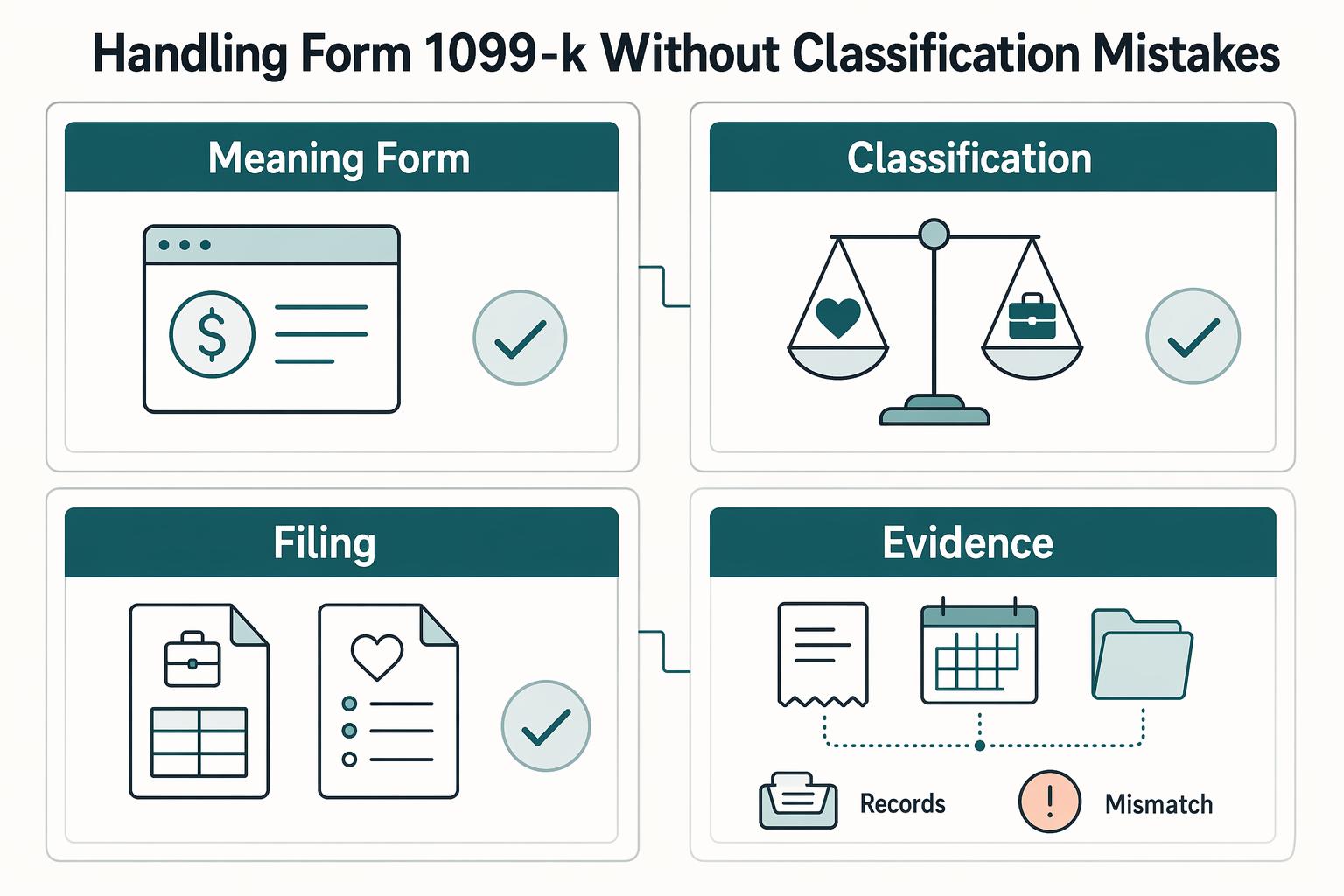
Treat Form 1099-K as a payment report, not as a classification decision. You still classify the activity from the full facts and circumstances, then report income in the right place on Form 1040.
You may receive Form 1099-K for either hobby or business activity, and the payments are taxable income that must be reported. If the activity has no profit intent, report that income on Schedule 1 (Form 1040), line 8. If your facts support business treatment, report it using the applicable business-income schedule on your return.
| Decision point | Wrong shortcut | Defensible handling |
|---|---|---|
Meaning of Form 1099-K | Treat it as proof of business status | Treat it as a payment total to reconcile |
| Classification step | Let the form label decide filing | Apply factor-based classification first |
| Filing route | Send all amounts to Schedule C | Route totals based on classification (Schedule 1 (Form 1040), line 8 for hobby income; business-income reporting for business activity) |
| Documentation | Keep only platform forms | Keep complete and accurate books and records; add a simple reconciliation worksheet if helpful |
Use this triage order before filing:
- Reconcile gross amounts from each
Form 1099-Kto your records for the same period. - Map transactions to the activity type you already classified.
- Route totals according to that classification on
Form 1040.
If you use a reconciliation sheet, keep it simple and readable. A one-page tie-out between platform totals, your ledger, and return inputs can reduce confusion later. A common failure mode is treating every 1099-K dollar as business income without factor review, which conflicts with the IRS factor-based approach.
The safest habit is to treat Form 1099-K as one input in your records, not the master record that overrides everything else. Start by checking whether the platform totals match the period and activity reflected in your own books. Then make sure the return entry matches the classification you already reached from the factor review. That order prevents the form from quietly driving a classification result it was never meant to decide.
This is especially important when your facts are mixed. You may see a formal-looking payment form and assume the IRS therefore expects Schedule C. But the core rule here does not change: classification turns on profit intent and the overall pattern of conduct, not the existence of a payment-reporting form. The form answers a reporting question about payments. It does not answer the legal question of whether the activity is a business.
Cross-border signals that raise the stakes#
When foreign accounts are involved, handle classification and foreign-account reporting as one coordinated filing sequence. Your classification position, Form 1040 reporting, and cross-border disclosures should tell the same story for the same tax year.
Form 8938 and FBAR are separate obligations. Form 8938 is filed with your annual return by that return due date, including extensions, when specified foreign financial assets exceed the applicable threshold. Filing it does not replace FBAR. If FBAR is in play, use tighter documentation standards for classification and filing support.
| Decision area | Lower-complexity domestic pattern | Cross-border pattern needing tighter control |
|---|---|---|
| Payment reporting | Reconcile totals in your return records | Do the same, plus track foreign account activity that may trigger FBAR or Form 8938 |
| Threshold checks | Return reporting is usually the main issue | FBAR can apply when a single-account maximum or aggregate maximum exceeds $10,000; Form 8938 has separate applicable thresholds that vary by filing context |
| Form relationship | One return narrative | Return filing and foreign-account reporting should not conflict |
| Valuation evidence | Standard account records | Keep periodic account statements to support maximum account value calculations |
Use this checkpoint before filing:
- Confirm whether foreign account maximum or aggregate maximum values crossed the FBAR
$10,000trigger. - Check whether specified foreign financial assets exceed the applicable
Form 8938threshold for your filing context. - Verify classification and foreign-account reporting records do not contradict each other.
- If no income tax return is required for the year, note that
Form 8938is not required.
A practical sequence helps here: lock your classification memo first, then test foreign-account forms against the same timeline and income records. If those files tell different stories, resolve that mismatch before submitting either set of filings. This section is about interaction risk and documentation order, not treaty analysis.
Cross-border filing raises the stakes because small inconsistencies can spread across more than one form set. If your Form 1040 file describes the activity one way but your foreign-account materials suggest a different timeline or source pattern, the problem is no longer just classification. It becomes a broader documentation issue. That is why tighter file control matters more here than in a purely domestic fact pattern.
The practical fix is not to create more paper for its own sake. It is to keep one coordinated year file with the same timeline, the same payment records, and the same classification memo supporting every related filing. If foreign account statements are relevant to maximum value calculations, keep those statements in the same working file you use for the return. If they are stored elsewhere and reviewed later, contradictions are easier to miss.
Red flags and when to bring in a pro#
Escalate when your facts, records, and filing position stop telling one consistent story. In hobby versus business decisions, the Internal Revenue Service considers all facts and circumstances, and no single factor controls the result.
| Red flag | Why this raises risk | What to assemble first |
|---|---|---|
| Repeated losses with weak records | Losses can be consistent with startup periods or circumstances outside your control, but weak records make intent harder to support | Complete books and records, year-by-year results, and supporting account statements |
| Major filing positions with thin support | A position without clear support can conflict with your facts-and-circumstances profile | Expense support, business-purpose notes, and clear return tie-outs |
| Inconsistent allocation or recordkeeping methods | Inconsistent methods can create conflicting narratives across filings | Allocation method, usage logs, and assumptions used in the return |
| Contradictory reporting positions | If facts and reporting treatment conflict, rework risk goes up | Factor summary and a clear mapping to filing treatment, including Schedule 1 (Form 1040), line 8 when the activity is not carried on for profit |
| California residency and sourcing friction | California residency is facts-and-circumstances, and California-source wage treatment depends on where services were physically performed | Residency timeline, work-location records, and support for CA workdays versus total workdays |
California is a common escalation point for mobile freelancers. FTB treats residency as fact-specific and does not issue written opinions for a taxpayer's specific residency period. Clean timeline and location records matter even more when part-year or nonresident treatment is in play.
The best time to escalate is before you file, not after a notice arrives. If two interpretations look plausible and the tax impact is meaningful, get review early while you can still adjust records and return mapping without a response deadline.
Use this path if a notice or dispute starts:
- Freeze position changes and assemble one complete file before responding.
- Make sure your federal
Form 1040and California positions are both supported by the same underlying facts, and document where treatment differs. - Respond through IRS or
FTBchannels with targeted documentation tied to each issue.
Another signal that it is time to bring in a pro is when you cannot clearly explain your position in plain language without slipping into conclusions. If your explanation keeps returning to "this is how I filed last year" or "the platform sent a tax form," you probably need a stronger analysis. A reviewer will want to see the facts, not just the outcome.
Professional help is also useful when the problem is organizational rather than legal. Sometimes the rules are not the real issue; the file is. A pro can often spot missing links quickly, such as a classification memo that does not match the records, or a return draft that does not match the reconciliation sheet. Catching those issues before submission is much easier than repairing them after a notice arrives.
Thirty-day implementation checklist#
Once you identify red flags, use the next 30 days to make your position filing-ready. Your records, draft return, and support documents should all tell the same story.
| Week | Primary outcome | Verification checkpoint | Escalation trigger |
|---|---|---|---|
| Week 1 | Confirm your provisional classification and document your current assumptions | Your memo still matches your actual activity and records | You cannot explain key assumptions with the records you have |
| Week 2 | Build the evidence file and reconcile payment records | Source totals tie to the amounts feeding your draft return | Material record gaps or unreconciled differences remain |
| Week 3 | Dry-run whether Schedule SE (Form 1040) is needed, using your current facts | You can trace net-earnings inputs and calculations back to source records | Line-level inputs are not supportable, or outcomes shift after reconciliation |
| Week 4 | Finalize your U.S. federal tax return position or pause and escalate | No unresolved conflicts across records, calculations, and filing position | Open documentation or calculation issues remain near submission |
Week 3 is the key risk checkpoint. Schedule SE (Form 1040) is used to figure tax due on net earnings from self-employment. This tax can still apply regardless of age, including if you already receive Social Security or Medicare benefits. Use the current form and instructions in your dry run so you are not working from stale assumptions.
Keep one cost check in the same review: self-employment tax is 15.3 percent, split into 12.4 percent Social Security and 2.9 percent Medicare. For 2024, IRS guidance states the first $168,600 of combined wages, tips, and net earnings is subject to the Social Security portion rules.
Minimum packet by day 30:
- Dated classification memo plus an update note for what changed since week 1.
- Reconciliation sheet tying source records to draft return inputs.
Schedule SEcalculation worksheet and assumptions log.- Final decision note: filing-ready now, or escalating before submission.
Add one final review pass before submission day: read your memo, then read your return inputs and reconciliations in that order. If the logic is hard to follow in five minutes, simplify the file and clarify conclusions while the facts are still fresh.
Main failure mode: treating one summary IRS page as complete. IRS self-employment guidance says its item list is not all-inclusive. If week 4 still has unresolved conflicts, escalate before filing.
You can make each week more useful by giving it one clear deliverable. In week 1, the deliverable is a memo that states your provisional classification and identifies open issues. In week 2, the deliverable is a clean tie-out between source records and the draft return. In week 3, the deliverable is a calculation file that shows whether Schedule SE belongs in the return and how the numbers were reached. In week 4, the deliverable is a final go-or-pause decision.
This cadence keeps the process from turning into last-minute cleanup. If week 2 ends with unreconciled differences, you already know week 3 calculations may not be reliable. If week 3 changes the economics of the filing significantly, you still have time in week 4 to revisit the classification memo and decide whether escalation is needed. The checklist is not just about finishing tasks; it is about catching contradictions while you still have room to fix them.
If you operate across countries, keep your filing timeline and residency evidence in one place with the Tax Residency Tracker.
Final takeaway and next step#
Classification is based on facts and circumstances, not a label you choose once and reuse forever. Reassess with current records before filing, and make sure your treatment and Form 1040 reporting tell one consistent story. If they conflict, pause and resolve the gap before you file.
| Decision style | What it looks like in practice | Potential filing impact |
|---|---|---|
| Label-first | Pick hobby or business first, then backfill support | Can create rework when facts do not fit |
| Fact-first | Review current-year facts, then map treatment | Can improve alignment between evidence and reporting |
| Mixed signals ignored | Keep last year's treatment after facts changed | Can increase correction risk later |
The IRS says taxpayers must weigh all relevant factors, and no single factor controls the result. If an activity is carried on without intention to make a profit, report that income on Schedule 1 (Form 1040), line 8. When facts support business treatment, maintain complete and accurate books and records that support that position.
The next step is not to hunt for one decisive form or one decisive sentence. It is to bring the file into alignment. Review the factors, confirm the income totals, make the return treatment match the memo, and note any weaknesses honestly. A modest, well-documented position is usually easier to defend than a favorable position supported by thin records.
- Re-run your factor review using current-year records.
- Confirm your planned
Form 1040reporting matches those records, includingSchedule 1 (Form 1040), line 8when applicable. - Update your decision memo with the date, conclusion, and open risks.
- Escalate if unresolved record gaps or contradictory facts remain near filing.
For state-tax overlap, review Do I Have to Pay State Taxes While Living Abroad as a Digital Nomad?. For filing operations after classification, continue with How to Handle Taxes for a Side Hustle.
If you want a single place to organize payment records and tax-document steps where supported, review the Gruv docs.
Frequently Asked Questions
What is the IRS hobby vs business test in one sentence?
The IRS looks at whether the activity is carried on with intent to make a profit or mainly for enjoyment. You must weigh all facts and circumstances, and no single factor controls the result.
Do I still report income if the activity is a hobby?
Yes. If the activity is carried on without an intention to make a profit, report that income on Schedule 1 (Form 1040), line 8. Even without a Form 1099-K, income from payments for goods, services, or property must still be reported.
Can hobby losses offset other income on my tax return?
Do not assume that hobby losses can offset other income. Treat that point as unresolved for this article’s scope.
Does getting Form 1099-K mean the IRS sees me as a business?
No. A Form 1099-K may be issued for payments tied to either hobby or business activity, so the form alone does not determine classification. Box 1a reports a gross payment amount, and IRS guidance notes gross can include items that are not taxable income.
What should I do if my facts look half hobby and half business?
Work from the IRS factors and evaluate all facts and circumstances instead of forcing a quick label. Keep records that support the position you take, including payment app or marketplace reports, payment card receipts, and merchant statements.
Where do I report hobby income versus business income on Form 1040?
For activity with no profit intent, report hobby income on Schedule 1 (Form 1040), line 8. For business income, use your records and current return instructions to map amounts correctly on your Form 1040 filing. Do not rely on a payment-form label by itself when deciding placement.
Try a related tool
Researched and edited by the Gruv editorial team. Gruv builds cross-border billing, payouts, and finance-operations software for global businesses.
Sources
Educational content only. Not legal, tax, or financial advice.
Related Posts

Do I Have to Pay State Taxes While Living Abroad as a Digital Nomad?
Living abroad does not end `state income tax` exposure by itself. The first decision is practical: choose a filing position your facts can support, then build records that support the same story all year.

How to Handle Taxes for a Side Hustle
If you want less stress at filing time, use sequence instead of shortcuts. When one year includes payroll income, contractor income, and time in more than one country, the order of operations matters. This guide gives you a defensible path so you can make each decision once, document it, and avoid rebuilding the return later.
The Freelancer's Year-End Tax Prep Checklist (US Expat Edition)
Your year-end target is filing readiness. By December 31, you want a complete file for your U.S. federal return, not a last-minute chase for documents. For a globally mobile freelancer, the hard part is usually proving what happened, choosing the likely FEIE or FTC lane, and spotting the facts that need professional review.