
Quick Answer
Identify who created the work and who can grant its rights. Agree a valid assignment or licence, separate background and third-party materials, define the territory and transfer trigger, and preserve creation and delivery records. Check the actual countries involved. EU VAT registration and payment records do not alone establish IP ownership.
Protect ownership, permitted use, and the evidence behind them#
For an Eastern Europe engagement, identify the creator, contracting entities, countries of performance and use, and the rights your client needs. Separate newly created deliverables from reusable background materials and third-party components. VAT administration can run alongside these decisions where relevant, but registration or an invoice does not establish copyright ownership.
Here is the plain-language baseline:
- Ownership: who legally holds IP rights; assignment or transfer moves title, while licensing can allow use without transferring title.
- Enforceability: your practical ability to defend rights through legal remedies and courts.
- VAT administration: VAT registration, returns, payment, and record-keeping.
- OSS: an optional One Stop Shop route where you register in one Member State for covered cross-border supplies.
- CBR: an advance VAT ruling route for cross-border transactions between participating Member States.
- Cross-border SME route: the VAT-exemption access path that starts with prior notification in your Member State of establishment and can apply only after EX-number grant or confirmation.
Keep the contract-rights and tax decisions separately documented. An applicable tax deadline can affect billing; an IP formality can affect transfer. Resolve each dependency before the activity that relies on it.
Use this quick decision flow:
- Inventory assets and every creator or contributor, including employees and subcontractors.
- Choose assignment or licence terms, list background and third-party materials, and check required formalities.
- Assess applicable VAT treatment separately, including ordinary rules or eligible special mechanisms.
- Assign owners, dates, dependencies, and evidence locations.
| Evidence type | What it proves | What it does not prove |
|---|---|---|
| OSS registration, VAT returns, payment records | VAT registration, declared treatment, or commercial payment activity | That IP title transferred |
| SME prior notification and EX number | Access to that VAT route | That your client owns the work |
| Contract language on assignment or licensing | Agreed rights terms, subject to authority, validity, formalities, and triggers | VAT compliance on its own |
Payment can trigger an assignment or licence if the valid agreement says so, but a paid invoice alone does not establish that all IP rights transferred. Read the operative rights clause, the creator’s authority, and any applicable formalities together.
We covered this in detail in The legal difference between 'licensing' your IP and 'assigning' your IP.
Build the Mental Model Before You Draft Contracts#
Start with two lanes before the first redline: one for IP and contract rights, one for VAT administration. That separation keeps tax-process questions from turning into ownership disputes and keeps deals from stalling for the wrong reason.
In the rights lane, decide assignment versus licence, who grants rights, and when rights transfer. In the VAT lane, decide the filing path, owner, and timing assumptions for invoicing or launch. Keep them separate. OSS registration, a CBR request, or SME prior notification can affect billing and timing, but none of them transfers copyright.
Use three labels in redlines#
Put three internal labels at the top of the draft and triage every open point through them.
| Label | Use for | Example |
|---|---|---|
| Legal blocker | Issues that change ownership, use rights, or enforceability | Unclear assignment or licensing language |
| Admin blocker | Filing or timing dependencies that affect VAT treatment, billing dates, or rollout without changing ownership | CBR, OSS, or the cross-border SME route |
| Planning note | Visible but non-blocking assumptions until verified | Current thresholds, current processing windows, or route eligibility |
A legal blocker changes ownership, use rights, or enforceability. If assignment or licensing language is unclear, fix it before signature. If your team is still mixing terms, align first with Work for Hire vs. Assignment of Rights: A Freelancer's Guide to Owning Your IP.
An admin blocker covers filing or timing dependencies that affect VAT treatment, billing dates, or rollout without changing ownership. This includes CBR, OSS, and the cross-border SME route. CBR applies to transactions involving participating Member States. OSS is optional, and OSS returns are additional to domestic VAT returns. The cross-border SME route starts with one prior notification in the Member State of establishment and, if granted, a single EX number used across Member States.
Use a planning note for an assumption that does not yet affect a binding commitment. If route eligibility or a threshold determines lawful tax treatment, resolve it before applying that treatment rather than treating it as permanently non-blocking.
Simple triage rule: if it changes title or permitted use, treat it as legal. If it changes filing steps or dates, treat it as admin. If it changes neither, park it as a planning note.
Turn the checklist into a decision table#
Once the labels are clear, keep one live table from first draft through signature.
| issue | owner | blocking status | next action | verification needed |
|---|---|---|---|---|
| Ownership label in scope and IP clause | Legal/commercial | Legal blocker if unclear | Decide assignment or licence and align contract language across deal docs | Confirm any local label, for example work for hire, is intended and valid for this deal |
| Complex cross-border VAT treatment | Finance/tax | Admin blocker if billing depends on it | Check whether CBR is available before promising dates | Confirm current participating-country scope |
| Cross-border SME route | Finance | Admin blocker if relying on SME access | File prior notification in the Member State of establishment and track EX-number grant or confirmation | Confirm current threshold and processing window before relying on them |
| OSS route for B2C activity | Finance | Planning note or admin blocker, based on launch dependency | Decide whether to use OSS and map domestic return obligations separately | Confirm activity or customer profile fits current OSS rules |
| Launch date tied to filings | Commercial | Planning note until verified | Give a conditional date, not a fixed promise | Confirm whether current public timing targets apply and note delay risk |
Two operating rules cut rework. Verify the filing path before commercial dates show up in client emails. Keep a small evidence pack with the table: draft version, route note, filing owner, and assumption-check date.
Track timing that needs verification#
The usual failure is false certainty, not missing contract language. If timeline commitments depend on SME, OSS, or CBR steps, keep these unresolved fields in draft notes until official guidance is checked:
- Confirm the current threshold with the national tax authority
- Confirm the current processing window from the official source
Close these fields only after a named owner checks live guidance. Keep route boundaries explicit: OSS is optional, CBR is not universal, and the EU SME route should not be assumed for a small enterprise outside the EU.
Use one short handoff script internally#
Clear handoffs keep the two-lane model alive in practice.
- Legal: "We are confirming assignment versus licence. Tax filings do not determine ownership."
- Finance: "We are confirming CBR, OSS, or SME steps, including prior notification and any EX-number dependency. These affect billing and timing, not ownership."
- Commercial: "Scope and price can move now; launch dates stay conditional until finance verifies the filing path."
If any team cannot state its lane that clearly, pause and reset before the next draft round.
What Is Automatic and What Needs Formal Filing#
After you split rights from VAT, split again: what is automatic and what depends on a filing. If you blur those categories, you create false confidence. VAT filings can look official but do not prove IP ownership, and contract wording can look final even when the right still depends on registration or local formalities.
This matters most when your deal includes transfer or exclusivity. Copyright protection in the EU starts automatically at creation, but licensing and usage still rely on national law, so keep these as separate checks: the right exists and the deal validly transfers or restricts it.
Classify each asset first#
For each asset, record the jurisdiction, whether protection exists, its territorial scope, and any application, registration, or contractual formality needed. Trade secrets and unregistered rights need different evidence from registered rights.
| Asset | Status | Key note |
|---|---|---|
| Copyright | Automatic | Run a jurisdiction check; if the deal assigns ownership or grants an exclusive licence, require local counsel confirmation |
| EU trade mark | Registration required | Do not draft as if rights are secured until registration status is confirmed |
| Patent (including the European patent route) | Registration required | Check grant, national validation where needed, and any registered unitary effect |
| Unregistered EU design | Can arise from qualifying disclosure | Three-year copying protection differs from registered design protection |
| Trade secrets | Protection depends on statutory conditions | Identify secret information, commercial value from secrecy, and reasonable protective measures |
- Copyright: usually
automaticat creation. Still run a jurisdiction check. If the deal assigns ownership or grants an exclusive licence, require local counsel confirmation. - EU trade mark:
registration required. Do not draft as if rights are secured until registration status is confirmed. - Patents: check grant and territorial coverage. National validation and unitary effect are distinct post-grant routes; check the route and formalities relevant to the countries needed.
- Unregistered EU designs and trade secrets: qualifying design disclosure can begin three years of copying protection; trade secrets require secrecy and reasonable protection. An NDA supports confidentiality but does not itself assign copyright.
Operator check: for each asset, identify the document that proves the right exists and the document that proves transfer or exclusivity. If those differ, keep both.
Map the VAT path separately#
Record the tax treatment relevant to this transaction. OSS, the SME exemption, and CBR are different mechanisms, not mutually exclusive choices for the business as a whole or mandatory IP-protection stages. Ordinary B2B services may use normal VAT rules, including reverse charge where applicable, without OSS.
| pathway | when to use | required filing action | owner | contract dependency |
|---|---|---|---|---|
| CBR | Complex cross-border VAT treatment where advance clarification is needed | File a cross-border VAT ruling request where available under national conditions | Finance/tax | Admin blocker if pricing, invoicing, or launch timing depends on the outcome |
| Cross-border SME route | Small enterprise using the cross-border SME VAT exemption (from 1 January 2025) | File prior notification in the Member State of establishment; use the granted EX number only in selected Member States where use is confirmed and eligibility is met | Finance | Admin blocker when SME treatment is required; confirm eligibility (including the EUR 100 000 Union turnover ceiling) and processing timeline for the specific case |
| OSS | Covered cross-border B2C supplies where one portal is useful | Register once, then file one OSS return and make one payment through the portal | Finance | Planning note or admin blocker depending on billing model; OSS is optional, OSS returns are additional to domestic VAT returns, and filing and payment follow the end of the following month deadline |
| None | No special route needed, or normal VAT arrangements chosen | No CBR request, no SME route, no OSS | Finance | Record the decision so nobody assumes a filing is pending |
Check CBR availability and national conditions if you need that ruling mechanism. For OSS transactions, retain the required records for 10 years from the end of the transaction year, not merely until the project closes.
Require written status before signature#
For every in-scope IP right and VAT pathway, require one written status: pending, confirmed, or blocked.
If a business-critical right or VAT path is still pending, treat unconditional delivery or launch promises as premature.
Keep proof of right separate from proof of process#
To keep the next steps clean, run two calendars: one for legal-right confirmation and one for VAT-process completion.
Use one explicit checklist split:
proof of right: signed assignment or licence terms, registration details where required, confidentiality controls where trade secrets matter.proof of process: prior notification records, EX number confirmation, OSS registration, return timestamps, payment records.
Do not let proof of process stand in for proof of right. That separation turns country variation into a verification task instead of a late-stage dispute.
Handle Country Variation Without Stalling Deals#
Treat country variation as a routing task, not a deal stopper. Map countries before scope, exclusivity, and launch dates are locked so you can adjust legal language without reopening commercial terms.
In Eastern Europe deals, a common failure mode is assuming one EU answer covers every country in the chain. IP is territorial, so the exploitation country can matter as much as the signing country.
Use one intake matrix for every cross-border deal#
Use a four-country lens that assigns risk, owner, and the legal check still required.
| matrix field | what you record | main risk | owner | required legal check |
|---|---|---|---|---|
| client entity | contracting party country and legal entity | wrong assumptions about who can receive rights, invoice, or claim under the contract | Legal or deal lead | confirm entity details, governing-law fit, and whether EU process routes are available |
| performance | where services are actually performed | local legal or compliance variation that can affect delivery and records | Operations with legal support | confirm whether local execution issues need review |
| exploitation | where deliverables are used, sold, licensed, or enforced | territorial IP gaps, especially when use extends beyond EU coverage | IP counsel or external local counsel | confirm coverage, transfer validity, registration scope, and enforceability in each use country |
| dispute venue | chosen court, arbitration seat, or likely forum | clause mismatch and enforcement surprises | Legal | confirm jurisdiction clause, conflict-of-laws position, and venue-specific enforceability |
Checkpoint: if exploitation and client-entity countries differ, do not treat the signing country as your only legal check.
Branch early when EU coverage ends#
If any in-scope country falls outside EU process coverage, mark EU assumptions as limited and open a separate local-enforceability track immediately.
OSS administers eligible EU VAT supplies; eligible non-EU suppliers can use the non-Union scheme for covered services. CBR depends on participating Member States. The cross-border SME exemption requires EU establishment and relevant eligibility. None of these mechanisms establishes IP rights in a non-EU country.
An EU trade mark is a unitary registration across EU Member States, not all countries described as Eastern Europe. A Unitary Patent covers its participating territory; a European patent can also require national validation outside that territory. A worldwide contractual licence defines permitted use, but does not enlarge the territorial coverage of a registered right.
Keep EU process details open until verified#
Where EU routes apply, keep unresolved fields in the matrix instead of hardcoding memory-based numbers:
- CBR availability: confirm current participating-state coverage from the official source
- Cross-border SME threshold: confirm the current threshold with the national tax authority
Start from the published EU reference point, then verify current country-level conditions.
- Cross-border SME timing: confirm the current process timing from the official source
The SME scheme publishes a normal registration process of up to 35 working days after receipt of prior notification, with longer investigation cases possible. Eligibility and EX-number confirmation must support the selected Member States before exempt treatment starts. Do not promise a 30-calendar-day tax completion.
- OSS status: eligible supplies, scheme, Member State of identification, effective date, and registration/return owner.
This prevents launch planning from relying on outdated assumptions.
Give the map one owner#
Assign one country-map owner per deal so assumption changes and contract language stay aligned with the countries actually in scope. That owner should keep territory, licence, and subcontracting language synchronized with the matrix, especially for white-label or multi-market delivery. Use the same working file for your territory drafting notes and How to Structure a 'White Label' Service Agreement.
Done properly, this reduces the late-stage failure risk where the contract is signed and invoicing-ready but only partly enforceable where you need it.
Related: IP Protection When Outsourcing Software Development to Eastern Europe.
Choose Ownership Structure That Matches the Engagement#
Assignment and licensing serve different commercial purposes. An assignment transfers ownership of the rights identified; a licence grants permitted use while the owner retains title. National law determines transfer formalities, default ownership, and which rights can be waived or transferred.
Use the terms narrowly:
- Assignment: transfer of IP ownership to another person or legal entity.
- License: permission for the client to use IP while you keep ownership.
- Work made for hire: a U.S. copyright concept with specific statutory conditions, so treat it as jurisdiction-specific language pending local confirmation.
Check the governing law and the law relevant to protection. As a country-specific illustration, the Polish Copyright Act in WIPO Lex, consolidated through March 2022, requires written form for transfer of economic rights under Article 53 and expressly identified fields of exploitation under Article 41. Confirm the current applicable text and valid signing method for a Polish transaction. A generic phrase such as all rights everywhere cannot substitute for required formalities.
Pick the starting posture that fits the delivery pattern#
| delivery pattern | client reuse expectation | your need to retain background IP | practical starting model | drafting note |
|---|---|---|---|---|
| one-off custom deliverable created mainly for this client | client expects to own and reuse the final output without asking again | low | assignment | Use only when you intend a full transfer of final-deliverable rights. |
| recurring service using your templates, methods, code snippets, datasets, or know-how | client needs use rights, not your full toolkit | high | license | Put scope, term, territory, and field of use in one controlling clause set. |
| white-label delivery where the client brands the output as its own, but you rely on pre-existing materials | client needs broad use of the deliverable, sometimes for onward supply | high | split model: transfer or broad license of foreground deliverables, retention of background IP | Separate newly created deliverables from pre-existing materials. |
| U.S.-linked copyright arrangement where a party insists on work-for-hire wording | client wants first-instance ownership language | varies | work made for hire drafting position, pending local confirmation | Do not assume this wording applies cleanly outside jurisdiction-specific rules. |
Quick rule: if the value is the finished output, assignment can fit. If the value is your reusable method, a license usually fits better. If both matter, split ownership explicitly instead of using vague "all materials" language.
Draft white-label clauses as two buckets, not one#
For white-label work, separate the contract into two buckets: foreground deliverables created under this engagement and background IP made up of data, know-how, information, and other materials you held before signing and need to perform or exploit the work.
Document background IP in writing before signature, ideally in a schedule listing pre-existing materials and related access rights. Keep all limits for that background IP in one controlling clause set: scope, term, territory, and, where needed, field of use. This avoids conflicts where one clause grants broad use and another narrows use to a specific project.
If several people contribute, trace each contribution and the authority to grant the promised rights. Jointly created work may need joint-ownership arrangements, assignments, or licences; joint ownership is not the only permissible commercial solution. Agree use, enforcement, licensing, and revenue arrangements rather than leaving them to assumptions.
Keep VAT in a separate lane. VAT chargeability and invoicing can affect timing, and EU invoicing rules apply to most B2B supplies, but VAT workflow does not decide IP title. If compliance could affect deal timing or billing, track current thresholds and process timing as pending official verification before relying on them.
Run this pre-sign ownership check#
Before signing, confirm these five points:
- What transfers: exact deliverables or rights being assigned or licensed.
- What stays with you: all listed background IP and pre-existing materials.
- What use is limited: scope, term, territory, and field of use in one controlling clause set.
- What local law status is: any written-form, registration, or jurisdiction-specific confirmation still required.
- What timing dependency exists: any VAT or invoicing step that could affect deal timing or billing, tracked separately from ownership.
For example, a developer creates a client dashboard using a pre-existing reporting library and an open-source chart package. List the custom dashboard code as the intended assigned foreground work, retain the reporting library, and grant the client the permissions needed to run and maintain the combined deliverable. Identify the chart package and its licence obligations separately; you cannot promise exclusive ownership of third-party code. If a subcontractor writes the export module, obtain its valid rights grant before promising those rights downstream. State the payment or other transfer trigger expressly. A paid invoice and repository access do not replace these terms.
Use a Pre-Sign Contract Checklist for IP Clauses#
Before signature, make the rights grant, authority, formalities, and commercial terms workable. Tax registration may complete later if the agreement makes the relevant billing or launch dependency conditional and the law permits that timing. Do not require every VAT process to finish before a contract can be signed.
Run one live checklist with five required fields#
Keep one checklist artifact in the deal folder and use it during the pre-sign call. Each line should include:
- Item
- Owner
- Status
- Dependency
- Evidence note
For the IP lane, track at least these items: ownership model confirmed in draft, written-form check completed, country-specific registration check flagged where relevant, confidentiality protection in place for pre-sign disclosures, and annex consistency confirmed. If a deal mixes pre-existing and newly created IP, keep that separation explicit in the checklist itself. If you need deeper clause separation, see How to Structure a 'White Label' Service Agreement.
Write evidence notes so someone outside the call can verify closure, for example an accepted redline version, counsel confirmation on formality, or a schedule listing pre-existing materials. Avoid vague notes like "discussed." Where country formalities are still uncertain, escalate to legal review before signature.
Keep VAT readiness explicit and separate#
Track VAT in the same packet only when it can move signature, launch, or billing dates. If OSS is in scope, assign owners for registration, filing, and payment. OSS is optional. If you use a scheme, supplies under that scheme must be declared through OSS, and OSS returns are additional to domestic VAT returns.
Where details are not yet verified, keep unresolved fields in the checklist instead of fixed numbers:
- Confirm the current threshold with the national tax authority
- Confirm the current filing window with the national tax authority
- Member State of identification pending tax review
If billing assumptions depend on OSS choices, log that dependency explicitly.
| status | what it means operationally | action before signature |
|---|---|---|
| complete | Agreed, owner accepts it, and evidence is in file | Signature may proceed on this item |
| pending with condition | Not fully closed, but condition is specific and accepted | Add condition to signing approval and assign named owner |
| blocker | Impacts ownership terms, authority, or launch or billing timing materially | Do not sign until resolved or redrafted |
Version-lock before approval#
Before approval, lock the exact contract version, annex version, and checklist version that cleared review. If contract text, annexes, or VAT assumptions change, rerun the checklist before signing.
Rerun immediately if the ownership model changes, country-specific formality assumptions change, or OSS assumptions are introduced or revised. This is how you catch late edits that quietly change execution risk before signature.
Related reading: Creative Commons for Freelancers Without Client Contract Conflicts.
Before you send the draft, generate a clean first-pass agreement and redline only the jurisdiction-specific clauses that need counsel review: Use the freelance contract generator.
Set Governing Law, Jurisdiction, and Dispute Resolution Up Front#
Set venue terms as one clause package before signature. In cross-border Eastern Europe work, splitting these terms across documents or leaving them half-defined can create avoidable enforcement risk.
Define the three terms before you negotiate#
Governing law identifies the legal system for contractual obligations. Where Rome I applies, party choice is subject to its rules and overriding mandatory provisions. It does not determine every territorial IP issue or all procedural questions.
Jurisdiction identifies the court forum. A choice of an EU Member State court under Brussels I recast is subject to validity, scope, and the Regulation’s rules, including exclusive jurisdiction for certain registered-IP validity disputes. A contract cannot simply override every mandatory forum.
Dispute resolution identifies the route for covered disputes, such as litigation or arbitration. Arbitration terms should identify scope, seat, rules, and appointment process. Court proceedings for interim relief or award enforcement can coexist with arbitration when the agreement and law permit them.
Choose the route both sides can execute, then draft procedure in the same package#
Choose a coherent route that both parties can use, with costs, language, notices, escalation, and evidence preservation addressed. Contract provisions cannot displace mandatory procedural law; identify the forum’s rules as well as the parties’ agreed logistics.
For arbitration, check the agreement’s validity and the New York Convention framework, including enforcement-state coverage and refusal grounds. For an exclusive court clause, assess the relevant jurisdiction and recognition regime. The Hague Choice of Court Convention has treaty, temporal, party, and subject-matter limits, including IP exclusions; do not assume it covers every infringement or validity dispute.
Check hierarchy across the full deal set before sign-off#
| Document | What to verify | Typical conflict to remove |
|---|---|---|
| Main terms | Governing Law, forum path, notice, cure, and evidence steps | Main terms select one court path |
| Annexes/schedules | Repeated or conflicting dispute text | Annex inserts arbitration or a different notice method |
| Order forms/SOWs | Short-form legal language and local procurement terms | Order form points to a different court or silent override text |
If anything conflicts, add explicit precedence language so one document controls.
Keep VAT operational in this section, not as ownership evidence. OSS and VIES are compliance tools: OSS returns are additional and do not replace domestic VAT returns, and VIES is a validation search tool for VAT registration status. OSS record-retention runs for 10 years, so define who keeps records and where. Treat jurisdiction-specific thresholds and filing windows as pending official verification before they are used in approvals or filing calendars.
Before legal review, run this pre-sign check:
- A coherent route for each category of dispute, including any intended court interim-relief or enforcement role.
- No competing forum language across main terms, annexes, and order forms.
- Notice, cure, and evidence steps are explicit, not implied.
- Red flag test: if you cannot name who keeps records, where notice is sent, and what evidence is preserved, pause signature.
Write Risk Allocation Clauses That Actually Protect You#
Draft Limitation of Liability, Indemnification, and Termination as one package. Together they determine whether you can actually run a claim response or a clean exit. If you review them in isolation, you can miss the real gap: a claim is recognized, but control, payment exposure, or post-termination rights are unclear. VAT process matters for context, but it does not determine contract-specific liability, indemnity, or termination outcomes.
The practical test is simple: if a dispute or exit starts tomorrow, can you identify who acts, who pays, what approvals are required, and what survives termination?
Tighten definitions before debating numbers#
For limitation of liability, make the clause state cap scope, exclusions, and cap mechanics. If it is unclear whether the cap is aggregate or per claim, your exposure is unclear. Check main terms, SOWs, and order forms for conflicting cap language.
For indemnification, lock the mechanics, not just broad promises. State the notice path, claim-response control, cooperation duties, and settlement-consent rules. Without that process, disputes over control and deadlines can escalate quickly.
For termination, define what happens on the termination date to licenses, deliverables, source files, access credentials, and unpaid amounts. If rights depend on payment, acceptance, or a separate assignment step, state that in the same package. If you need more ownership-structure context before drafting survival language, see Work for Hire vs. Assignment of Rights: A Freelancer's Guide to Owning Your IP.
| Clause | Balanced drafting | Risky drafting | Quick decision test |
|---|---|---|---|
| Limitation of Liability | Defines scope, exclusions, and whether the cap is aggregate or per claim | States a cap only, or leaves cap mechanics unclear | Can you calculate likely exposure from one read, without assumptions? |
| Indemnification | Names notice path, response control, cooperation duty, and settlement consent | Promises indemnity but does not define who runs the response | If a claim arrives today, can one person run the clause step by step? |
| Termination | States post-exit treatment of rights, files, access, and unpaid amounts | Ends the contract but leaves post-exit rights and obligations unclear | On exit day, can you tell what each side must stop, deliver, or pay? |
Use this as an execution test for real claim handling. If the package cannot be executed, it is not ready.
Keep VAT in its lane#
Keep VAT process as operational context, not contract risk allocation. OSS is optional and works through one Member State of identification. If you choose an OSS scheme, declare all supplies covered by that scheme via the OSS return. OSS returns are additional to regular VAT returns. EU OSS materials also reference record-keeping, invoices, and bad-debt-relief rules.
Keep VAT thresholds and filing windows in working notes as pending official verification. Do not treat OSS status, invoice status, or VAT filings as proof of ownership, indemnity scope, or termination rights.
Pre-approval check#
Before approval, confirm all of the following in one document set:
Limitation of Liabilityscope, exclusions, and cap mechanics align across main terms, SOWs, and order forms.Indemnificationnotice path, response control, cooperation duties, and settlement consent are stated consistently.Terminationlanguage matches ownership and license structure, including source files, deliverables, access, and unpaid amounts.- Your evidence pack is ready, for example acceptance records, delivery logs, invoice records, and written approvals.
- Nothing in this package conflicts with governing law, jurisdiction, or dispute-resolution terms.
Check these points in the operative draft and existing records before signature. Final delivery, acceptance, and payment records will be added as the engagement progresses; they cannot all exist at signing.
Prepare an Evidence Pack Before Any IP Infringement Fight#
Build your evidence pack before any dispute starts, and keep the core pack limited to dated, transaction-linked records you can retrieve fast. For cross-border Eastern Europe work, that is a practical way to protect your position without slowing operations.
Copyright protection generally arises automatically for eligible works, but existence, ownership, and authority to enforce are different questions. Keep creation history, contributor terms, valid assignments or licences, delivery and acceptance records, and the payment evidence relevant to any contractual rights trigger. Where registration is relevant to another IP right, keep its scope and status too.
Build the file around dated events#
Index dated events: agreement, creation, revisions, delivery, invoicing, payment, acceptance, and relevant filings. Keep explanatory notes for gaps or disputed facts; complex events may need an explanation as well as underlying records.
Use an artifact matrix at the top of the pack so legal, finance, and operations can all follow the same map.
| Artifact type | Owner | Date | Linked transaction stage | Storage location |
|---|---|---|---|---|
| Signed master agreement, SOW, order form, NDA | You or both parties | Execution date and amendment dates | Agreement and scope definition | Contracts folder, signed PDF repository |
| Creation record (draft file, source file, export, commit snapshot, dated version) | You or creator | Creation and revision dates | Authorship and work existence | Project archive, version history, source repository |
| Delivery and acceptance record (submission email, upload log, acceptance message, approval note) | You and client | Delivery date and acceptance date | Delivery and acceptance | Client communications folder, project platform export |
| Invoice and payment confirmation | You, payment provider, bank | Invoice date and payment date | Commercial performance and consideration | Accounting folder, bank export, payment processor |
| VAT or filing context record (OSS record, return support, optional registration receipt) | You or filing agent | Filing date or transaction date | Compliance context and timing | Tax folder, filing portal export |
Keep names and paths consistent between the table and stored files. If they do not match, review speed and confidence drop fast.
Keep VAT and filing records in the context lane#
Include VAT and filing records as context, not ownership proof. OSS records are for tax verification and transaction-level VAT details, so they help with chronology but do not prove authorship or assignment by themselves.
When ownership is challenged, your strongest records are still creation history plus signed rights language. VAT returns, OSS records, and invoices support the timeline around the work.
Where compliance assumptions are needed, log current thresholds and filing deadlines as pending official verification instead of stale numbers. If records span periods before and after 1 July 2021, label them clearly. If OSS records are included, keep them for 10 years from the end of the transaction year.
Be strict about what belongs in the core pack#
Preserve relevant evidence even if a screenshot lacks a date or a record cannot yet be tied to a stage. Mark what is known about its source and limitations and request missing context. Use an indexed core file for easy review, while retaining supporting material without alteration.
This is an operational point, not a theoretical one. Admissibility depends on forum, but noisy files slow review and raise reliability questions when capture source or timing is unclear.
Track relevant records held by another party and identify lawful routes to request or preserve them. Disclosure powers vary by forum and procedure; do not assume a court can obtain every external item.
Assign one custodian and test the handoff#
Assign one evidence custodian to own the top-level index, path accuracy, preservation, and archiving discipline. That role supports legal review by keeping the file reliable and retrievable during active work.
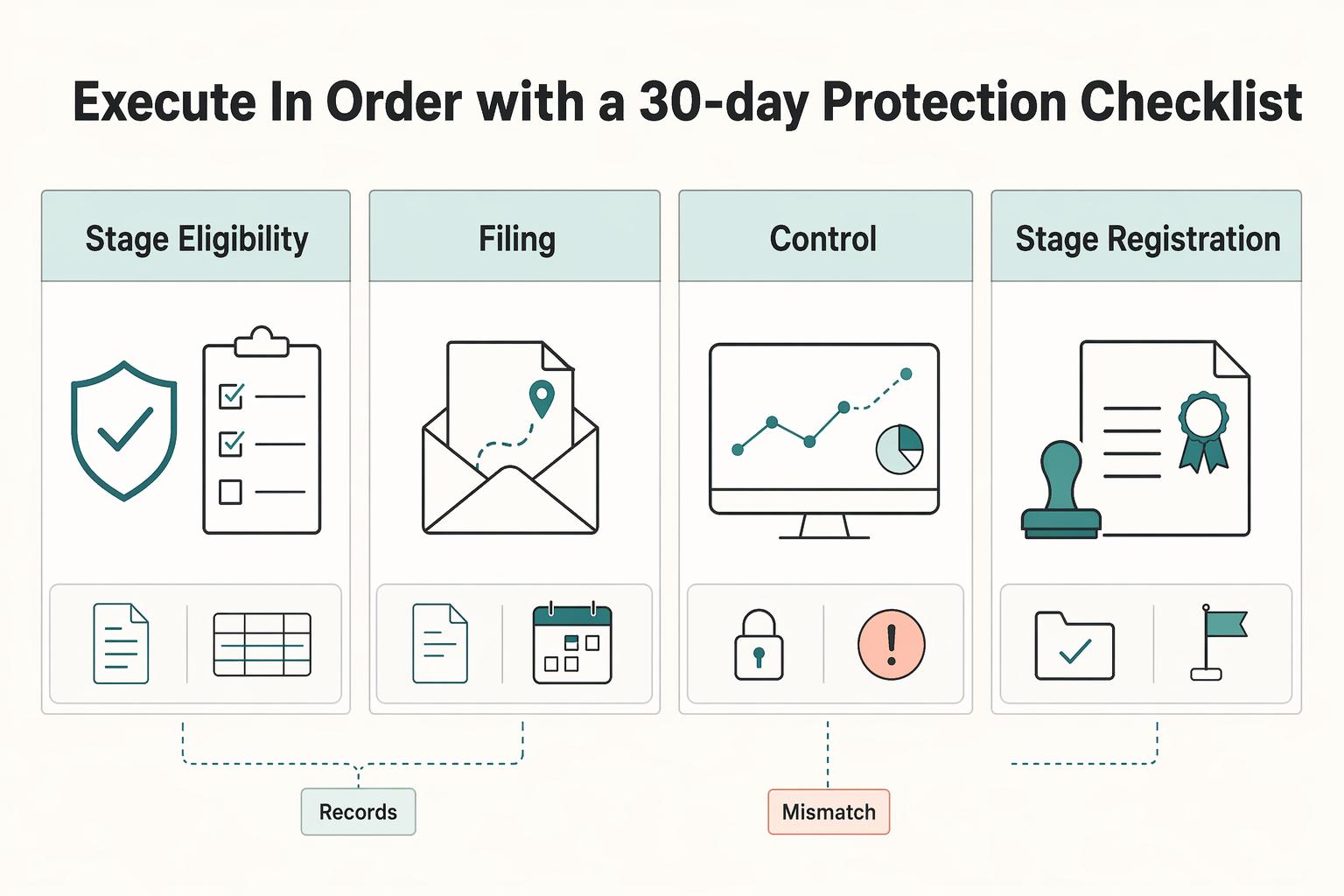
Run one handoff test: give the index to someone outside the deal and ask them to trace a transaction from signed agreement to payment and acceptance using only listed paths. If they cannot do it cleanly, the pack is not ready. Once it passes, move to Execute in Order With a 30-Day Protection Checklist.
This pairs well with our guide on AI Content Copyright Issues in Client Work Contracts.
Execute in Order With a 30-Day Protection Checklist#
Use 30 days to organize IP protections and the applicable tax tasks, not as a guaranteed filing deadline. Inventory assets and contributors, agree rights and formalities, establish access controls, then maintain the evidence file. Apply the SME and OSS branches below only where eligible; one is not a prerequisite to the other.
| Stage | Main action | Control point |
|---|---|---|
| IP setup | Inventory creators, assets, existing rights, intended grant, and territory | Check contributor authority, background and third-party materials, formalities, confidentiality, and access |
| Optional SME eligibility and notification | Check EU establishment, Union/national thresholds and relevant periods; file prior notification if eligible | 35 working days is a normal process window, not a 30-calendar-day guarantee; exempt treatment starts only after EX-number grant and selected-state confirmation |
| Applicable tax status | Track SME confirmation, OSS registration, ordinary VAT or CBR clarification separately | Do not present SME approval as an upstream requirement for OSS; identify actual dependencies |
| Evidence and reporting | Archive agreement and creation records; add delivery, payment and filing evidence as events occur | For OSS, retain required records for 10 years from end of transaction year; maintain other applicable retention separately |
Optional VAT branch: SME eligibility#
For the optional cross-border SME exemption, check EU establishment, Union annual turnover no more than EUR 100,000, and the relevant national or sectoral thresholds, which can be lower than the EUR 85,000 maximum. Review current and preceding-period conditions for each selected Member State. The normal process of up to 35 working days after prior notification can take longer for investigations; it is distinct from this article’s 30-day internal review cadence.
Keep jurisdiction fit in view while you do this. Patent protection is territorial by country, and copyright starts at creation, so your contract terms and evidence trail still need to align with where and how you operate.
Optional VAT branch: prior notification#
If you are using the cross-border SME route, file one prior notification through your MSEST. Log submission proof, filing owner, submission date, and storage path in the same evidence index.
Do not treat filing as approval. You can apply VAT-exempt treatment in selected Member States only after your MSEST grants the EX number and confirms it can be used.
Track the rights and tax status relevant to the deal#
Track status as its own stage. If anything slips, move the schedule but do not merge steps. Update owners, blockers, and decision logs so accountability and evidence continuity stay intact.
Trace the relevant records: the asset and contributor inventory, operative rights agreement, access decisions, deliveries, and any tax route actually used. Future acceptance or payment records should have an owner and storage plan, not an invented completed status.
Maintain evidence and any OSS records#
If using OSS for eligible taxable supplies, follow its own registration and effective-date rules independently of an SME application. Keep registration, returns, supporting transaction records, and payment evidence linked. Required OSS records must be retained for 10 years from the end of the transaction year even after leaving the scheme.
If the reviewer cannot follow the file end to end, you are not at closeout. Shift the date, fix the record, and keep the sequence intact.
Conclusion#
Start with the assets and creators, agree the rights and formalities, control access, and preserve the chronology. Run applicable VAT tasks alongside that work, with dependencies documented before relying on a tax treatment.
- Classify the issue first: ownership transfer, license scope, pre-existing materials, reuse rights, or VAT administration only.
- Lock ownership intent in contract language, then confirm locally that your chosen model works under the governing law. For ownership structure choices, use Work for Hire vs. Assignment of Rights: A Freelancer's Guide to Owning Your IP. If you are delivering under another brand, align drafting with How to Structure a 'White Label' Service Agreement.
- Choose the VAT path separately:
- OSS is optional for eligible EU VAT supplies. Union and non-Union returns are quarterly; import-scheme returns are monthly. Required scheme supplies are reported through it, separately from domestic VAT returns.
- CBR provides advance VAT clarification for qualifying complex transactions involving participating Member States. Request it through the participating country where you are VAT-registered under the applicable national conditions.
- Verify locally before launch: VAT process choices do not decide IP ownership, reuse rights, or contract enforceability outcomes.
- Archive one dated evidence trail across signed terms, invoices, approvals, delivery, payments, and VAT records.
Before work starts, check agreed rights, contributor authority, confidentiality, and any immediate filing dependency. Add delivery, acceptance, and payment evidence as those events occur.
If you want one operational flow for invoicing, payment tracking, and compliance-gated payouts while you manage cross-border client work, check fit here: Gruv for freelancers.
Frequently Asked Questions
What IP protection is automatic in Eastern Europe, and when is automatic protection not enough?
Copyright generally arises automatically for eligible original works; this does not prove your client owns your rights or that you can grant rights created by someone else. Check contributor agreements and transfer or licence formalities. Trade marks and patents generally require registration or grant; qualifying unregistered design rights and trade secrets have different requirements.
Is one EU approach enough, or do I need country specific steps for Ukraine, Georgia, or the Western Balkans?
Yes, country-specific steps can matter. EU IP registrations do not cover Ukraine, Georgia, or every Western Balkan country. Record the actual countries of creation, use, and enforcement and check local protection and transfer requirements. EU VAT mechanisms are separate from territorial IP coverage.
How do I choose between assignment of rights, work for hire, and a licensing contract for client work?
Use an assignment when you intend to transfer identified economic rights; use a licence when you intend to retain ownership and grant a defined permission. Work made for hire is a specific U.S. copyright concept, not a universal outsourcing label. Separate background materials and obtain rights from every relevant contributor under the applicable formalities.
Do I need formal registration for every project, or only for assets like trademark, patent, or industrial design?
Copyright usually does not require registration for protection, while patents and trade marks normally require filing and grant or registration for the relevant territory. Designs can have registered or qualifying unregistered protection. Trade secrets require secrecy and appropriate protective steps. Decide from the asset and country, not from the number of projects.
What should be non negotiable in governing law, jurisdiction, and dispute resolution clauses?
Make the governing law, dispute scope, forum or arbitration seat, rules, notices, and document precedence clear. Address mandatory forum rules and any intended court interim-relief or enforcement role. Arbitration and a court-support clause can coexist; conflicting clauses about the same dispute should be resolved.
What is the minimum contract stack before signing a cross border deal with IP risk?
Use terms covering the parties, deliverables, contributor rights, assignment or licence scope and timing, background and third-party materials, confidentiality, payment, and dispute handling. These can be one agreement with schedules or several incorporated documents. Keep applicable VAT records separately linked; they do not substitute for the rights grant.
What evidence should I keep to respond fast if an IP infringement claim appears?
Keep original creation and version records, contributor agreements, operative rights terms, permitted-use conditions, delivery and acceptance evidence, and payment records tied to any rights trigger. Preserve the disputed material and how you obtained it. An indexed chronology supports rapid review; tax records are supporting context, not standalone proof of ownership.
Try a related tool
Researched and edited by the Gruv editorial team. Gruv builds cross-border billing, payouts, and finance-operations software for global businesses.
Sources
- euipo.europa.eu/en/help-centre/design/faq-basic-questionstrusted
- eur-lex.europa.eu/legal-content/EN/TXTtrusted
- eur-lex.europa.eu/legal-content/EN/TXTtrusted
- europa.eu/youreurope/business/growing/protecting-intel...trusted
- sme-vat-rules.ec.europa.eu/sme-scheme/cross-border-sme-scheme_entrusted
- taxation-customs.ec.europa.eu/archives/taxable-persons/vat-cross-border-ru...trusted
- uncitral.un.org/en/texts/arbitration/conventions/foreign_arb...trusted
- vat-one-stop-shop.ec.europa.eu/one-stop-shop_entrusted
Educational content only. Not legal, tax, or financial advice.
Related Posts

Work for Hire vs Assignment of Rights for Freelancers
A freelance agreement is not just about price and scope. It decides who controls the rights in the work. If the ownership language is loose, rights can move earlier than you expect, cutting down your control once the work is delivered or used.
How to Structure a White Label Service Agreement for Cross-Border Delivery
Before drafting, decide the service boundary, payment risk, rights and customer-contact limits you need to protect. Assign one draft owner and keep unresolved terms visible. A formal signed packet is a useful control, but email, conduct or other communications can also create obligations under the applicable law.

A Freelancer's Guide to Canada's Anti-Spam Legislation (CASL)
Treat this article as a pre-send gate, not background reading. Use CASL as the baseline. If you are in Canada, or you send a Commercial Electronic Message to Canadian residents, the message is in scope. The same applies when a CEM is sent from or to computers or devices in Canada. This material treats messages routed only through Canadian systems as not subject to CASL, so flag those for separate review before you send.