
Quick Answer
For LRS, establish eligible FEMA resident-individual status and a permitted purpose, submit PAN and required bank declarations, and track the ordinary USD 250,000 allowance across authorised dealers for April–March. Separately budget applicable TCS, fees, and FX costs. Save transfer references and final status; sending instructions does not establish beneficiary credit.
Run your outward remittance like an operations process#
For an outward remittance, establish the eligible route and actual purpose, verify recipient details, budget the debit and charges, then save the transfer and settlement records. This guide gives resident individuals a repeatable process for LRS without treating every overseas business payment as the same transaction.
Examples include education, travel, permitted overseas investment, and payments for services. First identify the remitter and the payment route: LRS is for eligible resident individuals, not companies, partnerships, HUFs, or trusts. A freelancer’s business payment may require the AD bank to assess the applicable current-account or import-service rules rather than automatically placing it under LRS.
The operator's decision flow (the safe defaults)#
To make outward remittances repeatable, answer four questions in order:
- What exactly is this payment for (in one sentence)? Write it like you would explain it to a finance teammate: "Payment for X under invoice Y," not "miscellaneous."
- Who exactly receives it? Match the beneficiary's legal name and account details to what the recipient provided in writing. Small mismatches can lead to questions or rework.
- What will it cost, all-in? Get clarity on the FX rate your bank applies, the bank's transfer fee, and whether any charges could reduce the delivered amount.
- What will I show later if questioned? Assume you will need to explain "what, why, and where" quickly, without rebuilding the story from memory.
Hypothetical: you pay a designer abroad, the recipient says they received less than expected, and you scramble. With a fee-confirmation screenshot and a saved transfer confirmation, you can resolve it in one thread, not ten.
Build your "supporting file" once, then reuse it#
Create one folder template per remittance. Keep it boring and complete.
| Risk you want to avoid | What you do before sending | What you save after sending |
|---|---|---|
| Follow-up questions | Contract or invoice. One-line purpose description. Beneficiary details you received in writing. | Transfer confirmation or receipt. Any bank messages or acknowledgements. |
| Fee surprises | Request an all-in fee view (FX plus charges) before approving. | Proof of applied rate and charges shown in the confirmation. |
| Confusion across repeat transfers | Use a consistent internal naming convention (vendor, month, reason). | A simple note with date, amount sent, and recipient. |
One more safe default: if a bank flow mentions RBI, FEMA, and LRS, do not guess from blogs. Ask your bank for its current requirements for your specific transfer, then keep that response in your folder.
If residency or travel complicates your profile, keep your tax notes organized too (start here: our guide to a defensible 2026 filing plan).
Does your transfer fall under LRS? The 10-minute decision tree (use this before you click "Send")#
RBI’s LRS direction allows eligible resident individuals, including minors, to remit up to USD 250,000 in an April–March financial year for permitted current or capital-account transactions. The allowance is per person across authorised dealers. Establish the route and permissibility before checking headroom: being below the cap does not make a prohibited payment permissible.
Liberalised Remittance Scheme (LRS) is commonly described as a framework set by the Reserve Bank of India (RBI), and many guides describe it in the context of the Foreign Exchange Management Act (FEMA), 1999. In practice, LRS matters because your bank (the AD) uses it to decide what it can process and what it needs you to clarify.
The 10-minute decision tree (run it in order)#
- Confirm resident-individual eligibility under FEMA. FEMA residence is not simply income-tax residence or the bank’s discretion. Travel, employment, or a move can affect the facts. Update your bank profile and obtain a fact-specific assessment where needed; entities such as companies and partnerships do not use an individual’s LRS allowance.
| Check | Grounded cue | Safe action |
|---|---|---|
| Resident individual status | Your profile includes frequent travel, long stays abroad, or a recent move | Ask your bank how it will treat you for LRS, and loop in a CA if you need a definitive view |
| Outward remittance | A bank transfer converts INR and sends funds to a foreign bank account | Confirm this is an outward remittance |
| Purpose | A one-line purpose statement matches your invoice or agreement language | Lock the purpose before you touch the form |
| Unusual cases | You cannot describe the payment cleanly as who, what, and why | Pause and ask your AD bank to confirm it can process the remittance under LRS |
-
Identify an outward payment and the actual remitter. Receiving client income into India is a different transaction. Outward transfers can use different currencies and payment methods; converting INR to USD is not the defining eligibility test.
-
Lock the purpose before you touch the form. Your AD bank will need a stated purpose, and LRS remittances are described in terms of permitted "current" and/or "capital" account transactions. Write a one-line purpose statement that matches your invoice or agreement language so your documentation and your declaration tell the same story.
-
Pre-clear anything that sounds unusual. If you cannot describe the payment cleanly as who, what, and why, pause. Send your AD bank the exact wording you plan to use and ask it to confirm it can process the remittance under LRS.
Hypothetical: you intend to fund a permitted overseas brokerage account but the draft says subscription. Correct the description to the actual investment funding and check investment eligibility and bank requirements. Do not relabel a prohibited margin payment as a subscription to make it pass.
Track your annual headroom across banks (non-negotiable)#
Track the ordinary USD 250,000 annual allowance across banks and applicable LRS products. For specified purposes such as study, medical treatment, or emigration, separate rules can permit amounts above the limit on the required evidence. Confirm the applicable route with the AD bank before relying on an exception.
| Field to track | Safe default |
|---|---|
| Date initiated | Record initiation, debit and completed-remittance dates as supplied; retain the bank’s financial-year classification |
| AD bank name | One row per remittance |
| Amount in foreign currency | Copy from confirmation |
| INR debited (if shown) | Helps reconcile FX and fees |
| Stated purpose | Match your saved purpose note |
| Running FY total | Prevents accidental overages |
| USD equivalent counted toward LRS | Use the bank’s reported equivalent and retain its conversion basis; do not add unlike currencies |
If you want a deeper dive, read Financial Analysis of Foreign Currency Transactions for the Indian Freelancer Economy.
If you want a practical companion tool, try the free invoice generator.
The LRS mental model: cap, purposes, and what your AD bank is protecting#
Your AD bank processes LRS outward remittances based on the declarations and details you provide, so consistency matters. Treat the Liberalised Remittance Scheme (LRS) as a rule-bound operating lane. Your bank looks at your declarations, purpose classification, and core identity fields. If those tell one coherent story, it can process and record the transaction without avoidable follow-ups.
At the center: RBI's LRS direction allows Authorised Dealers to let resident individuals remit up to USD 2,50,000 per Financial Year (April to March) for permitted current or capital account transactions. FEMA then frames foreign exchange transactions as either current account or capital account. You do not need to memorize lists from the internet. You do need to present your transaction in a way your Authorised Dealer (AD) bank can classify and document.
RBI's reporting guidance also makes the posture clear. It notes that FEMA is administered through authorised persons and is based on the declarations and averments made to them by transacting parties. That line should shape how you show up. Your job is to give the bank a consistent story it can record.
Purpose-first: your "classification label" must match your paper trail#
Your purpose selection is the label your bank uses to classify why the outward remittance happens. Banks commonly capture that declaration through Form A2, an RBI-prescribed declaration used in outward remittance workflows.
| Item | Align it with | Why |
|---|---|---|
| Invoice or agreement description | Your one-line purpose statement and purpose selection | Keeps the paper trail consistent |
| One-line purpose statement in email or portal | Your invoice or agreement language | Helps your documentation and your declaration tell the same story |
| Purpose selection in the bank flow (often inside Form A2) | The underlying document, not your internal shorthand | Mismatch can trigger follow-up questions |
Safe default: make three things match as closely as possible.
- Your invoice or agreement description
- Your one-line purpose statement in email or portal
- The purpose selection in the bank flow (often inside Form A2)
If your documents say one thing and your purpose selection implies something else, expect follow-up questions. Prevent that by mirroring the underlying document, not your internal shorthand.
Use a clear description of the real transaction and select the corresponding bank purpose category. Codes are standardized classifications, so they need not repeat an invoice’s words character for character. Resolve differences in meaning; do not change the underlying purpose to fit a convenient code.
Two buckets to learn early: current vs capital (FEMA)#
FEMA distinguishes current-account transactions from capital-account transactions. Payments for services are generally assessed as current-account transactions; acquiring overseas investments or opening a permitted foreign account can involve capital-account rules. The actual arrangement, remitter, and applicable rules determine the classification.
| Bucket | What FEMA says it is | What that means in practice |
|---|---|---|
| Current account transaction | A transaction other than a capital account transaction | Service, travel and education payments can fall here under the applicable rules |
| Capital account transaction | A transaction which alters the assets or liabilities outside India | Check rules for the actual overseas asset, liability or investment |
RBI’s LRS FAQ states that PAN is mandatory for resident individuals’ LRS transactions through authorised persons. Ask the bank for the additional purpose-specific documents and the guardian process for a minor; PAN is not merely a bank preference.
Save the bank’s payment advice and trace reference. Where the route uses Swift, request the UETR and available message or equivalent confirmation. An instruction copy proves a payment was sent or initiated, not necessarily final beneficiary credit.
Which freelancer payments are actually LRS use cases (and which usually aren't)?#
Resident-individual eligibility and a permitted purpose are necessary for LRS. Determine whether a service or business payment uses LRS or another applicable current-account route with the AD bank. For investments, check the applicable overseas-investment rules and restrictions as well as headroom.
The "safe mapping" you can use without over-arguing with your bank#
FEMA defines current account transaction to include "payments due in connection with...services" and "expenses in connection with foreign travel, education and medical care." Use that phrasing to keep your story defensible, then back it with documents your AD bank can file.
| Payment you're making | What it can be described as under FEMA (for bank classification) | Supporting docs that reduce back-and-forth |
|---|---|---|
| Paying an overseas contractor | "Services" (current account language) | Contract/SOW, invoice, beneficiary details (name, address, bank, SWIFT) |
| Paying overseas course or exam fees | Education expense (current account language) | Offer letter, fee schedule, invoice from institution |
| Paying for conference travel abroad | Foreign travel expense (current account language) | Registration invoice, travel itinerary, event details |
| Paying for medical care abroad | Medical care expense (current account language) | Hospital estimate/invoice, patient details (as applicable) |
| Funding a foreign account (bank or broker) | Potential capital account transaction because it can "alter...assets...outside India" | Account opening proof, beneficiary account proof, a short "source of funds" note |
For tools or subscriptions paid by transfer, save the vendor invoice and verified payment instructions. The collecting beneficiary may be a disclosed payment processor or group entity; confirm its authority and bank details independently rather than requiring identical invoice and account strings in every case.
Paying abroad "to others" vs "to yourself": how to avoid preventable returns#
Do not debate intent. Fix data hygiene.
- Use the verified account name and routing instructions. Resolve material differences, aliases, or an authorized collecting entity with the recipient and bank.
- If you plan to remit to an account in your own name overseas, ask your AD bank upfront what proof it wants (for example, account statement or opening confirmation) and which purpose description it will accept. Classification can vary depending on whether the bank treats it as a current or capital account purpose.
Do not send prohibited transactions, including listed lottery or sweepstake purchases and remittances for overseas exchange margins or margin calls. A bank clarification can resolve classification or missing evidence; it cannot legalize a prohibited purpose. Do not alter descriptions to evade a restriction.
The remittance runbook: pre-flight → submit → confirm (with artifacts you'll reuse)#
Run every outward remittance as pre-flight inputs, a purpose-aligned submission, and immediate capture of proof like UTR and, when available, SWIFT confirmation. Think of it as an ops checklist. Pre-assemble bank-required fields, submit with purpose-aligned documents, then capture transfer proofs before you move on. This is the execution layer that reduces back-and-forth when your AD bank reviews an LRS transfer.
1) Pre-flight: your "inputs pack" (so the bank doesn't bounce the form)#
Start by gathering what your Authorised Dealer (AD) bank will ask for in its portal or paperwork. RBI's own FAQ makes one item non-negotiable: PAN is mandatory for resident individuals for all LRS transactions made through Authorized Persons. Build your pack around that, then add the fields banks typically validate for outward remittance routing:
| Input | What to provide | Why it matters |
|---|---|---|
| PAN | PAN, with your name matching your bank profile | RBI's FAQ says PAN is mandatory for resident individuals for all LRS transactions made through Authorized Persons |
| Beneficiary name and address | Beneficiary name and address | Form A2 explicitly captures the name and address of the beneficiary |
| Beneficiary bank details | Account number, IBAN where applicable, bank name, country | Banks typically validate these for outward remittance routing |
| SWIFT code | Beneficiary bank SWIFT | Used for bank-to-bank routing |
| Invoice / contract / fee letter | A document that supports the payment | Backs the remittance purpose |
| Purpose code and one-line description | Purpose code plus a description that mirrors the invoice wording | Helps the bank classify the reason for sending money abroad from India |
Hypothetical but common: you pay an overseas editor. If the invoice says "editing services," your purpose description should say "editing services," not "consulting" or "miscellaneous."
2) Submission + cost control: send clean, approve only when the math is clear#
Submit through your AD bank workflow (many banks explicitly require a wire transfer form with beneficiary details, amount, and purpose of remittance) and attach the documents that match the selection you made. Avoid vague labels if your underlying agreement says "tuition," "conference fee," or "account funding." You want your Form A2, portal fields, and invoice to tell one consistent story.
Ask for the applied FX rate, transfer fee, charge option, and known recipient or intermediary deductions. An OUR-style fee option or provider full-payment service has its own terms and limits. Check the chosen route and recipient’s requirements rather than assuming any branded option guarantees the same result everywhere.
Save these outputs immediately, then move on:
| Artifact to save | What it proves | When you'll need it |
|---|---|---|
| UTR / transfer reference | A reference you (and the bank) can use to trace the outward remittance | Tracking, bank follow-ups, returns |
| Swift payment advice/message or equivalent, if supplied | Evidence of instructions sent; final credit requires status or recipient evidence | Tracing the payment with the recipient bank |
| Debit confirmation / account statement entry (and fee details, if available) | What left your account (and what got charged) | Reconciliation, client or vendor queries |
Build an audit-ready LRS evidence pack (so holds don't freeze cashflow)#
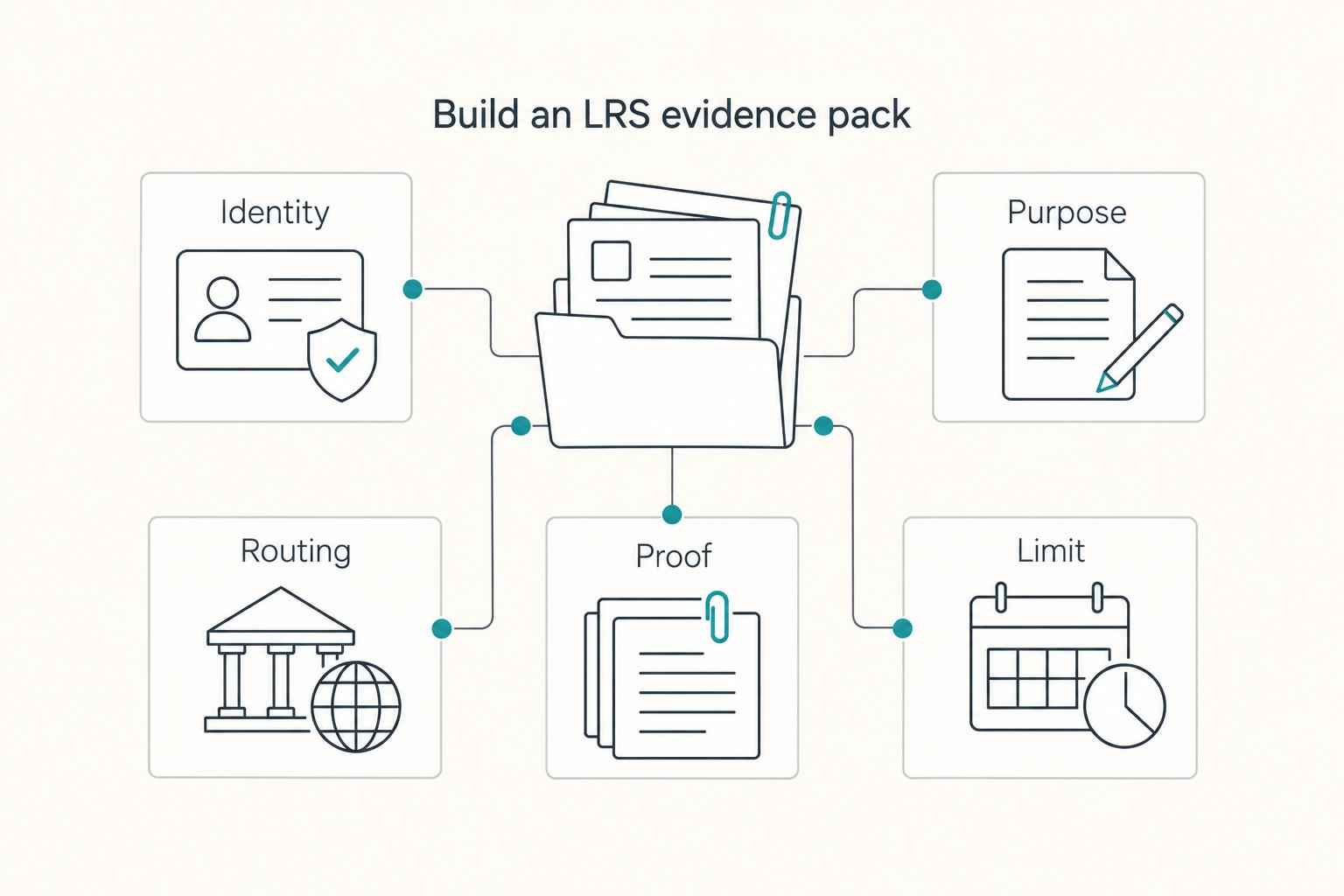
Build one evidence pack per outward remittance that mirrors what the bank records (especially Form A2 fields), so you can answer questions fast without rebuilding the story. Tie purpose, beneficiary, and transfer proof into one defensible file your AD bank can clear quickly, so you're confirming details instead of re-explaining them.
Your guiding principle: make your pack mirror what the bank itself records and reports. Form A2 (an RBI-prescribed application-cum-declaration for outward remittances under FEMA) captures the spine of the transaction, including amount, currency, purpose, and beneficiary details. Banks use it as a key source document for reporting outward remittances to the RBI.
If your documentation matches that spine, you stop "explaining" and start "confirming."
What to save (before vs after), and why it works#
Create one folder per transfer (date, beneficiary, purpose). Then drop artifacts in immediately.
| Moment | Save these artifacts | Why it reduces holds |
|---|---|---|
| Before you send | Signed contract or invoice. A 3 to 5 line purpose note that repeats the invoice language and states the declared purpose. Beneficiary onboarding info (beneficiary name, address, beneficiary bank account details, SWIFT, intermediary bank details if required). A simple FY headroom snapshot for LRS tracking. | Purpose clarity plus routing hygiene prevents mismatch loops (invoice says one thing, form says another). Headroom snapshot keeps your approvals honest. |
| After you send | Bank advice and transfer reference; UETR where available; payment message or equivalent confirmation, including ISO 20022 advice. Applied FX rate, fees, tax collection and reconciliation note. | Proof artifacts help the beneficiary bank trace. Reconciliation data helps you close books and answer queries without re-opening the portal. |
Hypothetical scenario: you fund a platform abroad for investing abroad and your bank asks, "What is this for?" Your purpose note, broker account evidence, and proof trail (reference plus MT103 if you have it) let you respond in one clean thread instead of scrambling across inboxes.
Track LRS headroom across banks (non-negotiable ops)#
The RBI master direction allows LRS remittances up to USD 2,50,000 per Financial Year (April to March), and the limit aggregates across all remittances through any Authorised Dealer (AD) bank in that year. Run a single ledger across banks (date, bank, declared purpose, amount, INR debited, references). This prevents accidental overages from splitting outward remittance activity across multiple portals.
Copy/paste SOP checklist:
- Identity: PAN on file. Name matches bank profile.
- Purpose: truthful transaction description and correct classification; meanings agree across supporting documents.
- Routing: beneficiary bank SWIFT confirmed. Intermediary bank details added if required.
- Proof: bank reference and any UETR or message/equivalent advice saved; final status checked.
- Limit: LRS running total updated for Apr to Mar financial year.
Will TCS hit this remittance? Build a cashflow-safe confirmation loop (don't guess from blogs)#
TCS can apply to certain LRS outward remittances, so confirm it with your AD bank before you send because it changes your debit-day cashflow. Treat TCS like a cashflow event, not a tax trivia point.
TCS is tax collected on your behalf where the remittance rules apply; it is separate from FX spread, service fees, and tax deducted at source on a supplier payment. Collection affects the amount debited or needed to complete the remittance. Preserve the collection record and check tax credit in your tax records; a returned transfer does not automatically return TCS already paid to the department.
The "pre-send confirmation loop" (script + proof request)#
For transfers from 1 April 2026, Punjab & Sind Bank’s current guidance identifies the Income-tax Act, 2025 section 394 framework. Its LRS schedule shows 2% above the INR 10 lakh aggregate threshold for education or medical treatment and 20% above it for other purposes, with eligible education-loan remittances exempt from TCS. Overseas tour packages have separate seller-collection rules. Confirm the actual transaction, current rules, aggregation, and exceptions before approving the debit; a budget speech alone is not enacted law.
Send one crisp message (email or ticket) with the details, then ask three questions. Include your remittance purpose and one-line description (matching your invoice), the amount and currency, and the beneficiary country. Also ask whether the bank will treat it as a current account transaction or capital account transaction under LRS (especially for investing abroad or account funding).
| Ask your AD bank | Why you need it |
|---|---|
| Will TCS apply to this remittance as submitted (purpose and transaction type)? | Prevent surprise deductions and rework. |
| How will it show on the debit (separate line item vs bundled into total)? | Makes reconciliation clean and prevents false "fee" alarms. |
| What proof will you provide for my records (certificate or advice)? | Builds an audit trail for your books and tax file. |
A hypothetical other-purpose LRS transfer: earlier applicable remittances total INR 9 lakh; the new remittance is INR 3 lakh. Assuming the INR 10 lakh threshold and 20% rate apply without an exception, INR 2 lakh of the new transfer exceeds the threshold, so TCS is INR 40,000. Budget INR 3.40 lakh plus actual fees and taxes on services, not merely INR 3 lakh. The USD LRS allowance and the INR TCS threshold are separate trackers.
Cashflow protection: keep a TCS buffer and file the artifact#
Keep an INR buffer for applicable collection, fees, and other scheduled payments. Save the bank’s tax-collection advice and applicable certificate or tax-statement record, then reconcile the credit against your PAN. Track supplier TDS and related remittance documentation separately where required; LRS approval does not settle those tax questions.
If your lifestyle complicates residency or remittance planning, pair this SOP with the digital nomad tax guide.
Related: How to Build a Diversified Investment Portfolio.
Investigate flags, holds, and returns from their actual cause#
Check the bank’s stated reason before changing a payment. A routing mistake can often be corrected; sanctions, prohibited purposes, or an ineligible route can require stopping or choosing a lawful alternative. Keep the original instructions, reason, correction, and decision together.
Common failure modes (check these before you argue policy)#
Banks and receiving institutions can hold or return wires due to "issues with the wire details, routing information, or compliance requirements." Start with data hygiene. It resolves issues faster than arguing policy.
Use this triage checklist in order:
- Beneficiary difference: check the verified account name, bank instructions, and any legitimate alias or collecting entity; resolve the actual mismatch rather than assuming all records need identical characters.
- Missing beneficiary address: Some banks and rails require a complete beneficiary address. Some return codes explicitly point to this (for example, a BE04-style code can indicate missing or invalid beneficiary address, but codes vary by network and bank).
- Incorrect SWIFT: Confirm the SWIFT for the beneficiary bank and whether the route requires an intermediary bank or correspondent bank.
- Purpose mismatch: If your invoice and your selected purpose don't read like the same transaction, it can trigger a compliance review.
| Symptom | First thing to verify | Fastest artifact to attach |
|---|---|---|
| "Beneficiary details invalid" | Name, account number, address | Beneficiary's bank letter or screenshot of bank details |
| "Routing issue" | SWIFT, intermediary/correspondent bank | Beneficiary's wire instructions (full) |
| "Compliance review" | Purpose vs invoice wording | Contract/invoice + a brief purpose note |
If you hit a compliance hold, respond like an operator#
Do not debate regulations in the abstract. Ship a clean narrative your Authorised Dealer (AD) bank can stand behind if questioned.
Send one reply that includes, as applicable and as requested by your bank:
- Invoice/contract (matching your purpose description).
- Purpose note: "Selected purpose code: X. Payment for: Y (matches invoice line). Relationship: Z."
- Source-of-funds explanation: a short note on where the funds came from, tied to relevant bank statement entries.
Hypothetical: a services payment is held because the memo mistakenly says equity. Confirm the real contract and invoice, submit the truthful corrected description, and ask the bank to reassess. If the payment actually buys equity, use the investment rules; do not relabel it as services.
If funds are returned or bounced: document like you plan to recover every rupee. Ask for the reason code from your bank or provider, then confirm whether an intermediary or correspondent bank deducted fees. Before you resend, re-check the account name/number, required intermediary banks, and what currency the beneficiary can accept.
Build a return log (this saves you in disputes and reconciliation):
- Debit date
- Return date
- Gross sent vs net returned
- Fees deducted (if any)
- UTR and SWIFT trail (use the UTR to trace a payment if it hasn't been received, when available for your rail)
Return timing depends on the route, institutions, reason, and investigation. Ask for the current status and expected next update rather than relying on a general 5–15-business-day promise. Keep the supplier informed and address due dates under the actual contract. A delayed or returned transfer does not automatically extend a fee already due.
Escalation path that works: ask your bank, "Which exact field or document blocks release (purpose mismatch, missing address, SWIFT route)?" Get a case/ticket number, and keep every email subject and attachment tied to the best available tracking reference (for example, the UTR, when available) so the bank can trace it without rework.
The safe default: run the decision tree, ship the audit pack, and protect your cashflow#
Run the same five-step system for every outward remittance under LRS, and you stop improvising under pressure. Bank portals vary, routing varies, and edge cases happen. Your process should not.
Five steps: applicability, purpose code, TCS, artifacts, and tracking#
1) Establish eligibility and route. LRS is for eligible resident individuals, including minors; the ordinary allowance is USD 250,000 per April–March year. Assess FEMA residence and the transaction’s rules, not merely the bank-profile label. For a minor, record guardian authorization and bank-required documents.
2) Choose a defensible purpose code. Purpose code is the label your bank uses for the remittance. Keep your invoice wording, beneficiary details, and your one-line purpose description aligned. If you cannot explain the purpose cleanly in one sentence, pause and rewrite.
3) Pre-confirm TCS handling before you hit Send. Do not guess from memory or social posts. TCS on LRS-related foreign exchange transactions is described by banks as introduced by the Finance Act 2020, and banks also warn that LRS and tax rules can change (often with effective-date updates). Ask your bank how it will treat your exact remittance, capture the reply, and stay current with RBI guidance.
4) Capture trace artifacts immediately (UTR plus SWIFT identifiers when available). A UTR (Unique Transaction Reference) is an alphanumeric tracking identifier for transactions. For SWIFT cross-border payments, the network uses a UETR (Unique End-to-End Transaction Reference) as the unique identifier to locate payment status. Save whatever your bank provides (UTR, SWIFT confirmation, any UETR reference) in the same place, the same way, every time.
5) Track your LRS usage for the full financial-year window (April to March). Run one tracker for the full April to March window, especially if you use more than one bank, so you do not overshoot silently.
| What varies | Safe default action | What you store in the evidence pack |
|---|---|---|
| Bank portal fields, document asks | Confirm checklist in writing with your bank | Email/ticket reply + submitted docs |
| Country routing and intermediary deductions | Ask for routing and expected fees upfront | FX quote, fee note, transfer advice |
| Card issuer treatment | Confirm with issuer or bank before spend | Written confirmation + invoice |
Build your "LRS Remittance" folder + two lightweight tools#
Create one folder template per transfer: 01_Purpose (invoice, purpose note, purpose code), 02_Bank (bank forms/details, bank emails), 03_Proof (UTR, SWIFT/UETR artifacts), 04_Recon (debit screenshot, fee note). Add a running limit tracker (date, bank, purpose code, amount, UTR).
Keep a 3-line bank script: "Here's the purpose code and description. Will TCS apply to this remittance, and how will it appear on the debit? Please confirm required documents."
Hypothetical scenario: you start paying overseas contractors monthly and also make other overseas remittances for a different purpose. You do not change your system. You run the decision tree, get purpose and TCS confirmed in writing, and drop the UTR and SWIFT trail into the same folder so reconciliation stays boring.
If you are scaling from occasional remittances to a repeatable workflow for a small team (batch runs, reconciliation, audit-ready records), evaluate tools like Gruv to standardize your process. Confirm market and program coverage before you implement anything. For tax residency edge cases, keep a separate reference file and see our guide to a defensible 2026 filing plan.
Frequently Asked Questions
What is the Liberalised Remittance Scheme (LRS) in India?
Liberalised Remittance Scheme (LRS) is the RBI framework that allows resident individuals to make an outward remittance for permissible current account or capital account transactions (or a mix). It sits inside India's broader foreign-exchange compliance framework under FEMA 1999. In practice, it is the compliance wrapper your Authorised Dealer (AD) bank uses when you send money out of India.
Who is eligible for LRS remittance (including minors)?
Eligible resident individuals, including minors, can use LRS for permitted purposes within the ordinary annual allowance or an applicable permitted evidence-based exception. For a minor, the guardian completes and signs the required declaration under the bank process. Companies, partnerships, HUFs, and trusts do not use LRS.
What is the LRS limit per year in India, and is it per bank or per person?
The ordinary LRS allowance is USD 250,000 per eligible resident individual per April–March financial year across authorised dealers. Track applicable transactions together, not separately by bank. Specified study, medical, or emigration transactions can have separate evidence-based rules for exceeding that limit; confirm the route before sending.
How do I send money abroad under LRS (step-by-step through an AD bank)?
You send money under LRS through your AD bank (branch, netbanking, or an RM process) by submitting Form A2 details, complete beneficiary details, and the correct purpose code. Provide whatever supporting documents your bank asks for for that purpose code, and save your proof right after submission (reference numbers and any bank-provided confirmations).
What documents are required for LRS remittance, and is PAN mandatory?
PAN is mandatory for resident individuals’ LRS transactions through authorised persons under RBI’s FAQ. Submit the required Form A2 details and purpose-specific supporting records, including applicable beneficiary and guardian information. Save the bank checklist and your actual submission.
What is a purpose code and why does my bank ask for it?
A purpose code is the regulatory label that explains why you are making the outward remittance. Banks ask for it because they must classify the transaction correctly for compliance and reporting. Picking the wrong code can trigger holds, document requests, or returns.
What happens if my remittance is returned (and how do I track SWIFT/UTR proof)?
Save the bank’s transfer reference and case number. For Swift payments, request the UETR and available payment advice or message confirmation; after the ISO 20022 migration, an ISO message or equivalent advice may be supplied instead of an MT103. These records support tracing but do not alone prove final credit. Record the reason, amount and currency sent, fees, amount returned, conversion differences, and any tax-collection treatment before resending.
Watch
How Indian Freelancers Can Use LRS
Try a related tool
Researched and edited by the Gruv editorial team. Gruv builds cross-border billing, payouts, and finance-operations software for global businesses.
Sources
Includes 5 external sources outside the trusted-domain allowlist.
Educational content only. Not legal, tax, or financial advice.
Related Posts

Digital Nomad Taxes in 2026 With a Defensible Filing Plan
With digital nomad taxes, the first move is not optimization. It is figuring out where you may be taxable, where filings may be required, and what proof supports that position.

Indian Freelancer Payment Analysis That Protects Net INR
A USD 1,000 invoice can produce several partial payments and a bank credit reduced by fees. Track three amounts separately: the invoice balance, what the client paid, and net INR available in your bank. The last number helps cash planning; it is not automatically your profit or taxable income.

How Freelancers Can Build a Diversified Investment Portfolio Without Breaking Cashflow
If you run a business-of-one, you do not need vibes; you need a repeatable system you can run.