
Quick Answer
Yes - eu tax blacklist impact can show up as payment and onboarding friction before any deal is canceled. Treat it as an execution risk: verify your VAT route, maintain a complete evidence file for each contracting entity, and block release when contract, invoice, and beneficiary details do not match. If you use the cross-border SME route, do not apply VAT-exempt treatment until the EX number is granted. That approach protects collections while scrutiny increases.
Start Here if Your Offshore Setup Touches EU Clients#
If your offshore entity, clients, or payment flow touches EU VAT obligations, make the compliance call early: lock your contract, invoicing, and VAT path before review pressure starts. For EU tax blacklist exposure, this is a revenue protection decision, not a policy debate.
| VAT path | When to assess | Grounded requirement |
|---|---|---|
| OSS | Cross-border B2C activity is nearing EUR 10 000 | Register in one Member State of identification and use that route for VAT declaration, payment, record keeping, audits, and scheme exit |
| VAT Cross-border Ruling (CBR) | Cross-border VAT treatment is complex or the transaction structure is unusual | Requests must follow national VAT ruling conditions in the EU country where you file |
| Cross-border SME scheme | You plan to use the scheme | Union turnover must not exceed EUR 100 000 and planning should allow up to 35 working days |
Macro outcomes vary, so focus on what you can control: tax handling, payment timing, reporting load, and reputation with counterparties. The goal is to keep delivery moving while your file is ready for scrutiny. In practice, I track four weekly controls: 7-day invoice-release lag, clarification loops per case, open exceptions, and unresolved owner gaps.
Before you commit to timelines, test whether your current records can survive a diligence request tomorrow. If not, build the file first and sign second. That sequencing choice can prevent avoidable rework when procurement asks for ownership or VAT evidence mid-project.
Start with the VAT baseline. Since 1 July 2021, EU VAT e-commerce changes affect the full e-commerce supply chain, and certain cross-border B2C supplies reference an EU-wide threshold of EUR 10,000. If that threshold matters for you, decide early whether to use One Stop Shop (OSS). Under OSS, you register in one Member State of identification and use that route for VAT declaration, payment, record keeping, audits, and scheme exit.
If your cross-border VAT treatment is complex, decide early whether a VAT Cross-border Ruling (CBR) request is worth the effort. CBR requests must follow national VAT ruling conditions in the EU country where you file. If you plan to use the cross-border SME scheme, confirm Union turnover does not exceed EUR 100,000 and plan around an indicative processing window of up to 35 working days.
Use this first-pass check before signing new EU work:
- If cross-border B2C activity is nearing EUR 10,000, decide on OSS and assign a single owner for VAT records.
- If the transaction structure is unusual, assess whether CBR is needed and confirm local filing conditions.
- If you use the cross-border SME scheme, confirm turnover is below EUR 100,000 and plan around the 35-working-day timeline.
- Keep an evidence pack ready: VAT registration status, contracts, invoices, and ownership documents used in onboarding checks.
If these checks are done, run a quick readiness pass before the next proposal. For implementation support, Browse Gruv tools, validate IDs in the EU VAT number validator, and standardize bill formatting with the free invoice generator.
What the EU Blacklist Means in Real Operations#
Treat EU tax blacklist exposure as a friction signal, not an automatic legal conclusion. The operational effects here sit mostly in Member State VAT administration, so practical planning should focus on where your clients pay from and where your filings happen.
Use these checks before calling any setup low risk:
- If you rely on OSS, confirm you are registered in one single Member State of identification.
- If a deal has unusual cross-border VAT treatment, check whether a CBR path exists between the participating Member States involved, and file under each country's national VAT ruling conditions.
- If you use the cross-border SME scheme, test both limits. Union turnover across the 27 EU Member States must not exceed EUR 100,000. You must also stay below each country's national annual threshold, and planning should allow up to 35 working days for registration processing.
A practical red flag is repeated requests for the same document in different formats. That can indicate inconsistent VAT documentation rather than one missing page. When this starts happening, stop treating the issue as one-off admin and reconcile your records.
However, do not treat Member State administration as uniform. Treatment differs by country, and a Member State can exclude a taxable person or intermediary from an OSS scheme.
Where the Impact Hits First for Freelancers and Small Agencies#
The first disruption is usually operational, not contractual. Reviews tighten first, so fast, clean documentation matters more than legal theory at the start.
Use this five-channel check for early review conversations. Keep these items together when you review a case:
- OSS registration status in your Member State of identification
- OSS declaration and payment workflow
- OSS record-keeping files for potential audits
- CBR suitability for complex cross-border VAT transactions involving two or more participating EU countries
- cross-border SME scheme eligibility (Union turnover cap, national annual threshold, and prior notification in the MSEST)
If one channel starts generating exceptions, expect related VAT checks to spread to the others. A registration question can quickly expand into declaration, payment, record-keeping, and eligibility follow-ups. Planning for that chain reaction helps you resolve one complete file instead of answering fragmented requests.
Run responses in sequence: confirm scheme eligibility first, then registration status, then ongoing filing and record-keeping evidence. Keep VAT registration evidence and transaction context together so reviewers can close the file in one pass.
Start with VAT readiness because it is the first file set to validate in practice. If you use OSS, confirm registration in one Member State of identification and keep declaration, payment, and record-keeping files current for audits. Also remember a taxable person or intermediary can leave OSS voluntarily or be excluded by a Member State.
When cross-border VAT treatment is complex, assess whether CBR is suitable. For transactions involving two or more participating EU countries, the request is introduced in the participating country where you are VAT-registered and follows that country's process.
If you use the cross-border SME scheme, confirm both limits before you promise timelines: Union turnover must not exceed EUR 100,000, and access also depends on each country's national annual threshold. File one prior notification through your Member State of establishment, and plan for processing that should not take longer than 35 working days after receipt.
If you also handle US-facing compliance questions, What is FinCEN? A Guide for Freelancers and FinTech Users can help separate those obligations from EU VAT work.
Exposure Triage by Business Setup#
Start triage with billing reality, then map VAT responsibilities. Priority should reflect where delays are most likely to hit collections.
| Business setup | Priority | First verification step | Escalation signal |
|---|---|---|---|
| No EU clients | Lower | Confirm there is no active EU billing and no pending EU onboarding. | A new EU deal enters pipeline or contract stage. |
| EU clients only | Medium | Confirm whether OSS is the right route and that registration sits in one Member State of identification for declaration and payment. | Missing VAT records, delayed onboarding, or unclear filing ownership. |
| EU clients with repeated cross-border VAT questions | Higher | Check whether complex cross-border transactions need advance VAT treatment clarity through a CBR route under national ruling conditions. | Repeated diligence requests before payment release or procurement approval. |
Decision rule: if recurring EU invoices are core revenue and your offshore setup repeatedly triggers jurisdiction questions, treat VAT review as high priority now rather than wait and see.
Different operating models may need different review depth. Keep the scope practical: records, transaction flows, and filing responsibilities.
Keep one short triage log at each review: what changed, which payer countries are affected, and which records were updated. This keeps decisions traceable and helps you avoid arguing over memory when exceptions appear later.
Set a standing checkpoint whenever your client mix or payer-country footprint changes. At that review, re-test SME access conditions in two steps. Confirm Union turnover across the 27 EU Member States remains within EUR 100,000, then confirm each target state's national annual threshold. SME registration can take up to 35 working days after prior notification.
Why Results Differ Across EU Member States#
Results differ by country, not just by where your entity is registered, because Member States do not administer cross-border VAT processes in exactly the same way.
You can see this in core VAT pathways. OSS allows registration in one Member State, but a Member State can still exclude a taxable person from the scheme. Cross-border SME treatment also varies by market because eligibility depends on each country's national annual threshold, even when Union turnover across the 27 EU Member States is within EUR 100,000. For complex cross-border VAT transactions, CBR can help, but requests must follow national ruling conditions and not all Member States participate.
Use a country-by-country lens before restructuring. Start with markets where your current VAT path has the most exceptions.
| Market check | Why to prioritize it |
|---|---|
| SME threshold fit | Eligibility depends on each Member State's national annual threshold, even within the Union-wide EUR 100 000 cap |
| OSS continuity risk | A Member State can exclude a taxable person from OSS, so registration in one state is not a guarantee everywhere |
| CBR availability and conditions | CBR requests must follow national ruling conditions, and not all Member States participate |
When choosing where to focus first, rank markets by near-term operational impact and current exception volume. That gives you a practical order: resolve countries where your VAT route is already failing or unclear, then work through lower-impact markets.
If rules or enforcement practice are unclear in a target country, confirm locally before changing structure. When advice differs across countries, prioritize markets with the largest near-term exposure and highest operational friction first.
How to Read the Mixed Evidence Without Freezing#
When evidence is mixed, do not pause controls. Tighten what you can verify now and keep moving.
Macro commentary can point in different directions, but your operating standard should still come from invoices, filings, and payer-country requirements.
For day-to-day decisions, anchor to checks you can confirm. Start with these:
- OSS replaced MOSS on 1 July 2021, and eligible sellers can register in one EU Member State for VAT declaration and payment on covered cross-border activity.
- The same reform context applies an EU-wide EUR 10,000 threshold for relevant sales categories.
- The cross-border SME route adds a Union turnover cap of EUR 100,000 plus each country's national annual threshold conditions.
If your setup is likely to face higher scrutiny, raise control quality first and postpone structural changes until the signal is clearer. A practical rule is to tighten documentation and timing discipline, then review structural changes after a defined period of clean reporting and stable collections.
Use one recurring checkpoint set:
- Reconfirm your VAT path by payer country: OSS, local registration, or SME cross-border treatment.
- Recalculate exposure to EUR 10,000 and EUR 100,000, and record each country's threshold status.
- Verify EX number status where relevant and plan lead time, since processing can take up to 35 working days.
- Keep a dated evidence file with registrations, threshold calculations, and notifications.
Time-box each review cycle so decisions do not drift. Close each cycle with one of three outcomes: keep current structure, tighten controls in specific countries, or escalate for structural review. That keeps mixed evidence from becoming a reason to delay basic execution.
Operational friction rises when proof is requested and your file is outdated. If that repeats in a high-revenue market, escalate locally before restructuring and protect billing continuity first.
If client-facing positioning is part of procurement checks, How to Write a Professional Bio That Attracts Clients can help you keep external messaging aligned with your documentation.
Choose Keep or Exit Using Clear Decision Rules#
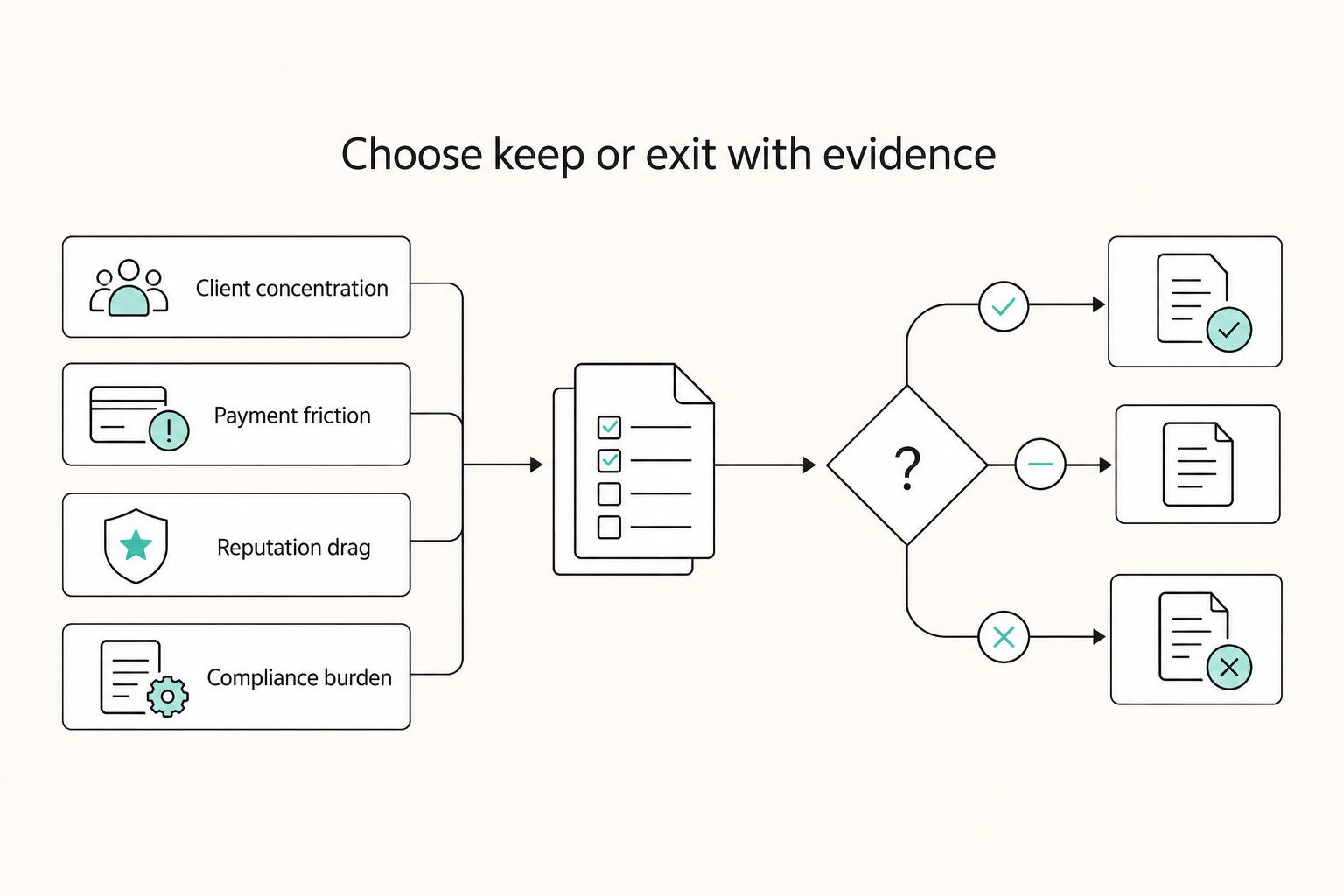
Choose based on operating durability, not on defending the current setup. Use a keep-versus-exit scorecard with dated evidence from the last two review cycles, then act on trend.
| Criterion | Keep signal | Exit signal |
|---|---|---|
| Client concentration in the EU | Revenue is spread across countries, with no single payer cluster driving most risk | Concentration rises, and exceptions or rechecks cluster in the same markets |
| Payment friction | Collection timing is stable and clarification requests are limited | Delays or clarification loops repeat across cycles |
| Reputational drag | Procurement and onboarding move forward without repeated structural objections | Approvals slow or deals stall because counterparties raise structure concerns |
| Compliance maintenance burden | VAT administration is predictable and proportional to revenue | Registrations, threshold checks, and evidence upkeep keep growing without matching benefit |
Make one judgment call first: if the structure looks efficient on paper but repeatedly creates operational friction, prioritize durability.
Anchor that call to verifiable VAT levers. Since 1 July 2021, OSS allows a taxable person to register in one Member State for scheme use, including covered cross-border VAT declaration and payment. OSS can reduce administrative load, but only when declaration, payment, record-keeping, and audit obligations stay current. Keep EUR 10,000 and EUR 100,000 separate in your records because they are different tests. Also account for SME cross-border processing that should not take longer than 35 working days after prior notification is received.
Before you choose keep, run a document check: current registration status, threshold calculations by period, prior-notification evidence, and any CBR request support for complex chains. CBR can clarify VAT treatment, but requests must follow national ruling conditions and the project includes participating countries only.
Do not wait for an annual reset to update this scorecard. Update it whenever a high-value market shows repeated operational delays or onboarding objections. Shorter feedback loops make exit planning more controlled if you eventually need to migrate.
Treat broader policy shifts as pressure to monitor, not as a stand-alone trigger. If two or more scorecard criteria trend negative for two consecutive cycles, prepare a migration option with timeline, ownership, and billing continuity steps.
Execute a 30-60-90 Day Compliance Sequence#
Treat this 90-day window as an internal execution sprint, not a statutory EU deadline: document your VAT pathway, verify it, and assign ownership before you scale EU work. I use this sequence when offshore teams need to stabilize EU collections quickly.
| Day range | Focus | Key actions |
|---|---|---|
| Days 1 to 30 | Map exposure | Link each EU counterparty to the contracting entity, payment path, and VAT treatment route; prepare prior notification early if the cross-border SME scheme may apply; confirm ownership of every data field |
| Days 31 to 60 | Align contract and intake controls | Update onboarding questions and contract support documents; align invoicing and payment instructions with the documented tax position; do not treat supplies as VAT-exempt until the EX number is granted and its use is confirmed |
| Days 61 to 90 | Dry review and ownership | Run a dry review; keep prior notification evidence and EX number confirmation on file where used; keep OSS documentation covering registration, declaration and payment records, and required record-keeping and audit readiness; assign named owners and a recurring review cadence |
Days 1 to 30 Map Exposure#
Build one exposure map that links each EU counterparty to the contracting entity, payment path, and VAT treatment route. Keep it as a single working register so legal, finance, and delivery teams review the same record.
If the cross-border SME scheme may apply, prepare filing early. The enterprise files one prior notification in its Member State of establishment, and that authority serves as the contact point with other Member States. Processing is expected to take up to 35 working days after receipt. You can confirm scheme details on the official cross-border SME scheme page.
At this stage, confirm ownership of every data field in the map. Unowned fields can become a source of conflicting answers during diligence, especially around beneficiary details and VAT treatment assumptions.
Days 31 to 60 Align Contract and Intake Controls#
Update onboarding questions and contract support documents so they consistently capture tax residence evidence, the intended VAT route, and escalation points for review. Keep the controls practical: they should surface gaps early, not force conclusions before the file is complete.
Align invoicing and payment instructions with your documented tax position. Do not treat supplies as VAT-exempt until the EX number is granted and your team confirms its use.
Add one verification pass before invoices go out: check the contract entity, VAT route, and beneficiary details against the latest approved file. This single check can catch preventable release holds before they hit collections.
Days 61 to 90 Dry Review and Ownership#
Run a dry review as if a counterparty requested the full file tomorrow. Pass only when the record is complete and consistent:
- Prior notification evidence is filed and date-stamped where used.
- EX number confirmation is on file before your team applies VAT-exempt treatment.
- OSS documentation covers registration, declaration and payment records, and required record-keeping and audit readiness.
- For envisaged complex transactions, there is a documented path to request a CBR advance ruling in participating Member States.
Treat failed dry-review items as release blockers, not admin backlog. If one item fails, assign an owner and due date immediately so unresolved gaps do not drift into live transactions.
Finish by assigning named owners for the exposure register and tax-file quality, with a recurring review cadence. If the client mix, transaction pattern, or VAT route changes, restart from exposure mapping.
Build the Evidence Pack Clients and Banks Actually Ask For#
Build the evidence pack before the next diligence request arrives: a complete, consistent file is easier to review and easier to defend.
Start with a minimum pack that is fast to verify#
Use one pack per contracting entity, with the same document order each cycle.
| Document | What to keep |
|---|---|
| Entity ownership map | For the contracting entity and ownership links |
| Tax residence support | For the invoicing entity |
| Signed service contracts | Relevant amendments for the invoice period |
| Invoice trail | Aligned to contract terms, VAT treatment, and payer records |
| Short policy note | Withholding tax treatment assumptions by payer country |
If you use OSS, keep your registration in the Member State of identification together with the required records, including invoices and bad debt relief records. If you use the SME cross-border route, keep prior notification evidence, MSEST communications, EX number confirmation, and the EUR 100,000 eligibility check for the current and previous calendar year. The registration process should not take longer than 35 working days after receipt of the prior notification. For operations teams, the official OSS guides are useful for checklist design.
Use a simple quality test before sharing the pack: can another person match every invoice to contract terms, VAT treatment, and payer details without asking for extra context? If not, tighten document labels and ordering until the pack is self-explanatory.
Add short position memos for challenge points#
Use internal memos to state the basis for tax treatment assumptions, with scope, owner, and review date. Keep one memo per material assumption so updates and sign-off stay clear.
For complex cross-border transactions, add a CBR readiness note. Identify the participating EU country where the filing entity is VAT-registered, confirm the national VAT-ruling conditions that apply there, and identify the filing entity. Where multiple companies are involved, one company can file on behalf of the others. The official CBR overview helps you align your request package.
Version records and enforce a release gate#
Maintain versioned records so you can show what changed after each update cycle, then tie release decisions to the latest version.
- Do not approve new EU-facing contracts if the current pack version is incomplete.
- Do not release invoices when contract entity, VAT route, and payment instructions conflict.
- If tax treatment assumptions are challenged, pause release until the memo owner updates assumptions and sign-off.
This adds administrative work upfront, but it can reduce due diligence back-and-forth, payout friction, and procurement objections. The tradeoff is clear: more preparation now, fewer release delays later.
For agencies balancing compliance effort against account economics, How to Calculate Client Lifetime Value (CLV) for Your Agency can help prioritize where cleanup effort has the highest payoff.
Apply the Rules in Your Payment Stack and Compliance Tooling#
Apply release controls that block payout when the evidence pack, VAT route, and approval record do not align. If this exposure is in scope, treat it as one operational check alongside the full record set. For faster pre-release checks, you can pair your intake flow with the EU VAT number validator.
Turn policy into payout states#
Use clear states such as Draft, Ready for Review, Approved for Release, and Held for Remediation, and require an approver, change note, and document version on every status change. Route higher-risk cases to stricter review based on internal policy.
For OSS-based flows, treat these as hard checks before release:
- Registration is tied to one Member State of identification.
- Declaration and payment records are complete.
- Required records on invoices and bad debt relief are maintained where relevant.
Run payouts in a fixed sequence#
Use one sequence across markets, and branch only where local program rules require it.
- Collect funds and attach the current contract, invoice, tax profile, and evidence-pack version.
- Verify counterparty and beneficiary details. If you use KYC gates, treat them as internal controls.
- Validate the VAT route for the transaction type. Where relevant, check the EU-wide EUR 10,000 threshold and, for the SME cross-border route, the EUR 100,000 cap.
- If SME prior-notification registration is pending, account for the process target of up to 35 working days after receipt.
- For complex cross-border transactions, consider a CBR request in the EU country where it will be submitted, apply that country's national VAT-ruling conditions, and name the filing entity. If multiple companies are involved, one company can file on behalf of the others.
- Release payout with traceable ledger references and duplicate-prevention controls.
Define one exception lane for records that fail checks. Keep the release decision binary: either all required documents match and payout proceeds, or the case stays on hold with a named owner and remediation note. That discipline helps prevent informal overrides that create repeat issues later.
Bound client promises by verified market support#
Therefore, do not promise payout speed or coverage until support is confirmed in your tooling and provider setup. Coverage and controls can vary by market and program, so pause contract approval if support is unverified or records conflict, then update the file and require fresh sign-off before retry.
The Practical Takeaway for a Durable Offshore Setup#
If concern about EU tax blacklist exposure is rising, tighten controls before it turns into payment delays. Treat this as an operations issue: reduce avoidable complexity, keep evidence complete, and avoid panic restructuring.
Durability usually comes from four decisions you control. Focus on your client-country mix, the number of entities between contract and payment, how strictly payout routes match approved records, and how quickly you can produce a complete file.
Prioritize the checks that protect cash flow#
Keep one clear owner per contracting entity so contract, invoice, VAT treatment, and beneficiary account details stay aligned.
Use documented checkpoints that can be verified during review:
- If you use the cross-border SME scheme, track turnover across all 27 EU Member States against the EUR 100 000 ceiling, and only start VAT-exempt supplies after your MSEST grants the EX number for the selected Member State(s).
- If you use OSS, keep registration, declaration, payment, invoice, and record-keeping files current in one place. A taxable person or intermediary can deregister voluntarily or be excluded by the Member State.
- If VAT treatment is unclear across countries, raise a CBR request under the national VAT ruling conditions of the participating EU country where the request is introduced. If multiple companies are involved, have one company submit on behalf of the others.
Review on a schedule, then escalate early#
Use an internal documented quarterly review to check response speed, payment friction, and whether entity or banking changes created new verification work. Set internal escalation thresholds in advance so you act before pressure reaches collections.
Keep a migration option ready#
By contrast, a real fallback is a ready file, not a theory: target structure, transition sequence, client notice draft, and a clear cutoff rule for incomplete documentation. The goal is to absorb stricter checks without breaking collections, client trust, or tax compliance.
Finally, run one immediate next step after this article: pick your highest-revenue EU market, run the first-pass check, and record the gaps with owners and dates. I recommend setting a 14-day close window for those gaps so execution stays measurable.
If you want a second pass on country and program fit, gather your current file first, then Talk to Gruv.
Frequently Asked Questions
What is the EU tax blacklist impact for a freelancer or small agency?
Treat the impact as a case-by-case verification issue rather than assuming a single EU-wide outcome. Keep your VAT route, evidence pack, and approval record aligned so reviews can be completed without avoidable delays.
Does being linked to a blacklisted jurisdiction make my setup illegal?
Not automatically. Legality depends on the applicable rules, your transaction facts, and the counterparties involved. Treat it as a verification issue and keep your supporting VAT and entity records current before making structural changes.
What usually changes first when a jurisdiction is listed?
There is no single first-step outcome that applies in every case. If you use the cross-border SME scheme, the enterprise files one prior notification in its Member State of establishment, and the process should not take longer than 35 working days after receipt.
Do all EU member states apply the same penalties and reporting pressure?
You should not assume identical treatment across Member States. For complex cross-border VAT treatment, taxable persons can request a CBR ruling in participating Member States under national ruling conditions.
Can EU clients still pay entities connected to blacklisted jurisdictions?
There is no universal yes-or-no rule that fits every case. A practical safeguard is to release only when the contracting entity, VAT treatment, and beneficiary details match the approved record.
Which documents should I keep ready to reduce payment and compliance friction?
Keep one current file per contracting entity with the contract, invoice trail, tax profile, and approval history. If you use OSS, keep registration details for the single Member State of identification plus declaration, payment, and record-keeping documentation. If you use the cross-border SME scheme, keep the prior notification file and turnover checks, including the EUR 100 000 cap and the EU-wide EUR 10 000 threshold where it applies.
Is the economic evidence settled on whether blacklisting works?
No, it is not settled enough to treat outcomes as predictable in every case. Use that uncertainty as a reason to run tighter controls and faster document response cycles, rather than relying on a single broad conclusion.
Try a related tool
Researched and edited by the Gruv editorial team. Gruv builds cross-border billing, payouts, and finance-operations software for global businesses.
Sources
Educational content only. Not legal, tax, or financial advice.
Related Posts
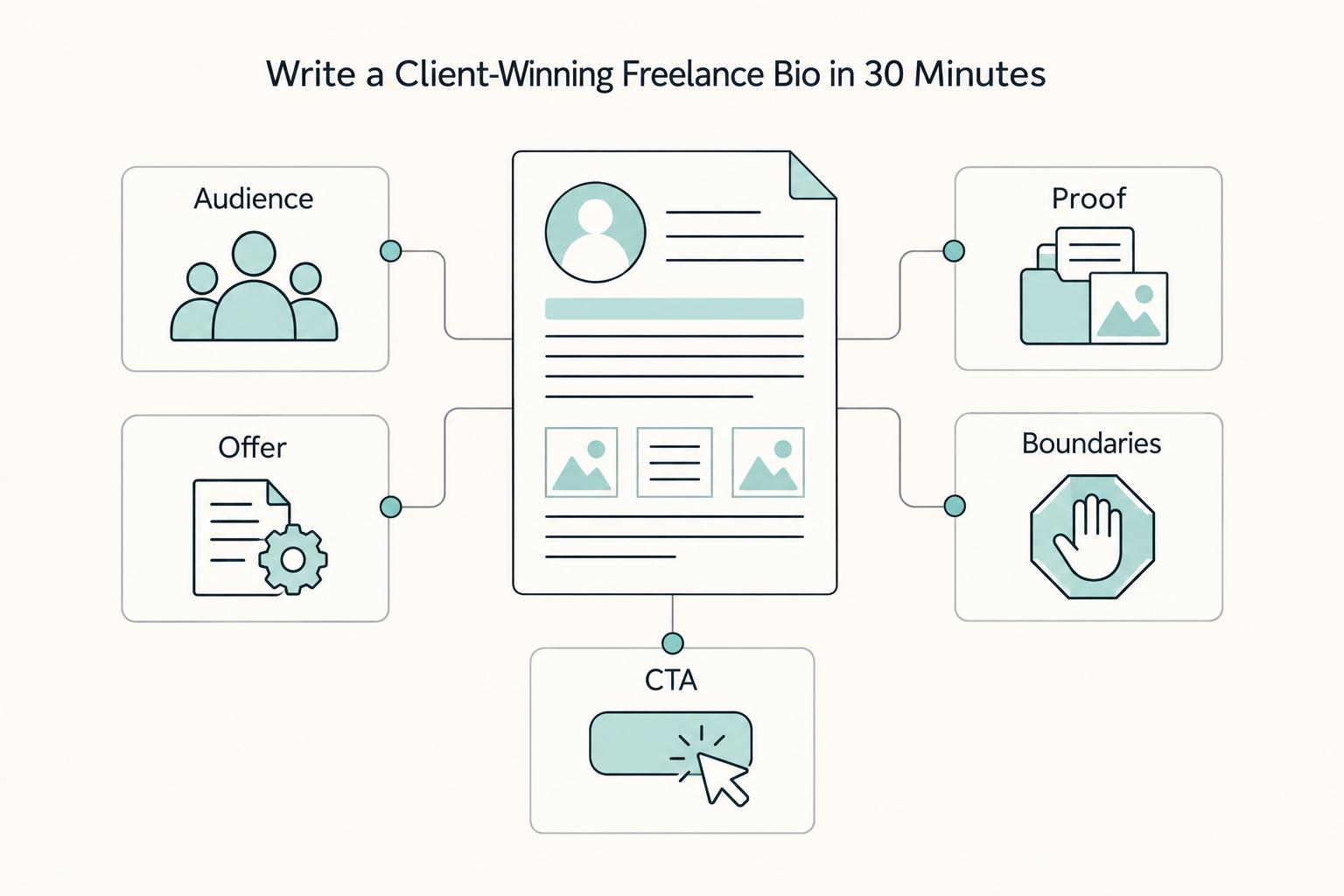
How to Write a Professional Bio That Attracts Clients
If you want to know **how to write a freelance bio** that is client-focused, write for scan speed, not autobiography. Clients often read your headline before they open your portfolio, and first impressions can form in less than seven seconds. Your opening should show fit, proof, and a clear next step fast.

What Is FinCEN for Freelancers and FinTech Users
If you are asking **what is fincen**, focus first on the decision in front of you. FinCEN, the Financial Crimes Enforcement Network, is tied to FBAR filing through FinCEN Form 114 when foreign financial accounts create reporting duties. By the end, you should know whether to act now, gather records, or escalate.

How to Calculate Client Lifetime Value (CLV) for Your Agency
To make pricing and acquisition decisions you can defend, use a consistent view of Customer Lifetime Value (CLV), whether revenue-only or margin-aware. This guide is for freelancers, creators, and small agency teams that invoice clients and need decisions that hold up under day-to-day planning pressure.