
Quick Answer
To write a privacy policy for your freelance website, first map every intake point where visitors submit personal data, then draft plain-English clauses that state what you collect, why you use it, who receives it, and how requests are handled. Keep legal wording aligned with the jurisdictions you serve, separate privacy text from contract terms, and publish only claims you can verify.
Build a privacy policy you can defend in client due diligence#
A privacy policy is easier to defend in client due diligence when each statement traces to real behavior. Treat it as a working record, not footer filler: what personal data you collect, how you use and manage it, and how someone can raise a concern.
Start with scope, then draft disclosures, then align the legal position to the places where your audience lives. That order helps prevent polished copy from describing a process you do not actually run.
Think of the draft as a promise log. Every promise needs three anchors behind it: who owns it, where it happens, and what record proves it. That mindset keeps the policy practical from the first step and keeps the final text aligned with day-to-day handling.
Step 1 Define your real scope before you draft#
Map every intake point first: website forms, newsletter signups, payment steps, and onboarding. If a visitor can submit personal data, keep that path in scope. Tie this to actual entry points, not assumptions about what the site collects.
A simple check helps here. Open your site as a new visitor and list each point where someone can leave data. Then compare that list with your current draft. Any intake point that appears on the site but not in the draft is a direct gap you can fix before review.
Step 2 Write plain-English disclosures that match operations#
Write direct statements for Data Collection, Data Processing, and Data Sharing. At minimum, make clear what information you collect, how you use it, and who receives it. If a sentence cannot be verified, tighten it or remove it.
A simple sentence pattern keeps this clear: what is collected, why it is used, and who receives it. Repeating that pattern reduces ambiguity and helps clients scan quickly.
Step 3 Set a legal stance you can defend across jurisdictions#
Do not assume one jurisdiction covers every visitor. Requirements differ by location. The EU and some U.S. states require privacy policies, while there is no single U.S. federal mandate. Keep complaint or recourse language clear enough that a reader knows what to do next.
Make this a release condition, not a future task. If you start targeting a new region, review the jurisdiction language before launch. That discipline is what turns a generic page into something you can defend. Related: Working Remotely in Latin America: A Visa Guide.
What to gather before you write a single clause#
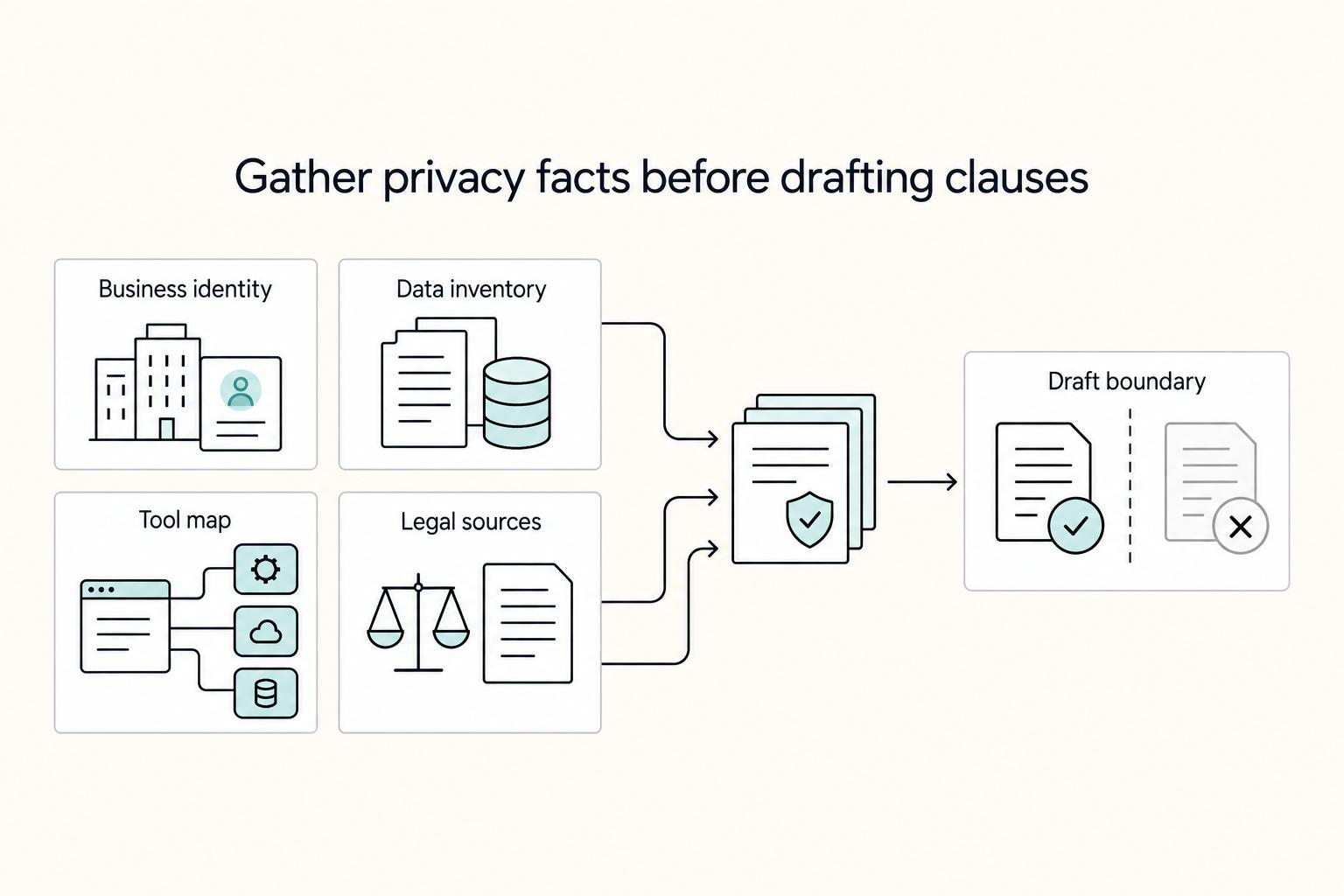
Before you draft, assemble a short prep pack with identity, data and tool inventory, legal references, and document boundaries. This becomes your evidence base when a client asks why a clause is there.
You do not need a large binder. A compact set of documents is enough if each item is current and owned, so capture ownership as you gather inputs.
Step 1 Confirm the accountable identity#
List the legal name on invoices, the public brand name, and who owns and operates the website. If the names differ, add one plain sentence connecting them. Publish one monitored privacy mailbox and route requests through it.
Add a quick verification check before drafting. Send a test message to the privacy mailbox and confirm it lands with the right person. If the inbox forwards through multiple people, document that path so you can explain how requests are handled.
Step 2 Build a data and tool inventory#
Document what you collect, how it is collected, why it is collected, and whether a third party receives it. Include CMS, forms, newsletter tooling, analytics, onboarding, and payment providers. If you collect technical data automatically, note that too.
Do this from live settings, not memory. Open each tool and capture the fields and destinations currently enabled. That helps you avoid mismatches between your inventory and your current setup.
Use one working sheet with these columns:
- data item
- collection method
- purpose
- storage location
- third-party recipient
Keep this sheet easy to maintain. If you cannot complete a row, treat that as a gap to resolve before you publish the matching policy statement.
Step 3 Collect legal references in one place#
Keep notes on the jurisdictions that apply to your audience in one reference file, such as the EU and relevant U.S. states. Mark which policy sections they affect. This helps you avoid broad legal wording that sounds complete but does not map to your real market exposure.
A practical method is to tag each policy section with the jurisdictions it touches. During review, you can see quickly whether a section has legal backing or only draft language, which reduces back-and-forth edits.
Step 4 Set document boundaries before drafting#
Define what belongs in the Privacy Policy versus Terms or service agreements. Keep privacy text focused on handling personal information. If sample language describes payment detail or processing behavior you do not use, do not copy it into your draft.
Set these boundaries before writing full prose. If you wait until the end, legal remedy clauses can drift into privacy text and create rework. A clean split between documents reduces confusion for readers and reduces questions during contract review.
Map your real data flows before drafting language#
Map live data paths before writing policy prose. Once each path is documented, your clauses stay concrete and due diligence questions become easier to answer.
This is where most abstract wording gets corrected. When you map real flows, vague statements become specific actions tied to tools and owners. That makes your language more credible and easier to maintain.
Step 1 Trace each intake point with a live test#
Submit a real test entry for each path, including contact forms and newsletter signup forms. Record every field captured, including hidden defaults and optional fields. Then confirm your notes match what each tool actually receives.
Run the test as a visitor would. Use realistic sample entries and verify where data lands first. If a field appears in one place but not in your map, pause and update the map before you draft that section.
Step 2 Document processing at row level#
Create one row per intake point and capture the data, purpose, first storage location, access, and vendor handoff. This makes it easier to spot over-disclosure and missing disclosures before publication.
Add one owner per row. Ownership turns the table from documentation into an operating control. When a reviewer asks who can confirm a handoff or access rule, you already have the answer.
| Intake point | Personal Data captured | Purpose | Storage/location | Access | Vendor processing |
|---|
Use this table as your main drafting reference. If a policy sentence cannot be traced to a row, revise it until the link is clear.
Step 3 Add lifecycle details before drafting#
Extend each row with how subscription and communication requests are handled. For newsletter activity, map how objections are handled so unsubscribe or preference language in the policy matches the action a user can take.
Include how access, deletion, rectification, and objection requests are routed in practice. These notes help keep policy wording aligned with what users can actually do.
Step 4 Apply one decision rule to every field#
If you cannot explain why a field exists, remove it or make it optional. This one rule improves clarity, reduces risk, and keeps the policy aligned with what you can defend in client review.
Use the same rule during updates. When new forms or plugins are added, ask the same question before launch. If there is no clear purpose, do not collect the field and do not add extra policy language to justify it.
Choose legal basis and write the user notice clearly#
Work from a per-activity matrix and treat legal text as publishable only after validation. The real risk is not short copy. It is publishing legal language that does not match your evidence pack.
This section works best when drafting and approval are separate. Draft the plain language first, then validate jurisdiction blocks, then publish. Doing all of that in one pass usually creates preventable errors.
Step 1 Build a basis matrix before prose#
Create one row per activity from your data map, such as contact reply, newsletter delivery, checkout handling, and onboarding follow-up. For each row, add purpose, audience location, proposed legal label, and a plain user-facing sentence.
Keep rows narrow and specific. A row that combines multiple activities makes legal mapping harder and increases the chance of conflicting labels. One activity per row keeps decisions clear and easier to audit later.
Verification checkpoint: each row has one owner, one proposed basis, and one draft sentence. Resolve competing labels before publication. If owners disagree on the label, mark the row as pending instead of forcing language into the live policy.
Step 2 Keep VAT context separate from privacy-law text#
Your supporting notes may include VAT context such as OSS expansion from 1 July 2021, the EU-wide EUR 10,000 threshold for certain cross-border B2C e-commerce activity, and the cross-border SME scheme cap of EUR 100,000 with a 35 working day process target. Keep those points in tax notes, not privacy-rights justification.
| Tax note | Detail | Keep in |
|---|---|---|
| OSS expansion | 1 July 2021 | Tax notes, not privacy-rights justification |
| Certain cross-border B2C e-commerce activity | EU-wide EUR 10,000 threshold | Tax notes, not privacy-rights justification |
| Cross-border SME scheme | EUR 100,000 cap; 35 working day process target | Tax notes, not privacy-rights justification |
Mixing tax thresholds with privacy language creates avoidable confusion. Reviewers may read that as a sign that legal mapping is incomplete, even when your operations are sound. Red flag: using VAT figures to justify privacy-law wording. Keep separate folders or sections for tax and privacy notes so this does not happen during late edits.
Step 3 Draft jurisdiction blocks as verified or pending#
Prepare jurisdiction notice blocks as working drafts until legal validation is complete. For each jurisdiction, map activity language to approved legal labels only after review. Add complaint-routing language only when that path is relevant and validated.
Mark each block clearly as verified or pending in your draft file. That status marker prevents accidental publication of unapproved language during deadline pressure.
When your audience expands, add the new jurisdiction block to pending first, then move it to verified only after review. This preserves consistency and reduces rushed edits.
Step 4 Write the notice as user action guidance#
Write the notice so a user can act: what happens to data, why it happens, where to submit a request, and what verification details are required. Before final approval, attach the basis matrix, jurisdiction assumptions, approval owner, and review date to the draft record.
Use direct action verbs in user-facing lines: submit, verify, respond, and escalate. Readers should not need legal interpretation to understand the next step.
As a final check, ask someone who did not draft the text to follow the request path. If they hesitate on where to go or what details to provide, tighten the language before publication.
Draft the non-negotiable clauses every freelancer site needs#
Use four clause blocks as a practical baseline before publication. They help move the page from generic text to something a client can review quickly.
| Clause block | What to include | Note |
|---|---|---|
| Identity | Legal entity name, responsible party, request channel, and what a requester should submit for identity verification | Use the same legal entity name that appears on invoices and contracts |
| Disclosures | What you collect, why you process it, how you protect it, and who receives it | Repeat the same pattern for each intake point |
| User requests | Request types as clear actions and what you do when identity cannot be verified | Before closing a request, confirm the action and the response log are complete |
| Governance | Effective date, revision approach, update triggers, owner, and review date | Trigger updates for a new data category, new recipient, or new purpose |
Treat this section as your baseline set. Optional language can be added later, but these four blocks are usually the most useful starting point during review.
Step 1. Name the legal identity and request channel Use the same legal entity name that appears on invoices and contracts. Identify who is responsible for the listed site data activities. Provide one request channel and explain what information a requester should submit so you can verify identity.
Make this clause easy to find. If identity and contact details are buried in long text, reviewers may treat the page as incomplete even when the information is present.
Step 2. Disclose personal data, purpose, processing, and sharing in one pattern For each intake point, state what you collect, why you process it, how you protect it, and who receives it. Repeat this pattern throughout the section so readers can compare one row to the next quickly.
Consistency matters more than elegant phrasing. When each clause follows the same structure, reviewers can verify details faster and with fewer follow-up questions.
Step 3. Define user requests as executable actions Describe the request types you handle as clear actions, not legal theory. Include what happens when you cannot verify identity so your team has a consistent response.
Add one internal checkpoint for each request type. Before closing a request, confirm both the action and the response log are complete. That helps when a client asks for evidence of handling quality.
Step 4. Add governance clauses that trigger updates when processing changes Show an effective date and a revision approach. Add explicit triggers for policy updates, such as a new data category, new recipient, or new purpose. Assign one owner and a review date so updates do not stall.
Without explicit triggers, updates can become ad hoc and happen only after a concern is raised. With triggers and ownership in place, review becomes more routine and changes are easier to track.
Write third-party, cookies, and cross-border sections with decision rules#
This section should read like a disclosure log: what exists, what it does, and what triggers an update. If the list becomes decorative, reviewers may flag it.
| Area | What to state | Rule or trigger |
|---|---|---|
| Third-party tools | Separate third-party links from tools that can access data behind the scenes, and state each item's role in one plain sentence | If a tool can access user identifiers, disclose it in Data Sharing |
| Cookies | Group cookies by the purpose categories you actually use and map each optional category to a user choice point | Keep cookie copy aligned with the consent interface |
| Cross-border data transfers | State where processing may occur, including your own location and any provider locations you can verify | Do not promise a transfer mechanism you have not validated; review before any new country rollout |
| Scope and maintenance | State whether the policy applies to website activity, service activity, or both; pair acceptance language with an effective date and revision date if you maintain one | Review before launch for a new third party, new cookie purpose, or new processing location |
The biggest value here is precision. Overstating tools or transfer claims can do more damage than keeping the section short. Clear scope and clear triggers keep this part defensible.
Step 1. Name external tools by data impact Separate Third-Party Links from third-party tools that can access data behind the scenes. For each item, state its role in one plain sentence. Use one rule throughout: if a tool can access user identifiers, disclose it in Data Sharing.
Keep this list aligned with your active stack. Remove retired tools and add new ones before launch so your policy does not become a historical snapshot.
Step 2. Explain Cookies by purpose and user choice Group cookies by purpose categories you actually use, then map each optional category to a user choice point. Keep cookie copy at the same level of detail shown in your consent interface so policy and interface do not conflict.
Mismatch can create confusion. If the policy says one thing and the banner shows another, users may get mixed signals. Review both views together before release.
Step 3. Write Cross-border Data Transfers as a factual scope statement If you serve international clients, state where processing may occur, including your own location and any provider locations you can verify. Do not promise a transfer mechanism you have not validated. Legal obligations can differ across jurisdictions, so review this section before any new country rollout.
Keep this language factual and limited to what you can verify today. Broad legal phrasing may look complete, but it creates risk if your provider footprint changes and the policy is not updated.
Step 4. Add scope, acceptance language, and maintenance triggers State whether the policy applies to website activity, service activity, or both. If you use acceptance language, make clear that access or use indicates acceptance, and pair it with an effective date (and a revision date if you maintain one). Set standing triggers: new third party, new cookie purpose, or new processing location means review before launch.
Write these triggers into your release checklist so they are not forgotten during product updates. A trigger that lives only in prose is easy to miss. Want a quick next step? Try the SOW generator.
Set rights handling and retention rules you can actually execute#
This section only works if the process behind it is real. Start with the basics: what data you collect, how you use it, and where you store it.
If your work involves contracts, payment details, or other personal data, make rights handling and retention simple enough to follow the same way every time.
Step 1. Start with a clear data map List the data you collect, how you use it, and where you store it. Keep the description plain enough that day-to-day handling matches your policy.
Step 2. Keep consent language specific and understandable Use consent language that matches the actual choice a person is making. Avoid vague wording that creates confusion about data use.
Step 3. Define retention expectations you can maintain Describe retention in practical terms and only at the level you can maintain. If details are still evolving, say so plainly and revise the policy as the process matures.
Step 4. Build regular updates into the process Treat your privacy policy as a process, not a one-time page. Regular updates help keep rights-handling and retention language accurate over time.
State your security controls without overpromising#
Publish only controls you can prove today. Anything aspirational should stay out of the policy until it is active and owned.
A short, truthful section is stronger than a long list of unsupported claims. Write this section to match what you can show quickly.
Step 1. List active controls with an owner and proof If you use specific security or privacy controls, state where each control applies and who owns it. Keep a current proof item for each control so you can answer due diligence questions without delay.
Proof can be simple and practical, such as current settings records and owner confirmation notes. What matters is that evidence is current and traceable.
Step 2. Describe access control as an ongoing process Explain how access is granted, reviewed, and removed. If you cannot show least-privilege practice or admin-change tracking, do not claim it.
Add a recurring review habit to keep this true over time. Keep the process visible and owned as account access changes.
Step 3. Keep cookie language aligned with actual user controls If essential cookies are required, state that clearly. For statistics cookies, use plain language that they are for statistical analysis and do not identify users personally when that is true. For marketing cookies, explain that they can track activity to personalize user experience, and describe any choice point in the same terms users see on the site. During updates, review policy text and consent interface together so they stay aligned.
Step 4. Add an incident statement you can execute now State how you investigate suspected exposure, contain access, assess affected data, and notify relevant parties through your defined communication path. Avoid legal timing promises unless they have been separately validated for your operating regions.
Make the statement procedural, not dramatic, so readers can follow sequence and ownership without guessing. Trust comes from evidence. Keep wording matched to real controls and owned actions.
Keep privacy policy language separate from contract risk clauses#
Keep each document focused on one job. Privacy text explains how personal data is collected, handled, and processed, while Terms or service agreements typically cover party-to-party legal remedies.
Keeping these documents separate makes data-handling disclosures and contract-risk clauses easier to locate.
Step 1. Set the boundary before editing Use the Privacy Policy (or privacy notice) for data-practice disclosures. Use Terms or service agreements for remedy and liability language.
Apply this boundary at sentence level. If a line does not explain how personal data is collected, handled, or processed, it likely belongs outside privacy text.
Step 2. Keep contract-risk clauses out of privacy text by default Unless counsel advises otherwise, consider keeping Limitation of Liability, Indemnification, Termination, Governing Law, Jurisdiction, and Dispute Resolution in Terms or contracts rather than in the Privacy Policy.
This keeps privacy disclosures focused on personal-data handling and keeps contract remedies in one place.
Step 3. Use one decision rule for every sentence If a sentence explains data handling, keep it in Privacy. If it governs legal remedies between parties, move it to Terms. This rule can also help during future edits by giving contributors a consistent placement standard.
Step 4. Add a clear cross-reference in both documents On the privacy page, point readers to Terms for liability, disputes, and termination. On the Terms page, point readers to the Privacy Policy for personal-data handling. Cross-reference lines help keep each document's purpose clear.
Pre-publish due diligence check for enterprise clients#
Before sending your policy to an enterprise prospect, run one final check: each line should map to a real process, a named owner, and a record you can produce quickly.
Do this as a separate pass, not while drafting. A focused review can catch issues that are easy to miss when you are still writing.
Step 1. Run a clause-by-clause verification Map every statement to ownership, execution location, and proof record. If any line lacks an owner or proof, revise or remove it before publication.
Keep this review in a single document so you can hand it to legal or procurement if needed. Fragmented notes can slow approvals.
Step 2. Test the user journey end to end Confirm a visitor can find the policy quickly, use the published request path, and understand next steps without extra guidance. If test users choose the wrong path, tighten wording before release. Run this test from both desktop and mobile views so small placement issues do not hide key links.
Step 3. Red-team vague claims in high-risk sections Review Data Security, Cookies, and any data-transfer language for overstatement. Replace generic language with controls you actually run and remove copied text that does not match your setup.
Use a strict editing rule here: if a sentence sounds strong but has no supporting record, rewrite it in concrete terms or delete it.
Step 4. Set maintenance triggers before launch Define trigger events and owners in advance: tool changes, new data types, new regions, or new processors. Treat each trigger as an automatic policy review event, not a future reminder.
Add these triggers to the same release checklist your team already uses. Shared visibility can help keep policy updates in sync with operational changes.
Keep a compact evidence pack with the published policy, including the current version, clause map, and key operating records. That pack makes diligence review easier.
You might also find this useful: A Freelancer's Guide to Negotiating with Enterprise Clients.
Copy and use this launch checklist today#
Use this as your final release gate for the policy. Every promise should match a real practice, a named owner, and a current record.
Before you publish, run the checklist in order and document pass or fail for each item. A checked list with no notes is less useful than a short record that shows what was verified and by whom.
- Confirm document identity is obvious. Show legal entity name, who is responsible for personal-information processing decisions, a privacy contact mailbox, and a visible effective or last-updated date.
- Confirm substance matches operations. Check Data Collection, Data Processing, Data Sharing, and Data Retention against current forms, tools, and handoffs.
- Confirm legal fit for active jurisdictions. Requirements can vary by state and jurisdiction, so review policy language for the places where you collect personal information.
- Confirm control claims are supportable today. Keep technical-control statements only if you can show current proof.
- Confirm document boundaries stay clean. Keep privacy text in the Privacy Policy, and keep broader contract terms in Terms or contracts.
Run this checklist whenever tools, data fields, processors, or target markets change so policy language stays aligned with real operations. If one item fails, hold release, fix the gap, and rerun the checklist before publishing.
Frequently Asked Questions
What is a freelance website privacy policy in plain English?
It is the page that explains what personal data your site collects, how you use it, and any sharing. For sites that collect visitor data, it is standard practice and may be a legal requirement depending on jurisdiction. Each statement should match a real form, tool, or owner you can verify.
Do I still need a privacy policy if I only use a contact form or newsletter?
Usually yes. A contact form or newsletter signup still collects identifying information such as a name or email address. Disclose the collection point, purpose, sharing, and how people can request details about their data.
Can I copy another freelancer's privacy policy and edit it?
Use other policies for structure, not as copy-and-paste text. Copied language can promise rights, controls, retention practices, sharing, or jurisdiction wording that do not match your setup. Start from your own data map and rewrite or remove anything you cannot verify.
What should I say about third-party tools, plugins, and processors?
Name the tools that handle personal data, state what data they handle, and explain why. Keep the wording plain and do not suggest access a tool does not have. If a tool can access user identifiers, disclose it clearly in Data Sharing.
What does lawful basis mean for my website under GDPR?
Under GDPR, lawful basis is the reason you rely on to process personal data. Keep it mapped at the activity level instead of using one blanket statement. If you rely on consent, avoid pre-ticked boxes and default options, and be ready to provide requested data details free of charge within one month.
What changes if my clients or leads are in multiple countries?
Do not assume one policy format works everywhere. Keep one accurate core process, then adapt wording and handling for the jurisdictions where you actually collect personal data. When you enter a new market, treat the jurisdiction text as pending until it has been reviewed.
How often should I update my privacy policy?
Update it whenever your data practices change, not just on a calendar. New fields, new tools, new processors, and new markets should all trigger review. Keep an effective date and a short internal change note each time you revise it.
Try a related tool
Researched and edited by the Gruv editorial team. Gruv builds cross-border billing, payouts, and finance-operations software for global businesses.
Sources
Includes 2 external sources outside the trusted-domain allowlist.
Educational content only. Not legal, tax, or financial advice.
Related Posts
Taxes in Germany for Freelancers and Expats
Low-stress compliance in Germany comes from decision order, not tax tricks. Use this sequence: confirm core facts, apply conservative temporary assumptions, verify the few points that can break invoices or filings, and keep one evidence file that explains each decision.
Working Remotely in Latin America Without Visa Guesswork
Treat this move as a verification project, not a booking sprint. If you are planning a remote-work move in Latin America, the first practical step is to separate what is clearly supported now from what still needs direct government confirmation before you spend money or lock dates.

A Freelancer's Guide to Negotiating with Enterprise Clients
Enterprise deals can be good business, but only if you protect your margin, cash flow, and risk before the paper starts moving. The point is not to win every clause. It is to get a deal signed that you can deliver profitably, get paid for on time, and defend if the relationship gets strained.