
Quick Answer
In Germany, you can deduct home office costs either through the daily Homeoffice-Pauschale of €6 per day, capped at 210 days, or through actual pro-rated room costs if a separate office is the center of your professional activity. The right option depends on your work setup, whether you have a dedicated room, and whether your total work expenses exceed the standard employee allowance.
A Three-Step Approach to the German Home Office Deduction#
If you're the CEO of your "Business-of-One," you don't need another confusing list of German tax rules. You need a workable playbook. The uncertainty around the German home office deduction - the Arbeitszimmer - isn't just about saving a few euros; it's about reducing risk and staying in control. When you run the whole operation, every administrative task you simplify and every compliance risk you remove gives you back time and attention. Not knowing if you are claiming too much, too little, or simply the wrong thing creates a constant low-grade distraction. If you freelance in Germany, getting this deduction right is part of running the business well.
This guide gives you a clear, three-step framework. Instead of sifting through dense legal jargon, treat this as a series of practical decisions. You will learn to:
- Diagnose Your Situation: First, accurately assess your professional profile. Are you a hybrid consultant, a fully remote employee, or a home-based freelancer? The answer defines your strategic options and risk exposure from the outset.
- Model the Optimal Financial Path: Next, run the numbers like a CFO. We will compare the simple lump-sum options against the more lucrative, but demanding, actual cost method. This isn't guesswork; it's a break-even analysis to determine which path maximizes your return for the effort involved.
- Build an Audit-Proof Dossier: Finally, assemble the specific documentation the German tax office (
Finanzamt) expects. This isn't just about keeping receipts; it's about constructing a logical, defensible file that proves your claim.
This methodical approach turns a source of anxiety into a controlled process. By the end of this playbook, you won't just "do your taxes"; you'll have a system you can rely on, so you can focus on running your business.
The Two German Home Office Systems and How to Choose#
That starts with a clear understanding of the two distinct paths the German tax authorities offer. Think of them as two operating models. Your decision comes down to a practical trade-off: do you want flexibility with minimal administrative drag, or are you willing to take on stricter compliance for more financial upside?
The Daily Lump Sum (Homeoffice-Pauschale): The Flexibility Option#
This is the simpler, low-overhead option. Designed for the modern professional who might work from a kitchen table or a dedicated corner, it completely bypasses the need for a separate, qualifying room. The mechanics are straightforward: you can claim €6 for every day you work predominantly from home. This is capped at 210 days per year, allowing for a maximum deduction of €1,260 annually. For many consultants and remote employees, this path provides meaningful tax savings without the burden of tracking utility bills or measuring square footage. It's a simple claim that fits the reality of modern work.
The Actual Cost Deduction: The Optimization Option#
This is the higher-upside path, offering a potentially unlimited deduction, but it demands absolute precision. This option is reserved exclusively for professionals whose home office serves as the undisputed "Center of Your Professional Activity" (Mittelpunkt der beruflichen Tätigkeit). This is a qualitative assessment; it's not just about where you spend the most hours, but where you perform the essential, defining activities of your profession. If you're a freelance software developer whose core work happens in that specific room, this option is built for you. Under this model, you can deduct the actual, pro-rated costs of the room - rent, utilities, insurance, depreciation on furniture - or opt for a flat annual lump sum of €1,260. The compliance burden is substantial, but the financial upside can be far greater.
The Critical Threshold: Understanding the Arbeitnehmer-Pauschbetrag#
Here is an important detail many professionals miss. Your home office claim - whether the daily lump sum or actual costs - only delivers a real cash benefit if your total work-related expenses (Werbungskosten) surpass the standard employee expense deduction. For 2024 and 2025, this standard deduction, known as the Arbeitnehmer-Pauschbetrag, is €1,230. The tax office automatically grants you this amount, no questions asked. That means your home office deduction is not a bonus on top of this; it is a component within your total claim. You only begin to see tangible tax savings once your total itemized expenses (e.g., professional development, work equipment, plus your home office claim) exceed this €1,230 threshold.
The "No Double-Dipping" Rule#
Finally, avoid a common and costly error: claiming both the home office deduction and the commuter allowance (Pendlerpauschale) for the same day. The rule is simple: if you work from home, you claim the Homeoffice-Pauschale. If you travel to your primary workplace, you claim the commuter allowance. You cannot do both. This is a red flag for the Finanzamt and exactly the kind of compliance risk you want to eliminate early.
Step 1: Diagnose Your Professional Profile to Define Your Strategy#
Now you need to place yourself in the right category. You can't choose the optimal path until you define your starting position. This isn't about your job title; it's about how you actually work and what counts as your primary workplace. Once you identify the closest of the three profiles below, you can rule out options that add unnecessary risk and focus on the strategy that fits.
| Profile | Work setup | Workspace condition | Deduction path |
|---|---|---|---|
| Hybrid Professional | Splits time between employer office and home; has a designated desk at the employer's location | No separate room required for this path | Daily Lump Sum (Homeoffice-Pauschale) |
| Fully Remote Employee | Home is the workplace under the employment contract; no permanent desk in Germany | Multi-purpose space, such as a desk in the living room | Daily Lump Sum (Homeoffice-Pauschale) |
| Fully Remote Employee | Home is the workplace under the employment contract; no permanent desk in Germany | Dedicated, separate office that is the center of work | Actual costs or Annual Lump Sum of €1,260 |
| Freelance "Business-of-One" | Home office is the "Center of Your Professional Activity" | Separate, enclosed room used almost exclusively for business | Actual Cost Deduction or Annual Lump Sum of €1,260 |
Profile A: The Hybrid Professional#
You are the classic consultant, account manager, or corporate employee who splits time between a company office and your home. You have a designated desk at your employer's location, and your presence there is a regular part of your workweek. Your primary objective is not to maximize a complex claim, but to safely account for the days you work remotely without creating an administrative headache.
For you, the strategic choice is clear: the Daily Lump Sum (Homeoffice-Pauschale) is your path. Trying to claim a dedicated Arbeitszimmer will usually fail, because the tax office can point to your employer's office as the "Center of Your Professional Activity." The daily €6 allowance is designed for exactly this scenario. It gives you meaningful tax savings with minimal compliance work and low audit risk, which fits your need for simplicity and efficiency.
Profile B: The Fully Remote Employee#
Your situation needs a finer distinction. Your German employment contract stipulates that your home is your workplace; your company provides no permanent desk for you in Germany. This makes your home office the default operational base, but the critical question remains: do you have a qualifying, separate room?
- If you work from a multi-purpose space (like a desk in the living room), your path is the same as the Hybrid Professional: the Daily Lump Sum. The law is unambiguous that a mere "work corner" does not qualify for the actual cost deduction.
- If you have a dedicated, separate office, you now face a strategic choice. Because your home is the center of your work, you are eligible to deduct the actual costs. You can carefully track pro-rated expenses (rent, utilities, etc.) or, for simplicity, opt for the Annual Lump Sum of €1,260. This offers a straightforward alternative to collecting receipts if your actual costs are only slightly higher. The key is that if a qualifying room exists and it is your center of activity, you must choose between actual costs or the annual lump sum; the daily lump sum is no longer an option.
Profile C: The Home-Based Freelancer#
As a freelancer, your home office is your headquarters. For this profile, it is the "Center of Your Professional Activity." This gives you the greatest potential for a significant deduction, but it also draws the highest level of scrutiny from the Finanzamt. Your decision is not merely about taxes but about business infrastructure.
The core of your strategy is deciding whether to structure your living arrangements to meet the Finanzamt's strict definition of an Arbeitszimmer - a separate, enclosed room used almost exclusively for business. If you meet this high bar, the Actual Cost Deduction allows you to write off a portion of your largest expense - your rent or mortgage - along with all associated costs, potentially far exceeding the €1,260 lump sum. However, this path demands flawless documentation. If the compliance burden seems too high, or if your actual costs are modest, you can still opt for the Annual Lump Sum of €1,260 as a safe, simple alternative, provided the room qualifies. If you freelance in Germany, this is a core financial-planning decision.
Step 2: Model Your Optimal Path with a Break-Even Analysis#
Once you've identified your profile, the next step is to run the numbers. This isn't guesswork; it's a comparison of effort, risk, and return. If you're choosing between deduction methods, let the math do the work.
Your choice pivots on three core variables: the administrative effort you're willing to invest, the level of audit risk you're prepared to accept, and the potential financial return.
The Effort vs. Reward Matrix
| Deduction Method | Compliance Effort | Audit Risk | Potential Financial Return | Best For Profile(s) |
|---|---|---|---|---|
| Daily Lump Sum | Minimal: Simple daily log required. | Very Low: Rarely questioned if days are logged. | Low: Capped at €1,260 per year. | A, B |
| Annual Lump Sum | Medium: Requires proof of a qualifying room. | Medium: Finanzamt may request floor plans/photos. | Medium: Fixed at €1,260 per year. | B, C |
| Actual Cost Deduction | High: Demands careful receipt tracking and pro-rata calculations. | High: Subject to the highest level of scrutiny. | High: Potentially unlimited, based on actual expenses. | B, C |
Calculating Your Break-Even Point#
For those with a qualifying separate room (Profile C and some in Profile B), the key decision is between the Annual Lump Sum and the Actual Cost Deduction. You can find the tipping point with a simple calculation.
The Annual Lump Sum gives you a flat €1,260 deduction. To see if tracking actual costs is worth the effort, determine whether your pro-rated annual expenses exceed this amount.
- Calculate Your Office's Share of Rent:
(office size in m² / total apartment size in m²) * monthly rent = pro-rated monthly rent
- Estimate Annual Pro-rated Rent:
[Pro-rated Monthly Rent] * 12 = [Annual Pro-rated Rent]
- Add Other Pro-rated Annual Costs: Add a conservative estimate for your share of annual utilities (electricity, heating, water), insurance, and cleaning costs.
- Compare to the Lump Sum: If your total calculated annual cost is significantly higher than €1,260, the Actual Cost method is your most profitable option.
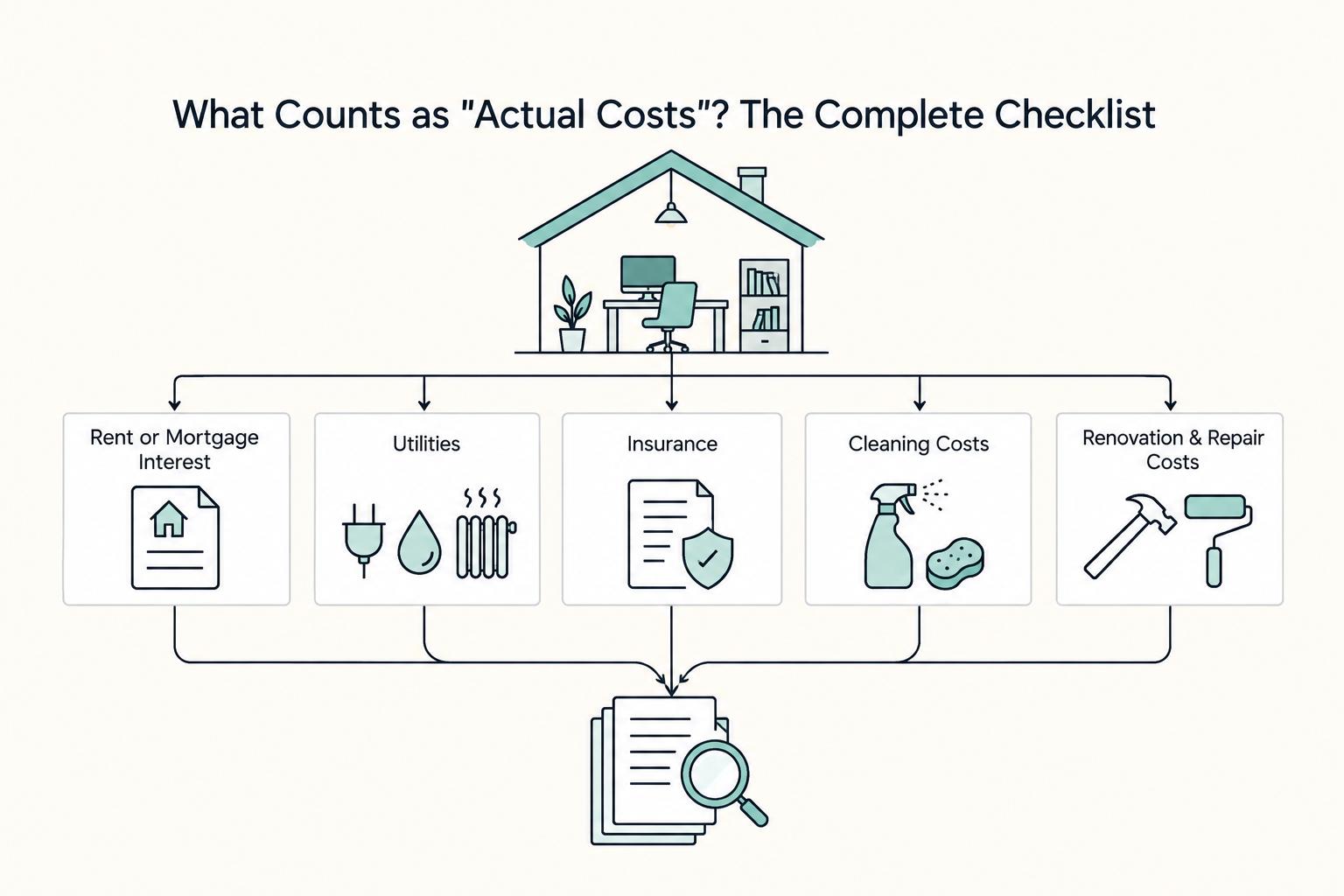
What Counts as "Actual Costs"? The Complete Checklist#
If your analysis points toward the optimization path, your next step is to gather evidence of every deductible expense. You can deduct a portion of the following:
- Rent or Mortgage Interest: The core of your deduction, calculated proportionally based on your office's square footage.
- Utilities: A pro-rated share of your electricity, heating, and water bills.
- Insurance: A portion of your homeowner's or renter's liability insurance (
Haftpflichtversicherung). - Cleaning Costs: If you hire a cleaner for your entire apartment, a part of that cost is deductible.
- Renovation & Repair Costs: Costs for renovating your office (e.g., painting, new flooring) can be fully deducted. Pro-rated costs apply for general apartment repairs.
- Depreciation (
Abschreibung): Office furniture, such as a desk or chair, can be depreciated over its official useful lifespan (typically 13 years).
Many professionals default to the lump sum for convenience without even roughly estimating actual costs. If your real expenses would materially exceed the €1,260 lump sum, that shortcut leaves money on the table. This modeling step is where you find that difference.
Step 3: Prepare the Documentation an Auditor Will Ask For#
At this stage, calculation turns into documentation. The questions an auditor will ask are usually predictable, so you can prepare the answers in advance and keep them in one clear file. This isn't just about saving receipts; it's about showing a consistent, professional record. Your goal is to make the review easy. When you do that, there is usually less reason for deeper questions.
Here is how you build that file, piece by piece.
- The Foundation: Your Contemporaneous Log. Forget vague recollections. A simple spreadsheet is often enough. Create a log with columns for: Date, Primary Work Location (e.g., Home, Corporate Office, Client Site A), and a Brief Note on Key Activities. This record matters for substantiating a daily lump sum claim and gives freelancers strong context for proving their home office is their main workplace.
- Documenting a Dedicated Room (
Arbeitszimmer). If your analysis points to the Actual Cost path, your evidence must be flawless. The German tax office requires objective proof that the room meets its strict criteria. Your dossier must include:
- A Precise Floor Plan: An architectural drawing of your apartment, with the
Arbeitszimmerclearly marked, showing the exact square meterage of the office and the total living area. This is the basis for all pro-rata calculations. * Photographs: Clear, well-lit photos of the fully furnished room from different angles. The images should exclusively show work-related items - a desk, office chair, professional literature - and nothing suggesting private use, like a guest bed or exercise equipment. * Lease or Mortgage Agreement: A copy of your rental contract or mortgage statement to verify your total housing costs.
- Organizing Your Expense Receipts. To claim actual costs, you need a trail of evidence. Create a simple digital folder system named by year (e.g., "Tax 2025") with subfolders for each expense category ("Rent," "Electricity," "Insurance"). Every time you receive a relevant bill, save a digital copy in the appropriate folder. This organized trail demonstrates a systematic approach and removes any suspicion of ad-hoc claims.
- The "Why" Behind the Work. If you're a freelancer claiming your
Arbeitszimmeras the "Center of Professional Activity," you need to articulate the qualitative argument. Include a concise, one-paragraph statement in your tax files that explains why your home office is indispensable. For example: "As a freelance UX/UI designer, this office is the central hub of all income-generating activities. It houses the specialized hardware required for design prototyping, serves as the confidential space for all virtual client workshops, and is where 100% of my project management and invoicing is conducted." This statement connects the physical space to your core business functions, cementing its essential role.
Frequently Asked Questions
How do I prove my home office days for German tax?
Keep your own consistent, contemporaneous log. A simple spreadsheet with the date, primary work location, and brief note on key activities is the best evidence for the daily lump sum. The tax office does not require a formal employer certificate, but the burden of proof is on you.
Is the German home office lump sum worth it?
It is worth it if you want the simplest option, have low actual costs, or do not have a dedicated room that qualifies. The lump sum is capped at €1,260 annually and is the lowest-effort path. It only creates a tangible tax benefit if your total work-related expenses exceed the standard employee allowance of €1,230.
What is the difference between the `Homeoffice-Pauschale` and deducting actual costs?
The Homeoffice-Pauschale is a daily flat rate for working from home and does not require a separate room. The actual cost method applies only when a separate, dedicated room is the center of your professional activity, and it is based on pro-rated real expenses rather than a daily cap. The flat rate needs a simple day log, while actual costs require floor plans, photos, housing documents, and receipts.
Can I claim home office costs if I work from my kitchen table in Germany?
Yes. You can claim the €6 daily lump sum for each day you work predominantly from home, even if you work from a kitchen table. You cannot claim actual pro-rated rent or utility costs for that setup.
Can I claim the home office deduction if I am a renter in Germany?
Yes. Being a renter does not prevent you from claiming home office costs. If you use the actual cost method for a qualifying Arbeitszimmer, your monthly rent is one of the main expenses claimed on a pro-rated basis.
What documentation is needed for the `Arbeitszimmer` deduction?
You need a precise floor plan showing the office size and total living area, clear photos of the room furnished exclusively for work, and your rental agreement or mortgage documents. You also need receipts and invoices for the expenses you claim, such as utilities, insurance, and repairs.
Can I claim both the home office lump sum and commuter allowance?
Usually no. If you work from home, you claim the home office lump sum, and if you travel to your primary workplace, you claim the commuter allowance. A possible exception exists if your employer has not provided a permanent workplace and you both work from home and travel to the office on the same day.
Researched and edited by the Gruv editorial team. Gruv builds cross-border billing, payouts, and finance-operations software for global businesses.
Sources
Includes 4 external sources outside the trusted-domain allowlist.
Educational content only. Not legal, tax, or financial advice.
Related Posts

Digital Nomad Taxes in 2026 With a Defensible Filing Plan
With digital nomad taxes, the first move is not optimization. It is figuring out where you may be taxable, where filings may be required, and what proof supports that position.

Can Digital Nomads Claim the Home Office Deduction?
Claim the deduction only when your facts and records can carry it. With the home office deduction for digital nomads, the real decision is usually a three-way call: claim it, do not claim it, or pause and get help because your file is not ready.
How to Write Off a Home Office as a Renter
A renter can claim the home office deduction when IRS eligibility tests are met and the business use of the home is clear to document. You are the CEO of a business-of-one, so run this like an operating decision: qualify first, document second, then calculate. If you want a low-friction approach, start with compliance, not aggressive tax savings.