
Quick Answer
Draft an NDA for a software development project by treating signature as the disclosure gate, defining confidential information in concrete software categories, matching mutual or unilateral structure to actual disclosure flow, and setting clear exclusions, permitted use, survival, and dispute terms before any sensitive sharing. Prepare an asset register, recipient map, and purpose statement so the NDA matches what will actually be shared in calls, demos, repos, and documents.
Why this NDA matters before you write a single line of code#
Use the signature as your disclosure gate. If the NDA is not signed, only share information you can afford to lose control of.
This is not paperwork for its own sake. Early sales calls, scoping, and demos can drift into real confidential material, including source code, architecture notes, test data, client datasets, security notes, and repo structure. If you disclose too early, you weaken your position later when you need to show you took reasonable steps to protect non-public technical or business information.
In practice, the risk often shows up in ordinary moments, not dramatic ones. A call starts with a harmless roadmap discussion, then someone asks to see the current schema, a staging environment, a backlog item with embedded business logic, or a quick repository tour "just for context." Once that happens before signature, the disclosure has already moved beyond high-level evaluation. That is why the gate matters: it gives your team a simple operating rule when a conversation starts sliding from general discussion into protected detail.
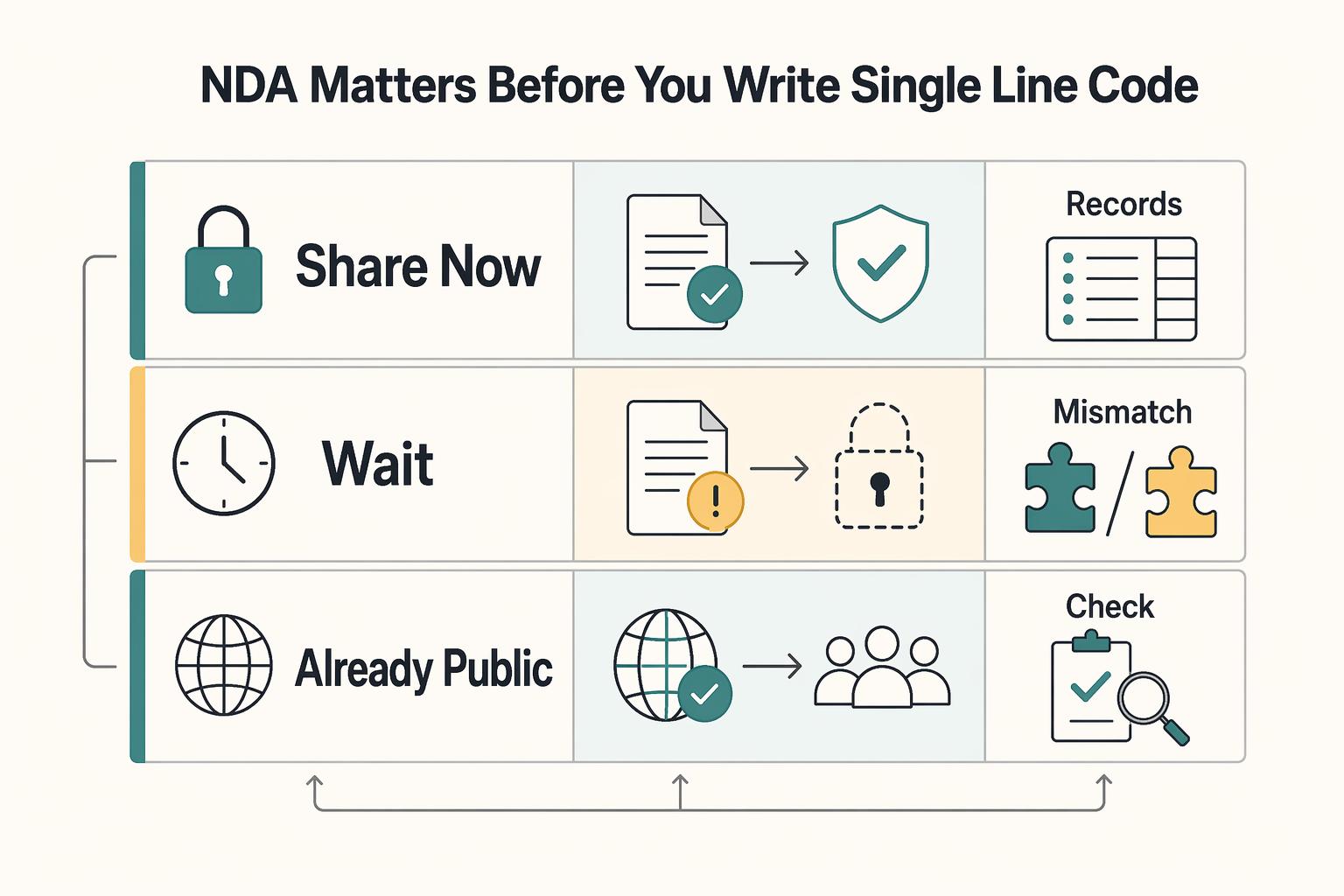
Before any serious call, classify what you plan to discuss:
| Bucket | Typical software examples | What to do |
|---|---|---|
| Share now | High-level problem framing, delivery process, public case studies, sanitized screenshots, public API docs, broad stack preferences | Proceed, but stay general and avoid client-specific or implementation detail |
| Wait for signature | Source code, architecture diagrams, database schema, backlog items with business logic, sanitized test data, authorized client datasets, internal security notes, pricing logic | Pause disclosure until the NDA is signed |
| Already public | Open-source repos, published product docs, public pricing, marketing pages, conference talks, released screenshots | Discuss freely, but do not mix with non-public detail |
If something is borderline, treat it as Wait for signature.
That default matters because borderline items are where teams slip. A diagram may look "high level" but still reveal internal architecture. A screenshot may appear sanitized but still expose client names, workflow states, or internal metrics. A demo database may look fake but still contain real structures, edge cases, or records copied from production. If your team has to debate whether something is sensitive in the moment, that is often a sign to hold it back until the signed NDA is in place.
Run this quick pre-disclosure check:
- Identify the parties. Use exact legal entity names, not email-signature shorthand.
- Map disclosure direction. Confirm whether sharing is one-way or two-way during discovery and solution design.
- Define protected scope. List the specific artifacts you need covered.
- Assign handling owners. Decide who controls calls, demos, files, and access permissions.
- Do a neutral-reviewer check. If a neutral reader cannot tell what is protected, who is bound, and what is excluded, pause and fix the draft.
Also set a meeting stop-line. If a call drifts into "just show the repo" or real client records, pause with a clear script: "We can cover the high-level approach now; repo, architecture, and client data wait for the signed NDA." Proceed only when the signed copy is in hand, disclosure is authorized, and your team knows the handling rules. An NDA does not authorize sharing client data or credentials: use sanitized data and grant least-privilege access separately when required. If your signed template allows post-disclosure written identification, follow that process exactly rather than assuming it applies by default.
This stop-line should be operational, not theoretical. Put it on the meeting prep note, give it to anyone running demos, and make sure the person sharing a screen knows what they are allowed to open. If you are presenting from a live environment, close tabs, hide notifications, and stage only the material that fits the Share now bucket. The legal document matters, but so does the discipline of not revealing protected material by accident while waiting for it.
Once sensitive software artifacts are shared, it can be hard to fully undo the exposure. Control the sequence first, then the technology.
What to prepare before you send any NDA template#
Prepare your internal file before you touch the template. If you cannot clearly show what is confidential, who receives it, and why, the scope may be vague and harder to enforce.
Keep this pack practical, not legalistic. A practical way to structure it is with three working parts: an asset register, a recipient map, and a purpose limitation. Together they help you decide what belongs in the NDA, what should wait until signature, and what should not be shared at all.
Think of this as the operating file behind the contract. The NDA is the external document. Your prep pack is the internal logic that makes the wording accurate. When the contract later says certain categories are confidential, this file should already show what those categories are, who may see them, and at what stage of the project they become relevant.
Before you start#
Set up one short control file with:
| Prep pack part | Question it answers | Control-file wording |
|---|---|---|
| Asset register | What is confidential? | what you might disclose |
| Recipient map | Who receives it? | who might receive it |
| Purpose limitation | Why is disclosure allowed? | why disclosure is allowed |
This is your decision tool, not the disclosure itself. If a neutral reviewer cannot tell what is sensitive, who is bound, and what use is allowed, revise before sending.
Keep it short enough that the team will actually use it. One concise control file that gets updated is better than a long internal memo no one opens. The goal is not to capture every possible future detail. The goal is to make sure the draft NDA follows the real disclosure plan.
Step 1: Build the asset register#
Start with concrete items you may discuss or share in the software project. Avoid vague labels like "technical info."
Use grounded categories such as:
- source code
- architecture designs
- algorithm notes
- business strategy
- client databases
- marketing plans
For each item, record:
- sensitivity reason
- disclosure stage
- owner
Use this quick triage table as an internal starting point to keep decisions consistent:
| Artifact type | Share now | Share after signature | Do not include |
|---|---|---|---|
| Public materials (already published product/docs/open resources) | Yes | No | No |
| High-level, non-sensitive project framing | Yes | No | No |
| Source code, architecture designs, algorithm notes, client databases, non-public strategy/marketing plans | No | Yes | No |
| Data or access you do not need for evaluation | No | No | Yes |
These are planning defaults, not universal legal rules.
The Do not include column is a control, not a formality. Some information should stay out even while the NDA is being negotiated.
That last category deserves attention because teams can over-share once an NDA is signed. The point of the register is not only to delay disclosure until signature. It is also to identify material that should not be part of evaluation at all. If a file, environment, or dataset is not needed for the current stage, keep it out of the discussion and out of any shared folder. A signed NDA supports disclosure; it does not require it.
As you build the register, sort items by likely sequence. What might be discussed in discovery is different from what might be shown during design review or implementation planning. That sequence matters because it helps you draft a purpose statement that is neither too narrow for the next call nor so broad that it becomes hard to apply.
Step 2: Build the recipient map#
Map recipients before you select or edit the template.
For each recipient, capture:
- exact legal entity
- person or role receiving information
- disclosure direction, one-way or two-way
- one-line business reason
If you cannot explain why a recipient needs a specific item, stop and remove or defer that disclosure. By the end of this step, every sensitive item should map to both a recipient and a purpose.
This is where overbroad sharing plans often become visible. A company may be the formal counterparty, but the actual recipients may include a buyer, a technical evaluator, an internal stakeholder on design, or an outside role reviewing implementation feasibility. If your team cannot tell who will actually receive the material, the handling rules become harder to enforce day to day. Tight mapping also helps you catch when a request for broader access is really a request for broader disclosure than the current deal stage justifies.
Step 3: Set purpose limitation and template baseline#
Use a standard baseline and make targeted edits. For software work, that baseline should cover confidentiality, compliance with security policies, and long-term protection of IP assets.
Write a purpose statement that matches the deal stage. It should be specific enough to control use and broad enough to allow legitimate evaluation activity. Then check that purpose against your asset register so the scope tracks actual disclosure needs.
Avoid broad catch-all drafting. Overly restrictive or vague language can fail in enforcement.
A good internal test is to read the purpose statement next to a few items in your register and ask, "Would this purpose clearly allow review of this item, but not unrelated use?" If the answer is no, revise before sending. The purpose statement should help your team say yes to appropriate evaluation and no to use that goes beyond evaluation. That is much easier to manage when the statement tracks the actual project phase.
If the governing law is unfamiliar or you are heavily customizing confidentiality definitions, get attorney review before sending so the draft is tailored to the governing state law.
Step 4: Run the pre-send gate#
Before the draft goes out, run one final quality check:
| Pre-send check | What to confirm |
|---|---|
| Confidential information definition | confidential information is defined in concrete categories |
| Scope and obligations | scope and obligations are precise, not overly restrictive or vague |
| Permitted use | permitted use matches the stated purpose |
| Baseline terms | baseline confidentiality and security-policy terms are present |
| Timing gate | get signature before work starts and before any Share after signature disclosure |
Then run the timing gate: as a practical checkpoint, get signature before work starts and before any Share after signature disclosure.
Treat this as a send/no-send checkpoint. If the register, recipient map, and purpose limitation do not line up, do not send the template yet. Fix the mismatch first. It is faster to clean up your own draft before it reaches the other side than to negotiate corrections after they have already reviewed a vague version.
Keep this prep pack as a living file. Refresh it when:
- project scope changes
- a new recipient is added
- discussions move into deeper technical exchange
Those are the points where an NDA that looked accurate can stop matching reality.
You might also find this useful: Confidentiality vs. NDA: What's the Difference for Freelancers?.
Choose Mutual NDA or Unilateral NDA in 60 seconds#
Pick the NDA type by actual disclosure direction, not by who sent the draft. Use mutual when both sides will disclose confidential information, and unilateral when only one side will.
Then do a reciprocity check. A two-way NDA works only when rights and obligations are broadly reciprocal. If both sides will disclose but protection needs are not aligned, use a reciprocal confidentiality structure with party-specific obligations instead of forcing a generic mutual form.
| NDA type | When to use | Typical software-sharing scenario | Negotiation friction | If access and protection do not match |
|---|---|---|---|---|
| Mutual | Each side will disclose and receive confidential information | Client shares internal business/customer context; you share non-public technical approach or delivery materials | Usually smoother on standard language; custom edits can trigger legal/internal review | Keep mutual label, but draft party-specific obligations if sensitivity differs |
| Unilateral | Only one side is disclosing confidential information | Client shares requirements/internal plans; you do not disclose non-public methods | Third-party or heavily edited templates may still require review/negotiation | If client wants deeper technical visibility from you, request mutual terms or limit disclosure until fixed |
A fast way to decide is to ignore the title on the draft for a moment and ask a simple workflow question: "Will we only receive, or will we also disclose?" If you will show architecture, estimates tied to internal methods, delivery materials, or any non-public technical approach, you are no longer in a clean one-way scenario. The paper says unilateral, but the work can become two-way.
Step 1: Map disclosure by phase#
Map disclosure by phase. This is an operating check, not a legal requirement.
- Discovery: If only one side is sharing non-public information, unilateral can still fit.
- Design: If you start sharing non-public architecture, tradeoffs, or solution logic, re-check for mutual.
- Implementation: If the exchange expands into repositories, deployment details, integration notes, or test context, confirm the NDA still matches reality.
- Handoff: If confidential material is moving both ways at this stage, the form should also be two-way, or reciprocal if duties differ.
Decide based on the next likely phase, not just the current call. If discovery is one-way today but design is likely to become two-way next week, it may be cleaner to fix the structure now rather than reopen the issue once technical review starts.
Step 2: Run the fairness test before signing#
Run the fairness test before signing. If the client wants deep technical visibility while keeping one-way duties, treat that as a risk-allocation warning.
Ask for mutual terms, or limit disclosure until the structure is corrected.
Do not assume the practical relationship will stay balanced without balanced language. If the document protects only one side while both sides are sharing sensitive material, treat that as one-sided risk allocation in the draft.
Step 3: Use reciprocal drafting when obligations differ#
Do not assume "mutual" automatically means balanced. If both sides disclose but one side needs different protection or permitted-use limits, use reciprocal drafting so each party's obligations can differ.
That can matter when both sides are sharing, but the types of information are not the same. One side may be focused on customer or business context, while the other side is sharing technical methods or internal delivery materials. The label can stay mutual, but the operative duties still need to make sense for the real exchange.
Step 4: Keep customization tight unless it is necessary#
Keep customization tight unless it is necessary. Standard templates are usually easier to move, while third-party or edited templates may require review and negotiation before signature.
If your team uses an approval queue, track delay using your current verified internal review range. Treat signature as the release gate for anything on your "share after signature" list.
Need the full breakdown? Read How to structure a 'joint venture' agreement for a software product.
Define Confidential Information so it is enforceable in software work#
The definition has to be concrete. In an NDA for software development, name the actual assets being shared so both parties apply the clause the same way and the risk of unauthorized disclosure is easier to control.
A usable definition does two things: it tells the Receiving Party what to protect and gives the Disclosing Party a clear handling rule. For written materials, follow the signed agreement’s marking rule; labeling them "Confidential" is a useful handling practice even when marking is not a condition of coverage.
The practical test is simple: can your team tell what falls inside the definition without guessing? If not, the wording is too abstract for real software work. Good definitions are specific enough to guide conduct before a dispute ever happens.
Step 1: Define Confidential Information as specific software categories#
Define Confidential Information as specific software categories, not catch-all language.
| Specific category language | Overbroad catch-all wording | Software example |
|---|---|---|
| "Unpublished computer code and related technical materials" | "All technical information" | Non-public code shared for evaluation |
| "Design definitions, specifications, flow diagrams, and flowcharts" | "All project materials" | Architecture docs and process diagrams |
| "Formulas, algorithms, and data structures" | "Any know-how" | Non-public logic or methods |
| "Documentation, customer lists, and pending patent applications" | "All business information" | Internal docs and business-sensitive records |
If you cannot point to what is protected, tighten the wording before disclosure. Preserve lawful reporting and compelled-disclosure routes as well. In U.S. agreements governing confidential information for workers, including contractors and consultants, 18 U.S.C. § 1833 requires notice of specified trade-secret reporting immunity; it can be supplied by a qualifying policy cross-reference. Omitting notice can limit exemplary damages and attorney-fee recovery under the federal trade-secret statute.
The point is not to create a longer list for its own sake. It is to reduce ambiguity when people are handling real artifacts. "All technical information" sounds broad, but it gives the team less guidance than naming the materials you actually expect to exchange. When teams are sharing materials quickly, clarity at the category level matters.
Step 2: Keep disclosing and receiving party roles explicit#
Keep party roles explicit. The Disclosing Party is the one sharing proprietary information, and the Receiving Party is the one receiving it. If those labels are unclear, the scope usually is too.
This matters during active project discussions, where what is being shared can change quickly. If the draft makes those roles hard to follow, handling can become inconsistent in practice. Clear roles make it easier to train the team on who is protected when, and what duty applies to each handoff.
Step 3: Set boundaries in plain language#
Set boundaries in plain language. Keep the definition readable enough that people can apply it consistently instead of interpreting a dense paragraph in different ways.
Operationally, boundaries help with triage. When a team member is unsure whether to share a file, they should be able to compare the file to the listed categories and marking rule without decoding a long block of legal wording. That is especially important when disclosures move quickly and the people handling them are not the people who negotiated the paper.
Step 4: Run a fast consistency check before sharing#
Before you share sensitive material, confirm it fits the protected categories and follow any marking or written-confirmation requirements in the signed agreement. Labeling written material "Confidential" also helps recipients handle it correctly. The team should be able to apply the definition during day-to-day work.
Make the check concrete. Pick a handful of likely items and verify they are classified the same way against the definition and marking rule. If classification is inconsistent, revise the wording before disclosure.
Related: IP Protection When Outsourcing Software Development to Eastern Europe.
Set Confidentiality Exclusions and Survival Period without slowing the deal#
Before you sign, check that exclusions preserve legitimate protection boundaries without unintentionally excluding confidential material, and that survival fits the disclosures. In software work, treat those two controls as key checks for whether confidentiality will still work once sharing expands.
Use the same disclosure inventory you built for Confidential Information. Work in this order: map what you will share, test each exclusion against that map, then set survival based on sensitivity instead of template habit.
This sequence matters because negotiating duration first can miss the bigger risk. A longer survival period does not fix a carve-out that unintentionally excludes confidential material; legitimate exclusions still apply. Start with the inventory, then test the carve-outs, then decide whether the remaining protection lasts long enough for the actual disclosures you expect to make.
Step 1: Map what you will actually share#
List real handoffs by phase: early discovery, design and architecture, then later technical materials and access. For each item, note sensitivity and planned timing so your redlines match actual disclosure behavior.
Track the disclosure period separately from surviving confidentiality duties. An agreement can stop covering new disclosures while continuing to protect material shared earlier; read both dates before the next handoff.
A useful internal view is a phase-by-phase handoff list. Not every disclosure happens on the same day, and later disclosures may be more sensitive than earlier ones. If you only think about the first exchange, you can end up with protection that looks adequate at signature but no longer fits the later phase when the real technical material starts moving.
Step 2: Test every exclusion against that map#
Review exclusions against the inventory and distinguish legitimate exclusions from unintended overbreadth. Information may remain excluded because it is public without breach, lawfully known beforehand, received lawfully from a third party, or developed independently. Check the conditions and supporting records instead of narrowing a valid exclusion merely because the item matters to you.
When the other side invokes an exclusion, require objective support and document who on your side can accept that position. Put one named reviewer on the redline trail so exclusion decisions are traceable.
| Clause pattern | Why it weakens protection | Safer fallback wording to propose |
|---|---|---|
| "Excluded if already known to Receiving Party" with no proof standard | Lets prior knowledge be asserted without evidence | "Excluded only to the extent prior knowledge is supported by contemporaneous written records." |
| "Excluded if it becomes public" | Can blur whether publicity resulted from the Receiving Party's conduct | "Excluded only if it becomes public other than through the Receiving Party's act or omission." |
| One short survival rule for all confidential material | Ignores sensitivity differences across phased disclosures | "Set survival by disclosure category/sensitivity, or tie protection to each disclosure date." |
The operational point is consistency. If someone on the other side says a category is excluded, your team should know who can evaluate that claim and what support is needed. Otherwise exclusion decisions can get made casually in email, and later no one can tell whether a category was intentionally carved out or just waved through during negotiation.
Step 3: Set survival by sensitivity, not template habit#
Set duration only after you test it against your inventory. If higher-sensitivity material is disclosed later, survival should reflect that risk profile.
If the counterparty resists longer protection, cut scope before conceding duration: share less, stage access later, or hold back the most sensitive items until broader contract terms are in place.
This is a practical tradeoff, not just a redline position. If the other side will not accept survival that fits the materials you would otherwise disclose, the clean solution may be to narrow the disclosure package rather than argue in the abstract. A smaller, better-controlled set of disclosures is often easier to protect than a broad set governed by a weak duration rule.
Step 4: Assign one owner for expiry and phase checks#
Treat this as lifecycle control, not signature administration. Assign one owner to track expiry dates, survival windows, and phased-disclosure timing so obligations are not left buried in an unmonitored spreadsheet.
Before each new disclosure phase, that owner should confirm the NDA is still active, survival still fits the next materials, and any exclusion decisions were accepted by the designated reviewer.
That owner should also be the person people ask before opening access to a later-stage item. The goal is to prevent a repeat of a preventable failure: everyone assumes the paper still works because it was signed once, even though the next disclosure phase no longer fits the agreement as written.
Lock Governing Law, Jurisdiction, and Dispute Resolution before signature#
Forum terms should be settled before you sign, not cleaned up later. Lock party names, dates, and contract linkage first, then finalize governing law, venue, and dispute path before you share sensitive material.
Step 1: Confirm legal anchors before forum terms#
Before you negotiate forum language, confirm the exact legal entity names, Effective Date, and how this NDA connects to any MSA/SOW. Your internal check should be simple: who is bound, from when, and which agreement controls if terms conflict. If that is unclear, keep disclosures limited until it is fixed.
Do not let forum negotiation distract from these basics. A polished clause on venue can still fail operationally if the wrong entity is named or the relationship to the main services documents is unclear. Set the anchors first so the later dispute mechanics sit on a stable draft.
Step 2: Choose the dispute structure you can operate#
A governing law clause selects which law applies. A forum selection clause selects where a dispute is heard. Keep those choices intentional and workable for cross-border enforcement.
Court litigation vs arbitration
| Option | Speed | Enforceability across borders | Cost predictability | Operational burden |
|---|---|---|---|---|
| Court litigation | Depends on court and procedure | Depends on court-choice and recognition path | Can expand with motion/procedure disputes | In U.S. courts, proceedings are generally public, which may increase exposure risk |
| Arbitration | Can be efficient, but not always faster | Can offer stronger cross-border posture because foreign awards are generally expected to be recognized and enforceable in Convention jurisdictions, subject to local procedures and defenses | Can be more predictable when the clause names administrator and rules | You must define rules, place of arbitration, and filing mechanics clearly |
Home forum vs counterparty forum
| Option | Speed | Enforceability across borders | Cost predictability | Operational burden |
|---|---|---|---|---|
| Home forum | May be easier for your team to run | Depends on where the other side and assets are | Can be easier for your side to budget | Lower coordination friction for your team |
| Counterparty forum | May reduce signing friction | Depends on local enforcement path | Can be harder for your side to scope | Higher management burden, especially for urgent action |
If you choose arbitration, name the administrator and rules in the clause. If you choose an exclusive court forum in an international deal, confirm whether the Hague 2005 choice-of-court framework is relevant to your jurisdictions.
The right choice is the one you can actually execute under pressure. A clause that looks neutral on paper can still be hard to run if it requires your team to coordinate notice, filings, and urgent relief in a forum no one is prepared to use. Test the clause as an operating path, not just a negotiating position.
Step 3: Draft dispute mechanics so they work under pressure#
Make each stage executable, not aspirational:
- Set notice method and addresses, email and physical, and state when notice is effective.
- Add a bracketed response window you can actually manage.
- Name an escalation owner, by role or person, on each side.
- Preserve interim-relief access in competent court, even if arbitration is the final forum.
- State final filing mechanics: for arbitration, specify place of arbitration and filing trigger, for example, Request for Arbitration. If mediation comes first, keep a clear placeholder window such as
[60] [90] days.
Clarity here reduces delay later. If a breach issue emerges, no one should be arguing first about where notice goes, who receives it, or whether a court filing is allowed while arbitration mechanics are being set up. Those are drafting details now, but they become operational details very quickly if something goes wrong.
Step 4: Catch conflicts before signature and gate disclosure#
Redline for remedy conflicts before signing. A common drafting risk is language that promises urgent court relief but elsewhere forces all actions into a single distant forum with no interim-relief carveout, or NDA forum terms that conflict with services-agreement liability or termination language.
Use one clean draft and one redline, and only release sensitive architecture details, repo access, or client datasets against the signed version that matches your remedy plan. If forum language stays unclear, slow disclosure until it is fixed.
This pairs well with our guide on How to Write a Scope of Work for a Mobile App Development Project.
Handle Termination, Breach Consequences, Limitation of Liability, and Indemnification cleanly#
Read these clauses as one linked set of controls. You should be able to tell what ends, what survives, what conduct is a breach, which remedies remain available, and whether indemnity is narrowly tied to confidentiality risk.
Keep the NDA, any linked MSA/SOW, and one live redline open together. If the NDA says it is the Entire Agreement, confirm that does not conflict with the services agreement you will actually operate under.
Step 1: Map termination and survival first#
Start by marking what stops and what continues after termination. Specific termination triggers (for convenience, for cause, or automatic) are not defined here, so draft those mechanics explicitly if you need them.
If confidentiality is meant to continue, the text should say so. If your draft includes return-or-destroy language, place it with the post-termination logic so obligations are easy to follow.
Your quick test is simple: from the draft alone, can you answer what ends, what survives, and what the receiving party must do with protected material after the relationship stops?
If you cannot answer that from the document without jumping between clauses, the draft is harder to use than it looks. Post-termination duties should be easy to follow because that is exactly when teams are winding down access, closing folders, and trying to clean up copies of shared material.
Step 2: Tie breach triggers to real misuse#
Do not draft breach around disclosure only if your real exposure is broader. The supported duty can include no unauthorized disclosure, copying, modification, or use, so your breach language should match that full risk pattern.
If the draft states unauthorized disclosure is a material breach, check that unauthorized copying, modification, or use also clearly triggers breach consequences.
This matters in software work because misuse is not always a public leak. The real harm may be retention, duplication, internal reuse, or modification outside the permitted purpose. If the breach clause is narrower than the actual duty, the draft may look complete while missing the conduct you are most worried about.
Step 3: Read liability limits against remedies#
If your remedy text allows injunctive relief and damages, make sure later liability wording does not neutralize that result. Do not assume a liability-cap amount, formula, or standard carve-outs are established, so define that interaction directly in your NDA or linked contract.
Read these provisions together, not one at a time. A clean remedy sentence near the front of the document can be undercut by later general liability wording if the two are not aligned. That kind of conflict is easy to miss during negotiation and frustrating to discover only after a problem appears.
Step 4: Keep indemnification narrow and defined#
If indemnification is included, keep it tied to defined confidentiality breaches rather than broad project language. Who indemnifies whom, duty-to-defend allocation, control-of-defense rules, or notice timelines are not defined here, so spell those out if you include indemnity.
| Clause area | Overbroad or risky wording | Safer scoped alternative |
|---|---|---|
| Remedy carve-outs | "All claims are limited to the general remedies in Section X." | State whether confidentiality breaches can still support injunctive relief and damages. |
| Liability cap conflicts | "Any claim under this NDA is subject to the MSA liability limits." | State explicitly how confidentiality claims interact with any cap. |
| Indemnity trigger | "Party B indemnifies Party A for any claim related to the project." | Limit indemnity to defined breaches of confidentiality obligations. |
A narrow indemnity is usually easier to understand and easier to negotiate. Once indemnity language starts pulling in broad project risk, you are no longer dealing with a focused confidentiality document.
Step 5: Run one operational misuse walkthrough before signing#
Do a fast "if this misuse happens, this clause activates" check with delivery and legal:
| Scenario | What the draft should do |
|---|---|
| Protected material is kept after termination | survival language and any return-or-destroy language in the draft should still control what happens next |
| Architecture notes are shared without authorization | breach language should activate, and remedies should remain available |
| Liability text appears to narrow that outcome | resolve the conflict in redline before disclosure starts |
This walkthrough does not need to be long. One short scenario review is often enough to expose gaps between what the team thinks the NDA does and what the text actually says.
Keep NDA scope separate from IP Ownership Clause and Non-Solicit Clause#
Keep the NDA focused on confidentiality. If a clause transfers rights, grants IP use permissions, adds hiring restrictions, or sets commercial terms, move it to the services or commercial contract, or to a separate restrictive-covenant agreement.
Open the NDA draft, your redline, and the services or commercial agreement together. Then run a strict tagging pass so each clause has one job.
| Clause type | Keep in NDA | Move to services/commercial agreement | Why this split reduces negotiation friction |
|---|---|---|---|
| Confidentiality duty | Yes | No | This is the NDA's core job: protect against unauthorized disclosure or use of confidential information. |
| IP ownership or assignment | No | Yes | Assignment transfers rights, which is a separate negotiation from confidentiality. |
| License or IP use permission | No | Yes | Licensing defines permission and use scope, which belongs in a commercial IP instrument. |
| Non-solicit or hiring restriction | No | Yes, or separate restrictive-covenant agreement | Non-solicit is a restrictive covenant, not a default confidentiality duty, and enforceability can vary by state. |
| Commercial terms (fees, delivery, acceptance) | No | Yes | Commercial obligations belong in the services deal, not the confidentiality lane. |
This separation helps your team operationally as well as legally. Delivery should be able to follow the NDA without wondering whether a sentence about "access" actually grants a license, whether a broad rights clause is assignment language that could transfer ownership, or whether a hiring restriction is now part of the confidentiality workflow. Each document works better when each one has a clear job.
Step 1: Tag each provision and split mixed-purpose clauses#
Tag each provision as: confidentiality duty, IP ownership or assignment, restrictive covenant, or commercial term. If one clause needs two labels, treat that as a red flag and split it.
The tagging pass is useful because mixed-purpose clauses often hide in ordinary wording. A sentence may start as a confidentiality obligation and end by limiting use in a way that functions like a license restriction or a commercial term. If you need two labels to describe one clause, it probably belongs in two places.
Step 2: Move non-confidentiality text to the right contract#
Move non-confidentiality text to the right contract. Escalate immediately if you see transfer wording such as "assigns," "hereby transfers," or "all rights, title, and interest," or broad license language framed as "access" language.
That cleanup can reduce process friction in NDA-only approval workflows. Once ownership, licensing, or commercial points are pushed into the right agreement, NDA review can stay focused on confidentiality.
Step 3: Treat non-solicit terms as separate from confidentiality#
Treat non-solicit language as separate from confidentiality, even if the draft says it "supports confidentiality." If non-solicit appears in the NDA, or enforceability is uncertain under the chosen governing law, route it for legal review.
Step 4: Keep one narrow no-license reservation in the NDA#
If needed, keep one narrow IP safeguard in the NDA: a no-license reservation stating that the receiving party gets no intellectual property or licensing rights from disclosed confidential information. Before signature, do a final operations check so your delivery team can follow confidentiality duties without accidentally accepting ownership transfer, licensing obligations, or hiring restrictions.
We covered this in detail in How to Write a Warranty and Disclaimer Clause for a Software Product.
Execute and store the signed NDA without operational gaps#
Execution is a release control, not an admin task. Do not share source repositories, algorithms, customer datasets, strategic roadmaps, or similar sensitive materials until the NDA is fully signed, logged, and linked to the active project record.
Set this up before release: keep one canonical location for executed agreements, use a file name that clearly marks the controlling copy, for example, ClientName_NDA_Executed_2026-03-24.pdf, store drafts and redlines in a separate Drafts folder, and assign one owner for access, circulation, and audit history.
Execution failures are usually boring ones: the wrong version gets signed, the signed copy is not easy to find, a redline gets circulated as if it were binding, or the project team starts sharing based on verbal confirmation that "legal approved it." Those risks are easier to prevent if execution is treated as a release gate with one owner and one controlling copy.
- Confirm final signers.
Check that the parties named in the NDA are the ones who signed, and that no required signature block is blank.
- Confirm the controlling version.
Compare the signed PDF to your last approved draft or redline so one executed copy clearly controls the confidentiality scope, defined purpose, and any marking requirements your team will follow.
- Approve disclosure only after logging the executed copy.
Do not send links or files until the executed NDA is logged and linked in the live project record.
| Operational step | Common failure mode | Control to implement now |
|---|---|---|
| Signature timing | Sensitive material is shared after verbal alignment but before signature | Block handoff until the executed PDF is logged |
| Version confusion | An older draft is signed with different confidentiality terms | Match the signed PDF to the last approved version before release |
| Draft-vs-executed mix-up | A redline is circulated as if binding | Keep Drafts and executed files separate and label executed files clearly |
It also helps to tie the executed copy to the first disclosure package. When the team is about to share source-repository access, algorithm documentation, customer datasets, or strategic roadmap materials, they should know exactly which signed file governs that handoff and where it is stored. That way, later questions about scope, marking, or timing can be answered from the project record rather than memory.
Final checkpoint: if your NDA uses marking requirements, label the first disclosure package correctly. If marking is missed, unmarked information can fall outside NDA protection.
Red flags in client NDA templates and how to respond fast#
When a client sends its paper, triage substance first. Fix disclosure direction, confidentiality scope, dispute path, and remedies before you spend time on style edits. Those are the clauses that decide whether the NDA actually protects you.
Before you redline, map who will disclose what in early work. If you will share your own confidential business information, one-way terms may not match reality and mutual terms may fit better. Also confirm you are reviewing the latest draft and current guidance.
A fast triage pass keeps you from wasting time on wording that does not matter if the structure is wrong. If the template is one-way when the relationship is really two-way, or if the confidentiality definition and duration are unclear, cleanup on formatting or tone will not solve the real problem.
| Red flag pattern | Why it is risky | Fast counterproposal |
|---|---|---|
| One-way obligations when both sides will share | Your disclosures are exposed while only the client is protected | Request reciprocal language or convert to mutual terms |
| Unclear confidentiality definition or duration | You may not know what is protected or how long obligations last | Define what is confidential and set a clear duration |
| Vague jurisdiction or dispute language | You may not know where or how a breach dispute is handled | Name jurisdiction and dispute path clearly |
| Unlimited liability language | A slip-up can carry severe consequences with open-ended exposure | Negotiate a defined liability cap and clarify remedy carve-outs; evaluate liquidated damages separately under the governing law |
- Check disclosure direction first. If both sides will disclose, request reciprocal obligations immediately. If that is rejected, narrow what you share until the structure is fixed.
- Check confidentiality scope and duration. Confirm what is defined as confidential and how long obligations last.
- Clarify dispute path. Make jurisdiction and dispute handling explicit.
- Check breach consequences. Confirm what happens if the NDA is breached before you sign.
- Align remedies to real risk. Review breach consequences and negotiate a defined liability cap and clarify remedy carve-outs. Liquidated damages are a separate drafting choice and can be unenforceable if punitive under the governing law.
When you respond, keep the counterproposal short and tied to the workflow. For example: if both sides will share technical material, ask for reciprocal obligations; if confidentiality scope or duration is unclear, tighten those terms; if the jurisdiction clause is vague, replace it with one clear route. Fast responses work better when they are anchored to an obvious operational mismatch.
If these core issues stay unresolved, pause signature and sensitive sharing until the draft is narrowed to enforceable confidentiality terms. That can be faster than cleaning up avoidable damage after a breach.
For a step-by-step walkthrough, see How to Structure a 'Testing and Acceptance' Clause in a Software Development Contract.
Before you return redlines, run your final clause choices through the NDA Generator so you send a clean draft that matches your disclosure plan.
Final takeaway and copy/paste pre-sign checklist#
The operating rule through all of this is simple: signature is the disclosure gate. If any checkpoint fails, pause sharing until the draft is fixed.
- Verify fit, purpose, and signers.
Confirm the NDA is for preventing unauthorized disclosure of Confidential Information, party details are correct, and signatures are complete. For beta testing, make sure the NDA covers the testers, feedback, product access, and permitted use; the agreement does not need a particular template title.
- Verify your real disclosures are actually covered.
Match the Confidential Information definition to what you will share: unpublished code, design definitions, specifications, and other technical materials you plan to disclose. Do not assume repo access, architecture walkthroughs, demo environments, or shared docs are protected unless the draft defines them that way. Mark written materials as "Confidential" where required.
- Separate confidentiality from other deal terms.
Keep this document focused on confidentiality obligations. If confidentiality scope, breach consequences, or related liability wording is unclear, resolve that before signing and review limitation of liability guidance.
- Run this pass/fail check before any handoff.
Ask: What is confidential? What is the duration? What are breach consequences? What jurisdiction applies?
| Check | Proceed now | Pause and fix first |
|---|---|---|
| NDA type and use case fit | The draft matches the actual disclosure setup | The template no longer fits the real sharing pattern |
| Confidential scope clarity | Core technical materials are clearly identified as confidential | Scope language is too vague for the materials you plan to share |
| Jurisdiction and breach terms | Jurisdiction and breach consequences are explicit | Jurisdiction or breach language is ambiguous or unresolved |
| NDA scope discipline | Confidentiality obligations are clear and central | Core confidentiality obligations are unclear |
If any row fails, do not share the repo, run the walkthrough, or open the demo. If all rows pass, proceed and tie each disclosure to the executed version.
After the NDA is signed, keep confidentiality separate from commercial terms by building your services agreement with the Freelance Contract Generator.
Frequently Asked Questions
What should an nda for software development include?
Include a clear definition of Confidential Information, a use limit tied to the stated purpose, well-defined exclusions, and clear forum terms. The draft should match the real workflow for calls, demos, repositories, and shared documents. List what you expect to share and confirm each item is either protected or intentionally excluded.
How do you choose between a Mutual NDA and a Unilateral NDA?
Choose by actual disclosure flow, not by who sent the draft. Use mutual terms when both sides will share non-public technical or business information, and unilateral terms when only one side will disclose. Map disclosures across discovery, design, and handoff, and update the structure before the next disclosure phase if the exchange becomes two-way.
When should you sign it?
Sign before any confidential disclosure, including serious discovery calls, demos, repo walkthroughs, or architecture reviews. Treat signature as a release gate and keep one canonical signed version before sharing. If a meeting is already scheduled, limit it to public or high-level material until the signed copy is logged.
How far can confidentiality exclusions go?
Exclusions should separate legitimately unprotected information from wording that unintentionally removes protection. Public information, proven prior knowledge, lawful third-party receipt, and independent development can remain excluded even when important to the project. Check the applicable conditions and evidence, preserve lawful reporting routes, and narrow only unintended overbreadth.
Can you use a free template for cross-border work?
A free template can be a starting point, but not the final draft for cross-border work. Localize governing law, court or arbitration terms, signer details, and execution method before sharing sensitive information. A standard baseline with only the needed edits is usually easier to operate than a broad rewrite.
What should you look for in governing law, jurisdiction, or arbitration terms?
Make the dispute route explicit before signature and choose a structure you can actually operate under pressure. Decide between exclusive court and arbitration, and if you choose arbitration, name the administrator, rules, place of arbitration, and filing mechanics. Keep the wording clear and consistent across the agreement and hold sensitive sharing until the route is settled.
What are the most common mistakes?
Common mistakes include sharing before signature, accepting one-way duties while you also disclose, letting exclusions outrun the disclosure plan, and assuming confidentiality language also transfers IP ownership. Another failure is losing control of the executed version or treating execution format as a blocker. Keep one final executed copy and tie each sensitive handoff to that controlling version.
Try a related tool
Researched and edited by the Gruv editorial team. Gruv builds cross-border billing, payouts, and finance-operations software for global businesses.
Sources
Includes 2 external sources outside the trusted-domain allowlist.
- law.cornell.edu/wex/non-disclosure_agreement_%28nda%29trusted
- law.cornell.edu/wex/nonsolicitation_agreementtrusted
- scholars.law.wlu.edu/ws/portalfiles/portal/40096510/Beyond%20Trad...trusted
- uscode.house.gov/view.xhtmltrusted
- uscode.house.gov/view.xhtmltrusted
- uscourts.gov/court-records/access-court-proceedingstrusted
- altigee.com/magazine/the-ultimate-guide-to-creating-nda-...external
- hcch.net/en/instruments/conventions/full-textexternal
Educational content only. Not legal, tax, or financial advice.
Related Posts

Limitation of Liability Clause for Freelance Software Developers
A liability clause sets which losses can be recovered and how much can be claimed. For a freelance developer, the useful starting point is the project risk: a failed acceptance test, an IP complaint, a data incident, or an unpaid invoice. Agree which risks the contract covers before choosing a cap number.
Best Digital Nomad Cities for Safety and Stability in 2026
Treat this as a relocation decision, not a travel mood. The fastest way to make a good call is to run every city through the same three checks in the same order: shortlist signal, stay feasibility, and day-to-day work readiness. Stick to that order and you avoid most expensive mistakes before money leaves your account.

The Freelance Payment Penalty: A Modeled Audit of Platform Fees, FX Spreads, and Payout Delays
The money rarely disappears through a single, easy-to-spot fee. The real loss is stacked. A marketplace takes its commission, a processor adds a charge for international cards, a bank or payment company converts the currency at a spread, a platform holds the funds before release, and a wire sheds a little to intermediaries on the way in. Each layer looks defensible on its own, but the worker feels the combined result as a smaller deposit and a later payday.