
Quick Answer
An effective IT outsourcing agency business plan is a weekly operating document that defines a narrow target market, clear service boundaries, delivery controls, and cash-flow rules. It should show what to accept, reject, and escalate, assign owners and review dates to objectives, align revenue assumptions with delivery capacity, and stay current through regular reviews.
Use the Plan as a Weekly Operating Tool#
An IT outsourcing plan must connect the service you sell to staffing, contract scope, invoices and cash. A generic template can supply headings, but the working plan needs enough detail for the team to decide whether it can accept the next client.
This guide turns the IT agency business plan into choices you can run next week: clear Objectives, explicit Contract scope boundaries, and checkpoints for early risk review. The document should describe how the business operates now and where it intends to grow over the next five years.
The practical test is simple. If a teammate cannot use the plan to decide what to accept, what to reject, and what to escalate, you do not have an operating document yet. You have a draft. Keep tightening until the plan answers real execution questions without guesswork.
Start by tightening what each core section must do:
- Executive Summary: record decisions after they are made, not where decisions are invented.
- Target Market: define a narrow buyer group with repeat needs.
- Value Proposition: state what you deliver, under what constraints, and what requires a signed change.
- Market Analysis: include market research that supports your strategy.
Use a minimum readiness test before calling the plan complete:
- Every objective has an owner, a measurable target, and a review date.
- Every offer has a written scope boundary.
- Revenue assumptions align with delivery capacity and cash timing.
- Key market claims are backed by evidence you can review.
Keep the plan current with a fixed review cadence, at least annually and more often during launch. If you plan to seek financing, keep your narrative, assumptions, and operating evidence aligned because lenders may review the plan during risk evaluation. Each section below moves from planning language to concrete choices you can verify, revise, and run.
Build the right mental model before you write#
Start with decision logic, not polished prose. Mental models help simplify complexity, assess how systems work, and improve decisions. Clarify what you sell, who buys it, and how delivery becomes cash without breaking service quality.
Define core terms before drafting long sections:
- IT outsourcing agency: outcome-linked delivery capacity, not just hours.
- Revenue Plan: how signed work becomes collected cash, including timing and failure points between invoice and payment.
- Financial Projections: assumptions under test, not promises.
For market analysis, interview the actual buyer: who approves the budget, what incident or project creates demand, what they use today and what they would pay to change it. Record the source and date for competitor pricing and buyer evidence. Broad outsourcing market forecasts do not establish demand for your chosen niche.
Anchor the plan around four linked decisions:
- Target Market: one buyer group with repeat pain and clear budget authority.
- Service mix: outcomes you will deliver now, and work you will decline.
- Operating controls: what must be true before kickoff, delivery, and invoicing.
- Cash Flow protection: how scope becomes invoice and collection, with escalation points when payments slip.
A practical sequence is to draft those four decisions, then test for conflicts. If your target market expects fast response but your service mix needs deep custom work, you either need tighter scope or slower promises. If your pricing assumes quick collection but your contract terms allow open-ended acceptance, your cash assumptions are already weak. Catch these conflicts on paper before they show up in delivery.
Add one writing checkpoint that keeps the plan honest: maintain an assumptions log with an owner, confidence level, and next review date for each major claim. If a claim has no owner or no review date, treat it as untrusted.
Use the assumptions log during reviews, not just at draft time. Mark each assumption as still true, partially true, or disproven based on recent client and delivery evidence. That small discipline prevents old assumptions from quietly driving new decisions.
If it helps your workflow, write the Executive Summary last. Once target market, service mix, controls, and cash rules are explicit, the summary can report decisions instead of aspirations.
Keep the mission and vision short: state the service, buyer and delivery boundary. Test each new offer against those choices and the available capacity before adding it.
Choose a niche with a pass fail filter#
Choose a niche only if it passes a delivery-reality test, not just a sales story. This is where planning protects you from overpromising beyond in-house capacity.
Specialization helps when your target client is specific and the work is repeatable. Higher-value clients often need higher-touch delivery, so an attractive offer can still fail if your current team cannot support the required service depth. Use one scorecard in your Market Analysis before launch:
| Service niche | Demand clarity | Delivery risk | Sales-cycle length | Margin durability |
|---|---|---|---|---|
| Managed IT services | Is buyer pain recurring and easy to describe? | Can your team deliver consistently without stretching beyond current capacity? | Is the path from first call to signed work predictable enough to plan? | Can delivery stay repeatable without constant exceptions? |
| Cybersecurity services | Are clients asking for a clearly defined outcome? | Do you already have the tools and expertise required for the scoped work? | Can you support the trust-building and qualification effort this offer needs? | Are deliverables and acceptance criteria clear before work starts? |
| Software development services | Can requirements be broken into staged outcomes? | Are discovery gaps and change pressure manageable with your current process? | Are you qualifying scope and timeline risk before committing? | Does pricing reflect delivery risk, not just build effort? |
Decision rules:
- If you cannot name repeatable buyer pain and a narrow Target Market, do not launch that offer yet.
- If the service needs more hands-on support than your team can sustain, defer it until staffing is stable.
- Set explicit no-go criteria in Contract scope so urgency does not turn into recurring exceptions.
Put this scorecard in the same place you review pipeline decisions. The point is not to complete it once and move on. The point is to apply the same filter before each major push in sales activity. A niche that looked feasible earlier can become risky if internal priorities, delivery conditions, or client expectations shift.
Avoid treating demand signals as proof of fit. Interest is not fit. Fit means you can deliver repeatedly without rewriting terms in every deal. If your team needs custom exceptions in most proposals, your niche is probably still too broad. Recheck this scorecard regularly and update assumptions as conditions change.
Pick your legal and compliance posture early#
Treat legal and compliance setup as a launch prerequisite, not a cleanup task. Your structure choice affects liability exposure, taxes, fundraising ability, and filing burden, so make this decision before registration.
For a US business, the SBA structure guide explains that a sole proprietorship does not create a separate legal entity, while LLC and corporation choices change liability, tax and administrative considerations. Other countries use different structures and rules. Compare the actual jurisdiction, ownership and employment model before registering; an entity does not remove every personal guarantee or professional liability.
Before your first client contract, map jurisdiction-dependent requirements and add a confirm-locally checkpoint for licensing, invoicing, and contractor rules. Most businesses also need a tax ID and appropriate licenses or permits, so treat them as gating items.
Minimum compliance set before kickoff:
- Tax compliance: tax ID status, required registrations, and clear ownership records.
- Data handling policy: how you collect, store, protect, and use client and payment data.
- Core agreements: signed vendor/customer terms before work begins.
Add a pre-kickoff verification step and pause launch if anything is missing. Compliance duties can still apply to small teams, especially if you accept card payments, store customer information, or employ people.
Keep a single compliance packet for each active client engagement. At minimum, include registration records, tax ID details, your data handling policy, and signed core agreements. Scattered records can slow checks and diligence.
Use legal support at defined triggers, not after a problem appears: before hiring contractors, onboarding beta users, or signing core vendor and customer agreements.
If ownership or compliance records are unclear, diligence usually expands, timelines slip, and terms can be renegotiated against you. Close these gaps early, then sell.
Design service packages and pricing that protect margin#
Protect margin by keeping packages simple, scope explicit, and change control written into every deal. A practical launch setup is three package types: project-based delivery, monthly retainers, and scoped assessments.
Package structure should match delivery shape, client needs, and risk level. Retainers can make cash flow more predictable, while project work usually needs explicit milestone billing and change control.
| Package type | Pricing approach | Boundary to define before proposal |
|---|---|---|
| Retainer services | Monthly retainer with included work and overage terms | Included work, exclusions, and response expectations |
| Scoped assessments | Scoped fixed fee for assessment; separate pricing for follow-on remediation | Exact assessment scope and out-of-scope items |
| Project-based delivery | Milestone billing with written change orders for new scope | Acceptance criteria and scope-change process |
If uncertainty is high, narrow the discovery deliverable or use a capped time-and-materials arrangement with review gates. Milestone invoicing changes cash timing but does not by itself protect a fixed price from scope uncertainty. An illustrative 50/25/25 schedule can bill deposit, midpoint and acceptance; define the deliverable, acceptance deadline, correction process and payment due date at each stage.
Before sending any proposal, run one pricing check:
- Confirm scope is specific enough for fixed pricing; otherwise use scoped discovery or capped time and materials with review gates.
- Confirm service terms and response expectations match current staffing.
- Confirm exclusions and change-order triggers are explicit in the draft contract.
- Confirm the billing schedule supports delivery cash needs, not only final handoff.
Record why a deal received its pricing model. If discovery is capped because scope is uncertain, keep the assumptions and review gate with the proposal. Separately record milestone billing dates and acceptance terms; payment scheduling does not change fixed-price delivery risk.
For an explicit delivery-margin target, use price = estimated direct delivery cost ÷ (1 − target margin). An illustrative $3,000 cost and 40% target margin imply $5,000 price. If cost rises 30% to $3,900 without a price change, margin becomes 22%, not 40%. Choose the target from your service economics; separately budget sales, administration and idle capacity.
Build delivery operations before you scale sales#
Scale sales only after delivery is standardized, or growth will amplify weak execution instead of fixing it.
| SOP | Owner | Record to keep |
|---|---|---|
| Intake SOP | Assign an owner | Clear intake record |
| Estimation SOP | Assign an owner | Documented estimate tied to scope |
| Handoff SOP | Assign an owner | Transfer checklist so context is not lost |
| Change-request SOP | Assign an owner | Written approval before new work starts |
| Closure SOP | Assign an owner | Final delivery and transition records |
For an IT outsourcing agency, operational efficiency is how well time, talent, and technology stay aligned from intake through closure. When work stays informal, inefficiencies and delays increase, and profitability can weaken even as revenue rises.
Set a minimum operating baseline before ramping pipeline volume:
- Intake SOP: assign an owner and keep a clear intake record.
- Estimation SOP: assign an owner and keep a documented estimate tied to scope.
- Handoff SOP: assign an owner and keep a transfer checklist so context is not lost.
- Change-request SOP: assign an owner and keep written approval before new work starts.
- Closure SOP: assign an owner and keep final delivery and transition records.
Consider QA checkpoints before client delivery and before invoice release. In both checkpoints, verify work against approved scope and keep evidence in the project record.
Treat each SOP as a controlled record, not a static template. When delivery problems repeat, update the relevant SOP and note the date and reason for the change. This helps create a process-improvement trail and keeps team behavior aligned with current expectations.
Document internal escalation paths and client communication expectations before scaling so teams respond consistently under pressure.
A common failure mode is selling faster than SOPs are standardized, then trying to solve delays with reactive hiring. That raises cost pressure without fixing process drift, and can erode trust as volume rises.
Create a client onboarding and contract control system#
Treat onboarding as a delivery control. Before kickoff, confirm who grants access, approves work, receives incident updates and accepts milestones. Missing permissions or contradictory scope should become an owned issue before the delivery clock starts.
| Step | Key check | Artifact |
|---|---|---|
| Qualification | Confirm fit with your Target Market, budget range, and response-time expectations | Qualification notes |
| Scoping call | Document business goals, technical constraints, dependencies, and exclusions | Signed summary |
| Risk screen | Flag delivery, access, compliance, and timeline risks before proposal | Owners and mitigations recorded |
| Proposal | Map deliverables, timeline, price, and assumptions to written Contract scope terms | Written Contract scope terms |
| Contract signing | Require approved Contract scope plus change-control language before scheduling kickoff | Approved Contract scope and change-control language |
Define the SLA in terms the team can deliver: covered hours, incident priorities, response versus resolution, dependency pauses and escalation contacts. For example, an illustrative priority-one response within 30 minutes during covered hours requires an available named responder; it is not a promise that every incident will be resolved in 30 minutes.
Use one Client Onboarding Process sequence for every new account, with a required artifact at each step:
- Qualification: confirm fit with your Target Market, budget range, and response-time expectations, then save qualification notes.
- Scoping call: document business goals, technical constraints, dependencies, and exclusions, then store a signed summary.
- Risk screen: flag delivery, access, compliance, and timeline risks before proposal, and record owners and mitigations.
- Proposal: map deliverables, timeline, price, and assumptions to written Contract scope terms.
- Contract signing: require approved Contract scope plus change-control language before scheduling kickoff.
- Kickoff checklist: confirm owners, communication channels, and first reporting date.
Before work starts, confirm technical and legal assumptions in writing: access rights, named approvers, data classes, acceptance criteria, and acknowledgment of your Data handling policy. If any item is missing, pause the start.
At kickoff, run a verification checkpoint tied to the Service Level Agreement. Confirm SLA acceptance, escalation contacts, incident communication expectations, and reporting cadence. Log the checkpoint in the project record with date and approver names.
Treat kickoff evidence as part of contract control, not separate admin notes. If a dispute appears later, useful records often include the signed scope, the acceptance criteria, the named approver list, and the kickoff confirmation log. Keep them together so delivery and account leads can reference the same facts.
Keep change control explicit. Every scope expansion should follow a written change request, impact statement, and signed approval for price and timeline resets before work begins.
Build financial projections from operational inputs#
Financial projections should be built from clear assumptions and treated as estimates, not promises. They help you plan, manage risk, and show investors and stakeholders that you are serious about growth by estimating future revenue, expenses, and overall financial health.
Use a weekly cash forecast for the first 13 weeks, a monthly revenue/cost/capacity model for the first year and a higher-level multi-year view when needed. Billing, revenue recognition and cash receipts can fall in different periods; record each separately.
Start with explicit assumptions and review them regularly:
- Revenue expectations based on past performance and market trends.
- Expense expectations and likely cost changes.
- Growth pace across the one-to-five-year period.
- Key risks that could change outcomes.
Before historical data exists, estimate capacity from available delivery hours, realistic billable utilization and loaded labor cost. Build sales from qualified opportunities, expected conversion, start dates and contract value; exclude unsigned pipeline from committed revenue. Replace assumptions with observed estimates, time records and collections as soon as possible.
A practical discipline is to separate assumption updates from performance explanations. First update the model with observed data. Then explain why outcomes changed. Mixing those steps can hide weak assumptions because teams spend review time defending old numbers instead of testing them.
Model downside, base, and stretch scenarios, then compare the financial impact:
| Scenario | What changes | What to monitor |
|---|---|---|
| Downside | Weaker revenue or higher costs than expected | Risk to financial stability |
| Base | Most likely assumptions from current data and trends | Projection vs. actual performance |
| Stretch | Stronger performance if assumptions hold | Whether growth remains sustainable |
When scenario outcomes diverge, focus on the assumption that moved first and adjust the plan accordingly. If the downside scenario threatens continuity, reduce fixed commitments and narrow focus before expanding.
Worked capacity, margin and cash example#
Assume three delivery people have 160 hours each per month: 480 available hours. At an illustrative 70% planned billable utilization, sellable capacity is 336 hours. Four retainers each include 40 hours at $2,500 per month, plus one 120-hour project at $100 per hour. Committed delivery is 280 hours, leaving 56 hours within the planned billable capacity for approved additions or estimate variation. This is a planning buffer, not permission to sell the remaining nonbillable time twice. Here the three people are independent contractors with variable availability: the agency buys only the 280 approved delivery hours, with no guaranteed minimum or payment for unused availability. The $35 hourly cost includes all agreed contractor delivery charges; agency sales, administration and other nonbillable work are included in the $5,000 overhead. For employees or guaranteed contractor capacity, expense the full committed cost and recalculate this example.
| Monthly assumption | Calculation | Result |
|---|---|---|
| Contract billing | 4 × $2,500 + 120 × $100 | $22,000 |
| Direct delivery cost | 280 × illustrative loaded $35/hour | $9,800 |
| Contribution before overhead | $22,000 − $9,800 | $12,200 |
| Illustrative overhead | Sales, administration and tools not already in delivery cost | $5,000 |
| Operating result before tax | $12,200 − $5,000 | $7,200 |
Now test cash timing. If retainers are collected in advance and only the project's 50% deposit arrives this month, receipts are $16,000. Assume the full $9,800 delivery cash cost and $5,000 overhead are due this month: net cash is $1,200, despite a $7,200 operating result if all work was delivered and recognized under the applicable policy. If one $2,500 retainer is late, net cash becomes −$1,300; $12,000 opening cash falls to $10,700. Do not use the unpaid project balance as available cash.
Use the downside to decide whether a new hire is affordable. Add the hire's actual fixed cost, start date and onboarding capacity reduction, then delay the expected client receipt and lower utilization. Keep employee/contractor obligations on their due dates. If cash falls below your chosen reserve, revise pricing, collection terms, staffing or launch scope rather than assuming the customer will pay sooner.
Plan cross-border money and tax operations from day one#
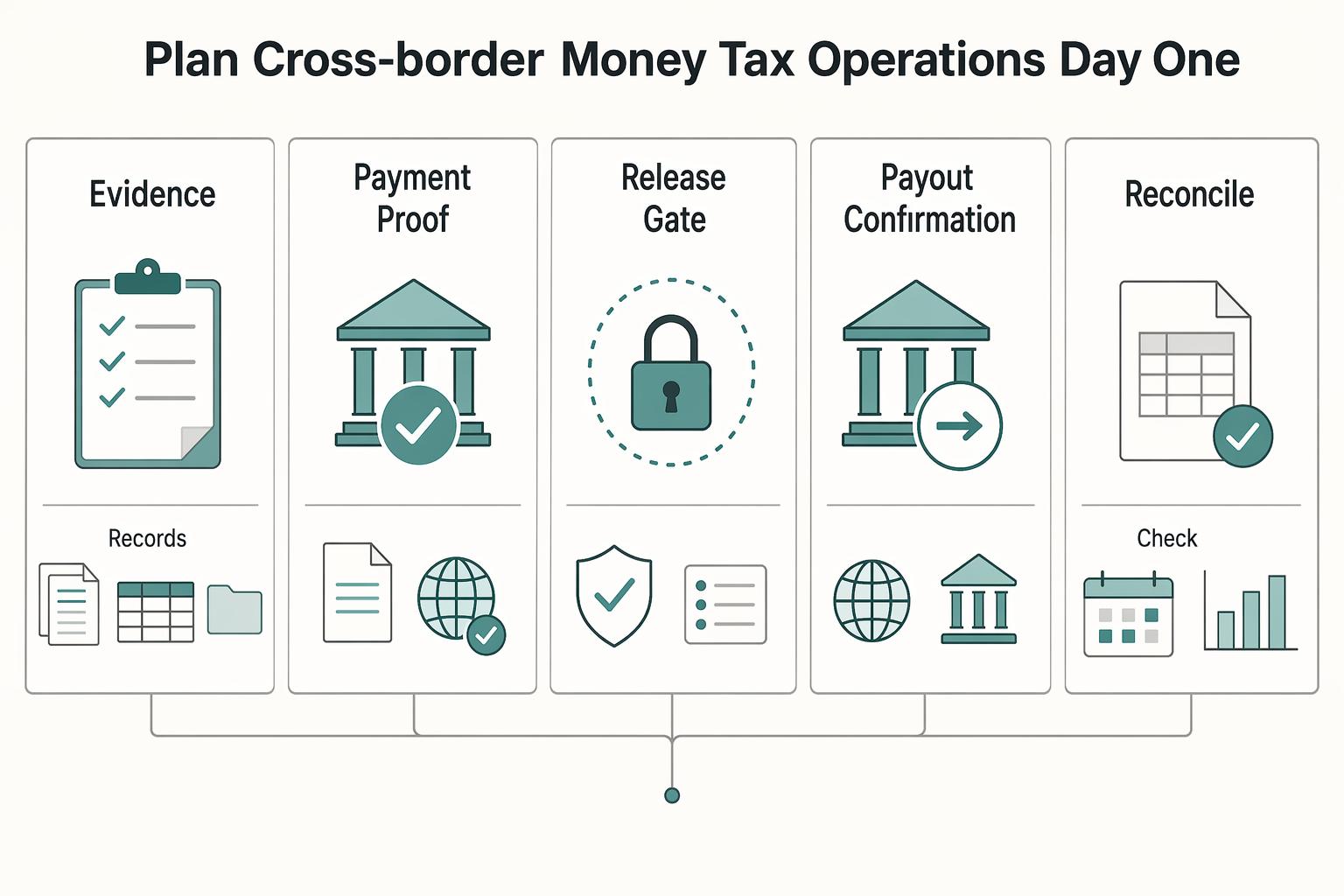
Keep parallel evidence paths linked to the engagement: client invoice to receipt and receivable reconciliation; contractor payable to approval, transfer submission, settlement and payable reconciliation. Contractor due dates remain independent of customer collection. The diagram shows evidence categories, not a requirement to collect before paying.
| Record | What to keep | Stage |
|---|---|---|
| Invoice record | Amount, currency, counterparty, service period, contract reference | Invoice issued |
| Payment proof | Date received, bank reference, FX rate used for books | Funds received |
| Payout approval | Approver, reason, linked invoice or milestone | Payout approved |
| Transfer submission | Transfer ID, beneficiary, submitted amount/date and current status; track unknown, failed and reversed attempts | Transfer submitted |
| Settlement evidence | Provider/bank confirmation, received amount, fees and actual settlement date | Settlement confirmed |
| Reconciliation note | Invoice totals, payouts, fees, ending balance | Reconciliation closed |
| Filing tracker | Required form, jurisdiction, due date, submission status | Filing tracker updated |
Maintain two linked evidence paths: client invoice, customer receipt and receivable close; contractor obligation, independent approval, transfer submission/status, confirmed settlement and payable close. Preserve contractor due dates even when the client is late. Track unresolved or failed attempts until resolved rather than calling a submitted transfer settled.
Keep a simple evidence pack for each transaction:
- Invoice record: amount, currency, counterparty, service period, contract reference.
- Payment proof: date received, bank reference, FX rate used for books.
- Payout approval: approver, reason, linked invoice or milestone.
- Transfer submission: reference, beneficiary, amount, submission date and current status; investigate unknown, failed or reversed attempts.
- Settlement confirmation: bank/provider evidence, received amount, fees and actual settlement date.
- Reconciliation note: invoice totals, payouts, fees, ending balance.
- Filing tracker: required form, jurisdiction, due date, submission status.
For a US person, including applicable entities, FBAR generally concerns a financial interest in or signature/other authority over foreign financial accounts whose aggregate value exceeds $10,000 at any time in the year, subject to exceptions. It is not triggered merely by having a US client. The annual due date is April 15 with an automatic extension to October 15; check specific relief or extensions where applicable. Form 8938 applies to specified persons and reportable assets under its own thresholds and is attached to the income tax return when required.
Keep FBAR and Form 8938 separate. A domestic operating agency is not automatically a specified domestic entity for Form 8938, and an individual owner's position may differ from the company's. Filing one form does not remove a separate obligation for the other. Preserve account location, ownership/authority, maximum values and taxpayer facts for the determination.
Add one checkpoint before each filing cycle closes: reconcile account records, payout records, and filing-tracker status in the same review. If one item is incomplete, mark the file as open and resolve it before final sign-off. This can reduce last-minute errors caused by partial records.
Client collection and contractor payment are separate obligations. Link both to the engagement, but reconcile them independently: invoice receivable to customer receipt and fees; contractor payable to its approved transfer and bank settlement. Store source/destination amounts, currencies, FX rate, fees, provider reference and posting date. For an unknown payout result, retrieve the original attempt before authorizing a replacement; verify changed bank details through an established independent contact.
Treat Form 8938 and FBAR filing points as items for qualified tax review, especially when account details or tax status change midyear. For execution, map invoices, payouts, and audit trails into one traceable flow and, where supported, use Gruv modules to keep reconciliation and records clean.
Execute a 90 day launch sequence with checkpoints#
Run launch in three 30-day phases with explicit checkpoints, and treat this as practical guidance, not a universal rule. Disciplined sequencing matters more than speed because skipped steps are where early launches often break.
This sequence should show what you build first, what you test second, and what you tighten before scaling. Keep targeting narrow in the first quarter so you do not spread effort too thin or confuse early clients.
| Window | Core work | Exit checkpoint before moving on |
|---|---|---|
| Weeks 1-4 (Days 1-30) | Build the foundation: define a focused target segment, clarify the offer, and assign clear owners for execution. | Target segment, offer boundaries, and owner responsibilities are documented and aligned. |
| Weeks 5-8 (Days 31-60) | Validate and test: run a focused pilot, test assumptions, and capture delivery friction. | Pilot evidence is logged, key assumptions are tested, and recurring issues have assigned owners. |
| Weeks 9-12 (Days 61-90) | Prepare launch: refine positioning and delivery standards based on pilot evidence, then finalize the go-live plan. | Launch plan and quality checks are documented, and top post-launch optimization priorities are set. |
During the pilot, track operational friction, not just revenue. Watch for repeated scope clarifications, handoff defects, acceptance delays, and invoice problems tied to unclear deliverables.
Add a short review cadence through all three phases. At each review, answer the same questions: what changed, what failed, what was fixed, and what still needs a decision owner. Repetition can expose weak areas faster than ad hoc status updates.
Use a simple end-of-quarter keep, fix, or cut review before adding headcount:
- Keep a service when margin is stable, delivery is predictable, and client behavior fits your model.
- Fix a service when demand is real but the same execution gap repeats and has a clear owner.
- Cut or pause a service when downside cash flow threatens continuity or quality still fails after corrective changes.
Keep one rule firm: if the downside case puts cash continuity at risk, narrow service mix or reduce fixed cost exposure before hiring. Finish the 90 days by rewriting your launch summary so it reflects proven operating reality, not launch assumptions.
Conclusion#
Review the plan each week against capacity, delivery exceptions and cash. Keep the niche and package boundaries narrow enough to price and deliver reliably; update assumptions when evidence changes. The plan is ready to use when the next client can be traced from approved scope to delivery, invoice, collection and any contractor payout with named owners and reconciled records.
Frequently Asked Questions
What should an IT agency business plan include to be usable in daily operations?
Include the target buyer, service scope/exclusions, pricing and change control, staffing/capacity, onboarding and SLA ownership, sales assumptions, financial forecasts and an invoice-to-receipt/payout reconciliation workflow. Each objective needs an owner, evidence and review trigger so two team members can make a consistent decision.
How much runway should a new IT outsourcing agency plan before hiring?
Use the weekly downside cash forecast rather than a universal number. Include the hire's full cost and start date, delayed collections, lower billable utilization and required reserve. Hire when the downside still funds obligations on their due dates; the worked example shows why profit alone is insufficient.
Which pricing model is best for Managed IT services versus Software development services?
Retainers fit repeatable support with defined included work, covered hours and overage terms. Scoped discovery or capped time and materials can fit uncertain development; fixed projects need clear acceptance and change control. Milestone billing helps cash timing but does not remove fixed-price delivery risk.
What legal and compliance items are non-negotiable before taking the first client?
Confirm the actual jurisdiction's entity, registration, tax, employment and data-processing requirements. For the engagement, agree scope, IP/confidentiality, authorized access, data handling, acceptance, SLA contacts and change control before kickoff. Record required exceptions and owners rather than assuming one global checklist is complete.
How do I build realistic Financial Projections without historical data?
Begin with available hours, utilization, loaded cost, qualified sales, pricing and receipt dates. Label assumptions and model downside/base/stretch; keep billing, recognized revenue and cash separate. Use a 13-week cash view and update it with actual hours, invoices and collections.
What are the most common year-one failure points for a small IT outsourcing agency?
Watch for unsupported SLA promises, weak access/acceptance controls, unapproved scope growth, hiring ahead of downside cash and missing payment links. Track repeated handoff defects, late invoices, aged receivables and payout exceptions, then update the responsible procedure.
Try a related tool
Researched and edited by the Gruv editorial team. Gruv builds cross-border billing, payouts, and finance-operations software for global businesses.
Sources
Educational content only. Not legal, tax, or financial advice.
Related Posts

Digital Nomad Health Insurance Comparison for Long-Stay Moves
Use focused time now to avoid expensive mistakes later. Start with a practical `digital nomad health insurance comparison`, then map your route in [Gruv's visa planner](/tools/visa-for-digital-nomads) so we anchor policy checks to your real plan before pricing pages pull you off course.

The Best Personal Finance Apps for Freelancers
If you are choosing among the best personal finance apps freelancers can use, start with payment risk, not popularity. The goal is simple: keep cash flow visible enough to act early when income slows or bills stay fixed.
The Best VPNs for Digital Nomads
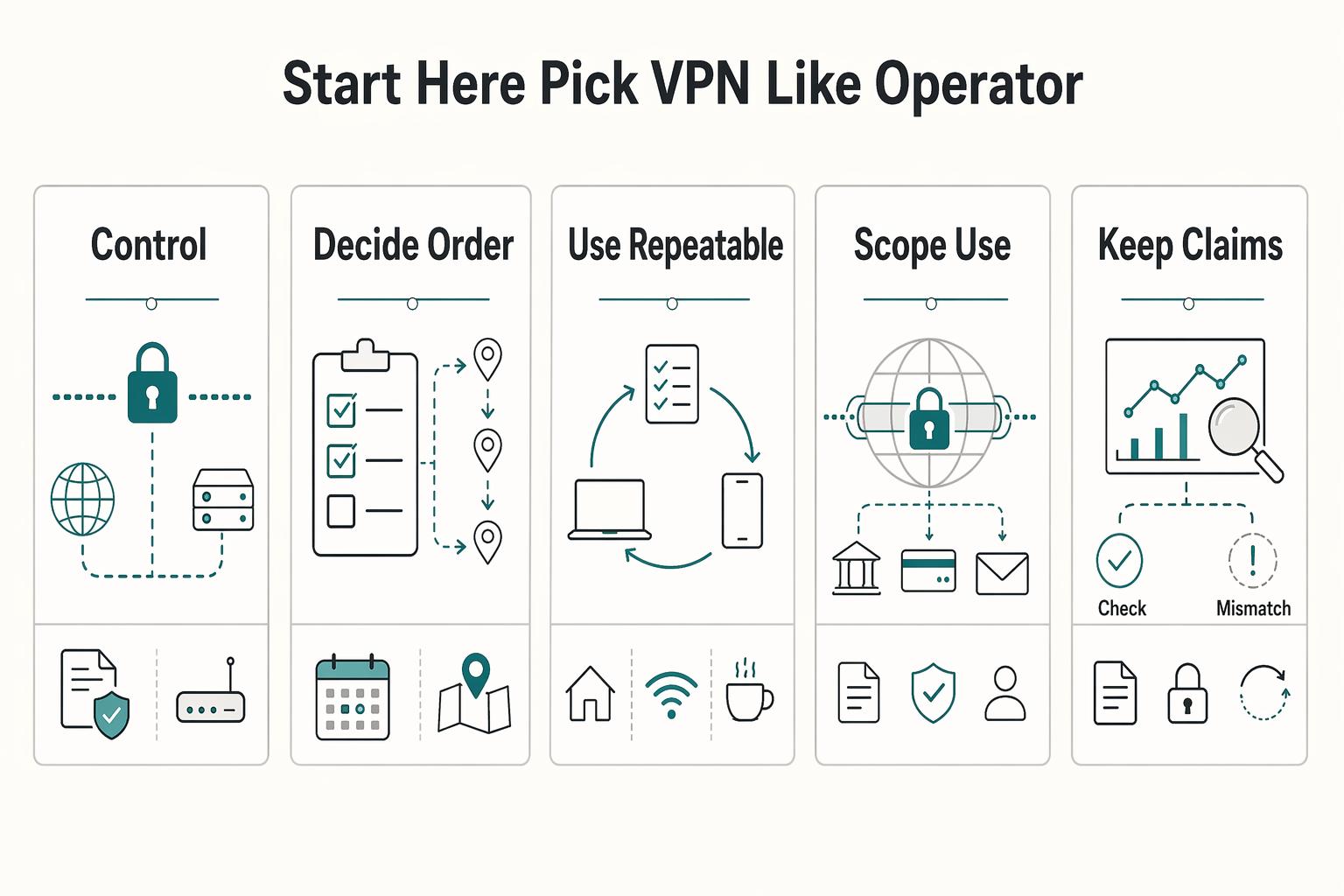
Treat this as a pre-trip decision, not a travel convenience. Pick one setup you trust, configure it before departure, and run the same short checklist whenever you change locations. A VPN creates an encrypted tunnel, which matters when sensitive account activity happens on shared networks.