
Quick Answer
A freelance contract termination clause should state who may end the engagement, on what grounds, with what notice and effective date. Add the agreed WIP valuation, final payment or refund calculation, suspension/restart process and continuing handoff duties. Use the pricing model and rights already agreed; a new draft does not change an active engagement by itself.
Define the Exit, Final Payment and Handoff#
A freelance contract termination clause should explain how the engagement can end, what remains payable and what must be handed over. Write the exit rules before the project starts so notice, unfinished work and final billing can be handled against agreed terms. A clause can reduce uncertainty; it cannot guarantee collection or make every unfinished task billable.
The practical risks are an unexplained final invoice, a project paused indefinitely, and a mismatch between payment, file delivery and rights already granted. Handle those separately rather than assuming withholding everything is the answer.
Build the clause as modular exit paths (not one vague paragraph)#
Contract termination ends the engagement or a defined portion of it, while accrued payment rights and specified continuing duties may remain. Define the effective date, remaining work, work-in-progress (WIP) valuation and post-exit obligations.
Instead of one vague paragraph, use a small set of modules you can mix-and-match by project. A modular structure is easier to negotiate, and it is easier to run when things get tense.
- Convenience: agree whether one or both parties may end without breach, the notice period, full or partial scope, effective date and financial consequences. It is not an automatic right in every freelance agreement.
- Cause: define material breach and the notice/cure process, with any justified exceptions for breaches that cannot be cured. A cure period is a negotiated mechanism, not a universal legal requirement.
- Suspension for nonpayment: specify which overdue invoices trigger a pause, required notice, any cure period, affected services and restart arrangements. An unqualified “without liability” phrase is not a guarantee of immunity.
- Money on exit: specify earned fees, agreed WIP valuation, authorized reimbursables, permitted cancellation charges and application or refund of advances without double counting.
A clean structure looks like this:
| Module | Trigger | What you control | What you must specify |
|---|---|---|---|
| Convenience | A party uses an agreed no-fault exit right | Timeline and handoff scope | Notice period/method, full or partial scope, effective date and agreed exit calculation |
| Cause + cure | Material breach | A fair off-ramp | Notice method, cure opportunity, termination effective date |
| Suspension | Nonpayment | Affected services and restart arrangements | Overdue trigger, required notice/cure, schedule effect and limits on delay liability |
| Money-on-exit | Any exit | Getting paid | Final invoice, substantiation, WIP valuation method, any agreed early-termination fee |
Run an offboarding workflow that survives messy approvals#
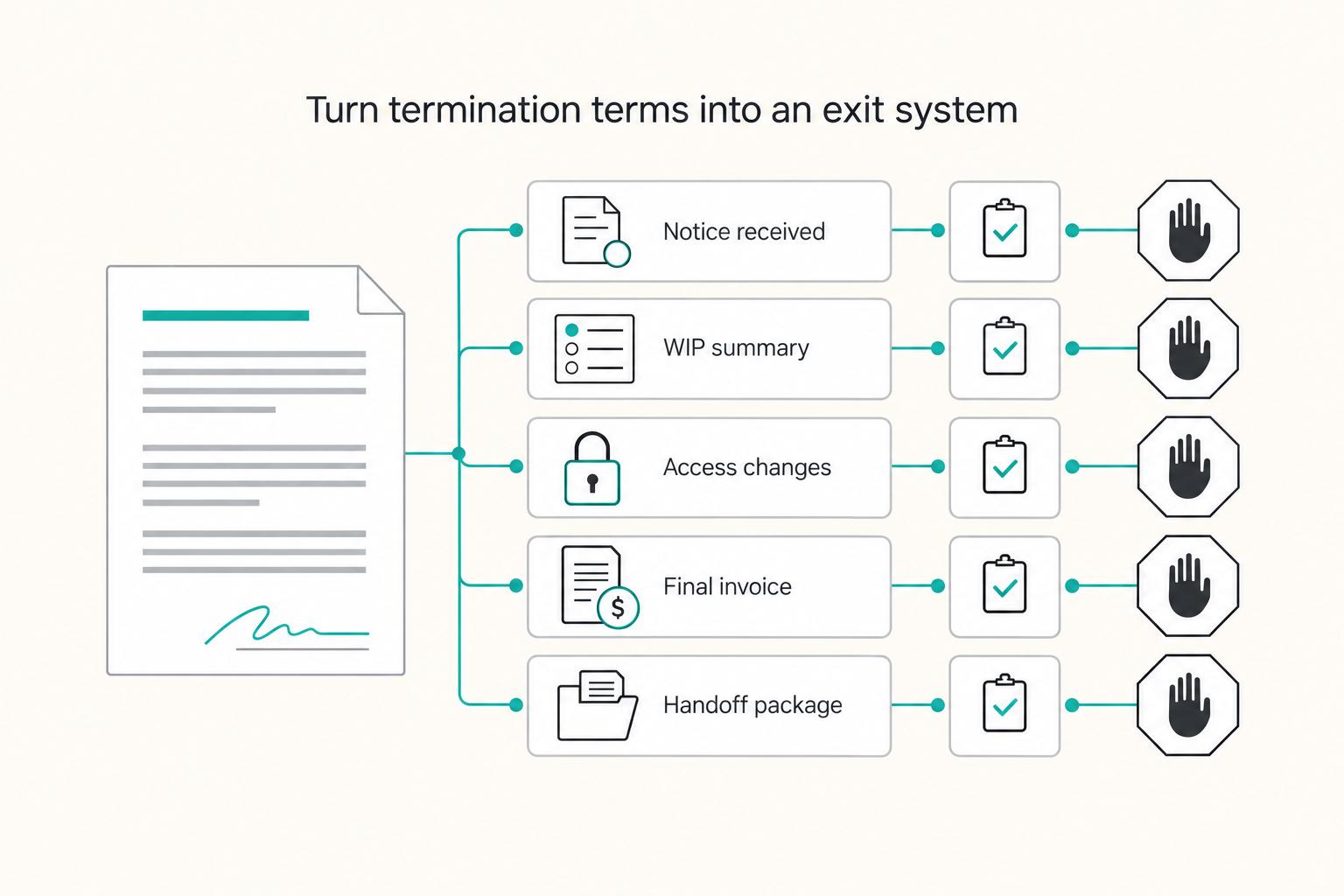
Treat termination like an ops checklist. The clause is the legal trigger. The workflow is how you make it real without losing time, money, or use:
- Notice: save the sent or received notice, delivery evidence, effective date and affected scope.
- WIP summary: list each deliverable as complete, in progress or blocked, with its agreed valuation basis and evidence.
- Access: coordinate removal of your accounts and transfer of client-owned administration through secure access tools; preserve required records and do not lock the client out of its own systems as collection pressure.
- Final statement: show earned amounts, agreed WIP, authorized costs and applicable cancellation charges, then deduct advances and other credits. State any refund and due date.
- Handoff: distinguish client materials, already transferred rights and required returns from new work whose transfer is validly conditional on payment. Follow the agreement and applicable data obligations.
If you do cross-border work, this workflow matters even more. Written notices, clear substantiation, and a disciplined handoff reduce friction when time zones and approval chains go sideways.
For a partial termination, identify the canceled deliverable and the work that continues. Confirm any resulting price or schedule adjustment through the agreed change process; the surviving scope should not be left ambiguous.
Before You Draft: Documents, Pricing and Exit Inputs#
Before you write a freelance contract termination clause, assemble the documents and "exit math" so your clause matches the deal you are actually running. This is the difference between a clause that looks good and a clause you can execute. You avoid contradictions, missing numbers, and a vague "done" definition that turns your final invoice into a debate.
Gather your contract stack (so you don't draft conflicting rules)#
Pull every document that governs the relationship, then read the termination-related sections as one unit:
| Document | Role | Termination check |
|---|---|---|
| Master freelance agreement | Baseline legal container | Cross-check definitions, payment terms, IP, and dispute resolution |
| Statement of Work (SOW) | Work container | Make sure termination references to deliverables or milestones align with the SOW |
| NDA | Confidentiality obligations | Do not imply you can keep using confidential materials after exit |
| DPA | Personal-data processing terms | Address what happens to personal data on exit in a way that matches the DPA |
- Master freelance agreement: the baseline legal container (definitions, payment terms, IP, dispute resolution).
- Statement of Work (SOW): the work container. A SOW defines "project scope, deliverables, timelines, and responsibilities between parties." If your termination clause references deliverables or milestones, it must align with the SOW.
- NDA: check continuing confidentiality, permitted use and return obligations. Termination does not by itself give permission to keep using client information.
- DPA, where required by the applicable regime and processing roles: check personal-data return/deletion, authorized retention and any processor or subcontractor obligations.
Verification: highlight any section that mentions "termination," "suspension," "fees," "survival," "confidentiality," "IP," or "data retention." Those are the usual collision points.
Write your exit inputs (so you can price termination without guessing)#
Document these inputs in a one-page "exit sheet." Then you can plug them into your termination clause, kill fee, and final invoice mechanics without guessing.
| Input | What to write down | Why it matters at termination |
|---|---|---|
| Pricing model | Hourly, milestone, retainer | Determines how you value WIP and what you invoice |
| Retainer status | Amount paid, amount consumed, remaining balance | Separate earned fees from unapplied advances and determine any credit or refund |
| Non-Cancelable Commitments | Tools, subcontractors, travel. Include amounts and cancellation penalties. | Only recover costs on the agreed legal basis; identify approvals, mitigation and refunds |
| Kill fee option | If agreed and legally permissible, define amount, trigger and interaction with earned fees | Avoid assuming a signed cancellation charge is enforceable or charging twice for the same loss |
Next, define "done" before anyone wants out. That usually means putting acceptance criteria in writing. Set "clear, measurable conditions" for satisfactory completion.
Define a separate mid-project valuation method. Acceptance criteria help assess a completed deliverable, but do not by themselves tell you what a half-finished fixed-price milestone is worth. Agree that method before starting; do not turn the project into hourly billing after cancellation unless the agreement supports it.
What termination protections do you actually need for this project? (10-minute decision framework)#
You don't need a different termination clause for every client. You do need a clause that matches how the project actually runs. That means how money moves, how deliverables get approved, and where projects realistically stall.
| Question | If this is the issue | Focus |
|---|---|---|
| How can the project end in real life? | "We're deprioritizing" (not a breach) | Termination for Convenience: written notice, effective date, extent of termination |
| How can the project end in real life? | Someone is failing to perform | Termination for Cause tied to material breach, with an opportunity to cure |
| Where is the greatest payment or schedule risk? | Delayed payment | Defined suspension trigger, notice/cure and restart terms |
| What gets messy when things go sideways? | Approvals and feedback loops sprawl | Evidence plus an agreed method for valuing incomplete work |
| What do you need to protect on exit? | Cash, time, rights, or all three | Money-on-exit mechanics and handoff package rules |
Use this quick decision pass to choose the right modules and fill in the blanks from your "exit sheet":
- How can the project end in real life?
If the most likely exit is "we're deprioritizing" (not a breach), Termination for Convenience should be clear about written notice, effective date, and the extent of termination. If the likely exit is "someone is failing to perform," Termination for Cause is typically tied to breach (often framed as material breach) and can include an opportunity to cure.
- Where is the greatest payment or schedule risk?
For late payment, define the pause trigger and notice process precisely. Limit any agreed protection from delay claims to a compliant suspension and its effects; do not assume “without liability” excuses your own breach, mandatory duties or every type of loss. Check the operative agreement and applicable rules before pausing.
- What gets messy when things go sideways?
If approvals sprawl, document WIP and use the agreed partial-work formula. Identify completed outputs, corrections still owed, and work blocked by missing inputs. An internal progress percentage or timesheet is evidence, not permission to invoice any amount you choose.
- What do you need to protect on exit: cash, time, rights, or all three?
Your answer tells you how much detail to put into the money-on-exit mechanics and the handoff package rules.
Prioritize the valid exit trigger, notice delivery, effective date and final balance calculation. Also list duties that must happen before payment, such as returning client materials or personal data. Those cannot safely be folded into a blanket payment gate.
Use the SOW generator to document deliverables and acceptance criteria, then align the exit valuation and notice provisions with your agreement.
Write Separate Exit Modules#
The fastest way to get a termination clause accepted is to make it readable and operational. Use small blocks, plain triggers, and clear outputs.
A practical structure is:
- Termination for Convenience (written notice + extent + effective date + payment for work performed up to termination, per the contract)
- Termination for Cause (material breach + notice + cure opportunity + termination effective date)
- Suspension for nonpayment (right to temporarily suspend services if invoices/fees aren't paid as agreed, plus restart conditions)
- Notices mechanics (what counts as valid notice + allowed delivery methods, and when notice is deemed received)
- Exit deliverables (finished + in-progress work product handoff, access changes, and a clear wrap-up checklist consistent with IP and payment status)
- Final invoice mechanics (what gets invoiced upon termination, and what must be paid before/at handoff)
The following sample illustrates one negotiated arrangement: bilateral seven-calendar-day convenience notice, a seven-calendar-day cure period for curable material breach, and a five-calendar-day payment warning before suspension. These are example choices, not statutory deadlines or a complete agreement. Use the contract’s actual notice recipients and receipt rules.
Example convenience and cause wording: “Either party may terminate the affected SOW on seven calendar days’ written notice delivered under the Notices clause. The notice must identify the affected services and effective date. For a curable material breach, the nonbreaching party may terminate if the breach remains uncured seven calendar days after receipt of a written notice identifying it. The settlement and continuing duties below apply on termination.” Resolve noncurable breaches, emergency rights and partial termination in the actual agreement.
Example suspension wording: “For an undisputed invoice unpaid after its agreed due date, the freelancer may suspend the affected services if it remains unpaid five calendar days after the client receives a written payment warning under the Notices clause. The warning must identify the invoice and affected services. On receipt of the overdue amount, the parties will confirm the restart date and any resulting schedule adjustment.” Limit any delay exclusion to a lawful, compliant suspension; mandatory rights and data-return duties still apply.
Calculate the Final Balance Without Double Counting#
Termination disputes rarely come from "you're not allowed to terminate." They come from "we don't owe that invoice" or "we already paid you."
Your clause should make payment on exit feel boring because it's predefined.
Match Evidence to the Agreed Pricing Model#
Use the pricing model in the agreement. For hourly work, approved hours and the rate may establish earned fees. For milestone or fixed-price work, use the agreed exit valuation, completed-stage prices or another authorized formula. The federal FAR termination clause has its own government-contract settlement rules; those do not automatically govern a private freelance engagement.
- Acceptance criteria ("clear, measurable conditions") so "satisfactory" is not a moving target.
- Substantiation (logs, timesheets, or other records) so your work performed and incurred costs can be verified.
Example settlement wording: “At termination, the final statement will show fees earned through the effective date under the SOW’s pricing and partial-work valuation method, authorized nonrecoverable expenses, and any applicable agreed cancellation charge, less advances, credits and amounts already paid. Any net amount payable or refundable is due within fifteen calendar days after receipt of that statement, subject to mandatory payment rules. Termination does not waive accrued claims or alter existing delivery, IP, confidentiality or data-return duties.” Define the valuation and charge in the SOW before using this example.
Make retainer treatment explicit#
Classify the retainer first: prepaid hours, advance against milestones and an earned availability fee can have different treatment. Show amounts paid, earned, applied and unapplied, then follow the agreed and permitted credit/refund rules. Do not call an advance nonrefundable merely because it was described as a retainer.
Suppose the SOW prices one completed stage at $1,500 and a second stage at $1,600, with an agreed exit formula valuing its documented halfway point at 50%, or $800. Add $200 of authorized nonrecoverable costs and a separately permitted $300 cancellation charge: total charges are $2,800. Deduct a $2,000 advance to leave $800 due. If permitted total charges instead equal $1,800, the $2,000 advance leaves a $200 refund. Do not add the advance as a charge or duplicate costs already included in the fee.
Don't bury non-cancelable commitments#
If you have non-cancelable commitments (tools, subcontractors, travel, cancellation penalties)-or other prior commitments you made on the client's behalf-termination is exactly when those costs surface. If your contract treats them as reimbursable, keeping those items listed on your "exit sheet" helps you invoice them cleanly as part of the exit math. It also keeps you from trying to reconstruct them while the relationship is deteriorating.
Use a kill fee you can explain#
A cancellation or kill fee can be a fixed amount or another agreed formula. Define whether it is additional to earned fees, which cancellations trigger it, and how mitigation, recovered costs or savings affect it. Agreement alone does not resolve enforceability: an excessive penalty or a charge that conflicts with mandatory rights can still be challenged. Do not add a fee after the client has already ended the project.
Define Payment Status, Fees and Currency#
A couple of small lines can prevent big arguments:
- Define the payment event and receiving account accurately. A transfer instruction is not evidence of receipt, and “cleared” does not make every payment irrevocable; records can still need adjustment for returns or reversals.
- Allocate bank and processor charges in the agreement, and distinguish a freelancer-borne charge from a remaining client balance.
- For cross-border payments, agree invoice currency and any conversion mechanism. A currency difference is not automatically a new charge against the payer.
Check Ownership and Delivery Duties Separately#
Termination is when IP language stops being abstract.
Ownership and usage rights depend on the agreement and applicable law. In the US, 17 USC §201 generally starts copyright with the author, but valid work made for hire has different initial ownership. Commissioned work qualifies only under the conditions in §101; a work-for-hire label alone is insufficient. An ordinary transfer generally requires the signed writing specified in §204.
Where an effective assignment expressly occurs upon payment, follow that condition for the covered rights. Where rights already transferred at creation or signature, nonpayment does not automatically reverse them. Check any existing licence, client-owned material and third-party rights as well. Do not promise you can retain ownership that has already passed.
List what must be handed over and when. Separate client materials and credentials, personal-data returns, already owed deliverables and new work covered by a valid payment condition. A payment-linked IP transfer does not automatically permit withholding all files, deleting client assets or disabling a live service.
Also cross-check the NDA and DPA so you don't accidentally over-share during handoff:
- NDA: check what your NDA says about what happens to confidential materials at exit (and what you can't keep using after you leave).
- DPA: follow the applicable return/deletion instructions and permitted retention basis. Under UK GDPR processor-contract requirements, the controller chooses return or deletion at the end of services, with legally required storage excepted. ICO guidance explains the required terms. Do not use personal data as payment collateral.
Keep the handoff bounded and secure. Grant the successor appropriate access rather than emailing reusable passwords; coordinate removal of your access after the transition. Keep only records you are entitled or required to retain and avoid copying confidential client content into your evidence archive indiscriminately.
Cross-Border Notices and Dispute Procedures#
If you do cross-border work, your termination clause has to survive real-world friction. That includes time zones, delayed approvals, and misunderstandings about what was "received" and when.
Specify a notice process both parties can follow across timezones:
- Written notices that are stored with date and scope.
- Clear substantiation for costs incurred and any work-in-progress you're billing as completed.
- Disciplined handoff (access changes, credential documentation, and a payment-consistent handoff package).
Governing law identifies the law used to interpret the agreement; a forum clause identifies where disputes are heard. Neither automatically displaces mandatory worker-payment rules. For example, covered New York state freelance services have statutory payment protections under GBS §1411. Align any negotiation, mediation or escalation sequence with formal notice and claim deadlines; do not assume discussions pause the clock.
Also, make sure your termination language doesn't conflict with your master agreement's dispute resolution framework. Your master freelance agreement is the "baseline legal container," and it often houses dispute resolution and other foundational terms. A termination clause that ignores the rest of the container is how you end up with internal contradictions at the exact moment you need clarity.
Common Drafting Gaps and How to Resolve Them#
Most termination failures aren't dramatic. They're small drafting gaps that become expensive when stress is high.
| Mistake | Recovery |
|---|---|
| One vague paragraph that tries to do everything | Break it into modules: convenience, cause, notices, survival, money-on-exit, IP/work product |
| No survival clause | Add a survival clause that lists the provisions that remain binding after termination or expiration |
| No written notice mechanics or no proof of receipt | Use a notices clause and keep the required receipt or verification |
| "For cause" is undefined or too broad | Define cause in plain language and pair it with a clear process |
| Assuming you can stop work for nonpayment | Make suspension explicit, including when you can suspend and what triggers restarting |
| The final invoice becomes a debate because "what was done" isn't anchored | Document scope-to-date and what has been delivered in a way that matches the pricing model |
| Assuming all files and IP may be withheld for payment | Check actual ownership, transfer timing, licences and delivery duties; retain only what the agreement and applicable rules allow |
Here are the most common problems, plus the cleanest ways to recover using what you already have:
Mistake: one vague paragraph that tries to do everything#
Recovery: break it into modules (convenience, cause, notices, survival, money-on-exit, IP/work product). When a clause is modular, you can point to the specific rule that applies instead of arguing about "overall intent."
Mistake: no survival clause (so post-termination obligations get fuzzy)#
List intended continuing provisions, such as accrued payments, confidentiality, authorized retention and dispute resolution. Check any indemnity’s scope and survival rather than assuming all indemnities should continue without limits. For an existing engagement, a new survival provision requires the appropriate amendment; obligations arising independently under law may already continue.
Mistake: no written notice mechanics (or no proof of receipt)#
Specify permitted methods, actual recipients, receipt timing, timezone and fallback for a failed delivery. If email is permitted, a rule dependent solely on a recipient sending a read receipt can leave notice uncertain. Keep the required delivery evidence and use the agreed fallback when mail bounces or confirmation is missing.
Mistake: "for cause" is undefined or too broad#
If "cause" isn't defined, it invites arguments about what counts-and turns "termination" into a label people slap on a messy project. Recovery: define cause in plain language and pair it with a clear process (what notice looks like, who gets it, and what has to happen before termination is actually effective).
Mistake: assuming you can stop work for nonpayment (without writing it down)#
Define suspension before entering the engagement. For an active project, check existing contractual and legal rights and required notice/cure before stopping; obtain a valid amendment for new terms rather than treating an updated draft as operative. Continue any duties unaffected by the pause and explain the proposed restart schedule.
Mistake: the final invoice becomes a debate because "what was done" isn't anchored#
When things end midstream, people start arguing in adjectives ("basically done," "not usable," "satisfactorily completed") instead of facts. Recovery: document scope-to-date and what's been delivered in a way that matches your pricing model, so the exit conversation has something concrete to attach to.
Mistake: releasing IP/work product as a "goodwill" move before payment is settled#
For future engagements, negotiate payment-linked transfers where appropriate. For a current exit, follow the rights already granted and the actual conditions; you cannot restore contractor ownership by adding a new payment gate after the event. Return client-owned materials and satisfy independent data duties even when the invoice is disputed.
Run the Agreed Offboarding Procedure#
A termination clause shouldn't require reinvention. Build it once as a modular set of exit paths, then run the same offboarding workflow every time:
- Written notice stored with date and scope
- WIP summary: complete / in progress / blocked
- Access changes coordinated securely; client-owned materials, already owed deliveries and required data returns handled on their proper schedule
- Final statement with earned fees, agreed WIP, permitted charges, authorized costs, advances/credits and any refund
- Handoff follows actual ownership, transfer conditions, existing licences and independent return duties
- Survival + post-exit cleanup: check your survival language (i.e., what's meant to remain effective after termination-often things like confidentiality or indemnification, if drafted that way), and confirm how disputes are meant to be handled post-termination (governing law/jurisdiction/arbitration/mediation). Also re-check NDA/DPA so you're clear on what's intended to continue after exit.
This approach keeps you calm when a client is chaotic, and it keeps your business protected when the project ends earlier than anyone planned.
Frequently Asked Questions
Is a termination clause mainly about ending the relationship politely?
A termination clause should define the exit trigger, notice, effective date, final balance and continuing duties. A professional tone helps both parties use those rules; collection still depends on the actual entitlement and recovery process.
What should a Termination for Convenience notice include?
Follow your contract's notice provision. If it requires written notice, make it written, state the effective date, and be clear whether the termination is full or partial-so there's no "we thought you were still on it" confusion.
How do I prevent a client from terminating "for cause" over minor issues?
Define material breach and the agreed notice/cure process, including any justified noncurable exceptions. This narrows the trigger but does not eliminate every termination right arising under the agreement or applicable law.
Can I stop work if the client doesn't pay?
Check the agreement and applicable rules before stopping. Specify suspension triggers, notice, any cure period, affected services and restart arrangements in advance. A clause saying “without liability” is not blanket immunity, and a new draft does not amend an existing engagement.
What should be in the final invoice after termination?
Show earned fees, WIP valued under the agreed method, authorized costs and any applicable permitted cancellation charge, less advances and credits. State the net payable amount or refund and its due date. Keep supporting records and avoid double counting; mandatory payment rights still apply.
Do NDAs and DPAs matter during termination?
Yes-other terms like confidentiality and any data-processing obligations don't automatically disappear just because the work ends. Handle confidential information and any personal data the way your agreement requires (including any return/deletion steps it spells out).
Try a related tool
SOW generator
Turn your scope, deliverables, and acceptance criteria into a clear SOW that matches your termination and billing terms.
Freelance contract generator
Start from a strong baseline freelance agreement and adapt key termination, notice, payment, and IP terms to your project.
Researched and edited by the Gruv editorial team. Gruv builds cross-border billing, payouts, and finance-operations software for global businesses.
Sources
Includes 1 external source outside the trusted-domain allowlist.
Educational content only. Not legal, tax, or financial advice.
Related Posts

The Freelance Payment Penalty: A Modeled Audit of Platform Fees, FX Spreads, and Payout Delays
The money rarely disappears through a single, easy-to-spot fee. The real loss is stacked. A marketplace takes its commission, a processor adds a charge for international cards, a bank or payment company converts the currency at a spread, a platform holds the funds before release, and a wire sheds a little to intermediaries on the way in. Each layer looks defensible on its own, but the worker feels the combined result as a smaller deposit and a later payday.

How to Respond to a Subpoena for Business Records
Move fast, but do not produce records on instinct. If you need to **respond to a subpoena for business records**, your immediate job is to control deadlines, preserve records, and make any later production defensible.
A US Expat's Guide to Investing in UCITS ETFs to Avoid PFIC Issues
The real problem is a two-system conflict. U.S. tax treatment can punish the wrong fund choice, while local product-access constraints can block the funds you want to buy in the first place. For **us expat ucits etfs**, the practical question is not "Which product is best?" It is "What can I access, report, and keep doing every year without guessing?" Use this four-part filter before any trade: