
Quick Answer
Write an indemnity clause by limiting it to specific third-party claims tied to risks you control, then state clear exclusions, defense control, proof requirements, cap treatment, and survival timing. Avoid catch-all phrases like any and all claims. Review the clause with limitation of liability, scope, IP, termination, and dispute terms before signing.
How to read indemnity language as a risk allocation tool and limit exposure to harms you actually caused#
An indemnity clause should allocate risk, not leave you with open-ended exposure. In a freelance contract or services agreement, the practical goal is to cover risks tied to what you actually control, limit downside, and keep the terms workable enough to sign.
This language matters because it can turn into real cost fast. These clauses decide who pays when there is a third-party lawsuit, an IP challenge, a regulatory fine, or a breach-related loss. Done well, responsibility stays with the party that caused the problem. Done badly, a small project can carry outsized liability.
This guide is practical contract guidance for freelancers and consultants, not jurisdiction-specific legal advice. Use it to spot one-sided language, narrow scope to your own conduct, and check how indemnity terms interact with protections elsewhere in the agreement.
Start with one rule: slow down if the clause reaches beyond harms tied to your own actions or negligence. Phrases like "any and all claims" are a red flag because they can create unlimited exposure. Treat claim mechanics as core terms, not drafting detail:
- who controls the defense
- whether costs are advanced or reimbursed
- what event actually triggers the obligation
You do not need mutual indemnity in every deal. You also do not need to accept a one-way clause just because it appears in the client's template. Sometimes mutual language balances risk better. Sometimes a narrow one-way obligation tied to your own work is enough.
By the end of this guide, you should have three things:
- decision rules for what to accept, narrow, or reject
- negotiation language you can send without making the deal adversarial
- a copy-and-paste checklist to verify triggers, defense control, and survival timing
One habit reduces surprises: do not review indemnity in isolation. Read it with limitation of liability, scope of services, IP, and termination terms so your actual financial risk under the clause is clear before you sign.
What to prepare before you draft#
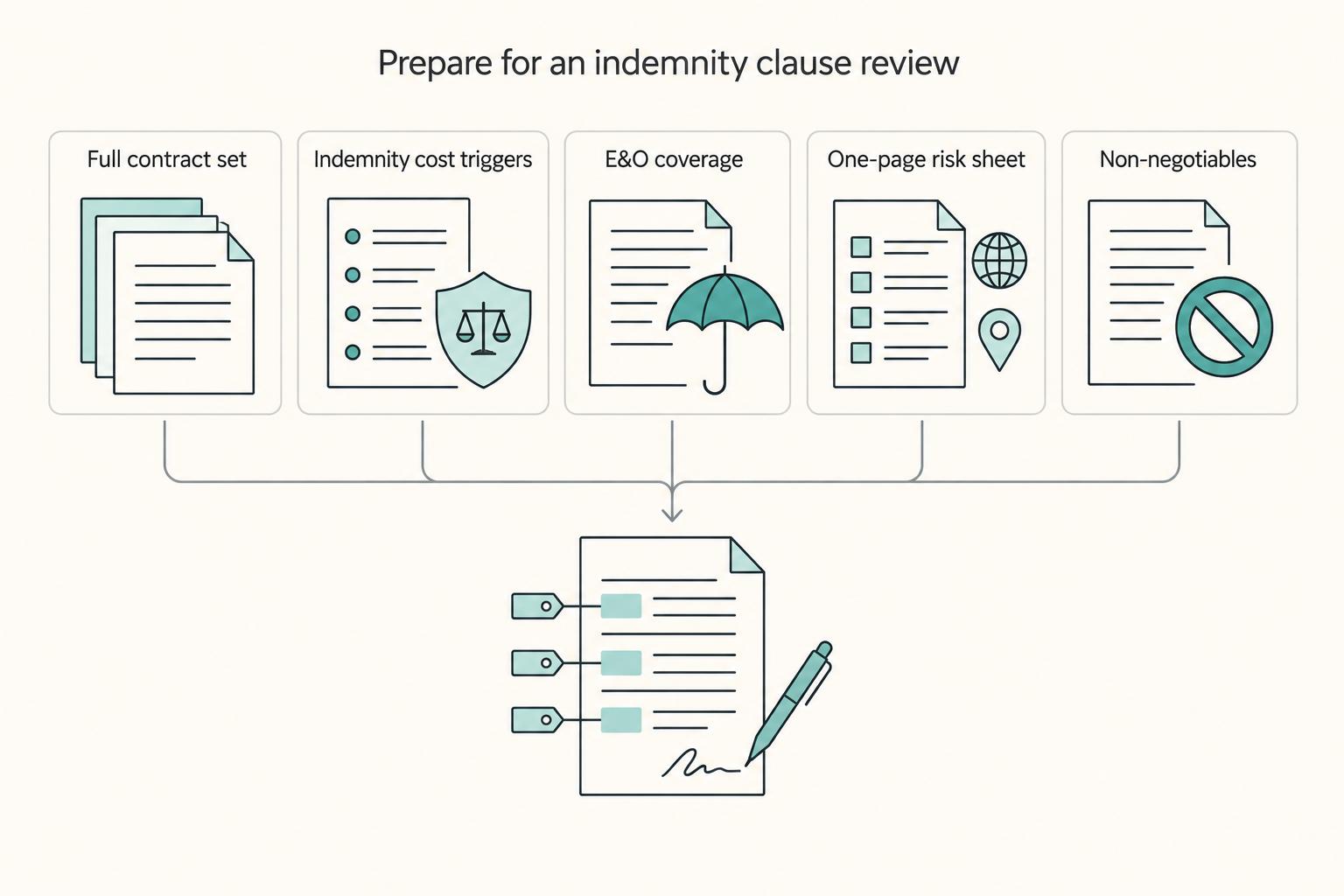
Before you touch the clause language, gather the full contract set, map the risks you actually control, and pull the documents that show what is insurable. That prep keeps the indemnity tied to defined terms in the agreement and to risks you can realistically cover.
| Step | What to review | Why it matters |
|---|---|---|
| Pull the full agreement set | Current Commercial contract or Services agreement draft and related sections that allocate or limit risk | Helps catch conflicts early and keeps indemnity scope tied to contract wording |
| Map the risks you actually control | Parts of the engagement you control and where claim exposure could arise | Separates your own work risks from risks the contract treats as outside your scope |
| Gather documents that confirm what is insurable | Insurance policy terms, contract language that defines risk categories, policy limits, and carve-outs | Checks whether policy terms and contract-defined risks line up before drafting |
Step 1: Pull the full agreement set#
Start with the current Commercial contract or Services agreement draft, not just the indemnity paragraph. Keep related sections that allocate or limit risk open at the same time so you can catch conflicts early.
Mark every place the draft assigns risk or limits it. If the contract defines specific risk categories, use those exact labels in your notes. Indemnity scope follows contract wording.
Step 2: Map the risks you actually control#
List the parts of the engagement you control and where claim exposure could arise. Keep the map narrow and practical. Separate risks tied to your own work from risks the contract places outside your scope.
If the draft includes unusual risk categories defined in the contract, pause and verify how that risk is described before you accept the wording.
Step 3: Gather documents that confirm what is insurable#
Pull the relevant Insurance policy terms and the contract language that defines risk categories before you draft. Coverage is limited to covered claims and subject to policy limits, so reviewing those limits is a core checkpoint.
Also check for carve-outs that can remove protection, including losses caused by willful misconduct or lack of good faith. If your policy terms and contract-defined risks do not line up, fix that first, then draft. If you need the full breakdown, read Limitation of Liability Clause for Freelance Software Developers.
Step 1 set risk ownership before wording#
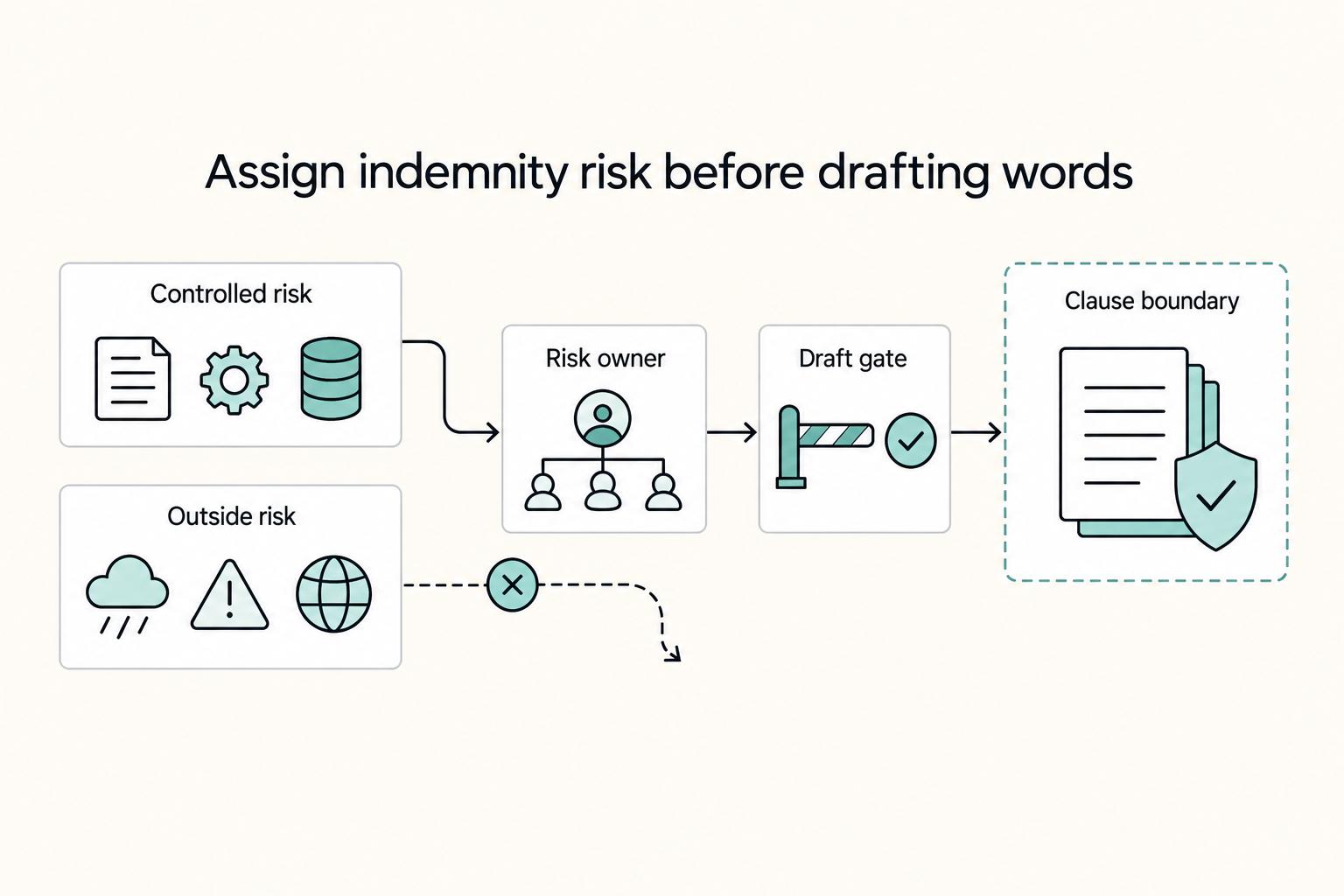
Set risk ownership first, then draft the clause. If you skip that sequence, indemnity can expand into liability for events outside your control.
In an Indemnity clause, the Indemnitor is the party promising to compensate for covered losses, and the Indemnitee is the party receiving that protection. Write the roles in plain English in your notes before you review the wording, such as "I indemnify the client for X" or "the client indemnifies me for Y."
Name the protected party and the obligated party clearly#
Identify exactly who is protected and who is obligated. If the protected side includes a broader group than the signing client, your exposure may be wider than it first appears. Tie the indemnity to defined parties, not vague labels.
Match indemnity to risks you control#
Use a simple rule: indemnify for risks you control and push back on responsibility for risks you do not control. Broad catch-all wording can create open-ended exposure because it is not tied to specific covered events. If the draft says you cover "any and all losses" connected to the project, narrow it before you do anything else.
Separate service-side and client-side failures#
Keep two buckets in your notes and, if possible, in the clause:
- your direct service failures
- client-side decisions, systems, instructions, or later use outside scope
For each obligation you accept, tie the trigger to a specific covered event. If both sides control different risks, mutual indemnity can be cleaner than a one-way promise because it allocates risk more evenly.
Step 2 define covered claims and carve-outs#
Once risk ownership is set, turn it into a closed list of covered claims and carve-outs. In the Indemnification provision, say what is covered, say what is not, and make sure each trigger can be proved from normal project records.
Use triggers you can verify#
Keep covered triggers tied to concrete events, not catch-all loss language.
- IP infringement tied to deliverables: limit it to materials you created or supplied under the agreement. Keep source files, licenses, asset history, and subcontractor terms.
- Defined Third-party claim scenarios: describe the claim type, for example a claim arising from what you supplied or did. Keep the claim notice, deliverable version, approvals, and revision trail.
If you cannot point to a document that proves a trigger happened, narrow the trigger. Exclusions should be just as specific as covered claims.
Carve out risk with equal clarity#
Common negotiation boundaries include explicit limits in the indemnity clause, such as a cap on liability, time limits for claims, and clearly defined exclusions tied to the deal.
Avoid wording like "any loss arising out of the services." Broad language can shift more risk than the engagement was priced to carry.
Remove template spillover#
If the language came from another template, trim anything that quietly widens indemnity through catch-all wording. Keep any trigger-linked promise short, project-specific, and testable against your records.
Before you sign, review indemnity in the context of the whole contract, especially on higher-risk deals. Check scope, IP terms, client responsibilities, and liability terms together so covered events and carve-outs stay aligned.
Step 3 separate indemnify defend and hold harmless#
Treat these as separate obligations, not bundled boilerplate. If you group the verbs together, you can expand cost exposure before it is even clear that a claim is covered by your Indemnification provision.
Separate the jobs each term is doing#
| Term | Practical role | Drafting check |
|---|---|---|
| Indemnify | Pay or reimburse covered loss | Keep it tied to the specific covered claim types and carve-outs from Step 2 |
| Duty to defend | Handle or fund defense of a claim when that duty applies | Define boundaries clearly so defense cost exposure is not open-ended |
| Hold harmless | Liability-allocation language used with indemnify or defend | Keep it aligned with the same narrow triggers, exclusions, and parties |
This matters because these terms are not treated the same way in every state. Some states treat defend and indemnify as separate duties. Do not assume a client's standard phrase means one predictable thing everywhere.
Treat duty to defend as a cost decision#
Defense cost exposure is different from reimbursement for a covered loss. If the client wants a defense obligation, define the scope clearly and stress-test it under the governing law before you agree.
Use a simple stress test. For each covered trigger, ask whether you would still accept defense exposure in a worst-case scenario before liability is resolved. If not, narrow the defense language before you sign.
Keep hold harmless tightly aligned#
Hold harmless should not reopen risks you already carved out. Its effect can vary by state, so treat it as operative language, not filler, and keep it within the same boundaries as the rest of the remedy.
This is also where standard client wording can hide unreasonable risk transfer. Keep the wording explicit and consistent, because ambiguous indemnity language is often construed against the party seeking indemnification.
Step 4 tie Indemnification to Limitation of Liability#
Your cap protects you only if the indemnity language clearly matches it. A conservative default is to have the Liability cap apply to indemnity unless you intentionally carve out a narrow exception.
Indemnity can operate as a separate risk-transfer promise that overrides what the general cap seems to do. That is where exposure can become uncapped through defense costs and settlement spend.
Cross check both clauses line by line#
Read the Indemnification provision and the Limitation of Liability clause together and resolve conflicts explicitly. Your redline should answer:
- Does the Liability cap apply to indemnity claims, yes or no?
- If indemnity is outside the cap, which exact claim types are outside it?
- Is the duty to defend outside the cap, or only final covered losses?
Silence is the real risk. A clause like "IN NO EVENT WILL [PARTY] BE LIABLE FOR MORE THAN X" does not help if another section creates payment obligations without saying whether the cap applies.
Choose a cap structure you can justify#
Pick a cap structure you can support from the contract itself:
| Cap design | What it ties to | What to verify |
|---|---|---|
| Fixed number | A stated monetary amount | The amount is explicit and consistent across clauses |
| Amount paid to date | Fees actually paid under the contract | Payment records and contract language align |
| Required insurance limit | Insurance amount required by the contract | Contract requirement matches the insurance amount used for the cap |
If indemnity sits outside the cap, keep the exceptions short and specific. Broad carve-outs can nullify the cap in practice.
Add a real survival period#
Indemnity should survive long enough to cover realistic claim timing, but not forever by default. Use a defined survival period or claim time limit tied to the covered triggers.
Time limits are a recognized drafting lever, but there is no single supported standard duration here. Set the period deliberately in the contract text instead of relying on a generic market number.
Use the uncapped indemnity tradeoff rule#
If the client wants uncapped indemnity, narrow the triggers and tighten defense and settlement control. Uncapped language should not cover every breach, every loss, or every project dispute.
Keep it limited to specific third-party claim categories. If the other side wants uncapped indemnity and rejects those limits, escalate before signature. Related: How to Use an Indemnification Clause to Limit Your Liability.
Step 5 write the claim procedure and proof requirements#
A workable indemnity clause does not just say who pays. It also says how a claim is noticed, reviewed, defended, and verified. Without that process, reimbursement decisions can drift away from the contract language.
Require written notice and cooperation#
For any Third-party claim, require written notice and make the notice mechanics explicit: delivery method, recipient, any required attachments, and response timing language.
Also require enough detail to test coverage, including the claim basis and the contract trigger being invoked. Add cooperation duties so the receiving party can evaluate and defend the matter without avoidable prejudice to the defense.
Separate indemnify vs defend, and assign control#
Keep indemnify and defend as distinct obligations in the clause. If there is a Duty to defend, state who controls counsel and defense decisions, and where written consent is required. State clearly who may:
- admit fault or liability
- settle the claim
- accept non-monetary remedies
- make statements that could expand exposure beyond the contract wording
Do not rely on assumptions about default control. Put the authority in writing.
Gate reimbursement behind proof and trigger match#
For reimbursement decisions, define what proof is required so review stays consistent.
Add a hard checkpoint: no indemnity payment until both are verified in writing:
- Claim facts are supported by the available documents.
- Those facts match a covered contract trigger.
That keeps the decision tied to the contract text and reduces drift into open-ended liability. You might also find this useful: How to Write a Limitation of Liability Clause.
Before you send redlines, generate a clean starting draft with the Freelance Contract Generator.
Step 6 lock cross-border rules for Governing Law Jurisdiction and Dispute Resolution#
Where this process runs is a risk decision, not boilerplate. In cross-border deals, indemnity outcomes depend heavily on whether the result is practical to enforce.
Choose law and forum that people can actually use#
Set Governing law and Jurisdiction deliberately. The practical test is whether both parties can actually operate under that setup and whether any judgment or award can realistically be enforced where recovery matters.
Name one governing law, then state where disputes are resolved. If you split them, do it intentionally and document why. Before signing, confirm what applicable laws affect each party and where enforcement would likely happen.
Set the dispute sequence in writing#
Write the order of operations directly in the contract: Direct Negotiation, then Mediation, then Arbitration or court. That keeps escalation clear and reduces process fights around the underlying issue. At minimum, the clause should state:
- who sends dispute notice and to whom
- whether negotiation is required before formal proceedings
- whether mediation is optional or required
- whether final resolution is arbitration or court under the jurisdiction clause
Then cross-check this section against Step 5 so notice paths, recipients, and escalation rules do not conflict.
Avoid split logic unless you can defend it#
Do not pair one place's governing law with a different exclusive forum by accident. An unexplained mismatch can create ambiguity and make disputes harder to resolve.
Poor cross-border drafting can prolong disputes and increase losses. Vague liability language can also create open-ended exposure. If you keep split logic, record the commercial reason in your deal notes or redline comments.
Narrow exposure when enforcement looks weak#
If enforcement looks uncertain, narrow the indemnity instead of broadening it. Tighten covered triggers and proof requirements so obligations match what can realistically be enforced.
Use this decision rule: if you cannot realistically enforce or resist claims in the chosen forum, reduce the promise now. Clear dispute-resolution and financial-responsibility mechanics help, but they cannot fix bad risk allocation later. We covered this in detail in How to Write a 'Force Majeure' Clause That Covers Pandemics and Geopolitical Events.
Step 7 align Termination with post-contract risk#
Review Termination and Survival period in the same pass. If you leave them for later, your indemnity clause can become harder to enforce or harder to limit after the project ends.
An indemnity is a promise to pay on a specified event, and it can be triggered when losses are incurred without first proving fault. Do not assume contract end equals risk end. Draft the Termination section and Indemnification provision together, then make sure they tell the same story.
State exactly what survives#
Name post-termination obligations directly instead of leaving them implied. Keep the list practical and specific:
- unresolved third-party claim handling, including notice, cooperation, defense control, and settlement approval
- obligations tied to losses or claims that were triggered before termination
- other obligations you expect to continue, stated in clear terms rather than by implication
If you are the indemnitor, tie surviving duties to defined claim types and the agreed process. If you are the indemnitee, check for carve-outs or restrictions that reduce expected coverage.
Define the end point and extension triggers#
Avoid open tails. State when indemnity survival ends, and state how pending claims are handled. If you want a claim raised before the end date to continue through resolution, say that explicitly.
Call out any post-termination exposure you want covered. Avoid vague wording such as "all obligations survive as necessary," and do not stay silent on pending claims. Ambiguous drafting can expand exposure or weaken defenses.
Before signing, trace one sample third-party claim from project end through notice, defense control, payment, and expiry. If any step relies on inference, tighten the text. This pairs well with our guide on How to Write a Termination Clause That Protects You.
Negotiation scripts for one-sided client clauses#
When a client sends one-sided indemnity language, negotiate in a fixed order: narrow scope to risks you control, align it with the Liability cap, and clarify claim handling before you sign.
| Step | Main move | Contract focus |
|---|---|---|
| Use a calm control-based counter | Indemnify for risks you control under the Services agreement, not for client-controlled actions | Defined triggers tied to the services |
| Offer fallbacks in a fixed order | Narrow triggers and covered loss types, then confirm cap treatment, then clarify defense and settlement process rights | Limitation of liability, defense costs, and claim handling |
| Replace purchase boilerplate with service language | Swap Purchase agreement text for services-focused Commercial contract language | Indemnifier, indemnitee, covered claim, and covered losses |
| Pause if core protections stay unresolved | Stop and escalate to legal review if scope limits, cap alignment, and clear claim procedure are still unresolved | Narrowed triggers, cap treatment, and claim-handling mechanics in the contract text |
Step 1 use a calm control-based counter#
Start with a direct commercial line: "I can indemnify for risks I control under this Services agreement; I can't take unlimited exposure for client-controlled actions." That keeps the discussion on risk allocation and scope, not personality.
Then redline to defined triggers tied to the services. Replace broad phrases like "any and all losses" with specific covered events linked to the transaction's actual risks.
Step 2 offer fallbacks in a fixed order#
If the one-sided wording stays, use this sequence:
- Narrow triggers and covered loss types to the transaction's actual risks.
- Confirm indemnity treatment under the Limitation of liability clause, inside or outside the cap.
- Clarify defense and settlement process rights, including how key claim-handling decisions and defense costs are handled.
Before agreeing, cross-check indemnity, limitation of liability, insurance references, and claim procedure side by side. If those clauses conflict, the draft is not ready.
Step 3 replace purchase boilerplate with service language#
If procurement is using text from a Purchase agreement, ask to swap in services-focused Commercial contract language that matches this services scope and claim profile.
Push for precise defined terms instead of fuzzy labels. Be especially clear on who is the indemnifier, who is the indemnitee, what counts as a covered claim, and what losses are covered. Weak drafting can shift payment responsibility for the other party's mistakes.
Step 4 pause when the three core protections stay unresolved#
Use a hard rule: if scope limits, cap alignment, and clear claim procedure are still unresolved, pause signature and escalate to legal review. Make sure the contract text itself shows narrowed triggers, cap treatment, and claim-handling mechanics.
For a step-by-step walkthrough, see How to Write an Arbitration Clause for a Freelance Contract.
Common mistakes and fast recovery moves#
The fastest way to reduce indemnity risk is to fix structural problems before sign-off, not just argue over a few words. Weak indemnity terms can leave you with avoidable costs.
Step 1 fence broad wording into defined coverage#
Treat broad hold harmless wording as a signal to clarify which claims and losses are actually covered. A practical recovery move is to tie those phrases to defined claim categories and clear triggers in the contract. Keep the third-party claim language tied to the period a party controlled the underlying activity. If trigger points or scope boundaries are still unclear, the allocation is still too open.
Step 2 review structure, not only scope#
Do not judge the indemnity section on coverage language alone. Check how the clause is built, including structural terms such as thresholds and survival period, and whether those terms stay consistent across the agreement.
A fast recovery move is a single consistency pass so the final text reflects one risk-allocation story.
Step 3 close known gaps before signing#
Do not assume non-contractual indemnity rules will cleanly fill missing terms. If the contract leaves the issue unstated, uncertainty can remain.
The recovery move is to settle key allocation terms in the contract text before signing, because defense costs can still be high even when a party in the end wins.
If your client still pushes one-sided terms, talk to Gruv about setting up a safer cross-border payment workflow with stronger controls.
Final contract check before you sign#
Run one final text-only consistency check before signing. This is where indemnity risk is set, because small wording shifts can change who bears damages, claims, and legal fees.
Step 1 confirm the indemnity trigger language#
Read the Indemnification provision as if a claim arrives tomorrow. Make sure the triggering events are clearly defined in the contract and that the scope matches what each party agreed to.
Use one practical test: each trigger should map to clear contract language. If the clause uses broad catch-all wording without clear boundaries, treat that as a signing risk.
Step 2 pin down who is protected and who pays#
Do not treat indemnity wording as boilerplate. Confirm which party is the indemnifying party and which is the indemnified party, and check that the clause states what losses are covered.
If that allocation is vague, your exposure can expand to damages, claims, and legal fees.
Step 3 reconcile indemnity with the rest of the risk terms#
Read the Indemnification provision alongside the contract's other risk-allocation terms. Make sure those clauses work together and that the outcome is intentional.
Check for term consistency across related clauses. If one clause appears to narrow risk while another broadens it, fix that before signature.
Step 4 test governing law jurisdiction and dispute terms as one package#
Treat Governing law, Jurisdiction clause, and Dispute Resolution as one risk-and-remedy system, not separate boilerplate. These terms can control procedure, available remedies, and practical outcomes if a dispute starts.
Look for one coherent path both parties can enforce. If the contract uses California law, clarity and public-policy compliance matter for enforceability. Do not assume that treatment applies everywhere.
Step 5 confirm the final wording is explicit#
Review the final indemnity wording for clarity before signing. The clause should explicitly state the core components, including who is protected, who bears the risk, and what claims or damages are covered.
Do not rely on implication. If language is ambiguous, resolve it before you sign.
Copy and paste this into your final review note:
- The Indemnification provision defines clear triggers and scope.
- The contract clearly identifies the indemnifying party and the indemnified party.
- Covered losses are explicit, including whether damages, claims, and legal fees are included.
- Governing law, Jurisdiction clause, and Dispute Resolution are coherent and enforceable for both parties.
- The final indemnity wording is clear enough to enforce and does not rely on implied meaning.
Related reading: What is a 'Force Majeure' Clause and Do You Need One?.
Frequently Asked Questions
What does an indemnity clause do for financial risk in a freelance contract?
An indemnity clause assigns responsibility for losses from defined events and shifts that risk between parties. It is most workable when the triggers, covered losses, and claim process are clearly stated. If the trigger language is vague, the exposure may still be unclear.
What is the real difference between indemnify, defend, and hold harmless?
Indemnify is about paying or reimbursing covered loss. Defend is about handling or funding the defense when that duty applies. Hold harmless is liability-allocation language that should stay aligned with the same narrow triggers, exclusions, and parties. Their effect can vary by jurisdiction.
Who should be the indemnitor and indemnitee in a services agreement?
There is no universal default. The indemnitor and indemnitee should be set as part of the overall risk allocation and tied to clearly defined party obligations. A practical rule is to match each indemnity trigger to the risks that party controls.
What should be excluded so indemnification does not become unlimited liability?
Exclude open-ended coverage that is not tied to defined events. Keep indemnification bounded to specific, identifiable risk scenarios, with clear exclusions, time limits for claims, and cap treatment where negotiated. Broad phrases like any loss arising out of the services can turn a small project into outsized exposure.
Is indemnity wording negotiable or standard boilerplate?
Indemnity wording is negotiable and should not be treated as untouchable boilerplate. A client template can still shift unreasonable risk. If the clause cannot be narrowed to risks you control and aligned with cap and claim-handling terms, pausing or declining the deal is a valid choice.
How do Governing Law and Jurisdiction change cross-border indemnity risk?
Governing law and jurisdiction shape how the clause is interpreted and whether the result is practical to enforce. In cross-border deals, set the governing law, forum, and dispute sequence deliberately and check that both parties can actually use that setup. If enforcement looks weak, narrow the indemnity instead of broadening it.
Does Termination end indemnification obligations automatically?
Termination does not automatically end indemnification obligations. The contract should state what survives, how pending claims are handled, and when survival ends. If any post-termination step relies on inference, tighten the text before signing.
Researched and edited by the Gruv editorial team. Gruv builds cross-border billing, payouts, and finance-operations software for global businesses.
Sources
- acus.gov/sites/default/files/documents/1988-02%20Fede...trusted
- comptroller.war.gov/Portals/45/documents/fmr/Volume_05.pdftrusted
- digitallibrary.un.org/record/467602/files/Trade_finance.pdftrusted
- faa.gov/about/office_org/headquarters_offices/ast/me...trusted
- gao.gov/assets/d24106403.pdftrusted
- scholarship.law.columbia.edu/context/faculty_scholarship/article/5429/vie...trusted
- scholarship.law.umn.edu/cgi/viewcontent.cgitrusted
- sec.gov/Archives/edgar/data/820609/00011931251016002...trusted
Educational content only. Not legal, tax, or financial advice.
Related Posts

Germany Freelance Visa Application Path for Freiberufler and Gewerbe
Choose your track before you collect documents. That first decision determines what your file needs to prove and which label should appear everywhere: `Freiberufler` for liberal-profession services, or `Selbständiger/Gewerbetreibender` for business and trade activity.
How to Use an Indemnification Clause to Limit Your Liability
The expensive mistake is treating indemnity as a standalone paragraph. Read it as a clause package with liability limits and dispute-forum terms, because one broad sentence can shift legal fees, losses, and third-party claims onto you before fault is proven.

The Freelance Payment Penalty: A Modeled Audit of Platform Fees, FX Spreads, and Payout Delays
The money rarely disappears through a single, easy-to-spot fee. The real loss is stacked. A marketplace takes its commission, a processor adds a charge for international cards, a bank or payment company converts the currency at a spread, a platform holds the funds before release, and a wire sheds a little to intermediaries on the way in. Each layer looks defensible on its own, but the worker feels the combined result as a smaller deposit and a later payday.