

Quick Answer
Define the express software or service warranty, its period and remedy first. Exclude only other warranties that applicable law permits you to exclude, using any required wording and prominence. Check acceptance, IP indemnity, liability and dispute clauses for conflicts before signing.
Start here and set the promise#
You need a Warranty Disclaimer that narrows avoidable risk without slowing the deal. The goal is not to disclaim everything. It is to say, clearly and early, what is and is not promised so broad sales language does not turn into a warranty claim later. By the end of this guide, you should have a usable Disclaimer of Software Warranty clause and a practical way to align it with your liability cap.
Define what this clause does#
A warranty disclaimer identifies permitted exclusions outside the promises forming the bargain. Those promises may arise from the signed agreement or other binding factual statements, and some rights cannot be excluded. Read the clause with the complete promise set.
Do not treat this as the same thing as a Limitation of Liability clause. They work together, but they do different jobs. A disclaimer narrows warranties. Limitation of liability addresses exposure if a claim still happens. Some agreements combine both ideas, but drafting is often cleaner when you decide them separately and then make sure they match.
Set your drafting target#
Your target is a disclaimer that matches the promises you actually intend to stand behind. Keep express warranties narrow and explicit. Avoid broad language that can be read as an extra guarantee.
Then pressure-test the clause stack as one package. Your disclaimer should not conflict with your limitation of liability clause.
Check the common failure point first#
Review product descriptions, demos and sales promises before finalizing the clause. Under UCC rules where applicable, factual promises or descriptions forming the basis of the bargain can create express warranties; mere opinion or praise is different. A contradictory disclaimer may not erase the promise.
Use a simple checkpoint: put your latest commercial materials and draft contract side by side, then remove contradictions. If the contract disclaims broad warranties but your sales language sounds absolute, fix the promise first and finalize the clause second.
Keep scope realistic#
This framework is for negotiated business-to-business software engagements. The UCC discussion is a US illustration where the relevant state law applies; consumer software and other jurisdictions may impose rights this clause cannot remove.
Gather the facts before you draft a single line#
Lock the contract facts before you draft the disclaimer. That is the fastest way to avoid contradictions, over-promising, and cleanup later.
Collect the controlling document set#
Start with the governing agreement. Then pull the related exhibits, schedules, and indexed contract references.
Confirm which document controls when terms conflict, and check its definitions and referenced schedules.
Map party scope, affiliates, and timing#
Verify exactly who is bound under the agreement. Confirm how each side is defined as a Party and both together as the Parties, then map affiliate coverage from those definitions.
Record any affiliates actually covered and whether the definition depends on control, a named list or another agreed test.
Build a promise inventory from deal artifacts#
Create one list of statements that affect scope and obligations, using the governing agreement, defined terms, indexed material contracts, and exhibits. Flag statements that sound absolute, measurable, or specific to a party. Use that list to remove conflicts before you draft the disclaimer text.
Flag unresolved law fields before drafting#
If template fields for Applicable law, Governing Law, or Jurisdiction are blank or inconsistent, flag them before you write warranty language. Do the same for unresolved party or affiliate fields.
Also confirm date alignment. Capture the stated Effective Date and any clause that treats the agreement as in force from an earlier date. A split-date structure can change which pre-signature statements get pulled into the contract context.
Related reading: How to Write a 'Force Majeure' Clause That Covers Pandemics and Geopolitical Events.
Pick the transaction posture before clause language#
Decide the deal posture first, then draft the clause to match it. If the posture and the papers do not line up, the disclaimer is easier to challenge.
Classify the deal by the main value being sold#
Use three buckets: primarily software license, primarily services, or mixed delivery. Start with one question: what is the customer mainly paying for?
If the value is access to existing software under a license or EULA, draft express promises and disclaimer language to fit that structure. If the value is custom implementation, migration, configuration, or build work, tie warranty promises to the actual deliverables instead of treating the whole engagement like a pure product sale.
Do not rely on headings alone. Courts can look at substance, not just labels, and warranty sections in IT contracts often carry core obligations.
Check the legal posture you may be inviting#
Where UCC Article 2 applies, merchantability addresses fitness for ordinary purposes. Software classification depends on applicable law and the transaction; contract labels alone do not settle the issue.
Use a practical rule here. License-dominant and services-dominant deals may call for different warranty and disclaimer posture. In mixed deals, split treatment by component instead of forcing everything into one blanket paragraph.
Also watch timing and presentation in layered deal flows. If the disclaimer appears in a way that catches the buyer off guard, enforceability risk goes up.
Match posture to the document stack#
Before drafting the warranty and disclaimer section, confirm your classification against the full paper trail:
- Governing agreement, whether license agreement, services agreement, or EULA
- SOW and order form
- Invoices and onboarding or implementation materials
- Letter of intent, if used
You are checking for one story across all documents. If invoices and onboarding describe custom enhancement work but the contract posture reads like pure off-the-shelf licensing, fix that mismatch first.
Run a final posture checkpoint#
Before sending draft language, verify that a neutral reader would classify the deal the same way from your SOW, invoice descriptions, and onboarding materials.
For license-heavy deals, the documents should consistently describe access to existing software and scoped support. For services-heavy deals, they should clearly state deliverables, specifications, and acceptance flow. For mixed deals, separate promises by component. Misalignment across documents can create avoidable dispute risk. Align the transaction posture first, then write the clause.
Related: How to structure a 'Service Warranty' clause in a development contract.
Define what you will warrant on purpose#
A narrow, provable warranty is stronger than a broad one you cannot support. If you cannot trace a promise to contract records, do not warrant it.
Build a yes list from facts you can actually evidence#
Your Express warranty should include only measurable, document-backed items. In practice, that means statements tied to written specifications, agreed tests, and documented defect correction within that scope.
Keep each sentence anchored to the defined Contract Documents. If a promise is not traceable to the controlling agreement set, keep it out of the warranty section.
Write a hard no list before the client does it for you#
Decide early what you will not promise, then state that boundary clearly. Common high-risk promises are open-ended performance or outcome commitments that are not stated in the contract documents. Do not promise those unless you are staffed and priced to support them.
Remove or revise unsupported proposed promises before agreement and align the sales materials. Do not move a binding promise into a contradictory disclaimer and assume it disappears; reconcile the commitment with the client and preserve mandatory obligations.
Anchor the limited warranty to acceptance and precedence#
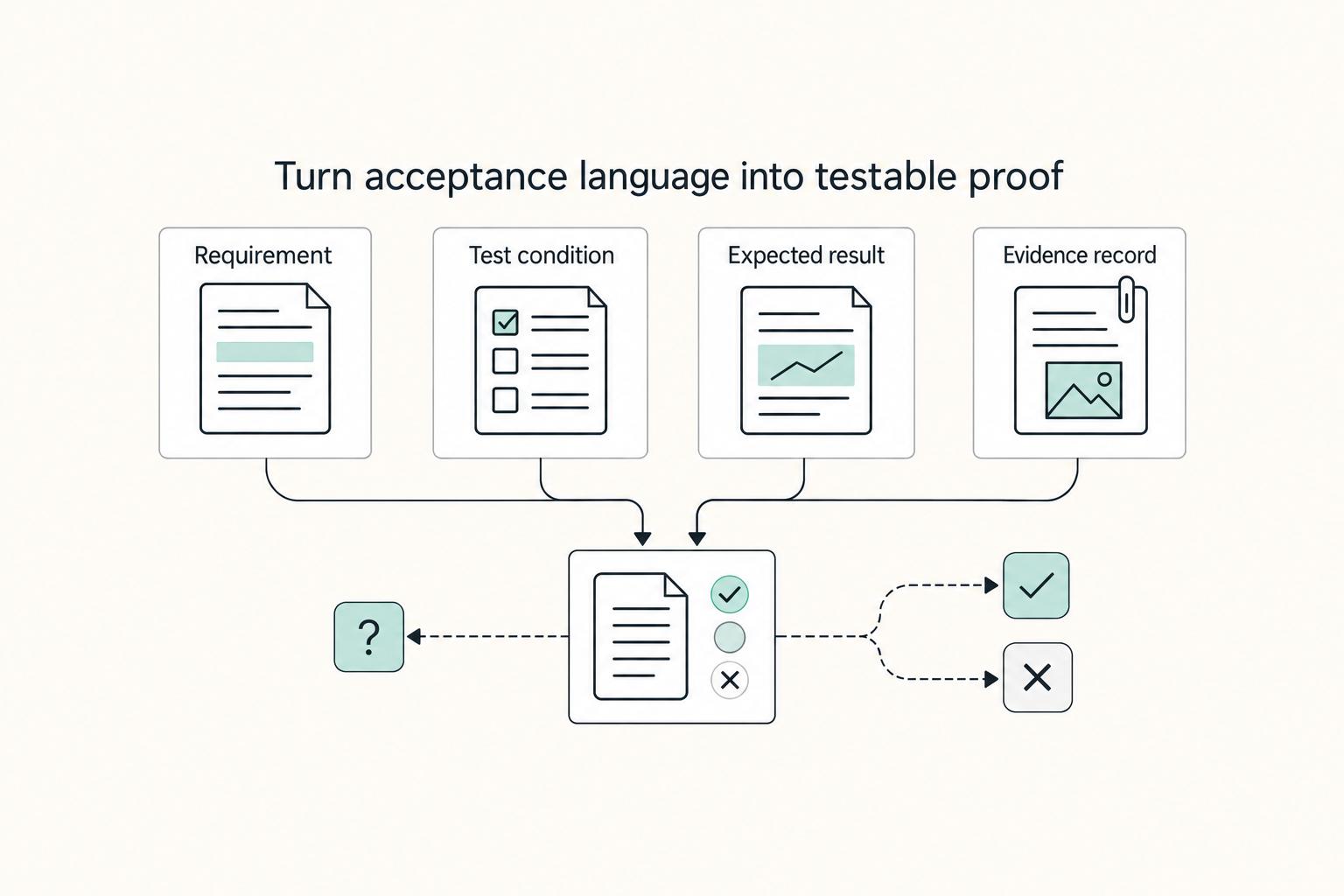
Make acceptance records the control point. State that the limited warranty is measured by acceptance criteria, test results, and written acceptance status so disputes are resolved by objective records.
If your contract uses an order-of-precedence clause, follow that stated hierarchy so conflicts are resolved by the controlling contract documents, not lower-priority materials. How to Structure a 'Testing and Acceptance' Clause in a Software Development Contract
Keep the section short and verify the evidence pack#
Keep this section brief and measurable. Use one narrow paragraph for what is warranted, a clear remedy or correction statement, then a clean handoff to the Disclaimer of Software Warranty clause for everything else.
Tie each promise to an agreed specification and decide how later defects are handled. Acceptance is evidence of delivery, not necessarily the end of a warranty. State the warranty period, notice process, correction deadline and agreed remedy if correction fails.
For a related risk-allocation clause, see What is a 'Force Majeure' Clause and Do You Need One?.
Draft the disclaimer core with option paths#
Once your yes list is fixed, disclaim only what sits outside that express warranty, and do it in language that works with the rest of the contract. Put the limited warranty first, then apply the residual disclaimer to the remaining software, services, or licensed rights.
Choose the disclaimer shape that matches the deal#
The structure should track the deal. If it does not, you create contradictions and invite redlines.
| Deal posture | Core disclaimer build | Where residual "as is" language can fit | Do not use this version when |
|---|---|---|---|
| Product-license heavy | "Except as expressly set forth in Section [Limited Warranty], the software, documentation, updates, and licensed rights are provided 'as is'..." plus your full implied-warranty disclaimer set | For the licensed software where that posture fits the bargain and local law | You separately promised specific performance, compatibility, uptime, or buyer-specific outcomes |
| Service-heavy | "Except as expressly set forth in Section [Limited Warranty], the services and related deliverables are provided 'as is'..." while keeping the express deliverable warranty narrow and clear | Usually limited to pre-existing tools, samples, beta items, or third-party components, not the core service promise | The text appears to disclaim the same deliverables, acceptance criteria, or correction duty you just promised |
| Mixed model | Split by asset type: licensed software and documentation under residual disclaimer; custom deliverables under the express acceptance-based warranty | Use for the reusable product portion, and apply carefully to custom implementation work | One sentence lumps product, services, and remediation together and makes the deal internally inconsistent |
Name the implied warranties you are disclaiming#
List the categories you intend to exclude, subject to applicable law: merchantability, fitness for a particular purpose and any relevant non-infringement warranty. Keep express commitments and separately negotiated IP indemnities intact.
A residual pattern is: “Except for the express warranties in the Limited Warranty section and rights that applicable law does not permit us to exclude, Provider disclaims other warranties to the extent permitted by law.” Add the specific permitted exclusions for your deal. Under New York UCC §2-316, an exclusion of merchantability must mention it and, when written, be conspicuous; a fitness exclusion must be written and conspicuous. The statute also addresses “as is” wording, subject to circumstances. These rules are an illustration, not a worldwide template.
Then verify the mechanics. The limited warranty section should point to the actual limited warranty, and the defined terms in this clause should match the agreement labels exactly.
Add anti-expansion language carefully#
Use anti-expansion language as cleanup, not as a substitute for consistent drafting. If it fits your form, add language disclaiming implied warranties arising from course of dealing or course of performance. Add any extra anti-expansion language only after a local-law fit check.
Keep expectations realistic. If commercial documents elsewhere make specific promises, this sentence will not reliably erase that conflict. Also weigh the trust issue. A broader residual disclaimer may reduce exposure, but it can also weaken the perceived quality commitment in service-led deals.
Cut overbroad text that conflicts with core promises#
If the disclaimer undercuts your promised deliverables, acceptance remedy, or core bargain, narrow it before signature. Courts can look past labels, and a term called a "warranty" can still be treated as more fundamental depending on substance, which can change remedy outcomes.
State-law limits are the other stop sign. Ambiguous or overly broad disclaimers can be unenforceable in some regimes. The practical rule is simple: disclaim broadly outside your narrow, provable warranty, and split product from services in mixed deals so your acceptance-based promise still reads as real.
Connect warranty language to Limitation of Liability and Indemnification#
A disclaimer helps only if the next clauses carry the same risk allocation. Read these together in this working order: Warranty Disclaimer, then Limitation of Liability, then Indemnification, then Termination. That is not a mandatory legal sequence. It is a practical review sequence that can catch contradictions early.
Read the clause stack as one risk system#
Start with the disclaimer: what did you actually promise? Then test liability: if that promise fails, what is the maximum exposure? Then test related risk-transfer terms: do they reopen exposure through a separate claim path? Finally, test termination: what duties survive after exit?
Use this check for license-heavy, service-heavy, and mixed deals. The structure of a software deal depends on party needs, so warranty and liability language should match the real delivery model. Then do a mechanical pass. Cross-references, defined terms, and asset labels need to align across clauses.
Raise cap-structure options early. Cap-allocation impasses tend to show up late in negotiations, and it is usually easier to deal with them sooner.
Pick a cap structure that matches the warranty position#
Commercial parties often use limitation-of-liability terms to allocate risk, but one flat cap may not fit both ordinary issues and high-risk contingencies. That is why you may see super caps and liability ladders.
| Cap structure | How it works | Exclusions to test | Collision check |
|---|---|---|---|
| Single general cap | One overall cap for most claims | Confirm that any damages exclusions match the intended allocation | Check whether a separate claim path can bypass the intended cap |
| Super cap for named risk | Higher cap for a specified high-risk category | Confirm whether exclusions differ for that category | Avoid creating two overlapping recovery paths for the same risk |
| Liability ladder | Different caps for different claim groups | Test each tier against the same allocation logic so terms do not undercut each other | Clarify which claims map to each tier |
Compare the plausible loss with the cap amount and insurance available. A fee-based cap can leave substantial buyer exposure; negotiate the categories and limits explicitly.
Trade risk areas instead of conceding all three#
A common impasse is that sellers may resist uncapped liability when downside could exceed deal value, while buyers may reject relying only on a general cap for ordinary contingencies. If a client wants broader warranties, make targeted tradeoffs instead of conceding broader warranties, uncapped damages, and broad risk transfer all at once.
Ask the client to name the exact concern first, such as conformity, third-party claims, or interruption risk. Then make a targeted trade instead of a blanket concession.
Use a fallback ladder before negotiations stall#
Negotiate with commercial levers, not only clause text.
| Trade | Counterbalance |
|---|---|
| Broader warranty language | Tighter scope: specific deliverables, clear acceptance criteria, short correction remedy |
| Higher caps | Price or separate premium support |
| Broader risk-transfer asks | Narrower, clearly defined matters you control |
| Legal exposure | Phased delivery with acceptance checkpoints and stop points |
If you want deeper cap-pattern examples, see A Deep Dive into the 'Limitation of Liability' Clause for Freelance Software Developers.
You might also find this useful: How to Write a Limitation of Liability Clause.
Set Governing Law Jurisdiction and Dispute Resolution early#
Set Applicable law, jurisdiction, and dispute terms early, not at the end. Draft these terms to fit the contract form you are actually using, such as a Software License Agreement, a software-as-a-service subscription agreement, or an End User License Agreement (EULA).
Choose the Applicable law first#
Choose governing law and forum deliberately. They can refer to different jurisdictions; that is not automatically a contradiction. Check that the forum clause and dispute process work with the chosen law and transaction.
Treat this as a real commercial choice, not template filler. In software deals, contract structure changes by delivery model, so dispute-law drafting should match the structure you are actually signing.
Use a simple verification test: search for "governing law," "applicable law," "jurisdiction," "venue," and "arbitration." Those references should tell one coherent story.
Pick one dispute path and draft it all the way through#
Pick one primary path and fully specify it. Court venue and arbitration can both work, and neither is automatically better in every case.
| Path | What to draft clearly | Practical risk if vague |
|---|---|---|
| Court venue | Which court hears disputes | Early arguments about where a case belongs |
| Arbitration | The arbitration path and process details | Process fights before the underlying breach is addressed |
A workable decision rule is simple. If both sides are comfortable with a named court, keep the court clause precise and direct. If you choose arbitration, do not leave it half-specified.
Run a consistency pass across the whole agreement#
Before signature, run one mechanical pass across the signature block, notice clause, and dispute clause. This is where you catch preventable conflicts.
Check these points:
- The entity named in the dispute clause matches the entity that signs.
- The notice address belongs to that signing entity and is current.
- Every reference to Applicable law aligns with the chosen venue or arbitration path.
- If assent is by use, download, installation, or access in license text, including an EULA, the dispute terms should appear in that same accepted text.
Clear notice and dispute mechanics keep a warranty disagreement from starting with a separate argument about how and where to raise it.
Align with delivery proof and acceptance evidence#
Your warranty and disclaimer language should track the same written acceptance mechanism used to confirm delivery. When the clause stack lines up with proof of performance, disputes can turn on documents instead of informal expectations.
Tie warranty carve-outs to the acceptance mechanism#
Use acceptance criteria and test records to assess agreed conformity. Those records do not automatically extinguish other binding factual promises, later-defect warranty coverage or mandatory rights. Align the warranty period and remedy with the acceptance process.
Keep one drafting rule in view: do not disclaim what you expressly promised. If a promise is in the contract, define it narrowly and disclaim only what sits outside that defined promise.
Use this quick check: read the warranty sentence, then the acceptance section, and confirm a third party could tell from the contract alone how acceptance is proved. If that is unclear, fix the drafting before signature.
For deeper drafting on acceptance, see How to Structure a 'Testing and Acceptance' Clause in a Software Development Contract.
Name the records that count as proof#
Say in the agreement which written records count as evidence of delivery, testing, rejection, acceptance, and approved changes.
The point is not that one record set is mandatory for every deal. The point is that your contract should say what counts for this deal and which written approvals control.
If acceptance terms and disclaimer language sit in different documents, use an order-of-precedence rule so conflicts are resolved by a stated document hierarchy.
Close the gap between kickoff promises and contract text#
Informal kickoff statements can create expectation gaps if they never make it into signed documents. Close that gap by pushing requirement changes into updated contract text, and state that changes are effective only when amended in writing by the parties.
If sales notes or demo language promise more than the contract, align the promise set before signature. Then keep the warranty disclaimer and the Limitation of Liability clause aligned to the same written delivery and change-control record.
Need the full breakdown? Read How to Structure a Maintenance and Support Agreement for Software.
Handle client redlines without slowing the deal#
Do not negotiate from a blank page. For your warranty and disclaimer terms, prepare a default response and one fallback for each common ask so negotiations do not turn into slow, heavy redlining.
Use this as a negotiation framework, not legal advice.
Prepare short response scripts before the first redline call#
Most objections here are about risk allocation, so keep your responses plain and repeatable across your warranty disclaimer and related risk-allocation terms.
- If the client says, "Remove As Is," respond: "We can narrow wording, but we cannot make an open-ended performance promise. The software is not promised to be error-free or to meet every user requirement."
- If the client says, "Delete the consequential damages exclusion," respond: "We can discuss targeted carve-outs for specific obligations, but we do not accept unlimited downstream business-loss exposure."
Each response should map back to a contract anchor, usually defined scope or commercial boundaries.
Trade expanded warranty for narrower uncertainty#
If the client asks for a broader warranty, trade for tighter boundaries instead of accepting the ask as-is. Narrow what is covered, define what is out of scope, and clarify support boundaries.
Use one rule in calls: if they expand the promise, reduce uncertainty somewhere else. Tie any added promise to named deliverables and clearly documented scope and support boundaries.
Keep one fallback per issue and control it in your clause library#
For recurring redlines, keep three positions ready: provider-favorable, balanced, and client-favorable. That gives you a controlled path to agreement without reopening the full contract every round.
Keep each fallback version tagged with basic metadata: clause type, risk level, last review date, and applicable contract types. If you cannot quickly tell which version fits the deal, expect slower negotiation and heavier redlines.
Common drafting mistakes and how to recover fast#
Recovery is usually straightforward: make your warranty language match the deal you actually sold, then clear contradictions in the editable contract draft.
| Mistake | Risk | Recovery |
|---|---|---|
| Using one blanket disclaimer for a mixed deal | One broad "as is" line can conflict with the commercial structure | Split the warranty scope so each promise maps to the relevant part of the transaction |
| Inconsistent buyer and supplier positions | A requested express IP warranty may conflict with a broad supplier exclusion | Agree which promises remain and how residual exclusions interact with them |
| Patching one sentence instead of repairing the full clause logic | Changing one sentence can leave the overall warranty position unclear if the rest of the clause still points in a different direction | Rework the full warranty clause so coverage and exclusions read as one consistent position across the editable contract text |
Mistake 1: Using one blanket disclaimer for a mixed deal#
A reusable software license and separately priced implementation work can need different promises. Separate what the product does from the professional services you perform, then give each an appropriate warranty and remedy.
Recovery: split the warranty scope so each promise maps to the relevant part of the transaction instead of treating everything like one product sale.
Mistake 2: Leaving buyer-requested promises and supplier exclusions in conflict#
If the buyer requests a specific warranty and the supplier proposes a broad exclusion, decide the agreed promise explicitly. Do not leave both contradictory positions in the execution copy.
Recovery: work from an unlocked draft and run a contradiction check across the full editable contract package, then narrow or remove statements that set expectations higher than intended.
Mistake 3: Patching one sentence instead of repairing the full clause logic#
Changing one sentence can leave the overall warranty position unclear if the rest of the clause still points in a different direction.
Recovery: rework the full warranty clause so coverage and exclusions read as one consistent position across the editable contract text.
This pairs well with our guide on How to Draft an NDA for a Software Development Project.
Final verification before signature#
Before signing, run one last consistency check across the full contract set. Treat this as risk control, not a formality. A disclaimer can limit exposure, but it does not eliminate risk.
Align disclaimer references end to end#
Align every disclaimer reference end to end. If you use both a Disclaimer of Warranty clause and a Disclaimer of Software Warranty clause, confirm they say the same thing across the main agreement, SOW, and any addenda. Then verify each cross-reference to any liability section so the warranty language and any Limitation of Liability clause reflect one consistent risk position.
Verification point: search the editable draft for "warranty," "disclaimer," "liability," and "as is," then read every hit in order.
Confirm the surrounding risk clauses match#
Confirm that any surrounding risk clauses in your draft are consistent with each other, including Indemnification, Governing Law, Jurisdiction, Dispute Resolution, and Termination. Check for conflicts, such as court versus arbitration or mismatched law and venue references, and fix them before signature.
Use the SOW and acceptance criteria as the practical check. The SOW should clearly state what will be delivered, and the acceptance criteria should show how completion is determined. If those sections are vague, disputes become more likely. For more detail, review A Deep Dive into the 'Limitation of Liability' Clause for Freelance Software Developers.
Save a complete evidence file before sending#
Prepare the clean execution copy, final redline, approved SOW, acceptance criteria and change orders in one folder. After signature, archive the executed agreement and the negotiation trail with them.
Confirm the file set shows the agreed wording, and record the signed version once execution is complete.
For a step-by-step walkthrough, see How to Write an Arbitration Clause for a Freelance Contract.
Use this copy paste checklist before you send the contract#
Use this as a pre-send baseline check, not a universal final list. It is not a substitute for jurisdiction-specific legal advice.
- Define warranties and representations clearly. Keep the express warranty scope narrow and explicit.
Quick check: identify what is warranted and by whom, the warranty period, defect notice process, correction deadline and remedy if correction fails. Confirm that acceptance does not itself end a continuing warranty.
-
Make exclusions legally effective. Name the intended permitted exclusions, preserve mandatory rights and check required writing, prominence and assent under the applicable law.
-
Read risk clauses together, not in isolation. Review warranty and disclaimer language beside Limitation of Liability, Indemnification, and Termination. Confirm whether liability is capped and whether consequential damages or lost profits are excluded, because those terms often control real exposure. For cap and exclusion structure, see A Deep Dive into the 'Limitation of Liability' Clause for Freelance Software Developers.
-
Keep dispute terms internally consistent. Align Governing Law, Jurisdiction, Dispute Resolution, venue or forum references, notice terms, and references to applicable law so they do not point in different directions.
-
Check signing authority before send. Confirm the signer has authority to bind the business entity. A disclaimer can limit exposure, but it does not automatically prevent legal action.
Frequently Asked Questions
What is a warranty and disclaimer clause in a software contract?
A warranty states a promise about software or services. A disclaimer excludes or narrows permitted warranties outside those express promises; it does not automatically eliminate liability or remedies. Read it alongside the liability and remedy clauses.
Which warranties are usually disclaimed in software agreements?
Software disclaimer language often includes implied merchantability and implied fitness for a particular purpose. Many agreements also use "as is" wording, which is another common way to frame a warranty disclaimer. Quick check: search your draft for "merchantability," "fitness," and "as is," then confirm the language matches the deal you actually intend to offer.
Can a software supplier disclaim all warranties in every situation?
No. Applicable mandatory rights can limit exclusions, and a contradictory disclaimer may be ineffective against express promises forming the bargain. Check the transaction and governing law before deciding what can be excluded.
Does it matter whether the deal is treated as a good or a service?
Yes. The applicable legal rules can differ for goods, services and mixed transactions. US courts may apply different tests depending on state law and the deal. Describe the transaction accurately, then confirm which rules apply before using an exclusion.
How does a Warranty Disclaimer interact with a Limitation of Liability clause?
They are related, but they do different jobs. A warranty disclaimer narrows or removes certain warranties, while a Limitation of Liability clause addresses damages and exposure if liability still exists. As a drafting check, confirm whether your contract combines them or keeps them separate, then read them together so they do not conflict. For deeper detail, see A Deep Dive into the 'Limitation of Liability' Clause for Freelance Software Developers.
What remains uncertain even with strong drafting in cross-border contracts?
Strong drafting reduces risk, but it does not eliminate dispute risk. In cross-border deals, treat enforceability and remedy outcomes as uncertain rather than assumed. Keep one tradeoff in view: some suppliers resist broader warranty exposure because insurance coverage may not align with those risks.
Try a related tool
Researched and edited by the Gruv editorial team. Gruv builds cross-border billing, payouts, and finance-operations software for global businesses.
Sources
Educational content only. Not legal, tax, or financial advice.
Related Posts

Germany Freelance Visa Application Path for Freiberufler and Gewerbe
Choose your track before you collect documents. That first decision determines what your file needs to prove and which label should appear everywhere: `Freiberufler` for liberal-profession services, or `Selbständiger/Gewerbetreibender` for business and trade activity.

Limitation of Liability Clause for Freelance Software Developers
A liability clause sets which losses can be recovered and how much can be claimed. For a freelance developer, the useful starting point is the project risk: a failed acceptance test, an IP complaint, a data incident, or an unpaid invoice. Agree which risks the contract covers before choosing a cap number.
How to Structure a 'Testing and Acceptance' Clause in a Software Development Contract
Scope creep usually gets blamed first, but a weak **testing and acceptance clause** is often what lets it happen. When that clause is vague, you lose control over the three things that decide whether a project stays profitable: what counts as done, what counts as extra work, and when final payment is due.