
Quick Answer
Name the site, market, URLs, outputs and implementation owner. Define the review window, correction duties and included revisions, then map invoice amounts to specific events. Agree how added scope changes price and dates. Keep cancellation reconciliation, dispute handling and ownership consistent with the signed agreement. For SEO, measure campaign results without promising a guaranteed ranking.
Write an SEO SOW That Defines Work, Review and Payment#
An SEO statement of work connects the campaign promise to tasks that someone can deliver, review and pay for. Name the site, market, outputs, implementation owner and billing events before work starts. The example below uses a fixed-fee campaign; adapt its quantities and terms to the engagement you actually sell.
Step 1. Separate proposal, SOW, and master agreement#
A proposal describes the offer and price; a statement of work sets the agreed work, dates and handoffs. A master services agreement (MSA), if used, holds recurring legal terms. You can combine them in one agreement for a small project. Identify the incorporated documents and the order of precedence, because a document’s title alone does not determine its binding effect. Read more about the proposal and SOW distinction.
| Practical issue | Vague SOW | Defensible SOW |
|---|---|---|
| Work boundaries | "Monthly SEO support" | Specific tasks, exclusions, deliverables, and standards |
| Change handling | New requests handled informally | Written change order with scope, price, and timeline updates |
| Invoicing | "Paid monthly" | Defined invoice trigger, due date, and late-payment path |
| Dispute path | Silent or conflicting documents | SOW matches the signed court or arbitration path |
| Ownership clarity | "Client owns everything" | Clear handoff terms and signed transfer language where required |
Step 2. Draft for five predictable failure points#
For scope creep, record the original URLs, markets, deliverables and implementation duties. Agree how authorized contacts approve changes, including price and schedule. This is a proposed commercial process, not a rule imported from federal procurement: FAR 43.103 also permits certain unilateral government modifications and does not govern an ordinary private SEO contract. Correcting work that fails the agreed standard remains part of the original obligation; it is not automatically a paid change.
| Failure point | What to specify | Why it matters |
|---|---|---|
| Scope drift | Define scope and have authorized contacts approve added work, revised fees and affected dates in the agreed written form. | Pages, markets, or reporting layers can expand without control. |
| Approval delays | Name the approver and tie each deliverable to an approval step. | A third party should be able to identify delivery and review timing. |
| Payment friction | State exactly what triggers invoicing and when payment is due. | A third party should be able to identify payment timing. |
| Cross-border enforcement | Keep the SOW consistent with the signed dispute mechanism in the contract set, whether that is court or arbitration. | Sloppy drafting creates avoidable risk. |
| IP handoff clarity | Make the transfer mechanics explicit in the signed contract documents. | Do not rely on informal ownership language. |
Name a primary approver and backup. State the review window, what a rejection must identify and how you respond. Keep acceptance, invoice issuance and the payment due date separate: an invoice can follow delivery if that is what the parties agreed, while a valid defect still requires correction. A missing approval should trigger the agreed follow-up rather than leave the next action undefined.
Cross-border enforcement is another place where sloppy drafting creates avoidable risk. Keep the SOW consistent with the signed dispute mechanism in the contract set, whether that is court or arbitration. Do not overstate what will be easy to enforce across countries.
Identify project-created material, pre-existing templates and third-party assets separately. If U.S. copyright law applies, §204 generally requires a copyright ownership transfer to be in writing and signed by the rights owner or authorized agent, with an exception for transfers by operation of law. Merely handing over a file does not transfer its copyright. Define any assignment or license and its payment condition in the signed agreement; work-for-hire and assignment are different mechanisms.
Step 3. Run this pre-kickoff check#
Before kickoff, confirm these basics:
- Every output has a quantity, delivery date, responsible owner and test for completion.
- The client supplies the agreed access and implementation owner; added work follows the agreed change process.
- Invoice triggers, review/correction steps, dispute route and ownership terms agree across incorporated documents.
That is your minimum baseline. The next section turns those checks into clause-level drafting.
What each of the seven SOW sections should include#
Use these seven sections to draft a campaign that can be operated from the page. Oregon’s SOW writing guide is a public-procurement reference for tasks, responsibilities and acceptance standards; the illustrative commercial clauses below are not mandatory statutory wording. Example engagement: one English-language site, one U.S. market, 20 named priority URLs, a technical recommendation log, five content briefs and a campaign report over four weeks. Implementation and content production are excluded.
| Section | Include | Avoid |
|---|---|---|
| Define the objective | The business aim, covered property or campaign, and what you will measure. | Broad promises with no context or control. |
| Define scope and exclusions | Exact tasks, covered channels or properties, and a clear out-of-scope list. | Bundled language that hides effort or leaves boundaries implied. |
| List deliverables and acceptance | Deliverable name, format, owner, delivery method, acceptance standard, and revision boundary. | Undefined standards like "to client satisfaction" without criteria. |
| Map milestones to invoice triggers | Named milestone, invoicing trigger event, and evidence trail such as email, folder link, access grant, or signed note. | Verbal-only billing triggers or memory-based timelines. |
| State assumptions, dependencies, and client responsibilities | Required access, approvals, materials, decision owner, and response expectations. | Timelines written as unconditional when they depend on client actions. |
| Control revisions, changes, and early stop scenarios | Included revision boundaries, correction duties, authorized change approval, cancellation valuation and advance reconciliation. | Starting added work before written approval. |
| Align payment terms, dispute process, and IP handoff | Invoice amounts and due-date anchors, currency and fees, agreed notice/cure before any pause, applicable late-payment terms, dispute route and project-material handoff. | Mixing dispute pathways or ownership terms across the proposal, SOW, and master agreement. |
Scope wording that is specific#
Scope is where a lot of preventable friction starts. Tighten it early so the rest of the document has a clear boundary.
| Vague wording | Clearer wording |
|---|---|
| “Monthly SEO support” | “This four-week engagement covers one named site, English-language pages and the U.S. market. Exhibit A lists the 20 URLs, technical audit, five briefs and final report.” |
| “On-page optimization as needed” | “Provide title, description, internal-link and content recommendations for the 20 listed URLs. The client’s developer implements them; provider CMS changes are excluded.” |
| “Ongoing strategy support” | “Include one 60-minute kickoff, one 45-minute findings call and one 30-minute handoff. Further meetings require agreement on fee and schedule.” |
| “Everything needed to improve SEO” | “Exclude article writing, translation, development, migrations, paid media, purchased links and new markets unless a change is approved.” |
Deliverable acceptance criteria that can reduce disputes#
Test completion against the deliverable, rather than an uncontrolled ranking result. Google’s hiring guidance warns that nobody can guarantee a number-one ranking. Record organic clicks, impressions and business conversions as campaign measures, with the period and data source specified; distinguish those goals from the acceptance tests for the work you promise.
| Deliverable | Quantity and handoff | Completion test |
|---|---|---|
| Technical recommendations | One spreadsheet and PDF summary by project day 10 | For the 20 named URLs, include tested issue/status, evidence, severity, proposed action and implementation owner. If a category has no issue, record that finding; do not invent recommendations to fill a quota. |
| Content briefs | Five briefs in the agreed template by day 20 | Each includes intended reader/query, intent, proposed outline, supporting sources and relevant internal links. Article writing and publishing are excluded. |
| Campaign report | One report and 30-minute handoff by day 25 | Show the agreed baseline/comparison periods, data sources, work delivered, implementation status and next actions. State unavailable data; do not fabricate pre-access history. |
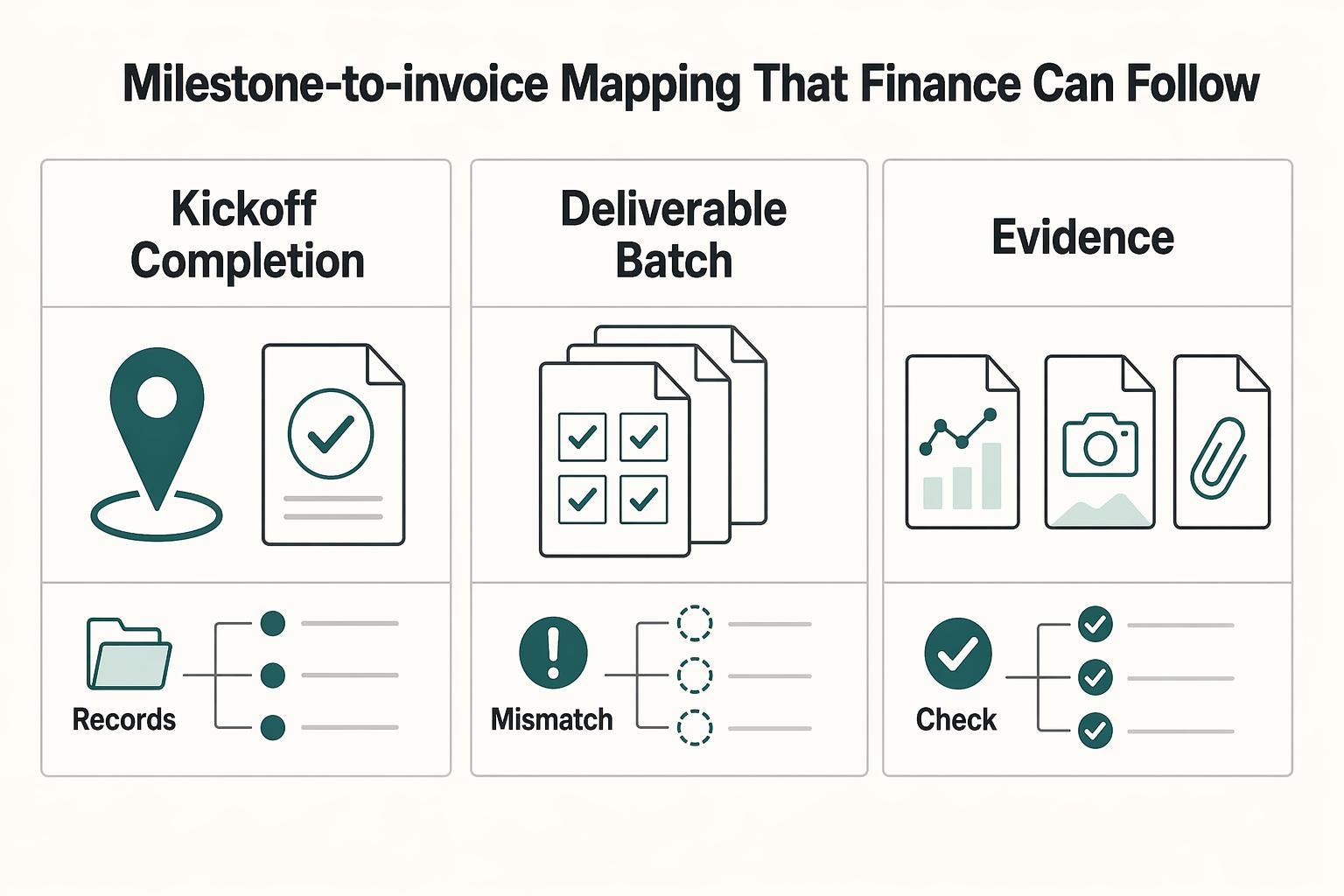
Milestone-to-invoice mapping that finance can follow#
Choose the invoice trigger deliberately and attach evidence. In this illustrative $6,000 project, a $2,000 advance is invoiced on signature and credited against the $3,000 audit phase. A further $1,000 is invoiced on complete audit submission, and $3,000 on submission of the five briefs and final report. The total is $6,000, not $8,000. These are submission-based billing terms; acceptance and correction remain separate. State the agreed due-date anchor and follow the overdue payment process if needed.
| Event | Invoice and due date in this example | Evidence |
|---|---|---|
| Signed SOW; funding before work starts | $2,000 advance, due before project day 1; credit it to the audit-phase fee | Executed SOW, invoice and confirmed payment |
| Complete audit package submitted | $3,000 phase value less $2,000 paid advance = $1,000 balance; due 15 calendar days after receipt of the proper invoice | Dated delivery email, spreadsheet/PDF links and advance reconciliation |
| Briefs and report submitted | $3,000 balance, due 15 calendar days after receipt of the proper invoice | Five brief links, report link and submission email |
| Client raises a specific delivery defect | Follow the agreed correction/dispute process; do not automatically treat the entire project as unpaid or accepted | Affected criterion, disputed amount, correction record and decision |
1) Define the objective. Separate the business goal from the work commitment. For this example, the aim is to improve the site’s organic acquisition by identifying technical issues and preparing useful content plans. Search engines, competitors, client implementation and buying behavior affect the eventual result.
- Sample objective: “Provide the audit, recommendations, five briefs and report specified in Exhibit A for the named site and market over four weeks.”
- Track the agreed campaign measures against a stated baseline and comparison period. Record major site changes and missing analytics data alongside results.
- Make acceptance depend on the agreed outputs and quality criteria, rather than a promised ranking, traffic increase or revenue total.
2) Define scope and exclusions. Attach the URL list and identify whether the engagement is an audit, implementation, content production or recurring support. A recommendation to repair a template is a different deliverable from changing and testing that template.
- Sample scope: “Review the 20 URLs in Exhibit A and provide recommendations on crawl/index status, page metadata, internal links and content gaps. Review site-level evidence relevant to those URLs.”
- Sample boundary: “The client implements recommendations through its developer. New pages, markets, languages, article writing, migrations and provider CMS changes are excluded.”
- If a site-level issue requires work beyond the named review, describe it in the recommendation log and quote implementation separately; do not silently convert the audit into development.
3) List deliverables and acceptance. Give the client a workable review process. In this example, the primary marketing approver has five business days after each complete delivery to accept it or identify specific unmet criteria, copying the backup approver.
- Sample review clause: “The client supplies one consolidated response identifying the affected deliverable and unmet criterion within five business days. The provider corrects agreed nonconformities without an additional fee and resubmits.”
- Include one consolidated preference-revision round for each brief within the original audience and subject. Changing the market or requesting additional briefs follows change control. Required corrections are distinct from discretionary revisions.
- If the approver is unavailable, contact the named backup and document affected dates. In this example silence is not deemed acceptance; delivery-based invoicing still follows the agreed event, with valid defects handled through the correction/dispute process.
4) Map milestones to invoice triggers. State the amount and whether the trigger is signature, submission, acceptance or a calendar event. The advance funds work and is credited to a phase; it is not an extra fee or proof that the phase has been earned.
- Sample billing clause: “The total project fee is USD 6,000 before any separately applicable tax. Invoice USD 2,000 on execution,USD 1,000 on complete audit submission and USD 3,000 on complete final submission, as shown in the payment schedule.”
- Project day 1 begins only once the agreement is executed, the advance is received and required access is available. The advance is due before work begins; the later invoices are due 15 calendar days after receipt of a proper invoice.
- Name the finance address, purchase-order requirement, remittance reference, permitted payment methods and responsibility for transfer fees. If conversion is permitted, agree its rate source and date rather than leave the amount to a later interpretation.
5) State assumptions, dependencies and client responsibilities. Allocate access, content facts, implementation and approval to named roles. For the audit, request read access to Search Console and analytics; additional permissions need a reason tied to included work.
- Sample access clause: “Before project day 1, the client supplies read access to Search Console and agreed analytics, the priority URL list and the named marketing, developer and finance contacts.”
- The client provides accurate product facts and legal/brand approval. Its developer implements and tests recommended changes unless implementation is expressly included. The provider records which recommendations were implemented before attributing results.
- If access or a required input is late, notify the client, identify the blocked task and continue unaffected work. Record a revised affected delivery date and any proposed extra cost in the agreed written process; a missing login does not automatically justify pausing every task.
6) Control revisions, changes and early stop scenarios. Compare a request with the agreed output and standard before pricing it. A missing source in one of the five agreed briefs is a correction. Five additional briefs are added scope. An internal underestimate is not by itself a client-authorized change.
- Change example: “Add five briefs for the same site at USD 200 each:USD 1,000 additional fee; move the affected batch date by five business days. The named client and provider contacts approve the revised scope, fee and date before added work begins.”
- If the change is declined, continue the original deliverables where feasible. Keep the request and decision with the SOW version; do not treat informal enthusiasm as approval of a price.
- Agree cancellation valuation before kickoff. Example only: the USD 3,000 audit phase is allocated USD 1,500 to the completed crawl/evidence component and USD 1,500 to analysis and recommendations. If cancellation occurs after only the first component is completed and earned under those terms, apply USD 1,500 of the USD 2,000 advance and refund USD 500, assuming no other agreed charges. Do not use an undefined “nonrefundable deposit” to skip reconciliation.
- Specify the notice method, due date for the final statement, treatment of approved external costs and handoff of paid work. If cancellation happens after different work is completed, calculate the balance from the agreed component values rather than reuse the USD 500 figure.
7) Align payment, disputes and ownership. Put recurring legal terms in the MSA if used and identify exactly where the SOW relies on them. Use the agreed notice and cure process before a permissible suspension; a payment issue is not permission to delete site content, revoke client-owned accounts or withhold everything indiscriminately.
- State the invoice dispute window, evidence required and treatment of undisputed amounts. Resolve a genuine delivery defect through correction, then apply the agreed billing remedy to the affected amount.
- Specify any lawful late-payment remedy and its trigger under the applicable contract and law. Country-specific statutory interest is not a universal cross-border penalty; verify the relevant regime before inserting a rate.
- Identify final project-created reports and briefs covered by an assignment or license, any payment condition, and rights needed to use retained templates or third-party material. Client-owned accounts, existing content and credentials remain separate.
- Align governing law, court forum or arbitration mechanism, precedence and notice details across the contract set. Have the intended mechanism reviewed for the jurisdictions involved rather than promise automatic worldwide enforcement.
Before signature, read the SOW as the approver, the finance contact, and the replacement operator. If any of them would still need a call to understand boundaries, approvals, or payment triggers, revise the wording and validate the legal terms with qualified counsel.
Check the SOW Against a Real Delivery and Invoice#
A good SOW is your control point before work starts. It aligns both sides on deliverables, timeline, and cost in writing before anyone starts tracking time.
| Final check | What to confirm |
|---|---|
| Campaign goal | The campaign goal is explicit and tied to a business outcome. |
| Strategy and timeline | The strategy summary and timeline are clearly stated. |
| Team members | The participating team members are named. |
| Deliverables | The deliverables are listed clearly. |
| Scope boundaries | Scope boundaries are explicit so requirements are not vague. |
| Phases and acceptance | Where useful, the work is split into phases and acceptance criteria are defined for each phase. |
Walk through a delivery before signing: the audit arrives, the approver reports a missing evidence field, and finance receives the agreed USD 1,000 balance invoice after the USD 2,000 advance credit. The provider corrects the missing field without a new fee and follows the agreed treatment of any disputed amount. A request for five additional briefs is handled separately through the USD 1,000 change example. The contract should make each next action clear.
Before you send the SOW, run this final check:
- Verify the site, market,20 URLs and five-brief quantity match the appendix and fee schedule.
- Check access, implementation owner, delivery dates, review window, correction and included revision duties.
- Reconcile USD 2,000+USD 1,000+USD 3,000 to the USD 6,000 total; confirm the advance is credited once.
- Record the named approver, backup, finance contact and authorized change contacts.
- Check added-scope approval, cancellation valuation and the final statement/refund process.
- Confirm governing law, dispute route, precedence and rights for paid deliverables agree across the executed documents.
Apply this checklist to your current draft now, line by line, before you send it.
Frequently Asked Questions
What is the difference between an SEO proposal and an SOW?
The proposal helps win the engagement. The SOW defines what you are obligated to deliver. Keep persuasive positioning in the proposal, then translate it into specific services, deliverables, and acceptance standards in the SOW that is attached to or incorporated into the contract set. In practice, that means moving broad promises into concrete SOW language tied to named properties, outputs, and completion criteria.
How do you handle payment terms in a cross-border engagement?
State currency, amounts, invoice triggers, the payment due-date anchor, finance contact and required invoice fields. Allocate transfer fees and agree any conversion source and date. For example, later invoices in the sample are due 15 calendar days after receipt of the proper invoice; the advance is due before work begins. Keep delivery, acceptance, invoice issuance and receipt of funds distinct, and use late-payment terms appropriate to the governing contract and law.
How do you prevent scope creep in an SEO campaign SOW?
Name the site, market, URLs or templates, quantities and implementation duties, then record exclusions. Require authorized written approval of added scope, fee and affected dates. In the example, five extra briefs add USD 1,000 and five business days only if both sides approve that change. Correcting a brief that fails its original completion criteria remains an original-scope duty.
What are the most essential clauses beyond scope, timeline, and payment?
Include client access and implementation responsibilities, confidentiality, data access, correction and cancellation handling, document precedence and ownership or license terms. Identify governing law and the actual court or arbitration mechanism rather than leave the choice unresolved. Match the legal terms across incorporated documents and adapt any arbitration provision to the parties and jurisdictions.
Is an SOW the same as a contract?
An SOW can be incorporated into an MSA or can contain the project agreement itself. Its effect depends on the agreed terms, how the parties conclude it and applicable law. Identify the legal parties, incorporated agreement and precedence rule. The sample assumes an executed contract set; a title such as “proposal” or “SOW” does not settle enforceability.
What makes an SEO SOW clear enough to operate?
List measurable deliverables, quantities, dates, responsible roles, review criteria and fee events. For example, the audit covers 20 named URLs and provides evidence, issue/status, proposed action and implementation owner. That lets the approver test completion; a ranking promise does not. Clear drafting supports administration, while enforceability still depends on formation, terms and applicable law.
Try a related tool
Researched and edited by the Gruv editorial team. Gruv builds cross-border billing, payouts, and finance-operations software for global businesses.
Sources
Includes 2 external sources outside the trusted-domain allowlist.
Educational content only. Not legal, tax, or financial advice.
Related Posts

Germany Freelance Visa Application Path for Freiberufler and Gewerbe
Choose your track before you collect documents. That first decision determines what your file needs to prove and which label should appear everywhere: `Freiberufler` for liberal-profession services, or `Selbständiger/Gewerbetreibender` for business and trade activity.

How to Use SEO to Attract High-Quality Freelance Clients
**Build your *seo for freelancers* around qualified leads, not raw traffic: tighten who you target, what you prove, and how you gate inquiries.** You're the CEO of a business-of-one. Your marketing job isn't "get more attention." It's "get the right work, predictably, without turning your calendar into a sorting machine."

The Freelance Payment Penalty: A Modeled Audit of Platform Fees, FX Spreads, and Payout Delays
The money rarely disappears through a single, easy-to-spot fee. The real loss is stacked. A marketplace takes its commission, a processor adds a charge for international cards, a bank or payment company converts the currency at a spread, a platform holds the funds before release, and a wire sheds a little to intermediaries on the way in. Each layer looks defensible on its own, but the worker feels the combined result as a smaller deposit and a later payday.