
Quick Answer
Start with a sow for podcast production that spells out deliverables, exclusions, invoice triggers, and a signed change-order gate for extras. Then map rights by asset type, stating what is assigned, what is licensed, and when transfer happens. Finish by defining approval path, acceptance criteria, delivery route, and dependency recovery actions so delays, revisions, and handoff disputes are handled by contract terms instead of ad hoc messages.
Pillar 1: Mitigate Financial Risk and Eliminate Scope Creep#
In a sow for podcast production, your financial protection usually comes from four places: scope and exclusions, payment terms, change orders, and termination. If any of those are loose, you usually end up arguing about extras, timing, or what gets handed over at the end.
| Clause | Weak construction | Strong construction |
|---|---|---|
| Scope | "Full podcast production for 8 episodes" | "Edit, mix, and master 8 episodes; deliver agreed output formats per episode, show notes up to the agreed word count, metadata entry, and upload to the named host or platform" |
| Exclusions | "Other services as needed" | "Not included unless listed: transcripts, audiograms, social clips, YouTube versioning, cross-posting/distribution targets, and extra revision rounds" |
| Payment | "Paid on completion" | "Invoice on the agreed trigger, with payment due window pending signed SOW verification; services may pause if contract terms allow and payment is overdue under the signed SOW; late charge only if valid under governing law" |
| Changes | "Client may request reasonable additions" | "Added work starts only after a written, signed change order with updated deliverables, timeline, and price" |
Separate scope from requirements, then list exclusions#
This is where scope creep usually starts. If "full production" stands on its own without limits, it becomes a container for whatever someone thinks should be included later.
State scope as the intended result and limits. Put tasks, deliverables, schedule, and assumptions in requirements. That separation makes the project easier to price, easier to manage, and harder to stretch.
Write deliverables so they are countable at the file and channel level: edit, mix/master, output formats, metadata, show notes, and upload targets. If transcripts, clips, audiograms, YouTube posting, or cross-posting are included, name them. If they are not written, do not treat them as included. Set revision boundaries the same way by defining the number of rounds per episode and what counts as a revision versus new work.
Tie payment to enforceable triggers#
Do not leave payment timing implied. If you do, your due date can end up out of step with your cash flow or production schedule.
| Payment item | What to state |
|---|---|
| Upfront payment | Agreed deposit or project initiation fee due before work begins |
| Invoice timing | Invoices issued on the signed SOW cadence, with payment due window pending signed SOW verification |
| Nonpayment | If payment remains overdue under the signed SOW, services listed in the contract may pause until payment is current |
| Late fees | Late fee applies only if enforceable under governing law |
| Expenses | Reimbursable expenses require written pre-approval |
Use explicit mechanics. Keep terms that depend on law or policy unresolved until review is complete:
- "Agreed deposit or project initiation fee due before work begins"
- "Invoices issued on the signed SOW cadence, with payment due window pending signed SOW verification"
- "If payment remains overdue under the signed SOW, services listed in the contract may pause (for example, editing, uploads, release scheduling, and file delivery) until payment is current"
- "Late fee applies only if enforceable under governing law"
- "Reimbursable expenses require written pre-approval"
Payment should attach to a clear event, not a vague expectation.
Require written, signed change orders for extras#
Extras need a formal gate. If you let added work live in chat threads or treat it as a favor, the project drifts before anyone has priced the change or reset the timeline.
Your clause should require a written, signed change order before added work starts. Each change order should state:
- The added deliverable
- The timeline impact
- The price adjustment
That keeps one-off requests from quietly rewriting the deal.
Use a termination checklist, not vague language#
Termination clauses work best when they are operational. A vague right to terminate sounds fine until the project stalls and both sides disagree about what happens next.
| Termination item | What to define |
|---|---|
| Trigger events | Missed delivery, inadequate progress, or other material breach/contract failure |
| Notice method | Written notice to the named contract contact, using the listed method |
| Cure period | Cure period pending contract and legal review, if your contract allows one |
| Amounts due | Approved work completed and any agreed kill-fee formula |
| Handoff conditions | Which completed files transfer, in what format, and when transfer occurs, for example, after outstanding payment clears |
If you use a kill fee, write the formula directly. Example percentages like 50% before completion and 100% for completed work appear in one podcast template, but they are negotiable terms, not universal rules.
Before you send your next proposal, build a first-pass scope with the SOW Generator so exclusions, revisions, and change requests are explicit from day one.
Pillar 2: Shield Your Intellectual Property from Hidden Liabilities#
Once money and scope are controlled, rights confusion can still create risk. In your SOW, reduce IP risk by naming assets precisely, stating what is assigned versus licensed, and assigning who handles third-party claims if a platform report appears.
Classify assets before you write ownership language#
Do not treat IP as one bucket. Podcast work can combine different asset types, and ownership can become unclear when final deliverables, raw recordings, templates, and pre-existing materials are bundled together.
| Asset type | Status to state | Extra detail |
|---|---|---|
| Final deliverables | State the intended transfer status | State the trigger |
| Project files | State the intended transfer status | State the trigger |
| Raw recordings | State the intended transfer status | Specify the format and handoff trigger if included |
| Templates | State the intended transfer status | State the trigger |
| Pre-existing materials | State the intended transfer status | State the trigger |
Separate rights and assets clearly, since podcast work can involve different right types, for example, copyright, trademark, design, patents, and related rights.
Use an asset schedule with distinct lines for: final deliverables, project files, raw recordings, templates, and pre-existing materials. For each line, state the intended transfer status and trigger, such as assignment after full payment, a license for defined use, or no transfer of ownership. If raw files or session files are included, specify the format and handoff trigger in the same clause.
Allocate third-party rights responsibility on purpose#
Third-party rights can become a failure point when responsibility gets assumed instead of assigned. The fix is to decide in writing who does what before anything is sourced or published.
For third-party materials, avoid implied responsibility. State who does each task: sourcing, scope-of-use check, permission/license recordkeeping, and first response if a claim is reported.
Because distribution is platform-specific, list intended channels explicitly. If a platform has a content-reporting mechanism, for example, Spotify, define who monitors reports, who drafts the response, and who provides supporting records. If your draft includes indemnity language, mark the boundaries for legal review before you sign.
| IP failure pattern | Defensible clause direction |
|---|---|
| "Client owns all content created" | "Client receives the agreed assignment or license only for Final Deliverables listed in the referenced exhibit, subject to the agreed payment or acceptance trigger. Unlisted assets remain with their original owner unless expressly transferred." |
| "Licensed materials included" | "Each third-party item must list sourcing party, approved use, and stored permission/license record." |
| "Use on all platforms" | "Permitted use is limited to named podcast platforms and listed formats. Unlisted reuse requires written approval." |
| "Producer may use client brand" | "Client grants limited use of named brand assets, show titles, or likenesses for approved credit, portfolio, or marketing uses under agreed brand rules." |
Define usage rights by channel and format#
"Promotional use included" is too vague to do real work. If clips, trailers, video versions, or repurposed edits matter to the launch plan, the SOW should say so directly.
State allowed uses by format and channel, such as full episodes, clips, trailers, video versions, or other listed repurposing. Then match the rights clause to the release plan. If distribution includes multiple podcast platforms and additional cutdowns, include those uses in the SOW language itself, not in informal messages.
Confirm credits, name use, and portfolio rights#
Credits and portfolio use are easy to leave implied and harder to fix later. A short permission checklist keeps both sides clear on what is allowed after release:
- Credit: credit status and placement, including whether credit is required, optional, or waived, and where it appears.
- Trademark and name use: which named client assets, show titles, logos, or host likenesses you may use for approved credit, portfolio, or case-study purposes, and whether prior written approval is required.
- Portfolio display: whether you may show excerpts, link published episodes, or describe the work after release, subject to agreed embargo or confidentiality terms.
If either side needs stricter brand-use limits or broader portfolio rights, capture that in the SOW now rather than leaving it implied.
You might also find this useful: How to Write a Scope of Work for a Mobile App Development Project.
Pillar 3: Engineer Project Success with Ironclad Operations#
Even with scope and rights covered, projects can still slip when approval and delivery rules are loose. To reduce revision conflict and deadline slippage, define the operating details directly in your SOW. Use one approval path, one accountable client approver, clear acceptance criteria, and explicit client dependencies with recovery actions.
Define the approval decision path#
Approval works best with a single path. Without one, feedback can come from multiple directions, which increases confusion and delay.
Write approval as a decision path, not a general promise to "review drafts." State exactly where feedback must be submitted, for example, one email thread, one shared doc, or one project portal. Then state that comments from side channels are not binding until reposted in that channel.
Name who can approve. In multi-stakeholder teams, identify one role or person as the approval authority for drafts and final delivery. Others can provide input, but only the named approver can issue binding approval or consolidated revisions.
Define late-feedback handling in writing: whether the schedule pauses, shifts by delayed business days, or moves to the next slot. If your contract uses deemed approval, state the trigger explicitly, with the turnaround window pending signed SOW verification.
Govern communication with a RACI split#
You do not need a heavy process here, just a clear split of responsibilities. A short RACI can reduce conflicting instructions before they create wasted work.
- Responsible: You, or your editor, execute production work and issue deliverables.
- Accountable: One client representative gives binding approval and consolidated feedback.
- Consulted: Stakeholders, such as host, brand, sponsor, or legal, provide input through the accountable approver.
- Informed: Stakeholders who receive status updates but do not direct work.
Include this contract rule: feedback from anyone other than the accountable approver must be consolidated before you act on it.
Set acceptance criteria and delivery specs#
This section tells you when the work is actually done. If acceptance is vague, final delivery becomes a matter of preference instead of a check against agreed standards.
Your SOW should state what is delivered, where it is delivered, how it is reviewed, and what counts as a valid revision request.
| Control area | What to define in the SOW |
|---|---|
| File package | Final master, any alternates, naming/version convention, and in-scope support files, for example transcript/show notes. State excluded files clearly if not included. |
| Delivery route | One copy submitted to the client representative via the named folder, platform, or email address. |
| Format baseline | For Apple RSS distribution, specify MP3 or AAC. If MP3 is used: mono 44.1/48 kHz at 96-128 kbps, stereo 44.1/48 kHz at 128-256 kbps. |
| Audio quality checks | Do not use a universal loudness promise across platforms. Set the platform or client-requested loudness target and true peak ceiling only after approved-brief or platform verification. |
| Revision acceptance | Valid revisions are departures from approved written requirements, such as outline, script, edit notes, file specs, or other stated criteria. Preference changes are handled through your change process. |
Before marking delivery complete, verify that the client-facing uploaded file is the correct version.
Map client dependencies and recovery actions#
When key inputs sit with the client, the SOW should say how timeline risk is handled. If inputs, approvals, or sponsor materials arrive late, the SOW needs to say what happens next.
Put each dependency in writing with owner, due point, impact, and recovery action.
| Client input | Deadline owner and due point | Downstream impact if late | Recovery action |
|---|---|---|---|
| Raw interview/source recordings | Client POC by agreed date, time, or milestone | Edit start shifts; release timing moves | Timeline extends by equivalent delay or draft moves to next available slot |
| Episode brief/outline/script approval | Client approver by agreed date, time, or milestone | Recording/editing cannot proceed on a locked direction | Work pauses until approval; milestones are rebaselined |
| Guest bio, links, headshot, show notes inputs | Client content owner by agreed date, time, or milestone | Metadata package is incomplete at publish stage | Publish without missing assets or schedule a separate metadata update |
| Sponsor copy, ad-read approval, compliance signoff | Client sponsor/legal contact by agreed date, time, or milestone | Branded segment cannot be finalized | Publish without ad placement or move slot; rework follows change-order terms |
Final check: if any dependency line is missing an owner, due point, impact, or recovery action, timeline risk is still undefined. For a step-by-step walkthrough, see How to Write a Scope of Work for an SEO Campaign.
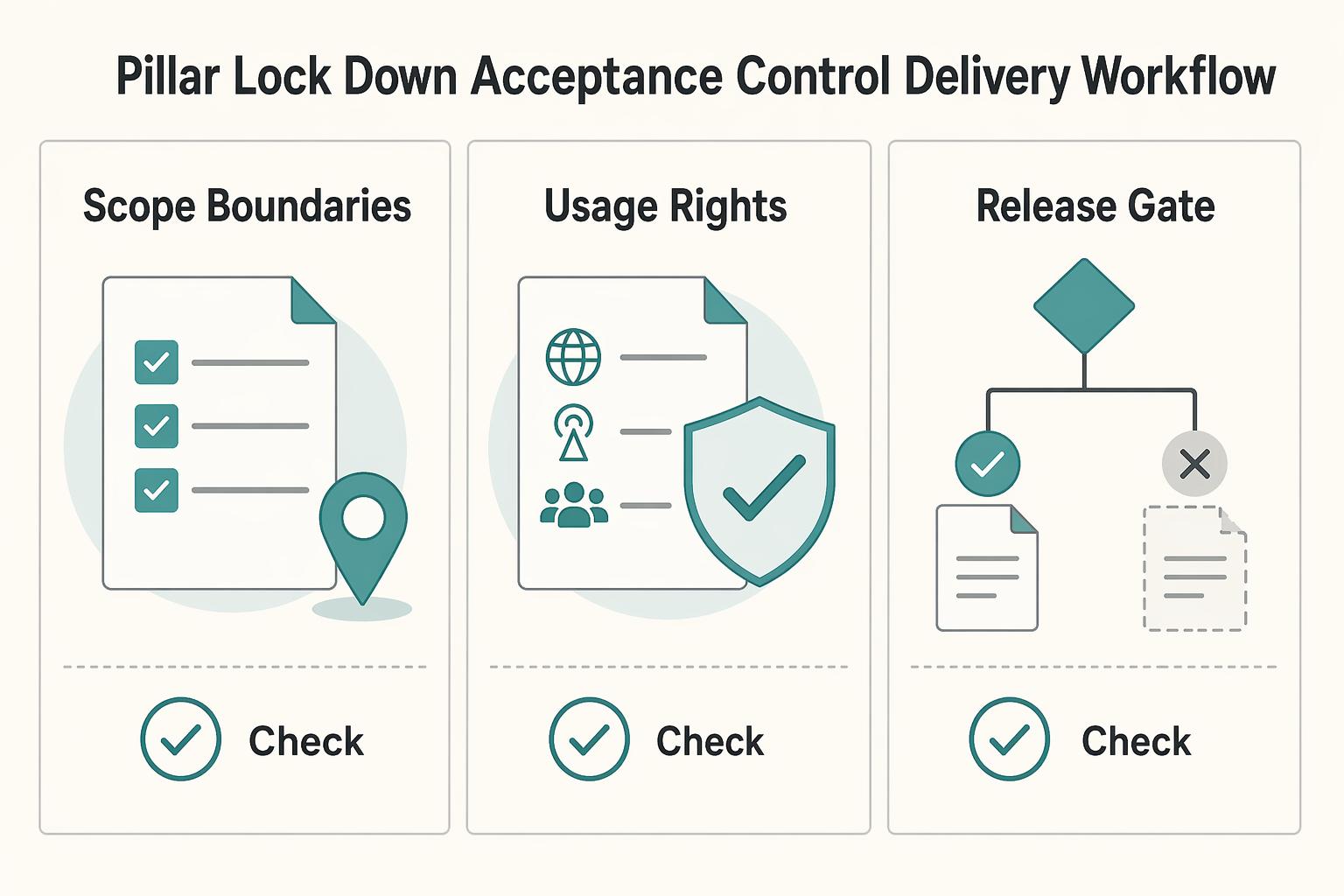
Your SOW is Your Ultimate Tool for Professional Control#
A good SOW is not a formality. It is the document that controls what happens after kickoff: what is in scope, how changes get approved, who holds which rights, and what counts as accepted delivery.
Pillar 1. Lock down scope to protect cash flow#
Start here, because weak scope language can create disputes and performance problems early. Define the work description, period of performance, deliverable schedule, applicable performance standards, and a written change-order rule before pricing is finalized. If new requests come in, treat them as out of scope until both sides approve the change in writing. That is what keeps "small extras" from turning into unpaid work.
Pillar 2. Lock down ownership and usage in signed terms#
Do not rely on assumptions for IP. Under 17 U.S.C. § 201, authorship is the default source of ownership, and any ownership transfer must be clearly stated in signed writing under 17 U.S.C. § 204. Ownership transfer and licensing are different choices, so spell out which one applies. If you retain session files, templates, or other working assets, state that directly and define any license the client receives.
Pillar 3. Lock down acceptance to control delivery workflow#
Acceptance standards are what turn delivery from an opinion into a decision. Set measurable acceptance criteria so sign-off is based on contract standards, not shifting preferences. Name the file package, delivery channel, reviewer, approval checkpoint, and acceptance trigger. Clear standards make it easier to confirm when work conforms to the agreed quality and quantity requirements.
| Decision area | Vague SOW | Controlled SOW |
|---|---|---|
| Scope boundaries | "We'll adjust as needed" | Work description, period of performance, deliverable schedule, applicable performance standards, and written change-order handling are defined |
| IP and usage rights | "Client owns it" | Ownership transfer terms, signed execution, and retained/licensed assets are separated |
| Delivery and sign-off | "Final files on completion" | File package, reviewer, approval step, and measurable acceptance criteria are stated |
Before your next engagement, review your current podcast production SOW template against these three controls. Patch any missing clauses, then mirror the same rules in your onboarding email, intake form, and kickoff checklist. Related: How to Launch a Podcast for Your Freelance Business.
After you finalize the SOW, turn it into a client-ready agreement with the Freelance Contract Generator so scope, payment, and approval terms stay aligned.
Frequently Asked Questions
What clauses actually stop scope creep?
Use controls that keep boundaries explicit: a detailed scope, clear responsibilities and deliverables, and a written process for handling added work. If a request falls outside the agreed tasks or deliverables, treat it as out of scope until both sides confirm the change in writing. That helps reduce schedule, fee, and trust problems when requirements shift.
Clause checklist: included services, project boundaries and expectations, responsibilities, deliverables, change request method, pricing and timeline impact for added work.
How should you write IP ownership in a podcast production SOW?
Do not assume ownership terms are implied. State who owns final deliverables, who keeps working materials (such as project files or templates, if relevant), and when rights transfer. Clear ownership language from day one lowers dispute risk at handoff.
Clause checklist: final deliverables ownership, working-materials ownership, transfer trigger, retained rights, reuse limits if any.
What payment terms belong in the SOW?
Put cost terms in the SOW itself, not across emails. Specify fee structure, invoice trigger, payment method, and the payment due window pending signed SOW verification, plus what happens if payment is late or work pauses. Before kickoff, confirm cost and timing terms align with the agreed timeline.
Clause checklist: total or recurring fee, invoice milestones, payment method, payment due window pending signed SOW verification, late-payment consequence after legal review, pause-rights language.
What should a termination clause say?
Write exit terms before issues appear. Define who can terminate, how notice is given, what completed and in-progress work is billable, and what is delivered if the project ends early. Keep the notice window and kill-fee formula unresolved until legal review verifies them.
Clause checklist: termination right, notice method, notice window pending legal review, payment for completed and in-progress work, handoff items, file-access terms after termination.
Who is responsible for guest booking and prep?
Assign ownership for guest sourcing, scheduling, prep, and guest-supplied materials in writing. If the client owns booking, state how delays or missing materials affect timeline and responsibilities. If you own part of it, define exactly which tasks you handle. Then tie those duties to dependency and recovery rules so schedule impact is explicit.
Clause checklist: booking owner, scheduling owner, prep owner, guest asset owner, delay impact, recovery action.
Should you specify file formats and delivery methods?
Yes, because delivery details define what “done” means. List the file package, export format, naming and version rules, delivery route, and who confirms receipt. Include masters, stems, transcripts, or support files only if they are in scope. Use a green-light/red-light checkpoint before proceeding and verify the final uploaded file before closing delivery.
Clause checklist: masters/stems in scope, file type, naming/versioning, delivery channel, review checkpoint, final verification step.
How do you write technical audio specs without overpromising?
Use client-specific or platform-specific specs, not a universal promise. Keep the platform or client-requested loudness target and true peak ceiling unresolved until the approved brief or distribution requirement verifies them. That keeps the clause accurate when requirements vary.
Clause checklist: requested platform/distribution target, format baseline, platform or client-requested loudness target, true peak ceiling, approval source for specs.
How do you add approval checkpoints without slowing the project down?
Use only the checkpoints that protect you from expensive rework. A practical model is green-light/red-light: work continues only after the named reviewer approves assets or notes, otherwise you issue a short blocker report. Keep checkpoints tied to real decision points so planning does not stall production.
Clause checklist: checkpoint stage, named reviewer, approval channel, green-light trigger, red-light blocker report, schedule effect.
What should you do about cross-border governing law and disputes?
Clarify rights and responsibilities early, but do not guess at governing law or dispute forum. If you and the client are in different countries, set governing law, dispute path or forum, notice method, and contract language only after legal review for the countries involved.
Clause checklist: governing law pending legal review, venue or dispute path pending legal review, notice addresses, contract language, escalation step if used.
Who carries third-party music or sound-effect license risk?
Do not assume default responsibility. Since third-party assets may be purchased or recorded during production, state who selects assets, who pays, who secures licenses, and what proof is required before final delivery. If the client supplies assets, require documentation of source and license status.
Clause checklist: asset source, approval owner, budget owner, license-procurement owner, proof-of-license documents, replacement process for unlicensed assets.
Try a related tool
Researched and edited by the Gruv editorial team. Gruv builds cross-border billing, payouts, and finance-operations software for global businesses.
Sources
- acquisition.gov/far/subpart-43.2trusted
- copyright.gov/title17/92chap2.htmltrusted
- des.wa.gov/sites/default/files/2023-12/EPM-scope-of-wor...trusted
- dgs.ca.gov/-/media/Divisions/PD/Acquisitions/CMAS/SOWin...trusted
- nyc.gov/assets/dca/downloads/pdf/workers/Model-Contr...trusted
- oregon.gov/das/Procurement/Guiddoc/SOWWritingGuide.pdftrusted
- procurement.colostate.edu/developing-statement-of-work-sowtrusted
Educational content only. Not legal, tax, or financial advice.
Related Posts

Germany Freelance Visa Application Path for Freiberufler and Gewerbe
Choose your track before you collect documents. That first decision determines what your file needs to prove and which label should appear everywhere: `Freiberufler` for liberal-profession services, or `Selbständiger/Gewerbetreibender` for business and trade activity.

How to Launch a Podcast for Your Freelance Business
Treat your podcast like a documented operating process that compounds your positioning over time. You're running a business of one, and the job is to build a machine you can run without chaos. Once you decide this is a business move rather than a weekend experiment, you need structure that protects your time and keeps shipping predictable.

The Freelance Payment Penalty: A Modeled Audit of Platform Fees, FX Spreads, and Payout Delays
The money rarely disappears through a single, easy-to-spot fee. The real loss is stacked. A marketplace takes its commission, a processor adds a charge for international cards, a bank or payment company converts the currency at a spread, a platform holds the funds before release, and a wire sheds a little to intermediaries on the way in. Each layer looks defensible on its own, but the worker feels the combined result as a smaller deposit and a later payday.