
Quick Answer
Start by locking one approved announcement sentence, assigning owners for drafting, approval, distribution, and follow-up, then write in inverted-pyramid order. Build the lead around who, what, when, where, and why, and remove any line you cannot verify in your evidence pack. Keep the core release concise, match outreach to relevant beats, keep unsolicited attachments under 3MB, and plan one follow-up after 3 to 4 days when there is no reply.
What a Good Press Release Should Do#
You can write this yourself, and that is often the right first move before you decide whether outside help is needed for complexity or messaging risk. If you want a press release your business can publish without role confusion or inflated claims, make the key decisions before drafting. A press release is a document you send to media contacts to share a news item.
Instead of jumping straight to hiring, start with DIY: confirm the story is newsworthy, define ownership, then outsource only as scope demands it.
This sequence helps you avoid a common waste pattern: drafting fast, realizing the angle is weak, then rewriting after approvals have started. That late reset can create version confusion and avoidable delays. If you lock channel fit, ownership, and core facts first, drafting is usually faster and cleaner.
Before You Start#
- State the announcement in one sentence. Checkpoint: a neutral reader can explain who is affected, what changed, and why now after one read.
- Choose media targets before drafting. Start with publications and sources your audience already trusts, then shape your angle to those outlets. Checkpoint: you can name the outlet type or beat before writing the body.
- Build a compact evidence pack. Include approved names, dates, claims, and one final announcement line everyone signs off on. If you send materials by email, keep unsolicited messages under 3MB, and prepare 300dpi images for print requests. Checkpoint: every concrete claim in your draft maps to a fact in your pack.
Success here is practical: a clear business announcement, a clear media outreach scope, and a sequence you can repeat. Aim for credibility and relevance, not guaranteed coverage.
Carry one standard through every section: consistency, clarity, and accuracy. If you do not have an internal style guide, AP Stylebook is a useful reference for editorial consistency. The goal is simple: one draft you can send to media contacts and publish on your site without changing core facts or intent.
Decide whether a press release is the right move#
Use a press release only when the story has clear relevance outside your business. If external value is weak, the issue is channel choice, not headline wording.
Start by testing news value before you draft. Ask what is new and why someone outside your business should care now. If either answer is vague, pause and tighten the angle before you write anything else.
| Scenario | Best channel | Why this fit works |
|---|---|---|
| A business update with clear external relevance | Press release | Its purpose is to help journalists assess whether the story is newsworthy |
| An update mainly for existing clients | Direct email | When the message is mostly for clients, a direct update is often a better fit than a media pitch |
| Educational guidance for your audience | Blog post | A standard post can give you room to explain and teach |
After selecting a channel, run one no-go checkpoint: if you cannot explain why a journalist should care, do not issue the release yet. Then set outreach expectations correctly. A release is meant to show news value, not promise pickup. Journalists may receive hundreds of emails each day, and coverage can still take time and follow-up effort, so treat pickup as possible, not automatic.
A practical friction point shows up when teams confuse internal importance with external relevance. A business change can matter deeply inside your company and still be the wrong fit for a release. If your strongest reason is internal pride, shift the message to client email or your blog and save media outreach for a story with broader reader impact.
Use this decision rule before you write a single paragraph. If you can clearly name the audience impact, keep going. If you cannot, pause and reshape the announcement first.
Gather the inputs before you write#
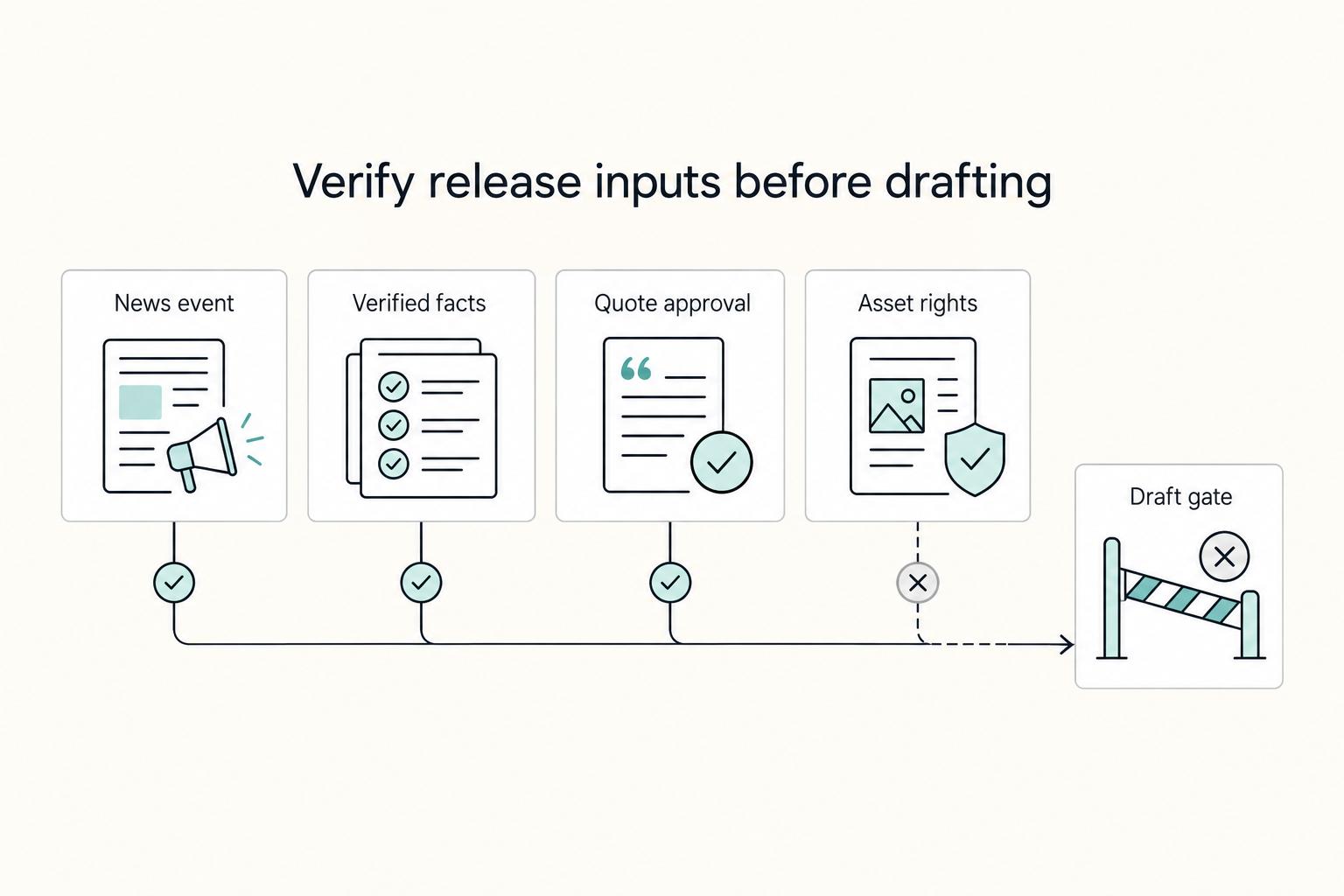
Once channel fit is clear, gather and verify your inputs before you draft. This is where details often go missing, conflict, or get approved too late.
Treat the release as a formal statement for media. Pre-draft accuracy is your first control step, not a final polish pass.
Before You Draft#
- Build a minimum evidence pack. Include verified facts, dates, and supporting details, plus one approved announcement sentence. Map each key line to the 5 Ws: who, what, when, where, and why.
- Lock one approved announcement line early. Write one plain sentence stating the change and why it matters outside your business, then get sign-off from the approval owner.
- Start from a press release template, then customize. Use the template for structure only. Keep sections that support your specific audience and angle, and delete filler.
- Separate the pitch from the release. Keep the pitch as a short email with one relevant angle. Keep the release as the full factual statement.
- Assign owners before drafting. Confirm who approves the final press statement and who handles media questions after sending. If distribution is outsourced, partners can support media-list building, journalist identification, and response tracking.
Create one compact claim file next to the draft and reuse it across your website, email, and social copy. If a claim is missing from that file, hold it until verified.
To keep this practical, treat your evidence pack like a send gate, not a note dump. Every key sentence in the release should point back to one approved line in that pack. That habit can reduce rework in draft review, final approval, and follow-up replies.
One failure mode is writing from memory, then correcting details after the draft is already circulating. That can create competing versions and weaken confidence in the final copy. Fix it by freezing the approved announcement line and claims first, then drafting from that locked set. Related: How to Write an Arbitration Clause for a Freelance Contract.
Set scope and ownership before drafting#
Set scope and ownership in writing before drafting so the writer, approver, and sender responsibilities are explicit.
To keep handoffs clear, separate four decisions early: angle selection, writing, distribution, and follow-up. Give each handoff one owner.
Ownership and scope checklist#
| Area | What to set | Key detail |
|---|---|---|
| Contract layer | Use a statement of work (SOW) for project-specific deliverables; use a service agreement, often called an MSA, for broader terms over time | For ongoing work, keep the service agreement stable and issue a separate SOW per project |
| Decision owner | Name one owner each for angle selection, writing, distribution, and follow-up | Put that ownership in writing |
| Deliverable tier | Define scope as draft only, draft plus media outreach list, or full outreach with response handling | For a first release, consider writing plus targeted distribution before broad outreach |
| Handoff checkpoint | Confirm the approved announcement line, final press statement text, sender, and send time | Do this before distribution starts |
| Change rules | Update the SOW in writing if angle, deliverable tier, or follow-up ownership changes | The contract is the reference point when scope changes or communication breaks down |
- Define the contract layer first. Use a statement of work (SOW) for project-specific deliverables. Use a service agreement, often called an MSA, for broader terms over time. For a first simple project, combined terms can work. For ongoing work, keep the service agreement stable and issue a separate SOW per project.
- Assign one owner per critical decision. Name one owner each for angle selection, writing, distribution, and follow-up, and put that ownership in writing.
- Choose the deliverable tier before drafting. Define scope in plain terms: draft only, draft plus media outreach list, or full outreach with response handling. For a first release, consider writing plus targeted distribution before broad outreach.
- Add a handoff checkpoint between writing and sending. Before distribution starts, confirm the approved announcement line, final press statement text, sender, and send time.
- Record change and dispute rules in the contract. The contract is the reference point when scope changes or communication breaks down. If angle, deliverable tier, or follow-up ownership changes, update the SOW in writing before work continues.
With this ownership map in place, drafting becomes execution of a defined assignment rather than midstream improvisation. The most useful detail here is explicit completion criteria. Draft complete should mean the draft has passed factual checks, naming checks, and approval sign-off, not just that text exists in a document. Outreach complete should mean messages were sent to the approved list and replies are assigned, not just that a list was built.
This written scope gives both sides a reference point if miscommunication or disputes arise.
Build a news angle and headline that passes the editor test#
If the angle is weak, the rest of the release is harder to land. Build one strong angle sentence and one clear headline before you write the body.
Write the angle in one line with three parts: what changed, who it affects, and why now. Then produce several headline options and remove anything that reads like generic marketing copy. The winning option should be understandable on first read, without decoding or hype.
Keep wording consistent between headline and opening paragraph. If your headline says one thing and your lead reframes it, it can read as drift. Templates can help with structure, but each announcement still needs an original angle and headline tied to real relevance.
A practical check is to read only the headline and first paragraph together. If they do not describe the same action, audience, and timing, tighten both before continuing. This checkpoint helps catch mixed messaging early, when fixes are still easy.
Tradeoff: clever headlines can attract attention, but clear, descriptive headlines usually perform better, especially when editors need to assess fit quickly. Choose clear language that carries the news value without extra interpretation.
Draft the opening and body in a strict order#
After angle and ownership are locked, draft in a clear order so an editor can assess the story quickly.
- Step 1. Write the lead with the full 5W summary. Open with one factual paragraph covering who, what, when, where, and why, and keep terms aligned with the headline.
- Step 2. Build the second paragraph with decision-critical detail. Add specifics on product, service, or event, plus timing, location, ownership, and why it matters.
- Step 3. Place quotes after facts, not before. If you use a quote, put it after the first two factual paragraphs, keep it relevant, and confirm permission for exact wording.
- Step 4. Add short context that supports targeted outreach. Include context only when it helps match the announcement to the right audience or beat. Keep send-ready assets practical: unsolicited attachments under 3MB, and print images at 300dpi or higher.
- Step 5. Keep the close clear and useful. End with what the announcement means for the audience now, without hype or repeated headline language.
This order keeps key facts easy to scan. If your lead is vague, your strongest detail may be missed.
Use one internal checkpoint before the final edit: remove paragraph two and read paragraph one on its own. If paragraph one cannot stand as a complete summary, rebuild it. Then restore paragraph two and confirm it adds specific value rather than repeating the lead.
Avoid loading context too early. Put context after core facts so the story remains easy to parse. Background belongs in supporting paragraphs, not ahead of the announcement.
Add credibility without overpromising results#
Credibility comes from verifiable facts and restrained wording, not from certainty language. Before you send, run a line-by-line claim audit.
Keep one working file of approved facts, dates, names, and quote permissions. If you cannot verify a line, rewrite it or remove it.
- Step 1. Audit every claim and label it. Mark each line as verified fact, interpretation, or promise. Keep verified facts, soften interpretations, and cut unsupported promises.
- Step 2. Replace certainty language with bounded language. State what changed and why it matters now. Avoid phrasing that implies guaranteed coverage or guaranteed response.
- Step 3. Use one quote only if it adds meaning. Include a stakeholder quote when it improves reader understanding. If it adds only enthusiasm, remove it.
- Step 4. Keep outreach expectations specific and cautious. Personalized outreach can outperform mass distribution in some cases, but results remain variable. Use one follow-up after 3 to 4 days if there is no reply.
- Step 5. Close with verifiable impact, not hype. End with what the audience can do, access, or decide now. Do not add fresh claims in closing lines.
Use this standard every time: prove each claim, keep language measured, and treat outcomes as variable. A practical red flag is certainty phrasing that outruns evidence. If a sentence predicts a result you cannot verify in advance, rewrite it as present fact or remove it. This helps protect credibility without making the release bland.
Keep quote discipline tight. A quote should add meaning the factual lines cannot carry alone, such as intent or context. If the quote repeats the lead in softer language, it adds length without adding useful clarity.
Edit to one-page clarity and risk control#
Treat editing as a release gate, not a cosmetic pass. Keep the core draft to one page when possible, and use a second page only if cutting further would remove required context.
- Start with one-page clarity. Keep what helps a reader decide quickly: what changed, who it affects, when it starts, and why it matters now. Move outlet-specific context to a separate background note or attachment.
- Run an overclaim check on every promise. Review line by line and remove or soften anything that sounds guaranteed. If a claim cannot be supported now, rewrite it as intent or cut it.
- Align the three anchors. Compare headline, lead, and closing press statement side by side. They should match on actor, action, and timing.
- Do a final naming pass before publication. Verify product names, people, and brand terms for exact spelling and capitalization using one approved naming list.
If the draft is still long after this pass, tighten the press statement first and keep extra detail outside the core release.
Use a fixed sequence to reduce rework: cut repetition, then check claims, then verify naming. Reversing that order can waste time because wording shifts during cuts may introduce new inconsistencies.
A useful quality checkpoint is to compare the headline, first paragraph, and closing line side by side. If those three elements disagree on what changed or who is affected, pause publication and reconcile them before distribution.
Plan distribution and follow-up so the release is actually used#
A strong draft can still underperform if distribution is generic. Match the story to the right contacts, use each channel for a clear purpose, and control follow-up.
| Stage | Action | Details |
|---|---|---|
| List build | Start with release type, then add journalists and editors whose recent coverage fits the announcement | Capture outlet, contact, beat, relevance note, channel, and owner |
| Channel use | Use direct outreach for priority contacts, and publish the same core update in your brand newsroom | For smaller news, offer one publication an interview; for wider relevance, use the release to reach a larger group of journalists and editors |
| Follow-up rules | Assign one owner per contact, define follow-up timing, and define stop conditions | Keep one exception path for inbound requests such as interview interest or requests for more detail |
| Outcome tracking | Log outcomes as replied, declined, requested details, or no response | Capture angle and channel so the next list is sharper |
- Build a beat-matched list first. Start with release type, then add journalists and editors whose recent coverage fits the announcement. In your tracker, capture outlet, contact, beat, relevance note, channel, and owner. If you cannot explain relevance for a contact, remove them.
- Separate channels by purpose. Use direct outreach for priority contacts, and publish the same core update in your brand newsroom as an owned reference point. For smaller news, offer one publication an interview instead of broad distribution. For wider relevance, use the release to reach a larger group of journalists and editors.
- Set follow-up rules before sending. Assign one owner per contact, define follow-up timing, and define stop conditions. Keep one exception path for inbound requests such as interview interest or requests for more detail.
- Track outcomes and improve the next cycle. Log outcomes as replied, declined, requested details, or no response. Capture angle and channel so the next list is sharper. If feedback repeatedly shows poor fit, tighten relevance before you expand outreach.
This keeps outreach focused, professional, and useful to the people receiving it. Targeting quality matters more than list size. A short list with clear relevance notes and clean follow-up ownership is better aligned with targeted distribution than broad outreach without context.
Keep the outreach tracker usable under pressure. If the tracker does not show owner and next action at a glance, replies can sit unanswered. That is a preventable miss, especially when interest arrives quickly after sending.
Use follow-up discipline to avoid spammy behavior. One professional follow-up can be enough when there is no reply. If there is still no response, log it and move on to improving angle fit for the next cycle.
If you want a deeper dive, read How to Manage Your Personal Brand as a Freelancer.
Decide when to DIY and when to hire#
Use a simple decision rule: if the scope includes sensitive messaging or strategic media outreach, consider hiring. If the announcement is straightforward and factual, DIY is a reasonable starting point.
| Option | When to use it | Article note |
|---|---|---|
| DIY | Use it when the announcement is straightforward and factual, and message complexity, timeline pressure, drafting confidence, and available editorial support are mostly low | One decision framework says DIY works best under about $50k/year when time is available and operations are low complexity |
| Hired support | Consider it if scope includes sensitive messaging or strategic media outreach, or if several decision factors are high | Recheck DIY versus hiring after each release using effort, stress, and revision load, not price alone |
| Marketplaces | Use them as sourcing channels, not quality guarantees | Compare candidates against the same deliverables, revision limits, approval flow, and distribution responsibilities; on Fiverr, review the Terms of Service |
| Fractional support | Use it as a transition after core systems are documented | If follow-up ownership is unclear, fix that before work starts |
- Score the decision before choosing. Compare message complexity, timeline pressure, drafting confidence, and available editorial support. If these are mostly low, DIY is usually workable. If several are high, consider hired support.
- Check capacity with a practical threshold. One decision framework says DIY works best under about $50k/year when time is available and operations are low complexity. Past that point, many founders enter a messy middle where DIY strain rises while full agency support may still feel early. Treat this as directional guidance, not a universal rule.
- Use marketplaces with explicit scope constraints. Treat marketplaces as sourcing channels, not quality guarantees. Compare candidates against the same deliverables, revision limits, approval flow, and distribution responsibilities. On Fiverr, review the Terms of Service because they govern access to and use of the platform.
- Write a brief that prevents rework. Include deliverables, revision limits, approval owner, distribution responsibilities, and handoff date. Share approved facts upfront. If you are moving out of DIY, fractional support can be a safer transition after core systems are documented. If follow-up ownership is unclear, fix that before work starts.
Recheck DIY versus hiring after each release using effort, stress, and revision load, not price alone. The key tradeoff is control versus capacity. DIY gives direct control over facts and tone, but can create delay when approvals and outreach compete with other work. Hiring adds support, but hiring without strategy or SOPs can increase costs, delays, and founder workload.
When you review candidates, compare the same sample task against the same brief. That gives you a fair basis for judging clarity, relevance, and ability to follow constraints. Platform reputation labels are less useful than performance against your exact brief.
Common mistakes and how to recover fast#
Four common, fixable issues are a weak angle, unclear ownership, anecdotal pricing assumptions, and bloated copy. Fix them in that order.
- Step 1. Define the news angle before drafting body copy. Rewrite one sentence that states the announcement, why it matters now, and who it affects, and keep the release focused on one topic. If it is not timely, relevant, or interesting to the target audience, rework it before writing the rest.
- Step 2. Assign scope in one line per task across writing and distribution. Use one line each for draft, fact check, approval, list build, send, follow-up, and inbox monitoring, with one owner and one deadline per line.
- Step 3. Reframe pricing inputs as directional, then request scoped quotes. Do not treat anecdotal rate posts as market truth. One older platform anecdote includes an internal correction on a fee claim, which is a reliability warning, not a benchmark. Use directional examples only, then request comparable quotes with identical deliverables, revision limits, and distribution responsibilities.
- Step 4. Trim the draft by priority so the lead stays visible. A press release should read like a short factual news story, not ad copy. Cut lines that do not support the lead, and move extra context to a background note. A practical target is 300 to 500 words, with around 400 as a useful center point.
Run the same recovery loop each time: angle, ownership, pricing discipline, then length control. The sequence matters because each step removes a different failure source. Angle fixes relevance, ownership fixes execution, pricing discipline fixes expectation risk, and trimming fixes readability. Skipping the order can cause rework because later fixes cannot solve earlier decision gaps.
Use this as an internal review script when a draft feels stuck. Ask which of the four failures is active, then correct that one before touching anything else. Focused recovery can be faster than broad rewriting.
Copy and paste launch checklist#
Use this checklist as a send gate. If one item fails, fix it before distribution.
- Step 1. Confirm channel fit for this business announcement.
A press release is for newsworthy information a journalist may consider for coverage. Name at least one target publication, the likely journalist, and why that audience should care now.
- Step 2. Prepare facts, approvals, and a customized press release template.
Collect approved facts and contacts first, then tailor the template to this announcement. Confirm every factual line in the draft maps to approved notes.
- Step 3. Assign ownership for drafting, outreach, and follow-up.
Set one owner and one deadline for drafting, fact check, approval, media outreach, and follow-up.
- Step 4. Edit for clarity, overclaim risk, and naming accuracy.
Confirm the draft answers who, what, why, where, when, and how in clear short paragraphs. Remove overclaim language and verify names, titles, and product labels.
- Step 5. Choose DIY or hiring with explicit scope.
If you hire, define deliverables, revision limits, distribution responsibilities, and follow-up ownership in writing before work starts. Fiverr uses predefined gigs, while Upwork supports hourly or longer-term contracts, so scope the work accordingly.
- Step 6. Send the release, track responses, and log lessons for the next media release.
Distribute to selected outlets for consideration, then track responses by contact and date. Record what worked and what failed so the next release is faster and cleaner.
A practical use tip: run this checklist twice, once before drafting and once before sending. The first pass catches missing inputs. The second pass catches drift introduced during edits and approvals.
Conclusion#
Strong press results usually come from clear decisions, not just a filled template. A press release is a document sent to media in hopes of coverage, so the key test is whether your story is genuinely newsworthy and relevant to a specific readership, with clear follow-up after sending.
Use this execution order to keep the process consistent from first draft to send:
- Draft one angle sentence first.
State what changed, who it affects, and why it matters now.
- Assign ownership before drafting.
If you are working with a team, name who owns drafting, reviews, outreach, and reply handling.
- Write in inverted-pyramid order and keep it concise.
Lead with who, what, where, when, and why, then add supporting detail in descending importance. Cut repetition and keep the core release to one page when possible.
- Treat outreach as targeted work, not distribution alone.
Match outreach to relevant publications and track follow-up so each send has a clear next action.
Draft your angle sentence and ownership map today, then write and send your first release with the checklist above. When the next announcement comes, repeat the same sequence and improve from your tracker notes instead of starting from scratch.
Frequently Asked Questions
Can a freelancer write their own press release, or is hiring usually better?
Either path can work. A release can be written by you, someone on your team, or an external freelancer or agency. Stay DIY if you can define a clear news angle and present facts clearly for journalists. Hire when those conditions are weak or when you need extra support to execute.
Do press release freelancers also handle media outreach, or just writing?
Do not assume outreach is included. Some freelancers deliver writing only, while others include outreach and follow-up as separate scope items. Ask for line-by-line scope that names deliverables, outreach tasks, follow-up ownership, and what completion means. If outreach matters to your outcome, make it explicit in the brief and contract terms.
How long should a press release be for a freelance business announcement?
Current evidence does not establish a universal word-count rule. Prioritize clear factual writing that helps journalists understand the story and relevance quickly. If a paragraph does not strengthen the announcement, remove it. Aim for concise, easy-to-scan copy.
How much does freelance press release writing cost, and what is still unknown?
Online pricing signals are too thin to treat as market truth. You may see anecdotal claims such as $10 for 100 words and personal volume notes like 2K to 3K words daily, but those are user reports, not verified benchmarks. Widely cited guidance also has age risk, including older material and articles flagged as dated. Use these inputs as directional context, then request quotes tied to exact scope and revision limits.
What should be included in a freelancer brief when outsourcing a press statement?
Start with one approved announcement sentence and the exact news angle. Add target publications, a reader-relevance check for each outlet, required facts, naming conventions, approval owner, and deadline. Close with explicit scope boundaries: writing only, writing plus outreach, and who handles replies. A good brief removes assumption gaps before drafting starts.
What outcomes are realistic from public relations outreach, and what should you not expect?
A release is written in the hope of publication, not as a guarantee of coverage. Realistic outcomes are editorial consideration and possible pickup when the angle fits what a publication covers. Do not expect guaranteed placement, guaranteed timing, or automatic results from distribution alone. Measure progress through relevance, response quality, and repeatable execution.
Try a related tool
Researched and edited by the Gruv editorial team. Gruv builds cross-border billing, payouts, and finance-operations software for global businesses.
Sources
Includes 2 external sources outside the trusted-domain allowlist.
- arts.ac.uk/students/student-careers/freelance-and-busin...trusted
- brand.vanderbilt.edu/editorialtrusted
- journalism.utexas.edu/sites/default/files/sites/journalism.utexas....trusted
- atanet.org/business-strategies/53-freelancing-mistakes-...external
- free-work.com/en-gb/tech-it/blog/freelancer-news/how-to-wr...external
Educational content only. Not legal, tax, or financial advice.
Related Posts

How to Manage Your Personal Brand as a Freelancer
Your brand is not a mood board. Think of it as the experience people have of your work: the promise you make, the proof you can show, and the way you present yourself across client touchpoints. Get that clear first, and your fit is easier to read from profile to proposal.

How to Write an Arbitration Clause for a Freelance Contract
**Build a simple dispute playbook so both sides know what happens next. Use it when conflict starts.** When you run a solo business, you cannot absorb unpaid work, vague terms, or open-ended civil court uncertainty. You are the CEO of a business-of-one, which means your contracts need to function like systems, not wishful thinking.

How to Get a Residence Permit in Germany as a Freelancer
**Treat your German freelance residence permit like an operations project, and you will cut avoidable delays before they start.** The hardest part is often not the forms but the uncertainty around procedure, especially if you are working from Berlin-based experience while local office workflows shift as you prepare paperwork. Confusion costs time, money, and momentum.