
Quick Answer
Write the lease by confirming the parties, property, lease type, term, payment terms, deposit terms, use, entry, notice, and termination details, then check every clause against local landlord-tenant rules before signing. Keep defined terms consistent, match termination language to the lease type, and make payment and execution mechanics explicit so both sides can read the contract the same way.
Why a lease that holds up starts with enforceability and consistent defined terms#
To write a lease agreement well, start with enforceability, not speed. Confirm who the parties are, what property is covered, when possession starts, what is due before move-in, and what happens at the end of the term.
A lease agreement sets expectations for both sides and helps prevent avoidable disputes when the terms are clear. Treat it as drafted language, not a template fill-in.
In practice, clarity comes from defined terms used consistently across the agreement. If a term appears more than once, define it once and reuse it exactly. A common residential form does this by carrying its definitions through the full agreement.
For example, keep Premises and rental unit separate. The Premises is the entire property, while the rental unit is the area where the Resident has the exclusive right of possession. That distinction shapes how you draft use, access, and responsibility clauses.
Before you start#
- Name parties consistently. Identify the contracting parties clearly, for example the owner and each Resident who signs, and use the same labels throughout.
- Set the effective moment. State that the lease is effective when fully executed by all parties.
- Tie possession to move-in payments where intended. If required pre-move-in payments are a condition to deliver possession, say that directly.
If you need to move quickly without weakening the language, draft clause by clause so the document is easy to sign now and still clear later, including on end-of-term holdover if legal proceedings to recover possession follow.
By the end, you should have a rental contract that is clear to negotiate and straightforward to review against local rules. Keep A Guide to Landlord-Tenant Laws for Your State open while you draft, and see How to Write a Legally Compliant Invoice in Germany for related reading.
Gather your inputs before you draft anything#
Start with intake, not clause writing. If the party details, property details, or tenancy type are unclear, the draft will drift and compliance checks become guesswork.
Confirm parties and property details#
Confirm the legal parties and property details first, then use those exact labels throughout the lease. Pick one naming convention, such as Landlord/Tenant or Lessor/Lessee, and keep it consistent.
Collect:
- Full legal names and contact information for the landlord or property manager and all tenants
- Complete property details, including address, unit number, property type, and amenities
Choose the document type first#
Choose the document type before drafting clauses because the tenancy type drives legal rights and obligations.
Use the type that matches the real arrangement:
- Fixed-Term Lease with a defined start and end
- Month-to-Month Lease Agreement (tenancy at will), usually renewed each rental period, with termination driven by statute and notice
Flag the main tradeoff early. Fixed-term language improves predictability, but someone who leaves early may still be liable for rent.
Pull your local rule checklist#
Pull your local rule checklist before you draft clause text. Check landlord-tenant law and state-specific lease requirements for the tenancy type you selected, then draft to those rules. Keep A Guide to Landlord-Tenant Laws for Your State open while you work.
If your checklist does not clearly show which rules apply to your chosen lease type, stop and fix intake first. That is faster than rewriting the contract later. For related reading, see How to Invest in Real Estate as a Digital Nomad.
Choose the right lease type before writing clauses#
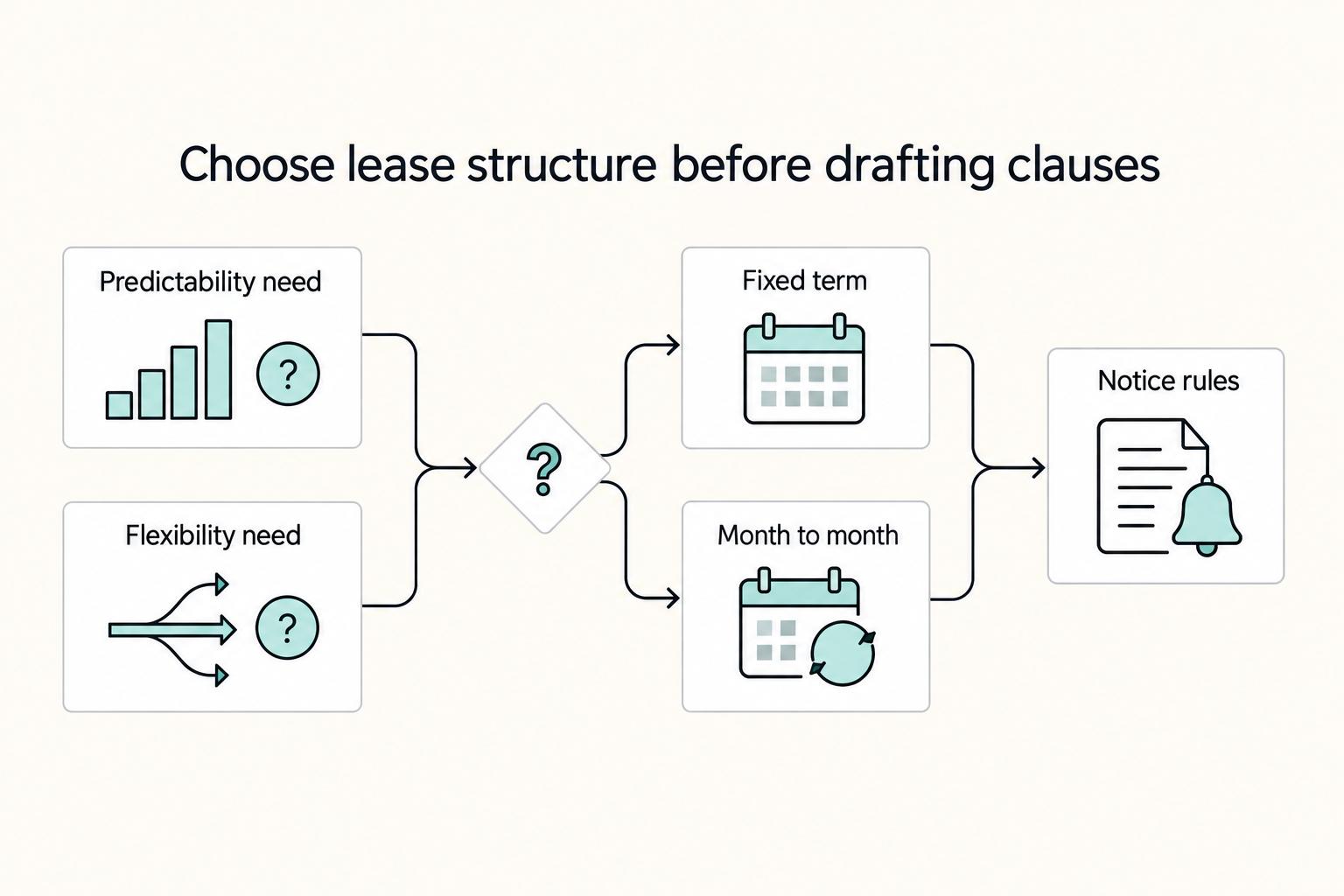
Choose the lease type first, then build the clauses around it. If predictability is your top priority, start with a Fixed-Term Lease. If flexibility matters more, start with a Month-to-Month Lease Agreement and define the notice mechanics early.
A fixed term is usually a defined period, for example six months or one year. It improves in-term stability but usually limits changes unless both parties agree. A month-to-month structure typically renews automatically unless either side terminates. That increases flexibility but reduces long-range certainty.
| Structure | Stability | Flexibility | Termination friction |
|---|---|---|---|
| Fixed-Term Lease | Higher during the stated term | Lower, because changes usually need mutual agreement | Defined by the term and notice language |
| Periodic Tenancy | Varies by recurring period and local rules | Varies by period and notice rules | Driven by notice process and local law |
| Month-to-Month Lease Agreement | Lower long-range certainty | Higher | Driven by notice terms and termination process |
If your local materials use Periodic Tenancy, do not assume it always works exactly like month-to-month. Confirm the actual period, renewal logic, and notice rules in your checklist before drafting.
Match the document label to the real setup, then confirm it against your local checklist. Do not rely only on template labels, since templates can miss property-specific details.
Before you draft payment or default language, write the term and notice blocks. State the rental term and how notice must be given for material changes or termination. You may see examples like a written 30-day notice, but do not treat that as universal. Verify the timing and method in your local rules.
Run one last wrong-type check before you proceed. Choose the form that matches your setup and the term model that matches your priority, then make renewal and notice mechanics explicit before drafting the rest.
You might also find this useful: How to Create a Service Agreement for a SaaS Product.
Draft the non-negotiable core clauses first#
Lock the core clauses before money terms: who the parties are, what the leased premises are, when the term starts, how use is defined, and how entry works. Weak or incomplete language here often creates disputes later.
Identify the parties and premises#
Identify the parties and premises so no one has to guess. Name the Lessor and Lessee clearly, and describe the leased premises precisely.
A practical structure is a Basic Lease Information block with lease date, parties, premises, commencement, and term, incorporated into the lease. If you use this summary, keep it consistent with the body text. One published lease example states that if Basic Lease Information conflicts with the lease, the lease controls.
For the premises clause, specificity matters. One example is: "Approximately 6,341 square feet of RSF." Use that same level of clarity for your property description so the exact space is identifiable.
State term, possession, and occupancy clearly#
State term and possession timing in plain language that matches your lease structure. State the Commencement Date and lease term clearly, and use that timing language consistently across the document.
Avoid wording that can be read two ways. Say exactly when the term begins and, where applicable, when possession is delivered. If occupancy or permitted activity is limited, put that in a dedicated use clause instead of leaving it implied.
Assign baseline duties and access rights#
Assign baseline duties to each side, and include an access clause on purpose. A dedicated Use of Premises clause helps prevent activity-related disputes. A dedicated Entry for Repairs and Inspection clause sets expectations for repair and inspection access.
Keep obligations readable and specific. State each side's responsibilities clearly, and spell out how repair and inspection entry works.
Check that each clause has one meaning#
Run a one-meaning check before you draft further. If a clause can be summarized two different ways, rewrite it until both sides would summarize it the same way.
Use quick fixes where needed:
- Replace soft wording with concrete wording
- Add an exhibit or schedule when the premises setup is hard to describe in one sentence
Do this now, before payment, deposit, and default clauses build on top of ambiguous basics. We covered this in detail in How to Create a Buy-Sell Agreement for a Partnership.
Write payment terms that prevent disputes#
Your payment terms should read like operating instructions, not assumptions. If someone has to guess how rent is paid or how the Security Deposit is handled, routine issues can turn into costly disputes.
Build the payment stack in order#
Build the payment stack in order and keep each item separate: monthly rent, due date, any grace period allowed by applicable law, accepted payment methods, and recurring fees.
| Payment item | What to state | Notes |
|---|---|---|
| Monthly rent | State the monthly rent | Keep each item separate |
| Due date | State the due date | List it with rent and other recurring terms |
| Grace period | State any grace period allowed by applicable law | Confirm local rules before finalizing |
| Accepted payment methods | State accepted payment methods | Also state how rent is paid |
| Recurring charges | List any recurring charges that apply | Examples given: pet, parking, utility, or HOA fees |
| Payment delivery and receipts | State what counts as payment delivery and how receipts are provided when applicable | Keep the process explicit |
In the rent-and-fees section, keep the full monthly obligation clear in one pass: monthly rent, due date, any grace period allowed by applicable law, accepted payment methods, and any recurring charges, such as pet, parking, utility, or HOA fees, that apply.
For the Rent Payment Procedure, state how rent is paid, what counts as payment delivery, and how receipts are provided when applicable.
Keep late-fee language narrow#
Draft the Late Fee Clause narrowly and align it with State-Specific Lease Requirements. Keep it consistent with your due-date clause so you do not create conflicting timelines.
Keep notice and documentation steps clear, and do not finalize this section until you have confirmed local rules. A useful starting point is A Guide to Landlord-Tenant Laws for Your State.
Add failure handling for rejected payments#
Add failure handling for rejected or failed payments. State how those payments are handled under applicable law and what the next payment steps are.
Keep this procedural, not emotional. Use predefined boundaries and leave room only for minor adjustments.
Write deposit terms for move-out#
Write Security Deposit terms with move-out in mind, not just move-in. Cover receipt expectations where applicable, return timeline requirements under applicable rules, and deduction categories, including itemized deductions.
Keep deduction categories concrete and supportable, and make sure the payment and deposit clauses read as one consistent process from first payment to final refund. That precision is what makes enforcement practical.
For a step-by-step walkthrough, see How to Write a Master Service Agreement for Long-Term Client Engagements.
Add operational clauses tenants actually negotiate#
These clauses allocate day-to-day risk, so draft them as clear operating terms, not side notes in the Rental Agreement.
Allocate utility responsibility clearly#
Use a dedicated Utilities Clause that identifies, for each service, who is responsible for maintenance and related costs. If responsibility changes at move-in or move-out, say that explicitly.
Add service-interruption language intentionally. A lease can assign responsibility for maintaining utilities servicing the premises while still stating that rent is not reduced or abated during disruptions, or limiting remedies to a breach claim. If your draft includes that structure, make sure the allocation is deliberate.
Make chargebacks explicit#
State when owner-performed work can be charged back to the tenant as Additional Rent so the payment obligation is clear. Keep that wording consistent with your repair and notice clauses to avoid conflicts across the lease.
Define permitted use and limits#
Define Tenant's Use of the Premises with specific allowed use and clear limits. Broad labels alone are usually too vague. Stronger drafting names permitted activities and restricted activity, including hazardous-substance limits where relevant.
For commercial deals, settle these business points early when possible. Use scope is often negotiated at the Letter of Intent (LOI) stage before the full lease is drafted.
Set maintenance and reporting expectations#
Set maintenance and reporting expectations so defects do not become liability fights. Require immediate notice of defects, service interruptions, or problematic conditions, and separate notice duties from repair-cost allocation.
Then define one reporting path that matches your notice section. The practical goal is simple: both sides can prove when notice was given, who acts next, and who pays if the issue traces to misuse by the occupant.
Add legal risk controls most templates underwrite#
Start with termination and dispute mechanics you can actually execute. Keep each clause specific: who acts, what notice is required, and what happens next.
Match termination language to the lease type#
Tie termination language to the lease type you chose. A Fixed-Term Lease should separate normal end-of-term exit from any early-break path. A month-to-month lease can state that the tenancy continues from the start date and ends through written notice rules.
Use a clear notice structure instead of generic wording. In one lease sample, the tenant gives written notice at least 30 days before the desired termination date, and landlord termination is by written notice as provided by law. Treat that as a drafting pattern, not a universal rule.
If early termination is allowed, include closeout checkpoints in the clause itself: possession return, a joint inspection, and any optional mutual release of claims the parties agree to.
Limit liability only where the lease already defines the risk#
Draft Limitation of Liability language narrowly and only for risks your lease already defines. State exactly which loss category or event the limit applies to, and avoid catch-all language that tries to cover everything. Then verify the clause against local mandatory landlord-tenant rules before finalizing.
Draft indemnity by scenario#
Draft Indemnification by scenario, not slogan. Specify which party covers third-party claims or property damage tied to that party's acts, omissions, or misuse. When responsibilities are parallel in fact, keep both sides' obligations parallel in the clause.
Align dispute notices with your notice mechanics#
Set a Dispute Resolution path that matches your notice mechanics. At minimum, define the first written notice of dispute, who must respond, and the escalation order you want to follow before litigation.
If your lease has a dedicated Landlord's Right to Terminate subsection, align dispute notices with that same notice framework and record trail. Then run a final local-law check with A Guide to Landlord-Tenant Laws for Your State.
Lock Governing Law, Jurisdiction, and enforceability details#
Lock these terms before signature: name the governing law, name where disputes are handled, and make execution mechanics unambiguous. These checkpoints help turn a workable draft into a more enforceable lease package.
State the governing law directly#
If your lease includes Governing Law, state it directly and keep it consistent with the rest of the lease. Do not leave it implied.
Run one consistency check across the lease. The governing-law clause, property information, and compliance checklist should not conflict. If they do, resolve the conflict in high-risk sections first, especially rent, deposit, termination, entry, and remedies, particularly when you started from a generic template.
Name jurisdiction and venue clearly#
Name jurisdiction and venue clearly enough that both parties can tell where a claim would be filed. Mandatory forum wording is not established, so treat this as a clarity check rather than a universal rule.
Read the dispute, notice, and jurisdiction clauses together and fix mismatched wording. If you define the property as Leased Premises by exhibit, use that defined term consistently throughout the lease.
Clean up the execution mechanics#
Use clean execution mechanics. Party names in the signature block should match the opening paragraph, and the lease should be tied to a clear execution date. One sample uses "made and entered into on December 1, 2013," and another defines an Effective Date as the date the lease is made.
| Execution item | What to confirm | Notes |
|---|---|---|
| Signature block names | Match the opening paragraph | Party names in the signature block should match the opening paragraph |
| Execution date | Tie the lease to a clear execution date | Examples in the article use 'made and entered into' wording or define an Effective Date |
| Effective Date and Commencement Date | Separate them if start-of-possession timing differs | A grounded example defines the Commencement Date as the later of the scheduled date or execution by both parties |
| Final signature version | Include all exhibits | Confirm the final signature version with all exhibits |
| Dated signature blocks | Include one for each party | Confirm dated signature blocks for each party |
| Extension instrument | Include any written extension instrument required for an option to extend | Renewal terms may need to be agreed in writing and signed at the time of extension |
| Insurance evidence | Include pre-occupancy insurance evidence if the lease requires it | Confirm it before circulation |
If start-of-possession timing differs, separate Effective Date from Commencement Date. A grounded example defines the Commencement Date as the later of the scheduled date or execution by both parties. That avoids start-date disputes when one side signs late.
Before circulation, confirm your execution set includes:
- final signature version with all exhibits
- dated signature blocks for each party
- any written extension instrument required for an option to extend
- pre-occupancy insurance evidence if the lease requires it
If renewal language applies, do not assume it is automatic. One grounded sample requires extension terms to be agreed in writing and signed at the time of extension.
Run a final enforceability check#
Run a final consistency check before sending for signature. Focus on internal consistency across remedies, termination, fees, deposits, access, indemnity, liability limits, and dispute language.
Do one last cross-read for conflicts across related clauses. For example, if the lease allows transfer of the security deposit to a new owner and releases the original owner from return liability after sale, make sure the deposit, sale or assignment, and notice sections say the same thing. Then run a final check with A Guide to Landlord-Tenant Laws for Your State and circulate one clean execution copy.
Negotiate edits without weakening the contract#
Negotiate from one controlled draft. Move business terms where needed, but keep risk-allocation protections intact.
Triage every redline first#
Triage every redline before you respond. Treat rent, term, renewal structure, and deposit handling as business terms, and treat Indemnification, Limitation of Liability, and Dispute Resolution as risk terms.
Use different flexibility levels for each bucket. A lower deposit request is a commercial tradeoff. Deleting indemnity or dispute mechanics can change legal exposure. Tag each proposed edit as "business" or "risk" before accepting anything so speed does not override protection.
Trade scope for clarity, not deletion#
If someone asks to remove a safeguard, trade scope for clarity instead of deleting the clause. Narrow triggers, loss categories, conduct standards, or process wording so the protection remains but is more precise.
Apply extra care to renewal edits. An option to renew can preserve extension rights, but enforceability depends on wording and compliance conditions, including notice and preconditions. Watch for small wording changes that can create larger future risk, including:
- renewal wording that leaves key terms open or unclear
- ongoing personal guarantees that continue into renewal
- rent review wording that can drive sharp increases
Keep one source-of-truth draft#
Keep one source-of-truth draft and log accepted edits clause by clause. Version drift can lead parties to think they agreed to different deals.
Use one working file, then maintain a short acceptance log tied to clause names. Before sending a final version, reconcile the signature draft against that log clause by clause, checking business terms first, then risk clauses, then renewal and transfer rights such as sublease or assignment limits.
Support concessions with evidence#
Support concession requests with evidence, not pressure. Documented on-time payments and landlord references can strengthen occupant-side asks.
For deposit edits, remember some jurisdictions set statutory deposit limits, which can narrow the negotiation range. If tenant improvements are discussed, define approval, scope, and responsibility clearly to reduce quality and vacancy-risk disputes getting pushed into verbal side agreements.
If you keep one rule from this section, use this: move numbers more freely than risk allocation, and when you compromise on protection, narrow the language rather than deleting the safeguard.
This pairs well with our guide on How to Structure a Joint Venture Agreement Between Two Freelancers.
Common drafting mistakes and fast recovery steps#
Many lease disputes at this stage are preventable. The fastest fixes are usually the same three: close local-law gaps in a borrowed template, rewrite vague rent procedure language, and make the Security Deposit clause clear without assuming one universal return process.
Audit any borrowed template against local rules#
Audit any borrowed Lease Agreement against the rules where the property is located. At minimum, make sure the commencement date, end date, renewal period, and extension terms are explicit, then check local rules on rent control, eviction, and lease registration requirements.
This is a practical way to recover from copy-paste drafting risk. State-specific tenancy rules can affect enforceability, and vague renewal language is a common conflict trigger. Quick check: both sides should give the same answer to "when does it start, end, and renew?" without interpretation. If you need a refresher, use A Guide to Landlord-Tenant Laws for Your State.
Rewrite the rent procedure so anyone could follow it#
Rewrite the Rent Payment Procedure so the agreed process is explicit and easy to follow. If details like exact late-fee triggers or failed-transfer cure windows are not established yet, treat them as open items and confirm local requirements before finalizing the clause.
If rent can change during the term, define the rent-escalation terms in the lease. Missing escalation language creates financial uncertainty, while upfront increase terms reduce avoidable conflict.
Close the deposit process before move-in#
Close the Security Deposit process before move-in, but do not assume one standard timeline or deduction framework across jurisdictions. Confirm the local rules that apply, then state the agreed process clearly in the lease.
Also assign routine repairs versus major maintenance duties in writing. Clear maintenance responsibility reduces disagreement and supports accountability.
Copy-paste final review checklist#
Do a final line-by-line check before signature to catch mismatches, not to renegotiate terms.
Confirm names, labels, and property details#
Confirm party and property details are consistent everywhere in the draft. If you use both Landlord/Tenant and Lessor/Lessee, those labels should map to the same legal names and legal addresses through the signature block. Verify the leased property address, execution date, and possession date.
Use a clear sign-off method, such as initials on each reviewed line, so you have a record that each requirement was checked.
Make sure lease type and termination match#
Make sure lease type, term, and termination language tell the same story. A Fixed-Term Lease should state a specific start and end date. A Month-to-Month Lease Agreement should read as ongoing until either party gives notice, and the Termination section should match that structure.
Quick test: both sides should answer, in the same words, "When can this end, and how?"
Review the payment terms as one block#
Review payment terms as one block so nothing conflicts. Confirm rent details, due dates, payment method, and, where relevant, currency. Then confirm the Security Deposit terms are present and aligned with the payment procedure.
For the deposit, confirm the amount, how it is handled while held, and the return and deduction conditions. Keep a signed move-in condition checklist in your file, since that record is used again at move-out when deposit deductions are evaluated.
Finish with a legal consistency check#
Finish with a legal consistency check and a local-law pass. If your draft includes Indemnification, Limitation of Liability, Governing Law, and Dispute Resolution, read them together to confirm they do not conflict with each other or the rest of the lease.
Then run one final check against local landlord-tenant rules before signature. If you need a quick last check, use A Guide to Landlord-Tenant Laws for Your State. A lease is legally binding, so this final pass is basic due diligence.
Need a separate contract-structure example? Read How to Structure an LLC Operating Agreement for a Multi-Member Partnership.
Before you send the draft for signature, if you use the Freelance Contract Generator, run this same checklist on the output for consistency.
Conclusion#
A strong Rental Agreement comes together in sequence: draft clearly, verify against the property and local rules, then execute carefully.
Step 1: Draft the full agreement deliberately. Write the core terms in order so later clauses do not conflict with earlier ones. Your quality check is simple: both sides should be able to summarize each clause the same way. If a rent, occupancy, or termination term can be read two ways, rewrite it now.
Step 2: Verify before signature, not after. Check that rights and obligations are understandable, and clear up unclear wording before anyone signs. Inspect the rental premises condition before concluding the contract. If accessory expenses are shifted to the lessee, set the approximate payment amounts in the draft so that friction point is not left open.
Step 3: Execute carefully and lock changes to writing. Do not rush signatures. If your form requires countersignature to become binding, treat that as a real checkpoint. Apply your local legal requirements review before execution, because local law can void overreaching language. Finalize a clean record: signed lease, required countersignature confirmation, property-condition notes, and written amendments only.
Once your lease language is locked, use Gruv's tools library to tighten the operational pieces that come after signature.
Frequently Asked Questions
What must be included in a legally compliant **Lease Agreement**?
Include the parties, property, lease type, term, commencement and possession timing, rent amount, due date, payment methods, late-fee terms, and security-deposit terms. Add any required disclosures and attachments, and make sure the agreement is signed and dated by the landlord and tenants. The draft should also state use, entry, notice, and termination terms clearly.
Is a template enough, or do I still need a state-law review?
A template is a starting point, not a compliance check. Generic forms can miss required state-specific terms or conflict with the actual property setup. Customize the draft and review it against local landlord-tenant rules before finalizing.
How do I choose between a **Fixed-Term Lease** and a **Month-to-Month Lease Agreement**?
Choose a fixed-term lease if you want more in-term stability and a defined start and end. Choose a month-to-month lease if flexibility matters more and termination will run through the local notice process. Match the document label, renewal logic, and notice language to the real arrangement.
How should I write a **Late Fee Clause** so it is clear and enforceable?
Write the late-fee clause so it matches the rest of the payment section. Keep the rent amount, due date, payment method, grace period, and late-fee language consistent and easy to read together. Confirm the fee structure against local rules before you finalize it.
What is the right way to handle a **Security Deposit** in the contract?
State the deposit amount, how it is held, the return process, and the deduction categories in the lease. Keep the deposit clause aligned with the payment section so move-in and move-out steps form one clear process. Confirm any receipt, timeline, and deduction requirements under local rules.
Which clauses beyond rent and term matter most for dispute prevention?
Clear use, entry, maintenance, notice, termination, indemnification, limitation of liability, and dispute clauses do a lot of the work in preventing disputes. A complete written lease reduces misunderstandings better than a partial draft or handshake deal. If any clause can be read two ways, rewrite it until both sides would summarize it the same way.
How do **Governing Law**, **Jurisdiction**, and **Dispute Resolution** change enforcement risk?
These clauses decide which law applies, where disputes are handled, and what process the parties follow. They can affect enforceability, so they should not be treated as generic boilerplate. Keep them consistent with the rest of the lease and verify them against local landlord-tenant rules before signing.
Researched and edited by the Gruv editorial team. Gruv builds cross-border billing, payouts, and finance-operations software for global businesses.
Sources
- chicago.gov/content/dam/city/depts/dps/ContractAdministr...trusted
- clame.nyu.edu/browse/E09546/312540/apartment_lease_form-t_...trusted
- contracts.hhs.texas.gov/sites/default/files/documents/2024-Aug/HHS00...trusted
- dgs.ca.gov/-/media/Divisions/PD/PTCS/PAU/FISCAL-Financi...trusted
- dhcs.ca.gov/provgovpart/Documents/Managed-Care-Boilerpla...trusted
- ecfr.gov/current/title-28/chapter-I/part-35/appendix-...trusted
- files.santaclaracounty.gov/exjcpb1426/2025-02/sample-ca_041_lease_agree...trusted
- hcd.ca.gov/housing-elements/docs/indio-6th-draft081321.pdftrusted
Educational content only. Not legal, tax, or financial advice.
Related Posts

Germany Freelance Visa Application Path for Freiberufler and Gewerbe
Choose your track before you collect documents. That first decision determines what your file needs to prove and which label should appear everywhere: `Freiberufler` for liberal-profession services, or `Selbständiger/Gewerbetreibender` for business and trade activity.
How to Invest in Real Estate as a Digital Nomad
**Run anything with money and moving parts like an operations system (cash, docs, delegation, and controls), not a "passive income" vibe.** Real life stress-tests weak spots. You change time zones, a client pays late, and something breaks at the worst moment. As the CEO of a business-of-one, your job is to build a setup that keeps working when you are not available on demand.
Landlord-Tenant Laws by State for Remote Owners
A lot of landlord advice assumes you are local, reachable, and able to handle legal and physical tasks yourself. If you own from another state or country, that assumption breaks quickly. The real risk is not inconvenience. It is missed notice windows, mishandled service, unverified registration gaps, and delayed enforcement when something goes wrong.