
Quick Answer
Use a formal greeting such as Sehr geehrte Frau Müller, followed by a clear purpose and one request. After the comma, start the next paragraph in lowercase unless the word is a noun or a formal pronoun such as Sie or Ihr. Close with Mit freundlichen Grüßen, without punctuation. For payment reminders, include the invoice number, due date, and an attachment; for extra work, name the agreed scope and ask for written approval.
Why German Email Formality is Your Greatest Risk Mitigation Tool#
Your email style is not cosmetic. In German business contexts, it can affect trust and whether a simple question turns into an avoidable scope or payment dispute. If you work with German clients, formality is not about sounding stiff. It is a practical way to show care, hold boundaries, and keep the record clean.
Step 1 Start every business relationship in the formal register#
Start every business relationship in the formal register. In practice, that means using Sie, addressing the person as Herr or Frau plus last name, and keeping a formal tone and structure until you are clearly invited to switch. This matters most in first outreach, when people are deciding whether you understand their norms before they judge your actual service.
That same habit protects you later. In a scope clarification email, formal language helps keep the discussion tied to agreed terms instead of sliding into vague, overly friendly back and forth. In a payment follow-up, it gives you enough professional distance to be clear without sounding emotional or passive aggressive. Tone consistency is part of process discipline. If you start formal, stay formal until the other side explicitly opens the door to du or a first-name basis.
A useful rule is simple: do not infer informality. A casual signature or a friendly sentence is not the same as an invitation. Only switch after an explicit signal.
Step 2 Treat formality as a visible competence signal#
Treat formality as a visible competence signal. German business communication is generally formal, especially at the start, so small details get read as clues about how carefully you work. If your email looks rushed, some clients may reasonably wonder whether your project handling will be rushed too.
Before you send, verify two high-value details that are easy to miss:
- After a salutation ending in a comma, begin the next paragraph with a lowercase word unless it is a noun or a formal pronoun such as Sie or Ihr.
- After the closing, there is no comma before your name, including after Mit freundlichen Grüßen.
These points sound minor, but they are useful checkpoints because they are objective. You can catch them quickly, and they signal that your attention extends past the main message body.
| Situation | Informal signal | Formal signal | Likely business impact |
|---|---|---|---|
| First outreach | First name, du, casual opener | Sehr geehrte Frau or sehr geehrter Herr plus a verified surname, Sie, formal structure | Lowers the chance of being read as careless or culturally off |
| Scope clarification | Chatty wording, implied assumptions | Clear reference to agreed terms, formal address, precise request | Keeps the discussion anchored to the work instead of personalities |
| Payment follow-up | Apologetic or overly familiar tone | Polite, direct reminder in formal register | Supports a professional reminder without adding friction |
Step 3 Use formal email behavior to support documentation#
Use formal email behavior to support documentation, not just politeness. When a client asks for extra work, changes timing, or delays payment, your job is to keep the communication readable later by someone else, including your future self. A formal message makes it easier to point to the exact issue, state what is agreed, and refer back to the contract as a neutral source of truth.
This is where the real risk control begins. Clean, auditable communication is easier when each message has a stable tone, a clear addressee, and plain wording tied to actual agreements. The failure mode is usually not one casual line. It is repeated casual ambiguity that blurs boundaries and turns a simple thread into financial or legal downside.
So the recommendation is straightforward: start formal, stay consistent, and use the contract when clarification is needed. Once you see formality as risk control rather than etiquette theater, the next step is to apply the protocol line by line.
The Non-Negotiable Protocol for German Business Emails#
Use one repeatable protocol before every send: verify the recipient, keep the message formal and factual, and run a final QA check. This gives you a clearer thread and fewer avoidable misunderstandings.
| Step | Focus | Risk reduced |
|---|---|---|
| Confirm the addressee | Verify who you are writing to before the first line, including the name and role | Wrong name, role, or addressee can weaken trust immediately |
| Keep the register formal | State the purpose early, make one clear ask, and support it with facts or concrete examples | Avoids exaggerated or indirect wording that can be read as uncertainty |
| Run a pre-send pass | Check recipient details, tone consistency, formal convention, and referenced facts or attachments | Prevents an email from feeling improvised and catches issues before sending |
Step 1 Confirm the addressee before you draft#
Verify who you are writing to before you write the first line. In German business settings, precision and structure are expected, so a wrong name, role, or addressee can weaken trust immediately.
| Contact scenario | Recommended greeting choice | Fallback option | Risk if chosen incorrectly |
|---|---|---|---|
| You have a confirmed individual contact | Use a formal named greeting that matches verified details | Use a neutral formal greeting without guessing role details | Wrong recipient details can read as careless |
| You only have a team inbox or unclear owner | Use a formal department-level greeting | Ask who is responsible before sending a high-stakes request | Slower routing and delayed replies |
| You are replying in an active thread | Keep the formal style already established | Stay neutral and formal if the thread style is mixed | Sudden tone shifts can create friction |
Step 2 Keep the register formal, direct, and evidence-based#
Write in a formal, concise, and objective style. Some startup contexts may be more relaxed, but your safer default is a structured business register.
State your purpose early, make one clear ask, and support it with facts or concrete examples when needed. If you need a decision, name the decision. If you need review, point to the exact file or attachment. Avoid exaggerated or indirect wording, which can be read as uncertainty.
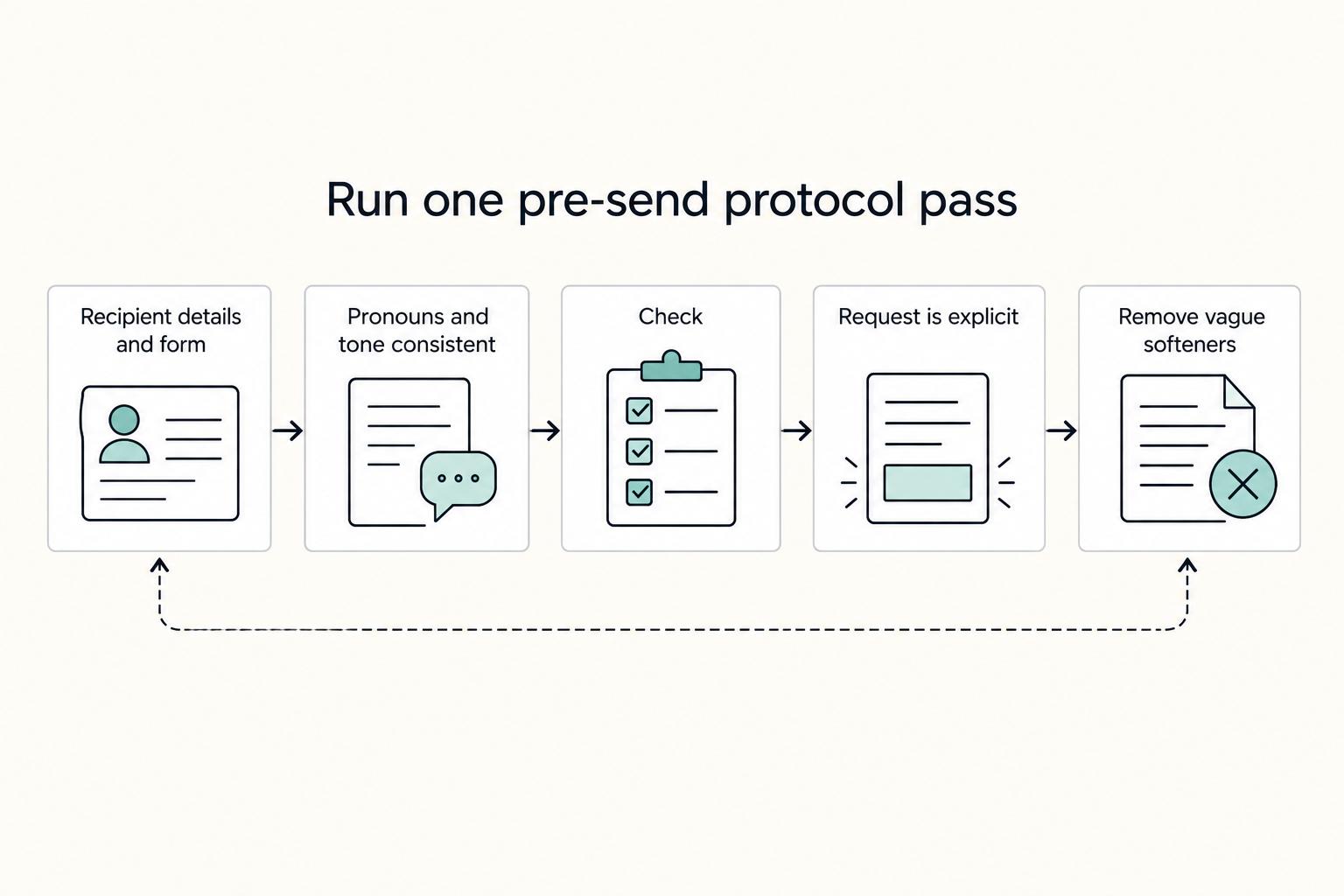
Step 3 Run one pre-send protocol pass#
Before sending, do one short QA pass so the email feels consistent and deliberate rather than improvised.
Use this mini-checklist:
- Verify recipient details and form of address.
- Keep pronouns and tone consistent from greeting to sign-off.
- Check that your greeting, opening line, and closing follow one formal convention.
- Confirm the request is explicit and any supporting facts or attachments are clearly referenced.
- Remove vague softeners that weaken clarity.
If one check fails, fix it before you send.
Related: The Unwritten Rules of German Business Etiquette.
Use one repeatable structure for high-stakes emails#
For high-stakes emails, do not improvise. Use one repeatable structure: context line, objective line, clear request, formal close.
| Scenario | Subject pattern | Verified elements | Escalate when |
|---|---|---|---|
| Initial outreach | Unterstützung bei Ihrer Website-Überarbeitung | Verified surname; one verified trigger; recipient company or project | You cannot verify a named contact; use a formal generic greeting only for lower-stakes outreach, or ask who is responsible before sending |
| Payment reminder | Zahlungserinnerung: Rechnung 2026-042 | Verified surname; checked invoice number; checked invoice date; attachment reference | Escalate only after your own records are verified |
| Scope-change response | Zusätzliche Leistungen für das Website-Projekt | Verified surname; new request or requirement; verified contract reference | New work is still treated as included; restate scope in writing and pause expansion until terms are updated |
In this context, risk usually comes from process errors, not style alone: wrong salutation, missing reference, unverified invoice detail, or an unclear ask. Keep the formal Sie default unless you have an explicit invitation to switch.
| Scenario | Intent | Tone level | Mandatory elements | Common failure pattern |
|---|---|---|---|---|
| Initial outreach | Start a relevant conversation without sounding generic | Formal, specific, restrained | Verified addressee, real context, relevant value, low-friction ask | Forced familiarity or a vague "let's connect" |
| Payment reminder | Prompt payment while preserving the relationship | Formal, calm, unambiguous | Invoice number, invoice date, attachment reference, payment-status request | Accusatory tone or unverified invoice details |
| Scope-change response | Protect scope without blunt refusal | Formal, factual, collaborative | Acknowledgment, verified contract reference, scope gap, proposed next step | Emotional argument or extra work before terms are updated |
Step 1 Send outreach that proves relevance quickly#
Subject: Unterstützung bei Ihrer Website-Überarbeitung
Illustrative example: Replace the name and project or invoice details before sending. For a man, use Sehr geehrter Herr plus surname; for an unknown recipient, use Sehr geehrte Damen und Herren.
Sehr geehrte Frau Müller,
ich habe gelesen, dass Sie Ihre Unternehmenswebsite überarbeiten möchten.
Ich unterstütze Unternehmen bei der Struktur und den Texten ihrer Websites. Gerne würde ich mit Ihnen besprechen, ob ich Sie bei diesem Projekt unterstützen kann.
Hätten Sie nächste Woche Zeit für ein kurzes Gespräch?
Mit freundlichen Grüßen
Ihr Name
Why this works: you establish relevance, then make one clear ask. When to escalate: if you cannot verify a named contact, use a formal generic greeting only for lower-stakes outreach, or ask who is responsible before sending.
Step 2 Send payment reminders that are firm and clean#
Subject: Zahlungserinnerung: Rechnung 2026-042
Illustrative example: Replace the name and project or invoice details before sending. For a man, use Sehr geehrter Herr plus surname; for an unknown recipient, use Sehr geehrte Damen und Herren.
Sehr geehrte Frau Müller,
zu meiner Rechnung 2026-042 vom 1. September 2026 konnte ich bisher keinen Zahlungseingang feststellen. Die vereinbarte Zahlungsfrist endete am 15. September 2026.
Eine Kopie der Rechnung finden Sie im Anhang.
Bitte teilen Sie mir mit, wann ich mit der Zahlung rechnen kann. Falls Sie die Zahlung bereits veranlasst haben oder noch Unterlagen benötigen, geben Sie mir bitte kurz Bescheid.
Mit freundlichen Grüßen
Ihr Name
The invoice number, due date, and attachment let the recipient check the payment quickly. Check your own receipt records before following up; handle VAT treatment on the invoice according to the actual transaction.
Step 3 Respond to scope changes without damaging trust#
Subject: Zusätzliche Leistungen für das Website-Projekt
Illustrative example: Replace the name and project or invoice details before sending. For a man, use Sehr geehrter Herr plus surname; for an unknown recipient, use Sehr geehrte Damen und Herren.
Sehr geehrte Frau Müller,
vielen Dank für Ihre Nachricht zu den zusätzlichen Produktseiten.
Die zusätzlichen Seiten sind im Leistungsumfang unseres Vertrags vom 1. September 2026 nicht enthalten.
Gerne erstelle ich Ihnen ein ergänzendes Angebot mit Preis und Zeitplan. Nach Ihrer schriftlichen Freigabe kann ich die zusätzlichen Arbeiten einplanen.
Soll ich Ihnen das ergänzende Angebot zusenden?
Mit freundlichen Grüßen
Ihr Name
Why this works: you anchor the message to the agreed scope, not personal preference. When to escalate: if new work is still treated as included, restate scope in writing and pause expansion until terms are updated.
In these examples, the salutation ends with a comma and the opening word is lowercase. Subsequent sentences start normally with a capital letter. Nouns and the formal pronouns Sie, Ihnen, and Ihr remain capitalized, even immediately after the greeting. The closing line has no comma.
For a step-by-step walkthrough, see How to Write a Pitch Email to a Brand for a Sponsorship.
Run a short pre-send workflow on the attached invoice#
Your email is only complete when the invoice behind it is consistent, checkable, and clear for finance teams. Treat the attachment as an official payment request and legal record, then run a short pre-send workflow before you hit send.
| Check | What to verify | Why it matters |
|---|---|---|
| Counterparty details | Recipient full name, address, invoice reference fields, consecutive numbering, and client VAT ID for cross-border EU B2B invoices | Keeps the invoice consistent, checkable, and clear for finance teams |
| VAT treatment | Determine the applicable VAT treatment; use reverse-charge wording when the recipient owes the tax and the invoicing rules require it | Reduces tax-treatment follow-ups, rejection, and reissue risk |
| Attachment consistency | Send to the appropriate billing contact for the customer named on the invoice; align service description, invoice number, project name, contract reference, and payment terms | Prevents avoidable back-and-forth with accounting |
Step 1 Verify counterparty details first#
Before attaching anything, confirm the recipient's full name, address, and invoice reference fields. If you use consecutive numbering, make sure the next invoice number is in sequence.
For an EU B2B invoice, check the client VAT ID using the European Commission VIES tool where relevant to the transaction, and retain the result. This check establishes VAT-ID validity; it does not by itself determine the place of supply or whether reverse charge applies.
Step 2 Confirm VAT treatment, then state it explicitly#
Determine the VAT treatment for the actual service and the supplier and customer locations before choosing invoice wording. If the recipient owes the tax under the applicable reverse-charge rules, include Steuerschuldnerschaft des Leistungsempfängers where German invoicing rules require it. Section 14a UStG sets the conditions; a valid VAT ID alone is not enough.
Use this quick scan before sending:
| Common invoice error | Correction | Business impact |
|---|---|---|
| Client VAT ID missing or unverified | VAT ID verified in VIES and entered correctly | Fewer tax-treatment follow-ups |
| VAT line is vague or unexplained | VAT treatment is explicit, including why VAT is not applied (if applicable) | Lower rejection and reissue risk |
| Reverse-charge case without supporting wording | Reverse-charge wording included after verification | Smoother accounting processing |
| Only one date shown | Both dates included: invoice date and service provision/delivery date | Better audit trail, fewer clarification emails |
Step 3 Run an attachment-consistency check#
Send the invoice to the appropriate billing contact for the customer named on it; the contact’s personal name need not be the invoiced legal entity’s name. Match the service description, invoice number, project name, contract reference, and payment terms between your message and the attachment.
This last check prevents the common failure mode: a polished message with an outdated PDF that creates avoidable back-and-forth with accounting.
From Anxious to Authoritative: Your New Communication Standard#
Use one repeatable standard for every high-stakes email: formal register for trust, structure discipline for risk control, and document consistency for professional authority. As an independent professional, this keeps client communication easier to review when scope, approvals, and payment details need to stay clear.
Write each message so the client can act after one read. State why you are writing, name the decision or action you need, and spell out what happens next. Keep the key context in the email body instead of implying it through attachments or older thread history.
Then run one consistency pass before you send: subject line, project label, invoice/reference number, dates, and attachment title should all match. If one label is outdated, fix it before sending.
Your repeatable standard
- Can the client see the purpose in one sentence?
- Did you ask for one clear action?
- Do the message and attachment match line by line?
- Are names, dates, references, and payment terms consistent?
- If you read it as the recipient, is anything still vague?
Frequently Asked Questions
Should I start with Sie even if the client sounds casual?
Yes. Start formal with Sie, a verified surname, and a formal greeting, then switch only after an explicit invitation. This avoids tone mismatches in early outreach and keeps communication easier to audit if scope or payment questions arise later.
What is the fastest QA check before sending a formal German email?
Run a 3 point pass: verify recipient details, confirm one clear request, and check formal conventions. The first word after the salutation should be lowercase after a comma unless it is a noun or a formal pronoun such as Sie or Ihr, and there is no comma before your name after Mit freundlichen Grüßen.
What should I include in a German payment reminder email?
Include a verified invoice number, invoice date, and attachment reference in a formal and neutral tone. Ask for payment status or missing documents in one line, and keep references consistent between the email body and the invoice PDF.
How do I handle VAT wording for cross border EU B2B invoices?
Check the VAT ID in VIES where relevant, then determine the transaction’s VAT treatment. VAT-ID validity does not establish reverse charge by itself. If the recipient owes the tax and German invoicing rules require the wording, include Steuerschuldnerschaft des Leistungsempfängers on the invoice.
Try a related tool
Researched and edited by the Gruv editorial team. Gruv builds cross-border billing, payouts, and finance-operations software for global businesses.
Sources
Includes 3 external sources outside the trusted-domain allowlist.
Educational content only. Not legal, tax, or financial advice.
Related Posts

How to Handle Cross-Cultural Communication with International Clients
Freelance cross-cultural communication is less about polite phrasing and more about shared meaning before work starts. Cross-cultural communication is how people from different cultural backgrounds adjust interactions to improve mutual understanding.
The Unwritten Rules of German Business Etiquette
German business etiquette is mostly about reducing ambiguity. For a high-stakes business-of-one, entering the German market is not just about closing one deal. It is about managing risk across the whole engagement. A cultural misunderstanding is not merely awkward. It can create scope creep, delay payment, and damage your reputation.

The Freelance Payment Penalty: A Modeled Audit of Platform Fees, FX Spreads, and Payout Delays
The money rarely disappears through a single, easy-to-spot fee. The real loss is stacked. A marketplace takes its commission, a processor adds a charge for international cards, a bank or payment company converts the currency at a spread, a platform holds the funds before release, and a wire sheds a little to intermediaries on the way in. Each layer looks defensible on its own, but the worker feels the combined result as a smaller deposit and a later payday.