
Quick Answer
Write the clause by naming specific trigger events like pandemic, epidemic, quarantine, and government measures, then tie each one to the exact obligation that is blocked and the remedy that follows. Use a narrow catchall only as backup, separate payment from delivery relief, define notice and mitigation steps, exclude financial hardship alone, and align the clause with governing law, forum, liability, and indemnity terms.
Introduction and the promise to the reader#
Before finalizing clause language, cross-check your draft against the Norton Rose Fulbright force majeure Q&A, a neutral force majeure clause pattern library, and the Kutak Rock force majeure FAQ.
By the end of this guide, you should be able to draft a pandemic-ready clause, defend each sentence, and negotiate scope without giving away relief you did not intend. Start with this practical three-part check: (1) trigger event, (2) affected obligation, (3) remedy.
A force majeure clause pandemic provision is contract wording that can excuse performance, or at least on-time performance, when a party is prevented or delayed by an event outside its control. Some legal systems define force majeure in law, while others rely mostly on contract text. In either case, relief is not automatic. The result turns on what your clause says and whether the event caused the missed or delayed duty.
Make one decision early: are you protecting delivery, payment, or both? Service disruption may support extra time or temporary suspension, depending on contract wording. Treat payment obligations as a separate drafting question. Do not assume one changes the other. State your intent directly.
Before you draft further, check whether the contract actually allows suspension during the disruption period. If it does not, you may name the event and still end up arguing breach instead of applying a clean remedy. The clause works only when the wording connects a real event to a specific blocked duty and a defined consequence.
A common failure mode is simple: no clause at all. Without one, parties usually carry disruption risk in their own promises, and fallback doctrines like frustration are narrow. This guide follows that order, and yours should too: contract inputs, trigger wording, causation, remedies, exclusions, notice and mitigation, governing law and forum, negotiation, and common failure points.
Start with your contract inputs before you draft#
Do not start from a template. Build the clause from the obligations you already signed, the notice process your contract requires, and the remedies your contract already allows.
Gather the full contract set#
Collect the governing agreement and any active documents that control milestones, acceptance, notice, payment, or termination. Then confirm one clean governing set that shows:
- the governing agreement definition
- existing force majeure wording
- notice mechanics
- payment terms
- acceptance terms
- termination mechanics
Missing a controlling document can weaken your position early, especially if the clause requires notice before force majeure can be invoked.
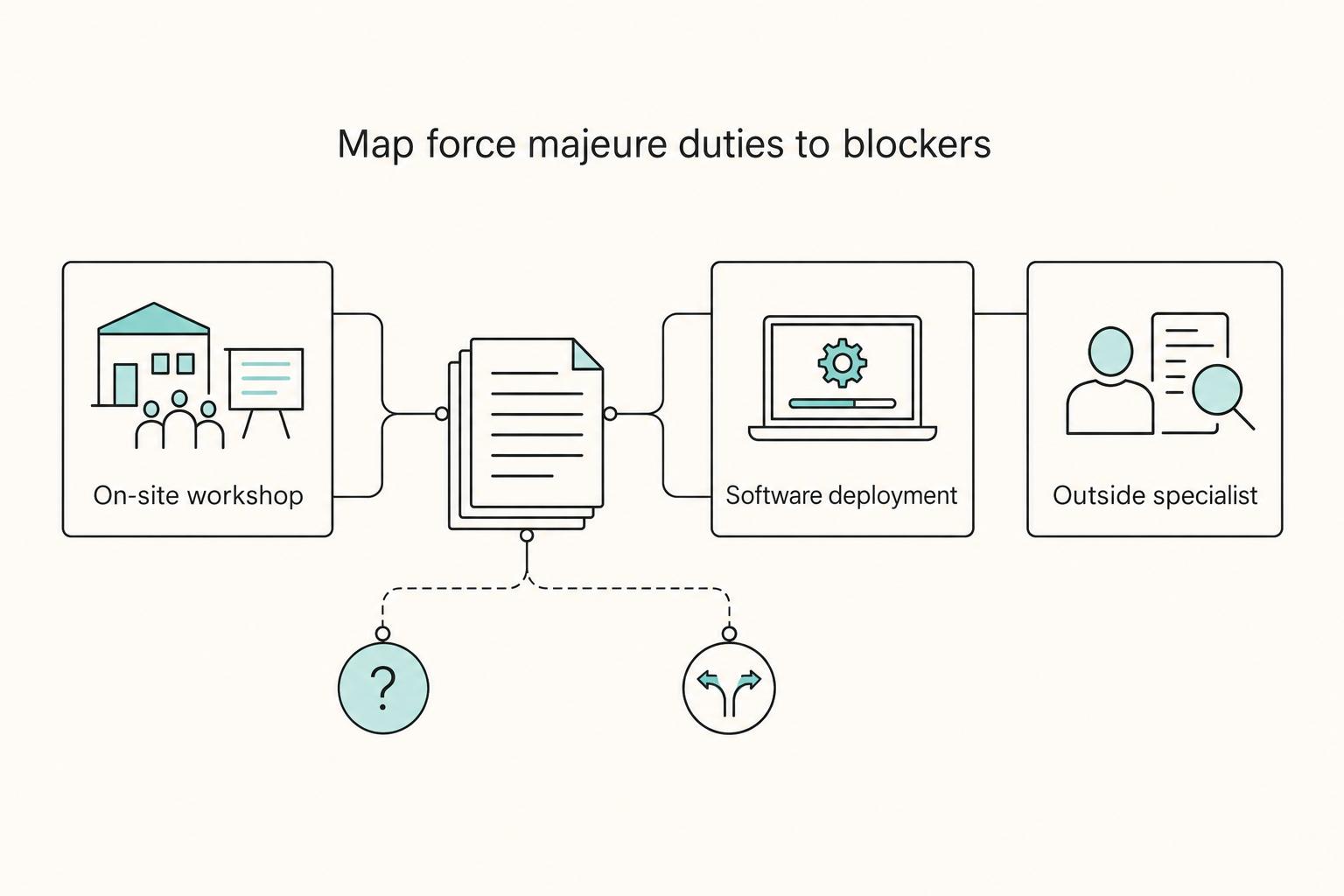
Map each obligation to a real blocker#
Map each contractual duty to the disruption that could actually block it. Keep this practical, for example: access limits, travel limits, client systems outages, subcontractor disruption, or a regulatory measure. That discipline keeps your draft aligned to contract language that is usually read narrowly.
| Contract obligation | Potential disruption | Evidence to retain | Fallback option |
|---|---|---|---|
| On-site workshop | Site access blocked | Closure email or access denial | Remote session if contract permits |
| Software deployment | Client system unavailable | Support ticket or outage email | Milestone extension if contract permits |
| Deliverable requiring outside specialist | Subcontractor cannot perform | Vendor notice | Partial delivery or substitute resource if contract permits |
Separate current rights from requested changes#
Separate fallback options into two buckets: what the contract already permits, and what would require renegotiation. Use rights already written into the contract first, and label anything else as a requested amendment.
Check payment terms separately from delivery relief in your contract. Do not assume service-delay relief automatically changes invoice timing or amount, and note that in the California discussion in our source, increased cost alone is not enough to excuse performance. Once you have that intake done, you can draft trigger events with precision.
Define trigger events with explicit words not vague catchalls#
If performance could be blocked by events your parties can identify in advance, name those events directly (for example, pandemic, epidemic, quarantine, or government measures). A broad phrase like "beyond reasonable control" can be a backup, but it should not carry the clause by itself.
Name the triggers in operational terms#
Draft for how delivery actually fails, not for abstract wording. Each trigger should point to a real blocker tied to a contract obligation and to proof you can keep if the clause is invoked later.
| Named trigger | Include it when your work depends on | Delivery risk it maps to | Common drafting mistake |
|---|---|---|---|
| Pandemic | A category you define expressly in the clause | The defined event prevents a stated obligation | Relying only on a catchall |
| Epidemic | A category you define expressly in the clause | The defined event prevents a stated obligation | Assuming it is covered without naming it |
| Quarantine | A category you define expressly in the clause | The defined event prevents a stated obligation | Treating it as automatically covered by other wording |
| Government measures | A government-action category you define expressly in the clause | The defined action prevents a stated obligation | Leaving the category broad and unbounded |
Quick check: for each named trigger, identify at least one affected obligation and at least one proof item for your evidentiary file.
Put a narrow catchall after the named list#
Use a clear hierarchy: specific events first, narrow backup second. Your catchall should not turn force majeure into an escape route from a harder or less profitable deal.
Pressure-test with concrete scenarios before redlining#
Test concrete situations before you finalize wording, then confirm the clause still maps scenario -> blocked obligation -> proof. If your clause names only broad concepts, you can miss the blocker that actually stopped performance.
Address known-at-signing conditions explicitly#
Do not leave this issue silent. Pick one treatment and say it plainly in the clause:
- State whether conditions known at signing are included or excluded.
- State what change would qualify as a new trigger event.
- State what proof is required to show the trigger prevented performance.
Choose based on what you are actually pricing and scheduling. Naming triggers is only the first step. Next, you need a causation standard you can actually prove.
Write the causation standard and evidence test#
Use this excerpt as a documentation standard, not a force majeure causation rule. It supports showing what agreement exists, what terms apply, and what was filed.
Anchor the claim to one obligation#
Start with three questions: What duty is tied to the agreement terms? Is there a written contract to attach? If no contract exists, do you have a full statement of the circumstances for acting as an agent? If you cannot point to those records, the claim is too broad.
Keep the prevent / impede / materially delay ladder usable#
Prevent, impede, and materially delay are not defined here, and no mixed-cause rule is established here. Treat those thresholds as outside what this filing excerpt can prove.
Build a compact evidence pack#
At minimum, keep the written agreement and documented oral terms, or a full statement of circumstances where no contract exists. If a formal written contract is indicated, attach a copy to the exhibit and retain dated filing records.
| Obligation | Agreement basis | Timeline | Filing status | Proof artifact | Contract reference |
|---|---|---|---|---|---|
| Name the blocked obligation from your contract | Cite the agreement basis from your contract | Record the timeline from your source records | Record the filing status from your source records | Attach the proof artifact from your source records | Cite the contract or SOW reference |
Triage invoke versus renegotiate#
Use this excerpt to confirm documentation and filing completeness, including that missing required information can trigger penalty and enforcement provisions. Use the contract text and legal review to decide invoke-versus-renegotiate outcomes.
After the record is complete, any relief terms (scope, duration, termination) must come from the contract itself, since those standards are not set here.
Build a remedy ladder that includes suspension and Termination#
Do not jump straight to termination. One workable sequence is delay, partial suspension, scoped performance, then termination, but set triggers and consequences for the specific contract type.
Define each stage in one direct sentence#
Delay means: You extend the timeline for a named obligation when it is temporarily blocked and the same duty can still be completed later.
Partial suspension means: You pause only the blocked obligations, while unaffected obligations continue.
Scoped performance means: You continue a reduced or revised subset of work when full performance is blocked but part of the work is still workable.
Termination means: You allow exit from the affected SOW or agreement only after the clause's defined checkpoint is reached and the contract's stated conditions are met. The termination threshold must be verified from the contract, SOW, or legal review before use.
Use an operational "if this, then this" table#
| If this is true | Use this remedy | Immediate action | What continues vs pauses | Risk if wording is vague |
|---|---|---|---|---|
| A named duty is blocked now, but can be completed later | Delay | Send notice if required, name the duty, and reset the affected date | Unaffected scope continues; only the affected timeline shifts unless the clause says more | Dispute over whether any deadline actually moved |
| Only part of the work is blocked | Partial suspension | List paused tasks and record pause start date | Unaffected tasks continue; blocked tasks and related dates pause | One side treats the entire project as suspended |
| Full performance is blocked, but reduced or substitute work is possible | Scoped performance | Issue written revised scope and acceptance terms | Revised subset continues; removed or deferred work pauses | Acceptance and billing disputes from informal scope changes |
| Blocking event continues past the defined checkpoint and conditions for exit are still unmet | Termination | Confirm duration record, any required mitigation record, and closeout terms | Future affected performance stops; agreed closeout steps continue | Exit rights are challenged if checkpoint or conditions are unclear |
For each row, keep records on file for the event condition, mitigation attempts (if required), and the contract element that changed.
Separate affected work from unaffected work#
State the mechanics directly so billing and acceptance do not become a second dispute.
- State whether invoicing pauses, continues, or shifts to revised milestones.
- State whether acceptance pauses only for affected deliverables or for the full SOW.
- For scoped performance, require written updates to deliverables, acceptance criteria, and milestone descriptions before revised work starts.
Keep termination narrow and evidence-based#
Treat termination as a checkpoint, not a first move. If you use duration and mitigation checkpoints, define both before exit. The notice-to-termination window must be verified from the contract, SOW, or legal review before example clause language is used.
State the legal effect narrowly for the affected obligations and period so the clause does not read as a blanket shield for unrelated issues.
Before final redlines, use this freelance contract generator to structure your clause set, then tailor force majeure triggers, notice, and remedies to your deal.
Add exclusions so force majeure is not misused#
Exclusions can be drafted to do one job: separate financial-only impact from actual performance blockage. Draft around a clean split: financial impact alone is excluded, while blockage of a named duty may still qualify under your trigger, causation, and remedy terms if the clause text supports it.
Use a decision rule for excluded versus excused outcomes#
A drafting baseline (not a universal legal rule) is: Performance is not excused for economic hardship, lost anticipated profit, market decline, reduced demand, cash-flow or funding pressure, or increased expense alone. Relief may still apply if the same event also prevents, impedes, or materially delays a named contractual obligation under the clause text.
Compare financial impact with actual performance blockage#
| Situation | Financial impact only or performance blocked | Treatment | Quick check |
|---|---|---|---|
| Lower margin or lost profit | Financial impact only | Often drafted as excluded by itself | Could the duty still be performed as promised? |
| Reduced demand or budget pressure | Financial impact only | Often drafted as excluded by itself | Did demand change, or was performance blocked? |
| Higher operating or delivery cost | Usually financial impact only | Often drafted as excluded unless performance is actually blocked | What evidence shows performance was still possible? |
| Applicable government order closes required site or access | Performance blocked | May be excused if tied to a named duty and covered by clause text | Keep the order, dates, place, and blocked duty in the file |
| Quarantine, travel, or access restriction stops the required method | Potential performance blockage if alternatives would materially change promised performance | May be excused only if your clause expressly covers it | Record attempted alternatives and why they failed |
Apply a workability screen before relief#
Treat "harder" and "not workable" as different. Before relief, keep a short record that shows:
- Blocked obligation: Name the exact deliverable, milestone, access right, or acceptance step that cannot occur.
- Reasonable workarounds attempted: List options tried, such as sequencing changes, substitute personnel, partial performance, remote method, or delay.
- Why alternatives fail: State why those alternatives would materially change the promised performance, method, or result, rather than just increasing cost or inconvenience.
If you want jurisdiction-specific support, verify the current authority from legal or source records before citing it.
Carve back government-measure blockage so exclusions do not swallow relief#
Keep economic-effects exclusions broad enough to prevent misuse, and consider a carve-back so relief can still be available when nonperformance is directly caused by compliance with an applicable government measure that blocks the named duty.
Use a simple line: commercial inconvenience stays excluded; order-driven blockage may still qualify where clause text allows. For each invocation, keep the measure or order, effective timing, affected place, and the link to the blocked duty. Also record the time from declaration to disruption as part of causation clarity.
Stress-test before signature with two scenarios#
Test the text against both outcomes:
- Closure or order-driven blockage after signing: relief can remain available if the clause text says so, subject to notice, mitigation, and your remedy ladder.
- Commercial weakness already visible before signing: relief should not convert pre-sign commercial risk into excuse rights.
If one read of the clause does not tell you what is excluded and what may still be excused, tighten it. Ambiguity here can create disputes, not flexibility. Related: What is a 'Force Majeure' Clause and Do You Need One?.
Align with Limitation of Liability and Indemnification#
Treat these clauses as one risk-allocation system. Hidden drafting gaps can sit dormant and become costly when a dispute starts.
Define your labels before you compare text#
Use consistent labels across the contract:
- Material breach: define what qualifies, so the termination trigger is clear.
- Indemnity scope: state which claim types and loss categories are covered.
- Liability limits: state what is capped, excluded, or uncapped.
- Termination trigger: align the trigger language with the rest of the agreement.
- Cross-reference terms: make sure definitions and references match everywhere they appear.
Small label mismatches often stay hidden until a dispute and then drive expensive outcomes.
Run a clause-check pass for reclassification risk#
Redline each related clause and ask one question: does any clause quietly expand liability beyond what the others appear to allow?
| Clause | Intended outcome | Conflict to fix |
|---|---|---|
| Termination | States when a party may exit and what counts as material breach | "Material breach" is undefined, creating room for protracted disputes |
| Limitation of Liability | Applies negotiated limits to covered claims | Scope is unclear or conflicts with nearby language |
| Indemnification | Shifts agreed categories of risk | Wording is broad enough to shift very large liability exposure |
| Definitions | Keeps key terms consistent across sections | The same term is used with different meanings |
| Cross-references | Keeps obligations synchronized across clauses | Outdated or mismatched references hide risk until a dispute |
Pay special attention to termination language. If you use material breach, define it clearly to reduce dispute risk.
Stress-test indemnity overlap#
Do a separate indemnity pass, because broad drafting can shift very large exposure. Test these overlap scenarios:
- A claim falls outside the risk categories you intended to shift.
- Indemnity language is broader than neighboring liability-limit language.
- Older wording remains in place and expands liability beyond current intent.
Narrow indemnity language so it covers the categories you actually intend to shift, and no more.
Lock one consequence chain across cross-references#
Before signature, read termination, limitation of liability, and indemnification together. They should produce one consistent allocation of risk.
Use this control sentence in your draft review: Termination language defines material breach clearly, and indemnity scope is limited to the agreed claim categories.
Set Notice Requirement and Mitigation Obligation operations#
This section should work like an operating playbook. It should tell you who notifies, how mitigation is handled, what sequence to follow during disruption, and how performance restarts.
Because fixed notice deadlines, mandatory notice fields, or a single mitigation/restart standard are not established, define those points expressly in your contract.
Write notice mechanics you can execute fast#
Use formal contractual notice and project-channel updates if your process needs both. State clearly whether project updates are supplemental only or can satisfy notice, based on your contract terms.
| Clause text to define in your contract | Why it can prevent disputes |
|---|---|
| Notice is given within a stated period after the affected party becomes aware of the impediment. | Creates a timing trigger and reduces late-notice arguments. |
| Notice is sent using the contract's notice method to the named recipient. | Reduces disputes over whether a message counted as notice. |
| Notice identifies the obligation affected. | Narrows any relief to the impacted duty. |
| Notice describes the event and how it affects performance. | Connects the event to delivery impact. |
| Notice states expected duration, or the next update date if duration is unknown. | Avoids open-ended silence during disruption. |
| Notice summarizes mitigation steps already taken or currently available. | Shows active response during delay. |
Before signature, cross-check this wording against the contract's notice article so timing, recipients, and delivery method match exactly.
Define mitigation as reasonable workaround effort for services#
For services work, choose and define the mitigation standard in the contract (for example, reasonable efforts, commercially reasonable efforts, or another agreed standard). Also state whether mitigation has cost or feasibility limits.
Spell out what "reasonable workaround" can look like in your setting: resequencing tasks, remote delivery where feasible, backup tools, substitute access requests, temporary scope narrowing, or partial deliverables with usable value.
If useful, list what the parties treat as disproportionate burden, such as materially higher cost, material security or compliance risk, or a forced delivery-model change beyond the contract's baseline.
For subcontractors, add a separate rule on how alternative sourcing is evaluated so replacement expectations are explicit rather than open-ended.
Use one disruption sequence every time#
Use the same sequence each time:
- Notify: send notice using contract mechanics, then send project-channel updates if applicable.
- Document: keep one record of impacted obligations, key dates, communications, and mitigation actions.
- Propose workaround: present options with scope, timeline, dependency, and cost-treatment impacts.
- Confirm revised plan: record agreed pauses, interim outputs, or adjusted delivery order.
- Re-baseline obligations: confirm updated milestones so the new schedule becomes the operative one.
Add clear restart mechanics so relief ends cleanly#
State how you will confirm that the impediment has ended, using contract-defined triggers that fit the work (for example, restored access, lifted restrictions, resumed tool availability, or recovered subcontractor capability).
If you use a restart notice, define what it must include, such as:
- what condition has cleared,
- when performance can resume, and
- which obligations restart immediately versus on the revised plan.
If appropriate for your workflow, require written confirmation on updated milestones so the relief window and restart date are clear.
Choose Governing Law Jurisdiction and Dispute Resolution that you can enforce#
Enforceability comes first. If you cannot prove notice, causation, mitigation, and clean records in the forum you choose, the clause will be hard to use when disruption hits. These terms are different and should be drafted separately:
- Governing law (choice of law): which law governs dispute merits.
- Forum selection clause: which court or location hears litigation.
- Personal jurisdiction: that court's authority over a party.
- Venue: the physical location where that court sits.
- Dispute resolution mechanism: court litigation, arbitration, or mediation.
Choose governing law you can defend under#
Pick the law that will interpret your clause, then draft to that reality. The same facts can excuse performance in one legal system and not in another, so do not assume a pandemic label carries the result on its own.
If you accept foreign governing law, reduce ambiguity in your own text: name trigger events, affected obligations, notice mechanics, mitigation duty, and your remedy ladder. Before signing, make sure you can explain how that law is likely to treat your exact drafting, not just the general concept.
Choose jurisdiction you can actually use#
If your path is court litigation, name the court location and decide whether the forum clause is exclusive. "Law of X" and "courts of Y" are not interchangeable.
For cross-border service contracts, exclusive choice-of-court clauses can be enforceable in international civil or commercial cases where the treaty route fits. The HCCH 2005 Choice of Court framework is built for that route and does not apply to consumer or employment contracts (status table snapshot: 39 contracting parties, last update 27-XI-2025). The HCCH 2019 Judgments framework is designed to support cross-border circulation of civil or commercial judgments (entry into force 1-IX-2023; status table snapshot last update 13-V-2025). Your practical check is still country-specific: verify that your relevant jurisdictions are actually covered for your deal posture.
Match dispute resolution to the deal#
Choose one final binding path and draft it clearly. Ambiguous dispute language can delay or compromise the process.
| Forum option | Enforceability for cross-border services | Evidence burden you should expect | Process friction | Cost-control fit |
|---|---|---|---|---|
| Exclusive court litigation | Can work if the choice-of-court clause is exclusive and enforcement routes fit | Contract, notice proof, causation record, mitigation record, witness and document trail | Can rise with foreign service, translation, and local counsel requirements | Can fit smaller disputes when forum access is practical |
| Binding arbitration | Used for cross-border enforcement because foreign arbitral awards have a recognition and enforcement framework | Same merits proof, plus preserve arbitration agreement and final award; enforcement can require original or certified copies | Front-loaded drafting choices like seat, language, and enforcement locations matter | Can fit deals with assets across multiple countries; not automatically cheaper |
| Mediation first, then named court or arbitration | Mediation alone is generally non-binding | Lower early burden, but full proof is still needed if escalated | Lower at the start; enforcement depends on the named binding step if talks fail | Works when the clause names the final binding forum and you verify current filing and notice requirements for that forum |
Cross-check with a defensibility test before signing#
Run this pre-sign test against the exact forum clause:
- Notice compliance: Can you prove formal notice went to the named recipient, by the contract method, on time, with any forum-specific procedural trigger verified from legal or source records?
- Causation: Can you tie the event to the blocked obligation with dates, dependencies, and delivery impact?
- Mitigation: Can you show alternatives attempted, results, and the revised plan offered?
- Record integrity: Can you produce signed contract versions, delivery receipts, emails or messages, and timeline records in a form the forum can accept?
Finish with one alignment pass across dispute clauses, notice mechanics, and evidence handling so your selected forum, notice workflow, and proof package all support the same enforcement path. For a step-by-step walkthrough, see A deep dive into the 'force majeure' clause when your client is in a politically unstable region.
Negotiate without stalling the deal#
Keep the negotiation moving by trading in the right order. Name events first, accept only a bounded fallback, and give up trigger breadth only in exchange for clearer remedies.
Name events and tie each one to a blocked duty#
Ask for a list-plus-formula structure, not a loose catchall. Put concrete events in the clause first, such as epidemic and compliance with a governmental order or other act of authority, then tie each event to a specific obligation it may prevent or impede.
Use a hard drafting test: for every named event, identify the duty it can block. If you cannot say exactly what performance is blocked, the wording is too general and reads like commercial pressure, not an impediment.
Bound the fallback before you accept it#
If the other side pushes for a shorter list, accept a fallback only if it is constrained. Require the event to be beyond the affected party's control, not reasonably foreseeable at signing, and not avoidable or overcome, with interpretation tied to governing law and forum.
Then lock in the operating details: prompt notice of the impediment, the affected obligation, expected duration, and mitigation already attempted. Treat notice as a core risk control, because late or failed notice can still create damages exposure even when a real impediment exists.
Trade trigger breadth only for remedy clarity#
If the other side narrows triggers, get cleaner outcomes in return.
| If you give up | Only accept if you gain |
|---|---|
| A broader event list | Express suspension for the period the impediment exists |
| Pandemic-specific wording | A restart rule with revised dates, dependencies, and acceptance timing |
| A wider catchall | Explicit payment treatment during suspension and a clear termination path if disruption continues |
Read the clause once as an execution test: are payment handling, partial performance, and restart dates actually stated? If not, most of the risk is still there.
Check redlines for execution gaps#
Use this checklist before signing:
- Triggers are narrow, but suspension language is missing
- Suspension is allowed, but restart mechanics or revised milestones are missing
- Notice is required, but recipient, method, or timing is not specified
- Mitigation is required, but there is no duty to explain alternatives tried
- Delivery may be excused, but payment treatment is silent
If delivery can pause but fees, deposits, or milestone timing are unclear, signature may come faster, but execution risk stays high.
Common mistakes and fast recovery moves#
Disputes here often turn on clause mechanics and records, not just how dramatic the disruption sounds. A real performance block is when an event actually prevents a named duty from being performed as promised. Commercial pain is business strain while performance may still be possible. A remedy ladder is operational when it tells you what happens next; if it only lists events, it is hard to apply.
| Mistake | Why it fails | Fast recovery move |
|---|---|---|
| Trigger and remedy do not match | You may name an event, but the clause may not clearly say whether performance is delayed, suspended, resumed, or ended | Map one blocked duty to one clause remedy. If the remedy is unclear, ask for written schedule relief or a change order instead of asserting full excuse |
| You label commercial pain as force majeure | Cost pressure or weaker demand can be serious, but may not show that performance was actually blocked | Change the ask: revised dates, scoped deliverables, or partial suspension of only the affected work |
| Your notice trail is weak | Your position is harder to support when the record does not clearly show what was blocked, when it was affected, and what you did next | Send a concise follow-up record now: blocked duty, timeline, current impact, and practical steps already taken |
| You treat fallback doctrines as a clause substitute | Force majeure and fallback doctrines are different frameworks | Use fallback doctrines as jurisdiction-dependent backup arguments, and get local legal review under the governing law before relying on them |
Choose the narrowest credible remedy. If disruption is temporary, ask for schedule relief first. If only part of performance is affected, use partial suspension and keep the rest moving. If performance is still possible but needs restructuring, move to scoped renegotiation instead of asserting full excuse.
Before you escalate, make sure you can show one clean evidence chain: blocked duty, blocking event, and a clear response record. Weak process can undermine these positions even when the event itself is serious.
Copy and paste closeout checklist#
Before you sign, use this as an enforceability check, not a wording polish. If the clause is unclear on triggers, causation, notice mechanics, remedies, or cross-clause fit, it can fail when you need it most.
| Step | Verify before signature | Pass if | Weak if | Recovery move now |
|---|---|---|---|---|
| 1 | Name trigger events | Pandemic events and government measures are stated expressly | The clause relies mostly on a broad catchall | Add explicit pandemic and government-action triggers, then keep catchall language as backup only |
| 2 | Lock the causation test to affected duties | Relief applies only when the event blocks the specific duty, and only for beyond-control, no-fault events | It excuses nonperformance in general, without linking event to duty | Redline to tie relief to affected provisions only, with a clear event-to-duty link |
| 3 | Make notice and suspension mechanics operational | Notice activates suspension mechanics, and the clause states what happens during the event and at resumption | Notice is vague, or start and stop mechanics are unclear | Add notice-triggered suspension wording and a practical resumption checkpoint |
| 4 | Confirm remedy sequence and payment treatment | The sequence is clear, including suspension, any scoped performance, any termination path already in the contract, and payment carveouts | Payment treatment is silent or conflicts with the remedy flow | State clearly whether payment obligations are excluded from relief and how payment terms interact with the remedy sequence |
| 5 | Check cross-clause coherence | Force majeure, payment, liability, indemnity, and dispute terms work together in one scenario | Another clause appears to turn excused delay into breach, damages, or indemnity exposure | Do one invocation scenario read-through and fix contradictions before signature |
Name trigger events#
Read your Force Majeure Event definition as if a third party will apply it in a dispute. You should see named pandemic language and named government-action language, not only a generic beyond-control catchall.
You pass if both are explicit. You fail if coverage depends mostly on catchall wording. Redline now by adding named triggers first, then keeping broader language as secondary support, limited to events beyond reasonable control and without fault.
Lock the causation test to affected duties#
Your clause should connect one event to one affected obligation, not excuse the whole contract by default. Ask yourself: if you invoked tomorrow, could you point to the duty affected and explain how the event caused that block?
You pass if relief is duty-specific and scoped to affected provisions. You fail if the clause excuses performance in the abstract. Redline now so only affected provisions are suspended when the event meets the beyond-control, no-fault standard.
Make notice and suspension mechanics operational#
Notice should be the switch that activates relief, not a formality. The clause should clearly say that, upon notice, affected obligations are suspended during the force majeure period, and it should state how performance resumes after that period.
You pass if start, during-event handling, and resumption are all clear. You fail if notice exists but does not trigger clear mechanics, or if start and stop points are unclear. Redline now with notice-triggered suspension language and a concrete resumption checkpoint, including any BCP recovery objective if your contract uses one.
Confirm remedy sequence and payment treatment#
You need a clear order of operations so both sides know what happens next. Confirm that the clause states the remedy flow and does not leave payment treatment ambiguous.
You pass if the sequence is readable and payment obligations are addressed expressly, including any carveout. You fail if payment can be read two different ways or is left silent. Redline now to state whether payment obligations are excluded from relief and align that choice with the rest of the remedy flow.
Check cross-clause coherence#
Do a final full-contract read, not a clause-only read. Your force majeure language should be reviewed alongside the payment, limitation of liability, indemnity, and dispute terms.
You pass if one invocation scenario runs cleanly from notice through relief and into any dispute path. You fail if another clause appears to reclassify excused delay as breach exposure. Final recovery move: run the scenario once and fix every contradiction before signature.
Related reading: Limitation of Liability Clause for Freelance Software Developers. If you want invoicing, payout tracking, and audit-ready records in one workflow, review Gruv for freelancers.
Frequently Asked Questions
Does a pandemic automatically trigger a force majeure clause?
No. This article does not support an automatic trigger. Treat force majeure as uncertain until official determinations and governing-law enforceability are confirmed.
Is lost revenue alone enough to claim force majeure?
No. Lost revenue alone is not enough from the evidence described here. Focus on documented operational impact instead, using records such as service health updates, official disclosures, and internal logs.
What is the minimum wording a freelancer should include for pandemic coverage?
This article does not verify a minimum wording formula. The dependable point is to check enforceability under the contract's governing law instead of relying on template wording alone.
Can a catchall provision protect me if the contract never says pandemic or epidemic?
Sometimes, but it is uncertain. This article does not confirm catchall enforceability, so you should validate the clause under the contract's governing law before relying on it.
When should I invoke force majeure versus renegotiate scope and deadlines?
Use evidence and legal validation rather than a fixed template rule. Document operational impact, monitor official updates, and treat force majeure status as uncertain unless it is officially determined.
What should a proper notice include to satisfy notice and mitigation duties?
This article does not provide a universal legal notice format or threshold. For a defensible record, keep dated evidence of what happened and what was impacted, including service health updates, official disclosures, and internal logs.
What is still unknown from current case outcomes across jurisdictions?
Current outcomes across jurisdictions are still uncertain. The article notes that, as of 7:00 AM CST on March 3, 2026, UAE authorities had not announced force majeure determinations or related regulatory relief after reported impacts in AWS's UAE region and secondary service impacts in Bahrain. If obligations touch UAE data residency under UAE Federal Decree-Law No. 45 of 2021, enforceability should be confirmed under the governing law before relying on template language.
Researched and edited by the Gruv editorial team. Gruv builds cross-border billing, payouts, and finance-operations software for global businesses.
Sources
Includes 3 external sources outside the trusted-domain allowlist.
- efile.fara.gov/docs/6822-Exhibit-AB-20221230-5.pdftrusted
- govinfo.gov/content/pkg/CFR-2010-title3-vol1/html/CFR-20...trusted
- pmc.ncbi.nlm.nih.gov/articles/PMC7798591trusted
- sec.gov/Archives/edgar/data/39911/000003991113000103...trusted
- state.gov/wp-content/uploads/2021/08/2020-Digest-Chapt...trusted
- afterpattern.com/clauses/force-majeureexternal
- kutakrock.com/-/media/files/news-and-publications/publicat...external
- nortonrosefulbright.com/en/knowledge/publications/849d7568/q-and-a-o...external
Educational content only. Not legal, tax, or financial advice.
Related Posts

Germany Freelance Visa Application Path for Freiberufler and Gewerbe
Choose your track before you collect documents. That first decision determines what your file needs to prove and which label should appear everywhere: `Freiberufler` for liberal-profession services, or `Selbständiger/Gewerbetreibender` for business and trade activity.
Do Freelancers Need a Force Majeure Clause in Client Contracts?
If you do cross-border client work, this clause is not filler. It is a risk-control tool for moments when an extraordinary event directly prevents performance. Whether it works depends on your wording and the governing law in the contract.

The Best Paid Advertising Channels for Freelancers (Google Ads
**Treat paid advertising as a cashflow system you can run weekly, not a one-off "channel test" you hope works.** If you are starting from zero, or dealing with inconsistent referrals, your real job is to choose and operate channels that do not break your follow-up, your measurement, or your bank balance. Judge channels by execution reliability, not hype.