
Quick Answer
Start by treating how to write a creative brief as an operations decision, not a template exercise: define value first, scope second, and completion evidence third. Use one objective line, make deliverables auditable with clear file and review boundaries, and set acceptance around documented sign-off from the named approver. Keep business outcomes visible, but do not use them as approval gates unless ownership and proof were agreed in advance. If requests shift after acceptance, log the change in writing before work continues.
To write a creative brief as a solo expert, define three things before kickoff: the value of the work, the scope in countable terms, and what completion looks like. The brief is not paperwork. It sets the strategic, practical, and commercial terms of the job. Done well, it aligns stakeholders early, gives you a reference when feedback drifts, and makes it easier to defend scope, timelines, and payment.
Generic templates built for large internal teams usually miss what matters most in a business-of-one practice. Your brief has to carry the whole engagement, so anchor it in three pillars: Value, Scope, and Victory. Together, they turn a routine project document into something you can actually run the work from.
Pillar 1: Define the Value (And Justify Your Premium)#
Define the business outcome before you discuss assets. If you cannot state what should change, for whom, and how success will be measured, you are probably not ready to price the work confidently.
A strong brief should set a clear objective and high-level game plan, then align stakeholders before execution. Your first job is not collecting asset requests. It is turning a vague ask into a clear objective that can hold up through pricing, kickoff, and later feedback.
Step 1. Interview stakeholders and write one objective line#
When possible, start your intake call with the people who own the result, not just the person requesting the deliverable. Use a short sequence and capture it live:
| Field | What to capture |
|---|---|
| Outcome | What needs to change in the business |
| Audience | Which audience segment needs to think, feel, or do something differently |
| Context | Where this message will be seen or used |
| Success signal | What signal will tell us it worked |
| Baseline status | What is happening now, if you have a baseline |
| Risk note | What could block measurement or make attribution messy |
Then turn the answers into one line in your brief using these fields: outcome, audience, context, success signal, baseline status, risk note. That field set is not an industry standard. It is just a practical way to keep fuzzy requests out of your scope.
Example structure: "Help [audience] do or believe [outcome] in [context], measured by [success signal]. Current baseline: [known / unknown]. Risk: [tracking gap, unclear owner, or external dependency]."
Verification point: remove the deliverable from the sentence. If the objective still makes sense, you have defined value rather than output. If the sentence falls apart without "landing page," "deck," or "email redesign," keep asking questions.
Step 2. Rewrite vague requests into verifiable brief language#
If the ask is vague, tighten it before you price. Specific, measurable framing is useful here because it pushes clarity before work begins. That is not just stylistic. It can make scope and pricing conversations easier later.
| Weak request | Strong brief language | How this can protect scope and pricing |
|---|---|---|
| "Increase brand awareness." | "Help first time founders recognize our bookkeeping service as a simpler option when comparing providers on the website, measured by qualified contact form submissions from that page." | Moves the conversation from "make it pop" to a defined audience, context, and success signal. That can reduce open-ended revision pressure. |
| "Make the deck more professional." | "Help procurement leads understand our offer faster during live sales calls, measured by more second meeting requests after presentations." | Ties the work to a buying moment, so you are pricing for a business goal, not personal taste. |
| "Refresh our email campaign." | "Help inactive trial users return and complete setup from the reactivation email path, measured by completed setup events from that sequence." | Clarifies which journey matters. That can make it easier to exclude unrelated email work from the quoted scope. |
If a client cannot get beyond vague language, treat that as a red flag, not a creativity challenge. You may still take the project, but note the ambiguity in the brief and do not pretend the value case is already clear.
Step 3. Validate metrics before pricing and before kickoff#
Separate the business KPI from the project signal you can actually review during the engagement. They are related, but they do different jobs. A client may care about revenue or pipeline, while your brief uses a closer signal such as submissions, click throughs, or completed setup events.
Use this checklist twice: once before pricing, and again before kickoff when the brief is finalized and agreed by stakeholders.
- Business objective is named
- Scope, timeline, key stakeholders, and purpose are written clearly
- Business KPI already tracked by client
- Project success signal for this brief is named
- Baseline is available, yes or no
- Tracking owner is named, or write "owner to be confirmed by client before kickoff"
- Known measurement risk is written into the brief
Failure mode: the client wants outcome accountability, but no one owns tracking and no baseline exists. Do not hide that gap. Write it down so expectations stay realistic.
Treat the brief as the single source of truth when tasks or decisions become unclear.
Step 4. Test the audience problem and the single key message. Audience definition can get weak when it stops at demographics. Use a pass or fail test. Can you name the blocked task, the desired outcome, and the proof trigger that would make this audience believe the offer is credible? If not, the audience section is still too broad.
Then write one Single Most Important Idea. One sentence only. It should capture what the audience should understand and why it matters in this context. This is the line you return to when feedback turns subjective.
A useful review test is simple: does the requested change make the audience's problem clearer, strengthen the proof trigger, or better express the single idea? If yes, consider it. If no, you can push back without sounding defensive. "I can make that change, but it does not support the agreed objective or key message, so it would be a new direction rather than a refinement." That is what keeps the project tied to an agreed business decision instead of a moving target of opinions.
Pillar 2: Define the Scope So Deliverables, Acceptance, and Changes Are Auditable#
Once the objective is clear, your next job is to make scope auditable. If an outside reviewer cannot see what is being delivered, what counts as done, and how changes are handled, the brief will not protect the project.
| Category | What it covers | How it is handled |
|---|---|---|
| Included | Named deliverables, listed meetings, stated review rounds, and handoff items already priced | Already priced in the brief |
| Excluded | Reopened phases, new formats, extra channels, and unplanned reactive asks outside the approved scope | If it changes direction, reopens accepted work, or adds a new deliverable after sign-off, route it through change control |
| Optional add-ons | Useful extras the client can approve and fund separately | If a request adds labor, outputs, or implementation work not named in the brief, place it here until approved |
Step 1. Define deliverables so they can be verified. Write each deliverable as a measurable output with acceptance criteria. Name the item, quantity, intended use, file specs, review boundary, and the phase-close event.
| Scope area | Vague wording | Auditable wording |
|---|---|---|
| Deliverable definition | "Create social assets" | "Design 3 static social post concepts for agreed platform use, based on the approved message and audience in this brief." |
| File specs | "Provide final files" | "Deliver approved final assets in the file formats and platform dimensions stated in this brief." |
| Revision boundaries | "Includes revisions" | "Includes the review rounds listed in this brief; requests outside approved direction or after sign-off are handled as a scope change." |
| Phase acceptance | "We'll refine after feedback" | "Concept phase is accepted when one direction is approved for refinement; requests to revisit rejected concepts after acceptance are new scope." |
| Handoff terms | "Source files included" | "Final asset delivery, working files, and usage terms are listed separately in the brief and agreement." |
Check: if a third party still asks "What exactly is being delivered?" or "What marks this phase complete?", rewrite until those answers are obvious.
Step 2. Classify every request as Included, Excluded, or Optional add-ons. This is how you stop vague requirements from turning into scope creep.
- Included: named deliverables, listed meetings, stated review rounds, and handoff items already priced.
- Excluded: reopened phases, new formats, extra channels, and unplanned reactive asks outside the approved scope.
- Optional add-ons: useful extras the client can approve and fund separately.
Use this rule: if a request adds labor, outputs, or implementation work not named in the brief, place it in Optional add-ons until approved. If it changes direction, reopens accepted work, or adds a new deliverable after sign-off, treat it as Excluded and route it through change control.
Step 3. Tie timeline promises to dependencies and role ownership. A date without dependencies and owners is a risk note, not a commitment.
- Requester: Your name and role — provides inputs and consolidates internal questions.
- Approver: Your name and role — gives one consolidated response and signs off each phase within the agreed review window.
- Implementer: Your name and role — publishes or applies final files, or confirms who will.
- Inputs due by: The agreed date for copy, brand assets, access, references, and required client input.
- Timeline rule: delivery dates move when required inputs, approvals, or access arrive late.
Check: every milestone needs both a dependency and an owner. If either is missing, treat that milestone as conditional.
Step 4. Log changes before work resumes. Plans should be adaptable, but changes still need written control before execution continues.
- What changed
- Who requested it
- Date received
- Impact on fee
- Impact on timeline
- New risk or blocked dependency
- Decision
- Written approval date before work resumes
If work continues before this is logged and approved, accountability blurs, schedules drift, and invoice disputes become more likely.
Related: How to Create a Brand Style Guide for a Client. If you want a deeper dive, read How to Write a Scope of Work for an AI Development Project.
Pillar 3: Define the Victory (And Make Your Final Invoice Undisputable)#
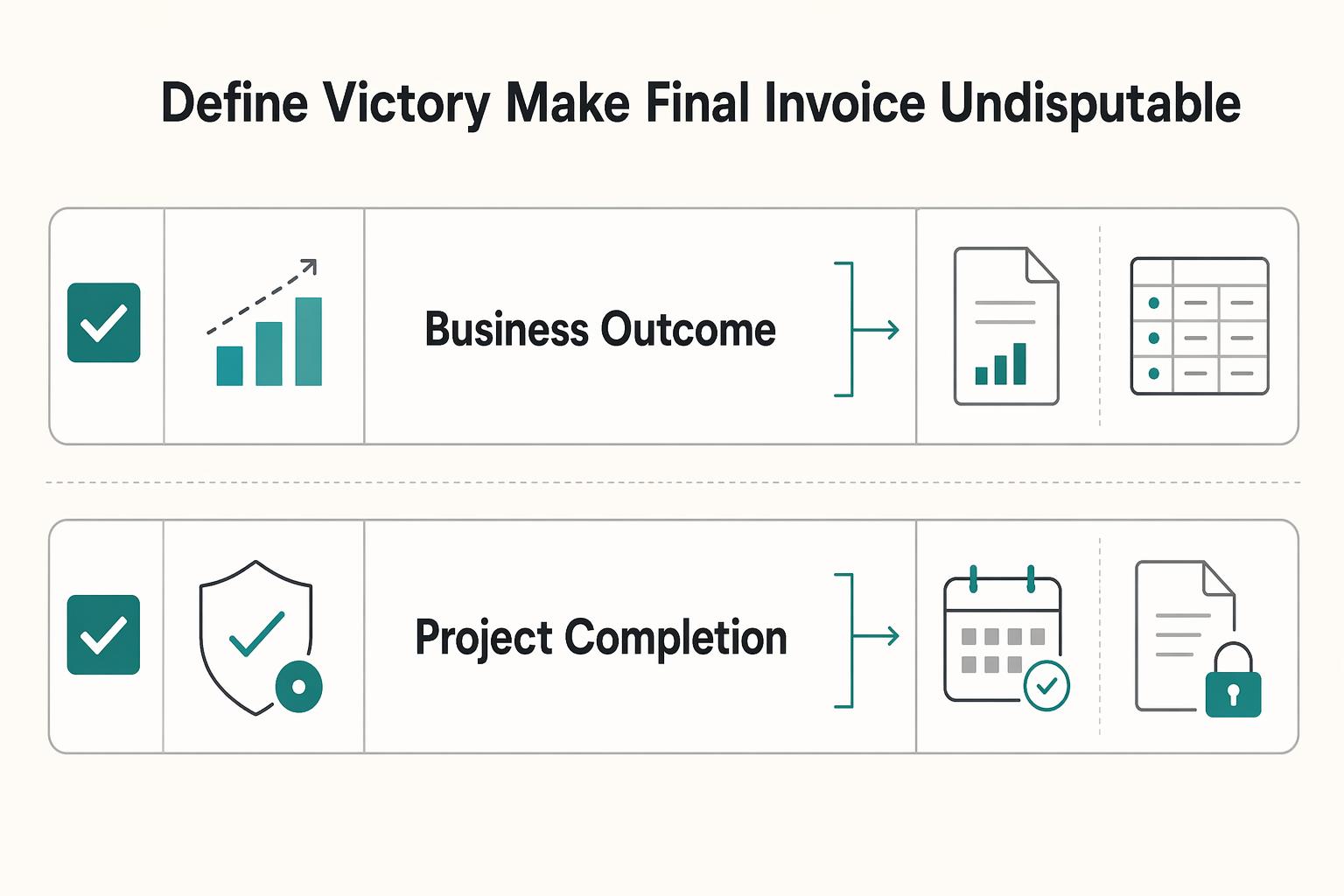
Define completion before production starts, and treat approval as a formal checkpoint, not a mood check. Keep business outcomes visible, but only use approval triggers that have a named owner and a clear record.
Step 1. Separate business outcomes from approval checkpoints. Track outcome goals and project acceptance separately so sign-off stays clear.
| Measure type | Primary owner | Evidence to keep | Use for phase sign-off? |
|---|---|---|---|
| Business outcome | Usually shared | Reporting notes and owner | Only if explicitly agreed in advance |
| Project completion | Project team + named approver | Submission record, package/file match, and approval record | Yes |
Step 2. Use a short request-for-approval flow. For each phase, send a direct approval request to the decision-maker or stakeholder, and name the exact deliverable in the subject line. Keep the approval channel explicit in the brief (for example, email, project tool, or signed document), and save the acknowledgement record.
Step 3. Make Definition of Done pass/fail. Write checks an external reviewer can verify without interpretation.
- Deliverables were submitted as scoped.
- Package and file requirements match the brief.
- Approval came from the named approver in the valid channel.
- The approval acknowledgement is saved.
Step 4. Close out in an invoice-ready order. Complete handoff in sequence, confirm closure in writing, and tie the final invoice to completed work plus recorded acceptance evidence. If ownership transfer is part of your agreement, document it clearly in writing rather than relying on assumption; this written, signed transfer document is one reference point.
Conclusion: You Are the Architect of Your Success#
Treat the brief as the decision point before work starts, not a recap after everyone is already moving. If you want the practical answer to how to write a creative brief, keep it in this order: value, scope, victory, then change control. If any one of those is still fuzzy, pause before production.
-
Write the objective. Explain why the design is needed, who it is for, and what success should look like. Your check: can someone outside the original conversation read one line and understand the goal without guessing? If they cannot, you do not have clarity yet.
-
List deliverables so they can be audited. Name the outputs, quantities, formats, and any budget or schedule checkpoints that need agreement. Your check: could a client compare the final files against the brief and confirm whether the work matches? Vague labels like "brand assets" or "campaign design" make alignment harder and are harder to review at sign-off.
-
Define completion with evidence. Decide what will count as complete before kickoff. Your check: at closeout, can you show the documented deliverables and what was delivered together in one place? If your handoff needs a client-specific artifact list, leave that list pending until it is verified against the current client, scope, contract, source documents, or project records before use.
-
Capture changes in writing before you continue. Brief details can change during execution, but the update should be visible and dated. Your check: every scope, schedule, or budget shift has a written note showing what changed and when.
That is the real risk control. Before you start, confirm how decisions and updates will be documented, and name the deliverable evidence you will keep. If you need adjacent docs, pair the brief with a clear scope of work. If you are still shaping the sell-in, add a stronger project proposal. For a step-by-step walkthrough, see How to Write a Scope of Work for a HubSpot Implementation Project.
Frequently Asked Questions
What should a creative brief actually do?
A creative brief should define the project's scope and goals and outline the key elements needed for execution. It should give direction, not lock in the creative concept too early.
When should the brief be finalized?
Finalize it during project initiation and get stakeholder agreement before kickoff. That timing helps teams align on objectives, requirements, and deliverables before work begins. If you have not seen the brief before the kickoff meeting, ask to review it first rather than trying to decode it live.
What if the client has not given enough input?
Do not fill the gaps with assumptions. Use an intake form and collect information in three groups: requester info, high-level project info, and detailed requirements. If key context is still missing, flag it and gather it before creative execution.
How is a creative brief different from a Statement of Work or a change order?
The brief aligns the work at the start by setting direction, scope, and goals. Treat a Statement of Work and change orders as separate project documents your team should define clearly. | Document | What is supported here | | --- | --- | | Creative brief | Sets direction, scope, goals, and key elements; supports early stakeholder alignment | | Statement of Work | Confirm with your project team | | Change order | Confirm with your project team |
What is the quickest way to avoid approval disputes later?
Get stakeholder agreement on the brief during initiation and keep objectives, requirements, deliverables, and scope explicit. Weak briefing is associated with scope misunderstandings and confusion about approval roles, so tighter briefing up front reduces avoidable confusion.
Try a related tool
Researched and edited by the Gruv editorial team. Gruv builds cross-border billing, payouts, and finance-operations software for global businesses.
Sources
Includes 2 external sources outside the trusted-domain allowlist.
- acquisition.gov/sites/default/files/archives/pdf/GSAR_Change...trusted
- ada.gov/law-and-regs/regulations/title-ii-2010-regul...trusted
- digitalcommons.usu.edu/cgi/viewcontent.cgitrusted
- ecfr.gov/current/title-28/chapter-I/part-36trusted
- fema.gov/sites/default/files/documents/fema_npd_devel...trusted
- ftc.gov/sites/default/files/documents/cases/2012/02/...trusted
- asana.com/resources/design-briefexternal
- blog.hubspot.com/marketing/creative-briefexternal
Educational content only. Not legal, tax, or financial advice.
Related Posts

Germany Freelance Visa Application Path for Freiberufler and Gewerbe
Choose your track before you collect documents. That first decision determines what your file needs to prove and which label should appear everywhere: `Freiberufler` for liberal-profession services, or `Selbständiger/Gewerbetreibender` for business and trade activity.
How to Create a Brand Style Guide for a Client
If you work alone, your guide does not need to be a full brand book. It should work as a control document. Standardize the few choices that keep coming up so your proposals, reports, invoices, decks, and delegated work look and sound like they come from the same business.

The Freelance Payment Penalty: A Modeled Audit of Platform Fees, FX Spreads, and Payout Delays
The money rarely disappears through a single, easy-to-spot fee. The real loss is stacked. A marketplace takes its commission, a processor adds a charge for international cards, a bank or payment company converts the currency at a spread, a platform holds the funds before release, and a wire sheds a little to intermediaries on the way in. Each layer looks defensible on its own, but the worker feels the combined result as a smaller deposit and a later payday.