
Quick Answer
Name the parties, attach a precise SOW, and define invoice events, due dates, acceptance and changes. Add tailored IP, liability, confidentiality, data, exit, notice and dispute terms. Read the schedules together and separate applicable tax administration from contract approval.
Draft the parties, scope and risk terms#
Start with the legal names of the client and supplier, their addresses and any company numbers. Identify who can approve changes and sign. Then make the work, payment, rights and exit terms specific enough that both sides can follow them during a dispute.
Read the main agreement, SOW, pricing schedule, redlines and recorded commitments together. Put the intended agreement into the final signed version and state which document takes precedence. Written records help reveal disagreements; a signature alone does not guarantee every term is enforceable. This guide assumes business-to-business services, since consumer engagements need different protections.
Lock down the SOW#
Write a SOW that lets a third party identify what will be delivered, which tests establish acceptance and which work is outside the fee. Include:
- objectives tied to the client outcome
- deliverables with clear form, format, and quantity
- acceptance criteria, including approver and timing
- exclusions, especially common client assumptions
- revision limits and a written Change Request path
- dependency assumptions, such as client access, feedback, assets, and sign-off timing
Use the agreed change-authorization method before adding work, and keep the approved scope, price and timing together. Written signed changes are a useful contractual default, not a claim that every oral agreement is legally ineffective. A request to fix a covered defect is not automatically chargeable new scope. Version and date the SOW, and define any ongoing support or revision limits.
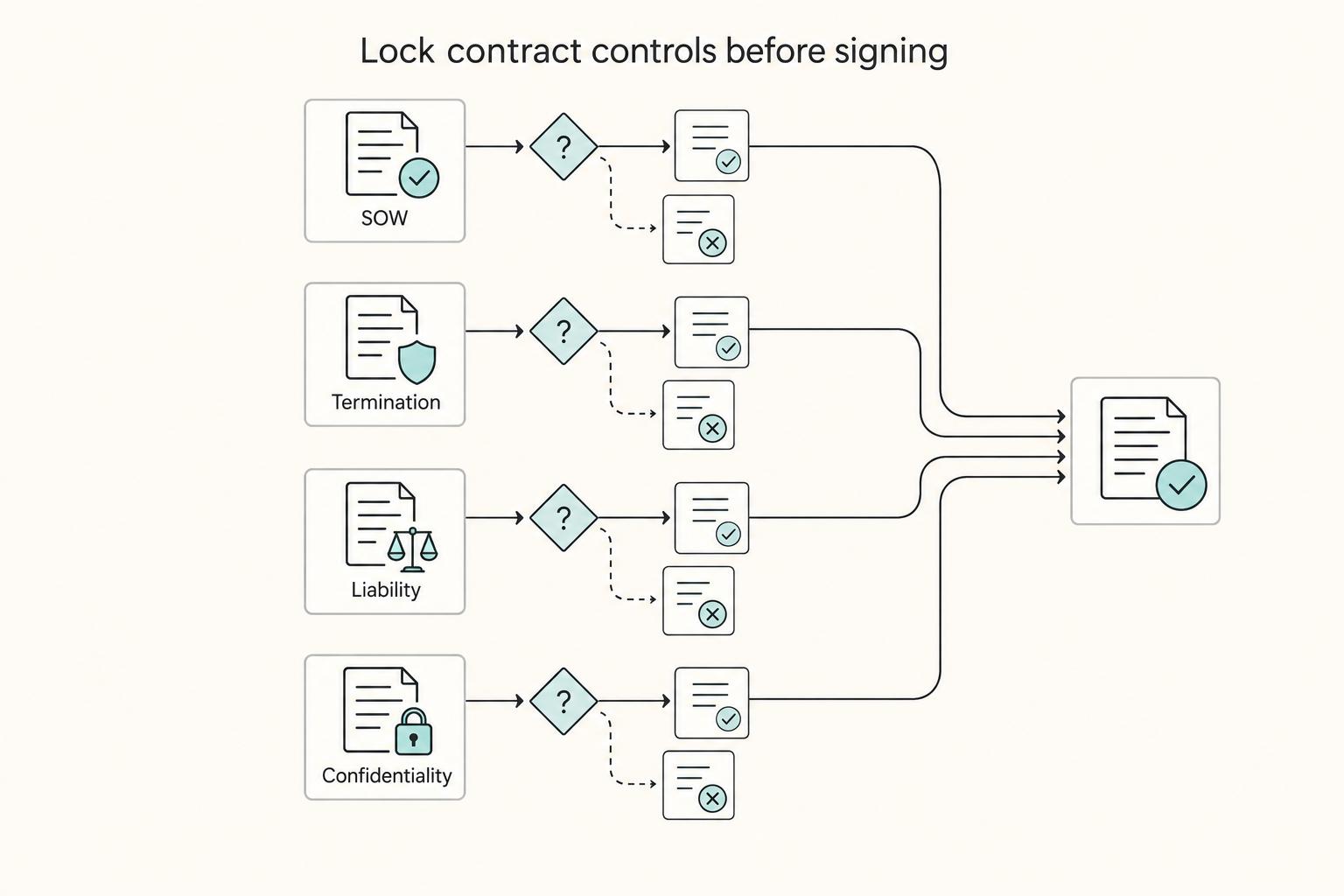
| Clause area | Ambiguous draft | Illustrative wording to complete and review |
|---|---|---|
| SOW | "You will help with the website." | "You will deliver the homepage and contact page in Figma and responsive HTML, based on the approved wireframe in Schedule 1. Two revision rounds are included. Copywriting and image licensing are excluded." |
| Termination | "Either party may end the project if needed." | Either party may terminate for convenience on [agreed number] days' written notice to [recipient and method]. The final account includes earned fees, approved non-cancellable costs and any agreed lawful cancellation charge, less payments already applied. |
| Liability | "Liability is limited." | Aggregate liability for [defined covered claims and period] is capped at [amount or precisely defined fee multiple], subject to identified carve-outs and liabilities that cannot lawfully be limited. |
| Confidentiality | "Keep information confidential." | Define Confidential Information, permitted recipients, exclusions, compelled-disclosure handling, survival [period or condition], and the return or deletion obligations that apply. |
Set the exit path#
Choose whether convenience termination is available as well as breach termination. Set any cure period, notice method and effective date; numbers from a template are not automatic UK defaults. Define:
| Exit item | What to define |
|---|---|
| Notice | Recipient, permitted method, deemed receipt, notice duration and breach cure period |
| Final invoicing | when final invoicing happens |
| Work in progress | how work in progress is treated |
| Handover | what handover is required |
| Access | Remove access after the required handover, with data and record obligations preserved |
A simple test helps here. If termination happened tomorrow, both sides should be able to say what is delivered, what is paid, and who handles handover.
Cap liability realistically#
Under UCTA 1977, death or personal injury resulting from negligence cannot be excluded or restricted, and other negligence limits are subject to reasonableness. The statutory provisions and jurisdiction matter; do not assume a cap excludes every claim.
An illustrative 125% cap on a defined £6,000 fee base is £7,500. State whether the base is fees paid, payable, one SOW or a defined period, and whether the cap is aggregate. Review indemnities and carve-outs alongside it: a separate unlimited obligation can bypass the expected protection. The figure is negotiable, not a legal safe harbor; insurance is not proof of reasonableness. England and Wales, Scotland and Northern Ireland are distinct legal jurisdictions.
Define confidentiality and data return#
Define confidential information, standard exclusions, permitted recipients and required disclosure handling. If you process personal data on the client's behalf, confidentiality alone is insufficient: ICO guidance on processor contracts covers processing scope, instructions, security, assistance, authorized sub-processors and audits. Include end-of-contract return or deletion at the controller's choice, with legally required retention addressed. Check current guidance, which the ICO marks as under review following the Data (Use and Access) Act.
Use confidentiality survival wording deliberately. A fixed period may work, but survival can also run until the information stops being confidential. Before signing, confirm where data is stored, who can access it, and whether subcontractors are bound by the same duty of confidence.
Set billing, acceptance and late-payment terms#
Once scope and exit are clear, turn them into invoice events you can actually administer. Your payment structure should match project uncertainty, approval complexity, and how much credit risk you can carry.
Cross-check invoice triggers, acceptance windows and payment deadlines across all schedules. If you are the sole-trader supplier, personal business-debt exposure matters; it does not determine whether the UK client will pay. Identify the actual supplier structure instead of assuming every reader operates a UK sole trade.
Choose the billing model that fits the job#
Pick the billing model based on how the work will actually run, not what sounds easiest when you sign. No model is automatically safer; outcomes depend on how clearly triggers and acceptance are defined.
| Billing model | Cash-flow risk | Dispute risk | Client friction | Admin overhead |
|---|---|---|---|---|
| Deposit model | Depends on how much is due before delivery | Depends on how clearly deposit scope and refund terms are defined | Depends on client policy and procurement process | Depends on how many deposit and true-up invoices you run |
| Milestone model | Depends on milestone timing and payment triggers | Depends on whether each milestone and approver is named clearly | Depends on the number of approval steps | Depends on how many milestone checks and invoices are required |
| Completion-only model | Depends on how long you fund delivery before payment is due | Depends on how clearly completion and acceptance are defined | Depends on client sign-off process | Depends on how long acceptance and collection take |
Use observable triggers only, such as kickoff, delivery of a named item, or approval by a named approver. Avoid vague triggers like "substantial completion."
Write payment terms so they are enforceable in practice#
State the invoice event, fee and currency, due date, invoice recipient, PO requirements, dispute process and permitted suspension after notice. For UK commercial payments, GOV.UK describes usual agreed limits of 30 days for public authorities and 60 days between businesses, with longer B2B periods permitted if fair. Without an agreed date, payment normally becomes late 30 days after invoice receipt or service delivery, whichever is later. Check the law's application to a cross-border contract.
Example: for a £6,000 project, an agreed £1,800 advance leaves £4,200 to be invoiced at the defined milestone. Say whether that milestone is delivery or acceptance, who reviews within how many business days, how defects are reported and what happens if feedback is late. Do not silently turn late feedback into deemed acceptance unless that is an agreed term. Record how the advance is applied so it is not charged twice.
Define termination compensation you can calculate immediately#
If the client can terminate for convenience, make the exit maths explicit before work starts. Cover at least these points:
- Trigger events: convenience termination, an agreed pause threshold, or client non-response that blocks delivery.
- Calculation basis: fees for work completed, approved non-cancellable costs, and any kill-fee method only if it is explicitly defined in the contract.
- Work product at termination: specify formats, handover and any lawful payment-dependent rights. Do not withhold client property, required data return or a deliverable already owed merely because an internal record is incomplete.
- Invoice timing: issue on the termination date, within a stated number of days, or at the next scheduled billing point.
For applicable B2B late payments, statutory interest is 8 percentage points above the applicable Bank of England base rate; check any different contractual interest remedy instead of adding both automatically. Fixed recovery compensation is £40 below £1,000, £70 from £1,000 to £9,999.99, and £100 from £10,000. Confirm applicability and calculation before demanding it. These remedies do not guarantee collection.
Keep any applicable Self Assessment calendar separate#
A UK buyer alone does not mean an overseas freelancer must register for UK Self Assessment. If you do need to file, keep tax cash available independently of client payment. For the UK 2025/26 tax year, HMRC's deadlines are:
| Checkpoint | Detail |
|---|---|
| Notify HMRC | 5 October 2026 if a 2025/26 return is required and you are newly filing or returning after not needing a 2024/25 return |
| File timing | The 2025/26 year ended 5 April 2026; a return can be sent from 6 April 2026 |
| Paper and online deadlines | Usual paper deadline 31 October 2026; online deadline 31 January 2027, subject to HMRC's applicable notice |
| Online access | Prepare the required UTR and account access; confirm whether reactivation or a different filing route is needed |
| Payment | 31 January 2027 for the balancing payment and first payment on account if applicable; second payment on account, if required, 31 July 2027 |
| Records and budgeting | Keep invoices, contracts, bank records and receipts continuously; voluntary weekly/monthly budget payments can help but do not extend due dates |
Late registration can lead HMRC to issue a later filing deadline, but does not move the stated payment deadline. Estimate the bill and maintain a buffer rather than waiting for a slow client to pay.
Choose copyright ownership and licence terms#
For freelance copyright work, the creator normally starts as owner; commissioning or paying for it does not automatically transfer copyright. IPO ownership guidance explains the employee exception and possible implied licences. Specify the rights granted rather than relying on either party's assumption. Other kinds of IP can have different rules.
Before you start: Keep the IP clause aligned with the payment clause. If your contract changes rights after final payment, say exactly what changes before and after cleared payment. Define exceptions up front so you do not promise rights you do not control:
- employment-style wording, where work created in the course of employment is treated differently
- your pre-existing materials
- third-party assets
- subcontractor contributions
Collaborative contributions can create joint ownership if they meet the authorship requirements; ordinary client feedback does not automatically make the client a co-author. Record contributors and obtain the rights needed to deliver the combined output.
Define background IP and third-party inputs#
Start by naming what you are not selling. Your templates, methods, libraries, prompt sets, design systems, and other pre-existing assets should sit inside a clear background IP carve-out.
Apply the same discipline to third-party materials. If a stock asset, font, plugin, or dataset is licensed for limited use, extra uses will need another licence. Before you sign, include a schedule listing pre-existing materials, third-party items, and any contributor other than you.
Build a transfer clause that is enforceable#
An assignment of copyright needs writing signed by or on behalf of the assignor. Signed drafting can also address future copyright under section 91 of the Copyright, Designs and Patents Act. For an exclusive licence, use signed written terms as well. Define the actual rights and conditions rather than treating a generic work-product sentence as sufficient.
| Transfer point | What to state |
|---|---|
| What transfers | specify deliverables and rights, including whether source or editable files are included |
| When transfer happens | state the trigger clearly in the contract |
| Payment condition | if transfer depends on cleared payment, state that explicitly |
| What remains with you until transfer | drafts, working files, background IP, and unassigned materials |
| Client editing or adaptation | include that right expressly in the assignment or licence terms |
Pick the ownership model that fits the deal#
Choose the model based on what the client actually needs, not on habit.
| Model | Ownership outcome | Your reuse rights | Exclusivity | Modification rights | Territory/media scope | Best fit |
|---|---|---|---|---|---|---|
| Assignment | Client owns the rights you assign, all or part, including limited duration if drafted that way | Usually none for assigned rights unless reserved | Exclusive ownership of the assigned scope | Depends on the rights assigned; identify any retained restrictions | Can be broad or narrowed | One-off deliverables the client wants to own |
| Exclusive licence | You keep ownership; client gets exclusive licensed rights, including against you for that scope | Limited for exclusive scope | High for licensed scope | Include expressly if needed | Easy to limit by use, territory, media, and term | Client needs exclusivity without full transfer |
| Limited licence | You keep ownership; client gets only stated permissions | Retained subject to the licensed scope and confidentiality | State whether non-exclusive; limited scope does not itself decide exclusivity | Only if granted | Easy to limit by campaign, platform, or term | Reusable content, templates, training assets |
If you keep background components, give the client the licence needed to use the delivered work containing them. A carve-out without that permission can make the paid deliverable unusable. Specify duration, territory, permitted modifications and sublicensing needs.
Cover moral rights, portfolio use and contributor paperwork#
Specify any evaluation licence before final payment, the rights that change on payment, and the included source or editable files. A payment condition does not automatically erase an implied licence or other existing obligation.
- Moral rights: separate from economic rights; not assignable; any waiver must be written and signed.
- Background IP carve-out: reserve your pre-existing tools, methods, and reusable components.
- Portfolio use: get express permission if you want to show the work later.
Keep a clean evidence file: signed contract, IP schedule, third-party licences, subcontractor IP paperwork, and proof of final payment if transfer depends on payment clearance.
Address the actual cross-border engagement#
For cross-border work, treat the contract as an operations checklist. Confirm who is contracting, then separate UK filing checkpoints from contract and tax items that need jurisdiction-specific verification.
Confirm entity, signatory and working status#
Use the actual supplier and client legal entities, company details where relevant, addresses and authorized signatories. If the supplier is a company, contract with that company rather than casually substituting its owner. Limited liability is not protection from every personal guarantee or personal wrongdoing.
Where services are supplied through the worker's own intermediary, assess off-payroll working. Public-sector and medium/large private or voluntary-sector clients generally make the status determination with reasons and reasonable care; for small private-sector clients, the intermediary generally remains responsible. Actual working practices matter alongside the contract. Simply labelling a worker independent or outsourcing all tax responsibility does not establish status. Confirm the applicable rules and client size; direct sole-trader engagements use the relevant employment-status rules instead.
Build the dispute clause from components, not copy-paste#
Do not assume one default forum fits every deal. Build this part explicitly, but treat final wording as legal-review work for the jurisdictions involved:
- The named governing legal system, such as England and Wales; UK law alone can be ambiguous.
- Courts with agreed jurisdiction, or a properly specified arbitration seat, rules and forum if arbitration is chosen.
- Negotiation or mediation steps and deadlines, including treatment of urgent applications.
- Whether the resulting judgment or award can be enforced where the counterparty's assets are located; a forum clause does not guarantee recovery.
Before signing, make sure these terms are reviewed for the actual contracting entity and where enforcement may be needed.
Treat tax wording as verified, scenario-specific drafting#
Tax wording is not a template exercise. Do not assume one cross-border tax clause applies in every case; confirm the exact treatment for the service and parties in scope before finalizing contract or invoice wording.
Define whether fees include or exclude VAT or similar taxes, what invoice information is required and how any legally required withholding is documented. Get advice for mixed supplies, reimbursed costs or cross-border billing rather than inventing a universal tax clause. If UK residence matters, consult the Statutory Residence Test guide; HMRC's standard online return may not fit a non-resident case, for which commercial software or paper supplementary pages may be needed.
Fix payment mechanics in writing#
| Decision area | What to state in the contract | Risk if vague |
|---|---|---|
| Invoice currency | Currency used on the invoice | Payment or reconciliation disputes |
| Settlement currency | Currency that must arrive in your account | Payment or reconciliation disputes |
| Payment rail | Bank transfer or payment platform, with account details | Payment or reconciliation disputes |
| Transfer and intermediary fees | Which party pays each fee type | Payment or reconciliation disputes |
| FX and receipt | Agreed conversion basis, receipt event and handling of shortfalls | An initiated transfer or net receipt may not satisfy the intended amount |
Pre-sign cross-border checks:
- Check the actual service's regulatory, tax and data-transfer requirements; a general compliance promise does not supply permission.
- Confirm contracting names and signing authority, and resolve contradictory schedule terms.
- Retain approvals, delivery evidence, notices, payment allocation and signed versions for the engagement.
Review the complete draft before signature#
Read the main agreement and schedules together, then test one delivery, one extra-work request and one early termination. Both parties should be able to identify the payment amount, rights and next permitted action without guessing.
- Confirm party names, signatories, supplier structure and the governing legal system.
- Match every priced deliverable to the SOW, acceptance process and dependencies.
- Check invoice events, amounts, due dates, notice requirements and payment allocation.
- Read the cap, exclusions and indemnities together; confirm IP rights and any payment condition.
- Confirm confidentiality, applicable processor terms, end-of-contract handling and disputes.
- Store one agreed execution version and its schedules; track any applicable tax deadlines separately.
Resolve material contradictions before signing or enabling the affected work. Keep approved changes and notices with the same project record, and reassess status or data arrangements if actual working practices change.
Frequently Asked Questions
What clauses should you put in a UK freelance contract?
Include party identity, SOW, price and payment dates, acceptance and changes, IP rights, confidentiality and data processing, liability, suspension and termination, notices, governing law and disputes. Tailor the set to the service rather than treating every template clause as necessary or valid.
How should you handle enforcement if the client breaches the contract?
Preserve the signed documents, performance evidence and invoice history. Identify the breached term, amount or remedy, then follow notice and cure requirements. Verify the governing law, court or arbitration route and enforcement practicality before formal action. A breach does not automatically permit stopping every duty.
Who owns the intellectual property in your freelance agreement?
For freelance copyright work, the creator normally owns initially unless rights are validly transferred; commissioned work may carry an implied licence. Identify assignment or licence scope, signed formalities, background and third-party inputs, and any payment trigger. Employment and joint creation can change the starting position.
Can you draft the agreement yourself without a lawyer?
You can draft the commercial terms yourself. Seek review for material liability, indemnities, IP transfers, data processing, unusual termination charges or cross-border enforcement. A company is separate from its owner, but personal guarantees and other exceptions can create exposure; do not assume it limits every loss to the original investment.
What makes a statement of work good enough to control scope?
Name deliverables, formats, quantities, acceptance tests and approver, review window, exclusions, included revisions, client dependencies and change authority. Ensure the price and milestone schedule match it, including what happens when client feedback is late.
What should you do differently for a cross-border client?
Confirm both entities, the governing legal system, dispute and enforcement route, invoice and settlement currencies, FX basis, fees and receipt condition. Separately assess applicable taxes, working status and data transfers. A UK client address alone does not establish the overseas supplier's UK filing duties.
What should you check on the tax and admin side before sending the contract or first invoice?
Check the actual supplier structure, tax position and VAT treatment, plus any employment-status or intermediary rules. For UK Self Assessment, HMRC's return criteria include sole-trader income over £1,000 before reliefs; other reasons can require a return below that figure. Prepare registration/reactivation and filing access if applicable, while keeping ordinary invoice and contract records. Tax administration does not itself approve the commercial contract.
What filing dates should you keep in mind once work starts?
For a required 2025/26 return, use the dated deadline table above, including the separate paper, online and payment dates. Confirm any HMRC notice for your case and payments on account. A missing final profit figure or unpaid client invoice is not permission to ignore a filing deadline.
Try a related tool
Researched and edited by the Gruv editorial team. Gruv builds cross-border billing, payouts, and finance-operations software for global businesses.
Sources
Includes 3 external sources outside the trusted-domain allowlist.
Educational content only. Not legal, tax, or financial advice.
Related Posts

Understanding the UK's Statutory Residence Test (SRT)
Treat SRT like ops, not folklore. You want a repeatable workflow you can run monthly so your tax-year answer is boring, documented, and easy to defend.

The Freelance Payment Penalty: A Modeled Audit of Platform Fees, FX Spreads, and Payout Delays
The money rarely disappears through a single, easy-to-spot fee. The real loss is stacked. A marketplace takes its commission, a processor adds a charge for international cards, a bank or payment company converts the currency at a spread, a platform holds the funds before release, and a wire sheds a little to intermediaries on the way in. Each layer looks defensible on its own, but the worker feels the combined result as a smaller deposit and a later payday.

How to Respond to a Subpoena for Business Records
Move fast, but do not produce records on instinct. If you need to **respond to a subpoena for business records**, your immediate job is to control deadlines, preserve records, and make any later production defensible.