
Quick Answer
Start with a three-phase saas cold email sequence: pre-send qualification, value-led touches, and commercial handoff. Do not send anything until checkpoint zero is complete (sending domain setup and warm-up). Build each opener from one verified signal and one owner role, then keep it tight with a 50-125 word body and a 4-7 word subject line. For follow-ups, assign separate jobs (insight, resource, perspective shift) and skip any touch that adds no new value.
For a high-end solo professional, business development often feels like a paradox. Your expertise supports premium fees, yet the process of winning new clients can still feel imprecise, undignified, and wasteful. Conventional cold outreach, with its templates and volume game, is not just weak at the top of the market. It can also damage the asset you depend on most: your reputation.
This is not a guide to writing better cold emails. It is a practical way to replace that model altogether. The High-Value Outreach Protocol gives a Business-of-One a more controlled, value-led approach to client acquisition. It rests on one principle: you do not ask for a meeting. You earn the right to a conversation.
Phase 1: The Pre-Flight Protocol - Your Framework for Risk-Free Targeting#
Targeting is the first real send gate. Before you build any sequence, you should be able to show why this company, this role, and this moment make sense. If you cannot, you are not ready to send.
Before you start: confirm checkpoint zero is handled. Infrastructure comes first in cold email execution, so your sending domain setup and warm-up should be in place before campaigns go live. If that work is still in progress, keep researching and segmenting, but do not queue live outreach yet.
Step 1. Map each prospect to strategic fit#
Your list should not start with industry and headcount alone. A practical template is a one-page record with four fields: product stage, likely pain category, buying motion, and owner role. The point is not to build a perfect taxonomy. It is to force a clear judgment about who owns the problem and whether your message will feel relevant.
In practice, that might look like: "expanding product, activation problem, hybrid buying motion, likely owner is Head of Growth." Or: "maturing product, retention problem, sales-led motion, likely owner is Customer Success leader." The exact labels matter less than the discipline of choosing them before you write.
Your verification point is simple: can you explain in one sentence why that role should care right now? If not, the account is still too fuzzy. A common failure mode is confusing company fit with role fit. A strong brand, a familiar SaaS category, or a recent funding round can look promising even when ownership is still unclear.
| Decision factor | Volume prospecting | Account-based targeting |
|---|---|---|
| List size | Large list first, fit later | Small list first, fit before send |
| Research depth | Light, often surface-level | Deep enough to name the business issue |
| Message basis | Segment assumptions | Account evidence plus role ownership |
| Main risk | Low relevance and higher reputation drag | Slower prep, but lower relevance risk |
| Best use | Broad testing when stakes are low | High-value outreach where trust matters |
If your service is premium or reputation-sensitive, account-based targeting can be the safer default. It is slower up front, but it can reduce wasted sends and give you better material for the next phase.
Step 2. Run a send-or-hold gate#
Once you have a target account, judge it the same way every time. A compact pre-send checklist in your sheet or CRM keeps that discipline in place.
| Decision | Criterion |
|---|---|
| Send | Role ownership is clear |
| Send | The message is relevant to that role |
| Send | Your reason for writing is obvious |
| Hold | Relevance is weak |
| Hold | The role owner is still a guess |
| Hold | Your note leans on personal trivia instead of business context |
| Hold | Required compliance checks are still pending |
If the account clears the first three checks, send. If any hold condition is true, wait.
That last point matters. Add a placeholder field such as "compliance check reviewed on the review date" and fill it only after you verify current requirements with up-to-date guidance.
Step 3. Capture evidence and turn it into one outreach hypothesis#
Research matters, but only if you keep it disciplined. Personalization is strongest when it is tied to evidence, and that evidence should live in your notes, not only in your head. For each account, capture one signal, where you found it, and one hypothesis about what the recipient likely cares about.
Useful signals often come from public material such as product pages, help docs, hiring pages, customer stories, pricing changes, executive interviews, webinars, or company posts. Record the source URL, the date you saw it, and the exact line or screenshot that supports your read.
Then turn that into one outreach hypothesis tied to a stated priority: "They are hiring for onboarding roles and publishing new setup docs, so the likely priority is reducing time to value."
This is your evidence pack. It keeps you honest and gives you a clean audit trail when you revisit the account later. The main risk is over-reading weak data. Personalization has limits, and the same message can land differently with different people, so do not stack five thin clues and call it insight. One strong business signal tied to one clear owner is better than a paragraph of shallow personalization.
If you want a deeper dive, read How to Write a Cold Email That Actually Gets Clients. If you're still refining your SaaS cold email sequence, browse Gruv tools.
Phase 2: The Value-First Engagement - Building Capital, Not Just Asking for a Call#
Run your sequence as a short series of useful touches, not repeated asks for a meeting. If a message adds no new value, do not send it.
That standard protects both performance and reputation. Broad, volume-first campaigns are commonly associated with weaker reply rates, while signal-based outreach performs better. You do not need perfect personalization, but you do need a clear trigger event and a real reason to contact this person now.
Step 1. Write an insight opener around one verified priority#
Your first email should prove relevance fast. A simple three-part structure helps:
| Element | Guidance |
|---|---|
| Part 1 | Name one verified business priority |
| Part 2 | Add one relevant observation tied to that priority |
| Part 3 | End with one low-pressure next step |
| Body | 50-125 word body |
| Subject line | 4-7 word subject line |
For example, if the company is hiring onboarding roles or publishing new setup docs, connect that signal to time-to-value or activation risk, then offer one practical asset such as a short teardown, benchmark note, or two-page brief.
Keep the message plain text, mobile-friendly, and short. A 50-125 word body and a 4-7 word subject line are practical constraints.
Check yourself before sending: can you point to the exact signal in your notes and explain the "why now"? If not, your opener is still generic.
Step 2. Give each follow-up a different job#
Follow-ups work when each one moves the conversation forward. Use a structured sequence, not repetitive chasing:
- Touch 1, insight: your initial observation tied to a verified priority.
- Touch 2, resource: one relevant asset such as a third-party resource, customer example, or teardown.
- Touch 3, perspective shift: one reframing point such as speed vs retention, activation vs support load, or self-serve vs sales assist.
Use one strict operating rule: do not send if there is no new value. "Just bumping this" is not value. Repeating the same CTA with new wording is not value. If you only have a reminder, pause and wait for a new signal.
Keep one clear CTA per email to reduce friction.
| CTA option | Best use in SaaS outreach | Why it works |
|---|---|---|
| "Happy to send a 2-page teardown of your current onboarding path." | When your observation is tied to activation, conversion, or setup friction | Gives immediate value without asking for a call |
| "I can share three benchmark patterns we see in trial-to-paid flows." | When you have cross-account pattern insight | Positions you as useful peer input, not a demo request |
| "If useful, I can send two non-competing examples worth reviewing." | When external reference points would help their evaluation | Low-pressure next step that is easy to accept |
| "Open to me sending a short checklist your team can review internally?" | When they are early-stage and not ready to meet | Lets them act asynchronously with low commitment |
Step 3. Close the loop before you become noise#
If the sequence does not convert, close it cleanly. Treat the breakup email as reputation protection, not a tactic.
Send it only after your planned touches are complete, and insert verified cadence details from your CRM or sending tool. Keep it short:
"Seems this is not a priority right now, so I will close the loop here. I sent [X] notes over [Y period] because I thought the [verified priority] work might be relevant. If that changes, I am happy to send the [brief/checklist/teardown]."
This keeps your record clean, respects inbox attention, and leaves the door open without forcing momentum. Related: Sole Trader vs. Limited Company: A Guide for UK Freelancers.
Phase 3: The Commercial Transition - From Conversation to Contract#
When a prospect shows real intent, your job is to make the buying path easy to trust. Use a simple handoff workflow: confirm fit, define scope boundaries, align on outcomes, then invite a formal proposal.
Step 1. Confirm fit before you price#
Do not send pricing until you can clearly state what is applicable in this deal. If fit is still vague, the proposal becomes guesswork and the gaps usually surface during legal, procurement, or finance review.
Before you move to commercial terms, ask a simple question: what actually needs review in this deal, and what does not? Capture that in your notes before you draft anything formal.
Verification point: confirm four items first: the business problem, the buyer-side owner, the likely commercial path, and unresolved blockers.
Step 2. Define scope boundaries and outcomes in plain language#
Before you invite signature, put clear edges around the work. A short statement of work or proposal draft should separate included vs excluded work, name dependencies, and define what "done" means.
Keep outcomes concrete without inventing results you cannot prove. Name the deliverable, the decision it supports, and who signs off.
If discovery keeps expanding, pause and restate scope before sending commercial terms.
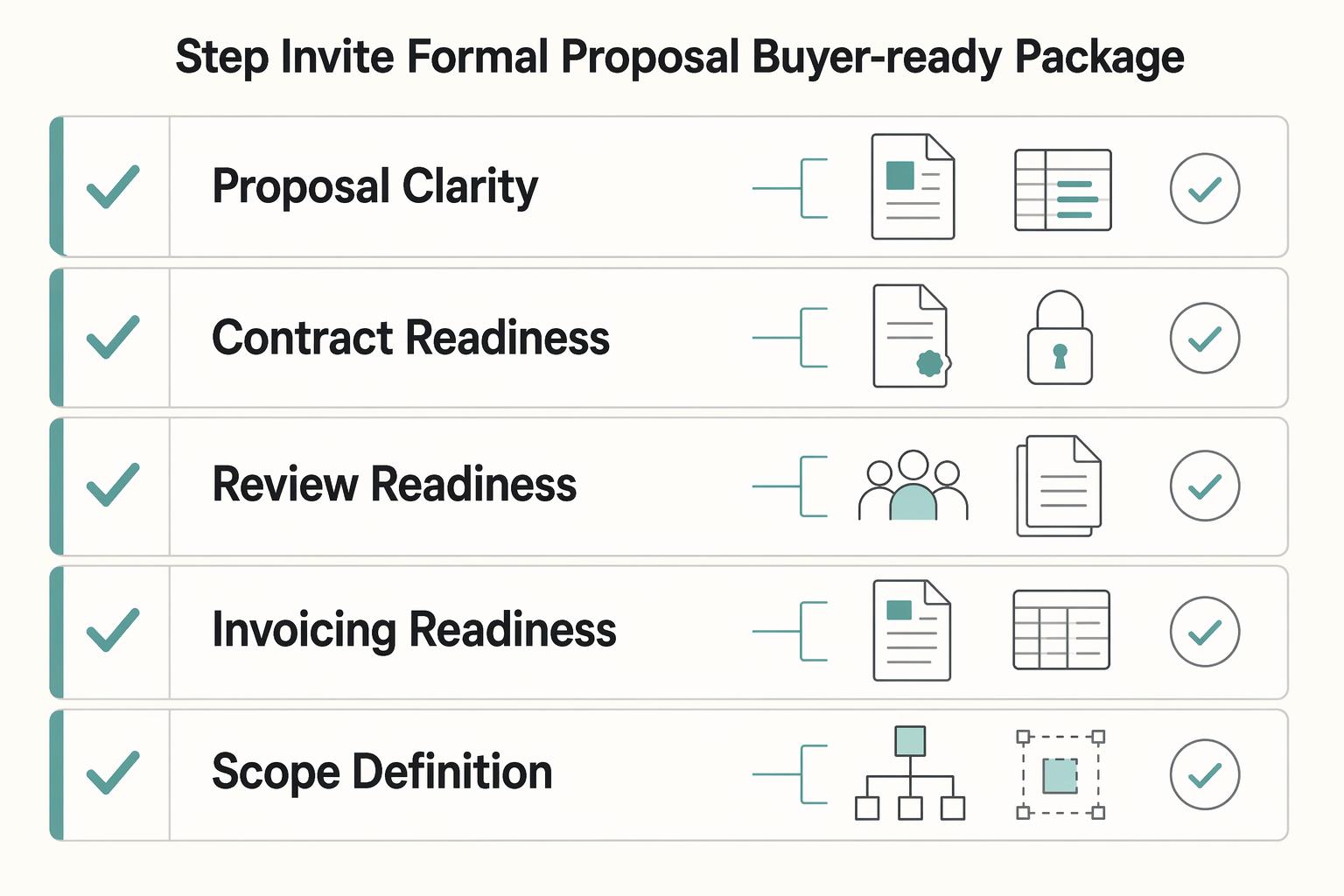
Step 3. Invite the formal proposal with a buyer-ready package#
When fit and scope are clear, move to a low-friction handoff: "If useful, I can send a formal proposal and the supporting documents your team needs for review."
| Package area | Included details |
|---|---|
| Proposal clarity | Scope, exclusions, outcomes, timeline, pricing model, and the exact approval you are requesting |
| Contract readiness | Services agreement or statement of work draft, plus a note on whether data handling terms need review |
| Review readiness | Security review touchpoint and procurement handoff notes; if unknown, use placeholders like [security contact after verification] |
| Invoicing readiness | Your legal entity details, the buyer billing contact path, and verified cross-border placeholders such as [jurisdiction], [required tax wording], [tax ID field], and [current threshold after verification] |
Keep legal and finance contacts explicit. Formal filings do this with designated legal-contact blocks; your version can be simpler, but the principle is the same.
| Handoff area | Risky handoff | Smooth handoff |
|---|---|---|
| Scope definition | Pricing shared before scope and exclusions are documented | Statement of work or proposal draft shows inclusions, exclusions, and dependencies |
| Legal review | Contract sent without a named owner or review path | Legal owner is identified, and data handling review is flagged early when relevant |
| Finance processing | Billing details appear only at invoicing stage | Billing contact path, entity details, and vendor setup needs are captured before kickoff |
| Cross-border admin | Tax and invoicing language is assumed | Jurisdiction-specific wording and thresholds are inserted only after verification |
If ownership for legal, procurement, or finance is still unknown, treat that as a blocker to resolve before requesting signature.
You might also find this useful: Best Lead Generation Tools for B2B SaaS Operators.
Conclusion: Apply the Same Outreach Discipline to Every Send#
Those FAQ rules matter only if you apply them every time. Your reputation is an operating asset, so treat outreach as something you protect on purpose, not something you improvise when pipeline looks thin.
| Area | Reactive outreach | Protocol-led outreach |
|---|---|---|
| Targeting quality | Generic list pulls and loose fit | Specific research and clear role relevance |
| Response quality | Weak opener, broad ask, repeated nudges | Fast relevance, concise copy, low-friction CTA |
| Conversion quality | Replies stall because the handoff is vague | Follow-ups restate the outcome and add new context |
Step 1: Tighten targeting before you write. In Phase 1, the outcome is better targeting quality. The practical test is simple: can you point to one specific reason this person fits now, not just in theory? If your opener sounds like flattery instead of research, it will read like spray-and-pray outreach, and that is where credibility starts to slip.
Step 2: Earn the reply quickly. In Phase 2, the outcome is stronger response quality. Before you send, check the three things the prospect sees first: sender name, subject line, and opening preview. You have roughly 6 seconds after open to prove relevance. Keep each email short, make the first line specific, and end with a low-friction ask such as a quick yes-or-no reply or a 15-minute call.
Step 3: Make the next step easy to trust. In Phase 3, the outcome is smoother conversion quality. Once you get a reply, stop nudging and start reducing friction. Every follow-up should add new context rather than repeat the same ask, and the next step should be clear and easy to understand. If you scale generic sends from your primary domain or keep chasing without added value, you increase deliverability risk and are more likely to be ignored.
Make this a repeatable operating discipline for your sequence. Hold every send to the same checklist: consistent research, concise copy, low-friction CTAs, and follow-ups that add new context.
For a step-by-step walkthrough, see How to Build a Waitlist for Your SaaS Product Launch.
Frequently Asked Questions
What is a better CTA than "book a demo"?
Ask for the smallest next step that still helps the buyer decide. In a SaaS cold email sequence, that usually means a low-friction CTA such as a quick yes-or-no reply or a short call. If your ask needs a calendar commitment before you have earned interest, it is probably too heavy.
How many follow-ups are too many?
Use a decision rule, not a magic number: keep following up only while each touch adds new context. One common schedule is Day 2, 5, 10, 17, 22, and 30, while another uses 4 to 6 follow-ups every 2 to 4 business days. Verify timing against your segment and sales cycle. Past touch 7, returns usually drop, so change channel, pause, or close the loop instead of repeating the same ask.
How do you keep B2B outreach compliant?
Avoid universal legal claims. Requirements vary by jurisdiction, so verify the rules that apply before sending. In practice, keep outreach tightly relevant to your ICP and the trigger event behind the message, and document your rationale internally.
How do you build trust, not just earn an open?
Lead with a problem signal the prospect will recognize, then add one contextual insight tied to their market, team, or recent trigger event. Back it with relevant evidence you can actually show, such as a short teardown or a benchmark caveated for like-for-like comparison. If your email talks more about features than the buyer's situation, rewrite it.
What metrics should you actually track?
Compare like-for-like datasets before judging your numbers. SMB SaaS often replies better than enterprise, so benchmark by segment, not by internet averages. | Metric | Signal type | What you do next | |---|---|---| | Open rate | Weak directional signal | Check subject lines and deliverability, but do not judge sequence quality from this alone | | Reply rate | Decision-useful pipeline signal | Use SaaS bands as a rough check: under 1.5%, 1.5 to 3%, 3 to 5%, 5%+; if low, tighten ICP and message relevance | | Meeting booked rate | Strong conversion signal | Compare against SaaS bands under 0.3%, 0.3 to 1%, 1 to 2%, 2%+; if replies are fine but meetings are low, fix your CTA | | Bounce rate | Deliverability health signal | If you are above 5%, pause list expansion and verify data quality before sending more |
Try a related tool
Researched and edited by the Gruv editorial team. Gruv builds cross-border billing, payouts, and finance-operations software for global businesses.
Sources
Includes 3 external sources outside the trusted-domain allowlist.
- catalog.dunwoody.edu/catalog-student-handbook/previous-college-ca...trusted
- knowledge.wharton.upenn.edu/where-ai-works-showtrusted
- law.utexas.edu/faculty/uploads/publication_files/ball-e-dis...trusted
- nlp.stanford.edu/~lmthang/morphoNLM/cwCsmRNN.wordstrusted
- sec.gov/Archives/edgar/data/1886190/0001193125213338...trusted
- autobound.ai/blog/cold-email-guide-2026external
- blog.sendspark.com/cold-email-follow-upexternal
- cognism.com/blog/email-sequenceexternal
Educational content only. Not legal, tax, or financial advice.
Related Posts
How to Write a Cold Email That Actually Gets Clients
If you want this channel to produce clients, track movement through your pipeline, not noise in your inbox. The goal is simple: move the right prospects from researched to contacted to qualified reply to booked call to signed project.

Sole Trader vs Limited Company UK for Freelancers
If you need a practical starting rule, choose sole trader for a faster start and lighter admin. Choose a limited company when legal separation and company-level compliance are worth the extra work.
How Independent Professionals Build HubSpot Sales Cadences
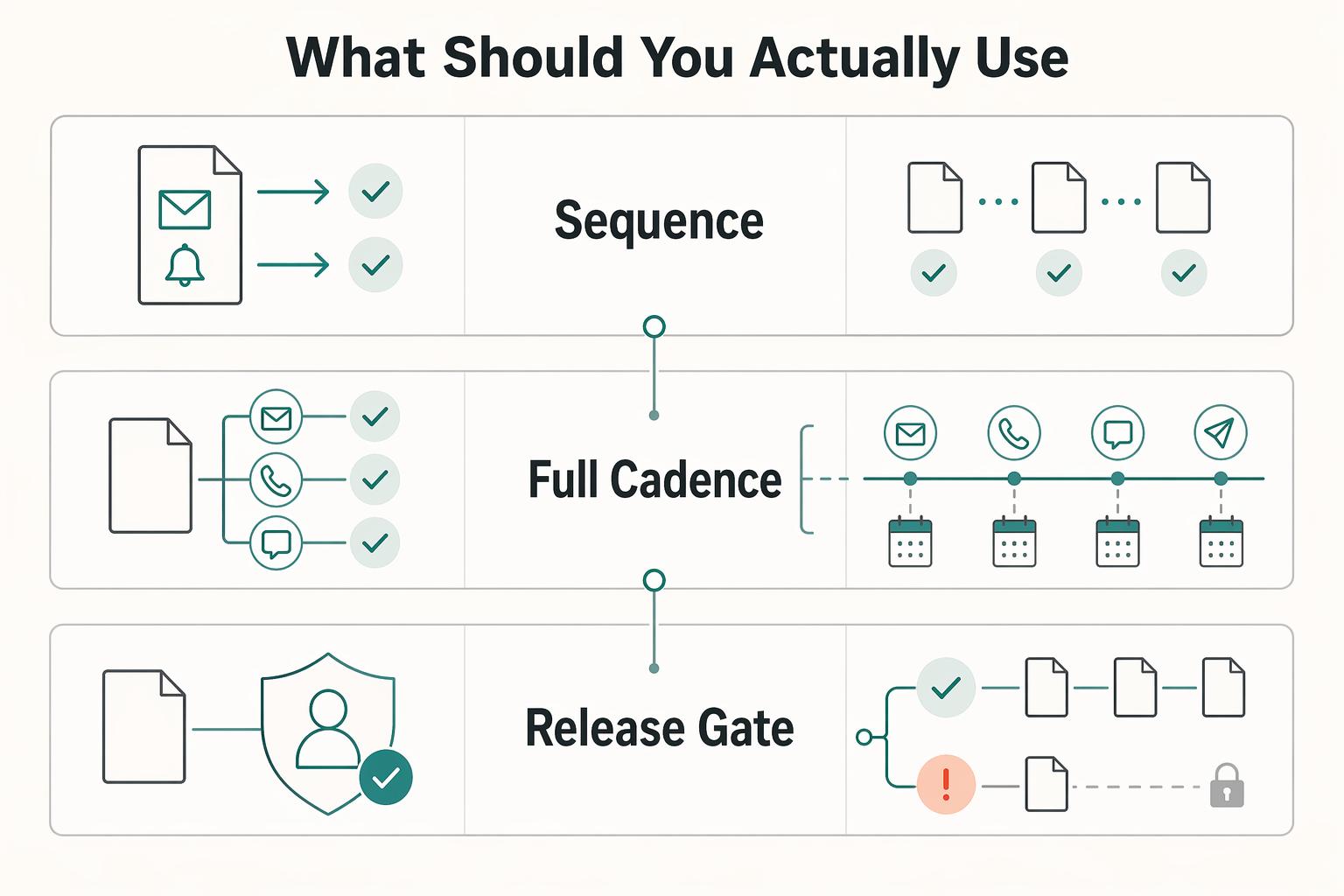
**A HubSpot Sequence is a tool. Your sales cadence is the client acquisition system around it.** HubSpot sales cadences become useful when you treat the cadence as the real decision layer: who qualifies, which channels you use, when each touch happens, and what each message is meant to do.