
Quick Answer
Start by treating the proposal as a business case, then build it in sequence: market proof, author-market fit, product proof, and submission fit. For how to write a book proposal, your core package is an overview, an annotated chapter outline, and sample chapters that stay consistent on audience and promise. Finish with recipient-specific compliance checks so name, materials, file format, and positioning all match the current submission page.
Your Book Isn't a Manuscript; It's a Business. Here's How to Pitch It.#
A nonfiction book proposal is not just a request for approval. It is a business case. An editor is weighing acquisition risk: is there a clear need, a reachable audience, a distinct concept, and an author who can help sell the book?
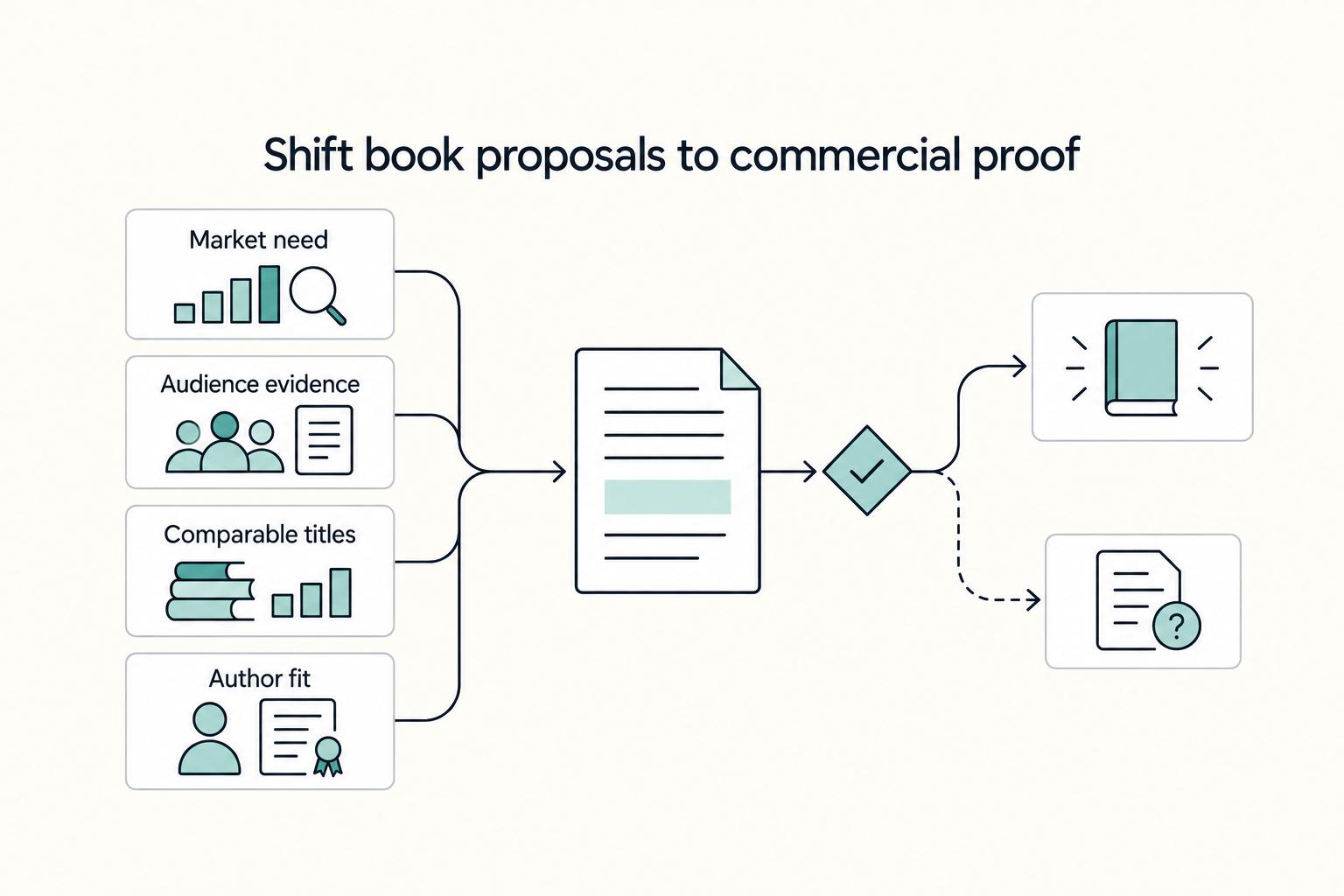
Step 1. Shift from creative pitch to commercial proof#
If you are figuring out how to write a book proposal, start by changing the job the document needs to do. For nonfiction, the proposal can sell the book before most of the manuscript exists. Even if your manuscript is already done, you may still be asked for a proposal, so do not treat it as optional.
| Creative pitch | Business case |
|---|---|
| "Here is my idea." | "Here is why this book should exist now." |
| Relies on passion and voice | Relies on need, audience, comparables, and author fit |
| Centers the manuscript | Centers the concept, market, and sales potential |
Before you draft, run one quick check: can you explain the hook in one sentence, name comparable books, and say what is meaningfully different about yours? If not, stop there. A weak or flabby concept is a common proposal failure mode.
Step 2. Gather proof before writing proposal pages#
Do the research first. A proposal is much easier to write when you gather the inputs before you start shaping pages.
- audience proof: who the book is for and what need it serves
- positioning: comparable published books and your point of difference
- author credibility: why you are the right person to write it
- launch capability: the channels, network, or platform you can realistically use
Then pressure-test the four pillars: define the topic clearly, prove the need, name the audience specifically, and document why you are the right author. Verify submission guidelines before you format anything. Expectations vary by publisher, and common guidance ranges from about 10 to 25 pages to 15 to 50 pages, with complex proposals running longer once sample chapters are included. Once that foundation is in place, your next job is to prove the market opportunity behind the concept.
If you want a deeper dive, read How to Write a Book to Establish Your Freelance Expertise.
The Market Opportunity: Prove Your Book Is a "Why Now" Investment#
Your goal in this section is to reduce acquisition risk with proof, not opinion. Show four things in order: who the book is for, where demand is visible, what existing books miss, and why that gap is commercially real now.
Publishers may invest tens of thousands of dollars in a concept, so broad enthusiasm is not enough. Build your case as a sequence, not a pile of disconnected data points.
Before you start#
Create a simple evidence pack before drafting:
- source links
- date checked
- screenshots for numbers that may change
- one-line interpretation of what each signal means
This keeps your overview sharp when an agent or editor scans the highest-priority sections first.
Step 1. Define the audience in three rings#
Use TAM, SAM, and SOM in plain language so your scope is credible:
- TAM: everyone who could care about the topic
- SAM: the subset your specific promise actually serves
- SOM: the realistic slice you can reach first with channels you already have
If your topic is broad but your method is specific, a smaller SAM is a strength. Use a practical reader test: define the audience by role, problem, and trigger, not by a vague interest label.
Common overreach to avoid: claiming the full global category as your market instead of the reachable slice.
Step 2. Validate demand with signals from at least two channels#
A solid "why now" case uses at least two demand signals from different places, each with a one-line interpretation.
- Industry associations and trade groups: membership, conference themes, certifications, annual reports. Confirm the current figure from that source. Interpretation: shows an organized audience around the problem.
- Retailer category signals: category activity, review volume on comparables, recurring subtopics. Confirm the current figure from that source. Interpretation: shows readers already buy in this area.
- Search demand tools: keyword patterns, topic clusters, trend direction. Confirm the current figure from that source. Interpretation: shows ongoing discovery behavior.
- Creator communities: newsletters, LinkedIn groups, forums, podcasts, niche communities. Confirm the current figure from that source. Interpretation: shows active conversation and language fit.
If channels conflict, say so and narrow your claim.
Step 3. Map competition so the gap is explicit#
Comparative titles should prove both market activity and unresolved need.
| Comparative title | Audience served | Promise delivered | Blind spot | Your distinct angle |
|---|---|---|---|---|
| Name a comparable title from your category research | Describe the audience that title serves | Summarize the promise that title delivers | Identify the reader gap that title leaves | State your distinct angle versus that title |
| Name a comparable title from your category research | Describe the audience that title serves | Summarize the promise that title delivers | Identify the reader gap that title leaves | State your distinct angle versus that title |
| Name a comparable title from your category research | Describe the audience that title serves | Summarize the promise that title delivers | Identify the reader gap that title leaves | State your distinct angle versus that title |
Do not attack other books. Show reader-relevant gaps.
Step 4. Show buying intent, not just interest#
Interest means attention; buying intent means people commit money, time, or professional effort. Use signals like paid trainings, workshops, event tracks, coaching offers, or repeat category purchasing behavior, and confirm the current detail from that source before citing it.
For each signal, add one sentence that translates it into acquisition logic. If you cannot explain how a metric reduces uncertainty, cut it.
Once this market proof is clear, the next test is author-market fit: why you are the right person to capture this demand.
The Founding Team: Frame Yourself as the "Why You" Expert#
After you prove demand, prove that you are the right person to reach that audience and deliver this book. This section should make your author-market fit obvious to a reader who does not know you, not just make you sound impressive.
Treat your bio and platform as risk-reduction evidence in a publisher's investment decision.
Step 1. Build a three-part proof stack#
Use proof in this order: relevant expertise, audience access, and execution history tied to this exact topic.
Relevant expertise means experience that directly matches the book's promise. Audience access means you can already reach the specific reader you defined in your market section. Execution history means you have completed adjacent work that shows discipline, such as articles, teaching, workshops, newsletters, research, or talks on this same subject.
| Weak claim | Strong proof |
|---|---|
| "I'm passionate about this topic." | "I have worked on this topic for a verified timeframe in a verified role or context, and the book grows from that work." |
| "I have a large following." | "My audience metric is documented and verifiable, and it overlaps with the defined target audience for this book." |
| "I'm a recognized expert." | "I have published, spoken, or taught consistently on this topic over a documented, verifiable timeframe." |
| "People ask me about this all the time." | "I can document a verifiable metric for workshops, replies, signups, repeat invitations, or other demand signals tied to this subject." |
Step 2. Organize platform proof by channel type#
Do not list metrics as one block. Group them by how they help you reach readers.
- Owned channels: newsletter, website, podcast, mailing list, courses. Confirm the current figure from that source.
- Borrowed channels: guest podcasts, media, partner newsletters, conferences, associations, communities. Confirm the current figure from that source.
- Conversion signals: speaking invitations, workshop registrations, replies, downloads, waitlists, repeat attendees, book-related lead magnets. Confirm the current figure from that source.
Use one filter for every metric: does it show how your platform reaches this target audience better than a generic visibility claim? If not, cut it.
Step 3. Keep only trust signals that lower risk#
Keep signals that prove topic alignment, audience relevance, and consistency over time. A niche talk in front of your exact reader can be stronger than a broad mention that does not match that audience.
If your reach is mostly local or confined to one organization, explain how you will extend beyond that so the project does not read as too narrow. Keep a small evidence pack here as well: link, date checked, screenshot for changing metrics, and one line on why the item matters.
Once your "why you" case is clear, the next test is product quality: whether the structure and sample pages show publishable thinking on the page.
The Product: Demo Your Intellectual Property with Precision#
Build this section in sequence: overview first, then annotated chapter outline, then sample chapters. Together, these pieces stand in for the finished book, so any mismatch creates immediate doubt.
Step 1. Draft the overview first#
Your overview should read like a clear sales document, not a topic description. In direct, unambiguous language, confirm five things fast: the reader problem, the promise, your approach (what sets it apart), audience fit, and why a book is the right format for this solution.
Use a quick self-check: underline one sentence for each of those five jobs. If you cannot, the overview is still too abstract and makes evaluators do extra interpretation work.
Step 2. Build the annotated chapter outline from the promise#
Turn your promise into a chapter-by-chapter outcome path. Each chapter note should state what changes for the reader, not just what the chapter is about.
| Weak chapter summary | Strong chapter summary |
|---|---|
| "Chapter 2 covers networking." | "Chapter 2 shows the reader how to turn cold industry contacts into warm follow ups using a repeatable outreach method." |
| "This chapter discusses pricing." | "This chapter helps the reader choose a pricing model, explain it clearly, and avoid common undercharging mistakes." |
| "A chapter on productivity." | "This chapter helps the reader remove the bottleneck that keeps the method from being used consistently." |
Then run a proposal-package coherence check before submission:
- Same thesis in overview, outline, and samples
- Same target reader across all three
- Same core promise, without drift in wording or scope
Step 3. Use sample chapters to prove execution#
Treat sample chapters as an execution-risk test: can you deliver this promise clearly and consistently on the page? Prioritize clarity, teachability, and a stable voice over cramming in every idea.
Polish checklist before submission:
- Open each sample with a clear reader outcome
- Keep examples concrete and easy to follow
- Use terminology consistently across sections
- Make sure each explanation matches the overview promise
Proposal effort is expensive when the package is weak, so this proof needs to be tight. Once the product proof is credible, the next test is commercial: how the book will reach readers.
The Go-to-Market Strategy: Build a Credible Sales & Marketing Plan#
Your proposal should make one thing clear: you already have a practical path to reach readers, not just a hope that promotion will appear later. In traditional nonfiction publishing, publishers look for both platform and plan, so show what you will execute, when, and what proof you can show now.
Step 1. Prioritize channels by control, then expand#
Start with channels you control directly, then layer in lower-control visibility plays.
- Owned audience (highest control): email list, newsletter, website, community, speaking touchpoints you already run
- Partner amplification (medium-high control): collaborators and organizations with an existing relationship
- Earned visibility (lower control): podcasts, newsletters, and publications that must accept your pitch
- Bulk or institutional routes (conditional): use only when your topic and current work make this realistic
Build actions across three phases: pre-launch warming, launch conversion asks, and post-launch integration into talks, workshops, or client education. If the plan depends on building your platform later, credibility drops quickly.
Step 2. Map each channel to execution proof#
| Channel | Concrete action | Evidence you can already show | Success signal |
|---|---|---|---|
| Owned audience | Pre-launch: publish topic-focused content and brief your audience. Launch: send direct buy/share asks. Post-launch: keep the book in workshops, talks, or client education. | Recent sends, active site/community, current audience baseline. Confirm the current figure from that source. | Replies, clicks, waitlist growth, or direct sales activity |
| Partner amplification | Ask existing collaborators or associations to feature the book in events, webinars, or member channels. | Prior collaboration, direct organizer access, or active relationship history. Confirm the current figure from that source. | Confirmed placements, co-promotions, or scheduled partner events |
| Earned visibility | Pitch outlets where your topic clearly fits their audience and format. | Prior guest appearances, published bylines, warm intros, or editor contacts. Confirm the current figure from that source. | Confirmed interviews, guest posts, or booked appearances |
| Bulk or institutional channels | Where relevant, package the book with training, speaking, or team learning offers. | Existing client base, workshop track record, or buyer access. Confirm the current figure from that source. | Bulk inquiries, team-session requests, or organizational interest |
Step 3. Qualify partnerships before naming them#
Only include partnerships that pass three tests: the relationship exists now, the audience matches your reader, and you can describe a realistic activation path. Replace aspirational name-dropping with concrete activation language.
If this section lacks proof, specificity, or channel fit, it reads as risk instead of de-risking. That is a common rejection trigger.
De-Risking Your Pitch: Avoid the "Red Flags" of Instant Rejection#
A strong proposal can still lose momentum if it looks generic, mismatched, or carelessly packaged. You cannot control taste or timing, but you can remove avoidable friction before you submit.
Packaging matters because agents and publishers review high volumes, and standards vary by recipient. Use this as a practical pre-submit screen, not a universal rejection formula.
| Red flag | Why it hurts | What to do instead |
|---|---|---|
| Generic submission | It signals weak research and weak target fit. | Personalize each opening for the specific recipient and include one concrete reason they are the right fit. |
| Unclear reader problem | If the audience and problem are fuzzy, the pitch reads like a personal appeal instead of a market-facing proposal. | State who the book serves and what problem it helps solve in the opening section, before longer bio context. |
| Weak comp-title fit | Irrelevant comps make positioning harder and reduce confidence in your category judgment. | Use category-relevant comps with clear audience/promise overlap. Use recent comparables, and if a recipient gives recency guidance, follow that criterion. |
| Submission or format misses | Missed instructions create avoidable friction and can signal poor execution. | Follow that recipient's exact guidelines, use standard format where requested, and make title, genre, word count, and comps easy to find. |
Run four checks on every final draft:
Personalization check:If your opener still works after a name swap, it is not specific enough.Audience-problem clarity check:A cold reader should quickly answer who the book is for and what it helps them do.Comp-title relevance check:Keep only comps that match category context and reader intent.Submission-guideline compliance check:Match required materials, order, file type, and formatting instructions exactly.
Final pre-submit checklist:
- Confirm recipient name, outlet, and personalized opening all match.
- Confirm the audience, problem, and positioning are clear early.
- Confirm comp titles are accurate and relevant.
- Confirm guidelines and standard formatting requirements are fully met.
- Confirm no typos, broken links, tracked changes, or unclear file names remain.
A polished package does not guarantee a yes, but it helps ensure preventable mistakes are not the reason for a no.
Conclusion: From Proposal to Published Asset#
A proposal is more likely to get traction when it makes the commercial case clearly enough that an agent or editor can quickly see three things: there is real market need, you are the right person to write the book, and there is a credible path to readers. That is the point of a nonfiction proposal. It is not to sound impressive. It is to reduce uncertainty for the person deciding whether to take it on.
- Finish the business case before you polish the extras.
Make your final pass through the market section, platform evidence, and go-to-market plan first. For many nonfiction projects, that case can matter more than the writing alone. Checkpoint: every audience or platform number you cite should be current and verifiable from a screenshot, export, or recent event record.
- Match the package to the live target, not to a generic template.
Proposal length varies a lot. Some common norms land around 10 to 25 pages double spaced, excluding sample chapters, while complex packages can run 50 pages or more once chapters are included. Check the target's current submission page, required materials, and whether they want a query, a proposal, pasted pages, attachments, or a form. Red flag: if they ask for a proposal, you still need one even if your manuscript is complete.
- Submit where the positioning is credible, then follow up like a professional.
If your concept may read as too narrow or too local-interest, fix that framing before you send. If your project is memoir and your platform is still thin, be realistic that proposal-only selling can be harder. Keep a simple tracking sheet with submission date, version sent, required materials, and follow-up date so your process stays clean and your positioning stays consistent.
From here, move into targeted submission and disciplined follow-through. If your next step is representation, start with A guide to 'literary agents' and how to query them. For a step-by-step walkthrough, see How to 'outline' a non-fiction book.
Frequently Asked Questions
What is the most important part of a nonfiction proposal?
If you have to choose where to spend your next five hours, spend them on marketability first. For many nonfiction decisions, the marketability of the premise, topic, or author matters more than the artfulness of the writing alone. Your strongest early materials are your market case and platform case. After that, verify the target's guidelines and package requirements.
How do you prove there is a market for your book?
Prove it with evidence you can show, not with broad enthusiasm about the topic. In practice, that means clear audience indicators, signs of reader response to the topic, and a tight publisher-fit rationale. The goal is to make your business case concrete enough for a publisher or press to evaluate.
How long should a proposal be?
Follow your target's guidelines first. Published guidance varies widely: some sources describe 10 to 25 double-spaced pages excluding sample chapters, while some press-focused guidance points to shorter proposals (such as 6-8 pages). Complex packages can run 50 pages or more once sample chapters are included. The practical check is not page count by itself. It is whether your live target wants a standard proposal document, a proposal package, or a press-specific form.
Do you need a literary agent to submit a proposal?
Not always. Direct submission workflows do exist in some contexts, including presses that require online proposal forms or other press-specific materials. Requirements vary by target, so verify each press or publisher's current submission process before you send materials. If you need help with that path, see A guide to 'literary agents' and how to query them.
Should you write the full book before the proposal?
Usually no for nonfiction, because a strong proposal can help you secure a contract before the full manuscript is written. Do not turn that into a rigid rule, though. Expectations can differ by project type, including platform-driven versus narrative nonfiction, so drafting beyond sample chapters can still be useful in some cases.
What should you expect to submit besides the proposal itself?
Assume you are preparing a proposal package, not just one document. Depending on the target, that may include 1 to 2 sample chapters, and some presses replace an open-ended document with very specific forms such as a 500-word project description and a 200-word statement on why that publisher is the right fit. Your checkpoint is simple: confirm the exact package on the target's site before you submit, because requirements are not uniform.
Try a related tool
Researched and edited by the Gruv editorial team. Gruv builds cross-border billing, payouts, and finance-operations software for global businesses.
Sources
- connect.gonzaga.edu/asset/file/293/reflective-writing.pdftrusted
- ctb.ku.edu/en/table-of-contents/assessment/assessing-co...trusted
- ecb.europa.eu/press/financial-stability-publications/fsr/h...trusted
- grinnell.edu/doc/grinnell-college-guide-writing-research-...trusted
- pmc.ncbi.nlm.nih.gov/articles/PMC8825646trusted
- research.fsu.edu/media/1268/guideproposalplanningwriting.pdftrusted
- waldenu.edu/news-and-events/publications/articles/2009/0...trusted
- wcu.edu/pmi/1998/N91NOV22.PDFtrusted
Educational content only. Not legal, tax, or financial advice.
Related Posts

How to Write a Book as a Freelancer Without Scope Drift
The book needs a defined job and a defined boundary before you draft. In this cycle, give it one job: either support your client book services, or strengthen your own authority book so your niche, offer, and sales conversations become clearer.
How to Get a Literary Agent Through a Structured Query Process
To get a literary agent, start by changing the job you think you are doing. You are not asking for permission. You are choosing a business partner for a process that is exciting, subjective, slow, and often emotionally hard, with rejection, long response times, and silence as part of the reality. That shift can lead to better fit and clearer decisions under uncertainty.

The Freelance Payment Penalty: A Modeled Audit of Platform Fees, FX Spreads, and Payout Delays
The money rarely disappears through a single, easy-to-spot fee. The real loss is stacked. A marketplace takes its commission, a processor adds a charge for international cards, a bank or payment company converts the currency at a spread, a platform holds the funds before release, and a wire sheds a little to intermediaries on the way in. Each layer looks defensible on its own, but the worker feels the combined result as a smaller deposit and a later payday.