
Quick Answer
Yes. You can use Wise to move funds from a foreign corporation, but it does not carry your tax or classification obligations. Verify the exact fee path for send, receive, convert, or card before each invoice, then keep the contract party, invoice legal name, and receiving details aligned. When you bill through an entity, submit Form W-8BEN-E to the payer early and keep the filed copy in your records.
The Real Question Isn't "How to Use Wise," It's "How to Get Paid Compliantly"#
If you're searching for wise to pay salary from foreign corp, start with your operating setup, not the app. Wise is a payment rail, but your compliance position is what protects you after payment arrives.
Use a simple boundary:
| Wise handles | You handle |
|---|---|
| Sharing receiving details so a person or business can pay from their bank | Worker classification facts and contract reality |
| Receiving funds through account details, including USD details that Wise says are not a bank account | Tax treatment, filings, and reporting obligations |
| The transfer rail itself | Invoice, contract, and payee identity consistency |
Use Wise as the rail, not as evidence that your arrangement is compliant. Classification turns on facts, not labels. IRS guidance looks at control and independence across behavioral, financial, and relationship categories, and a contract alone does not settle status. If the day-to-day reality looks like employment, contractor wording alone will not fix it.
Your exact obligations depend on jurisdiction. In U.S.-related cases, the work can include:
- Self-employed individuals generally must file annually and pay estimated taxes quarterly, and self-employment tax may apply.
- FBAR may apply to qualifying U.S. persons when aggregate foreign account values exceed $10,000 at any point in the year. The due date is April 15 with an automatic extension to October 15.
- A foreign individual paid by a U.S. payer may use W-8BEN to establish foreign status and, where applicable, claim treaty benefits.
- For 1099-NEC, treat thresholds as tax-year sensitive and verify current-year instructions before relying on one number.
To reduce misclassification risk, make your documents line up from day one:
- Signed services agreement that matches how the work is actually done
- Invoices issued under the same legal payee identity used for receiving details
- Requested tax form(s), where applicable
- Records that show deliverable-based scope rather than staff-like, open-ended duties
Do not present Wise as the compliance solution. Show a clean, consistent setup where payment routing, legal identity, and documentation line up. If you need to tighten entity-account separation, read Separating Business and Personal Finances: An Important Step for LLCs.
Once that boundary is clear, the rest gets simpler. Rail choice is tactical, while compliance design is the control layer that protects you. For a related issue, see How to Pay Foreign Property Taxes Without U.S. Tax Surprises.
Tier 1: Choosing Your Payment Rail (The Least Important Decision You'll Make)#
Treat this as a tactical filter, not your compliance strategy. Choose the rail that gets your invoice paid with the fewest surprises from send to settlement.
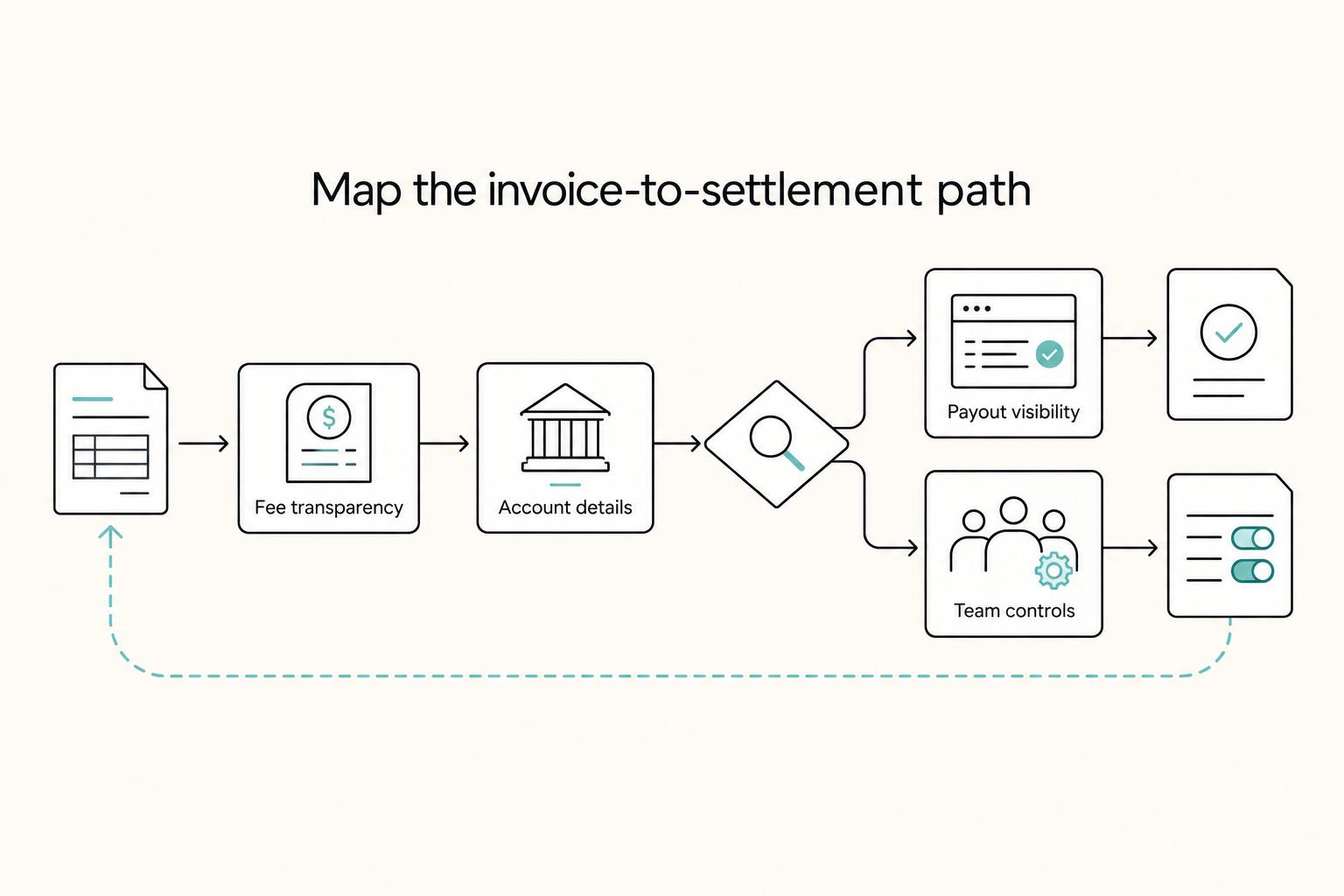
Step 1 Choose based on your real invoice-to-settlement path#
Start with one real payment flow: invoice currency, sender country, the receiving details you will share, whether you convert on receipt, and where funds go next. Then judge the rail on only four things:
- Speed: Check the route you will actually use, domestic or international, and confirm how you will track delays.
- Cost transparency: Confirm fees before sending, and check whether FX terms depend on market hours or plan allowance.
- Multi-currency usability: Confirm you can receive in the currencies your clients actually pay, using workable account details.
- Team controls: Confirm who can initiate, approve, and follow up on payments in your setup.
Run a small live test with the same currency and receiving details you plan to put on invoices. If the sender is unclear on the route, or your invoice wording does not match the receiving setup, expect friction.
| Decision dimension | Wise | Revolut Business | What to verify before choosing |
|---|---|---|---|
| Fee transparency and FX behavior | Says pricing is visible before transfer and uses the mid-market rate without markup | Says FX uses the interbank rate during market hours and within plan allowance; fees may apply outside allowance | Your corridor, amount, and plan terms, especially any outside-hours or allowance treatment |
| Account details and currency setup | Offers domestic and international receiving details by currency | Supports multiple currency balances with unique account details | Verify current currency and entity support for your account |
| Payout visibility and follow-up operations | Transfer tracker available; approval-required payments can auto-cancel after 7-10 days (currency-dependent) if not approved | In-app transfer locator; approval workflows available on supported plans | Your delay-escalation process, approval ownership, and plan-level control availability |
| Operational controls for team payments | Approval flow can require another team member before completion | Custom approval processes for team requests on supported plans | Verify current feature support and limits for your plan |
Step 2 Match the rail to your operating shape#
Choose the rail that fits how you actually get paid, not the one with the most features on paper. If you work mostly solo and want straightforward receiving details plus predictable FX framing, Wise can be a cleaner starting point. If you need team approvals or larger outbound transfer workflows, Revolut Business may fit better. Confirm the exact plan terms and feature coverage before you decide.
Step 3 Keep this decision in its place#
Do not let the rail choice carry more weight than it deserves. If that search brought you here, keep this decision tactical. Rails move money. Your real protection comes from contracts, invoicing discipline, and entity setup in the next sections.
You might also find this useful: How to Pay the IRS from Abroad Without Misapplied Payments.
Tier 2: Building Your "Compliance Armor" (The Layer That Protects Your Business)#
Once you choose the rail, the real work is the file behind each payment. Your protection is not the transfer tool, but the contract, invoice review, W-8 handoff, and reporting cadence that support it. This is the layer that reduces avoidable compliance surprises.
Keep one client file with the signed agreement, current invoice template, tax forms, and payment evidence. That file helps you show independence quickly when finance, tax, or banking checks happen.
Step 1 Write a contract that proves independence in practice#
Your contract should read like an outside business delivering results, not staff being managed. U.S. guidance looks at real control and independence factors, not labels alone.
| Contract area | What the agreement should show |
|---|---|
| Control of methods | Define deliverables, deadlines, and acceptance criteria, but avoid terms that let the client set your hours or direct step-by-step execution. |
| Tools and expenses | State that you provide your own tools or supplies and bear your own expenses unless a narrow exception is documented. |
| Substitution/delegation | Where commercially realistic, preserve your right to use help at your expense. |
| Engagement boundaries | Tie work to a project, SOW, or term, and avoid open-ended wording that makes you look embedded in the client's core team. |
| Relationship intent | Keep terms consistent with a business-to-business service relationship. |
Before you sign, do one last check: does the agreement read like an outside business delivering results? If it reads like staff management, risk rises.
Step 2 QA every cross-border invoice before sending#
Treat invoicing as a compliance check, not just an admin task. In EU VAT rules, invoicing is compulsory for most B2B transactions.
| Invoice area | What to confirm |
|---|---|
| Identity fields | Unique invoice number, your company name, address, and contact information, plus any required customer-identification fields. |
| Tax-treatment fields | VAT amount if applicable, total due, and any required tax IDs or jurisdiction-specific wording after verification. |
| Payment terms | Invoice date, due date, currency, and any contract-required references or late-fee terms where allowed. |
| Settlement details | Receiving details that match the invoice currency and chosen rail. |
| Final pass | Confirm legal names match the contract, totals reconcile, and tax wording is verified for the applicable jurisdiction. |
Use that as your baseline checklist, then add any jurisdiction-specific requirements you have verified. Before you send, do one final pass: confirm legal names match the contract, totals reconcile, and tax wording is correct for the applicable jurisdiction.
Step 3 Hand off Form W-8BEN-E early to client finance#
If you invoice through a foreign entity, use Form W-8BEN-E, not W-8BEN, which is for individuals. Give it to the withholding agent or payer early, ideally during onboarding or before the first invoice reaches accounts payable.
Use a simple handoff process:
- Send the signed W-8BEN-E to the client finance contact.
- Ask for confirmation that it is on file and whether supporting documents are required.
- Store the submitted copy in your client file.
Keep the refresh cycle visible:
- Track validity through the last day of the third succeeding calendar year from signature date.
- Re-issue within 30 days after a change in circumstances that affects correctness.
- For withholding or treaty outcomes, verify the current treatment for your exact facts.
Step 4 Run a recurring tax and reporting cadence#
Put this on a calendar, not into a year-end scramble. Set aside funds as payments arrive based on your verified local obligations, and adjust when revenue changes.
| Cadence item | Timing or trigger | Article note |
|---|---|---|
| Estimated tax cadence, if applicable | April 15, June 15, September 15, January 15 (following year) | Underpayment by period can trigger penalties. |
| Account monitoring for U.S. persons | Aggregate foreign account value above $10,000 at any time in the year | FBAR trigger. |
| FBAR timeline | Due April 15 with automatic extension to October 15 | Use the stated filing timeline here. |
| Record retention | Keep FBAR records for 5 years | Keep general tax records as long as needed to support return positions. |
| Jurisdiction gaps | Verify local thresholds or triggers where non-U.S. rules apply | Check non-U.S. rules separately. |
At minimum, keep those dates, triggers, and retention rules visible in your calendar. Then keep the evidence pack complete: contracts, invoices, bank statements, W-8BEN-E records, payment proofs, and filed reports. If you want a deeper dive, read Hiring Your First Subcontractor: Legal and Financial Steps.
Before you send your next invoice, generate the right payee tax form. That keeps your client setup clean from day one: Use the W-8 form generator.
Tier 3: Architecting Your Corporate Structure (The Engine of Your Autonomy)#
If your starting point is getting paid by a foreign company, decide your structure first and your payment rail second. When you operate as a business owner, money paid to yourself may be treated as an owner-compensation flow. It is not automatically employee salary, and the label depends on entity and tax treatment.
Step 1 Reframe pay as an owner flow and keep your records consistent#
Your structure affects taxes, paperwork, and liability, so your wording and operations need to match it. The IRS ties income-tax return filing to business structure, and it also notes you cannot classify yourself only by issuing a W-2 or 1099-NEC.
Use one consistency check across the whole stack: contract party, invoice identity, bookkeeping category, and receiving account should all describe the same setup. If you present yourself as an independent business, keep collection and payout operations in that business context.
For Wise specifically, keep business activity in business accounts. Wise states that personal accounts are not for business transactions, and it also notes that some business corridors are restricted.
Step 2 Compare sole proprietorship vs LLC on operational impact#
This choice is mostly about separation versus simplicity. The table below is the practical view:
| Decision point | Sole proprietorship | LLC |
|---|---|---|
| Liability separation | Not a separate legal entity; you can be personally liable for business debts and obligations. | State-created legal entity; liability separation may help, but is not absolute in every situation. |
| Admin burden | Easiest to start; if you run business activity without registering another entity, you are generally treated as a sole proprietorship. | Usually requires registration and more setup steps. |
| Banking/payment ops fit | Can work early, but account setup and usage still need to match business activity. | Formal registration records can support business onboarding when entity documentation is requested. |
| Tax handling workflow | Business structure determines which income-tax return form is filed. | Federal tax treatment depends on member count and elections; for example, a single-member LLC is generally disregarded for income tax, while a multi-member domestic LLC defaults to partnership unless an election is filed. |
| Documentation footprint | Fewer formal entity records by default. | State registration usually creates formal entity records. |
If you want the lightest setup and accept higher personal exposure, sole proprietorship may be enough. If you want separate-entity status and more formal records, an LLC may be a better fit.
Step 3 Run a quick structure-selection checklist before registering#
Before you register anything, pressure-test the choice against how you actually work:
- Risk tolerance: Are you comfortable operating without a separate legal entity?
- Client profile: Do your clients require formal vendor onboarding and entity documentation?
- Cross-border complexity: Do you need to validate multi-owner, foreign-entity, or local registration/payroll rules in your jurisdiction before choosing?
- Growth plan: Are you planning for broader operations that benefit from formal structure early?
Then prepare the exact operating package you will use: entity record, if formed, tax-classification notes, contract legal name, and invoice account details.
Step 4 Choose direct B2B vs EOR with a control-based lens#
Choose based on how the relationship actually works, not on what sounds cleaner in procurement. Use direct B2B when the engagement is genuinely business-to-business under your own business identity. Use EOR when the client needs an employment model and wants payroll and compliance administration handled by a third party while retaining day-to-day managerial control.
This is a fit decision, not a universal rule. Misalignment happens when a relationship is labeled B2B but run like staff management, and classification analysis looks at behavioral control, financial control, and relationship factors.
Once you choose, apply it everywhere: contract party, invoice identity, tax workflow, and payment-rail setup should all match the same structure. If you want a walkthrough, see How to Use Wise to Pay International Invoices with a US Credit Card.
Conclusion: Run this like a disciplined business setup#
If you want to pay yourself reliably, run this like a disciplined business setup. The rail moves money, and you own the decisions around it.
-
Choose the rail. Pick the payment method that fits your currencies, payment volume, and admin load. Wise Business is one option among many, and features like BatchTransfer can simplify multiple invoices, but the rail still only handles money movement.
-
Run the compliance process. Before each payment, verify who is being paid and that payment details match the invoice. Then check tax and employment implications based on the payee's residence and status, since mistakes here can lead to avoidable penalties, fines, or interest.
-
Set the structure to match reality. Paying international contractors can add friction through overseas tax and employment rules plus multi-currency payroll logistics, so choose an operating structure you can run consistently.
-
Do the next actions now. Formalize your agreement, standardize one invoicing process, keep one evidence file per payment with the contract, invoice, payment confirmation, and account records, and maintain a compliance calendar for cross-border tax, employment, and multi-currency issues. If accounts are still mixed, fix that next with Separating Business and Personal Finances: An Important Step for LLCs.
For a fuller walkthrough, see How to Pay US Subcontractors from Canada. If you want a reusable operating stack for future clients, keep your tools in one place and standardize your workflow: Explore Gruv tools.
Frequently Asked Questions
Does Wise handle your taxes or payroll compliance for international payments?
Based on the provided Wise pricing excerpts, Wise covers money movement and fees, not tax filing, payroll withholding, or worker-classification services. Treat those compliance areas as outside what this guide confirms, and keep your own records based on your local requirements.
How do you tell where Wise stops and the rest of your process starts?
Start with the boundary shown on Wise pricing: send, receive, convert, and card actions, with upfront pricing that varies by currency. This quick check keeps that line clear: | Option | What it does | What you still own | | --- | --- | --- | | Wise | Moves money, converts currency at the mid-market rate, and shows pricing by feature | Anything outside those payment features (for example contract, tax, reporting, and reconciliation workflows) is not covered in the provided Wise excerpts | | Direct B2B | Not defined in the provided Wise excerpts | Confirm legal, tax, and process responsibilities separately | | EOR | Not defined in the provided Wise excerpts | Confirm responsibility splits in your agreement |
What are your main tax and reporting duties if a foreign company pays you?
The provided Wise excerpts do not specify your tax or reporting duties. Confirm filing requirements, schedules, and any account-reporting obligations under your current jurisdiction rules before relying on a payment workflow.
Is an EOR the only compliant option?
The provided Wise excerpts do not cover EOR legal scope or compliance outcomes. Determine whether an EOR is required based on your contract model and local legal or tax guidance.
How do you receive payments from a foreign client without using an EOR?
The provided Wise excerpts do not validate non-EOR legal setup. What they do support is checking the exact Wise feature you plan to use (receive, convert, send, or card), then confirming live fee details for the relevant currency before transacting.
How do you verify Wise fees before you invoice or move funds?
Check the live Wise pricing page for the exact action you plan to take, since send, receive, convert, and card pricing are listed separately and vary by currency. Wise also says you pay for what you use (no subscriptions or plans) and that conversion uses the mid-market rate. Then open the regulator-standardized fee view as your second checkpoint. The page examples include fixed receiving fees such as 6.11 USD for USD wire/Swift, 2.16 GBP for GBP Swift, and 2.39 EUR for EUR Swift, but verify current values at time of use.
What is the foreign-account filing issue people often miss?
That issue is not defined in the provided Wise excerpts. There are no thresholds, forms, penalties, or deadlines for foreign-account filing included, so verify those directly for your residency and tax status.
Why might a US client ask you for Form W-8BEN?
The provided Wise excerpts do not explain W-8BEN requirements. If you receive that request, confirm what applies to your actual payee status before submitting documents.
Try a related tool
Researched and edited by the Gruv editorial team. Gruv builds cross-border billing, payouts, and finance-operations software for global businesses.
Sources
Educational content only. Not legal, tax, or financial advice.
Related Posts

How LLC Owners Separate Business and Personal Finances
For an LLC, separating business and personal money is best treated as a weekly habit, not a one-time bank setup. It keeps records cleaner, cuts month-end cleanup, and creates clearer boundaries as the company grows.

Hiring a Subcontractor for the First Time Without Costly Surprises
**Start with a risk-control sequence, not an ad hoc handoff.** As the Contractor, your goal is simple: deliver cleanly, control scope, and release payment only when the work and file are complete.

The Freelance Payment Penalty: A Modeled Audit of Platform Fees, FX Spreads, and Payout Delays
The money rarely disappears through a single, easy-to-spot fee. The real loss is stacked. A marketplace takes its commission, a processor adds a charge for international cards, a bank or payment company converts the currency at a spread, a platform holds the funds before release, and a wire sheds a little to intermediaries on the way in. Each layer looks defensible on its own, but the worker feels the combined result as a smaller deposit and a later payday.