
Quick Answer
Use storybrand for freelance website messaging as a risk-reduction system, not a style exercise. Put the client’s problem first, position yourself as the guide, and show a clear path from inquiry to handoff. Keep your stakes specific to business friction, then support your authority with checkable proof and process visibility. If buyers can quickly see who you help, how work runs, and what happens next, your copy is doing its job.
Beyond Marketing: Why StoryBrand is Your Most Powerful Risk-Mitigation Tool#
Used well, StoryBrand copy on a freelance website is not about sounding polished. It lowers buyer uncertainty on your homepage so a cautious client can quickly see that you understand the stakes, have a clear way of working, and are unlikely to create avoidable friction.
Step 1 Reframe your homepage around the client, not your service#
Start with the basic StoryBrand move: the client is the hero, and you are the guide. On the page, that means your first screen should describe the client's situation and decision pressure before it talks about your methods, background, or passion. If your headline leads with "I help brands..." or "I'm a freelance designer...," you make yourself the main character too early.
Use a simple rule: every homepage block should answer two questions. What decision pressure is this client dealing with, and how do I help them move through it confidently? The guide role works because it combines empathy and authority. You show empathy by naming the problem in the client's language. You show authority by making the next step feel structured, not vague.
Use a quick checkpoint. Ask someone unfamiliar with your site to look at the first screen for 10 seconds. If they cannot tell who you help, what problem you solve, and what to do next, the page still carries too much ambiguity.
Step 2 Rewrite each block as a trust signal#
Clear messaging does more than improve marketing. It also filters out a common failure mode: broad positioning that tries to please everyone and gets ignored.
StoryBrand is often described as seven key elements. A useful homepage adaptation is to treat that as seven practical jobs:
| Homepage job | What you should say | What weak copy looks like | Buyer concern it resolves |
|---|---|---|---|
| Hero goal | "You need a site that helps buyers understand your offer fast." | "Custom digital solutions for modern brands." | "Is this for a business like mine?" |
| Problem | Name the operational or sales friction they face. | "Standing out online is hard." | "Do you understand the real issue?" |
| Guide | Show empathy plus proof of competence. | "I'm passionate about helping clients win." | "Can I trust you to lead this?" |
| Plan | Explain clear process steps. | "Let's collaborate and make magic." | "What happens after I inquire?" |
| Call to action | Offer one clear next step. | "Reach out sometime." | "How do I start without hassle?" |
| Cost of delay | State what confusion or inconsistency is costing them. | "Don't miss out." | "Why should I act now?" |
| Outcome | Describe the practical result. | "Transform your brand presence." | "What changes if this works?" |
Step 3 Replace hype with operational detail#
This is where the page becomes credible. Instead of promising "smooth results," show specifics a buyer can verify. Include your project phases, what is in and out of scope, when clients hear from you, and how you handle sensitive materials or approvals if that matters to the work. Those details are not official StoryBrand requirements, but they are strong trust signals because they reduce surprise.
| Trust detail | What buyers want to know |
|---|---|
| Project phases | What the phases are |
| Scope | What is in and out of scope |
| Client communication | When they will hear from you |
| Sensitive materials or approvals | How you handle them, if they matter to the work |
There is an important tradeoff here. StoryBrand is a tool, not your whole marketing or business setup. Clear copy helps, but it will not cover for weak proof, unclear offers, or messy delivery.
Use this quick audit before you publish:
- Does the first screen talk about the client's problem before your credentials?
- Does each section reduce a specific buyer concern?
- Is your plan concrete enough that a client can picture the engagement?
- Have you replaced vague promises with visible operating details?
- Is there one clear next step, not three competing calls to action?
For a step-by-step walkthrough, see How to Create an FAQ Page for Your Freelance Website.
How to Define the Real Problem Your High-Value Clients Face#
Your problem section should quickly make one thing clear: what is going wrong for the client, why it matters to the person reading, and what should not be this difficult. If the message is vague or overloaded, people often leave before they reach out.
| Lens | Prompt | Example |
|---|---|---|
| External obstacle | What is visibly happening right now? | people cannot quickly understand the offer or next step. |
| Internal pressure | What does that feel like for the person responsible? | uncertainty, pressure to make a clear decision, concern about making the wrong call. |
| Principle at stake | Why is this situation not acceptable? | it should not take extra effort just to understand an offer and move forward. |
In the 7-part StoryBrand sequence, the customer is the hero, and the problem is central. The framework directly supports external and internal obstacles. For practical website copy, it also helps to add a third lens: the principle at stake, or what should not be this hard.
Use these three prompts to rewrite one problem statement.
- External obstacle: What is visibly happening right now?
Example: people cannot quickly understand the offer or next step.
- Internal pressure: What does that feel like for the person responsible?
Example: uncertainty, pressure to make a clear decision, concern about making the wrong call.
- Principle at stake: Why is this situation not acceptable?
Example: it should not take extra effort just to understand an offer and move forward.
Upgrade weak phrasing into decision-ready phrasing.
| Weak freelance phrasing | Stronger business-risk phrasing | Decision-maker it speaks to |
|---|---|---|
| "You need a better website." | "Your current site makes the offer hard to understand, so some visitors leave before reaching out." | Buyer |
| "Projects feel messy and delayed." | "When next steps are unclear, decisions slow down and momentum drops." | Team lead |
| "We offer lots of custom options." | "Too many options at once can make it harder to choose a path." | Procurement |
| "We'll handle everything for you." | "Clear scope and clear next steps reduce avoidable review friction." | Legal |
Mini workflow: translate interview notes into homepage language (without overpromising).
- Pull exact client phrases from emails, calls, and proposal feedback.
- Tag each phrase as external obstacle, internal pressure, or principle.
- Keep only language you can support from real client wording.
- Turn it into one block that names the audience, the external obstacle, the internal pressure, the avoidable friction, and the basic goal in one or two sentences.
- Check that you are explaining the offer and next steps, not promising outcomes you cannot guarantee.
Quick self-audit for this section.
- Does each problem statement name a practical business impact?
- Does it name the human pressure on the decision-maker?
- Does it state the principle at stake?
Engineering the "Guide" Section: How to Project Unshakeable B2B Authority#
Your Guide section should quickly make one thing clear: you are a low-risk hire because your claims are checkable. The strongest version combines proof, relevant context, and a clear operating model.
| Layer | Include | Peer should identify |
|---|---|---|
| Case example | one case example | proof |
| Domain context | one line of domain context | audience fit |
| Operating model note | one operating model note | communication cadence |
Step 1. Replace praise with proof. Use testimonials as support, not the main evidence. Lead with a compact case block that shows baseline, your role, and a result the buyer can verify.
If you do not have a confirmed metric yet, say that the verified outcome metric is pending source-record confirmation. If you mention a credential, use the exact label only as issued (for example, StoryBrand Certified Guide only when that exact wording applies).
| Generic claim | Evidence-based case proof | Buyer risk concern resolved |
|---|---|---|
| "They were great to work with." | "Baseline, scoped role, and verified outcome metric pending source-record confirmation." | Can this person deliver a measurable outcome? |
| "They understand our industry." | "Client type and specific constraint pending client-record confirmation. Current compliance requirement pending official or policy source confirmation." | Will we have to train them on basics first? |
| "They are very professional." | "NDA before sensitive files, weekly status updates, response window, handoff format." | Will this project become disorganized or risky? |
Step 2. Publish a proof stack, not a personality pitch. Build this section with three layers: one case example, one line of domain context, and one operating model note. In that operating note, state your communication cadence, what you need from the client, and how you handle data or approvals.
Quick check: a peer should be able to identify your proof, audience fit, and communication cadence in under 20 seconds.
Step 3. Add what procurement and legal reviewers look for. Keep this on-page checklist tight:
- One mini case study with a baseline and a verified result, or a result marked as pending source-record confirmation
- One domain-specific constraint or requirement, worded from confirmed source records
- One trust signal for review workflows, such as NDA readiness, data-handling expectations, or documentation available on request
- One link for privacy detail: GDPR for Freelancers: A Step-by-Step Compliance Checklist for EU Clients
If this section sounds polished but shows no depth or tactics, buyers may read it as positioning rather than proof.
You might also find this useful: How to Create a Unique Selling Proposition (USP) for Your Freelance Business.
Publish phases that show scope, checkpoints, and handoff readiness#
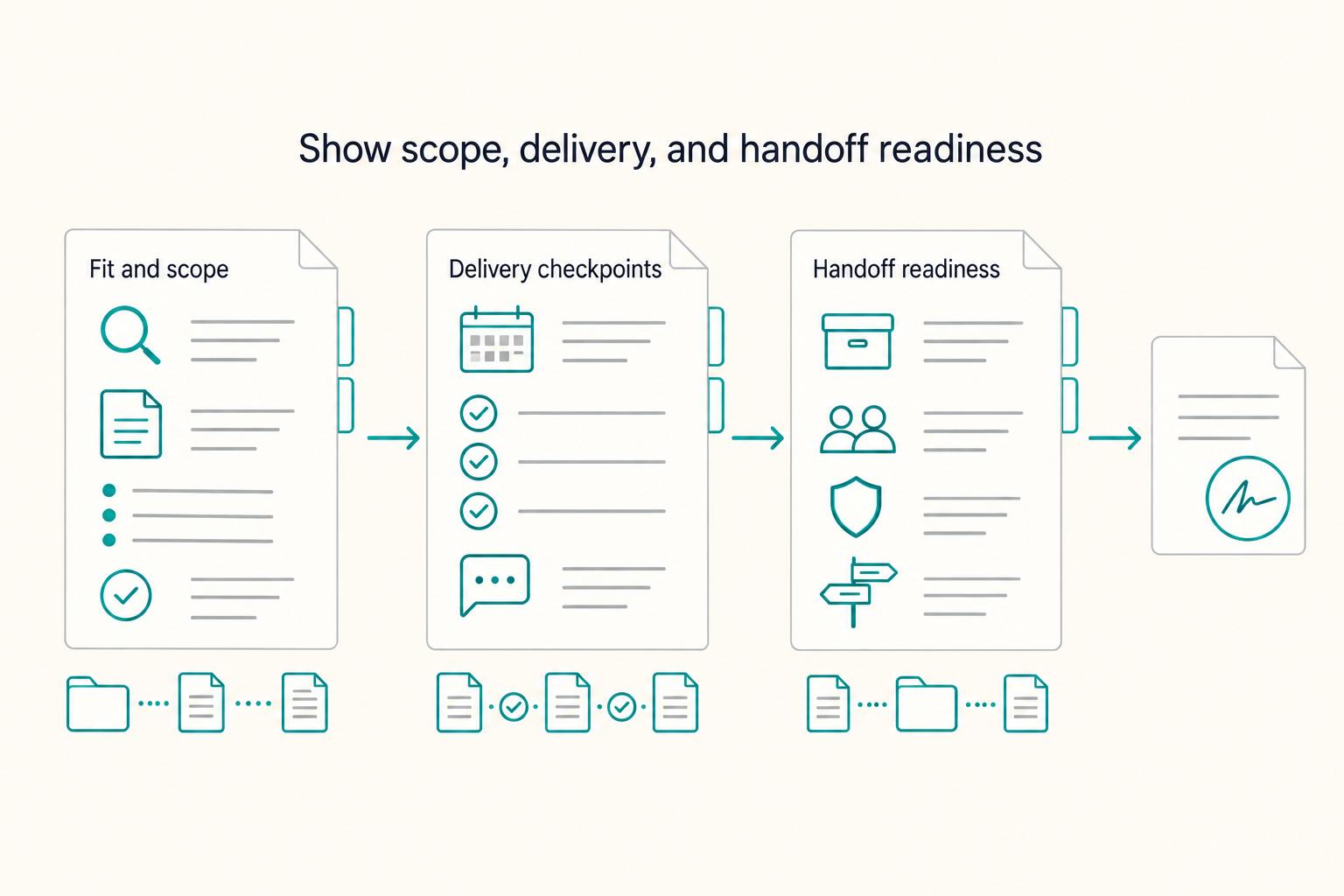
Your Plan section should make working with you feel controlled, not ambiguous. Keep the simple StoryBrand principle, but publish it as a phased engagement framework that shows scope clarity, decision checkpoints, handoff readiness, and post-launch boundaries.
Before publishing: use phase names that match your real process. Any onboarding requirement or support window must be verified from contract, policy, or client records before it appears on the page. You can place this on your homepage or services page, but keep the wording consistent across pages.
| Phase | Basic freelancer 3-step copy | Risk-aware engagement framework copy | Buyer concern resolved |
|---|---|---|---|
| Phase 1 | "Book a call." | "We confirm fit, collect required inputs, define scope, and record approvals before work starts." | Will this start vague and expand without control? |
| Phase 2 | "I do the work." | "Delivery follows named outputs, review checkpoints, approval points, and a clear update rhythm." | Will I lose visibility or need to chase status? |
| Phase 3 | "You get results/files." | "Handoff includes agreed assets, ownership transfer details, support boundaries, and next-step options." | What happens after delivery, and who handles issues? |
Step 1: Publish a scoped entry phase#
State what you need from the client, who is involved, and what gets approved before production. Name practical roles, such as the day-to-day contact and final approver. Before naming a current onboarding requirement, verify it against contract, policy, or client records so requirements stay accurate over time.
Make the output explicit: scoped brief, approved outline, or recommended direction. Add one plain-language gate such as: "Work starts after scope, deliverables, and approver confirmation."
Step 2: Show delivery with checkpoints#
Describe delivery as a sequence of visible decisions, not a black box. Tell buyers what is reviewed, when feedback is needed, who signs off, and how often they get updates.
Include escalation language that signals operational maturity without fake precision: "If scope, access, or timeline blockers appear, they are raised to the named approver." Keep this specific to your process, because broad "we do everything" positioning is easy to ignore.
Step 3: Define handoff readiness and support boundaries#
Remove post-launch ambiguity in one pass: what is handed over, when it is considered complete, and what support is included. Verify any support window against contract or policy records before naming it, then state what is in-bounds versus what requires a new scope.
Clarify ownership at handoff. If the client takes over internally, say so; if you offer continued help, present it as optional support, not open-ended coverage.
We covered adjacent messaging structure in How to Write a Compelling 'About Me' Page for Your Freelance Website.
Conclusion: Your Website is an Automated Trust-Building System#
Treat your site as part of your sales process, not as a brochure. StoryBrand frames clear messaging as a way to remove confusion, show fit, and set expectations before a call happens. In practice, that creates a cleaner starting point for the sales conversation.
Step 1 Replace broad copy with buyer-facing clarity#
The core StoryBrand principle here is simple: clarity gets a yes; confusion gets a no. The real risk is not being "too specific." It is sounding so broad that the right buyer cannot tell whether you solve their problem. That is why brands that try to please everyone get ignored.
| Old copy pattern | Upgraded copy pattern | Buyer behavior you want |
|---|---|---|
| "I help businesses grow" | Name the specific problem, stakes, and who it is for | Self-qualification |
| "I'm passionate and experienced" | Show proof, process, and decision-making role | Confidence before the call |
| "Contact me to learn more" | Explain scope entry, review points, and handoff | Fewer fuzzy inquiries |
A useful test is straightforward: if a qualified buyer can skim your homepage and explain what you do, for whom, and how work starts, your messaging is doing its job.
Step 2 Audit the three sections that matter most#
Before you publish, check the three sections that carry most of the clarity load:
- Clarify the problem with external, internal, and business-stakes language.
- Prove your role with concrete evidence, not personality claims.
- Publish the engagement framework with checkpoints, approvals, handoff assets, and verified support boundaries.
Failure mode: if any section still sounds like it could belong to ten other freelancers, tighten it.
Step 3 Build the next page that carries the sale#
Once your homepage message is clear, carry the same standard into your services page so the offer matches the promise. If you need help turning this into working website copy, start with How to Create a High-Converting Freelance Services Page.
Related: Social Proof for Your Freelance Website.
Frequently Asked Questions
How do you adapt StoryBrand to B2B freelance services?
Shift the message from your service list to the buyer's business problem and the outcome they need. Keep the client as the hero and position yourself as the guide who helps them act with less risk. Use a quick skim test on your header so a visitor can tell what you do, how it helps, and what to click next. Your main call to action can appear twice because many people will not scroll past the header.
How should you frame failure without sounding manipulative?
Name the cost of doing nothing in terms your buyer already uses internally. Your stakes section gets stronger when you express the downside financially or operationally, such as rework, delayed launches, approval bottlenecks, avoidable support load, or lost sales opportunities. If your warning could apply to any business in any industry, it is too vague to build trust.
What kind of plan should you show for a complex project?
Use a simple 3-step plan when the work is straightforward and easy to explain quickly. If the project spans multiple stakeholders or months, show phases, review points, and client responsibilities so the buyer can see how decisions happen and when they stay in control. | Plan style | Use it when | What you should show | Trust signal it creates | | --- | --- | --- | --- | | Basic 3-step plan | The offer is narrow and the start is straightforward | Start point, delivery step, handoff or review step | Low friction and easy to buy | | 3-phase engagement | The work has discovery, execution, and review | Phase goals, client inputs, review checkpoints, next action | Control, oversight, and lower perceived risk | | Expanded phase checklist | The buyer needs more operational detail before signing | Key meetings, approvals, dependencies, and delivery artifacts | You can handle complexity without making the site feel chaotic |
How do you prove authority without relying on testimonials alone?
Show evidence and process, not just praise. Put one or two short case studies on your homepage or services page with outcome types you can verify later, such as shorter cycle time, fewer handoff errors, reduced manual steps, or better lead quality. Then pair them with one process artifact like a reporting snapshot, timeline view, or review checklist. A logo strip and a vague quote may create recognition, but often do not show what changed or how you work.
Can your site help with onboarding and compliance conversations?
Yes, if you treat your plan as pre-onboarding orientation rather than proof that you already meet every compliance requirement. Show the checkpoints a client will hit after saying yes, such as intake form, asset or access request, kickoff call, review points, and final handoff documents. Avoid compliance promises unless you can verify them for that specific client.
How should you map this messaging to your website pages?
You do not need one fixed sitemap because these content blocks can move. A practical default is header first, then stakes, success, guide proof, plan, and call to action. The real test is whether each section answers the next buyer question with less confusion. If you are getting traffic but not inquiries, treat that as a diagnosis problem and use a quick audit to see which phase needs attention first.
What is the fastest way to check whether your copy is actually working?
Start at the top of the page and ask whether a qualified buyer can explain your offer, benefit, and next step after a quick skim. If they cannot, the issue is usually not design polish. It is unclear messaging or missing trust details. Another warning sign is traffic without sales or inquiries, because broken funnels often hide in plain sight until you test what the page is actually saying.
Try a related tool
Researched and edited by the Gruv editorial team. Gruv builds cross-border billing, payouts, and finance-operations software for global businesses.
Sources
Includes 8 external sources outside the trusted-domain allowlist.
- 6figurecreative.com/how-to-guide-your-clients-through-the-six-st...external
- agencyboon.com/blog/storybrand-websitesexternal
- ashlynwrites.com/the-1-secret-to-better-website-copy-for-risi...external
- betterstory.marketing/faqs/what-is-storybrand-copywritingexternal
- booksnthingswarehouse.com/wp-content/uploads/2024/07/BU_Business_AUTHO...external
- cathygoodwin.medium.com/copywriting-for-the-story-journey-the-missin...external
- christianmauerer.com/dr-jj-peterson-mastering-storytelling-ep31external
- digital102.com/building-a-storybrand-donald-millerexternal
Educational content only. Not legal, tax, or financial advice.
Related Posts

GDPR Compliance Checklist for Freelancers Working With EU Clients
Start by separating the decisions you are actually making. For a workable **GDPR setup**, run three distinct tracks and record each one in writing before the first invoice goes out: VAT treatment, GDPR scope and role, and daily privacy operations.

Georgia 1% Tax for Entrepreneurs Without Filing Surprises
Treat Georgia's 1% tax path as a compliance question first and a rate discussion second. The goal is a setup you can defend under review, not a shortcut that fails at filing time.

How to Create a High-Converting Freelance Services Page
If you want fewer renegotiation loops, treat your page as a qualification tool, not a polished brochure. The goal is not more inquiries for their own sake. It is fewer vague inquiries that turn into messy delivery.