
Quick Answer
Start by treating reciprocity as a controlled client-acquisition workflow: run a short fit call, require structured intake, and move qualified prospects into a paid Project Roadmap. Keep the early step bounded with clear in-scope and out-of-scope lines, then end with one explicit next action. Use this approach to show decision-ready value without drifting into free implementation advice. The key is that each stage has a named deliverable and a stop-or-advance decision.
Beyond 'Freebies': A Risk-Mitigation Framework for High-Ticket Freelancing#
For reciprocity to work on higher-value freelance deals, you have to stop treating it like "give something free and hope they feel grateful." Serious buyers usually move when risk feels lower. They want something useful, bounded, and easy to evaluate.
Higher-ticket B2B decisions are often not made by one person on one call. There may be several stakeholders, and some teams need buy-in from six to 10 decision-makers. In larger organizations, or in risk-sensitive work, risk, procurement, and compliance stakeholders may stay involved from planning and due diligence through ongoing monitoring, not just at contract signing. That is why a generic PDF, a loose brainstorm call, or a free audit can fall flat. It creates activity, but not enough certainty to move the deal forward.
Why reframe reciprocity as ethical risk reduction?#
The core idea is simple: people tend to return benefits they receive. The useful version of that principle is not pressure or implied debt. It is helping the buyer make a safer, clearer decision.
In practice, your early value should do three things: clarify the problem, show how you think, and define the next step. It should not drift into unpaid delivery. If your intro offer solves the whole issue, produces custom recommendations with no guardrails, or ends with "let me know if you want to continue," you have moved from trust-building into free consulting.
Checkpoint: if you cannot name the offer, limit the scope, and describe the deliverable in one sentence, it is probably too loose.
How to replace freebies with a strategic value demonstration#
A better move is a small, structured engagement that gives the buyer evidence, not just goodwill.
| Criteria | Freebie | Strategic Value Demonstration |
|---|---|---|
| Scope control | Open-ended call or generic asset | Bounded review with clear inputs and limits |
| Qualification signal | Low, anyone can consume it | High, the buyer must share context and engage seriously |
| Buyer confidence | Mild interest, little proof | Concrete evidence of your judgment and fit |
| Next-step clarity | Vague follow-up | Defined recommendation and decision path |
| Risk to you | Unpaid consulting, scope creep | Managed effort tied to a specific outcome |
What matters is not size. It is decision value. Ask for the inputs that let you assess reality instead of guessing: current materials, stated goals, known constraints, stakeholder concerns, and what success needs to look like internally. If a prospect will not provide any of that, treat it as a qualification signal, not a puzzle you need to solve for free.
Set up Phase 1 before you advance#
Before you move deeper, set up Phase 1 as a narrow diagnostic. It needs to be controlled enough to protect your time and strong enough to reveal whether there is a real fit. The outcome is not "they liked me." It is a documented problem, a clearer buying path, and an honest go or no-go signal before either side invests more.
Do not advance until you can verify three things: the problem is real, the buyer can access the information needed to assess it, and there is a clear decision owner or internal champion for what comes next. If one of those is missing, pause there instead of pushing toward a larger proposal.
Phase 1: The Diagnostic - Using Value to Qualify and Control Scope#
Run a short diagnostic before any full proposal. Your goal is to test mutual fit, close the biggest information gaps, and decide whether a paid Phase 2 is warranted, not to give away custom strategy.
In early freelance sales, trust often has to form through text-heavy, low-context exchanges. That setup can create information asymmetry and uncertainty on both sides, so the practical target is a usable level of certainty for a decision, not perfect certainty.
Ask for a structured intake before you diagnose#
Make the diagnostic conditional on a basic intake. If a prospect will not share core context, treat that as qualification data.
| Input | What to ask for |
|---|---|
| Problem context | What is happening, what changed, and the outcome they want |
| Stakeholder goals | Who is involved, what each person needs, and what success looks like internally |
| Constraints | Timing, technical limits, brand limits, legal/procurement review, and other non-negotiables |
| Decision process | Who approves, what the next internal step is, and what must be true to move forward |
Then ask for one or two working artifacts tied to your workflow. For example: current homepage copy and nurture emails (copy), page inventory and brand guidelines (design), integration notes and backlog excerpt (development), or recent campaign summary and landing pages (paid media).
Keep intake detail moderate: too little forces guesswork, too much slows momentum. Ask for task-relevant information, avoid unnecessary personal information, and handle any files/forms with privacy-safe access and retention practices. Confirm the exact legal requirements that apply to your clients and location before storing prospect data. If EU-client handling is in scope for your work, review your process here: GDPR for Freelancers: A Step-by-Step Compliance Checklist for EU Clients.
Checkpoint before the call: you can state the problem, name the decision owner or champion, and identify the main constraint in one sentence each.
State the boundary in reusable terms#
Set boundaries before the meeting and repeat them in follow-up so scope stays controlled.
| Boundary | What to say |
|---|---|
| In scope | Review provided materials, surface key observations, flag 1-3 risks, and outline next-step options. |
| Out of scope | Implementation guidance, custom solution design, detailed project plans, workshops, or production-ready deliverables. |
| Paid next step | Phase 2 blueprint to validate approach, define scope, and produce the plan needed for approval or execution. |
If they ask, "So what would you do?" before enough evidence exists, hold the line: you can clarify decision points in Phase 1, while full solution design belongs in Phase 2.
Deliver a decision-ready diagnostic report#
End with a short Diagnostic Report that is easy to share internally. Use this structure: observations, risk points, options, and recommended next action.
| Report section | What it covers |
|---|---|
| Observations | What the intake and call show right now |
| Risk points | What could block results, approval, or implementation |
| Options | Plausible paths without full design work |
| Recommended next action | Proceed to Phase 2, pause, or stop |
Your handoff should end with one explicit decision prompt for Phase 2, so there is no ambiguity about the next paid step.
Phase 2: The Blueprint - De-Risking the High-Ticket Sale#
After Phase 1 confirms possible fit, do not jump to a full proposal. Use a paid, limited-scope blueprint as the bridge. It gives the buyer a smaller first decision and gives you a documented basis for a clear go/no-go on the larger engagement.
Define the blueprint before you discuss the fee#
Treat the blueprint as a concrete planning artifact. In plain language, define four items in the offer: objective, scope boundaries, acceptance criteria, and explicit non-goals. If you cannot name the exact decision this phase supports, the offer is too vague.
Before kickoff, confirm:
- One approved objective sentence
- A short in-scope list
- A clear out-of-scope line
- Acceptance criteria both sides can check at handoff
This prevents the common failure mode where each stakeholder expects a different output.
| Decision path | Buyer risk | Approval friction | Decision speed | Evidence quality for next step |
|---|---|---|---|---|
| Direct full proposal | Higher, because scope, budget, and execution are approved together | Higher, because more stakeholders need confidence early | Can slow when major questions are still open | Uneven if discovery is still limited |
| Paid blueprint | Lower, because the first approval is smaller and bounded | Lower, because review scope is narrower | Can move faster to proceed, pause, or stop | Stronger, because findings and options are documented |
Set the blueprint fee from scope and decision value, not guesswork#
Do not rely on generic package pricing. Price this phase from what you are actually committing to: analysis, meetings, artifacts, and review rounds. Then sanity-check that price against the decision value of the output.
Use this test: if the outcome is "do not proceed," does the fee still feel justified by what the client received? If not, tighten scope or upgrade the artifact quality.
Co-create with your internal champion#
Use this phase to produce decision-ready material, not free extra delivery. First, align success criteria with your main contact. Then provide stakeholder-ready artifacts they can reuse internally:
- A short decision memo
- A clearly labeled risk section
- A scope map
- Two to three implementation options with tradeoffs
Also equip your contact with a simple narrative: what was validated, what this phase answered, what remains unknown, and what finance, procurement, or legal will need for the next approval step.
End with a handoff package, not a soft sell#
Close Phase 2 with a structured handoff package. It should include the recommended path, implementation options, and explicit go/no-go criteria for the full engagement. A new stakeholder should be able to read it and understand what was learned, what decision is pending, and what document comes next.
If the client proceeds, your full proposal should reuse the blueprint's scope and risk language. If they pause or stop, the phase still delivered bounded value with clear boundaries.
Phase 3: The Partnership - Building a Moat Around Your Best Clients#
After the contract starts, reciprocity should run as a process, not occasional "extra value." Your goal is to make your help consistently useful, easy to share internally, and strong enough to support renewals and referrals.
Turn early help into a repeatable cadence#
Use a one-page retention plan so your outreach stays practical instead of reactive. Track insights in three categories: market shift, risk alert, and optimization idea.
Before you send an update, run a quick relevance filter:
- Does it connect to an agreed goal?
- Does it help your contact make a decision?
- Does it reduce a real risk they are carrying?
If the answer is no, do not send it yet. Interesting but non-practical updates become noise, and repeated "extras" can turn into unpaid advisory work.
Use specificity as your quality check. Score your plan from 0 to 10: if you cannot name the next useful insight for each priority client, who should get it, and why it matters now, it is not specific enough.
Run a client-only briefing with clear boundaries#
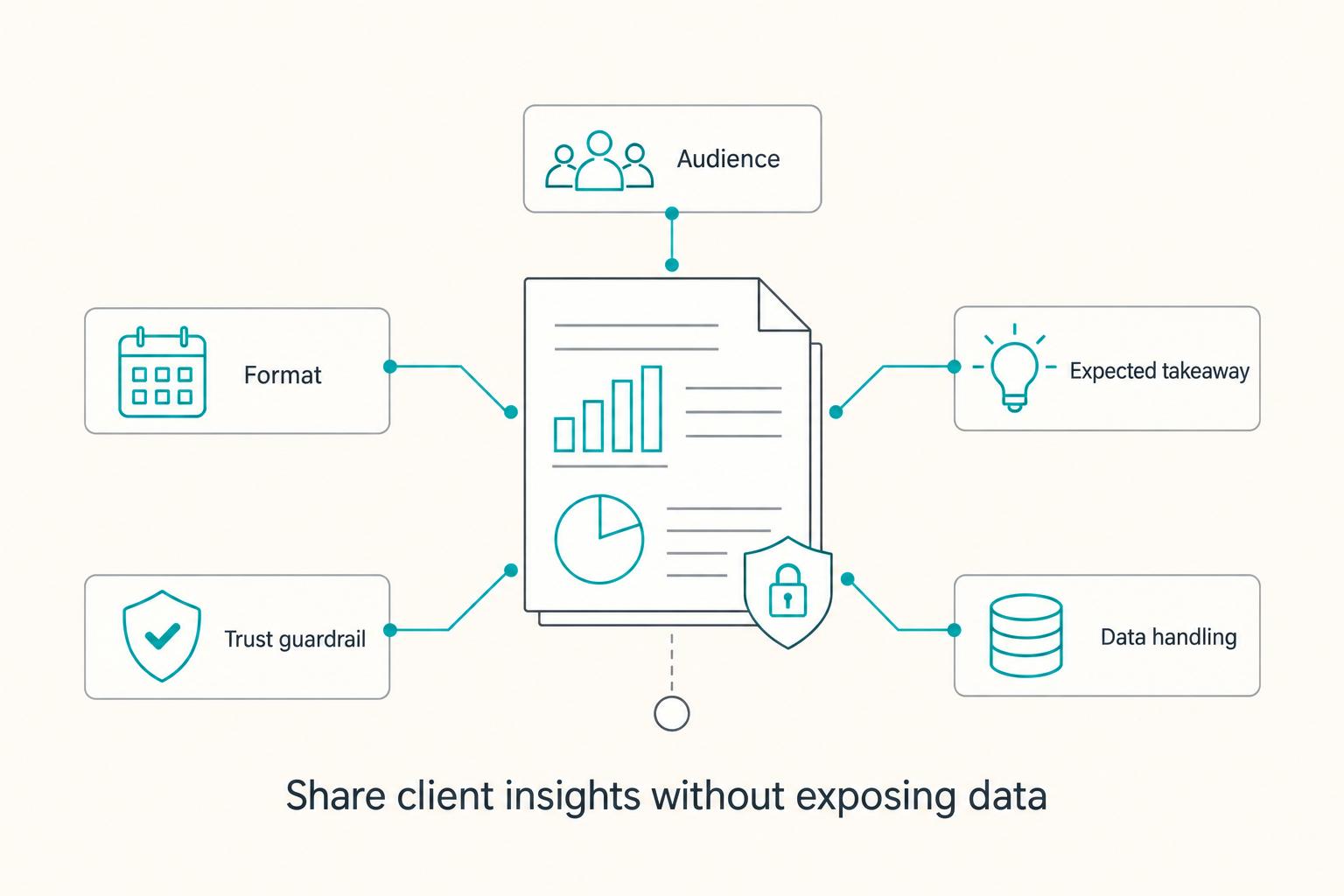
A client briefing works best when it has a defined audience, format, and takeaway. Keep the audience to current clients (and selected past clients where relevant), use a short live session or concise written brief, and make the expected takeaway one clear implication they can act on.
| Briefing element | Guidance |
|---|---|
| Audience | Current clients (and selected past clients where relevant) |
| Format | A short live session or concise written brief |
| Expected takeaway | One clear implication they can act on |
| Trust guardrail | Do not include identifiable client data, internal screenshots, or named examples without permission |
| Data handling | Share anonymized patterns, remove confidential details, and keep handling consistent with your existing process |
Set a strict trust guardrail: do not include identifiable client data, internal screenshots, or named examples without permission. Share anonymized patterns, remove confidential details, and keep handling consistent with your existing process; if EU personal data is involved, follow your existing GDPR process.
Equip your champion with assets they can forward internally#
Your main contact needs assets they can send without rewriting. Build a small kit mapped to stakeholder needs:
| Internal audience | Asset | What it should answer |
|---|---|---|
| Direct manager | Progress summary | What changed, what is on track, what needs a decision |
| Executive sponsor | Executive-ready update | Why this work matters to the business now |
| Finance or procurement | Decision memo | What was delivered, what comes next, and what is approved |
If your contact can forward each asset as-is, your communication is doing its job.
Ask for advocacy only at earned moments#
Ask for referrals only after a clear win, such as an accepted deliverable, a successful launch, a renewal, or unsolicited positive feedback. Keep the ask specific: restate the problem you solved, then name the kind of introduction that would actually help.
Do not ask while account friction is unresolved. If payment delays or fee disputes are active, fix that first, then make the request when the relationship is stable and the result is recent.
Is It Working? A Simple Framework for Measuring Reciprocity ROI#
You should treat reciprocity assets like a system, not a feel-good tactic: track early signals first, then business outcomes, and make explicit keep/fix/stop decisions.
Separate leading indicators from lagging outcomes#
Do not wait for signed revenue to tell you an asset is broken. For each asset, track leading indicators first: who engaged, whether they match your documented ideal partner profile, whether they accepted a next step, and whether they reached the blueprint phase without heavy chasing.
Use a short operator checklist for each asset:
- Did this attract the right people?
- Did it create a clear reason to reply?
- Did it move into a scoped conversation?
- Did it avoid unpaid advisory drag?
If needed, run a lightweight seven-question diagnostic and score the gaps before you keep publishing or reusing the asset.
Track lagging outcomes separately in your CRM or sheet: completed blueprint engagements, full contracts from those engagements, follow-on scope, retained revenue, and referrals after delivery. This split helps you diagnose whether the issue is attention, fit, or conversion.
Standardize source labels and track fit, not just volume#
If source labels are vague, attribution is noise. Use one fixed format for every inbound lead: Channel | Asset | Offer | Fit
Examples: LinkedIn | Pricing teardown post | Blueprint | A-fit and Referral | Client-only briefing | Strategy audit | B-fit.
Define A-fit, B-fit, and C-fit against your ideal partner profile before logging new records. High volume from poor-fit leads is not a win. Also watch for false positives: reason-based phrasing (like using "because") can raise replies, but replies only matter if they turn into qualified conversations.
Measure blueprint conversion in context#
Your core conversion metric is still:
Full contracts signed from completed blueprint engagements / total completed blueprint engagements
Do not import someone else's benchmark. Set your current target range from your own recent completed blueprint data, then update that range as your sample grows. If the sample is still thin, review recent cases manually and look for pattern breaks instead of forcing certainty.
Use interpretation rules:
- Blueprint completion is healthy, but full-contract conversion drops: fix offer design, fit, or how the blueprint sets up the next decision.
- Qualified leads rarely reach blueprint: fix positioning, source quality, or the asset-to-sales handoff.
Compare lifetime value against effort and friction#
Judge each path by long-term business quality, not just first-close speed.
| Acquisition path | Non-billable effort | Sales-cycle friction | Expansion potential | Referral contribution | Value snapshot |
|---|---|---|---|---|---|
| Reciprocity-led client | [X hours] across diagnostic and blueprint | Medium early, lower after proof | High when blueprint scope is tight | Often meaningful after delivery wins | Initial deal [A] + follow-on [B] |
| Referral-only intro | [X hours] for qualification and proposal | Usually lower when trust is preloaded | Medium to high, fit-dependent | Can compound if the referrer stays active | Initial deal [A] + follow-on [B] |
| Cold outbound client | [X hours] for prospecting and follow-up | Higher and more variable | Mixed | Usually weaker until trust is earned | Initial deal [A] + follow-on [B] |
An asset can still be a bad investment if it creates long cycles, weak expansion, or repeated unpaid pre-sale work.
Review on a cadence and make keep/fix/stop decisions#
Run data-hygiene checks weekly, performance reviews monthly, and hard decisions quarterly.
Double downwhen you see repeated A-fit leads, acceptable blueprint movement, and downstream expansion or referrals.Fix positioningwhen engagement is strong but fit is weak, or blueprint projects stall before full contracts.Stop this assetwhen it repeatedly attracts poor-fit buyers, creates unpaid advisory drag, or depends on fuzzy attribution.
Keep reporting clean. If you cannot defend the labels and underlying records, you do not have measurement.
From Tactic to System: Your New Client Acquisition Protocol#
Use reciprocity as a documented workflow, not an ad hoc tactic: move every lead through Diagnose -> Blueprint -> Partner, and make an explicit advance-or-exit decision at each stage.
| Area | Stop doing | Start doing |
|---|---|---|
| Offer design | Offering a vague free consult | Run a short fit call, then offer a named paid diagnostic or Project Roadmap |
| Qualification | Taking any interested call | Check urgency, decision-maker access, budget reality, and capacity to act before custom work |
| Scope control | Solving live in discovery | State what you will review, what you will not solve live, and what written artifact they will receive |
| Payment terms | Treating problem definition as free | Introduce a paid blueprint before custom strategy work, with a bounded written deliverable |
| Follow-through | Sending loose recap emails | Send a scope summary, risk list, priority sequence, and one clear next step |
- Diagnose (fit first): Keep the free call for qualification only. If one of your four criteria is missing, exit instead of advancing to custom analysis.
- Blueprint (paid clarity): Present the paid diagnostic as the step where you define the problem, document risks, and recommend a path. Before the call ends, confirm the exact artifact you will deliver and the delivery date.
- Partner (evidence-based advance): Move to proposal only when the diagnostic shows a real business problem, an active buyer, and workable scope. If implementation requests appear during discovery, pause, restate scope, and either re-scope or exit.
- Delivery cadence (trust maintenance): Once engaged, send concise updates your internal champion can reuse to explain progress and upcoming decisions.
Start this week by finalizing four assets: intake questions, a named paid diagnostic offer, a one-page diagnostic template, and a standard post-call handoff message. Then review your last 90 days with three checkpoints: pipeline quality by fit code, diagnostic-to-main-engagement conversion at [your current %], and client-fit outcomes at [your current retention or expansion marker]. If diagnostic volume increases while fit or conversion falls, tighten qualification and scope boundaries before scaling outreach.
Frequently Asked Questions
Should you offer a free consult or a paid diagnostic?
If your goal is reciprocity, the format matters less than clarity and boundaries. Free value can help, but free access alone does not always lead to action, so define what is included and end with a direct next-step ask. | Format | Use it for | Keep it to | |---|---|---| | Free consult | Initial value and mutual fit | Time-boxed conversation with a clear next-step ask | | Paid diagnostic / Project Roadmap | Deeper analysis and decision support | Explicit scope, defined deliverable, clear decision point |
How do you stop reciprocity from turning into unpaid consulting?
Give value without expecting an immediate return, but set boundaries up front. Keep the exchange personal (not anonymous), be explicit about what help is in scope, and ask directly for the next action. If requests expand beyond scope, pause and reset.
What should your qualification criteria be before you give any meaningful value?
Before giving substantial custom help, check whether reciprocity conditions are in place: the exchange is personal (not anonymous), there is some social accountability, and you can ask for a concrete next action. If those are missing, keep value light and standardized.
How do you measure whether this is actually paying off?
Track whether each value-first touchpoint leads to a clear next action and then to paid work. Compare outcomes by touchpoint over time, and expect mixed results rather than guaranteed lift. If you need a refresher on the numbers, review How to Calculate ROI on Your Freelance Marketing Efforts.
How do you use the reciprocity principle in freelance marketing without sounding manipulative?
Give useful clarity first, without expecting an immediate return, then ask directly for the next action instead of hinting. Language matters, and explicit helpful intent is stronger than vague politeness. If your approach only works when someone feels cornered, stop.
Do you need to check any compliance or policy issues?
Treat compliance as a separate check and confirm current local standards before launching data collection, recordings, or follow-up workflows.
Try a related tool
Researched and edited by the Gruv editorial team. Gruv builds cross-border billing, payouts, and finance-operations software for global businesses.
Sources
- aura.antioch.edu/context/etds/article/1158/viewcontent/Dale_f...trusted
- cisa.gov/information-and-communications-technology-su...trusted
- clame.nyu.edu/default.aspx/E05J95/311988/TheAdweekCopywrit...trusted
- ec.europa.eu/programmes/erasmus-plus/project-result-conte...trusted
- fdic.gov/news/financial-institution-letters/2023/fil2...trusted
- hks.harvard.edu/sites/default/files/centers/mrcbg/files/97_f...trusted
- le.utah.gov/xcode/Title53H/C53H_2025101420251206.rtftrusted
- nyc.gov/assets/planning/downloads/pdf/our-work/plans...trusted
Educational content only. Not legal, tax, or financial advice.
Related Posts

GDPR Compliance Checklist for Freelancers Working With EU Clients
Start by separating the decisions you are actually making. For a workable **GDPR setup**, run three distinct tracks and record each one in writing before the first invoice goes out: VAT treatment, GDPR scope and role, and daily privacy operations.

LinkedIn for Freelancers Who Want a Predictable Client Pipeline
Treat LinkedIn as two jobs you run at the same time: a credibility check and a conversation engine. If you only chase attention, you can get noise. If you only send messages, prospects may click through to a thin profile and hesitate.
How Freelancers Can Use Cialdini's Influence as a Client Decision System
Use influence across the full client lifecycle, not just on a proposal call. When decisions become hard to revisit, the same pattern usually shows up: persuasion happened, but the reasoning and options were never made explicit.