
Quick Answer
Put the recommendation, status or requested action first, then add the facts needed to judge it. Use this structure for proposals, project updates and invoice emails. For billing, explain the agreed payment trigger and provide the relevant references; acceptance evidence belongs where acceptance is a contractual condition.
The Pyramid Principle: State the Decision First, Then Support It#
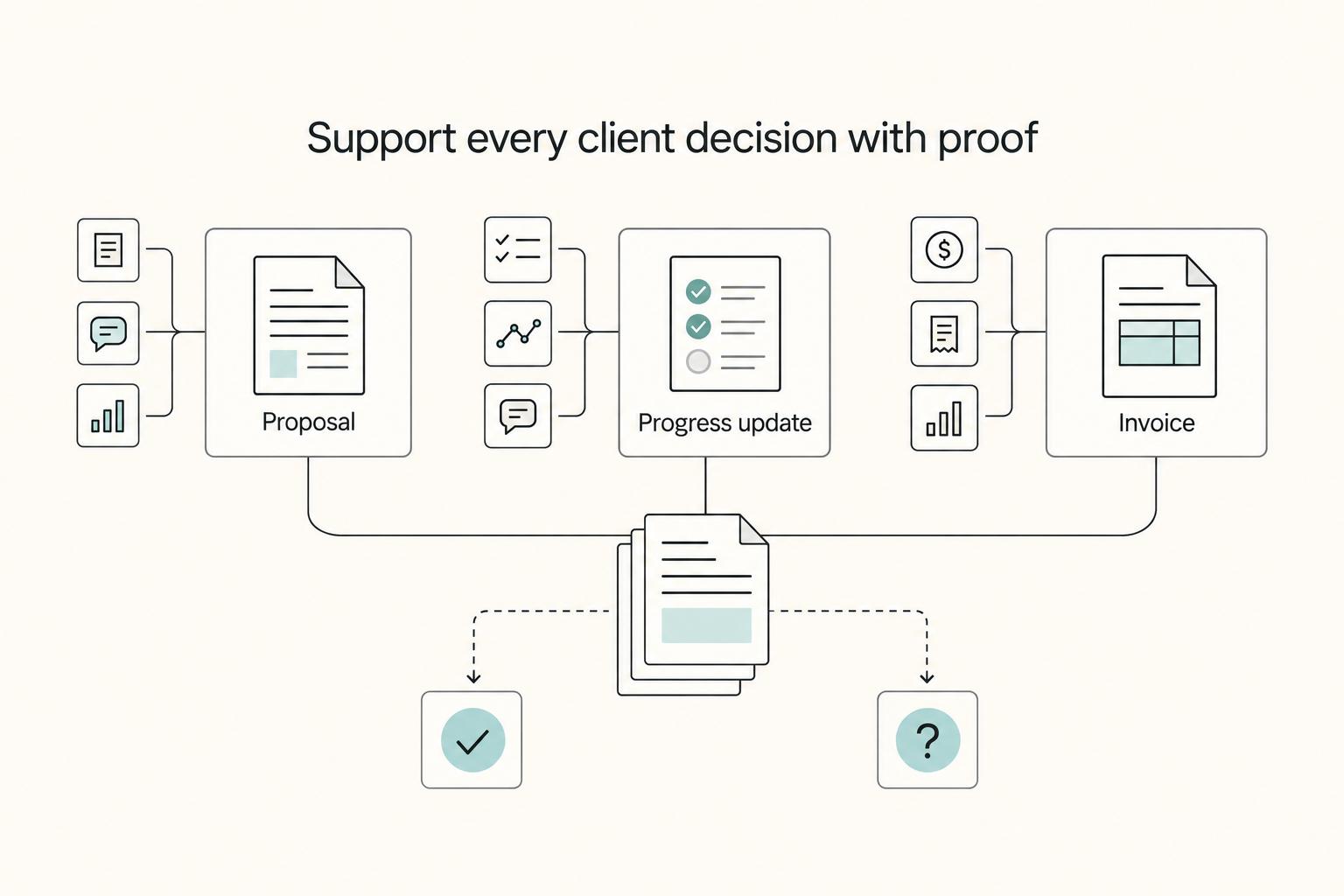
Treat the pyramid principle for client communication as a practical rule: state the decision first, then support it with organized proof. When a client message buries the point, misunderstandings grow and create extra back-and-forth.
| Context | Support groups | Proof layer |
|---|---|---|
| Proposal | outcome, scope, boundaries | proposal version, date, named deliverables, saved approval trail |
| Progress update | status, blockers, next action | link the artifact, note what changed, name blocker owner, next checkpoint |
| Invoice | billing event, amount, payment instruction | contract trigger, supporting evidence, reference IDs, required attachments |
Barbara Minto’s Pyramid Principle organizes supporting ideas under one main point. For client work, the practical habit is to identify the question your reader needs answered, state your answer clearly and support it with relevant facts.
Step 1. Write the answer first, before you draft#
Write the answer first. Before you draft a proposal, update, or invoice note, finish this sentence: "The client should know or decide that ___." Use that top line as the single conclusion you want the reader to act on.
Use a simple checkpoint: if someone reads only the first one or two lines, do they know the recommendation, status, or payment ask? If not, you are still warming up instead of communicating. A common failure mode is opening with background, process detail, or chronology and making the client hunt for the point.
Step 2. Group your support into a small set of distinct points#
Group your support into a small set of distinct points. Two to four points is a practical range: each should do a separate job, and together they should cover the decision.
For a proposal, group outcome, scope and boundaries. For an update, group status, blockers and next action. For an invoice, group the agreed billing event, amount and payment instruction.
Step 3. Attach proof that can survive a reread#
Attach proof that can survive a reread: links, versioned files, dated approvals, delivered assets, milestone notes, or acceptance evidence. Acceptable proof is anything specific enough that a client, finance contact, or future you can verify what was promised and what was done without reconstructing the story from memory.
| Context | Unstructured message | Pyramid-structured message |
|---|---|---|
| Proposal | Starts with background and ideas, with scope buried later | Starts with the promised outcome, then scope, boundaries, and proof of fit |
| Progress update | Lists activities completed in time order | Starts with current status, then supporting facts, risks, and next action |
| Invoice | Leads with attached invoice and generic thanks | Starts with the payment ask, explains the agreed billing event and supplies the references |
That closed loop is the point: promise, proof, payment. The next three sections apply the same logic to proposals, updates, and invoices so each message does one clear job and leaves a usable paper trail.
Stage 1: Write Proposals That State Outcome, Deliverables, and Exclusions#
Your proposal should answer this immediately: what business result you are committing to, what the client will receive, and what is outside scope.
Step 1. Lead with one outcome statement tied to business impact#
Lead with one outcome statement tied to business impact, not your internal effort. Write a first sentence the client can approve or reject. Example: "You will receive a landing page copy package that supports the launch of Product X and gives your team approved messaging to publish."
If your first lines focus on process ("research, meetings, collaboration"), scope usually gets interpreted too loosely. If you want pricing tied to outcomes and value, your opening has to describe the outcome in plain language.
Step 2. Separate deliverables from activities and group them into buckets#
Separate deliverables from activities, then group deliverables into clear, non-overlapping buckets.
- Deliverables: what the client receives (for example, memo, deck, prototype, migration plan, final asset pack).
- Activities: how you produce it (for example, calls, research, testing, revisions).
Use a repeatable structure: outcome first, deliverable groups second, boundaries third. This works across strategy, creative, and technical projects because it removes guesswork.
| Weak proposal language | Pyramid-structured language |
|---|---|
| "Brand strategy support for Q2" | "Deliver a messaging brief, positioning options, and a final approved narrative for the Q2 launch." |
| "Design iterations included" | "Includes two revision rounds on the selected concept after consolidated client feedback." |
| "Website updates as needed" | "Includes updates to the five listed pages only. New pages, template changes, and copy beyond those pages are excluded." |
| "Client collaboration required" | "Client will provide source files, one decision-maker, and feedback within the agreed review windows." |
Step 3. Lock boundaries in writing before you send pricing#
Before you send pricing, lock boundaries in writing: inclusions, exclusions, client responsibilities, dependencies, revision policy, and change-request path. If you later use an engagement letter or service agreement, keep these terms aligned so your scope does not drift between documents.
Use details that hold up later: proposal version, date, named deliverables, and saved approval trail (email or signature). Avoid vague phrases like "ongoing support," "minor tweaks," or "as needed" unless you define limits.
Before sending, run this checklist:
- Does the first paragraph state one business outcome the client can judge?
- Are deliverables listed as outputs, not mixed with activities?
- For each deliverable, are inclusions, exclusions, and client inputs explicit?
- Is the revision policy clear enough that extra rounds become a change request?
- Could your future update and invoice point back to this proposal without re-explaining context?
Stage 2: Make Status and Required Decisions Clear#
Once scope is set, each update should make your judgment easy to scan: current status, client impact, and immediate next action in plain language.
| Status | Impact line | Next step |
|---|---|---|
| On track | Current impact on date/handoff remains intact | Name the immediate action and confirmation checkpoint |
| At risk | Name the issue and the date, dependency, or review window it may affect | Name the recovery action and the input or approval needed by the next checkpoint |
| Off track | Name the reason and the date, scope, or sequence it changes | Name the replan action and when you will return with a revised path |
Step 1. Open every update with status, impact, and next action#
Open with status, impact and the action needed. For example:
- The launch copy is at risk for Friday because the product claims are still unapproved.
- The draft and the three claims needing review are linked below; design can continue with the approved sections.
- Maya, please approve or revise those claims by Wednesday at noon. If that slips, I’ll send a revised delivery date.
If someone reads only this opener, they should still understand where things stand and what happens next.
Step 2. Structure the update around the client's core questions#
Structure the rest of the update around the client's core questions:
- Timeline confidence: Is the agreed checkpoint still holding?
- Visible progress: What changed since the last update?
- Unresolved risks: What is open, and what is the likely effect?
- Required decisions: What input or approval is needed, from whom, by when?
| Reactive update style | Pyramid-structured update style |
|---|---|
| Starts with task recap | Starts with current status, impact, next action |
| Lists activity without outcome | Shows what changed and why it matters to the milestone |
| Mentions risks vaguely | States open risk, likely effect, and owner |
| Ends with broad "thoughts?" ask | Ends with one clear decision/input request |
Step 3. Add a compact proof layer and state the next checkpoint#
Add a compact proof layer so the client can verify progress quickly: link the artifact, note what changed, name blocker owner, and state the next checkpoint.
Use this cadence checklist across email, shared docs, and PM tools:
- Keep the same opening-line format each time
- Cover timeline, progress, risks, and decisions in the same order
- Label artifacts clearly and note what changed since last update
- Name blocker owner when work is stuck
- State the next checkpoint in every update
- Keep one current source of truth and point other channels to it
You might also find this useful: How to Present a Creative Concept to an Enterprise Client.
Stage 3: Write Invoices That Are Easier to Process#
Your invoice email should let the buyer or finance approver act without extra clarification. Link the payment request to the agreed billing event and relevant contract references.
| Invoice item | What to include |
|---|---|
| Governing document | The relevant agreement, statement of work or purchase order; match its identifiers |
| Billing event | The contractual billing trigger: acceptance, deposit, scheduled billing or another agreed event |
| Reference IDs | invoice number, project code, PO number, Service Order ID, or Order Form ID |
| Required attachments | invoice PDF, deliverable recap, and any client-confirmed billing field |
| Usage-based charges | Usage period, quantities and agreed pricing terms supporting the charge |
| Escalation path | buyer, finance contact, or procurement owner if payment is blocked |
Step 1. Lead with the payment action and processing details#
Lead with the payment action. In pyramid terms, the apex is the ask, so put the processing details at the top, where routing decisions happen.
- Subject:
Invoice number | project or milestone | Due date - Opening line:
Please process the invoice for the confirmed amount, due date, and project or milestone. - Payment CTA:
Payment link attached below. If your team needs a PO, vendor ID, or billing code, reply here with the required field and I will update the invoice.
Quick test: if only the subject and first line are forwarded to accounts payable, is there enough context to route it correctly?
Step 2. Tie the charge to the governing document and billing event#
Tie the charge to the agreement and the billing trigger. Use the actual statement of work, purchase order or other controlling document for the engagement, and include its reference where the client requires it. A deposit or scheduled invoice may be due before final acceptance; explain that agreed trigger instead of implying the work is complete.
Then include a compact proof layer in the email body or attachment note:
- The agreed billing event and the work or period covered
- Acceptance evidence where acceptance triggers billing
- reference IDs: invoice number, project code, PO number, Service Order ID, or Order Form ID
- required attachments: invoice PDF, deliverable recap, and any client-confirmed billing field
| Friction-heavy invoice email | Pyramid-structured invoice email |
|---|---|
| Opens with a generic note | Opens with invoice number, amount, due date, and payment action |
| Mentions "completed work" loosely | Maps charges to the agreed billing event and governing document |
| Leaves out IDs and processing fields | Includes invoice ID, PO/order references, and required billing fields |
| Triggers avoidable follow-up questions | Gives buyer and finance approver enough detail to route or approve |
Step 3. Remove preventable blockers before you send#
Before you send, remove preventable blockers. The most common issue is inconsistency between invoice language and the Service Order or Order Form.
Use this pre-send checklist:
- invoice amount, scope label, and milestone match the proposal and latest update
- Service Order or Order Form reference is included where applicable
- The contractual billing trigger is documented, with acceptance evidence where required
- reference IDs and required attachments are complete
- If usage-based charges apply, the period, quantity and agreed rate are clearly labeled
- escalation path is named (buyer, finance contact, or procurement owner) if payment is blocked
For a step-by-step walkthrough, see A Guide to Using Loom for Asynchronous Client Communication.
Write So the Client Can Decide and Act#
Use the next client message to make one decision easier. State the recommendation, status or payment action first, then supply enough evidence for the reader to judge it.
The main failure mode is the communication illusion: the message was sent, but the decision still is not clear. Use a higher standard instead: clarity, structure, and confidence, with a paper trail another stakeholder can pick up without extra context.
| Background-first message | Decision-first message |
|---|---|
| Practical behavior | Opens with background, mixes updates and asks, leaves the decision implied |
| Default message structure | Context first, chronology, scattered requests |
| Likely client response | Follow-up questions, slower handoffs, harder internal forwarding |
Make the shift in your next client cycle#
- Proposal (scope control): Open with the recommended outcome, then group deliverables and boundaries so scope is clear at a glance.
- Update (expectation control): Open with verified status, add key actions and proof, then state the decision or input you need.
- Invoice: open with the payment action, then attach evidence for the agreed billing event, including acceptance where required.
- Reflection habit: After each message, ask where your idea did not land clearly, and tighten the next proposal, update, or invoice accordingly.
We covered this in detail in How to use 'First Principles Thinking' to solve client problems.
Frequently Asked Questions
How do you start using the pyramid principle for client communication without rewriting everything?
Start with the first two lines of each client message, not the whole template. In your proposal, lead with the recommended outcome. In your update, lead with the verified current status. In your invoice email, lead with the requested action. Take one live template and rewrite only the opener so the reader can act without scrolling.
What should a project update look like in practice?
Use an answer-first opener, then keep the rest tight. Add two to three key actions, and end with the result, risk, or decision needed. A simple check: if a client reads only the first sentence and the three bullets below it, they should still know whether the work is on track and what happens next. For your next update, use this order: status, two to three actions, result or learning, request.
Should you send a long narrative update or an answer-first update?
Use the answer-first version when your client is busy, likely to skim, or may interrupt and probe for the main point. Long narrative can work for sensitive context, but it raises the chance that the main point gets buried. As a quick test, cut any opening history until the status appears in sentence one.
How do you use this in a proposal without sounding overly certain?
Lead with your recommendation, but keep the support specific and conditional where needed. If details still depend on discovery, say that the final deliverable scope is still being confirmed instead of pretending the unknown is settled. Rewrite your proposal opening so it states the recommended outcome first, then groups the supporting work into two or three clean sections.
Where does SCQA fit if you still need to explain the background?
Use SCQA when the client needs a short setup before your recommendation: Situation, Complication, Question, Answer. Keep that introduction tight. If you do not get to the point quickly, you risk losing executive attention. For your next complex proposal or reset email, draft four one-line prompts in SCQA order before you write the final message.
What does MECE mean for your day-to-day client writing?
You do not need to turn MECE into theory to use it. Treat it as a quick check from Barbara Minto's book: if two supporting bullets say nearly the same thing, merge them. If a buyer, approver, or finance contact would still have an obvious unanswered question, add the missing point. Review one proposal or update and remove overlap between your support bullets.
Who is Barbara Minto, and do you need to study the full method first?
Barbara Minto developed the Pyramid Principle for organizing ideas under a main point. You can apply the core habit before studying the full method: draft the answer to the reader’s question, then add the facts that support it and the next action.
Can you use the same structure in invoices and payment follow-ups?
You can use the same conclusion-first structure. Open with the main requested action, then include only the key supporting details needed for the next step. If any details are still being verified, state that clearly instead of implying certainty. Before sending, check whether the first line alone makes the action clear.
Try a related tool
Researched and edited by the Gruv editorial team. Gruv builds cross-border billing, payouts, and finance-operations software for global businesses.
Sources
Includes 2 external sources outside the trusted-domain allowlist.
- barbaraminto.comexternal
- barbaraminto.com/courseexternal
Educational content only. Not legal, tax, or financial advice.
Related Posts

GDPR Compliance Checklist for Freelancers Working With EU Clients
Start by separating the decisions you are actually making. For a workable **GDPR setup**, run three distinct tracks and record each one in writing before the first invoice goes out: VAT treatment, GDPR scope and role, and daily privacy operations.
How to Present a Creative Concept to an Enterprise Client
Treat the meeting as a decision checkpoint, not a taste review. Your job is to move the concept through clear questions, decision ownership, and risk ownership before execution starts.

The Freelance Payment Penalty: A Modeled Audit of Platform Fees, FX Spreads, and Payout Delays
The money rarely disappears through a single, easy-to-spot fee. The real loss is stacked. A marketplace takes its commission, a processor adds a charge for international cards, a bank or payment company converts the currency at a spread, a platform holds the funds before release, and a wire sheds a little to intermediaries on the way in. Each layer looks defensible on its own, but the worker feels the combined result as a smaller deposit and a later payday.