
Quick Answer
Use a fixed three-hour block and run social media for freelancers as an operating system: pick two primary channels with the 3-C check, publish one proof-led post, then prioritize warm DMs and follow-up. Add UTM parameters to conversion links and review GA4 Traffic acquisition with CRM notes so you can see which channel moves people toward scope questions or calls. Keep a simple log and change one variable per monthly review.
Build a Freelance Social Media System in Under Three Hours a Week#
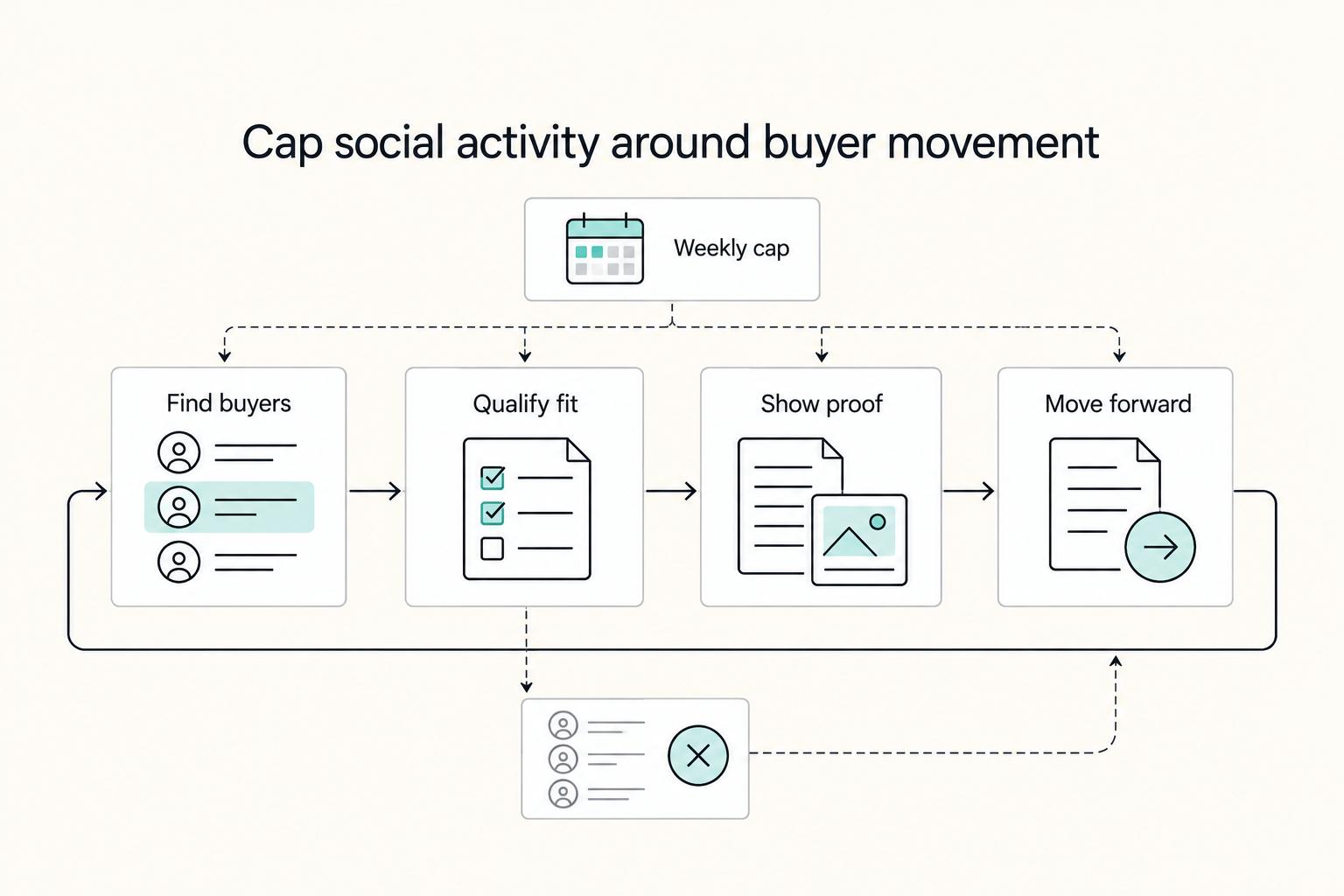
Treat your social presence as a capped client-acquisition block, not a daily posting race. If an activity does not help you find, qualify, or move real buyers forward, it does not belong on your weekly calendar.
This approach works best when you stop treating posting as the job. The job is producing qualified conversations. Content, comments, DMs, and profile updates matter only if they help you do that inside a time limit you can actually sustain.
Before you start#
Write these two lines before you post anything. A qualified lead is a person who fits your service and shows budget, authority, need, and timeline. A non-qualified lead is a person who consumes attention but lacks fit, buying authority, real need, budget, or near-term timing. Keep both lines at the top of your notes and use them to filter every task and every CRM entry.
Step 1. Block the time and define what counts as evidence. Set one recurring weekly block with a hard ceiling you can sustain. That cap matters because content work can easily spread across the week and crowd out the work that pays you.
Before the week starts, decide what proof you will use: a case-study snippet, result summary, deliverable screenshot, or short breakdown of how you solved a client problem. Checkpoint: each planned action should point to one buyer question and one next step.
| Input | Expected signal | Warning sign | Action |
|---|---|---|---|
| One proof-led post tied to a real service outcome | Replies, profile visits, or DMs from people who resemble your buyer | Likes from peers but no fit questions | Keep the topic, tighten the CTA or qualifier |
| Warm follow-up with past engagers, referrals, or open conversations | Clear next-step replies, booked calls, or scope questions | Pleasant chat that never reaches project details | Keep follow-up, shorten the message, ask one qualifying question |
| One support comment that answers a common objection | Relevant profile clicks or DM continuation | Broad agreement with no buying intent | Adjust the comment to mention a specific use case |
| Trend chasing or posting generic tips | Spikes in impressions only | Attention with no qualified conversations | Drop unless it can be tied to proof |
| Jumping between platforms every week | Scattered activity | No clean read on what brings fit | Drop the switch and hold your current setup steady |
Step 2. Plan with a gate, not a brainstorm. Use the first part of the block to plan one post, one follow-up batch, and one review target. Do not rebuild the process from scratch every week. A common freelancer failure mode is chasing inspiration instead of repeating what already produced serious conversations.
Pass the planning gate only if each item answers three questions: who is this for, what proof supports it, and how will I tell whether the response is qualified rather than merely active?
Step 3. Execute in fixed order. Publish first, then do outbound and follow-up, then handle replies. That order matters because it keeps you from hiding in content creation while live opportunities cool off. Clients hire for outcomes, not more posts, so most of your execution time should go to warm DMs, comment replies, and scheduled follow-ups with people who are already near a decision.
The checkpoint is whether every active conversation ends with one of three outcomes: a next step, a disqualifier, or a dated follow-up entry in your CRM.
Step 4. Review against lead quality, not noise. Do not grade the week by reach alone. Review who responded, what they asked, and whether they matched your fit criteria on budget, authority, need, and timeline. If a post looked busy but the replies stayed vague, the signal is weak. That is where many freelancers make the wrong call and post more instead of tightening the offer, proof, or follow-up message.
Keep a tiny evidence log in a notes app or spreadsheet so you do not need extra tools. Use this format each week: date, activity, proof used, response quality, next step, keep/adjust/drop. Then apply one rule consistently:
- Keep when an activity produced or advanced qualified conversations.
- Adjust when it created replies but the fit was weak or the CTA confused people.
- Drop when it repeatedly brings attention without real buyer movement.
This is the core operating model. Once you can run this cycle cleanly, choosing channels gets easier because you know exactly what signal you are trying to produce. Related: A Guide to Website Accessibility (WCAG) for Freelance Developers.
Prepare your inputs before you post anything#
If your message, proof, and boundaries are unclear, posting more often usually creates more low-fit conversations, not better ones. Tighten these inputs first so your posts, comments, and DMs stay consistent.
Before you start#
Keep two live assets open while you plan:
- A working doc for your message and operating rules
- A proof folder or portfolio location for evidence
At the top of each, keep: Asset, Owner, Last Updated, Link.
Step 1. Write your three-line filter. In your planning doc, write:
- Your positioning statement
- What counts as a qualified lead
- What disqualifies a lead
Your positioning line should state who you help, what work you do, and the outcome you are hired for. If it still reads like "I help brands grow," it is too broad to filter the right buyer.
Checkpoint: can someone read those three lines and quickly tell if they fit? If not, revise before drafting.
Step 2. Build a proof pack you can actually send. For each core service, keep these five evidence items ready and note where each lives:
- Case-study summary: portfolio page
- Outcome metric placeholder: internal notes until you can share approved numbers
- Deliverable sample: redacted file in a cloud folder
- Testimonial: dated screenshot or approved quote file
- Scope context: proposal template or project summary
Use proof with context. A claim alone creates curiosity; proof plus scope helps a buyer judge fit.
If you reference a regulation or policy, verify it with an official source. FederalRegister.gov says it is not an official legal edition and instructs users to verify against an official Federal Register edition, with a link to the official PDF on govinfo.gov.
| Input area | Strong input | Weak input | Likely pipeline outcome |
|---|---|---|---|
| Positioning | Specific buyer, service, and outcome | Broad language with no filter | More activity, fewer qualified conversations |
| Proof pack | Clear artifact + context + location | General claim with no artifact | Trust friction and slower qualification |
| Boundaries | Reusable written rules across touchpoints | Different answer in each conversation | Scope drift and payment friction |
Step 3. Set operating boundaries you can repeat word for word. Write short reusable message rules for:
- Contract terms
- Invoice process
- Revision policy
- Scheduling
- Primary communication channel
Goal: consistency, not rigidity. If your DM answer, proposal language, and kickoff message conflict, revise the rule now.
Step 4. Run a go/no-go check before publishing. Use three tests:
- Clarity test: does this match your positioning and offer one clear next step?
- Trust test: does each meaningful claim point to real proof or a verified source?
- Fit test: does the CTA attract your defined buyer and screen out poor fit?
If any test fails, mark it no-go: revise inputs first, then publish.
Choose two primary channels with a clear decision rule#
Use two primary channels only if that keeps your system focused and measurable. A channel stays primary when your buyer is active there, the format lets you show credible proof, and the next action moves into your pipeline in a trackable way.
Two channels is a working limit, not a universal rule. The point is quality over quantity: spreading across too many platforms usually hides what is actually producing leads.
Step 1. Set a pass/fail rule for each candidate channel#
Write one sentence for each candidate channel: My buyer is here, I can prove value here, and I can route interest from here into a tracked next step.
If you cannot write that sentence clearly, do not make it primary yet. Tie this back to your buyer persona, business objective, and qualified-lead definition from the previous section.
Step 2. Run the 3-C check before you commit#
Use Cost, Capability, and Customer ROI to compare options. Cost includes time and follow-up load, not just spend. Capability asks whether the format fits your proof. Customer ROI means clicks, leads, and sales, not likes or followers.
| Channel type | Cost | Capability | Customer ROI | Evidence signals | Operational friction | Disqualifier |
|---|---|---|---|---|---|---|
| Professional network | Moderate time | Strong for expertise posts, case snippets, and positioning | Strong only if attention becomes qualified conversations | UTM link clicks, qualified inbound messages, booked calls | Ongoing replies and profile upkeep | Most attention is from peers, not buyers |
| Visual portfolio channel | Higher prep load | Strong when your work is easy to show with examples | Useful only if viewers move to inquiry actions | Portfolio visits, inquiry starts, leads referencing specific work | Requires permission-safe visuals and consistent formatting | Your value is hard to understand in visual-first posts |
| Fast conversation channel | Low production, high monitoring | Good for short insights and relationship building | Keep only if conversations produce trackable inquiries | Link clicks, email signups, qualified DMs | Easy to spend time in low-fit threads | High activity, low-fit inquiries |
Give each primary channel a distinct job so effort does not overlap.
Step 3. Measure attributable outcomes, then keep/swap/drop#
Add UTM parameters to every conversion-focused social link. In your CRM, log source, campaign, lead quality, and next step so you can trace which channels and posts create real pipeline movement.
Use a simple rule:
- Keep: channel consistently brings qualified leads with a clear next action.
- Swap or drop: channel generates activity but weak-fit inquiries.
- Check false positives before big changes: review message fit, audience targeting, and channel choice together so you do not mistake noise for progress.
If outreach is part of your plan, How to Network with Journalists on Social Media is a useful next read.
Set up profiles that pass a client trust check in 30 seconds#
Before you post more, fix the destination. Your profile is a conversion step: a prospect should quickly understand what you do, see credible proof, and know what to do next.
Step 1. Audit your profiles in a practical scan order#
Use this scan order across LinkedIn, your portfolio, and your website bio: relevance, credibility, then next action. Treat it as a practical review order, not a universal rule.
Open each profile as if you were a new buyer and ask:
- Relevance: Is it clear who you help and what service you offer?
- Credibility: Are your skills, experience, or work examples visible without digging?
- Next action: Is there one clear way to contact you or start?
If you need to explain the profile out loud for it to make sense, tighten it.
Step 2. Tighten the five fields that carry most of the trust load#
Focus on the fields that do most of the work:
- Headline: State the service clearly.
- Bio: Expand the same message in plain language.
- Offer statement: Say what a client can hire you for now.
- Proof snippet: Show a concrete work example near the top.
- Call to action: Give one primary next step.
On LinkedIn, complete your profile and clearly showcase your skills and experience. Keep wording aligned across LinkedIn, portfolio, and website so buyers do not get mixed signals.
| Profile element | Weak version | Strong version | Friction when weak |
|---|---|---|---|
| Headline | Clever but vague | Clear service focus | Buyer cannot confirm fit |
| Bio | Generic background | Service + relevant experience | Credibility is hidden |
| Offer statement | "Open to opportunities" | Specific service to hire | No clear commercial intent |
| Proof snippet | No visible examples | Work example near top | Buyer must hunt for proof |
| CTA | Multiple scattered links | One clear primary next step | Action path is unclear |
Step 3. Check profile signals before increasing content volume#
Before you publish more, check whether profile traffic and inquiry quality are moving together. If attention rises but qualified conversations do not, tighten message-to-proof alignment and simplify your CTA path first.
Use the same tracking approach from the previous section so you can spot where interest drops. Verify your links and contact path regularly so people do not hit a dead end.
Publish proof-led content that moves buyers to action#
Publish each post to help a buyer make one decision, backed by one clear piece of proof and one next step. If a draft tries to prove everything at once, narrow it until the decision is obvious.
Step 1. Choose one buyer doubt to remove#
Start with the friction you hear most often in calls, DMs, and proposal follow-ups.
- Fit uncertainty
Use this when the buyer is asking, directly or indirectly, whether you are right for their type of project. Show relevance through client type, project type, problem type, or a before/after example tied to the service you sell now.
- Reliability uncertainty
Use this when interest is present but confidence in execution is weak. Show your process, checkpoints, testimonial evidence, or a concrete artifact that makes your execution standards visible.
- Scope uncertainty
Use this when the buyer likes your work but is unclear on what is included. Show a deliverable excerpt, mini walkthrough, or a tightly framed example of what changed because of your work.
Before you publish, run this check: "After reading this, the buyer should feel more confident about ___." If you cannot complete it in one line, the post is still too broad.
Step 2. Match the claim to the proof artifact#
Buyers often use other people's experiences to decide whether a service is worth buying, so strong wording without proof usually underperforms. Make the claim verifiable inside the post.
| Claim type | Best proof format | What to include | Common risk to avoid |
|---|---|---|---|
| Outcome claim | Before/after snippet, result summary, or short case slide | What changed, client context, and why the change mattered | Big claim with no context, so relevance is hard to judge |
| Process claim | Step breakdown, annotated screenshot, or short walkthrough video | What you did, a key checkpoint, and what "good" looked like | Listing steps without showing how they reduce buyer risk |
| Communication-fit claim | Testimonial line, feedback excerpt, or sanitized client message | Specific words on clarity, responsiveness, or collaboration | Generic praise that does not support your service claim |
Keep this verification triad in every post: what changed, what you did, and why it matters. If one is missing, engagement can look fine while inquiry quality stays weak.
If you cannot share full client material, share sanitized evidence with context. Remove names or sensitive details, but keep enough to evaluate the claim: industry, problem, deliverable type, and outcome direction.
Step 3. Repackage the same claim for your two primary channels#
Keep the claim and evidence consistent, then adapt the packaging by channel. This is how you repurpose without sounding inconsistent.
For example, the same claim can be a short LinkedIn post with one screenshot, then an Instagram carousel that sequences problem, artifact, and result. Same claim, channel-native format.
Repurpose only the posts that generated qualified conversations. Use objections from comments and DMs to improve the next version, especially around boundaries like timeline, team setup, or what is included.
End each post with one next step, not several. One qualifier question helps readers self-sort, and stronger in-post proof gives you cleaner qualification in comments and DMs, which makes routing into your weekly cadence simpler.
If your bio is still too broad, How to Write a Freelance Instagram Bio That Filters for Fit can help you tighten it.
Run a three-hour weekly cadence with fixed order of operations#
Keep the sequence fixed each week: publish, engage, review. That order keeps your effort usable, so you do not create more activity than you can follow through.
Use capacity as your guardrail. A practical rule is to load only about 80% of your available capacity so client delivery does not get squeezed. Block your three-hour session at a time that will actually happen, then run a short weekly planning checkpoint, often Sunday afternoon, to choose one post, one follow-up priority, and one test.
Step 1. Publish one proof-led post, then add one support comment#
Your output is one live proof-led post plus one support comment that handles a likely objection. Keep the comment focused on fit, scope, or the next step.
Your quality check is message fit: can a buyer quickly see what changed, what you did, and what they should do next? If not, tighten the post before moving on.
Your handoff is a follow-up list. Capture people who engaged in a way that suggests buying intent, then move them into your engagement block.
Step 2. Qualify engagement before you expand it#
Use this block for replies, warm DMs, and scheduled follow-ups. Keep it targeted, because manual social handling can drain creative energy and pull time from other marketing work.
Your output is a short log for each active conversation with three fields: contact context, buyer-fit signal, and next action. Example: "LinkedIn comment," "asked buyer-specific scope question," "send scope questions."
Your quality check is simple: every active thread has a clear status. Your handoff is priority order for review: active qualified threads first, new outreach second.
| Weekly situation | Cut first | Protect | Why |
|---|---|---|---|
| Low-time week | Extra posts or extra channels | One proof post, follow-up, review | Too little posting can reduce visibility, but scattered output is easier to cut than buyer conversations |
| High response load | New outbound | Replies, qualification, next-step logging | Existing demand is higher-value than starting conversations you cannot manage well |
| Testing scheduling or AI help | Full automation rollout | Focused pilot with tracked quality and engagement | Test timing or automation in a controlled way before scaling |
Step 3. Review conversation quality, then move qualified leads into scope and terms#
Your output here is one decision for next week: keep, adjust, or drop. Log the date, what you changed, and what happened in conversations so your next move is evidence-based.
Use message fit as the diagnostic before scaling. If engagement is high but buyer questions stay vague or off-target, adjust the message, proof, or qualifier before increasing activity. If you test scheduling tools or AI support, treat it as a focused pilot and include moderation, licensing, and safety/legal checks before expanding use.
Your final handoff is operational: once a conversation is qualified, move it out of DM back-and-forth and into scope and terms. Confirm the brief, boundaries, and commercial details in writing so delivery stays protected. Related reading: The Best Social Media Scheduling Tools for Freelancers.
Turn engagement into qualified client conversations#
Use engagement to qualify and advance, not to collect reactions. If a comment, DM, or community reply does not confirm fit and produce a clear next step, treat it as activity, not pipeline.
Step 1. Build from a maintained niche-fit list#
Work from a maintained niche-fit list, not your live feed. Keep three buckets in your CRM or planning doc: people, accounts, and communities that match your service, buyer type, and proof.
Before you reply or reach out, write a one-sentence fit reason. If you cannot state it, skip the thread. Refresh this list in your weekly review: keep sources that produced real buyer questions, and remove sources that produced noise, vague praise, or off-scope requests.
Do not confuse familiarity with fit. A busy community or friendly commenter can still be wrong for your offer. If a thread drifts into free consulting, broad brainstorming, or work you do not want to repeat, close it early.
Step 2. Move each thread through a clear stage map#
Use explicit entry and exit criteria so conversations do not stall in polite back-and-forth.
- Stage 1: Signal captured
Entry: someone leaves a relevant comment, replies in a niche community, or sends a warm DM after seeing your work. Exit: you ask one clarifying question tied to fit, scope, or readiness.
- Stage 2: Fit checked
Entry: they share real context about the problem, project, or decision process. Exit: you make a continue-or-close decision. Continue only if the work fits your offer and they are open to a better process.
- Stage 3: Next step set
Entry: fit is clear enough to move beyond casual chat. Exit: you send the next concrete action, such as scope questions, a brief, or a call invite.
| Engagement type | Best use case | Qualification signal to look for | Recommended next action |
|---|---|---|---|
| Public comments | Someone reacts to a proof-led post or asks a relevant public question | They ask about process, scope, results, or whether you handle their kind of problem | Reply with one useful answer plus one qualifier, then invite a DM or brief if fit looks likely |
| Warm DMs | They already know your work through content, referral, or a prior exchange | They share a current problem, timing, or buying context | Confirm fit, then move to scope questions or a call |
| Community replies | A niche discussion where your expertise directly applies | They provide concrete context instead of asking for generic tips | Answer in-thread first, then move private only when a defined next step is clear |
Step 3. Review quality before you increase volume#
Review conversation quality before adding outreach volume. Use a simple lens: fit, readiness, and scope clarity. Ask: did these threads involve the right buyers, were they ready to move, and did the scope become clearer over time?
Then label every open thread as either continue with a named next action or close. If quality is weak, adjust message and targeting first, then reassess volume. Close politely when fit is poor, scope stays vague, or the buyer resists any improved way of working, because those threads usually stay inefficient.
Track the right signals and know when to pivot#
Pivot only when your review shows measurable, time-bound evidence that client quality is improving. If your goals are vague, you will mistake motion for progress.
Step 1. Label signals by business intent#
Track leading signals for conversation quality and qualified next steps, then separate outcome signals for project-fit outcomes. This keeps you from treating raw activity as success.
Use this pattern check during each review:
| Signal pattern | What it usually means | Pivot action | Do not change yet |
|---|---|---|---|
| High activity, low fit | You are getting attention without enough buyer intent | Tighten your qualifier question or CTA | Do not switch channels from one review period |
| Low activity, high fit | Fewer interactions, but better-fit buyers are responding | Repeat the same proof angle more consistently | Do not broaden your offer just to increase volume |
| Flat activity, flat outcomes | Current message is not creating interest or movement | Test one variable, for example format or audience angle | Do not change channel role, offer, and qualification criteria all at once |
Step 2. Run controlled pivots#
Keep each pivot measurable and time-bound. For cleaner learning, change one variable per test and hold the rest of your setup steady long enough to compare results. Also avoid direct apples-to-apples comparisons of raw activity across platforms, because platform conditions can differ.
Step 3. Log the decision before you act#
Before you pivot, write a short decision note:
- Hypothesis
- Observed signal
- Decision
- Next review trigger
If you cannot fill all four lines clearly, hold your current approach until you have better evidence.
For a step-by-step walkthrough, see The Best Tools for Managing Your Freelance Social Media Presence.
Protect your reputation with low-risk operating habits#
Trust is operational: you protect it by making your identity easy to verify, handling client information carefully, and giving prospects one clear next step.
| Reputation risk | Early warning sign | Immediate fix | Prevention habit |
|---|---|---|---|
| Identity mismatch | Your name, profile details, or work history look inconsistent across LinkedIn, website, and portfolio | Align your core identity details across your primary profiles | Review identity details together before publishing new proof |
| Insecure sharing | You are about to send client information on open Wi-Fi or through scattered channels | Pause, switch to a secure connection, and resend through one trusted channel | Treat open Wi-Fi as high risk and use a VPN when working in public |
| Overshared client proof | A post or case study includes client details that should not be public | Remove or redact before publishing | Sanitize proof before reuse and keep only approved versions in your proof pack |
| Unclear contact path | Prospects ask where to reach you or which link to use | Reduce to one primary CTA and one backup method | Keep the same contact route across LinkedIn, website, and portfolio |
-
Align your identity. Keep your LinkedIn, website, and portfolio consistent so people can verify who you are without friction. This lowers the trust risk that comes from a weak or unclear online footprint.
-
Handle client information in four moves. Classify what is sensitive, limit what you keep or forward, sanitize examples before reuse, and transmit securely. Open Wi-Fi can expose transmitted data, including passwords, so avoid sending client briefs, logins, or files there. If a request feels suspicious, verify identity through more than one source before sharing details.
-
Keep proof defensible. Store redacted screenshots, approved testimonials, and outcome summaries in your proof pack. That way, your content builds trust instead of creating risk by exposing project material.
-
Make referrals and next steps obvious. Keep one referral lane with clear fit criteria and one primary contact path. Once a month, run a trust audit across LinkedIn, your website, and your portfolio: can someone verify who you help, see credible proof, and find the next step without asking for clarification?
Common mistakes and fast recovery steps#
When results slip, fix one failure mode at a time. Make one correction, run one cycle, then review before you change anything else.
| Mistake pattern | Likely root cause | Immediate fix | What to monitor next cycle |
|---|---|---|---|
| You post across too many places with generic advice | Scope drift and weak buyer focus | Narrow your active channels and rewrite each post around one buyer problem, one proof point, and one next step | Whether qualified replies get clearer, not just louder |
| You get attention but no real inquiries | No clear conversion path | Add one CTA and one qualifier question to each discovery post | Whether replies include fit details like scope, timeline, or decision owner |
| You get warm responses, then lose momentum | Follow-up is inconsistent | Schedule follow-up before new outreach and log each thread's next action | Whether active conversations move to call, brief, or close-out |
| Your offer reads like admin support, not marketing judgment | You describe tasks instead of business value | Reframe your offer around customer understanding, outcomes, and constraints you handle; use a short written marketing plan when the service is complex | Whether prospects ask strategy questions, not only price or posting volume |
Step 1. Choose the single row that matches your failure mode#
Choose the single row that matches your current failure mode and apply only that fix this week.
Verification check: You can state, in one sentence, who you help, which business problem you solve, and the next action you want.
Step 2. Triage every response: qualify, route, then record the next action#
Triage every response in three moves: qualify, route, next action. Qualify against your lead definition, route to the right path, for example a call or brief, then record the next action and due date. If demand feels unstable, keep pitching and marketing until your workload is strong enough that you can decline work intentionally.
Step 3. Change one variable at a time, then protect your evidence#
Change one variable at a time, then protect your evidence. Keep backup screenshots of published work and back up business documents so you still have proof if links disappear.
Verification check: At cycle end, review only the metric tied to the fix you made. That discipline sets up cleaner day-30, day-60, and day-90 checkpoint decisions in the next section.
Execute the 90-day sequence with monthly checkpoints#
Run the next 90 days as one controlled cycle. You will make clearer decisions if you keep the structure stable, log every change, and review evidence at month end instead of reacting to one noisy week.
Before you start, update two working documents: your content calendar and your evidence log. In the calendar, track post date, channel, format, buyer problem, proof asset, and CTA. In the evidence log, track date, the single variable you changed, what happened to qualified conversation quality, lead-fit movement, follow-up completion, and your keep/cut call. Verification check: after a busy month, you should be able to see what you planned, what shipped, and which one variable moved.
| Month | Focus | What to keep stable | What to test | Evidence to review | Decision output |
|---|---|---|---|---|---|
| 1 | Message and channel discipline | Positioning, primary channels, CTA path, posting rhythm | One customer-outcome hypothesis | Reply quality, DM and call notes, lead-fit movement, follow-up completion | Keep or rewrite the core message |
| 2 | Proof packaging | Audience, offer, CTA, channel roles | One format or proof-presentation change | Which posts create qualified conversations, objection patterns, follow-up completion | Keep the stronger format, cut the weaker one |
| 3 | Conversion and follow-up | Core message, channels, proof angle | One follow-up or routing change | Movement from reply to call or brief, closed/lost reasons, follow-up completion | Reallocate time and set your next 90-day baseline |
Step 1. Lock month one#
Write a one-sentence customer-outcome hypothesis and keep it visible in your calendar. Assign ownership to yourself and set a two-week validation check, even if you work solo. Your priority this month is fit: confirm whether your message attracts the right conversations.
Do not change channels, niche, CTA, and proof angle in the same month. That creates noise and makes results hard to interpret.
Step 2. Test month two#
Keep audience and offer fixed, then test one packaging variable only. Useful options: post format, proof type, or framing of the same claim. Log the exact change so you can compare it against month one.
Review qualitative and quantitative evidence together. Do not rely on likes alone. Save strong-reply screenshots, note repeated objections from DMs or calls, and check whether stronger posts move leads toward a call, brief, or proposal.
Step 3. Reallocate month three#
Use month three to improve conversion, not to reset strategy. If conversation quality is strong but follow-up completion is weak, fix follow-up handling first. If follow-up completion is steady but lead-fit movement is weak, tighten your qualifier question or buyer framing for the next cycle.
At month end, cut one low-yield activity and carry one proven behavior forward.
- What I kept stable
- What I tested
- What evidence I reviewed
- What I will keep, cut, and carry into the next month
Wrap up with a copy-paste weekly checklist#
When your week gets crowded, use this as your baseline system, not a rigid formula. Keep the sequence stable, then scale volume up or down based on capacity.
Step 1 Decide. Lock your weekly block and choose one primary channel role, one proof asset, and one conversion action. Keep those roles stable for the week so your signals stay readable.
Step 2 Publish. Share one proof-led post and one support comment that addresses a real buyer question or objection. If you use links, add UTM parameters so campaign traffic can be identified in GA4 and reviewed in the Traffic acquisition report.
Step 3 Log. Update one evidence log and one stage-based lead view. Move each active conversation to its current lifecycle stage and record one clear next action.
Step 4 Cut. Remove one low-yield activity that created activity but not qualified conversations. Protect follow-up time before adding more posting volume.
Step 5 Align. Check that your profile, proof, CTA, and outreach language still match. If you adjust next week, change one variable at a time so you can see what actually moved results.
| Task | Done | Signal captured | Next action |
|---|---|---|---|
| Decide channel role, proof asset, and conversion action | ☐ | ||
| Publish one proof-led post and one support comment | ☐ | ||
| Log UTM traffic, replies, and lifecycle-stage movement | ☐ | ||
| Cut one low-yield activity | ☐ | ||
| Align message, proof, and CTA across touchpoints | ☐ |
If the week goes off-plan, use this fallback: publish one proof piece, follow up with active leads, log outcomes, and stop. Then run this review prompt: Which activity created the strongest qualified conversation, and which one produced poor-fit or low-signal responses? Set one change for next week based on that answer.
Want to confirm what's supported for your setup? Talk to Gruv.
Frequently Asked Questions
What is the best first platform if you only have three hours a week?
Pick the channel that fits your buyer, gives you a clear action path, and is realistic to follow up on inside your weekly cap. If two options seem equal, choose the one where your proof pack is easier to show and where replies, DMs, or booking steps are easier to handle without creating admin drag. Stick with that choice long enough to see a pattern before you swap, unless lead quality clearly drops. Record why you changed direction so you do not react to one quiet week. If LinkedIn is one of your finalists, A Freelancer's Guide to LinkedIn Marketing can help you tighten the setup.
How do you promote services without sounding pushy in comments and DMs?
Start by adding value, not dropping ads into every thread. Answer a real question, join a relevant discussion, or share a useful example from your work. Move to a next step only when the person has shown interest or the fit is already clear. Your message should point to one proof asset and one qualifier question, such as timeline or project type, so the exchange feels useful instead of generic. A common failure mode is spamming or sending the same pitch everywhere.
How often should you post when client delivery is heavy?
Keep the cadence you can actually sustain, even if volume is low, and pair posting with follow-up. Consistency usually helps more than bursts of activity followed by silence. If paid work squeezes your schedule, prioritize publishing and follow-up. Do not try to compensate for a missed week by posting everywhere at once, because that can weaken message clarity and follow-up quality.
When should you add a second channel instead of improving the first one?
Add a second channel only after the first one is producing readable signals and your follow-up is staying consistent. If the first channel is getting profile views or replies but those conversations are weak, fix the message, proof packaging, or qualifier question before you expand. If the first channel creates qualified conversations and your weekly process still fits inside your time budget, test the second channel with one clear job and keep the original channel role stable. Make that decision from your own tracked patterns, not trend pressure or platform envy.
What metrics prove your content is driving qualified leads, not just reach?
Use signals that show two-way interaction and movement toward real sales conversations, not attention alone. A practical approach is to track qualified DMs, discussion quality, feedback, and whether conversations move to a clear next step. Likes and impressions can show visibility, but they should not decide your next move by themselves. When you review your log, check whether a content change connects to a repeatable business result or recurring objection. | Review cue | Treat it as signal when | Treat it as noise when | |---|---|---| | Profile visits | they rise alongside qualified replies or call requests | they rise but no one takes the CTA | | Comments and DMs | they include real questions, fit details, or useful feedback | they stay vague, off-topic, or praise-only | | Post engagement | it leads to follow-up conversations you can track | it looks busy but never moves to discovery | | Content saves or shares | they cluster around useful, value-led posts | they never connect to any next step | | Reach numbers | they improve together with conversation quality | they improve but lead quality does not |
How do you know your profiles are helping, not hurting, conversion?
Run a quick consistency check across your public profiles before you blame the channel. You should present the same service focus, show current proof near the top, and offer one clear next step so a prospect does not have to reconcile mixed messages. Another avoidable mistake is blurring business and personal pages in a way that confuses who you help or what you sell. If identity, proof, and CTA are not aligned across profiles, fix that first before changing your content plan.
Try a related tool
Researched and edited by the Gruv editorial team. Gruv builds cross-border billing, payouts, and finance-operations software for global businesses.
Sources
- catalog.southernct.edu/undergraduate/courses.htmltrusted
- congress.gov/event/119th-congress/house-event/LC75086/texttrusted
- ctstate.edu/images/Archives/Archived-Catalogs/MCC/MCC-20...trusted
- federalregister.gov/documents/2024/12/13/2024-28690/protecting-a...trusted
- ftc.gov/system/files/ftc_gov/pdf/PrivacyCon-2022-Gun...trusted
- kings.edu/pdf/Catalog2014-2015.pdftrusted
- nyc.gov/assets/dca/downloads/pdf/about/PublicComment...trusted
- pmc.ncbi.nlm.nih.gov/articles/PMC8354841trusted
Educational content only. Not legal, tax, or financial advice.
Related Posts

LinkedIn for Freelancers Who Want a Predictable Client Pipeline
Treat LinkedIn as two jobs you run at the same time: a credibility check and a conversation engine. If you only chase attention, you can get noise. If you only send messages, prospects may click through to a thin profile and hesitate.

Build a Freelance Referral Program Without Payout Disputes
Your week one control set is a practical baseline: the offer, the Referral Program Terms and Conditions, and the decision log. If a payout decision cannot point to one clause in the terms and one dated record entry, you are not ready to launch.

A Guide to Website Accessibility (WCAG) for Freelance Developers
Here's the clean operator move. Do not argue about labels. Anchor the work to a standard you can actually build and verify, then lock scope and sign-off inside the Statement of Work (SOW).