
Quick Answer
Start by making your proposal a decision sequence: define the outcome, present tier options with clear inclusions and exclusions, and state when a change requires a revised quote. Put the same boundaries in the SOW so scope and approvals stay aligned. For cross-border work, lock invoice currency, payment method, and fee allocation before kickoff. Use anchoring with real, fully scoped options, not decoys, so clients compare like-for-like and you protect what actually reaches your account.
Pricing Design, Proposal Structure, and the Client Decision Path#
Step 1 Reframe your price as a risk control tool#
Treat pricing as protection, not just persuasion. In a solo business, price design helps protect your cashflow, your boundaries, and the odds that work gets approved and paid with less friction.
In practice, a defensive pricing approach has three parts working together: your pricing design, your proposal structure, and the client decision path. The goal is simple: make it easy for a client to choose a clear scope, clear terms, and a clear next step before the project starts.
Step 2 Design choices ethically#
Nudging influences client action. Choice architecture is how you arrange information so some options are easier to notice and compare. The label matters less than the standard you apply: guide a clear decision without hiding tradeoffs or steering the client into a bad fit.
Use this checkpoint before you send: can a client open your proposal and quickly see what each option includes, what has to happen before work starts, and what changes the price? If yes, you are guiding a decision. If no, you may be creating room for scope drift and payment confusion. These effects are context-dependent and can backfire, especially when clients feel pushed or when information is uneven.
| Reactive pricing behavior | Defensive pricing behavior | Potential process effect (context-dependent) |
|---|---|---|
| Quote sent as a single number | Proposal with clear options and visible scope boundaries | Scope and terms are easier to compare before invoicing |
| Terms discussed after verbal approval | Payment terms and start conditions shown before approval | Start and payment expectations are clearer before approval |
| Price rewritten on every objection | One recommended option plus clear alternatives | Decision paths are clearer and negotiation rework may decrease |
Step 3 Check for asymmetry before you send#
The main red flag is information asymmetry. If you understand the real scope, assumptions, or approval path better than the client does, your proposal needs to make that visible. If it does not, confusion can come back later as revisions, delays, or invoice resistance.
Once you see that asymmetry, build in sequence: positioning, tier design, anchoring, then cross-border safeguards. You might also find this useful: How to apply 'Game Theory' to your freelance pricing and negotiations. For a quick next step, try the free invoice generator.
The Mindset Shift: From Vendor to Strategic Partner#
If you want pricing to protect cashflow, present your proposal as a business decision, not a task list. This shift does not guarantee faster approvals, but it can reduce ambiguity by making scope, terms, and client responsibilities explicit from the start.
In nudge terms, this is choice architecture: you change how options are presented, while the client keeps full freedom to choose. Vendor positioning leads with deliverables and hours. Partner positioning leads with the problem, intended outcome, and decision conditions.
Step 1 Ask discovery questions that expose the decision#
Start with the decision context, not just requested tasks. Use questions like:
| Discovery question | Focus |
|---|---|
| What must be true for this project to be considered successful? | Project success |
| What business problem is this solving right now? | Business problem |
| Who approves, and what do they need to approve confidently? | Approver and approval needs |
| What happens if this is delayed, unclear, or reworked? | Delay, clarity, or rework |
| What inputs, access, and turnaround times are required from your side? | Client inputs, access, and turnaround times |
Before you draft, confirm you can state the target outcome, decision owner, success criteria, and client dependencies. If any of those are unclear, narrow scope or propose paid discovery first.
Step 2 Convert scope into an outcome statement and a boundary statement#
Open your proposal with the intended outcome, then define the boundaries that protect delivery. Keep it practical: what is included, what is excluded, what the client must provide, and what triggers a scope change.
You are not promising guaranteed results. You are showing that your fee is tied to a defined objective, explicit assumptions, and risk-aware execution rather than open-ended time.
| Area | Weak positioning | Partner positioning | Expected client response |
|---|---|---|---|
| Proposal framing | "Here are my tasks." | "Here is the outcome, boundary, and decision path." | Approval is based on clearer criteria |
| Pricing language | "My rate is..." | "This fee covers this objective under these assumptions." | Less focus on rate-only comparison |
| Client role | Passive reviewer | Active owner of inputs and timelines | Shared responsibility is clearer |
Step 3 Match price format to engagement type#
Use a rounded format when the engagement is fixed and easy to evaluate at a glance. Use a precise format when pricing is built from documented assumptions or scoped components. The amount can stay unresolved until the source record is checked; the proposal should still show why that format fits the work.
Whichever format you choose, keep the logic visible. Rounded still needs clear boundaries. Precise still needs clear assumptions. If the message and structure do not match, clients are more likely to pull the conversation back to hourly bargaining.
This pairs well with our guide on A Guide to Tiered Pricing Models for Freelance Services.
Building Your Defensive Tiers to Eliminate Scope Creep#
Build tiers so a client can quickly decide what to fund now, what is included, and what happens if needs expand. In practice, clearer options reduce friction between first inquiry and funded order. The freelance platform examples are platform-specific (Fiverr/Upwork), but they still show why clarity matters: with 1,000 inquiries, a 2% conversion rate yields 20 orders, while 4% yields 40.
Step 1: Define the target outcome. Write one outcome sentence per tier, focused on the result, not a task list.
Use language like: This tier is designed to deliver the agreed outcome for this project.
Quick check: if someone can read the tier and still ask, "What is this for?", tighten the outcome statement.
Step 2: Define included scope and out-of-scope triggers. List what is included in plain language: assets, rounds, meetings, stakeholders, turnaround, client inputs. Then list what triggers a scope change.
Use language like: This tier includes the defined scope needed to deliver the agreed outcome. Requests that add a new deliverable, channel, stakeholder, or timeline shift are treated as scope changes and re-scoped before work starts.
| Tier level | Deliverable-based phrasing | Outcome-based phrasing | Client perception | Scope-change handling | Payment-risk impact |
|---|---|---|---|---|---|
| Entry | "3 assets, 2 calls, 2 revisions" | "One defined outcome for the project with standard support" | Buying units | Boundary is easier to miss unless triggers are explicit | Not directly established by available evidence |
| Middle (recommended) | "More assets + more support" | "Core outcome plus approval/handoff support" | Buying a complete decision package | Easier to map new requests to add-on or upgrade | Not directly established by available evidence |
| Complete | "Everything in middle + extras" | "Broader coverage for continuity and coordination" | Buying operating continuity | Expanded needs can move into documented upgrade path | Not directly established by available evidence |
Step 3: Define the upgrade path. Keep an intentionally bounded entry tier, a recommended middle tier for typical coordination needs, and a complete tier for broader continuity support.
Use language like: If your project includes additional coordination needs, the middle or complete tier is the better fit because it includes the appropriate support.
Step 4: Put change language in the proposal. Your day-to-day protection comes from prewritten upgrade language, not ad hoc negotiation.
Use language like: If you need additional support, I can move this into the appropriate tier or issue a revised quote for the added scope.
Scope-change protocol (mini-checklist):
- Restate the new request in writing.
- Match it to a named scope trigger.
- Confirm fit: current tier, add-on, or upgrade.
- Send revised scope and fee before starting added work.
This keeps your proposal easy to approve and easier to document when requests change. For a step-by-step walkthrough, see What is 'Loss Aversion' and how it affects your pricing decisions.
The Art of the Professional Anchor: Frame Value Before Price#
Use anchoring as a sequence, not a price trick: set the business stakes first, show full-scope context second, and present scoped options third. If you open with price alone, especially in online labor marketplaces where bill rates are publicly visible, clients are more likely to compare you on surface numbers instead of fit.
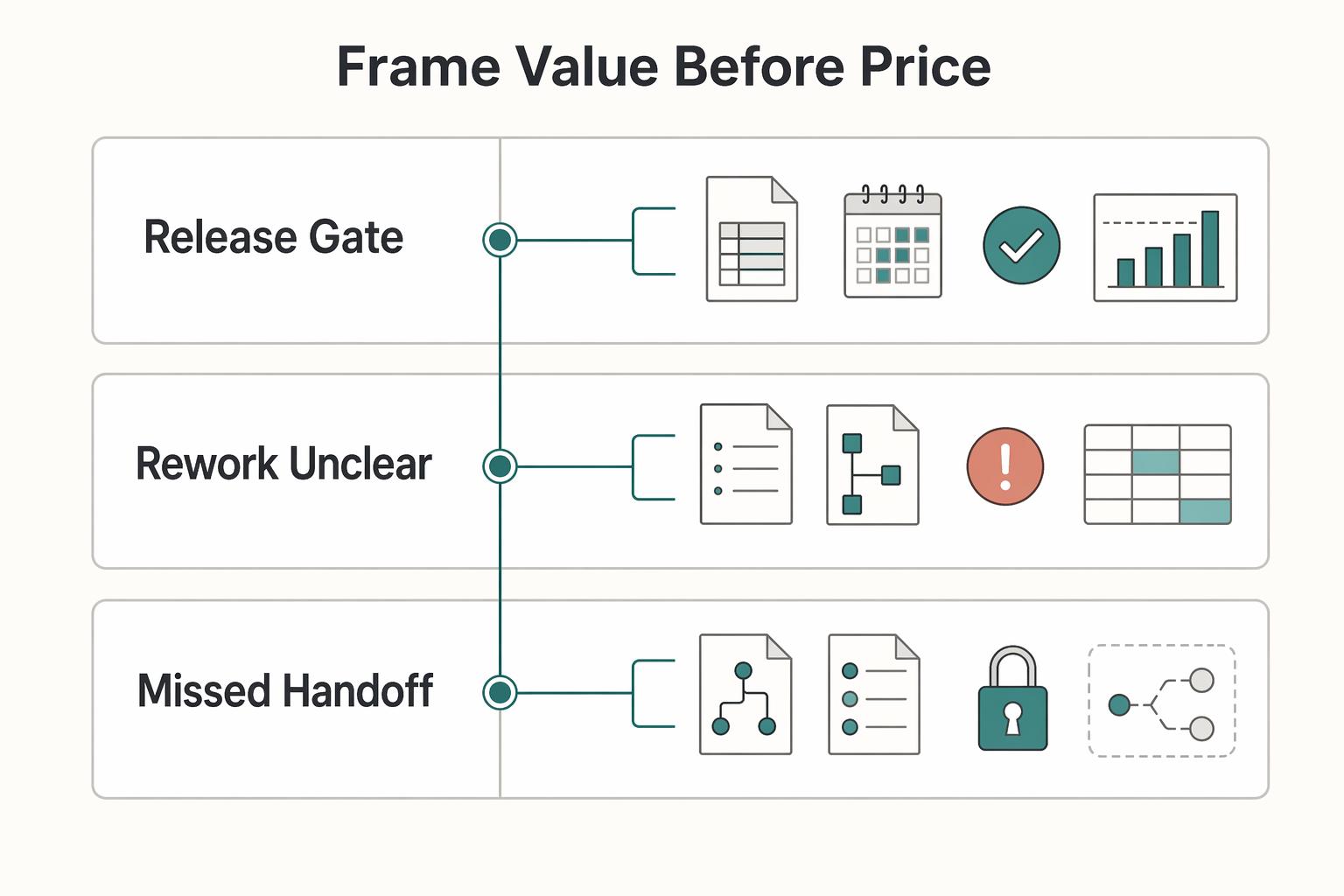
Step 1. Establish business stakes in discovery. Start with friction the client already sees: where work slows, where approvals stall, what gets reworked, and what happens if nothing changes by the next cycle. Do not invent a dramatic loss figure. Collect client-provided inputs you can verify later.
Use this check: each major pain point in your notes should include an input source. Examples: founder estimate, ops lead input, team time logs, support tickets, or prior approval history. If a source is missing, treat that point as a hypothesis, not pricing evidence.
Step 2. Present full-scope context before scoped options. Before you show tier pricing, briefly frame the broadest credible engagement and the risk it is meant to reduce. Then narrow to the specific options you are offering now. This keeps the anchor grounded in scope and decision context.
Use a simple anchor sequence:
Premium context anchor:Broadest credible scope with verified assumptions and continuity supportRecommended scoped option:Target offer grounded in your verified discovery inputsNarrow option:Leaner scope with only the essential deliverables
Step 3. Build cost of inaction with the client, not for the client. Treat Cost of Inaction as a collaborative worksheet. Estimate impact only with client inputs, and confirm assumptions before pricing discussion. If a number is uncertain, keep it qualitative.
| Operational friction | Client input | Input source | Risk type | Decision implication |
|---|---|---|---|---|
| Delayed approvals | Estimated delay per cycle | PM notes or stakeholder interview | Timeline risk | May require added review support |
| Rework from unclear brief or messaging | Estimated hours or frequency | Team lead input or time log | Labor waste | May justify audit plus revision scope |
| Missed handoff or launch tasks | Known handoff failure points | Postmortem or email thread | Delivery risk | May require implementation support |
Step 4. Keep anchors ethical, specific, and documented. Every anchor should map to a documented outcome, clear scope, and explicit assumptions in the proposal. Avoid inflated claims or vague transformation language. If you cannot point to discovery notes, assumption checks, and the scope line that supports your recommendation, rewrite or remove the anchor.
Pricing for the Global Arena: Mitigating Cross-Border Complexity#
After you anchor value and scope, protect what actually lands in your account. For cross-border work, treat quoted price, invoice amount, and net receipt as separate decisions, and lock those decisions before the proposal goes out.
Before you send terms, confirm four inputs: your target earnings in your home currency, the client's billing-currency requirement, the payment rail they will use, and who owns supplier setup approvals on their side.
Step 1 Set your internal pricing base, then choose billing setup#
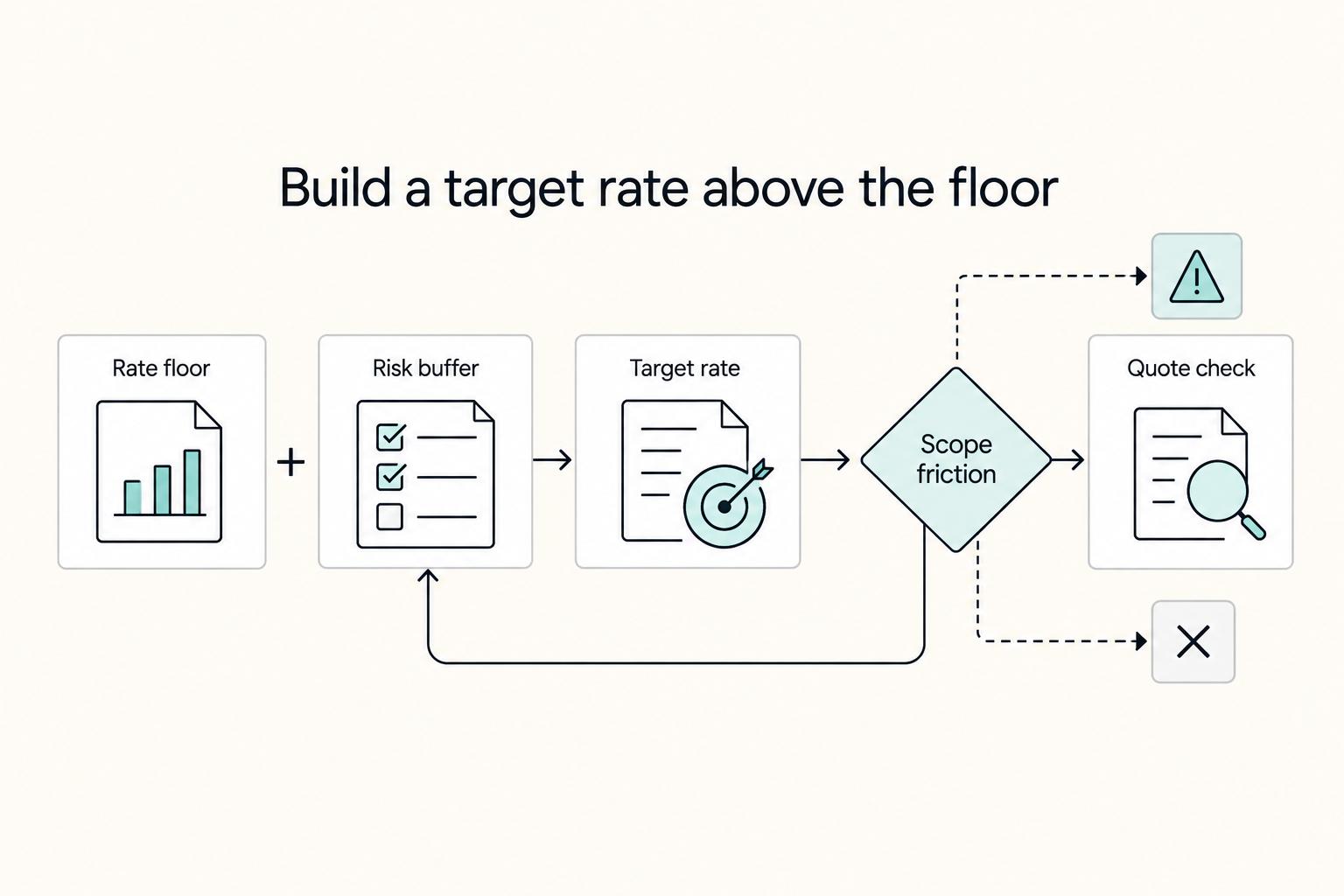
Start from the amount you need to retain in your own currency, then document how invoicing and conversion will work. Use buffer handling only for variable costs you cannot isolate cleanly at quote time, for example FX movement between quote and settlement, and fixed-fee handling for known charges.
When you use a buffer, document the buffer basis, date checked, source record, and owner in your pricing worksheet before the proposal goes out.
| Currency setup | Who absorbs conversion/transfer costs | Margin risk exposure | When this setup is appropriate |
|---|---|---|---|
| Bill and receive in your currency | Defined by contract terms | Lower | When client procurement supports paying in your currency |
| Price in your currency, bill in theirs | Defined by fee-allocation clause and conversion point | Medium | When client requires local-currency invoices but you need home-currency control |
| Price and bill in client currency | Often you, unless terms reallocate costs | Medium to high | When foreign-currency billing is not approved |
| Platform or marketplace billing | Often dictated by platform policy | Higher | When checkout/payment terms are controlled by a platform |
If a platform sits between you and the client, treat fee policy as a primary risk item. In some platform models, commissions can be high enough to materially compress margins.
Step 2 Bake compliance and operations overhead into your rate design#
Cross-border projects add admin load even when clients pay on time. Build this into your pricing model up front:
- tax-document handling and handoff ownership
- invoice data requirements from client AP workflows
- payment rail limits, routing constraints, and intermediary deductions
- reconciliation time when remittance details do not match invoice references
A practical control is to collect the client's supplier onboarding checklist, invoice requirements, payment-fee schedule, and AP escalation contact before you give final pricing approval.
Step 3 Add a reusable Global Payment Terms clause to proposals and SOWs#
Do not leave payment mechanics to follow-up emails. Include this checklist in your proposal/SOW:
| Clause item | Specify |
|---|---|
| Invoice currency | Whether your base price is set in your home currency |
| Fee allocation | Bank, platform, intermediary, and conversion charges |
| Tax and onboarding | Responsibility for tax documents and supplier onboarding materials |
| Payment timing | Whether the clock starts on invoice receipt, approval, or supplier activation |
| Escalation path | Failed, delayed, or short transfers, with named contacts |
If the client requires a payment route you did not choose, require written fee allocation and escalation ownership before kickoff. That is cashflow protection, not friction.
Conclusion: Your Price Is Your Strategic Foundation#
Your price is not just a sales number. It is a control point for scope clarity, payment clarity, and client expectations before the work starts. If a proposal leaves room for confusion on deliverables, option structure, or payment handling, fix that before you send it.
| Check | Verify |
|---|---|
| Recheck your positioning | State the business problem and outcome first, not just the deliverables |
| Rebuild your options | Each tier has clear boundaries, and the middle option is genuinely viable rather than a vague compromise |
| Reorder the anchor | Lead with the highest-context offer so the rest of the pricing is compared against value, not raw cost |
| Confirm payment terms | How payment will be made, who owns fees, and what must be approved before sending |
That is the practical value of the approach. You are not trying to force a yes. You are giving the client a clearer path through your positioning, tier design, anchor, and payment terms so the deal is easier to understand and less likely to be misread later. On marketplaces like Upwork, bill rates are publicly visible, so clients can compare options quickly.
A common failure mode is treating pricing as a one-line fee and leaving key decisions buried in email. When options are unclear, the middle option can lose its role as the comparison point, and payment responsibilities can be misunderstood. Your proposal should carry that weight upfront, with the SOW and payment clause doing the verification work.
For your next proposal cycle, run those four checks in order.
You will refine this over a few proposal cycles, not in one pass. The FAQ below covers the execution blockers that usually show up once you start applying it. Related: How to Calculate Your Billable Rate as a Freelancer.
Frequently Asked Questions
How can tiered pricing prevent scope creep?
Treat your proposal and SOW as contract design, not admin. Set a clear pricing checkpoint before work begins: either set price before collaboration starts (early pricing) or after co-creation ends (late pricing), then document inclusions, exclusions, and change paths for each tier. In the reported experiment, early pricing was associated with higher freelancer prices and profits. It did not increase effort or improve product quality or overall welfare, so use tiering mainly for scope clarity and commercial alignment, not as a guaranteed performance lever.
What is a professional alternative to charm pricing for consultants?
Use a number format that reads as intentional and is easy to explain in the proposal. | Price format | Possible read | Evidence status here | | --- | --- | --- | | Rounded project fee | Deliberate and simple | No direct performance proof here | | Precise custom fee | Tailored to defined conditions | No direct performance proof here | | Retail-style endings (for example, x,999) | Potentially more promotional in tone | No direct performance proof here | What this evidence does support is that pricing is more than math and can shape buyer behavior. It does not prove one number format is universally best, so explain your format choice in plain commercial terms.
How do you use price anchoring in a freelance proposal?
If you use an anchor, make each option real and fully scoped, not a decoy. Keep the same fields across options so the client can compare like-for-like without hunting through the page. Pricing does shape behavior, but no single anchor order is reliably superior. Keep only options you can deliver exactly as written.
How should I adjust my pricing for international clients?
Use contract design to set commercial terms before work starts, including settlement currency, payment method, and fee allocation. If those commercial terms change after approval, pause and reissue terms before proceeding.
How does value based framing differ from hourly billing?
The strongest supported distinction here is price timing, not a universal billing doctrine: early pricing sets price before collaboration, while late pricing sets it after co-creation. In the cited experiment, early pricing was linked to higher freelancer prices and profits, but not to higher effort, better product quality, or higher overall welfare. If scope is still unclear, state that uncertainty and define a scoped step before final pricing.
Try a related tool
Researched and edited by the Gruv editorial team. Gruv builds cross-border billing, payouts, and finance-operations software for global businesses.
Sources
Includes 1 external source outside the trusted-domain allowlist.
- calteches.library.caltech.edu/705trusted
- depauw.edu/learn/microexcel/MicroBook/MicroExcel.pdftrusted
- digitalcommons.pepperdine.edu/cgi/viewcontent.cgitrusted
- ok.gov/dcs/solicit/app/viewAttachment.phptrusted
- pmc.ncbi.nlm.nih.gov/articles/PMC11461486trusted
- sas.upenn.edu/~baron/journal/toc.htmtrusted
- web-docs.stern.nyu.edu/marketing/Website/Marketing%20Science%20Prog...trusted
- eurekafoong.com/documents/foong_gerber_chi2021_genderpricing...external
Educational content only. Not legal, tax, or financial advice.
Related Posts

GDPR Compliance Checklist for Freelancers Working With EU Clients
Start by separating the decisions you are actually making. For a workable **GDPR setup**, run three distinct tracks and record each one in writing before the first invoice goes out: VAT treatment, GDPR scope and role, and daily privacy operations.
How to Calculate a Freelance Rate You Can Actually Get Paid On
A workable rate is not the neat number a calculator produces. It is the number that still works after you account for real billable capacity, non-client time, scope drift, and the gap between sending an invoice and receiving cleared cash. Start with hourly math even if you do not plan to bill hourly, then turn that number into a quote with clear `payment terms`.

The Freelance Payment Penalty: A Modeled Audit of Platform Fees, FX Spreads, and Payout Delays
The money rarely disappears through a single, easy-to-spot fee. The real loss is stacked. A marketplace takes its commission, a processor adds a charge for international cards, a bank or payment company converts the currency at a spread, a platform holds the funds before release, and a wire sheds a little to intermediaries on the way in. Each layer looks defensible on its own, but the worker feels the combined result as a smaller deposit and a later payday.