
Quick Answer
Use a letter of intent freelance as a controlled bridge: confirm intent, outline high-level commercial direction, and state the next step to a definitive agreement (MSA/SOW). Keep most terms non-binding, but explicitly carve out any binding protections you truly need now (like confidentiality or exclusivity). Avoid final-sounding delivery language, add an expiry date, and don’t begin work until the contract gates are cleared.
You're about to send an LOI - here's how to use it to close faster and stay protected#
Use an LOI to align on preliminary terms now, while clearly separating "intent" from anything that binds immediately. If you came here looking for freelance LOI guidance, start with the safe baseline: keep the document genuinely preliminary, and do not let it quietly become the contract you meant to negotiate later.
Treat every document as part of your system, not a one-off email attachment.
A Letter of Intent (LOI) outlines preliminary terms before you sign a detailed agreement. LOIs show up during the early stages of a business partnership, acquisition, or major contract when you want alignment before you negotiate the full contract.
An LOI is often (but not always) non-binding. Even when a declaration-of-intent document is described as non-binding, it may still include specific legally binding clauses. Non-binding (with potentially binding clauses) means you may see binding terms such as confidentiality, exclusivity, or applicable law inside an otherwise "non-binding" document. Your job is to make those boundaries unmistakable.
Pick your track before you draft#
| Track | Primary goal | What to keep clear on page one |
|---|---|---|
| Using an LOI for a freelance engagement | Outline preliminary terms and the path to a detailed agreement | State that the detailed agreement will follow, and separate non-binding points from any binding clauses |
| German-speaking declaration of intent (Absichtserklärung) | Use local terminology for a "declaration of intent" | Keep the intent language clear, and separate non-binding points from any binding clauses |
Before you start, lock four inputs#
| Input | Article guidance |
|---|---|
| Objective and next step | Align on what you are trying to accomplish and what comes after the LOI. |
| Roles | Note who is responsible for what at a high level (without turning it into a full contract). |
| Scope and timeframe | Write a plain-language snapshot of what the work covers and the intended timing. |
| Binding vs non-binding terms | Use explicit headings, and call out any binding clauses (if any) directly. |
Use these four inputs as your checklist before you draft.
Imagine a client sends an LOI that is "non-binding," but it includes broad exclusivity language. Keep things moving by leaving the intent points intact, tightening any binding clause to what you actually accept now, and pushing everything else into the detailed agreement.
Used well, an LOI gets you aligned early, then hands off cleanly into the detailed agreement that governs the real working terms. Especially when multiple departments or organizations are involved, a declaration-of-intent document like an MOU can help prevent misunderstandings and costly delays. For freelance work, the formal freelancer or independent contractor agreement commonly covers scope of work, payment terms, and intellectual property ownership.
Which LOI are you actually trying to use - deal, visa, or job-search?#
Pick the LOI track based on what needs approval next: deal momentum or German freelance visa evidence. In the German freelance visa or residence permit context, Letters of Intent (LoIs) are meant to show that potential clients (including German companies) intend to hire you, that you will find clients in Germany, and that you can sustain yourself. For a services deal, "LOI" is a practical label, but the document's purpose needs to be explicit.
| Track | Primary purpose | What it should show now |
|---|---|---|
| Freelance engagement LOI | Keep a services deal moving while you align on intent | Your intent, the key points you want aligned, and what you are asking the other side to confirm |
| Germany visa LOI (Absichtserklärung) | Evidence for a German freelance visa / freelance residence permit application | Potential clients intend to hire you, you will find clients in Germany, and you can sustain yourself |
| Job-search letter | Employment candidacy | Your fit for a role (often not the same thing as client intent for an independent services engagement) |
Step 1: Define the exact approval you need#
Name the immediate unlock in one sentence at the top of your draft. Are you trying to get a client comfortable enough to move forward, or are you building evidence for a German freelance visa application? Once that is written, keep every line pointed at that purpose so the document does not drift. Expected outcome: you can explain, in one line, why this document exists and what happens next.
Step 2: Build the visa version only when the goal is immigration evidence#
For the German freelance visa, applicants use letters of intent from potential clients to show they will find clients in Germany. Some guidance also describes these LoIs as an essential point of a freelance residence permit application and as helping show you can sustain yourself. Practical checklists include items like hourly or project-based pay and approximate duration.
Some templates use the German term Absichtserklärung. Some guidance suggests the letter "should be written in German" and that LoIs from non-German companies should not be the majority. Treat those as guidance, not automatic legal rules. If visa prep is your main path, keep this workflow close by: Germany Freelance Visa: A Step-by-Step Application Guide. Expected outcome: a visa-focused LOI that supports intent and credibility without pretending to be a full contract.
Step 3: Block template drift from job-search letters#
Do not let an employment-application template dictate your client document. If the language reads like you are applying for a role instead of documenting a client's intent to engage you, rewrite it so it matches the real relationship: independent parties exploring services. Then move working terms into your detailed contract when you are ready. Expected outcome: you keep the LOI useful, protect your position, and avoid mixing employment language into a services deal.
Do you even need an LOI for this client - or should you go straight to an MSA/SOW?#
Use an LOI when you need to confirm intent and the next step before you are ready to lock full working terms. Otherwise, go straight to your MSA/SOW.
This is sequencing, not paperwork. If the only missing piece is a full agreement, do not add an extra document just because it feels professional. If you do use an LOI, keep it narrowly tied to the decision you need now. Make the handoff to the next document explicit.
Before You Start: lock the decision gate#
Use this gate before you send anything:
- Decision owner: Who must approve the next move on each side?
- Decision scope: What needs agreement now vs. what is intentionally left open?
- Next artifact: What exact document follows this one (LOI → SOW, MSA + SOW, etc.)?
- Start condition: What must happen before any work begins?
Verification point: if either side cannot answer these four lines in plain language, pause and tighten the draft.
Step 1 to Step 3: route the draft by signal#
| Signal in current draft | Action now | What to verify before send |
|---|---|---|
| The draft reads like a high-level alignment document | Keep it focused and short | It states what you're aligned on and what comes next |
| The draft starts turning into the full contract | Move the negotiation into your formal contract flow | Everyone is clear which document will carry the full terms |
| You're mixing purposes (e.g., deal momentum vs. a separate administrative letter) | Split the documents | Each document has one job, one audience, and one next step |
- Define the immediate decision. Write one sentence describing what this document must resolve right now. Expected outcome: both sides are evaluating the same objective.
- Separate intent from execution terms. Keep this step about direction and process, not a full operating manual. Expected outcome: no one treats this document as the complete deal.
- Force a clear next step. State who does what next and which document is expected to carry the full working terms. Expected outcome: the process moves forward instead of stalling in "almost agreed."
Step 4: stop contract creep early#
If the draft starts accumulating heavy obligations, detailed risk allocation, or day-to-day operating terms you have not fully negotiated, stop and re-route into your MSA/SOW flow. You can still move quickly. If you're using an LOI, keep it limited to intent and transition, and put the detailed working terms where they can be reviewed properly. Use this rule every time: one document, one purpose, one clear handoff to the next step.
Prep pack (10 minutes): what to gather before you draft anything#
Gather the key deal terms and required paperwork first, then draft the LOI to reduce payment delays and compliance risk. Get clean inputs before you put anything in writing.
Most LOIs are non-binding, and it helps to say so when that is the intent. Still, follow-on actions matter. Even with non-binding language, a court could treat it as binding if what you do afterward supports that.
Before You Start#
Create one source of truth for the deal. Keep commercial notes, draft versions, and required paperwork together. When teams move quickly, important data gets scattered across inboxes and spreadsheets. That creates legal and operational headaches and makes it easier to miss documents that later block payment.
Step-by-step prep pack#
- Write the intent in one line. State what this LOI is meant to confirm right now, and, if applicable, plan the exact non-binding language you intend to use.
- Lock the commercial direction. Gather the price (or range) and the key terms you are already aligned on. If helpful, outline a simple timeline for the process so you are not negotiating in a fog.
- Decide how you'll handle confidentiality. Either include non-disclosure provisions in the LOI or state that you will execute a separate NDA. Do not wait until redlines to make this decision.
- Confirm documentation needed for payment. Ask what Finance, Legal, or Compliance will require before they can issue payments. Missing paperwork creates exposure, and if required paperwork is not in place, Finance may not be able to issue payments.
Verification table#
| Check | Why it matters | Pass signal |
|---|---|---|
| LOI intent line | Keeps the LOI from drifting into "the full deal" | Anyone can explain the intent in one sentence |
| Non-binding plan (if intended) | Reduces ambiguity in a preliminary agreement | Draft notes include the exact non-binding wording |
| Confidentiality choice | Avoids liability gaps from missing confidentiality terms | You chose: LOI clause or separate NDA |
| Documentation list for payment | Prevents compliance exposure and payment delays | Finance confirms what they need to issue payments |
If you send the LOI and only later get hit with "we still need documents" or "we need confidentiality terms," you lose momentum. Requesting documents mid-project can also shake confidence. This prep pack keeps the process tight so you are not fixing preventable issues after work is already in motion.
Draft a hybrid LOI: non-binding deal terms, a few binding protections#
Draft a hybrid LOI that keeps the deal terms non-binding while making only a few named protections binding.
| Step | What to do | Practical check |
|---|---|---|
| Project snapshot | Identify both parties and describe the project in plain language; add that detailed deliverables will be set out in the definitive agreement. | A stranger can understand what you do without it reading like a promise to ship. |
| Money mechanics | State your pricing model and any key assumptions early, while keeping invoicing detail for later documents. | The LOI clearly says what must happen before work begins, without implying you have already started. |
| Binding split | Add separate Non-Binding Terms and Binding Terms sections, and make clear the deal is conditioned on a later definitive agreement. | You can point to one paragraph that binds now, and one paragraph that does not. |
| Legal posture | If you include dispute language, keep it lightweight and intentional; some LOIs treat governing law as a binding carve-out. | The LOI protects essentials without smuggling in full contract obligations. |
| Next-step deadline | Add an outside date and an express right to terminate if the definitive agreement is not executed by the deadline. | The LOI names the next document, the deadline, and what happens if that deadline passes. |
A Hybrid LOI includes both non-binding deal terms and selected binding protections. Keep it simple. Say, in plain language, that the deal is subject to the execution of a definitive agreement (for example, a later services agreement or SOW, if you use one). Then spell out exactly which sections, if any, bind now.
A strong LOI does three things. It captures commercial direction. It separates binding vs non-binding terms in a way a reader cannot miss. It creates a clear path to a definitive agreement. Ambiguity is how "non-binding" LOIs start to look binding.
| Draft area | Put it here | Why |
|---|---|---|
| Commercial direction | Non-Binding Terms | Keep scope, budget direction, and timing preliminary until the definitive agreement |
| Immediate protections | Binding Terms | Carve out only what you want enforceable now (often confidentiality, expenses, governing law, or similar) |
| Full risk allocation | Definitive agreement stage | Put complete delivery and liability mechanics in the final documents |
- Define parties and a project snapshot. Identify both parties and describe the project in plain language, but avoid final-sounding delivery verbs that read like a firm commitment. Add a sentence that the detailed deliverables will be set out in the definitive agreement (for example, a later services agreement or SOW).
Practical check: could a stranger understand what you do without it reading like a promise to ship?
- Put money mechanics before momentum. State your pricing model (and any key assumptions) early, while keeping invoicing detail for later documents. If you want a "start trigger" (like a paid discovery invoice), frame it as a negotiated deal term, not a legal default.
Practical check: does the LOI clearly say what must happen before work begins, without implying you have already started?
- Mark binding vs non-binding like you mean it. Add one section labeled Non-Binding Terms and a separate section labeled Binding Terms, and make the non-binding provision explicitly cover what is, and is not, intended to bind. This is also where you reduce the risk of drifting into an "agreement to agree" (often unenforceable) by making clear that the deal is conditioned on a later definitive agreement.
Practical check: can you point to one paragraph that binds now, and one paragraph that does not?
- Pre-wire legal posture without turning the LOI into the full contract. If you include dispute language, keep it lightweight and intentional. Some LOIs treat items like governing law as binding carve-outs, and you may also see dispute-resolution language (including arbitration language) at the LOI stage, while leaving heavier risk-allocation clauses for the definitive agreement.
Practical check: does the LOI protect essentials without smuggling in full contract obligations?
- Force a next step with an expiry date (and a termination trigger). Add an outside date (expiry) and an express right to terminate the LOI if the definitive agreement is not executed by the deadline. Deadlines keep the LOI from floating indefinitely and make the conversion workflow obvious.
Practical check: does your LOI name the next document, the deadline, and what happens if that deadline passes?
If a client pushes for "immediate kickoff" after verbal alignment and sends an LOI loaded with final delivery language, do not fight the momentum. Reframe it. Keep the LOI truly preliminary, carve out only the protections you actually need binding now, and push the full obligation set into the definitive agreement stage.
Once the LOI sets direction, your next risk-control is a clear SOW (scope, assumptions, out-of-scope, and acceptance). Draft one fast with the Statement of Work generator.
Is your LOI accidentally binding? The language traps, red flags, and how to recover#
Yes, an LOI can become binding if the wording (and what you do next) reads like a final agreement, so separate non-binding deal terms from any binding carve-outs. This section is the stress test. The goal is simple: keep commercial terms clearly aspirational, and make any binding sections explicit and limited.
Simply calling something a "letter of intent" does not make it non-binding. A properly drafted LOI can be mostly non-binding while keeping only selected carve-outs (such as confidentiality or exclusivity) binding. That binding vs non-binding split is the control point in your LOI workflow.
Trap map and recovery moves#
| Trap | Red flag in draft | Recovery move |
|---|---|---|
| Promise verbs that read final | "Contractor shall deliver" or "we will complete" | Replace delivery verbs with intent language (for example, "the parties would") to reinforce non-binding intent, and make clear that detailed deliverables belong in a later definitive agreement (such as an SOW, if you use one). |
| IP transfer too early | "Work for Hire" or broad "Assignment of Rights" in the LOI body | Push IP ownership/transfer language to the definitive agreement. Work-for-hire language can make the hiring or commissioning side the initial copyright owner, and under U.S. copyright law a copyright transfer generally must be in a writing signed by the transferring party. |
| Restrictive control terms | Broad Exclusivity or Non-Compete language with unclear scope | Narrow scope and extent so the restriction is specific and not excessively burdensome. If you include it at LOI stage, make the limits unmistakable. |
| Scope packed into a fixed number | One fee line with no assumptions or boundaries | Add assumptions and out-of-scope bullets now, then move full delivery detail into the SOW (or later definitive agreement). |
| Action before paper catches up | Team starts work while key terms remain open | Slow down: align the language, document the intent, and avoid conduct that makes the LOI look like the "real" contract. |
Why these traps bind people#
A "non-binding" label helps, but it is not foolproof. An LOI can still be interpreted as binding if it sets out material terms, and later conduct can create risk too. If you keep performing as though the deal is final, you may undercut your own non-binding framing.
A covenant to negotiate in good faith is an express promise to negotiate in good faith, and that kind of promise can be binding when you write it into the LOI. Whether broader good-faith duties apply can depend on the governing law and the specific wording, so do not assume "non-binding" eliminates all obligations.
5-step recovery protocol#
- Freeze new performance. Pause new work while you clean up language that reads like a final commitment.
- Issue a clean redline. Use clear headings that separate Non-Binding Terms from Binding Terms.
- Rewrite commitment verbs. Swap "will/shall" on commercial terms for intent language (for example, "would" or "intend to") to help reinforce the non-binding framing.
- Move heavy mechanics to the definitive agreement. Keep full delivery obligations and risk-allocation clauses for the later definitive agreement stage (for example, an MSA/SOW, if you use one).
- Get it signed in its corrected form. Do not rely on casual messages to "fix" meaning. Use an updated LOI (and signatures) so the document itself reflects the intent.
Run this check before every send. It keeps the LOI useful, protects your downside, and preserves momentum without drifting into accidental commitments.
Germany freelance visa LOI (Absichtserklärung): minimum viable letter + credibility score (so it actually helps)#
A formal letter can create a clear paper-trail record as evidence. If you're including client intent as supporting documentation in a German freelance visa application, keep it simple: real business correspondence, consistent with the rest of your paperwork, and easy for a third party to understand.
For a German freelance visa, the baseline is simple: unless you are an EU or EEA citizen, you need permission to live and work in Germany. You also need to convince the immigration office that you have the right skills and enough resources to do well in Germany. A formal letter format helps because it reads as official correspondence and creates a paper-trail record.
An official required template for a client-intent letter is not spelled out here, so treat the steps below as format guidance, not a guarantee of what the immigration office will request.
Step 1: Start with purpose and document type#
Write one plain sentence that states the purpose of the letter: it is a client communicating intent to engage with you (or explore an engagement). Keep the wording tight and avoid language that reads like a final, signed service contract. If it starts sounding like "you will deliver X by date Y," rewrite until it is clearly intent, not commitment. Expected outcome: the reviewer understands what the letter is trying to communicate on the first read.
Step 2: Use a formal structure reviewers can trust#
A block-style letter is a format used by organizations that places company letterhead at the top.
| Element | Why it matters | Pass check |
|---|---|---|
| Formal letter format | Letters convey a high degree of formality and respect | The document reads like official correspondence |
| Company letterhead (when an organization sends it) | Block-style letters used by organizations have letterhead at the top | The sender is clearly identified at the top |
| External-reader clarity | Letters are typically sent to people or organizations outside the sender's organization | A third party can tell who writes to whom (and why) |
| Concise length | Letters are usually one to two page documents | The letter stays focused and readable |
| Archive-ready record | Letters can create a formal paper-trail record as evidence | You can file and retrieve the final version easily |
Expected outcome: the letter looks credible before anyone evaluates the details.
Step 3: Run a practical credibility check before submission#
Use this pass/fix checklist:
- Confirm alignment. The letter supports (or at least does not contradict) your overall story about your skills and resources in Germany.
- Confirm clarity. The purpose, parties, and context are obvious to an outside reader.
- Confirm identification. The sender is clearly identified (for example, via company letterhead).
- Confirm record quality. You keep a final version you can file and retrieve.
Expected outcome: you submit documentation that is easy to review and easy to re-check.
Imagine this scenario: a potential client sends a short chat message saying they may work with you. You thank them, then ask if they can restate that intent as a formal letter so your file is clearer and easier to archive.
If visa prep is your main objective, use this section as your letter standard and follow the full process in Germany Freelance Visa: A Step-by-Step Application Guide.
Scripts + evidence ladder: how to ask for an LOI (and what to use if the client refuses)#
Ask for a short LOI that states intent, the next step, and what's binding vs. non-binding. LOIs can include both binding and non-binding provisions, so make the split explicit. If they will not sign yet, capture the best available written evidence. Your goal is to keep momentum without accidentally turning "intent" into "commitment."
Copy and paste scripts that lower friction#
Use these scripts as-is, then tailor the names and scope so a third party can understand who intends to do what.
- Deal track script
text Could you sign a short LOI so both sides can confirm intent, budget range, and a target start window? This is a preliminary document, not the final freelance contract. After this, we move to an MSA/SOW for the full terms.
- Germany visa track script
text I'm preparing my German freelance visa application. Could you provide a short LOI confirming your intent to collaborate, plus a description of the type and scope of the work? This is not the final contract, just supporting documentation for my application file.
Practical check before you hit send:
- Say what it is (intent + proposed terms) and what it is not (the final contract).
- Name the next step (for example, moving to a full contract/SOW).
- If anything is meant to be binding, label it clearly (common examples include confidentiality, exclusivity, payment of expenses, and governing law).
- Keep it clearly "pre-contract." If key terms are left open for future negotiation, an LOI is less likely to form a binding contract; in some cases, courts have treated LOIs as binding when they contain all the material terms.
Evidence ladder when the client refuses#
Treat this as an internal quality ladder, not an official ranking, and not a guarantee of what any counterparty or authority will accept.
| Tier | What to collect first | How to use it |
|---|---|---|
| 1 | Signed LOI on company letterhead (or Absichtserklärung for Germany) | A clean, single document you can file and re-share |
| 2 | Draft or countersigned commercial document set (for example, a proposal + draft SOW) | A structured intent trail if Tier 1 is delayed |
| 3 | Email confirmation from a corporate domain | Written intent and scope language in plain English |
| 4 | Calendar invite plus procurement or internal approval reference | A time-stamped operational record that the deal progressed |
For Berlin, the official service page says applicants can alternatively submit at least 2 Absichtserklärungen ("letters of intent") with details on the collaboration and a description of the type and scope of the activity. Use that as a city-specific signal, not a universal rule for every office.
Build a deal pack that survives audit and review#
Store every artifact in one folder with version dates so you can quickly show who agreed to what, when, and what got paid. Keep supporting documents that show amounts and sources of gross receipts, plus invoices and proof of payments. IRS guidance says you should normally keep these tax records for three years, so design your filing system to be durable, not ad hoc.
| Record or form | When to use | Article note |
|---|---|---|
| Version-dated deal folder | Ongoing recordkeeping | Store every artifact in one folder, with version dates, so you can quickly show who agreed to what, when, and what got paid. |
| Gross receipts support | Audit and review support | Keep supporting documents that show amounts and sources of gross receipts. |
| Invoices | Audit and review support | Keep invoices. |
| Proof of payments | Audit and review support | Keep proof of payments. |
| Form W-8 BEN | When requested by a withholding agent or payer | Submit the requested form. |
| Form W-9 | To provide a correct TIN to payers or brokers filing information returns | Submit the requested form. |
If a payer requests U.S. tax documentation, submit the requested form. Use Form W-8 BEN (when requested by a withholding agent or payer) or Form W-9 (to provide a correct TIN to payers or brokers filing information returns). Where supported/when enabled, Gruv can help you collect payments via hosted checkout and payment links, with clear status tracking and reconciliation-friendly exports, and provide dedicated receiving details (virtual accounts) designed to support automatic reconciliation.
If your main goal is visa execution, keep this script and evidence workflow next to your full checklist in Germany Freelance Visa: A Step-by-Step Application Guide.
Close with control: use the two-track LOI system - and don't start work until the gates are met#
Use an LOI as a controlled bridge to a definitive agreement, keeping most terms non-binding while making only chosen protections binding. A template helps, but what scales is a repeatable sequence you run the same way every time, so the deal keeps moving without accidental obligations.
With an LOI, the label alone does not decide what is binding. If you want it to stay mostly non-binding, say so plainly, and add a definitive agreement gate (no binding obligations, other than any stated binding carve-outs, unless and until a later agreement is executed). Time-box it with an expiration/term clause so negotiations do not stay open-ended.
Use this as your default workflow (a practical risk-control sequence, not a universal legal rule): LOI → paid discovery or deposit (if you choose) → MSA/SOW → invoice → payment record → start. This keeps negotiations clean and reduces the chance that conversations, correspondence, or conduct quietly override what you thought the LOI did.
If you are managing two goals, keep them separate on purpose. One track is your commercial deal (LOI → MSA/SOW). The other is any immigration or visa documentation you are collecting (for Germany, this may sit in a Section 21 self-employment context). Keep facts coordinated across both, but do not mix documents designed for different audiences.
| Track | Primary gate | Outcome you're aiming for |
|---|---|---|
| Freelance deal track | LOI → definitive agreement | Terms land in MSA/SOW, with scope and fees handled at the right layer |
| Germany visa documentation track | Intent + supporting documentation | A coherent, file-ready narrative that fits your case (often discussed under Section 21) |
Operator Sequence You Can Reuse#
- Set LOI intent. State what is non-binding, and name any binding carve-outs you intentionally keep (for example, confidentiality or exclusivity).
- Set value gate. If you use paid discovery or a deposit, define it as a negotiated business condition (and keep it clear).
- Set contract gate. Move full execution terms into MSA/SOW. Your MSA frames the relationship, and your SOW can specify services/deliverables, fees, and timelines.
- Set billing gate. Invoice in the agreed format and keep the payment record tied to the right document set.
- Set start gate. Start work only after your chosen gates clear and the documents match what you are actually doing.
Hypothetical scenario: a client wants you to start right after the LOI, then emails edits that expand scope and shift risk. Stay in control by treating the LOI as a bridge, not a green light. Hold kickoff until the MSA/SOW reflects the real deal, and your billing/payment paper trail matches the plan.
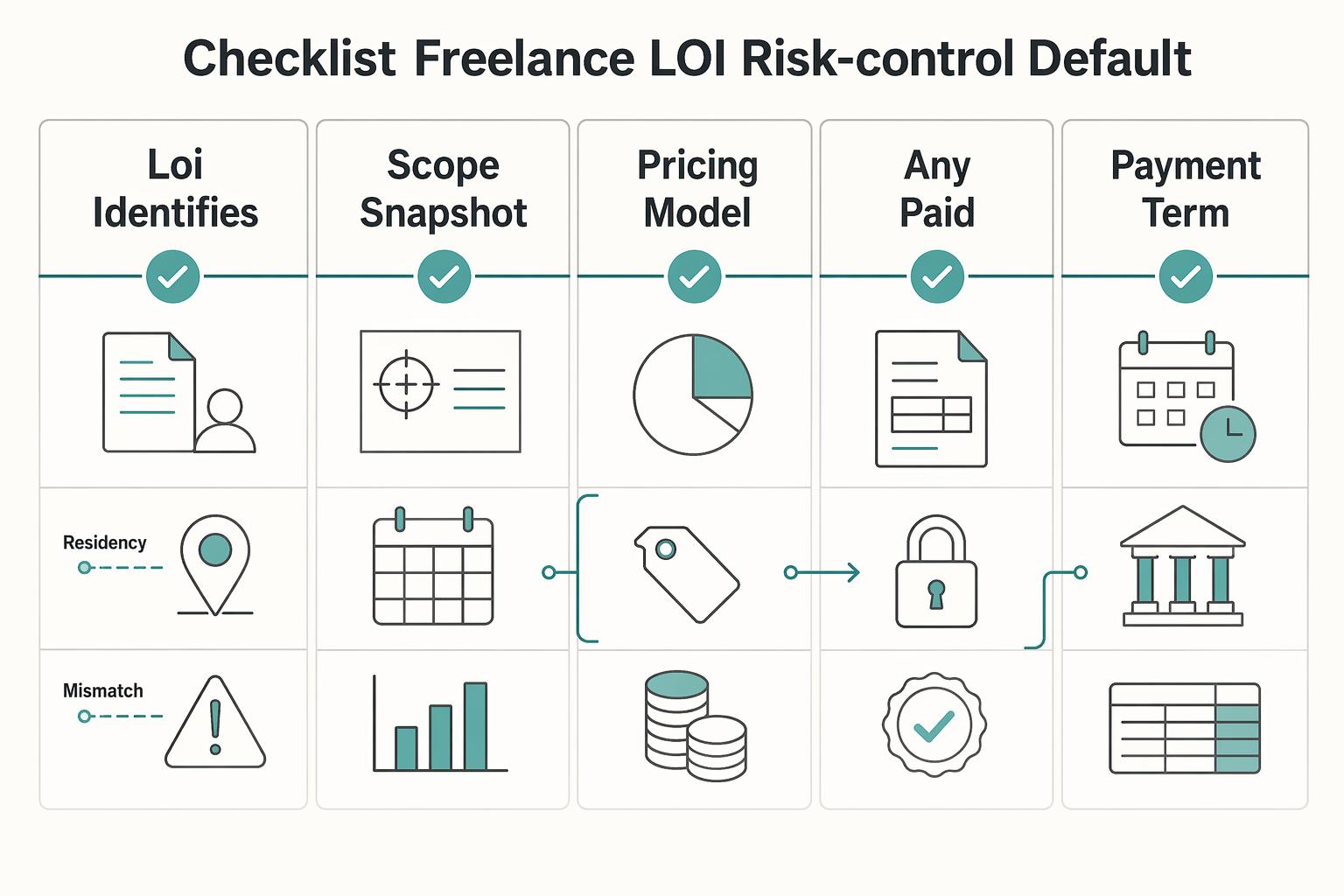
Checklist - Freelance LOI Risk-Control Default#
- LOI identifies parties clearly (for example, by legal name) and states the next step: move to MSA/SOW (definitive agreement).
- Scope snapshot, assumptions, and out-of-scope notes exist (details live in the SOW).
- Pricing model, budget range, and any validity/expiration window are clear.
- Any paid discovery/deposit trigger is explicit (if you're using one).
- Payment term, currency, and fee-responsibility language are set or reserved for MSA/SOW.
- Binding vs. non-binding sections are labeled clearly (do not rely on the title alone).
- Confidentiality is covered via NDA reference or a narrow binding clause.
- IP language avoids accidental transfer risk (for example, overly broad "Work for Hire" or "Assignment of Rights" in the LOI).
- LOI includes an expiry/term plus a conversion plan (e.g., "sign MSA/SOW by a target signing date").
- The LOI points forward to MSA terms you'll finalize there (common placeholders include termination, limitation of liability, indemnification, governing law/jurisdiction, and dispute process, when chosen).
If your primary objective is visa execution, pair this close-control workflow with Germany Freelance Visa: A Step-by-Step Application Guide.
If you use a "deposit/paid discovery gate," make it real by sending an invoice the client can't misunderstand. Use the invoice generator.
Frequently Asked Questions
What is a letter of intent for freelancers?
A Letter of Intent (LOI) is a preliminary document used before a final contract, and it’s typically not binding by itself. It helps you and the client capture proposed terms and confirm intent while you work toward a full services agreement. Treat it as a bridge: alignment now, definitive agreement next.
Is a letter of intent legally binding?
Generally not, but an LOI can become a contract if it gets too specific and reads like a final agreement. Even when most of the LOI is non-binding, some clauses can still be enforceable (common examples include confidentiality or exclusivity). The cleaner approach is a clear binding vs. non-binding split in plain language.
What should a freelance LOI include (minimum checklist)?
At minimum, identify the parties by their legal names (not initials or informal names) and describe the intended collaboration at a practical level. Clearly label what is binding now vs. non-binding and preliminary. State what comes next (for example, moving to an MSA/SOW).
What should a letter of intent for the German freelance visa include?
For Berlin, official guidance calls for the submission of at least two declarations of intent (Absichtserklärungen) with information on the type, scope, and description of the occupation. At the federal level, the route is a residence permit for the purpose of freelance employment, and document requirements can vary by individual case. For full process context, use Germany Freelance Visa: A Step-by-Step Application Guide.
How do I get letters of intent for a freelance visa without scaring clients?
Explain that a letter of intent is not a contract and they are not forced to hire you. Ask for a short statement of intent plus a simple scope description. Offer a draft/template they can edit.
How many letters of intent do you need for the German freelance visa?
For Berlin, published guidance calls for at least two declarations of intent that include collaboration details and activity/occupation scope. Do not treat that as a universal rule for all of Germany. Federal guidance also notes that document lists are not exhaustive or universal and depend on the individual case.
Can a letter of intent be an email (and what’s stronger than email)?
This guide does not establish a universal rule that an email alone equals a formal LOI in every case. If you want less ambiguity, use a clear LOI format that identifies the sender and the parties by legal name, and spells out scope and the binding vs. non-binding split. Keep emails as supporting record, not your only proof.
Try a related tool
Researched and edited by the Gruv editorial team. Gruv builds cross-border billing, payouts, and finance-operations software for global businesses.
Sources
Educational content only. Not legal, tax, or financial advice.
Related Posts

Germany Freelance Visa Application Path for Freiberufler and Gewerbe
Choose your track before you collect documents. That first decision determines what your file needs to prove and which label should appear everywhere: `Freiberufler` for liberal-profession services, or `Selbständiger/Gewerbetreibender` for business and trade activity.
A Freelancer's Guide to Retargeting Campaigns
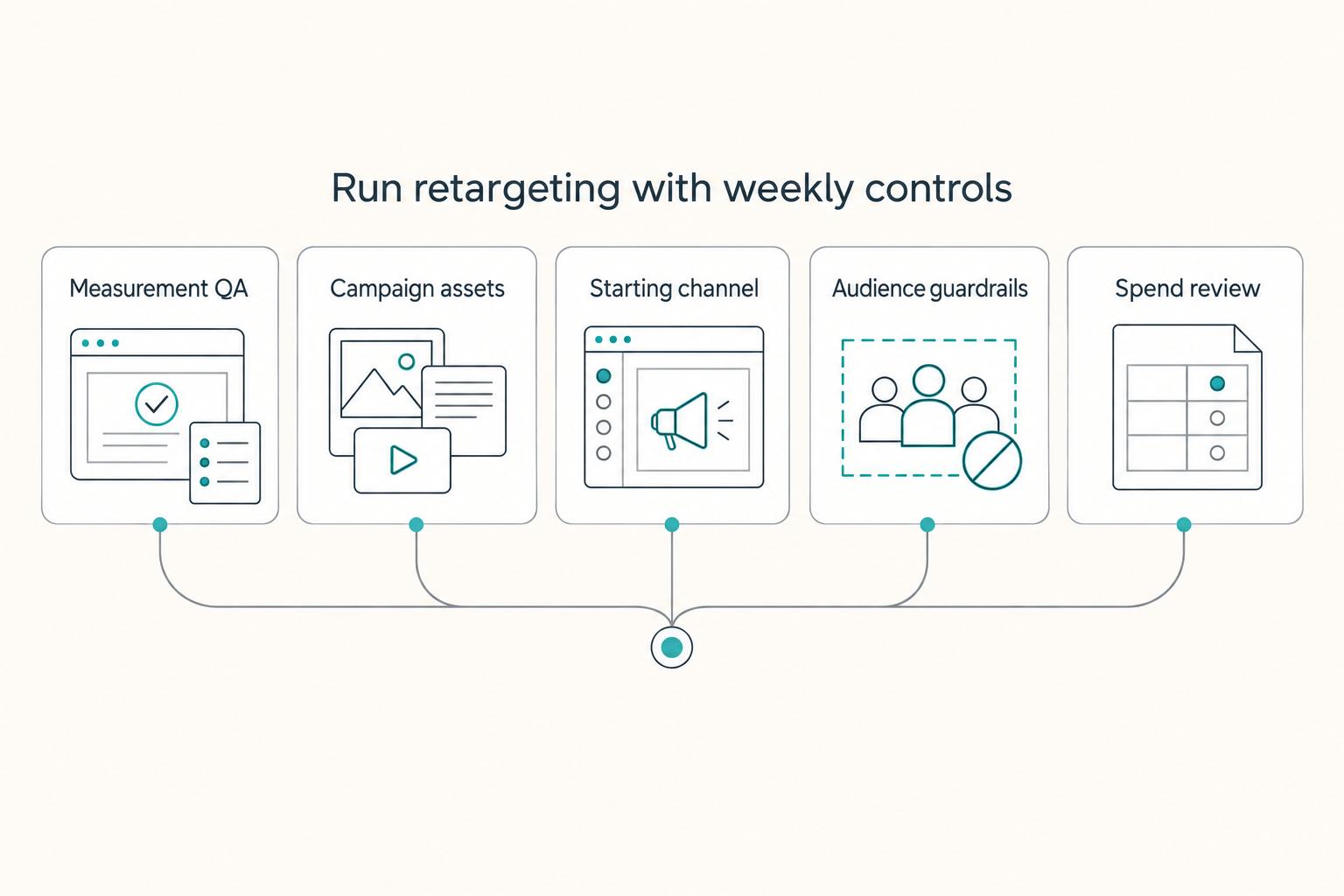
**Run retargeting for freelancers like a system, not a pile of ad tweaks, so you control budget, reputation, and measurement.** You are not here for a fuzzy definition. You are here for a workflow that makes the next decision obvious, even when the data looks noisy. As the CEO of a business-of-one, your job is to turn paid acquisition into a controlled process, not a recurring surprise.

The Freelance Payment Penalty: A Modeled Audit of Platform Fees, FX Spreads, and Payout Delays
The money rarely disappears through a single, easy-to-spot fee. The real loss is stacked. A marketplace takes its commission, a processor adds a charge for international cards, a bank or payment company converts the currency at a spread, a platform holds the funds before release, and a wire sheds a little to intermediaries on the way in. Each layer looks defensible on its own, but the worker feels the combined result as a smaller deposit and a later payday.