
Quick Answer
An indemnity you give usually adds a payment obligation. Limit its exposure by defining covered claims and losses, causation-based exclusions, defense/settlement control and whether all defense costs and indemnity share the liability cap. Review governing law, insurance and survival together. Received indemnity can allocate client-controlled risks back to the client; it does not prevent a third party from making a claim.
What an Indemnification Clause Actually Does#
Giving an indemnity usually adds a payment obligation; it does not by itself limit your liability. You limit that exposure by negotiating the covered claims, exclusions, defense process and interaction with the liability cap. An indemnity received from the client can allocate client-controlled risks back to the client, but its value also depends on enforceability and the client's ability to pay.
An indemnity clause can create two separate obligations: reimbursing losses and funding a defense while a claim is still active. Defense cost is often the early cash risk. If the trigger is broad, uncapped, and tied to a forum-method you cannot manage, exposure can exceed the project value.
Distinguish the risks you control from those the client controls. For a content or software project, client-supplied material, unauthorized edits and out-of-scope use need explicit treatment. A particular IP indemnity may cover defined infringement claims without a negligence finding; decide whether you accept that specific risk rather than treating breach as the only possible trigger.
- Map the clause package first. Read Indemnification, Limitation of Liability, and Dispute Resolution in one pass. Expected outcome: you see whether the clauses work together or conflict.
- Split defend duties from reimburse duties. Mark language that triggers immediate defense spend versus language tied to proven breach or actual loss. Expected outcome: you can target the lines that create early cash exposure.
- Draft narrow carve-outs. Exclude risks outside your control from your obligation. Expected outcome: your promises match work you can control and verify.
- Use a short negotiation script. Say plainly: you can cover breaches you directly cause, not unrelated claims or open-ended defense cost. Keep a fallback ready. Expected outcome: clearer procurement discussions on concrete edits.
The goal is not zero risk but risk you can price, document, and manage.
What should you prepare before reviewing an indemnification clause?#
Prepare your documents and risk boundaries first, then review clause language.
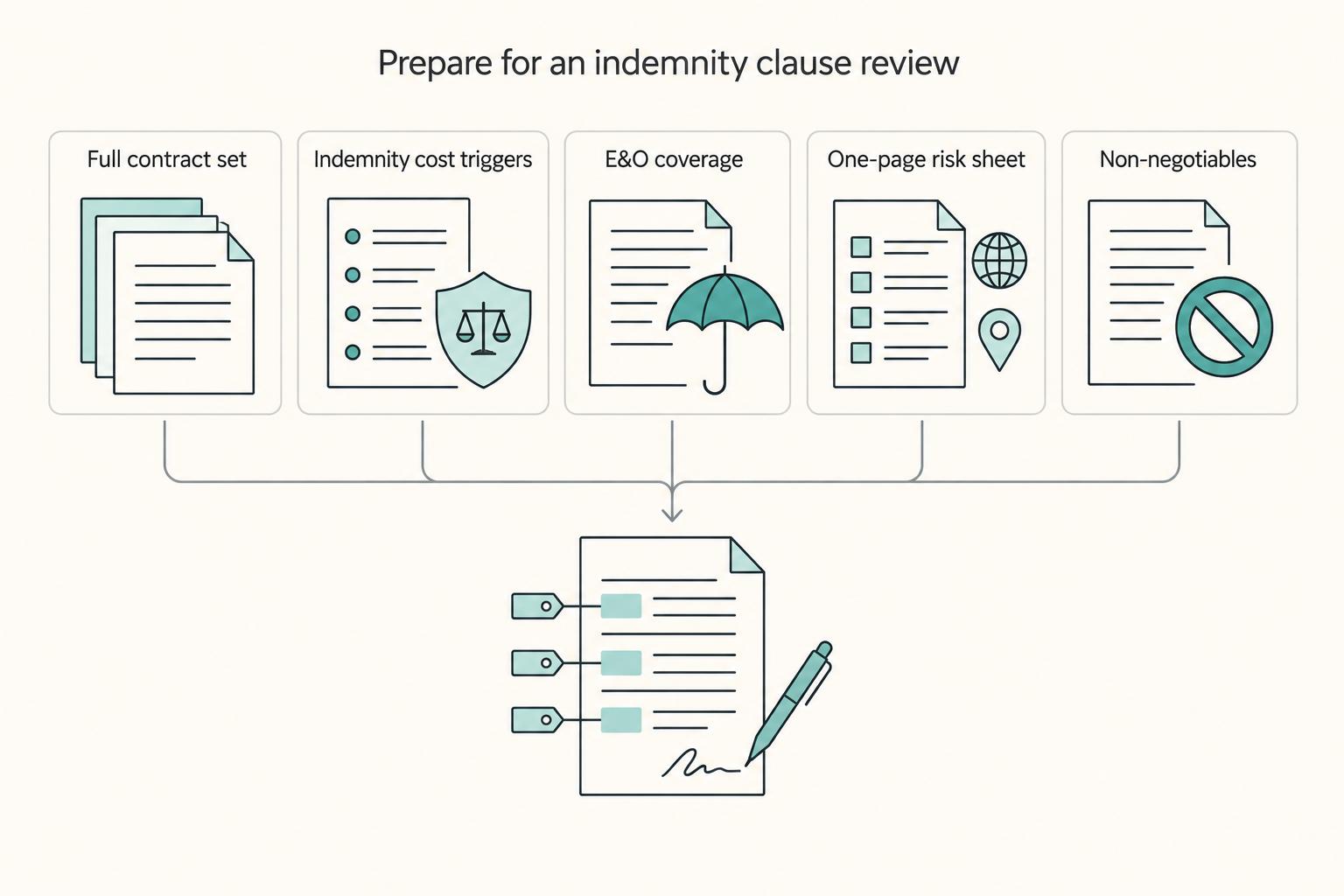
| Prepare | Article details |
|---|---|
| Full contract set | Current freelance contract, statement of work, and any prior contributor template the client uses |
| Indemnity cost triggers | Third-party claims, attorneys' fees, duty to defend, settlements, and judgments |
| E&O coverage | Policy limits and exclusions |
| One-page risk sheet | Service type, likely claim scenarios, domestic or cross-border context, jurisdiction/forum issues, and any pre-court dispute steps |
| Non-negotiables | Open-ended one-way indemnity, uncapped legal fees, and unclear post-termination exposure |
- Collect the full contract set. Gather the current freelance contract, statement of work, and any prior contributor template the client uses. This helps you catch scope changes and risk shifts across documents.
- Flag indemnity cost triggers before redlining. Mark language on third-party claims, attorneys' fees, duty to defend, settlements, and judgments so you can separate early defense spend from later reimbursement exposure.
- Match contract promises to E&O coverage. Check policy limits and exclusions so the indemnity language does not promise protection your coverage may not provide.
- Create a one-page risk sheet. Note service type, likely claim scenarios, domestic or cross-border context, jurisdiction/forum issues, and any pre-court dispute steps.
- Set your non-negotiables before the call. Define your floor on open-ended one-way indemnity, uncapped legal fees, and unclear post-termination exposure.
Before sending redlines, list each covered claim and its trigger. For mixed responsibility, ask for allocation to the extent caused by each party and exclusions for the client-controlled portion. An exclusion for any client edit should not erase your responsibility for an unrelated defect you caused.
What does an indemnification clause actually make you pay for?#
An indemnification clause can make you pay more than final damages: it may shift defense costs, settlements, and other listed losses to you, and defense spend can start when a claim is alleged based on the contract wording.
| Term | Article definition |
|---|---|
| Indemnify | Reimbursement for covered loss |
| Defend | Legal response to a covered claim, which can create immediate legal-fee exposure |
| Hold harmless | Language aimed at keeping those losses off the protected party |
Use these as review distinctions, not guaranteed definitions in every jurisdiction. Interpretation depends on the wording and applicable law. Deleting the word 'defend' alone may not remove defense obligations. California Civil Code 2778 supplies defense-cost and defense-duty defaults unless contrary intent appears; other jurisdictions and regulated contract types can differ.
- Indemnify: reimbursement for covered loss.
- Defend: legal response to a covered claim, which can create immediate legal-fee exposure.
- Hold harmless: language aimed at keeping those losses off the protected party.
Use this four-part review:
- Identify the trigger event. Check whether obligations start from your breach or negligence, or from broad phrases like "arising out of" or "any and all claims."
- Define who is covered. Confirm whether coverage is limited to the client entity or also extends to affiliates, officers, contractors, or other parties.
- List covered cost categories. Separate damages, settlements, judgments, legal fees, and investigation costs so you can see what is actually being shifted.
- Check defense and settlement control. Confirm who chooses counsel, who controls strategy, and who can approve settlement.
For a breach or negligence indemnity, negotiate allocation to the extent caused by your covered conduct in the services. For a separately requested IP indemnity, define the deliverables and infringement claims, client-material/modification exclusions, remedies and cap treatment expressly. Have the governing-law review address defense defaults as well as the chosen words.
Indemnification vs Limitation of Liability vs liability disclaimer#
Treat these three clauses as one risk package, not separate boilerplate. Indemnification allocates responsibility for specified losses, commonly in third-party claims. A limitation of liability clause and a liability disclaimer set boundaries on liability between the contracting parties. If indemnity is broad and cap/disclaimer language is weak, your exposure can outgrow the deal.
| Clause | Primary job | Typical risk if drafted loosely |
|---|---|---|
| Indemnification | Assigns responsibility for specified losses, often tied to third-party claims | You absorb claims and defense costs outside your control |
| Limitation of liability clause | Sets a ceiling on recoverable damages between contract parties | The cap may not apply to indemnity unless the contract says so |
| Liability disclaimer | Narrows or excludes responsibility for certain loss categories | It can create false comfort while indemnity remains broad |
Pressure-test clause interaction in writing with three scenarios: an IP allegation tied to deliverables, a confidentiality-breach claim, and a delivery-delay dispute.
- Map the claim type. Mark each scenario as third-party or direct party-to-party.
- Map the money path. Track where defense costs, damages, and exclusions land.
- Map the alignment fix. Add clear carve-backs so indemnity and liability-cap language do not conflict.
Keep redlines plain: indemnity for defined third-party claims, and direct liability terms aligned with the agreed cap structure.
Step 1 Redline scope of indemnity before price and timeline#
Redline indemnity scope before price and timeline so risk is clear before commercial terms are locked. Broad wording like "any and all claims" can shift more exposure than either side intended.
- Define covered claims first. Remove catch-all phrasing and state which third-party claims are actually covered.
- Narrow covered parties. Limit protected parties to those directly tied to the services.
- Limit covered losses. Specify what losses are included, and separate claim defense obligations from loss reimbursement.
- Add causation-based exclusions. Allocate client-provided materials, unauthorized modifications and uses outside scope to the extent they cause the covered claim.
- Run one checkpoint. Can you identify each covered risk, its trigger, the loss categories and the financial limit? A defined infringement obligation without a breach finding is a distinct commercial choice, not automatically a drafting error.
The matrix below illustrates negotiation concepts, not complete insert-ready clauses. It omits terms that must be drafted together: defense duties, cap application, mixed responsibility, notice, settlement consent and governing-law treatment.
| Requested text | Revised text |
|---|---|
| "Contractor indemnifies for any and all claims, losses, and expenses" | "Contractor indemnifies for third-party claims directly caused by contractor breach of this agreement" |
| "Includes all costs" | "Includes reasonable defense costs only for covered claims" |
| No exclusions | Exclude the covered claim to the extent caused by client materials, unauthorized modifications or out-of-scope use |
Tight drafting here reduces later disputes by making scope and exclusions explicit.
Step 2 Set mutual terms, caps, and carve-outs you can defend#
Negotiate reciprocal responsibilities where both sides control relevant risks, then align indemnity, liability caps and insurance. Reciprocal does not require identical wording: a client's indemnity for supplied material and your indemnity for your original deliverables can address different conduct.
Use mutual indemnity by default: each side covers losses caused by its own breach. If a client asks for one-way indemnity, treat it as an exception and narrow it hard.
- Name party roles clearly. State who is indemnitor and who is indemnitee.
- Align indemnity with the cap. Specify what stays inside the limitation of liability clause and what is carved out, issue by issue.
- Check insurance fit. Compare indemnity promises to available E&O coverage, and flag obligations that may be uninsurable or outside policy scope.
- Control loss categories. Exclude indirect and consequential losses unless the client can justify a specific exception.
Use the actual service and plausible claim scenarios to choose a financial limit. A low project fee does not prove the risk is low, and a higher insurance limit is not a reason by itself to promise that amount. Confirm which loss categories are covered and whether defense costs erode the cap or sit outside it.
For illustration, assume a $10,000 project and an agreed $20,000 aggregate cap that expressly includes indemnity and reasonable defense costs. A covered settlement of $15,000 plus $8,000 defense costs totals $23,000; under that hypothetical enforceable cap, $20,000 is recoverable and $3,000 is above it. If defense costs sit outside the same settlement cap, the full $23,000 may be payable. If indemnity is entirely carved out, the $20,000 cap does not bound that obligation. This arithmetic illustrates drafting choices, not a prediction of a court or insurer outcome.
Write the claim-handling terms as well as the cap#
- Require prompt written notice to the designated contact; define any consequence of late notice rather than assuming every delay voids the indemnity.
- Name who appoints and pays counsel, how conflicts of interest are handled and what cooperation costs are covered.
- Require consent before settlements that admit fault, impose non-monetary duties or leave the protected party exposed; define consent standards and the effect of an unreasonable refusal.
- State how mixed covered/uncovered claims and disputes about defense costs are handled while the claim proceeds.
- Specify whether defense fees and all claims share one aggregate limit, and reconcile exceptions and order-of-precedence clauses across the contract/SOW.
For a hypothetical design claim, distinguish your original artwork from a logo the client supplied. Preserve the original brief, supplied file and modification history. A negotiated client-material exclusion may allocate a claim caused by that logo differently from one caused by your own artwork. The claimant can still pursue its claim; the allocation governs responsibility between the contracting parties, not a release from third-party liability.
How should Governing Law, Jurisdiction, and Dispute Resolution change your risk?#
These terms directly change indemnity risk: governing law shapes how indemnity is interpreted, and jurisdiction/forum decides where disputes are fought. In cross-border work, that process design can matter as much as the clause wording.
- Review governing law and forum as one package.
Confirm both are explicit and consistent, since they solve different problems: one selects the legal rules, the other selects where the case can be brought.
- Set a clear dispute sequence before formal proceedings.
A tiered process can use notice, a cure opportunity where meaningful, escalation and mediation before the chosen formal forum. Give each step a time limit and address urgent relief and filing deadlines. Do not let internal escalation cause a missed third-party response or statutory deadline.
- If both law and forum are foreign to you, tighten indemnity scope.
Limit triggers to defined breach-based events, keep consequential loss excluded unless specifically agreed, and avoid open-ended defense obligations you cannot control in that process.
- Lock operating details and fallback forum options.
- Claim notice recipient by role and email.
- Deadlines for acknowledgment and response.
- Who appoints counsel and who controls settlement consent.
- The agreed court or arbitration process; any change to another forum requires a defined agreement. A remote hearing is a hearing format, not a substitute for a forum.
Run one hypothetical third-party claim through this sequence before signing. If notice, escalation, forum, or settlement control is unclear on paper, cost and delay usually increase in practice.
Keep the claim-notice contact, counsel-selection rule and escalation deadline in the contract record so the procedure can be used when a claim actually arrives.
Step 3 Align Termination and survival terms with indemnity risk#
Termination does not automatically extinguish accrued rights or later claims about earlier work. A clear survival schedule helps define continuing obligations, but an end date is not a guarantee that every legal exposure disappears.
Separate continuing duties, accrued rights and the time allowed to bring a claim. The contract should state the intended treatment of indemnity, confidentiality, payment and dispute provisions. Applicable law and mandatory limits still matter; a contractual survival period and a statutory limitation period are different concepts.
- Step 1: Put all surviving clauses in one schedule.
Name each surviving clause and state why it survives.
- Step 2: Define survival duration where possible.
Specify the duration of each continuing obligation and what happens to claims notified within that period. Discuss any contractual claim deadline with governing-law counsel; a short period may be invalid or impractical. Preserve timely notified claims until resolution if that is the intended deal, instead of assuming a 12-month clause erases them.
- Step 3: Separate closeout from claim disputes.
Keep final invoices, earned amounts and deliverable handoff separate from a disputed indemnity demand. Check any valid set-off or hold provision and applicable payment law; the existence of an allegation alone should not be treated as permission to stop every payment.
- Step 4: Run a failure-mode test before signature.
Scenario: the contract ends, a late third-party claim appears, and the surviving package has no cap, no notice mechanics, and no end date. If that reads as open-ended, tighten scope, align with cap language, and define notice and response steps in surviving terms.
Use a simple post-termination checklist: final deliverables, written approvals, requested edits, and dated change logs. This will not guarantee an outcome, but it gives you a usable timeline if a claim appears.
Step 4 Use a negotiation script that protects you without stalling the deal#
Use a two-track script instead of debating line by line: lead with a preferred package, and keep a narrower fallback ready if the client insists on one-way terms.
- Step 1: Lead with your preferred package.
Ask for mutual indemnity, a clear cap, and carve-outs that match who controls the work and decisions.
- Step 2: Keep your fallback package ready before the call.
If one-way indemnity is required, propose breach or misconduct as the narrower trigger, while expressly addressing any defined IP risk you separately agree to cover. Exclude client modifications and out-of-scope use only to the extent they cause the claim; they should not erase responsibility for your own contributing conduct.
- Step 3: Use direct script language on scope and defense.
"I propose covering claims caused by my breach or misconduct, with any separately agreed IP risk defined explicitly. Client changes or out-of-scope use should be excluded only to the extent they cause the claim." "I cannot accept open-ended defense obligations without cap alignment and clear control over counsel and settlement consent."
- Step 4: Trade terms in risk order if cap changes are refused.
Narrow trigger language first, then set defense-control terms, then discuss pricing.
- Step 5: Escalate with a one-page risk memo and proposed drafting concepts.
Use four fields: requested term, proposed change, exposure if unchanged and business rationale. Ask the client's legal reviewer to integrate the proposed concepts into the complete clause package; a short script or table is not a substitute for that drafting.
This approach helps keep negotiations moving while avoiding open-ended exposure.
Common mistakes and how to recover when talks go wrong#
When talks break, fix the clause package as a system, not isolated lines.
| Mistake | Recovery |
|---|---|
| Using a liability disclaimer as a stand-in for indemnity | Reopen both clauses together and align trigger, cap, and carve-outs |
| Accepting one-way indemnity without reviewing governing law and jurisdiction together | Ask for mutual terms first. If refused, propose breach or misconduct as the narrower trigger, expressly address separately accepted IP risk, and exclude client changes or out-of-scope use only to the extent causing the claim. Revise law and forum together. |
| Leaving termination survival vague | Separate continuing duties, accrued claims and claim deadlines; state what happens to timely notices |
| Agreeing to defend every allegation immediately | Define the trigger and add cooperation duties, counsel control, and settlement-consent rights |
| Promising more than your E&O coverage can support | Ask the broker/insurer to assess the actual clause; contractual promises can exceed insured liability |
- Mistake: using a liability disclaimer as a stand-in for indemnity.
A disclaimer allocates liability between the contracting parties; indemnity is a different mechanism. Recovery: reopen both clauses together and align trigger, cap, and carve-outs.
- Mistake: accepting one-way indemnity without reviewing governing law and jurisdiction together.
One-way terms can leave you paying even when responsibility is mixed, and law and forum serve different roles. Ask for mutual terms first. If refused, propose breach or misconduct as the narrower trigger, expressly address separately accepted IP risk, and exclude client changes or out-of-scope use only to the extent causing the claim. Revise law and forum together.
- Mistake: leaving termination survival vague.
An unclear survival clause leaves timing disputes unresolved. Recovery: identify continuing duties and accrued claims, draft notice/deadline treatment and have the applicable legal limits checked.
- Mistake: agreeing to defend every allegation immediately.
Defense obligations can activate at the allegation stage. Recovery: define the trigger and add cooperation duties, counsel control, and settlement-consent rights.
- Mistake: promising more than your E&O coverage can support.
Check the actual policy with the broker or insurer: insured activities, territorial and forum limits, contractual-liability exclusions, IP/cyber exclusions, deductible, defense-cost erosion and consent requirements. If cover is claims-made, also check reporting and any required continuity or run-off arrangement. A certificate or headline E&O limit is not confirmation that this indemnity will be paid.
If talks stall, reset with one package: you can cover losses tied to your breach, with a cap and clear process control, but not open-ended defense for issues outside your control.
Conclusion and copy-paste contract check checklist#
Good pace and good protection can coexist when indemnity is handled as a linked package. Narrow triggers, align indemnity with cap language, and confirm governing law, forum, dispute path, and survival terms before signature.
Mark each item confirmed, revise or escalate. Any unresolved material trigger, cap, defense or forum issue needs resolution before signature; do not rely on an arbitrary number of checklist failures.
Copy-paste checklist:
- Are covered claim types and triggers explicit, including any accepted infringement risk without a fault finding?
- "Is there mutual indemnity or a justified, narrowed exception?"
- "Do legal fees and losses have clear boundaries and caps?"
- "Do Governing Law and Forum create manageable enforcement risk?"
- "Does Dispute Resolution include ADR or another clear non-litigation path with practical escalation?"
- "Do Termination and survival terms clearly state which obligations continue after the agreement ends?"
Then run one written scenario: a third-party claim arrives after delivery, the client requests immediate defense, and forum is disputed. Confirm defense-cost responsibility, capped exposure, governing law, forum, and surviving obligations. If any answer is unclear, redlines are not ready.
Keep two clean text blocks for close: a preferred package and a narrowed fallback. Preferred means reciprocal protection with cap alignment. Fallback means tighter triggers, strict scope, and explicit defense-cost obligations.
Store the signed contract, SOW, insurance assessment and final negotiation record together. If a claim arrives, preserve it and the delivery/change evidence, notify the insurer and the contract contact through the required process, and obtain advice before accepting a defense, admitting liability or settling. Keep the claim's own response deadline visible during escalation.
Frequently Asked Questions
What is an indemnification clause in a freelance contract?
It is a contractual promise to cover specified losses when defined triggers are met, often tied to breach, misconduct, or third-party claims. The core test is whether the trigger matches work you can control.
Can indemnification make me pay a client's legal fees?
Yes. Express defense duties or reimbursement language can create legal-fee exposure before final liability. Applicable law may also supply defense duties even without that word; California Civil Code 2778 is one example. Review the trigger, control, cap and governing law together.
Should I ever accept a one-way indemnity clause?
Sometimes, with defined scope, pricing and claim-handling controls. Propose breach or misconduct as the narrower trigger, expressly address any IP risk separately accepted, and exclude client changes or out-of-scope use only to the extent causing the claim. Align the cap and defense costs with those promises.
What indemnity terms are reasonable for freelancers and consultants?
There is no universal reasonable package. Define covered risks, causation and mixed responsibility, loss categories, notice/cooperation, counsel and settlement control, and whether defense costs fall inside the aggregate cap. Align those choices with the work and actual insurance.
How is an indemnification clause different from a limitation of liability clause or liability disclaimer?
Indemnity allocates responsibility for specified losses, often involving third-party claims. Limitation language caps recoverable damages between contract parties. A disclaimer can address baseline responsibility, but it typically serves a different function from indemnity drafting.
What should I check before signing an indemnity clause in cross-border services?
Review governing law, jurisdiction, and dispute sequence together. Law sets legal interpretation. Forum sets where disputes are heard. Ambiguous drafting on either point can create process disputes before merits are addressed.
When do Governing Law, Jurisdiction, and Dispute Resolution terms become a deal-breaker?
Treat it as a red flag when law and forum are both foreign to you and indemnity remains broad or uncapped. If process terms are unclear or defense cost is open-ended, pause signature and fix the clause package first.
Try a related tool
Researched and edited by the Gruv editorial team. Gruv builds cross-border billing, payouts, and finance-operations software for global businesses.
Sources
Includes 2 external sources outside the trusted-domain allowlist.
Educational content only. Not legal, tax, or financial advice.
Related Posts

How to Fire Your Accountant or Lawyer
You can change an accountant or lawyer while protecting the work already in progress. The practical priorities are active deadlines, usable records, authority to act and final billing. An accountant transition and a lawyer transition share those priorities, but their professional and court procedures can differ.

The Freelance Payment Penalty: A Modeled Audit of Platform Fees, FX Spreads, and Payout Delays
The money rarely disappears through a single, easy-to-spot fee. The real loss is stacked. A marketplace takes its commission, a processor adds a charge for international cards, a bank or payment company converts the currency at a spread, a platform holds the funds before release, and a wire sheds a little to intermediaries on the way in. Each layer looks defensible on its own, but the worker feels the combined result as a smaller deposit and a later payday.

How to Respond to a Subpoena for Business Records
Move fast, but do not produce records on instinct. If you need to **respond to a subpoena for business records**, your immediate job is to control deadlines, preserve records, and make any later production defensible.