
Quick Answer
Start by pausing and running triage with your records, then reply in writing from what is documented. Check the signed agreement, SOW, approval notes, and invoice trail before you infer intent. Use a calm Airbag-style message that restates current terms, flags the gap, and asks one focused decision question. If the issue resolves, log it and update the weak spot in your workflow, such as change approvals, billing follow-up, or your single written decision thread.
Start by assuming confusion, not bad intent#
Use hanlon's razor in client communication as a triage tool, not an excuse. Much client friction is not pure malice, but it can still disrupt delivery if you handle it loosely. The useful move is not to judge character first. It is to diagnose what actually happened.
In plain terms, it means you first ask whether confusion, carelessness, or a simple miss could explain the problem before you assume bad intent. That distinction matters. Assuming a non-malicious cause does not mean being passive. You still protect your boundaries and keep clear records. If someone missed a deadline because they got the day wrong, that calls for a different response than deliberate avoidance. In both cases, you document what happened and what happens next.
A quick first check: pause before replying and test more than one explanation. Did someone get the day wrong? Was there a misunderstanding? Is this a one-off mistake rather than a pattern? That pause helps you avoid a common failure mode: blaming the nearest person and assuming they are out to get you.
From here, use a simple three-step approach:
- Diagnose the issue so you can tell a mix-up from a pattern.
- Respond with protection built in so you stay calm without getting vague.
- Improve the process after the incident so the same problem is less likely next time.
If you use those three steps consistently, you make better calls under pressure and keep ordinary client problems from escalating.
The Foundation: From Emotional Reaction to Clinical Diagnosis#
Use the pause as a diagnostic step: separate what you can verify, what might explain the issue without bad intent, and what you still need to confirm before you respond. The goal is not to excuse behavior. It is to make a better decision under uncertainty.
1) Separate facts from interpretation#
Start with the narrowest description you can support. Replace "they are disrespecting me" with observable details: when the invoice was sent, what was requested, and what is or is not in the brief. If it is not in the thread, contract, or call notes, treat it as interpretation, not fact.
Use records as support, not as final answers. A timestamp, signed SOW, or approval thread can strengthen your read, but none settles every question on its own.
2) List plausible non-malicious causes#
Before replying, write down two or three explanations that do not require hostile intent. Your contact may still be waiting on internal approvals. The request may come from unclear scope language. Tone can read differently across language and communication norms, so do not label directness, brevity, or delayed timing as bad intent too early.
When evidence is thin, stay conservative and avoid strong accusations.
3) Mark the assumption you must verify next#
Ask: which assumption, if wrong, would change your response? Verify that first.
| Response style | Example |
|---|---|
| Reactive | "You keep moving the goalposts." |
| Diagnostic | "Can you confirm whether this request is inside the original scope or an added item?" |
That one shift improves decision quality and helps protect the working relationship and your risk position. It also prepares you for the next step: deciding whether this is a one-off process miss or an emerging pattern.
This pairs well with our guide on How to Handle Cross-Cultural Communication with International Clients.
Step 1: The Triage Protocol - Is It System Failure or Willful Action?#
Before you reply, run triage: confirm what is documented, test likely non-malicious causes, then judge risk from the pattern rather than the emotion.
1) Check the record first#
Open the signed agreement, statement of work, and latest approved change record. Verify, in order: scope, payment terms, revision boundaries, and approval workflow. Anchor your view to the last documented agreement, not memory.
If a request could change a deliverable, snapshot the current state and save the working file before you make edits. Your checkpoint is simple: you can point to the exact clause, thread, or approval note that supports your read.
2) Test likely non-malicious causes#
Start with the clearest explanation, but do not force a tidy story that ignores the context you already have.
| Scenario | Likely non-malicious cause | Verify next | Risk is rising when |
|---|---|---|---|
| Invoice delay | Approval is stuck, billing ownership changed, or payment follows an internal cycle | Confirm the invoice reached the right contact and matches agreed terms | Delays repeat, explanations conflict, or follow-up gets silence |
| Scope expansion | New internal pressure or incomplete visibility into the original scope | Compare the ask to signed scope and approved changes | New asks keep appearing without approval or budget discussion |
| Vague feedback | Stakeholders are misaligned, the brief is weak, or reviewer context is limited | Ask what outcome is wrong, which example is preferred, and who has final approval | Feedback stays abstract across rounds and approvals keep shifting |
A useful self-check: move from "Why are they doing this?" to "Which missing fact would change your response?"
3) Separate one-off friction from a pattern#
Treat a single miss as possible process friction. Treat repeated late payment, repeated off-channel requests, or repeated approval reversals as higher risk.
Keep a client history note: date, event, relevant contract term, what you asked to verify, and how it resolved. Agree on a change-approval process and record scope, price and schedule changes there. Chat messages or calls may have legal effect; do not assume a change is nonbinding solely because it was discussed outside email.
Finish triage with three outputs for Step 2: your working diagnosis, the current risk level, and your response posture.
Step 2: The 'Airbag' Response - Protecting Yourself While Assuming Good Intent#
After triage, reply in a way that keeps the relationship calm and protects your downside. Assume good intent, but write from the record so your scope, payment position, and options stay clear.
Acknowledge without conceding#
Use this sequence every time: acknowledge, restate the current agreement, flag the gap, ask one alignment question. Anchor your restatement to what you verified in Step 1 (agreement, SOW, approved change record, invoice status), not memory or tone.
| Reply style | Tone | Risk to you | Likely outcome |
|---|---|---|---|
| Reactive reply | Defensive or vague | Blame language, accidental concessions, unclear record | More friction, slower alignment |
| Airbag reply | Calm and specific | Better boundary control and clearer documentation | Faster alignment and a usable paper trail |
Quick self-check before sending: can you point to the exact line, thread, or approval note behind your restatement?
Reusable message structure#
Use short scripts you can adapt to the verified terms.
- Scope expansion
Thanks for sending this. My understanding is that the current scope covers the deliverables already approved in writing. This request appears outside that scope. Do you want this handled as a change to the current work or as a separate addition?
- Payment delay
Hi, checking on the invoice for this project, which appears due under the current payment terms in our records. It may be stuck in approval or routed to the wrong contact. Can you confirm status and expected payment date?
- Priority change
Thanks for the update. I understand this new priority is now urgent. Under the current plan, that affects the deliverable and timeline already in motion. Should I pause that work and re-sequence, or should I send a revised scope and timing for approval?
Confirm decisions in writing the same day#
If a decision happens on a call, Slack, or text, move it into written confirmation that same day. Keep the recap explicit on four points:
- owner
- deliverable
- dependency
- next action
Example format: "Confirming today: your team will send the needed dependency by the agreed date. I will deliver the next approved item after that. If scope or timing changes, I will send an updated change note for approval."
Stay collaborative when a clear written follow-up gets a clear response. Move to a more formal posture when you see repeated non-response after documented follow-ups, or repeated breaches of terms already confirmed in writing. At that point, stop improvising, cite the exact agreement, state the required next action, and pause further concessions unless your record supports them.
We covered this in detail in How to Handle a Client Who Constantly Delays Providing Feedback.
Step 3: Run an After-Action Review and Change One Process#
After you contain the issue, run a short after-action review so the same friction is less likely to repeat. Keep it practical: use the record, choose one process change, and apply it.
Run a quick post-incident review from the written record#
Use this four-part internal template:
- What happened?
- Where did your process fail?
- What early signal did you miss?
- What control will you add next time?
Work from written records, not memory: the agreement, the thread where the issue surfaced, approvals, billing records if relevant, and your written recap. If those records do not show a clear gap, keep the conclusion provisional and avoid overcorrecting.
Update one operational artifact at a time#
Make one concrete change first, then test it in real work before adding more.
| Issue type | Artifact to update | First update to make |
|---|---|---|
| Scope confusion | SOW | Clarify deliverables, exclusions, and change approval steps |
| Payment friction | Invoice workflow | Confirm billing contact, required billing details, and follow-up cadence |
| Unclear kickoff ownership | Onboarding expectations | Define decision-makers, channels, and approval points early |
| Side requests scattered across chat | Communication SOP | Define which channel can change scope and how decisions are confirmed |
Turn red flags into explicit decisions#
Use a simple table so repeated patterns trigger a clear action.
| Pattern you notice | Working interpretation | Action |
|---|---|---|
| One minor miss, then quick correction after clarification | Likely process miss | Monitor |
| Repeated out-of-scope asks after written clarification | Boundary pressure or unclear ownership | Set boundary |
| Refusal to sign, pay, or confirm core terms in writing | High execution risk | Consider disengagement under the agreed notice and termination process |
| Frequent channel-switching to avoid written confirmation | Low accountability | Set boundary |
| Repeated term breaches with disrespectful tone | Relationship cost rising | Consider disengagement under the agreed notice and termination process |
Close the loop#
Document the change with a date, then apply it to current clients where the same gap exists and to all new clients through your standard materials. If you do not roll the change into active work and future work, the lesson stays theoretical.
Review Context, Respond from the Record, Then Fix the Gap#
Your goal is not to guess motives. Your goal is to run a repeatable procedure: review context, respond from the written record, and then fix the process gap that created the issue.
When stress spikes, switch your question from "Why are they doing this?" to "What does the thread and my documentation show, and what is the next clean move?"
- Read context before reacting.
If you are added late to an email chain or project thread, catch up first. Before replying, summarize the request, the latest decision, and one missing detail. Then ask focused questions rather than assuming the omission was deliberate.
- Respond with procedure, not emotion.
Anchor your reply to the relevant record: contract, scope document, invoice workflow, or written follow-up. Give one clear next step instead of arguing intent. Checkpoint: point to one source of truth and ask one focused question if needed.
- Fix the system after the moment passes.
Once resolved, update the business artifact that failed: scope wording, approval notes, invoice trail, or your rule for one written decision thread. Strong craft helps, but people and business process discipline are what keep issues from repeating.
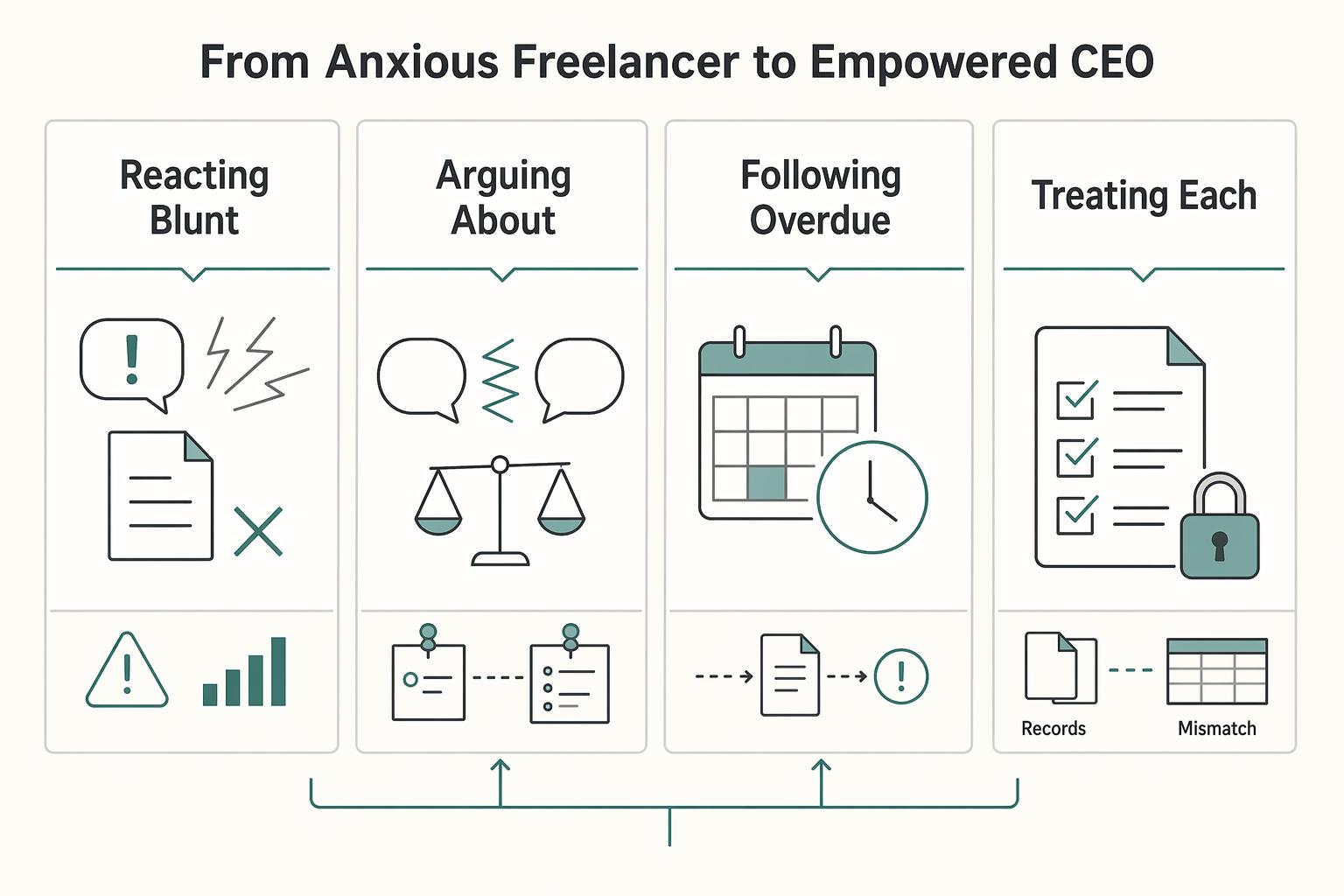
| If you catch yourself doing this | Do this instead now |
|---|---|
| Reacting to a blunt message as disrespect | Read the full thread, restate the ask, then send one clarifying question |
| Arguing about scope in circles | Point to the signed scope and offer a clear path: in-scope now or add-on approval |
| Following up on an overdue invoice with frustration | Verify invoice details and reminder history, then continue follow-up in the same written thread |
| Treating each issue as isolated drama | Update the contract/process note so the same gap is less likely next time |
You will still face vague feedback, long threads, and payment friction. The difference is that you handle them with context review, written proof, and an executable next step, then repeat that discipline as a normal operating practice.
Frequently Asked Questions
What do you do when a client has not paid an invoice?
Start with triage, not accusation. Confirm the invoice reached the right billing contact and that the key details are clear. Then send a short note like: "Hi, I'm reconciling accounts and wanted to confirm the invoice reached the right person. I've attached it here again. Can you let me know if anything is needed on your side?" Keep payment follow-up in one written thread and track each reminder in your records.
How do you handle scope creep without sounding defensive?
Assume the client may see the new request as a natural extension. Use the Airbag response: "That makes sense as a next step. It sits outside the deliverables in our current SOW. I can either keep moving on the original scope or send a quick add-on estimate for approval." Do not start extra work until the change is approved in writing.
When should you stop assuming good intent and escalate?
Shift from diagnosis to pattern recognition when the same issue repeats after clear written clarification. It is hard to prove malicious intent, so focus on repeated behavior and project impact instead of motive. Say: "To keep the project workable, I need us to follow the agreed process for scope, approvals, and payment from here." Then decide whether this relationship still fits.
What if the feedback is vague, contradictory, or impossible to act on?
Treat it as a translation problem first, not a personal attack. Reply with choices: "When you say 'more dynamic,' do you mean stronger visuals, faster pacing, or a different tone?" Then add, "I can revise in either direction once you confirm which one you want." Tie the next revision to one chosen interpretation and record it in your revision notes or approval thread.
How do you handle cross-cultural or multilingual friction?
Use extra caution before assigning intent. This approach is about clarification-first responses, not hard rules for multilingual or distributed-team workflows. Use plain language, restate the request, and verify meaning: "I want to make sure I understood correctly. Are you asking for the shorter version or the more detailed version?" Confirm decisions in one written channel.
Does this approach make you look weak or too soft?
No, not if you pair assumed good intent with records and limits. You are not saying "anything goes." You are saying, "I will respond rationally, verify against the contract or SOW, and only move forward on written approvals." That is stronger than reacting from irritation. If micromanagement is part of the pattern, this guide on how to handle a client who is micromanaging your project is a useful next step.
Try a related tool
Researched and edited by the Gruv editorial team. Gruv builds cross-border billing, payouts, and finance-operations software for global businesses.
Sources
Includes 3 external sources outside the trusted-domain allowlist.
- nycourts.gov/reporter//files/bv/114AD3d.pdftrusted
- nycourts.gov/reporter//files/bv/174AD3d.pdftrusted
- pmc.ncbi.nlm.nih.gov/articles/PMC12467906trusted
- pmc.ncbi.nlm.nih.gov/articles/PMC7149322trusted
- askamanager.org/2014/04/my-boss-didnt-talk-to-me-directly-ab...external
- mitre.org/sites/default/files/publications/se-guide-bo...external
- watersbusinessconsulting.com/2024/12/12/can-hanlons-razor-help-your-busin...external
Educational content only. Not legal, tax, or financial advice.
Related Posts

GDPR Compliance Checklist for Freelancers Working With EU Clients
Start by separating the decisions you are actually making. For a workable **GDPR setup**, run three distinct tracks and record each one in writing before the first invoice goes out: VAT treatment, GDPR scope and role, and daily privacy operations.
How to Handle a Client Who is Micromanaging Your Project
Treat a **client micromanaging project** as an operating risk first, not a personality problem. Before you debate tone or intent, measure what the interruptions are doing to delivery time, focus, and team capacity. If you do not track them, you can keep absorbing them as "just part of client service" even when they are quietly reducing the value of the engagement.

The Freelance Payment Penalty: A Modeled Audit of Platform Fees, FX Spreads, and Payout Delays
The money rarely disappears through a single, easy-to-spot fee. The real loss is stacked. A marketplace takes its commission, a processor adds a charge for international cards, a bank or payment company converts the currency at a spread, a platform holds the funds before release, and a wire sheds a little to intermediaries on the way in. Each layer looks defensible on its own, but the worker feels the combined result as a smaller deposit and a later payday.