
Quick Answer
Agree on cancellation compensation before work starts. Define notice, termination basis and objective stage triggers, then specify whether each amount is cumulative or additional, how deposits and paid milestones are credited, and how approved expenses are handled. Invoice the resulting balance with evidence and apply the rights and handoff terms for the affected work. Enforceability and tax treatment depend on the applicable law and facts.
Treat a kill fee as risk control when a project ends early#
A client cancellation can leave you with completed work, non-cancellable costs and time you reserved for the project. Agree in advance on what is payable if the project ends early, how you will prove the stage reached and what rights the client receives.
Use the following stages, calculation options and draft clause prompts to negotiate a cancellation arrangement that fits the project and its governing law.
Step 1: Reframe the conversation (internally first)#
Explain the commercial reason for the fee: you have reserved capacity and may incur setup or delivery costs before the client receives the final output. Show the calculation rather than presenting a charge as automatic punishment for leaving.
A freelance kill fee is an agreed cancellation or early-termination payment triggered by the circumstances described in the contract. It may be a separate fee or part of total compensation due on cancellation. State which, so completed-work charges and deposits are not counted twice.
Step 2: Install the system (not a single clause)#
A kill fee clause often works best when it's paired with clear termination language and connected to how you actually deliver. Think: SOW phases, stakeholder churn, and changes that creep in.
Kill fees aren't just a publishing thing. They show up anywhere upfront investment is high and project cancellation is a constant risk-including in fields like software development and consulting. Use this mental model:
| Component | Purpose | Where it lives |
|---|---|---|
| Termination terms | Defines how either side can end it | Master agreement / contract |
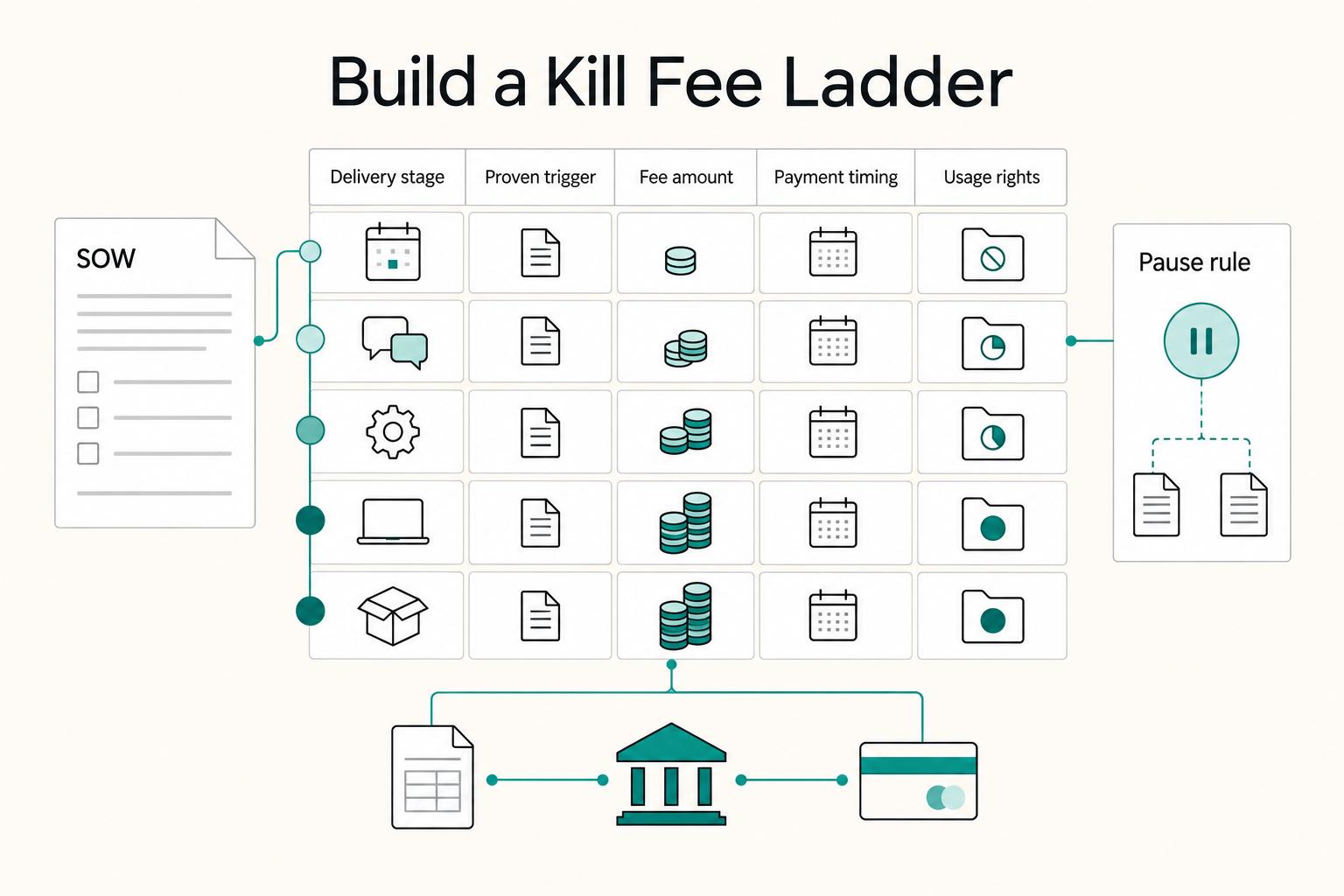
| Kill Fee Ladder (stage-based) | Defines what you get paid if they end early | SOW + payment terms |
| Scope + change process | Prevents "scope drift" from turning into "termination drama" | Scope of work / project process |
| Rights + IP after termination | Clarifies what they can use (and what they can't) | IP/ownership section |
Step 3: Default to "milestone-based" for modern services#
If your work runs in phases (strategy → design → build → launch), use a milestone-based kill fee. It ties cancellation consequences to the stage the project reached. That's clean, explainable, and negotiation-friendly.
The result is an agreed calculation and evidence trail, not a guarantee of enforceability or collection.
What is a freelance kill fee-and when should it (and shouldn't it) apply?#
A freelance kill fee is a pre-agreed payment the client owes if they cancel a project before completion-most often when they terminate "for convenience," not because you breached the deal. This section draws the lines: what the fee is, when it activates, and where you should be careful about applying it if you want a defensible, professional freelance contract.
Step 1: Define the fee in plain language (and keep it proportional)#
Tie the fee to a clearly defined termination-for-convenience option, if that is the commercial arrangement you choose. Federal procurement termination rules govern their own contracts; they do not establish a default cancellation right or fee for a private freelance engagement.
Explain the amount using reserved capacity, non-recoverable setup, completed work and avoided costs, without charging twice for the same loss. Applicable law determines how a cancellation price or damages clause is assessed. Calling the charge a reasonable pre-estimate is not a universal legal test or a cure for an excessive amount.
Step 2: Set "start of work" triggers inside the SOW#
A kill fee clause collapses if "work started" stays fuzzy. Put 1-2 objective commencement triggers in your Statement of Work (SOW) and name them explicitly. Examples you can adapt:
| Trigger example | Example wording |
|---|---|
| Kickoff meeting | "Work starts when the kickoff meeting occurs." |
| System/account access | "Work starts when the client grants access to required systems/accounts." |
| Discovery/research | "Work starts when the discovery/research phase begins." |
| First draft/prototype | "Work starts when the first draft/prototype gets delivered." |
Step 3: Build fairness: separate "for convenience" from "for cause" (with a Cure Period)#
Kill fees are typically tied to termination for convenience (ending "without cause"). If a client terminates for cause, the contract often handles payment differently-especially if you're given notice and a chance to fix the issue.
Where appropriate, agree on notice of a specified breach and a workable opportunity to cure. Define which breaches can be cured and any immediate-termination exceptions; a cure period is not mandatory for every termination.
Pick a duration you can operationally meet, then tie it directly to the termination clause.
Step 4: Call out "gray areas" in the SOW (so nobody litigates reality later)#
If you know certain situations tend to create disputes-paused projects, shifting stakeholders, "we have the work but we're not using it," or midstream scope changes-define how they're treated up front. Spell out what counts as cancellation/termination vs. completion vs. a change in scope, and what gets paid in each path.
Record client-caused delays, cancellation and completed-work acceptance separately. A request for a change is not itself a termination notice.
What should you prepare before adding a Kill Fee Clause?#
Before you paste a freelance kill fee into your freelance contract, you need to know (1) where it lives, (2) what "stage" means in your world, and (3) what other agreements might interact with it. This is the setup that makes your kill fee clause workable in practice, not just "nice wording."
Before You Start: grab your minimum contract stack#
Step 1: Collect the documents the client will actually sign (and decide where the clause goes). A Statement of Work (SOW) usually spells out deliverables, timelines, payment terms, and acceptance criteria-exactly the inputs you need for stage-based cancellation rules.
Often, the SOW sits as an appendix to a broader contract or MSA. Use this quick placement guide:
| If your deal uses... | Put the kill fee where? | Why |
|---|---|---|
| Standalone agreement + SOW | Agreement (term/termination) + SOW (stages/amounts) | Keeps legal authority + project math together |
| MSA + multiple SOWs | MSA (termination framework) + each SOW (kill fee ladder) | Lets you adjust per project without renegotiating the MSA |
Verification point: you can point to one signed document that clearly links the Termination Clause to the SOW's stage-based Kill Fee / Cancellation Fee / Early Termination Fee.
Step 2: Map your work into verifiable stages with an evidence trail. Don't pick "vibes" like 50% done. Pick events you can later support with artifacts (where available): kickoff notes, dated deliverables, approval emails, repo commits, access logs.
If a client disputes an Invoice, you'll want a clean packet: the original invoice, relevant proof of payment/transaction records (if applicable), and written correspondence. If your system for capturing proof feels messy, fix that now with one tool and one habit. (The Best Note-Taking and Knowledge Management Apps for Freelancers helps.)
Dependencies + permissions: the two sources of surprise fights#
Step 3: List third-party and compliance dependencies, then define pass-through expense rules. If you plan to spend money (subcontractors, data tools, paid research, travel), consider requiring written pre-approval and documentation for reimbursement.
This prevents the "we never authorized that" conversation after termination.
Step 4: Check your NDA/DPA before you promise reuse or resale rights. An NDA restricts sharing information deemed confidential, and a DPA governs how a processor handles personal data for a controller.
If either applies, confirm what you can keep, reuse, or show in a portfolio before you offer "reuse" as part of your contract protection, because the answer depends on what your specific agreement actually says.
Step 5: Pre-select your safe default commercial positions (you can negotiate later). Decide-up front-your default billing and payment terms and what happens to access and hand-offs after Termination, consistent with whatever your contract/SOW actually states.
You don't need perfect terms; you need consistent ones you can execute every time.
Use the SOW generator to prepare a draft with stages, references and payment terms, then adapt it to the agreement.
Should you use a kill fee, a deposit, milestone billing-or a combo?#
Choose the payment structure that fits the exposure: an advance, milestone billing, a cancellation fee, or a combination. If you combine them, define credits and offsets so the total is clear.
Once you've mapped stages and evidence, choose the lightest structure that still creates a clear payment consequence under your Termination Clause. This matters most when the client insists on Termination for Convenience (ending "without cause"). It should still specify notice and compensation so it holds up in practice.
Step 1: Choose your mix based on project risk#
Consider whether work can actually be reused or sold, subject to confidentiality and IP terms. Bespoke work and reserved capacity may justify an advance or cancellation arrangement; subtract costs you avoid and avoid treating every unused hour as the full project price.
Step 2: Count stakeholders and timeline length. If approvals travel through multiple people or the timeline stretches, use milestone billing-payments scheduled to predefined milestones instead of one final bill. Add a milestone-based kill fee so cancellation maps cleanly to what's "done."
Step 3: Surface third-party costs early. If you'll spend money (tools, subcontractors, travel), put pre-approval + reimbursement mechanics directly in the SOW. Make sure your termination language covers non-recoverable expenses.
A kill-fee calculation can reflect incurred costs, including non-recoverable expenses and partial deliverables' value. Don't leave expenses floating.
Step 2: Know what each tool does (so you don't misuse it)#
Compare the role of each payment term:
| Tool | What it is | What it helps you do | Where it lives |
|---|---|---|---|
| Deposit / advance | Upfront payment with specified credit and refund treatment | Secure the engagement and get moving with an upfront payment | Fees/Payment Terms + SOW |
| Retainer | Availability fee or advance against services, as agreed | Set up ongoing availability under a defined scope | Retainer terms + SOW |
| Milestone billing | Payments scheduled around predefined milestones | Align payment to delivery instead of relying on one final invoice | SOW + invoicing schedule |
| Freelance kill fee | Payment when a project gets canceled before completion | Define compensation if the client terminates early (often tied to completed milestones) | Termination Clause + SOW ladder |
| Change Order | Written scope change agreement | Document scope/timeline/fee changes before the new work becomes "the deal" | SOW process section |
Step 4: Use a procurement-friendly reframe when clients push back. Keep it plain: "This is the agreed compensation if you terminate for convenience. It documents notice + payment so stopping work is clear."
Practical check: if you can't tie the kill fee to SOW stages ("If we stop after X, then Y is due"), simplify the ladder until it reads like an invoice schedule, not a legal puzzle.
Build your Kill Fee Ladder (stages → % → rights → invoice timing)#
Build your freelance kill fee as a stage-based ladder inside the Statement of Work (SOW), so "early exit" turns into a clear, invoiceable number instead of a negotiation. Now you're operationalizing it: stages → triggers → percentage → payment timing → rights.
Step 1: Map a few rungs to your real delivery stages#
Map the costs and earned work at each stage, then agree on a fixed amount or percentage if useful. Explain whether it is total cancellation compensation or an additional charge. Later stages often involve more work, but percentages are negotiable rather than industry defaults.
For illustration, the table uses a $6,000 project and cumulative amounts due on a convenience cancellation, including work fees already earned. These numbers are hypothetical, not standard rates. Credits for payments already made and separately approved expenses are handled below.
| Rung | Stage (in SOW language) | "Stage reached" trigger (objective) | Illustrative cumulative compensation on convenience cancellation |
|---|---|---|---|
| 0 | Before work begins | No commencement trigger reached | $0 in this example; state deposit refund treatment |
| 1 | Discovery complete | Workshop and notes delivered | $1,200 total before payment credits |
| 2 | First draft delivered | Dated draft delivered | $3,000 total before payment credits |
| 3 | Near-final delivery | Agreed near-final output delivered | $4,800 total before payment credits |
| 4 | Completed scope | Agreed completion/payment criteria met | $6,000 ordinary project fee, subject to agreed terms and credits |
Suppose the client cancels after the first draft in the illustrative $6,000 ladder. The cumulative stage amount is $3,000, including work fees rather than adding them again. With a $1,500 deposit already credited and $200 of separately approved, non-cancellable expenses not included in the ladder, the balance is $3,000 − $1,500 + $200 = $1,700, before applicable tax. If an additional $500 milestone payment was already credited, the balance becomes $1,200. State the expense treatment and any refundable excess advance explicitly.
Step 2: Write the trigger language like an operator (so it holds up)#
Action: In your Kill Fee Clause (inside the Termination Clause, with SOW cross-references), define triggers that you can prove: "delivered," "sent," "workshop conducted," "repository tag created," "handoff shared."
Clear triggers make the stage calculation easier to verify. They do not establish that a fee is lawful or reasonable in every jurisdiction.
Specify rights for the particular paid work or cancellation outcome. Rights do not automatically revert merely because the project ends; follow the effective assignment, licence and termination provisions.
Define extended pauses. Agree on the pause length, notice, restart process and any pause-to-termination trigger before it happens. Follow that procedure if the client stops providing inputs; do not invent a retroactive cancellation charge.
Handle scope changes separately. Check whether feedback is a correction, included revision or genuine addition. Obtain approval for a changed fee or schedule before extra work. A refusal of extra scope does not automatically convert the contract into termination for convenience.
Draft terms for the cancellation calculation#
Use a short, modular clause set (Kill Fee + Termination + Payment mechanics) so procurement can redline cleanly without breaking your freelance kill fee logic. With your ladder stages and triggers living in the SOW, your job here is to make termination and payment operational: clear options, clear definitions, and an invoice AP can actually process.
Step 1: Drop in a "tight clause stack"#
Keep the fee calculation, termination procedure and payment mechanics distinct so an edit to one does not silently change the others.
| Building block | What it does | Where it lives |
|---|---|---|
| Kill Fee Clause (stage-based) | Converts cancellation into an objective amount due based on SOW stages | SOW + referenced in MSA/Agreement |
| Termination Clause | Distinguishes Termination for Convenience vs Termination for Cause + Cure Period | MSA/Agreement |
| Payment mechanics | Triggers invoicing on termination + makes payment processing straightforward | MSA/Agreement + SOW |
Use plain language such as cancellation compensation and show the amount or method. A familiar label helps discussion, but the operative calculation and triggers matter more.
Draft starting points to adapt with the actual stage table, commercial terms and governing-law requirements:
- Cancellation compensation: On Client termination for convenience under the agreed notice procedure, total work and cancellation compensation is the cumulative amount for the highest stage reached in the incorporated schedule, less all payments credited toward it. Do not also add the same completed-work fees. Separately approved non-cancellable expenses are payable only to the extent not already included or paid.
- Convenience termination: State who may end the project, how notice is given, the effective date and the resulting payment and handoff obligations.
- Cause termination: Define material breach, required notice and any opportunity to cure, exceptions and the payment/rights consequences. The convenience ladder does not automatically apply to a different termination basis.
Step 2: Define terms so AP can pay-and nobody argues about "done"#
Action: Add a short Definitions section and tie each term to your ladder and Invoice trigger:
| Term | What to define |
|---|---|
| Commencement | What starts the clock-e.g., kickoff held or deposit received. |
| Deliverables | The specific items listed in the SOW. |
| Acceptance | What counts as accepted-avoid open-ended "when satisfied". |
| Pause | What counts as a pause + when a pause becomes termination. |
Enforceability depends on the clause’s substance and governing law. For example, California Civil Code 1671 treats many commercial liquidated-damages provisions differently from specified consumer contracts. Under English law, Cavendish/ParkingEye distinguishes primary payment obligations from breach remedies and assesses a penalty by reference to legitimate interest and proportionality. Neither supports a worldwide rule that writing reasonable forecast of loss guarantees enforcement.
Action: Make payment processing easy:
- Require invoices to include key references (invoice number + any contract/PO authorization), since AP systems often require them to process payment.
- If you charge interest/late fees, write "where enforceable" and keep it simple.
If the agreement includes a liability cap, check how it interacts with payment obligations, IP terms and termination compensation. A cap based on fees paid can produce an unintended result before any payment; do not add one automatically as part of a kill-fee clause.
Finally, address expenses in the SOW if applicable-especially anything that requires written approval and anything you want handled cleanly if termination happens.
Who owns the work after termination-and can the client still use it?#
Choose what rights apply to each deliverable at termination. You can negotiate rights contingent on a specified payment, a limited evaluation licence or rights for separately paid milestones. Honour rights already vested and avoid making an unrelated unpaid invoice automatically cancel every client right.
Step 1: Install a rights matrix tied to payment status#
Action: Put a simple matrix in the SOW (or an exhibit) that ties License / Assignment to specific payment states. This prevents the "we paid something, so we own it" argument.
| Payment status at termination | What client gets | Terms to specify |
|---|---|---|
| Cancellation compensation paid | The rights granted for specified partial work, if any | Whether the charge includes a licence or only cancellation compensation |
| Separately paid milestone | Previously vested rights remain under the agreement | Which milestone rights have become effective |
| Full agreed scope paid | The licence or assignment agreed for that output | Exact payment condition, exclusions and permitted uses |
Step 2: Make "no rights until paid" operational#
For U.S. copyrightable work, initial ownership generally rests with the author unless work-made-for-hire rules apply, and a copyright transfer generally needs a signed writing. Payment alone does not establish ownership. Licences, including existing or implied permissions, need separate review; no signed assignment does not necessarily mean no usage rights.
State the intended assignment or licence and when it takes effect. The Copyright Office transfer guidance explains the role of written transfers and recordation. Scope the rights to the agreed work and account for preexisting or third-party materials.
Operational language you want (in plain English):
- Identify who initially owns the copyrightable output and any work-for-hire exception.
- Specify the licence or assignment, relevant deliverables and payment condition.
- Separate unpaid work from rights already vested in paid milestones; follow required handoff and confidentiality terms.
Price and negotiate the rights required for the client’s intended use. Keep reusable tools or methods distinct from project output rather than assuming every ownership term deserves the same premium.
U.S. work-made-for-hire treatment for commissioned work requires both a qualifying statutory category and the required signed agreement; there are nine categories. A freelancer label, payment or a clause alone is insufficient. Employee work within employment scope follows a different path.
Step 3: Don't promise reuse/resale you can't legally deliver Action: Read your NDA and confidentiality terms before you promise you can "reuse anything." NDAs create legally binding duties to keep information confidential-so carve out client-confidential information and any embedded data, then define what you can reuse (general know-how, non-confidential techniques) without leaking their specifics.
Check that the agreed rights match the commercial price. Partial payment may properly buy a limited licence or ownership of a paid milestone if the agreement says so; it is not automatically a misassignment.
How do you invoice and collect a kill fee-especially with cross-border clients?#
Invoice the amount triggered by the agreed termination terms, with stage evidence, credits and due date. Show any rights or handoff terms applicable to that payment. Clear documentation helps accounts payable process it, but does not make a disputed charge automatically collectible.
Before you start (don't skip this)#
You need three inputs on hand: the signed freelance contract/SOW, the kill fee ladder stage reached, and a checklist of what you actually delivered (files, links, dates). If you can't point to those, you'll argue feelings instead of facts.
Step 1: Issue a termination invoice that answers objections in one screen#
Action: Generate the invoice promptly once termination (or pause-to-termination) triggers under your termination clause. Make it self-verifying.
| Invoice field | Example content |
|---|---|
| Subject line/description | "Kill Fee per Section X (Termination / Kill Fee Clause)" |
| Stage reached | "Stage 2 - First draft delivered" |
| Deliverables completed list | Bullets with dates (e.g., "Brief v1 delivered 2026-02-10") |
| Calculation and credits | Cumulative stage amount less credited payments; approved expenses separately itemised |
| Amount + payment instructions | Rails + account details |
| Due date | "Due on receipt" or "Net 7," if that's what you agreed |
Include:
- Subject line/description: "Kill Fee per Section X (Termination / Kill Fee Clause)"
- Stage reached: "Stage 2 - First draft delivered"
- Deliverables completed list: bullets with dates (e.g., "Brief v1 delivered 2026-02-10")
- Calculation: show cumulative amount, payments credited, any separately approved expenses and net balance.
- Due date: pick a short, explicit window you can enforce-and align it to what you negotiated (e.g., "Due on receipt" or "Net 7," if that's what you agreed).
- Payment instructions and due date: use the agreed currency, fee allocation and contractual payment window.
Step 2: Control cross-border friction (FX + indirect tax) upfront#
Action: Decide how money moves before it moves.
Use a simple rule set:
- Invoice currency: state it on the invoice and in your payment terms.
- FX + bank fees: define who bears conversion and transfer fees, and how you handle short payments (e.g., "Client pays all bank/FX fees; any shortfall remains due").
- VAT/GST lines: keep your invoice template capable of adding tax lines. Indirect tax treatment of termination/cancellation fees can vary by jurisdiction and by how you characterize the fee, so avoid blanket promises.
For U.K. VAT, HMRC’s current guidance normally treats early-termination payments linked to the contracted supply as further consideration for that supply. Calling a fee compensation does not make it VAT-free. Registration, place of supply and the nature of the underlying supply still matter; a U.K. client alone does not require every overseas freelancer to charge U.K. VAT.
Choose the payment method and define receipt. Compare supported bank or card methods by cost, settlement timing, dispute handling and client procurement requirements. Bank payments can also be recalled or reversed in some circumstances.
A card dispute can reverse a payment, subject to the provider’s process and outcome. Retain the contract, cancellation notice, stage evidence and correspondence for a response rather than assuming a preferred rail removes collection risk.
If you accept card anyway:
- Apply the rights condition actually agreed for the affected deliverables; do not automatically revoke existing paid rights.
- Preserve delivery logs and acceptance evidence.
Define the relevant payment milestone as funds received and available under the agreed terms, rather than a screenshot of a payment instruction. Avoid promising that cleared funds are permanently irreversible; refunds, recalls or disputes may still occur.
Step 4: Make reconciliation inevitable (or you'll chase ghosts) Action: Request an invoice reference in the transfer memo so you can match the money to the right invoice without back-and-forth.
Use invoice number, payer reference, amount, currency and date to reconcile the receipt. An authorised treasury provider or affiliate may pay on the client’s behalf; investigate a mismatch through a known channel rather than automatically rejecting a legitimate third-party payer.
Document cancellation and resolve disagreements#
Confirm notice, effective date, termination basis, stage and calculation before invoicing. Follow the contract’s handoff, payment and dispute procedures; keep agreed rights and access obligations separate from leverage over an unpaid invoice.
Step-by-step: the "no-drama" sequence (do this in order)#
Step 1: Validate notice. Check your Notice clause first. It controls how, when, and to whom termination notices must go to count as valid. Don't assume an email thread qualifies if your contract specifies something else.
Step 2: Confirm termination in writing. Send (or request) a short written termination confirmation that references the Termination clause section and the effective date/time. You want a timestamped record you can attach to your invoice later.
Step 3: Classify the termination type. Mark it as:
- Termination for convenience (client ends it unilaterally "without needing to prove fault or breach"), or
- Termination for cause (material breach-often requires notice and an opportunity to cure before termination).
Step 4: Confirm the stage reached (prove it). Match the work to your SOW stage definitions and gather evidence (delivery links, timestamps, acceptance notes, etc.). This step makes your kill fee ladder real.
Step 5: Issue the invoice. Reference the kill fee clause + stage trigger in the line item description (you already built this format in the prior section).
Step 6: Stop the terminated work and offboard under the agreement. Preserve evidence and complete required handoffs, then revoke access you control where authorised. Do not delete client data, disable client-owned systems or remove access the client remains entitled to use as a collection tactic.
Step 7: Apply the agreed rights outcome. Release any rights conditioned on the specified payment when that condition is met. Preserve rights already vested in separately paid work; non-payment of a cancellation invoice does not automatically revoke them.
Keep the stage and calculation evidence#
Keep one folder per project with:
- SOW + kill fee ladder stage definitions (PDF)
- Delivery timestamps (emails, Loom links, file shares, commits)
- Meeting notes + decision log + change requests
- A simple hours/effort ledger (dates, category, duration)
The file supports the stage reached, the amount calculated and the commercial basis agreed at signing. It is useful evidence, not a way to turn an otherwise invalid fee into liquidated damages by presentation.
Common mistakes + fast recovery plays
| Client move | What's happening | Recovery move |
|---|---|---|
| "Let's pause" (forever) | Indefinite hold becomes a silent cancellation | If your contract has a pause-to-termination trigger, use it; invoice the stage. If you want to offer an alternative, put any reactivation terms in writing. |
| Request for extra revisions | Possible addition, included revision or correction | Classify the request and use the agreed change process. Refusal of extras is not automatic convenience termination. |
| "No usable deliverables, so no payment" | They're arguing value, not contract triggers | Point to stage triggers + your documented deliverables list + any license/usage terms (e.g., internal review only until paid), if you have them. |
| Non-payment after termination | There may be a dispute or collection delay | Send the contractually required notice, identify the amount disputed and follow the agreed dispute process. Restrict access only where authorised, preserving client-owned data and vested rights. |
Support the calculation with dates, work records, costs and credits. If the client disputes the trigger or amount, address that issue rather than repeating that you worked hard.
Agree on stages, credits, rights and payment mechanics#
A stage-based cancellation table can make early-exit compensation easier to calculate. Pair it with notice and termination terms, payment credits, approved-expense handling and a precise rights outcome. Choose the structure for the engagement rather than treating every project as needing the same ladder.
Step 1: Put the Kill Fee Ladder where it belongs-inside the SOW#
Define the start and stage triggers using observable evidence in the SOW or incorporated schedule, then state the calculation and credits. Keep the operative contract’s references and precedence clear.
Build your ladder like this (customize percentages; the structure matters more than the numbers):
| Stage (SOW) | Trigger evidence you can prove | Kill fee basis (choose one) |
|---|---|---|
| Stage 1: Reserved / Discovery | kickoff held, access granted, intake completed | % of total or fixed fee |
| Stage 2: In progress | first work product delivered (outline, draft, prototype) | % or time + non-cancelable costs |
| Stage 3: Near-final | revisions round started or near-final delivered | % or time + committed costs |
| Stage 4: Delivered / Ready | final files ready or delivered | remaining fees due (not "kill fee," just completion) |
Before signing, compare a cancellation at each stage with completed-work fees, costs avoided, expenses and amounts already paid. Resolve overlap in the wording so an invoice does not charge for the same work twice.
Step 2: Make termination predictable, then make rights clean#
Action: Write one Termination Clause with two lanes:
- Termination for Convenience (client can end unilaterally).
- Termination for Cause (breach), with a Cure Period-a defined window that "allows a party to address and correct a contractual issue" before termination.
Define the rights condition precisely. A narrow internal evaluation licence can precede broader rights if agreed. Specify which deliverables and payments control the grant, and preserve effective rights in separately paid milestones.
Action: Remove forum ambiguity. Add:
- Governing Law (which rules apply).
- Jurisdiction / forum selection (which court/location hears it), or Arbitration (future disputes go to arbitration, not court).
Also note: governing law and jurisdiction solve different problems-don't treat them as interchangeable.
Copy/paste checklist (Kill Fee system in 2 minutes)
SOW + stages
- SOW defines "start of work" trigger(s) and a stage-based Kill Fee Ladder (% + stage evidence)
- Change Order trigger for scope shifts + revision limits
- Expenses approval rule + reimbursement timing
Termination + payment
- Convenience and cause termination procedures, with notice/cure or immediate exceptions appropriate to the engagement
- Invoice timing and payment due date, late fees where enforceable
- Cross-border terms: invoice currency, FX/bank fees allocation
Rights + dispute rails
- Deliverable-specific rights and payment conditions, including vested rights in paid milestones
- Governing Law + Jurisdiction (or Arbitration) + Dispute Resolution path
Ops runbook
- Notice → effective date and basis → stage/calculation/credits → invoice → agreed stop-work and handoff → applicable rights outcome
Optional ops upgrade: standardize your "termination evidence" (emails, stage sign-offs, invoices) inside a single knowledge base so every kill fee clause outcome stays traceable end-to-end-start with The Best Note-Taking and Knowledge Management Apps for Freelancers.
Frequently Asked Questions
What is a kill fee for freelancers?
A freelance kill fee is a pre-agreed payment the client owes if they cancel, shelve, or decide not to proceed-often after work starts. It's a "cancellation fee" or "early termination fee" that converts disruption (lost calendar slots, ramp time, opportunity cost) into a contract-backed invoice. You usually document it inside a kill fee clause tied to your termination clause and SOW stages.
How much should a freelance kill fee be?
Set it as a reasonable forecast of your loss, not a punishment. You can structure it as a fixed amount or a percentage of the total project, and ladder it by stage (so early exits cost less than late exits). Tie the number to real cost drivers-onboarding time, reserved capacity, non-recoverable prep, and any "can't resell" custom work.
Is a kill fee enforceable?
It depends on the terms, facts and governing law. A negotiated cancellation price can differ from liquidated damages for breach, and consumer rules may differ from commercial-contract rules. Explain the amount, avoid double counting and excessive charges, define the trigger and preserve evidence; these steps support the claim without guaranteeing enforceability.
Kill fee vs deposit vs retainer-what's the difference?
A kill fee is triggered by the agreed cancellation event; a deposit is an advance or security payment whose credit/refund terms must be specified; a retainer can pay for availability or be an advance against services. Milestone billing pays under the agreed progress triggers. State how they interact rather than treating every upfront payment as non-refundable.
When does a kill fee apply (before kickoff, after first draft, after final delivery)?
It applies when your termination clause says it applies-and you should make that explicit by stage in the SOW. Kill-fee clauses are commonly written to cover cancellations after work has begun, and you can define stage-based triggers (kickoff complete, first draft delivered, etc.) to keep it clean. Operational rule: you don't argue about "effort"; you invoice based on the stage trigger you can prove.
Do I still own the work if the client pays the kill fee?
Payment of the kill fee alone does not establish copyright ownership either way. For U.S. copyrightable work, check initial ownership, any valid work-for-hire arrangement and effective assignments or licences. A signed assignment may be payment-contingent, and rights for a separately paid milestone may already have vested.
Can the client use the work after paying the kill fee?
Check the effective agreement and any existing permissions. You can grant limited rights to specified partial work or make a new grant conditional on a stated payment. Honour rights already vested, and keep confidential or third-party materials within their permitted uses.
Try a related tool
Researched and edited by the Gruv editorial team. Gruv builds cross-border billing, payouts, and finance-operations software for global businesses.
Sources
Includes 2 external sources outside the trusted-domain allowlist.
Educational content only. Not legal, tax, or financial advice.
Related Posts
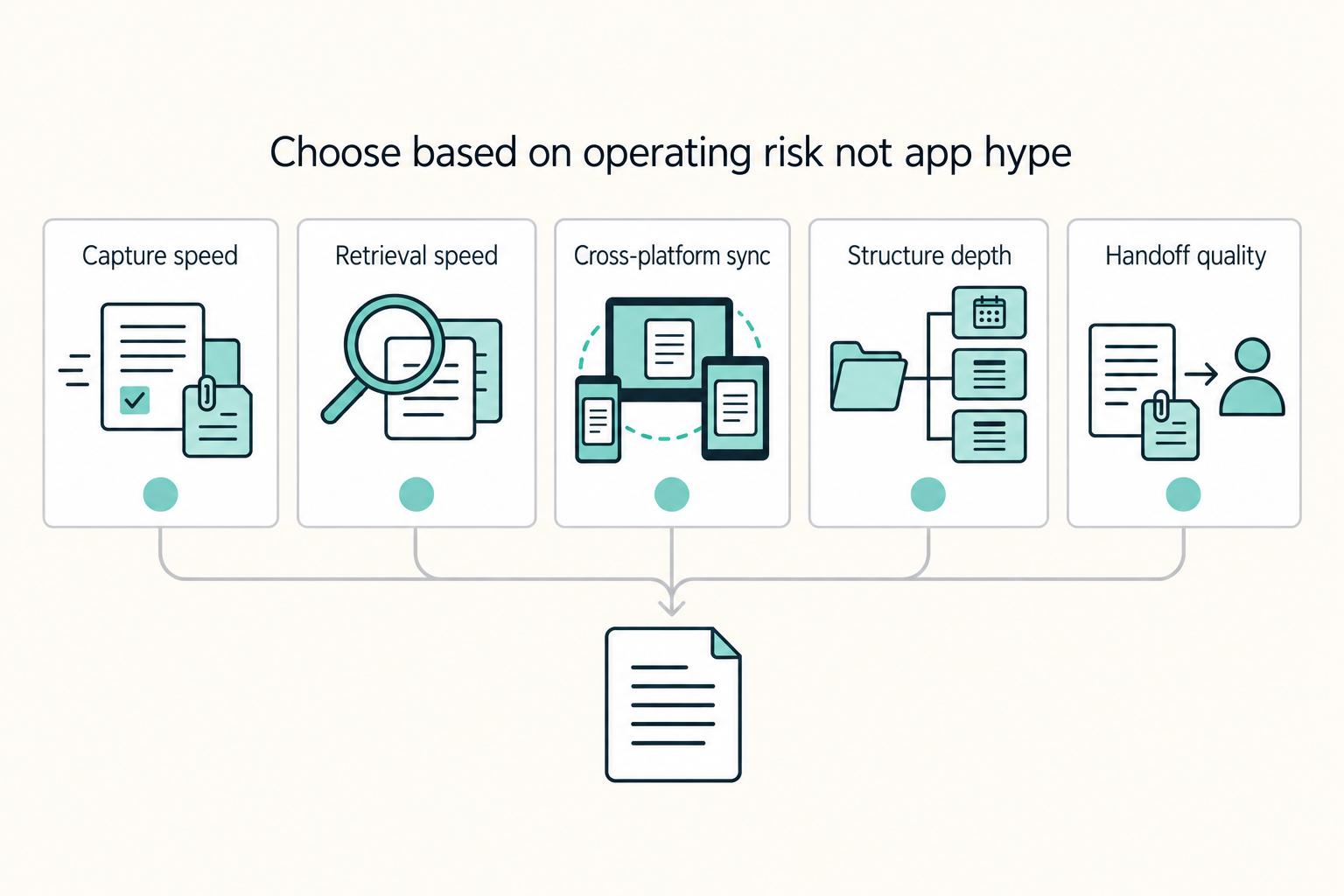
The Best Note-Taking and Knowledge Management Apps for Freelancers
Make this decision in one sitting, then move on. One primary note app, used as the default place for client decisions, follow-ups, and reference notes, does more to cut missed details, messy handoffs, and tool churn than another week of comparing screenshots ever will.

The Freelance Payment Penalty: A Modeled Audit of Platform Fees, FX Spreads, and Payout Delays
The money rarely disappears through a single, easy-to-spot fee. The real loss is stacked. A marketplace takes its commission, a processor adds a charge for international cards, a bank or payment company converts the currency at a spread, a platform holds the funds before release, and a wire sheds a little to intermediaries on the way in. Each layer looks defensible on its own, but the worker feels the combined result as a smaller deposit and a later payday.

How to Respond to a Subpoena for Business Records
Move fast, but do not produce records on instinct. If you need to **respond to a subpoena for business records**, your immediate job is to control deadlines, preserve records, and make any later production defensible.