
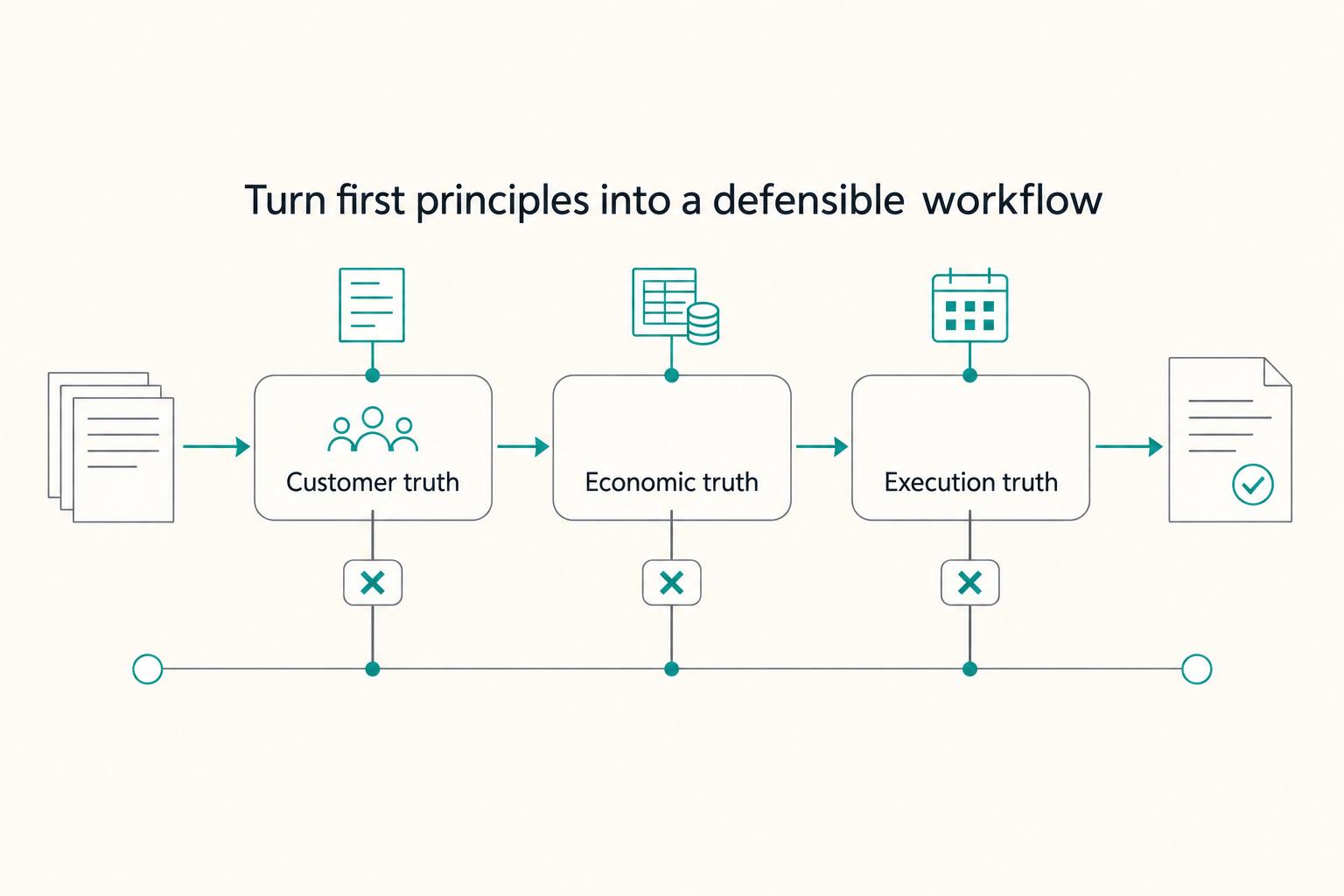
Consultants face a critical risk as their traditional reliance on established frameworks is being commoditized by AI and built on outdated assumptions. The core advice is to adopt a structured, three-stage first principles framework to deconstruct problems, challenge these flawed assumptions, and build new strategies from a foundation of verified truths. This rigorous process allows consultants to create uniquely valuable and defensible recommendations, securing their role as indispensable strategic partners who deliver superior outcomes.
The Consultant's Dilemma: Why Your 'Best Practices' Are Now Your Biggest Risk#
You are a top-tier consultant, a "Business-of-One." Your clients buy your judgment, your credibility, and your confidence. Your reputation is your most valuable asset, and you protect it fiercely. So when you hear the buzz around "first principles thinking"—the mental model famously used by disruptors like Elon Musk to deconstruct entire industries—it feels both tantalizing and terrifying.
On one hand, the promise is immense: to move beyond applying commoditized frameworks and deliver genuine, breakthrough innovation. On the other, in a high-stakes engagement, setting aside the "proven" playbook can feel less like strategic brilliance and more like professional malpractice. The fear is palpable: Will the client see this as a reckless deviation? Will it look like I'm experimenting on their dime?
This is the innovator's dilemma, tailored specifically to you. But what if we've been framing the risk incorrectly? The instinct to cling to established case studies and frameworks that got us here is powerful, but in a world of accelerating change, applying an old map to a new territory isn't just ineffective; it's negligent.
This guide will systematically reframe first principles thinking not as a risky creative exercise, but as the ultimate risk-mitigation framework for established professionals. It’s about leveraging a structured process to build bulletproof recommendations that are more defensible, more logical, and immensely more powerful than any off-the-shelf model. You won’t be presenting a "wild idea"; you will be presenting the inevitable conclusion of a rigorous, evidence-based journey.
If you want a concrete starting point, treat first principles work as a documented operating discipline, not a personality trait. The Stanford Graduate School of Business overview of first-principles thinking is useful for framing the mindset, and you can turn that mindset into a reusable delivery routine with the SOW Generator or by browsing other supporting workflows in Gruv tools.
Why 'Reasoning by Analogy' Is the Riskiest Move You Can Make#
The ground beneath the consulting world has fundamentally shifted. The old playbook of relying on past case studies and established frameworks—what we call reasoning by analogy—is no longer the safe bet. For decades, it was the hallmark of professional diligence. Today, it’s the biggest gamble you can take. Here’s precisely why.
AI Is the Master of Analogy#
The first hard truth is that generative AI can analyze, synthesize, and apply existing frameworks faster and more comprehensively than any human. Your value is no longer in knowing the McKinsey 7S model or Porter's Five Forces by heart; an AI can retrieve and apply those in milliseconds. When your problem-solving process is based on recognizing patterns from the past, you are in a direct, unwinnable race with a machine. The truly valuable, uniquely human work is no longer in pattern-matching; it's in pattern-making. Your competitive advantage lies in the ability to build the model that comes next—a model born from the unique, fundamental truths of your client's situation.
Frameworks Have Become Commoditized Knowledge#
When every competitor and, increasingly, the clients themselves have access to the same strategic frameworks like SWOT or PESTLE analysis, these tools lose their power to create a unique advantage. Applying a generic template to a client’s nuanced problem might feel safe, but it leads to indistinguishable, low-impact recommendations. True value is not found in fitting a client’s problem into a pre-existing box. It is created by building a new box—a bespoke solution derived from the fundamental truths of their specific situation. This shift from applying commoditized knowledge to generating proprietary insights is central to modern consulting.
The Catastrophic Risk of Outdated Assumptions#
Perhaps the most critical danger of reasoning by analogy is that it implicitly accepts that the foundational principles of a past success are still valid today. A strategy that worked wonders for a retail client pre-pandemic might be disastrous in a world of permanently altered consumer behavior. Relying on an old analogy is like building a skyscraper on a foundation you haven't inspected. The entire structure is at risk of collapse. First principles thinking is the ultimate form of due diligence. It forces you to bypass dangerous assumptions and ask, "What do we know for a fact to be true in this specific context?" By starting from a bedrock of verified truths, you protect both your client and your reputation from the immense risk of building a brilliant solution to the wrong problem.
Three Stages That Turn First Principles Into a Defensible Workflow#
Moving from a crumbling premise to a solid one demands a repeatable system. Vague advice like "ask why five times" isn't enough when your reputation is on the line. This proprietary three-stage framework is your system for transforming first principles thinking from an abstract ideal into a practical, defensible workflow.
Stage 1: The Assumption Audit (Deconstruction)#
This is the essential due diligence phase. Your objective is to systematically dismantle a client's problem to unearth the unstated, unverified beliefs propping up their current strategy. Instead of accepting the presenting problem at face value—"How can we improve our marketing?"—you must dig deeper to challenge the very foundation of the question. A first principles approach compels you to ask, "What are the fundamental, verifiable truths about our customer's journey, and what are we merely assuming to be true?"
Your goal is to create a clear, visual separation between fact and fiction, like a balance sheet for strategic beliefs.
A helpful checkpoint here is to separate a real analogy from a weak one. The Indiana University critical-thinking chapter on analyzing analogies is a strong reminder that a familiar comparison still has to survive evidence, scope, and relevance tests.
- List the assumptions the client keeps repeating as if they were facts.
- List the evidence you already have versus the evidence you still need to collect.
- List the one assumption that would collapse the recommendation if it turns out to be false.
| Evidence question | What to verify | Why it matters before you recommend anything |
|---|---|---|
| Customer truth | What customers actually do, not what the team assumes they prefer | This stops you from building a strategy around a myth. |
| Economic truth | What the margin, conversion, or retention math actually shows | This keeps enthusiasm from outrunning commercial reality. |
| Execution truth | What the team can deliver within the current operating constraint | This keeps the recommendation tied to real capacity. |
| Flawed Assumption (Reasoning by Analogy) | Bedrock Truth (First Principles Inquiry) |
|---|---|
| "We need a bigger marketing budget to grow." | "Our customer lifetime value is $1,200, but our average acquisition cost on Platform Y is $1,550." |
| "Our top competitor is successful because they launched feature Z." | "Our most loyal customers cite our responsive customer service, not feature parity, as their primary reason for staying." |
| "To increase sales, we must lower our prices." | "Our data shows that purchase decisions in our category are 80% driven by social proof and only 20% by price." |
This deconstruction reframes the entire engagement from finding a solution to first finding the truth.
Stage 2: The Bedrock Build (Reconstruction)#
Once you have audited the assumptions and are left with a handful of verified, fundamental truths, the creative chaos of brainstorming ends. A process of logical deduction begins. This stage is about reasoning up from the bedrock you just uncovered. If a bedrock truth is that your highest-value customers come from organic search and have a 90% retention rate, the logical conclusion isn't to pour more money into costly, low-retention social media ads. The logical build is to construct a strategy that doubles down on creating valuable content for that specific channel. This method ensures every component of your recommendation is directly traceable to a verified fact, making your logic unassailable.
- Start with the fact that changes the economics the most.
- Build only the next recommendation that can be defended from that fact.
| Bedrock truth | Implication for the recommendation | What you should not do next |
|---|---|---|
| The profitable segment behaves differently from the biggest segment | Design the offer around the profitable segment first | Do not copy a broad-market playbook just because it feels familiar. |
| The true bottleneck sits in delivery, not demand generation | Shift effort toward capacity, handoff, or operations | Do not default to another top-of-funnel campaign. |
| The team cannot yet prove the upside | Run a bounded pilot with explicit validation criteria | Do not sell certainty you have not earned. |
Stage 3: The Pressure Test (Validation)#
This final stage is where you proactively mitigate your career risk and build unshakeable client trust. A recommendation derived from first principles can seem radical if presented in isolation. Its power comes from showcasing the rigorous process that produced it. You don't just present the final plan; you walk the client through the entire journey. You start by holding up the flawed assumptions everyone, including them, once held. You then reveal the bedrock truths you discovered and validated together. By the time you introduce your new solution, it doesn't feel like a wild, risky idea. It feels like the only possible conclusion—the most logically sound, rigorously tested path forward.
This validation step benefits from systems thinking. The NASA Systems Engineering Handbook is a useful reminder that strong decisions make assumptions, interfaces, and validation criteria explicit before execution begins. Use that same discipline in your recommendation pack, then keep the project record tight with the SOW Generator and a clear escalation path through contact Gruv when client complexity spills into operations.
- State the assumption that changed the recommendation.
- State the evidence that now supports the new path.
- State the condition that would force you to revisit the recommendation again.
How to Deploy This Framework in a High-Stakes Client Meeting#
This framework is powerful in theory, but its true value is in its application. Here’s how to deploy it to position yourself as a strategic partner, not just a hired gun.
- Frame the Session as a "Strategic Stress Test." Avoid academic labels. Position the workshop as a "strategic stress test" or an "assumption audit." This framing speaks directly to the client's anxieties about risk. It reframes the exercise from a critique of their past decisions into a prudent, forward-looking act of due diligence. You’re not there to tell them they were wrong; you are there to partner with them to ensure the foundation for their next strategy is sound.
- Use "Killer Questions" to Guide Deconstruction. Your most valuable tool is the ability to ask questions that challenge long-held beliefs without causing confrontation. As author Richie Norton says, "My job is to help my clients ask better questions... ask a better question, get a better answer." Start with the client's stated goal and work backward with relentless, respectful curiosity.
- If the goal is "Increase market share by 10%," your killer questions are:
- "What must we collectively believe is true about our customers to achieve this?"
- "What is the actual, verifiable evidence for that belief?"
- "What if the opposite were true? What would that imply?"
- "What core assumption, if proven wrong, would cause this entire strategy to fail?"
- Visually Map Assumptions vs. Truths. Use a whiteboard or a shared digital space to create two columns: "What We Assume to Be True" and "What We Know to Be True (with evidence)." As you facilitate the discussion, populate the columns. The visual gap that emerges is often startling for the client team. It creates a powerful, shared moment of clarity, revealing precisely where the strategic risk—and your greatest opportunity to add value—lies.
- Assign "Truth-Seeking" Homework. A successful session ends with action. Identify the most critical, unverified assumptions from your visual map and assign team members the task of finding the "truth" before your next meeting. This isn't about offloading your work; it's about fostering ownership. When they bring their findings back, the bedrock truths belong to them, not just you. As the legendary Peter Drucker warned, "Erroneous assumptions can be disastrous." By empowering the client to help validate them, you build a strategy that is not only more robust but also deeply owned by the people who must execute it.
Applying the Framework to Your Own Pricing, Positioning, and Operations#
Once you master this approach for clients, the most powerful next step is to apply the same rigorous lens to the business that matters most: your own. Your pricing, positioning, and operations are likely built on deeply ingrained industry analogies. Deconstructing them is the key to unlocking exponential growth, especially when you revisit value-based pricing for strategic consultants through a first-principles lens.
- Audit the service line that creates the most revenue volatility.
- Audit the workflow that consumes time without improving the client result.
This is also where a business-of-one can turn strategy into operating leverage. Use your own workflow as the first test case, measure where decisions stall, and turn the result into a repeatable offer. If you need a structured next step, start in Gruv tools or talk to Gruv before you expand the system to a client engagement.
- Deconstructing Your Pricing: The standard analogy is, "I sell my time for money." A first principles approach demolishes this and asks a more fundamental question: "What is the fundamental, quantifiable value a client receives from the outcome of my work?" This shifts your thinking from selling a commodity (hours) to pricing based on tangible results. It’s the difference between charging for 40 hours of work and charging for the $400,000 in new revenue your work directly enables. As author Jonathan Stark argues, hourly billing "punishes expertise... The better you are, the worse you get paid." Deconstructing the "time for money" assumption allows you to build a value-based model that decouples your income from the hours you work.
- Deconstructing Your Positioning: The common analogy is, "I am a [Job Title] for [Industry]." This sounds specific, but it positions you in a crowded market. First principles thinking forces you to ask: "What is a specific, high-value, and painful problem that I am uniquely equipped to solve?" You're no longer a generic title but a specialist who solves a particular business pain. This makes you the only logical choice for an ideal client experiencing that exact problem, effectively removing your competition.
- Deconstructing Your Operations: The prevailing analogy is, "I need this suite of popular software to run a professional business." This often leads to a significant "admin tax" that consumes your time. A first principles question cuts through the noise: "What is the absolute minimum number of tasks and tools required to deliver my core value and maintain compliance?" This forces a ruthless audit of your tech stack and workflows. Eliminating this operational friction maximizes the time you can spend on the high-value, strategic work that drives both client results and your own revenue.
From Anxious Innovator to Confident Strategist#
Embracing first principles thinking isn't about taking wild leaps of faith; it's about building a more solid foundation to stand on. For too long, consultants have been caught between the pressure to deliver groundbreaking results and the career risk of deviating from established norms. This structured framework transforms that source of professional anxiety into your greatest strategic asset.
By methodically breaking down a problem to its fundamental truths, you are not inventing a risky new idea; you are revealing the most logical path forward. This shift moves you from being a purveyor of commoditized "best practices" to becoming a trusted partner who builds resilient, defensible, and uniquely valuable solutions.
Your core competency is no longer reasoning by analogy—a skill now being automated by AI—but the ability to question the foundational assumptions that everyone else takes for granted. This fosters a deeper kind of confidence, one rooted not in bravado but in the rigor of your work. When a client challenges your recommendation, you can calmly walk them through the flawed assumptions you dismantled together and the bedrock truths upon which your new strategy is built. Your recommendation is no longer just an opinion; it is the inevitable conclusion of a transparent and logical process.
This is how you future-proof your "Business-of-One." In a market flooded with generic frameworks and AI-generated insights, your ability to perform this deep, foundational analysis becomes your moat. You stop selling your time and start delivering outcomes, securing your position as an indispensable strategic partner who doesn't just solve problems, but redefines them.
Use the same standard on your own practice: document the assumption, name the evidence, and keep the operating record current. When the next client issue appears, you want a method you can defend, not just a clever answer. If you want more implementation support, start with Gruv tools or keep the next conversation practical through contact Gruv.
Frequently Asked Questions
What is a simple framework for first principles thinking?
It's a three-stage process for building a bulletproof argument. 1. The Assumption Audit: Deconstruct a problem to identify every underlying belief. 2. The Bedrock Build: Discard unproven assumptions and reason up from the verifiable truths that remain. 3. The Pressure Test: Validate your new solution by showing how it’s the most logical conclusion from a rigorous, transparent process.
What are the biggest risks of using first principles in consulting?
The risk isn’t in the thinking, but in the communication. If you present your conclusion as a sudden 'big idea' without revealing your process, clients may see it as unfounded and reckless. The key is to make the client a partner in the Assumption Audit. This reframes the exercise as a collaborative due diligence process, which builds immense trust.
How can I introduce first principles thinking to a skeptical client?
Lose the jargon. Never announce you're using 'first principles thinking.' Instead, frame the session as a 'strategic stress test' or an 'assumption audit.' You can say, 'Our current strategy is built on a set of foundational assumptions. Before we invest further, let's work together to rigorously test whether those assumptions are still true.' This approach feels diligent, not disruptive.
Can you give a specific example of first principles for a consultant's pricing strategy?
Reasoning by analogy is looking at competitors and saying, 'They charge $200/hour, so I will too.' A first principles approach starts with a verifiable truth, such as: 'This specific workflow improvement will reduce customer churn by 2%, saving the company $500,000 next year.' Reasoning up from that bedrock truth, you can confidently price your engagement at $50,000—a clear and defensible investment that provides a 10x return.
Is first principles thinking just the 'Five Whys'?
No, though the 'Five Whys' is a useful tactic within the deconstruction stage to find a root cause. First principles thinking is the entire overarching strategy. It doesn't just ask 'why' about a single problem; it identifies all assumptions in a system, reasons up from the verified truths, and builds an entirely new model from that foundation. One is a tool for diagnosis; the other is a framework for innovation.
How does AI change the value of first principles thinking for consultants?
AI makes this skill more critical than ever. Generative AI is the ultimate master of reasoning by analogy. As this capability becomes a commodity, your competitive advantage is no longer in knowing the answer based on past data, but in having the skill to question the fundamental assumptions the AI's data is built on. AI cannot effectively question its own premises. You can. That ability is the most valuable and future-proof skill you can possess.
Researched and edited by the Gruv editorial team. Gruv builds cross-border billing, payouts, and finance-operations software for global businesses.
Sources
Includes 1 external source outside the trusted-domain allowlist.
Educational content only. Not legal, tax, or financial advice.
Related Posts

GDPR Compliance Checklist for Freelancers Working With EU Clients
Start by separating the decisions you are actually making. For a workable **GDPR setup**, run three distinct tracks and record each one in writing before the first invoice goes out: VAT treatment, GDPR scope and role, and daily privacy operations.

Digital Nomad Health Insurance Comparison for Long-Stay Moves
Use focused time now to avoid expensive mistakes later. Start with a practical `digital nomad health insurance comparison`, then map your route in [Gruv's visa planner](/tools/visa-for-digital-nomads) so we anchor policy checks to your real plan before pricing pages pull you off course.

Value-Based Pricing for Strategic Consultants Under Real Payment Risk
Undercharging usually starts before the invoice: when you send one attractive number without clear pricing logic, ownership, or controls for scope or rate changes. In value-based consulting, your price and payment structure are one decision, so you need to build them that way.