
Quick Answer
Agree deliverables, acceptance tests, review deadlines, release rules, fees, and dispute steps before kickoff. Verify provider-held funds for the work you will start, submit through the required channel, fund scope changes before extra work, and reconcile gross release, deductions, payout, and bank receipt.
When funded milestones help protect a large project#
If you invoice after delivery, you hand over the work before payment is under your control. On a large freelance project, that is a payment-control gap first and a collections problem second.
Diagnose the leverage mismatch#
The core issue is not invoicing itself. It is the sequence. You deliver the work, send the invoice, and then wait while payment moves into the client's internal process.
Longer terms widen that gap. Under Net 45, the buyer has 45 calendar days from the invoice date to pay, so a July 1 invoice is due August 15. Net 30 shortens the wait. Net 60 extends it. In practice, longer terms give the client more flexibility while putting more strain on your cash reserves.
One detail matters more than many teams realize: when the payment clock starts. If your contract and invoice do not clearly state whether timing starts on invoice date, delivery, completion, or approval, disputes can follow. Payment can slip by days or weeks.
That ambiguity creates operational drag. One side may believe payment starts after approval while the other assumes it starts when the invoice is sent. If those checkpoints are not aligned in writing, delays can follow even after work is delivered.
This is why the risk should be framed as leverage, not just lateness. Once the client has the usable deliverable, your main tool is follow-up. If approval ownership and invoice timing were not settled before kickoff, you are trying to solve process questions after value has already changed hands.
Map the failure sequence before it happens#
Payment delays often follow a very ordinary sequence. It can look like this:
- You deliver the agreed work.
- The client now has the usable output.
- You issue the invoice and payment timing begins.
- Delays or approval bottlenecks become your follow-up burden.
- Unclear ownership of approval slows resolution.
This is the practical risk. Once the work is in the client's hands, vague payment timing language can turn into a cash-flow problem.
The weak point is usually not the invoice itself. It is the handoff between delivery, approval, and payment steps. If the contract is silent on who approves and when the payment clock starts, delays become a clarification exercise.
Map that sequence before the project starts. Ask yourself where the deal could stall: review, invoice processing, milestone acceptance, or a late scope disagreement. You are not assuming trouble. You are removing predictable ambiguity while you still have negotiating leverage.
Treat scope creep as a payment-structure issue#
Scope creep is not just a scoping problem. It is also a payment-structure problem.
When most of the money sits at the end, extra requests can get folded into "final delivery" while your unpaid balance stays open. Late in the project, that can weaken your options. You either absorb more work to keep momentum or pause and renegotiate while you are still waiting to be paid.
A tighter structure can force change requests into a payment decision earlier. That can improve revision discipline and protect margin. For a deeper margin view, see The Silent Profit Killer: How to Stop Margin Erosion in Your Freelance Business.
The sequence matters here. If a client asks for "one more round" after a milestone is effectively done, you want the structure to make that request visible as a decision point. Is it already covered by the milestone language? Is it a revision inside the agreed round? Or is it a new request that needs a new funded step? If those answers are not tied to payment, extra work can slide into the project by default.
That is why late-stage flexibility can become margin pressure. You are no longer negotiating from an open proposal stage. You are negotiating after time has been spent, delivery has happened, and final payment is still unresolved. A stronger structure does not eliminate scope discussions, but it keeps them attached to a documented decision and a payment checkpoint.
Compare decision paths, not just payment terms#
Payment terms alone do not tell you enough. Look at how each structure handles forecasting, disputes, leverage at acceptance, change requests, and admin time.
| Decision criterion | Plain-language definition | Invoice after delivery | Escrow-based structure |
|---|---|---|---|
| Cash-flow predictability | How clearly you can forecast when cash arrives | Often lower on longer terms (Net 30/45/60), because payment happens after delivery | Can be higher when payment handling is defined as part of the deal structure |
| Dispute path | What happens when timing/scope/acceptance is contested | Can become ad hoc, especially if start-point language is unclear | Can be clearer when payment rules are set before work starts |
| Leverage at acceptance | Who has practical control at final handoff | Client holds delivered work while payment is still pending | Can be more balanced when payment checkpoints are pre-agreed |
| Change-request control | How easily "one more round" is separated from core scope | Harder when most money is due at the end | Easier when change decisions are tied to pre-agreed payment checkpoints |
| Admin overhead | Time spent setting up vs. chasing payment later | Lower at setup, but follow-up can grow if delays start | Higher at setup, with less reliance on end-stage chasing |
Read the table as a workflow comparison, not just a finance comparison. One model concentrates admin at the end, when leverage is weakest. The other shifts more admin to the front, when terms can still be clarified without disrupting delivery. That tradeoff can be worth making on larger or longer projects because front-loaded structure is often easier to manage than end-stage collections.
Switch when risk signals show up#
Do not wait for a bad payment experience to tighten the structure. Move away from pure invoice-after-delivery when these signals show up:
| Signal | Detail |
|---|---|
| Large fee | The fee is large enough that waiting through Net 30/45/60 would strain cash flow. |
| Long timeline | The timeline runs weeks or months, not a short task window. |
| Multiple reviews or changes | The project has multiple review rounds or likely change requests. |
| New or unclear client | The client is new or unclear about invoice approval timing. |
| Undefined start point | Your contract or invoice does not explicitly define the payment-term start point. |
Use these signals to decide whether deposits, shorter phases, or escrow fit the deal. Choose a protection level that covers the amount and delay you can absorb; two signals are an internal screening prompt, not a universal requirement.
Do not overcomplicate the decision. You are looking for concentration of risk, not a perfect score. A new client with clear finance ownership may still be workable on normal invoicing for a small task. A repeat client on a long, revision-heavy project can still justify milestone protection because approval drag and scope expansion can still happen. The right trigger is not trust alone. It is whether delay or disagreement would put you in a weak position after delivery.
Related: How to Conduct a 'Pre-Mortem' to De-Risk a Large Freelance Project.
Step 1: Define funding, review, and release before work starts#
Confirm the actual provider workflow before signing. Funding, submission, acceptance, release, withdrawal availability, and bank receipt are distinct events. A client’s transfer screenshot is not proof that the provider has verified funds for your milestone.
On Upwork fixed-price work, check the active milestone’s Funded status before starting and use the required submission flow. Protection depends on funded scope and correct submission, and does not guarantee payment in every dispute.
Escrow.com milestone transactions require full transaction funding at the start and release funds as milestones are completed. This differs from funding one active Upwork milestone at a time. Write the amount, funding model, inspection start, acceptance/rejection action, fee allocation, and payout method into your setup checklist; do not copy one provider’s rules into another.
Example: a 12,000 project with a funded change#
Assume three phases: 3,000 for three homepage concepts plus one consolidated revision round, 6,000 for the approved staging build, and 3,000 for source files and handoff notes. Name the reviewer, submission channel, measurable acceptance tests, review window, and release rule for each. These are sample commercial amounts, not provider fees or recommended universal proportions.
For an Upwork-style sequential plan, verify the active 3,000 phase is funded before design starts; the remaining 9,000 proposal is not proof of funds for later work. For an Escrow.com milestone transaction, its full-funding model means verifying the 12,000 transaction funding first. The same deliverables require different funding checks.
If an extra integration adds 2,000, record the added tests, dates, price, reviewer and funding arrangement in a change order. Total agreed work becomes 14,000. On a one-active-milestone workflow, schedule the additional funded phase without starting it early; on a fully funded transaction, use the provider-supported amendment or new transaction and verify the additional coverage. Do not silently consume money assigned to a different phase.
Assume a 3,000 gross release, a hypothetical seller fee of 90 and payout charge of 10, no tax or FX, and no other deductions. Net proceeds are 2,900: 3,000 = 90 + 10 + 2,900. If bank cash has not arrived, record the 2,900 transfer as pending under your accounting policy rather than received. The illustrative fee amounts are not a quote; use actual statements. Remaining funded phases, refunds, and disputes stay in their own records.
Step 2: Explain the payment process before contract handoff#
If you use escrow, decide when you introduce it and keep that timing consistent. Clients should hear the same payment process on the call, in the proposal, and at handoff. Treat this as a practical workflow, not a benchmark claim or a guarantee that escrow will predict client behavior.
1. Set and repeat the payment path#
Set the payment path and repeat it in the same order every time:
- Discovery call: confirm budget range, approval owner, and whether procurement or finance must review payment setup.
- Proposal: restate the payment path in writing.
- Contract handoff: confirm the same payment path and named owners before kickoff.
Before you send the proposal, your minimum clarity is simple: who approves budget, who handles contract steps, and who can block setup.
Use this sequence as a workflow aid, not as proof that one escrow timing performs better than another. If the person on the call cannot name who approves budget or who owns payment setup, treat that as an unresolved dependency to close before kickoff.
Keep the wording stable across steps. If you say one thing on the call, soften it in the proposal, and change it again in the handoff email, the process becomes harder to follow.
2. Define your SOP so decisions are not arbitrary#
You need one written default communication workflow, not case-by-case improvisation. In practice, your policy should state:
- how you explain escrow to clients,
- who can approve exceptions to the initial payment path,
- what must be documented when terms change.
Keep the wording aligned across the call recap, proposal, handoff email, and kickoff checklist so the client gets one answer at every step.
This matters internally as much as externally. A written SOP gives you a reference point: not "what feels reasonable today," but "what your process requires before you start." That reduces drift between sales conversations and project delivery.
Exceptions should also leave a record. If the payment path changes, write down why, who approved the change, and what alternative protection is in place.
3. Use readiness signals as internal status checks#
Treat these as operating labels, not validated predictors:
Proceed: approver is named, payment questions are answered directly, and the method is confirmed in writing.Pause: budget seems available, but approval ownership is unclear or payment setup is deferred.Decline: terms are not documented, the agreed payment method is repeatedly reopened, or basic finance steps are rejected.
Read these signals in context. A Pause is not a soft Proceed; it means the project is not operationally ready yet. A Decline is an internal risk call, not a claim about client intent.
4. Use neutral talk tracks for common objections#
When clients push back, stay factual and process-focused:
- Complexity: "I'll send a short setup checklist with owners and steps so your team can review quickly."
- Trust: "This is a process-alignment step so payment terms are agreed before delivery starts."
- Timing: "Let's confirm this before kickoff so dates and approvals stay aligned."
- Fees: "Let's review the fee impact now and confirm acceptance in writing before work begins."
| Point in process | Escrow introduced early | Escrow introduced later |
|---|---|---|
| Discussion context | Payment method is discussed while scope is still being finalized | Payment method is raised during contract review or after verbal alignment |
| Ownership visibility | Approval owners can be requested during onboarding | Approval ownership may be confirmed closer to kickoff |
| Documentation timing | Payment steps can be documented before work starts | Documentation may be completed later in the cycle |
Use a simple decision rule: proceed when ownership and payment steps are clear in writing, pause when ownership is unclear, and decline when terms cannot be stabilized. For implementation detail, keep one reference attached to proposals, such as A Guide to Using an Escrow Service for High-Value Projects.
The value of these talk tracks is not persuasion for its own sake. They keep the conversation anchored to workflow. You are not trying to win a debate about whether the client is trustworthy. You are clarifying how a large project will move from kickoff to payment with less ambiguity, and whether the remaining blocker is mechanics or internal alignment.
Step 3: Align scope, acceptance, and dispute evidence#
Escrow only helps if the documents line up. For freelance project work, your MSA and escrow instructions should match line by line on scope, acceptance, change control, and release conditions. In many projects, the MSA sets commercial terms while the escrow holder follows transaction instructions, so mismatches can create avoidable dispute risk.
Align the MSA and escrow instructions before kickoff#
Do a side-by-side check of each milestone before work starts. Use this minimum alignment checklist for every milestone:
| Alignment point | What should match |
|---|---|
| Deliverable scope | Same deliverable scope in both documents |
| Acceptance criteria | Same acceptance criteria in both documents |
| Reviewer or approver | Same reviewer or approver named |
| Release trigger and timing | Same release trigger and timing |
| Change-control path | Same change-control path for scope changes |
If one document says "homepage concepts plus one revision" and the other says "design phase," rewrite before kickoff.
Keep governing law, dispute resolution, and provider procedures explicit. If the MSA and provider terms conflict, resolve their precedence before signing rather than assuming your private contract overrides the provider’s release workflow.
A quick practical test helps here: could a person who has never seen the project compare the two documents and reach the same understanding of what unlocks release? If not, your language is still doing too much by implication. The goal is not elegant drafting. It is consistency across the documents that actually control delivery and release.
Draft milestones so a third party can verify acceptance#
Write each milestone so acceptance can be tested, not argued. If a neutral third party cannot tell whether the milestone was met, the language is too vague. Use this enforceability checklist for every milestone:
- Deliverable definition
Specify output, format, quantity, and version.
- Objective acceptance test
State what must be true for acceptance.
- Evidence format
Define proof of delivery, such as platform submission, dated link, exported file, repo reference, or signed review note.
- Reviewer/approver
Name one acceptance owner.
- Release trigger
State the supported release trigger and review window. Written acceptance and an automatic release after inaction are different triggers; name which the provider applies and how the client must request changes or dispute within the deadline.
| Vague milestone | Verifiable milestone |
|---|---|
| "Initial design phase" | "Milestone 1: three homepage concepts in Figma for the approved brief, plus one consolidated revision round. Reviewer: named marketing lead. Evidence: Figma link + PDF export submitted through the agreed channel. Release: written acceptance that all listed items were delivered." |
| "Development complete" | "Milestone 2: approved landing page build matching signed design files, deployed to staging and shared by URL. Evidence: staging link + repository commit reference. Release: reviewer confirms page loads and matches approved design scope." |
| "Final handoff" | "Milestone 3: final source files, asset package, and handoff notes in the agreed folder. Evidence: dated folder link + handoff document. Release: all listed files are present." |
On Upwork’s current fixed-price payment workflow, formal submission starts the 14-day client review. Inaction can trigger automatic release; requested changes reset review when work is resubmitted. Approved or automatically released funds then enter a five-day security hold before becoming available to withdraw. Withdrawal and bank arrival take their own time.
The operational mistake to avoid is relying on informal approval language outside the agreed workflow. A positive message in chat may be helpful context, but your strongest position comes from acceptance being tied to the exact evidence and trigger already named in the milestone. When you submit work, package it in the same way the milestone expects so there is no gap between what the document says and what your delivery record shows.
Use change control before doing extra work#
This is where many projects slip. Treat scope creep as a classification process, not an informal discussion:
- Classify the request against the written deliverable, acceptance tests, and included revision rounds.
- Record changed scope, price, dates, approval owner, and evidence channel in a written change order.
- Use the provider’s supported amended or additional milestone workflow; confirm the changed work is covered by verified funds before starting.
- On Upwork, only one milestone can be funded at a time; sequence a new phase after the current release rather than assuming a proposed future milestone is funded.
That sequence keeps the audit trail clean: client request, scope decision, written change order, and funding proof.
It also keeps project communication calmer. Instead of debating whether a request is "small," you compare it to the existing milestone. If it fits, proceed. If it changes the agreed output, revision count, or timeline, document the change and tie it to funding. That makes the decision easier to explain and easier to defend later.
Choose a provider model using enforceability criteria#
Choose the provider model based on governing terms, dispute path, and workflow constraints. Two guardrails matter here:
- Do not assume your MSA automatically controls a platform dispute unless platform terms explicitly incorporate it.
- Check current provider policies before final recommendations. Terms and procedures can change.
| Decision point | Platform-integrated escrow | Standalone escrow service |
|---|---|---|
| Governing terms | Platform terms often govern platform workflows and disputes | Provider agreement controls; may differ by location |
| Dispute model | Often internal platform dispute process | May include negotiation period and optional third-party arbitration |
| Workflow constraints | Tied to platform milestone and submission rules | Driven by provider instructions and terms |
| Funding model | Upwork permits one funded active milestone at a time | Escrow.com requires full milestone-transaction funding at the start; check the selected provider’s model. |
| Identity and authorization | Confirm the actual account, legal terms and relevant provider entity | Verify the exact escrow entity, jurisdiction, authorization and official website rather than trusting an emailed link. |
When comparing models, do not stop at fees or convenience. Ask which system gives you the cleaner enforcement path for the type of project you are running. If the work needs strict submission flow and the client is already inside a marketplace, platform rules may be the main operating constraint. If the project needs different release instructions, standalone terms may fit better, depending on the provider's current rules. The right choice is the one that makes scope, acceptance, and release easiest to prove within that provider's actual workflow.
You might also find this useful: How to De-Risk a Fixed-Price Project with a Phased Payment Schedule.
Before you lock the next milestone, turn acceptance criteria into clear deliverables with the SOW Generator so disputes are easier to resolve.
Invoice and reconcile each escrow event#
In an ordinary escrow arrangement, your client remains the buyer and the escrow holder is the payment intermediary. Link the invoice to the client, contract, and milestone. If the arrangement includes a separate reseller or Merchant of Record, check the contractual buyer and invoice chain instead of applying this rule automatically.
Client funding is evidence that money is held for agreed conditions, not that it is freely available to you or has reached your bank. Keep funded amount, acceptance, released amount, deductions, available balance, payout instruction, and bank receipt as separate statuses.
For U.S. tax timing, cash-method income can arise on actual or constructive receipt, including unrestricted funds available before a bank withdrawal. Substantial restrictions and the intermediary’s role affect the analysis; escrow funding and bank arrival are not universal recognition dates. Accrual timing follows the applicable income-recognition rules. Save the agreement and availability history for your accountant. See IRS Publication 538.
Invoice fields + escrow linkage#
Use an invoice format that ties the contract, milestone, and escrow records together:
| Invoice field | Detail |
|---|---|
| Your legal name and address | Include on the invoice |
| Client company name and address | Include on the invoice |
| Unique invoice number | Include on the invoice |
| Invoice date | Include on the invoice |
| Milestone description | Matches the MSA |
| Amount, currency, and any required tax line | Include on the invoice |
| Contract reference | Example contract reference, such as MSA-2026-01 |
| Escrow reference | Example escrow transaction reference, such as ESC-TXN-78421 |
| Payment note | Reference the funded milestone and payment via escrow; state the actual invoice amount and required issue/due dates without asking the client to pay the same obligation twice. |
This helps prevent a mismatch: the invoice is addressed to the client, but the payment remitter shows up as the escrow entity with no reference linking the two.
You want someone reviewing the file later to be able to trace the transaction without guessing. If the milestone label on the invoice differs from the label in the contract or the escrow record, reconciliation becomes slower and error-prone. The cleaner the naming and reference structure, the easier it is to match commercial documents to payout records.
Records workflow by event#
Record each event on its own terms and keep the supporting documents together:
| Event | Record treatment | Documents to retain |
|---|---|---|
| Invoice issued | You billed the client for a defined milestone | Invoice copy, contract reference, milestone scope excerpt |
| Escrow funded | Client funded the intermediary for that milestone | Funding confirmation, escrow transaction summary, client funding confirmation |
| Milestone accepted | Release condition was met under agreed criteria | Acceptance evidence, delivery proof, review or approval record |
| Funds released | Provider has processed the milestone release; inspect deductions and availability | Release statement, fee details, remaining held balance |
| Payout sent and bank received | Track transfer separately and match actual bank cash | Payout reference, currency, bank credit, fee/FX bridge and accounting note |
After release, match the invoice, milestone, contract and escrow IDs, then bridge gross release to net proceeds through fees, refunds, holds, and currency conversion. A bank deposit can be smaller and later than the invoice; record why instead of forcing equal dates or amounts.
Immediate reconciliation is useful because memory fades quickly on multi-phase projects. If you wait until quarter-end or tax season, small mismatches become harder to explain. A missing milestone label, an altered description, or a payout that lands under the provider name instead of the client name is much easier to resolve while the project thread is still active. It is also easier when the documents are still easy to retrieve.
Tax documentation and reconciliation guardrails#
Keep one evidence pack per milestone: invoice, acceptance proof, escrow statement, bank deposit evidence, and your accounting or tax treatment note. Mismatches often involve names, such as client on the invoice versus escrow sender on the payout, or missing reference IDs.
If you receive Form 1099-K, use it alongside your own records to determine correct income. Do not treat it as standalone truth. 1099-K amounts can be gross and may include items that are not automatically taxable. If payer or name details are wrong, contact the issuer immediately and keep all correction correspondence.
Set retention to cover the applicable tax, contract, dispute, and local legal requirements. The IRS retention guidance includes three years in ordinary cases and longer periods for specified circumstances, including certain omissions and missing returns. Do not delete an active dispute file merely because a usual tax period ended.
A practical habit helps here: at the end of each milestone, save the full packet together rather than scattering files across email, accounting software, and provider dashboards. The article already gives you the components. The value comes from keeping them as one pack so you can answer the basic questions fast: who was billed, what was accepted, when release happened, and how the payout ties back to the invoice.
Nexus and jurisdiction scope#
Escrow use alone does not determine where tax obligations apply. Nexus and indirect-tax rules vary by jurisdiction, and physical presence is not the only trigger. Threshold frameworks differ across states and measurement windows, so use local rules for your filing year and facts.
Consult a qualified tax advisor before relying on any specific threshold, and verify current filing-year rules before using exact numbers. Also get advice when your filing position depends on whether your services are taxable in a client jurisdiction.
The key control here is restraint. Do not let the presence of an escrow intermediary distort the underlying tax question. Your analysis still depends on your facts, your client location, the services involved, and the rules that apply for the filing period. Where the provider sits is not, by itself, a shortcut answer.
For a separate workflow build-out, see The 3-Stage Notion Setup for Freelance Project Management.
Keep the milestone record open through payout reconciliation#
Agree terms, verify funds, deliver through the required channel, record review and release, and reconcile proceeds. Issue invoices according to the applicable agreement and tax rules; release is not a universal instruction to issue a new invoice for work already billed.
Standardize onboarding around agreed terms#
Standardize onboarding around agreed transaction terms and escrow instructions. Keep release conditions explicit enough that a neutral escrow agent can apply them with minimal interpretation. Before kickoff, each milestone should include a clear deliverable, delivery date, payment amount, and funded status.
Standardization matters because repeated clarity is easier to maintain than custom negotiation on every deal. The more your onboarding, proposal, and handoff all describe the same path, the less room there is for payment mechanics to drift after work begins.
Use funded milestones for clear phases#
Use funded milestones by default for clearly defined fixed-price phases, especially when delayed payment would strain your cash flow. If scope is still evolving, do not force a vague fixed-price setup. Narrow the phase until the deliverable is clear, or use hourly terms for evolving work.
Set review timing on purpose. If your provider uses an Inspection Period, define it up front and tie it to acceptance or rejection actions so release timing is clearer.
The practical test is whether someone outside the project could tell when the phase starts, what counts as delivery, who reviews it, and what happens next. If not, the phase is still too loose for clean milestone handling.
Connect delivery, approval, invoicing, and payout#
Connect delivery, approval, invoicing, and payout reconciliation as one chain. Approval is not the same as money received, and provider release timing can include holds. Treat payout confirmation as the financial checkpoint before you close the milestone.
Keep one evidence pack per milestone: signed scope, milestone terms, delivery proof, approval request, invoice, transaction reference, and payout confirmation. Keep these records even if no Form 1099-K arrives, so your income and expense trail stays clear.
This step is easy to skip when the client relationship feels smooth. Do it anyway. A clean chain is valuable precisely because it reduces ambiguity later, whether the issue is accounting, a provider question, or a client disagreement about what was completed and when.
Put the operating checklist in place#
Implement this operating checklist now:
| Workflow step | What to lock in | Owner |
|---|---|---|
| Onboarding | Terms + escrow instructions agreed in writing | You |
| Funding check | Milestone funded before work starts | You |
| Delivery acceptance | Written acceptance or rejection trigger and review window | You + client |
| Invoicing | Invoice tied to the approved milestone release | You |
| Reconciliation | Payout statement matched to invoice and transaction record | You |
Use these gates: verified funding before covered work starts; formal submission and tracked review deadlines before assuming release; actual release and payout records before reconciling; bank evidence before marking cash received. Automatic release after inaction can be valid under provider terms even without a separate approval message.
This does not remove risk. It can make payment more predictable, smooth cash flow, and reduce dispute friction when something needs clarification.
For the broader ops stack, see The Best Project Management Tools for Freelance Developers.
If you also need a Merchant of Record, compare that legal role separately from escrow. Merchant of Record for Freelancers describes Gruv’s offering; confirm the contractual sales, billing, and payout responsibilities for your case rather than assuming it supplies this escrow workflow.
Frequently Asked Questions
What is the best escrow service for high-value freelance projects?
There is no universal best option, so choose based on verifiable fit rather than brand familiarity. Use a short screening checklist: a clear dispute process, supported geographies and currencies you can confirm, a transparent fee breakdown, and payout rails that work for your location. Before you commit, confirm the provider can give you funding confirmations, release records, and transaction statements for your audit trail. Verify the provider’s exact legal entity and official site through the relevant regulator; for California independent escrow, use DFPI’s consumer guidance to find the licensee listing.
If two providers look similar, compare how easily each one lets you document the full chain from funded milestone to released payout. A cleaner record trail can matter more than a small difference in headline cost when you need to reconcile payments or document a dispute.
How can you use escrow to prevent scope creep?
Define each milestone as one deliverable with clear acceptance criteria, then require funding before you start that milestone. If a request falls outside the written milestone, pause and issue a change order tied to a new funded milestone. The operating rule is simple: no funded milestone, no additional work.
The protection comes from timing as much as wording. You are deciding on scope classification before the extra work is done, not afterward. That is what helps keep "just one more thing" from turning into unpaid labor.
Is escrow necessary for repeat clients?
Escrow can still help on a large repeat-client project when delay would strain cash or approvals are complex. It is a commercial choice, not an automatic requirement. If you choose deposits or ordinary invoicing instead, document acceptance, billing triggers, credit exposure, and the amount you can afford to leave unpaid.
Repeat relationships often reduce uncertainty in communication, but they do not remove internal approval steps on the client side. A known contact can still run into internal delays or changing stakeholders, so the process should still protect the project economics.
What are the alternatives to escrow for freelancers?
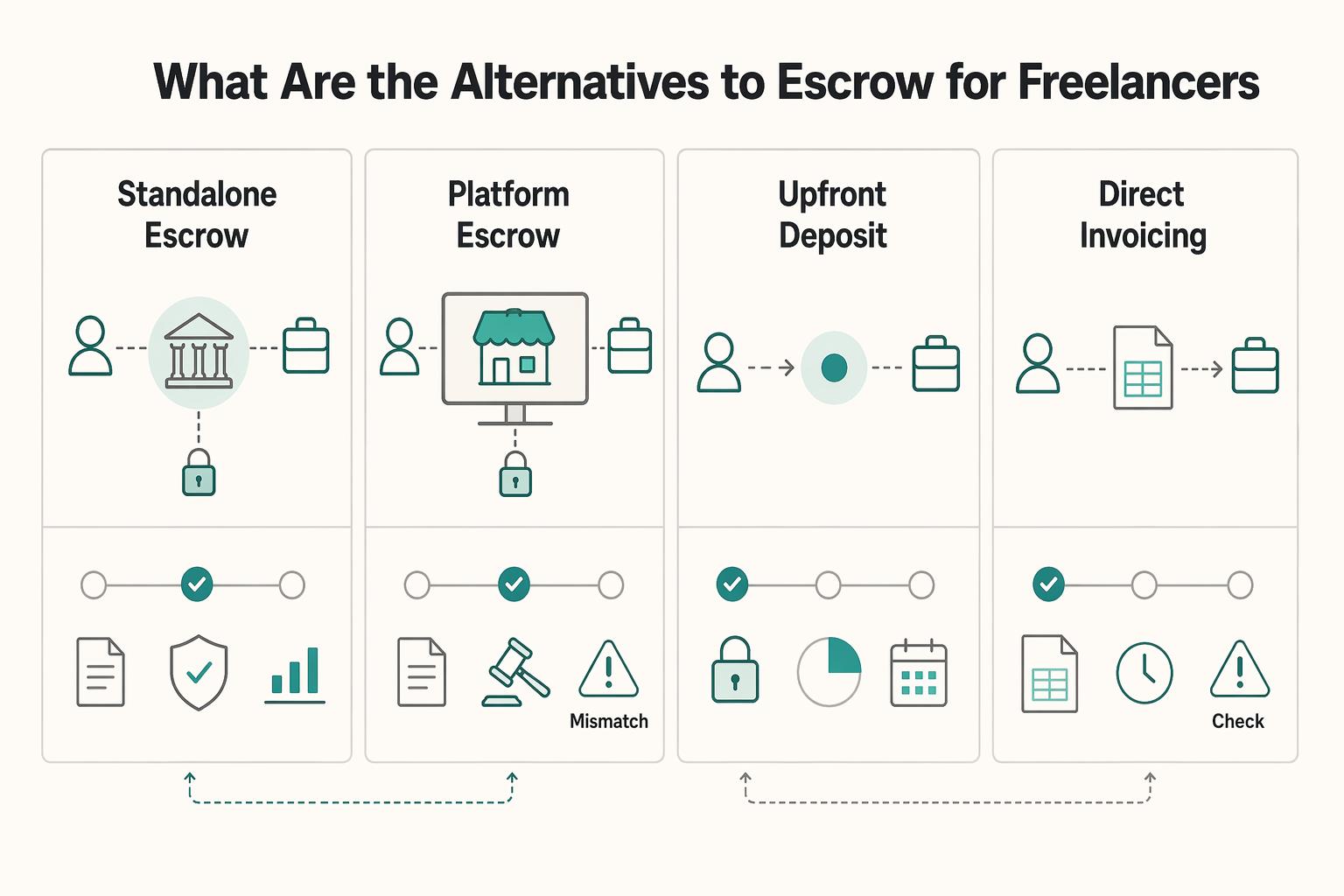
Alternatives include a direct advance deposit followed by milestone invoices, staged invoicing within an agreed credit limit, and hourly billing for evolving scope. Standalone and marketplace escrow are two escrow models to compare with those alternatives.
Treat these as different control models, not just payment styles. The decision should match project size, workflow complexity, and how much risk you can absorb if approval drifts after delivery.
How much do escrow services typically cost for a large project?
Obtain a quote for the actual transaction amount, currency, service type, funding method, and payout method. Escrow.com’s fee calculator separates transaction and disbursement charges; record the quote date and whether the buyer, seller, or both pay. For a marketplace, inspect the fees shown for that contract rather than substituting a standalone escrow rate. Budget any applicable FX and dispute costs separately, and use the actual statement for reconciliation.
A simple way to keep fee review practical is to note which fees affect deal pricing up front and which only matter if something goes wrong, such as a dispute. That keeps your proposal math and your risk review from getting mixed together.
What happens if a client refuses to release funds from escrow?
Keep the disputed amount and milestone narrow, and assemble signed scope, delivery evidence, version history, review actions, invoice and escrow references. Respond through the provider’s formal process before its deadline; continuing to negotiate in chat does not extend that window. On Upwork’s fixed-price dispute workflow, a remaining-deposit refund request requires a response/dispute within seven calendar days. Record the actual notice deadline and submit the complete evidence set.
In many cases, keeping the dispute narrow helps review. Do not broaden the argument to the entire relationship if the contested issue is whether one milestone met one release condition. Keep the record focused and chronological.
Can escrow be used for international clients and different currencies?
Some providers support international projects, but eligibility depends on the parties, service, countries, currencies, account checks, and payout method. Verify these before funding and agree who bears conversion and transfer charges. Do not infer support for a corridor just because a currency appears in marketing material.
That verification should happen before the client funds anything. It is much easier to resolve geography, currency, and payout questions before kickoff than after a milestone is complete and release is waiting on a setup issue.
Researched and edited by the Gruv editorial team. Gruv builds cross-border billing, payouts, and finance-operations software for global businesses.
Sources
Includes 4 external sources outside the trusted-domain allowlist.
- dfpi.ca.gov/regulated-industries/escrow-law/consumer-inf...trusted
- irs.gov/publications/p538trusted
- irs.gov/businesses/what-to-do-with-form-1099-ktrusted
- escrow.com/milestonesexternal
- escrow.com/milestones/how-it-worksexternal
- support.upwork.com/hc/en-us/articles/211063748-How-Fixed-Price-...external
- support.upwork.com/hc/en-us/articles/211063718-How-payments-for...external
Educational content only. Not legal, tax, or financial advice.
Related Posts

Stop Freelance Profit Margin Erosion Before It Hits Cashflow
Revenue can hold steady while the business underneath it gets weaker. What comes in matters, but what you keep after the work is delivered is the clearer signal of health.
A Guide to Using an Escrow Service for High-Value Projects
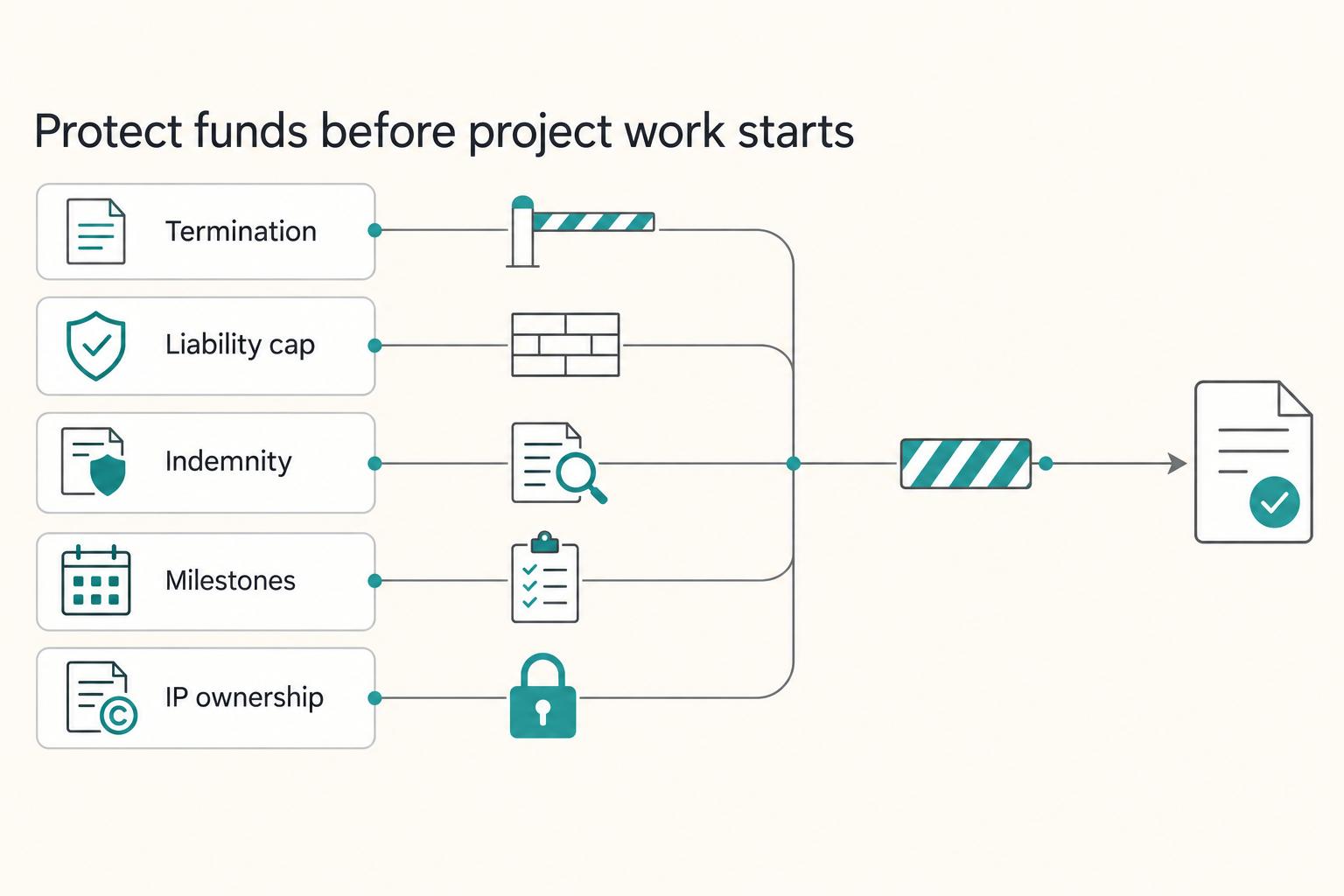
A high-value project exposes you to payment risk well before the final invoice. Escrow can reduce that risk by holding the client’s funds before work starts and releasing them under agreed conditions. It works best when the scope, acceptance rules and dispute process are clear; a funded balance alone cannot prevent every disagreement.

The Freelance Payment Penalty: A Modeled Audit of Platform Fees, FX Spreads, and Payout Delays
The money rarely disappears through a single, easy-to-spot fee. The real loss is stacked. A marketplace takes its commission, a processor adds a charge for international cards, a bank or payment company converts the currency at a spread, a platform holds the funds before release, and a wire sheds a little to intermediaries on the way in. Each layer looks defensible on its own, but the worker feels the combined result as a smaller deposit and a later payday.