
Quick Answer
Use commitment and consistency to retain clients by securing clear written buy-in before kickoff, running a predictable delivery cadence during the project, and closing with a handoff that shows results and the next useful step. This reduces scope creep, late payments, stalled decisions, and post-project drop-off because expectations, approvals, billing, and follow-up stay visible and easy to act on.
For consultants and independent professionals, the feast-or-famine cycle is often a control problem, not just a cash flow problem. The issue is rarely your skill. More often, you never secured enough client commitment at the start, so the engagement rests on loose agreements and good intentions.
That is how you end up with scope creep, late payments, stalled decisions, and client relationships that fade once the work is done.
The fix is not more hustle. It is a tighter sequence before, during, and after delivery. The three phases below show how to turn one-off projects into steadier client relationships by making expectations visible, approvals explicit, and next steps easy to act on.
Phase 1: Settle fit, terms, and start conditions before kickoff#
The work that supports retention starts before kickoff. If you want fewer bad-fit projects, less scope drift, and stronger follow-on work, treat pre-kickoff as a decision sequence, not a sales afterthought. This is where commitment and consistency show up in practice. The client confirms fit, agrees to clear terms, and completes a real start action before you reserve time.
| Step | Main check | Written record |
|---|---|---|
| Step 1: Qualify fit | Real owner, real outcome, workable path to approval | Written recap with objective, success measure, decision-maker, timing, dependencies, and open risks |
| Step 2: Align documents | Proposal, scope, assumptions, timeline, and interaction history in one shared set | Shared folder, client portal, or signed-document stack with the current version |
| Step 3: Set boundaries | In-scope work, out-of-scope items, revision limits, client responsibilities, review windows, and change handling | Statement of Work carries the agreed boundaries |
| Step 4: Start gate | No kickoff until the agreement is signed and the billing path or other agreed start condition is confirmed | Billing contact, legal entity details, purchase order or vendor setup requirement if relevant, and kickoff owner verified |
Step 1: Qualify the fit before you write a full proposal. Your first job is not to impress. It is to confirm that the project has a real owner, a real outcome, and a workable path to approval. Ask direct questions: What problem are we solving first? Who signs off on scope and spend? What has to be true for this to count as a win? What inputs or access will your team need to provide?
If those answers stay vague, slow down. A fast proposal sent into a fuzzy buying process can easily become a stalled opportunity. A useful checkpoint is a written recap sent after the call. Keep it short: objective, success measure, decision-maker, timing, dependencies, and open risks. Ask the client to reply with corrections. That reply is your first written proof of alignment. If they cannot confirm the basics in writing, the project is not ready for kickoff.
Step 2: Align everything in one shared document set. Scattered records create avoidable friction later. Do not let the proposal live in one email thread, scope notes in another, and approvals inside chat messages. You need a single source of truth where the client can see the proposal, scope, assumptions, timeline, and interaction history. The format matters less than the discipline. A shared folder, client portal, or signed-document stack all work if both sides can quickly find the current version.
Use the proposal as a mutual success plan, not a brochure. It should state the business goal, what you will produce, what the client must provide, what will not be included, and how changes will be handled. That is what prevents revision fights and "quick extras" later.
| Scope area | Weak wording | Strong wording you can reuse |
|---|---|---|
| Deliverable | "Brand guide included" | "One brand guidelines PDF, up to 12 pages, covering logo usage, color palette, typography, and tone of voice." |
| Client inputs | "Client provides materials" | "Client provides final logo files, brand questionnaire, and one decision-maker for feedback by the agreed dates." |
| Revisions | "Reasonable revisions" | "Two rounds of consolidated feedback per deliverable. New requests after round two are quoted separately." |
| Timeline | "Project runs about 4 weeks" | "Week 1 discovery, Week 2 draft, Week 3 revisions, Week 4 final delivery, assuming client feedback arrives within two business days." |
| Out of scope | "Extra work billed separately" | "Scope excludes copywriting, website build, translation, and additional formats unless added through a written change request." |
Step 3: Convert agreement into commitment. Your Statement of Work should carry the boundaries that protect the relationship later. That includes in-scope work, out-of-scope items, revision limits, client responsibilities, review windows, and change handling. The goal is not to sound rigid. It is to remove avoidable ambiguity before anyone is under deadline pressure.
One simple rule helps here: if a request falls outside the signed scope, do not argue it live on the call. Refer back to the agreed document and send a written change note with the added work, timing effect, and price impact. That keeps scope discipline professional instead of personal.
Step 4: Activate the start with a commitment and readiness check. A concrete start gate is more than an admin step. It is a commitment signal. Define the start condition in advance and tie scheduling to that condition. No kickoff until the agreement is signed and the billing path or other agreed start condition is confirmed.
This is also where many projects fail quietly. Verify the billing contact, legal entity details, purchase order or vendor setup requirement if relevant, and kickoff owner before the first meeting goes on the calendar. A client can sound fully committed and still be blocked by procurement, missing access, or an internal approver you never met.
Before you start, confirm all of this so Phase 2 becomes execution against a shared record instead of guesswork about what was "understood":
- Proposal outcome, deliverables, and success measure match what the client approved
- Scope boundaries are written plainly, including what is out of scope
- Revision limits, feedback format, and change-request handling are documented
- Billing contact, invoice path, and start-trigger commitment step are confirmed
- Kickoff owner, required access, and first-meeting agenda are ready
If compliance questions come up during onboarding, read GDPR for Freelancers: A Step-by-Step Compliance Checklist for EU Clients.
Phase 2: Make status, billing, and scope changes predictable during delivery#
Trust during delivery comes from predictable signals, not effort the client cannot see. You should make it obvious where work stands, how billing maps to progress, and how new requests move from idea to approval.
| Control point | What is set | Proof or trail |
|---|---|---|
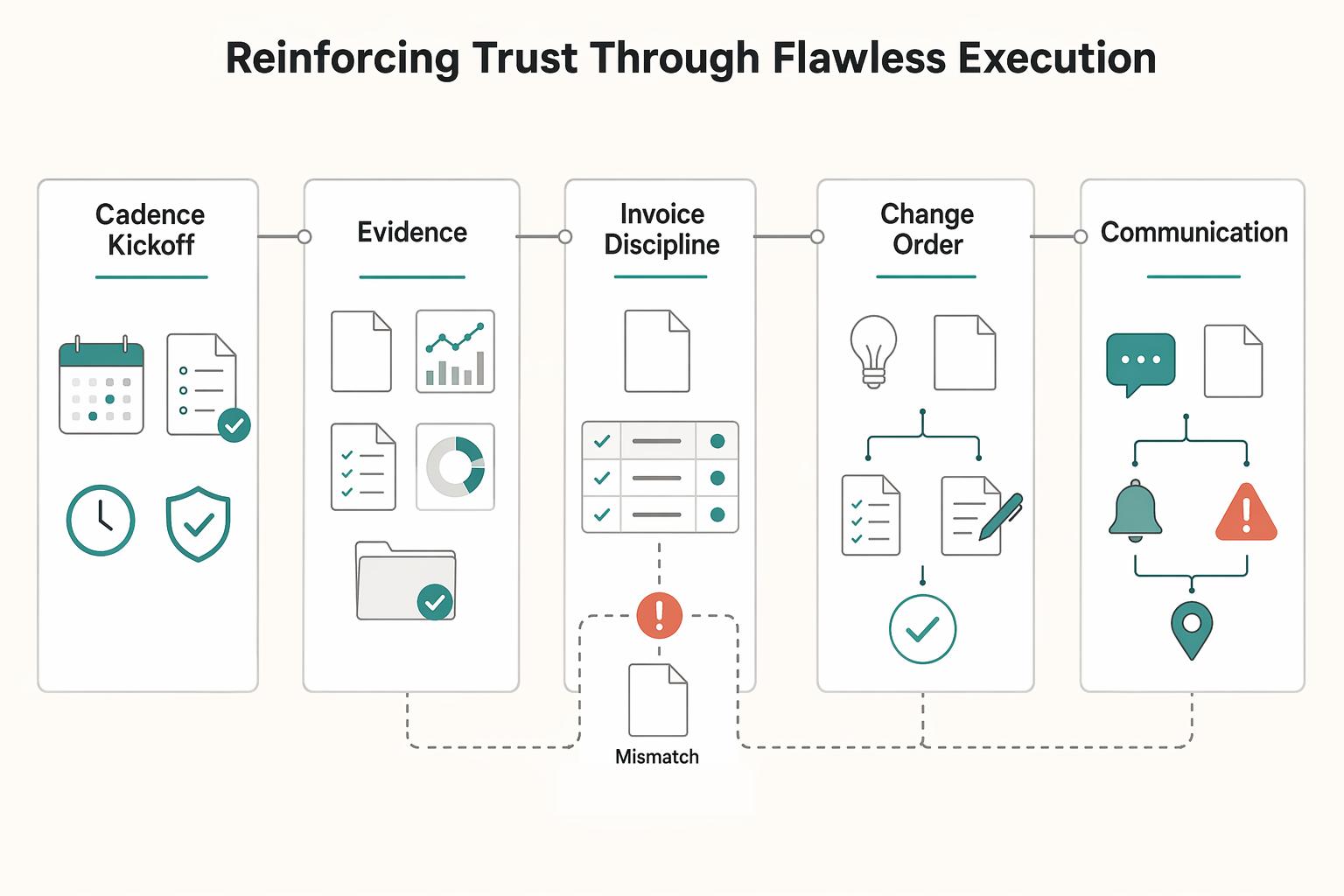
| Cadence at kickoff | Update day, update format, response-time expectation for normal questions, and one escalation path for blockers or approvals | Status update covers what was completed, what is next, what is waiting on the client, and what decision or risk needs attention |
| Current record | Current status, latest draft, approvals, open questions, and decision notes together | Work can resume from the latest approved state |
| Invoice discipline | Clear line items and labels that match the proposal and SOW | Charges map to milestones, deliverables, or approved changes, and the approval trail is saved |
| Change-order sequence | Acknowledge the request, map it to scope, issue revised terms in writing, and pause added work until approval | Written approval before new scope starts |
Step 1: Lock your cadence at kickoff. Set four items in writing: update day, update format, response-time expectation for normal questions, and one escalation path for blockers or approvals. This is not about constant availability. It is about removing ambiguity so the client always knows what happens next.
Use the same update format every time so it is easy to scan:
- What was completed
- What is next
- What is waiting on the client
- What decision or risk needs attention
Keep status in one primary record so people are not chasing inbox threads, chat, comments, and call notes. Tool sprawl and manual handoffs slow response and create avoidable confusion.
| Area | Inconsistent signal | Consistent signal |
|---|---|---|
| Communication | Updates appear only after the client asks, and the format keeps changing. | Updates arrive on the agreed day in the same format, with clear next steps and named blockers. |
| Invoicing | Line items are vague, totals do not map clearly to milestones, and approvals are hard to trace. | Each invoice maps to a deliverable, milestone, or approved change, with a visible approval trail. |
| Scope handling | New requests get a verbal "yes" and later become confusion, delay, or billing friction. | New requests are acknowledged, checked against scope, issued in writing with revised terms, and paused until approved. |
Step 2: Make progress observable and resumable. Your client sees evidence, not your internal effort. Keep current status, the latest draft, approvals, open questions, and decision notes together so anyone can understand the project without a reconstruction call. If work pauses, you should be able to resume cleanly from the latest approved state.
Step 3: Treat invoicing as a delivery signal. Invoice discipline is part of service quality. Use consistent formatting, clear line items, and labels that match your proposal and SOW so both delivery and finance contacts can validate charges quickly.
Keep records audit-ready:
- Map charges to milestones, deliverables, or approved changes
- Keep reference labels consistent across proposal, SOW, and invoice
- Save the approval trail with each invoice (accepted estimate, signoff, or written change approval)
Step 4: Run the same change-order sequence every time. Use a two-layer control model: in-scope work proceeds, out-of-scope work stops at an approval gate.
- Acknowledge the request. Confirm the requested outcome.
- Map it to scope. Check SOW boundaries, assumptions, and revision limits.
- Issue revised terms in writing. Include scope, timing, dependencies, and a note that approved change-order wording still needs to be confirmed.
- Pause added work until approval. Continue original scope where possible, but do not start new scope without written approval.
Execution checklist#
- The client can state your update day, format, response expectation, and escalation path.
- Status, files, approvals, and decisions are in one current record.
- Invoices map cleanly to milestones, deliverables, or approved changes.
- Every charge has a retrievable approval trail.
- Every new request follows the same written approval sequence.
If you're also weighing where to base your practice, see Thailand's Long-Term Resident (LTR) Visa for Professionals.
Phase 3: The Value Loop: Turning a Finished Project into Your Next Contract#
Close the project so the client can quickly see results and choose the next step with confidence. If closeout is just a file dump and invoice, they have to reconstruct the value themselves.
| Step | What is captured | Next action |
|---|---|---|
| Step 1: Retention handoff | Objective, final delivered assets, where each asset lives, which version is final, and agreed ownership or usage status | Define the next useful path if they want to continue |
| Step 2: Proof asset permission | Permission first, approved outcomes, attribution level, and draft for review | Get approval before publication and before reusing quotes in proposals |
| Step 3: Relevance-first follow-up | Renewal dates, usage changes, other behavior signals, preferred contact route, delivered outcomes, open risks, and likely next needs | Mark the channel or timing standard as unresolved in CRM or client notes if it is not yet defined |
Step 1: Build a retention handoff, not a goodbye. Use your signed SOW and original goals as the anchor, then show what changed because of the work. Your closeout should do three things in one place: recap the objective, list final delivered assets, and define the next useful path if they want to continue. For each asset, state where it lives, which version is final, and the ownership or usage status already agreed in your contract.
Use this check: could someone who missed the last two calls read your handoff and understand the outcome, deliverables, and next decision in under five minutes?
| Closeout area | Weak closeout | Strong closeout |
|---|---|---|
| Recap | Generic summary of tasks completed | Outcome-based summary tied to the original goal and what changed |
| Handover | Bulk file link with little context | Structured handover with final versions, locations, and agreed ownership or usage status |
| Future path | "Let me know if you need anything" | Defined continuation path with 1 to 3 specific next-step options |
Step 2: Turn the win into a reusable proof asset only with permission. Treat case studies and testimonials as opt-in. Ask permission first, align on which outcomes the client approves, choose attribution level, then draft for review. Attribution can be full name, role-only, anonymized, or private-use-only.
Keep approval checkpoints before publication and before reusing quotes in proposals. If the client declines a public case study, ask for a private testimonial or permission to describe the work without naming them.
Step 3: Use relevance-first follow-up. Post-project follow-up works best when it is relevant, timely, and low-friction, so use triggers instead of sending messages just to hit a schedule. Practical triggers include renewal dates, usage changes, and other behavior signals you already track.
If your channel or timing standard is not yet defined, mark it as unresolved in your CRM or client notes. Confirm the client's preferred contact route before the engagement ends.
Maintain a short interaction history with delivered outcomes, open risks, and likely next needs. If clients tend to drop off right after early delivery, audit onboarding and first-project experience before adding more follow-up touches.
Before you mark the engagement finished, verify that you have:
- tied final outcomes back to the SOW or original goals
- listed delivered assets, final versions, and agreed ownership or usage status
- given the client a clear next-step path for future work
- requested case study or testimonial permission with attribution options
- captured approval before publishing or reusing any client proof
- logged follow-up triggers, preferred channel, and key relationship notes
For a related angle, read The Psychology of Client Retention: Building Long-Term Freelance Relationships.
Conclusion: What Each Phase Does and How to Put It in Place#
The value of this approach is simple: each phase reduces a different risk and sends a different trust signal. Before work starts, clear scope and defined roles reduce ambiguity. During delivery, routine check-ins and milestone reminders show reliability. After delivery, a concise success summary and a clear next step make follow-on work feel earned, not random.
| Operating model | Before work | During work | After delivery |
|---|---|---|---|
| Linear project cycle | Win the project, then move on | Updates happen when needed | Relationship often goes quiet |
| Flywheel operating model | Define scope, roles, and success clearly | Maintain routine contact and visible progress | Close with proof of value and a reason to reconnect |
Step 1: Implement Phase 1 first. Standardize your scope boundaries and who decides what. The checkpoint is basic but important: can both sides explain success, responsibilities, and what sits outside scope in plain language?
Step 2: Standardize Phase 2 next. Put routine check-ins and milestone reminders on the calendar, and decide who sends them. Planning only helps when the process and relationship are real, not when the document exists but nobody follows it.
Step 3: Review Phase 3 after every engagement. Send a short success summary, note the next likely need, and set a follow-up reminder. If contact drops after delivery, clients may simply forget you and choose someone else when the next need appears.
Treat this like adaptive planning, not a rigid script. Keep the structure, then adjust the details to your client, scope, and service.
Use this self-audit before you roll out the full process:
- Do you start every project with clear scope and explicit roles?
- Do you have routine check-ins or milestone reminders scheduled?
- Do you close with a written summary of outcomes and next opportunities?
- After each project, can you point to one repeatable improvement instead of one-off tactics?
For a step-by-step walkthrough, see How to Use Google Drive for Client Collaboration and File Delivery.
Frequently Asked Questions
What are professional alternatives to loyalty programs for consultants?
For consultants, better alternatives are relationship-based actions that help clients get value and return when they need support. Send a relevant insight after launch, offer a written priority-access policy for returning clients, or provide short educational support. Keep boundaries clear by stating what is included, what is not, and when a new request moves into paid scope.
Is it manipulative to use psychology in client relationships?
It is not manipulative if the goal is to help the client make a clear decision with transparent terms and informed consent. In practice, that means setting expectations in writing, handling new requests openly, and keeping boundaries clear before work starts. If a tactic relies on confusion, pressure, or urgency you created, it is a red flag.
Try a related tool
Researched and edited by the Gruv editorial team. Gruv builds cross-border billing, payouts, and finance-operations software for global businesses.
Sources
Includes 3 external sources outside the trusted-domain allowlist.
Educational content only. Not legal, tax, or financial advice.
Related Posts

GDPR Compliance Checklist for Freelancers Working With EU Clients
Start by separating the decisions you are actually making. For a workable **GDPR setup**, run three distinct tracks and record each one in writing before the first invoice goes out: VAT treatment, GDPR scope and role, and daily privacy operations.

Thailand's Long-Term Resident (LTR) Visa for Professionals
For a long stay in Thailand, the biggest avoidable risk is doing the right steps in the wrong order. Pick the LTR track first, build the evidence pack that matches it second, and verify live official checkpoints right before every submission or payment. That extra day of discipline usually saves far more time than it costs.

Freelance Client Retention: Weekly Systems for Repeat Work and Long-Term Relationships
Keeping good clients is easier when they can predict how you work. Use a weekly checklist to keep communication, scope, and admin clean before small issues turn into bigger ones.