
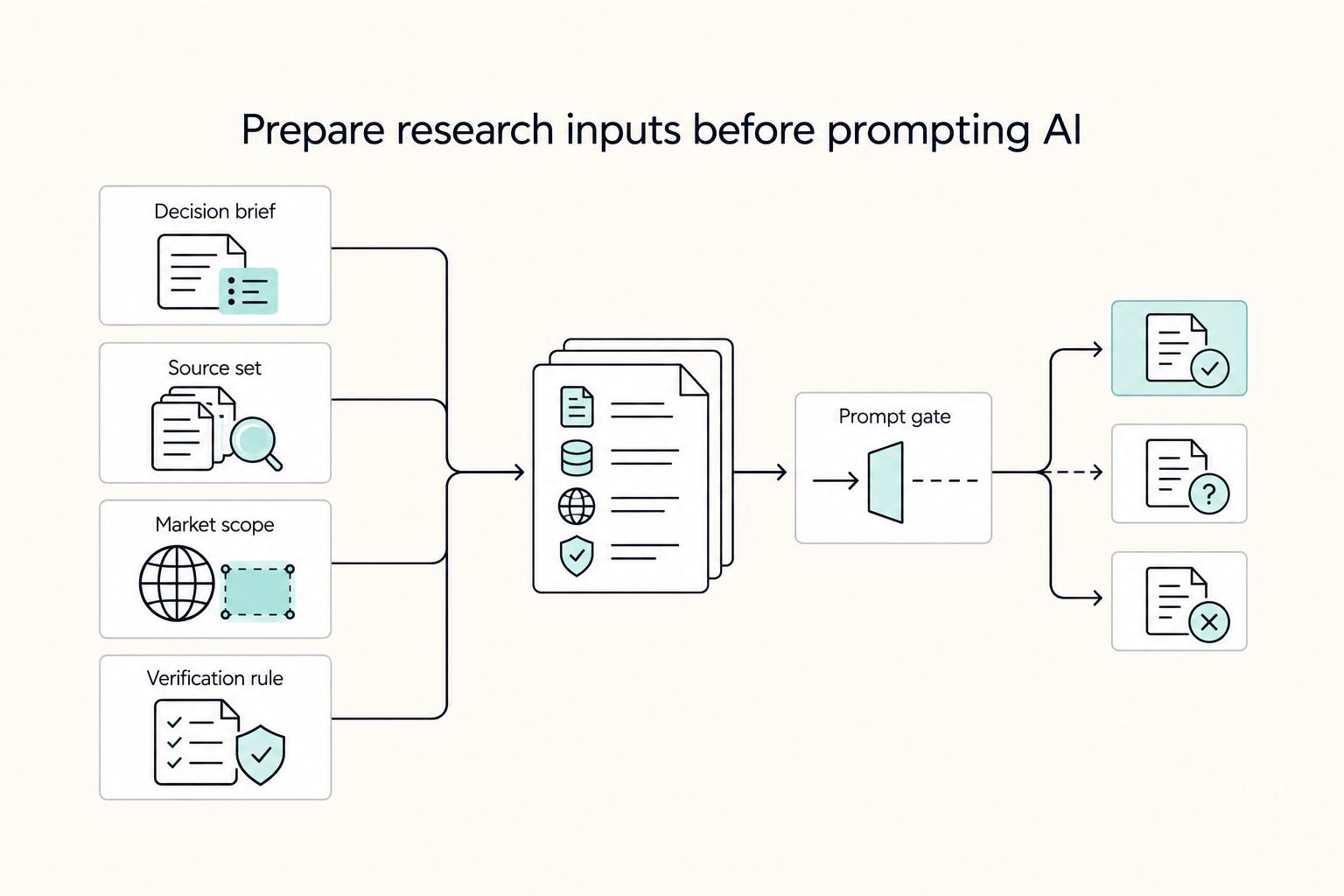
Quick Answer
Start by defining one client decision, then use AI for draft synthesis while keeping human review for contradiction checks and final wording. For ai for freelance market research, maintain a running evidence table with artifact name, date, and confidence so every recommendation can be traced. Set rewrite triggers in advance for conflicting signals or weak samples, and only deliver guidance that passes a final verification pass.
Where AI Fits in Freelance Market Research#
AI appears to be shifting freelance demand in different directions, so your research process needs to stay fast and evidence-led. Across more than 3 million postings, one analysis covering about one year before and after ChatGPT reported 20 to 50 percent declines in jobs involving writing and translation skills, while demand for machine learning skills grew 24 percent and AI chatbot development nearly tripled. That split is why the work has to stay disciplined, not just fast.
Speed helps only if your conclusions survive client review. Keep AI focused on pattern finding, keep human review focused on ambiguity and claim strength, and keep proof behind every recommendation. If you skip that separation, you can end up with a polished draft that still struggles under basic client questions about where each claim came from.
Before You Start#
Bring these three inputs to your first prompt:
- A decision and deadline (for example:
Choose pricing direction for Q3 launch by May 30) - A source folder for evidence artifacts (interview notes, survey exports, competitor snapshots, synthesis drafts)
- A data-boundary note for sensitive details that should stay out of prompts unless approved
- Step 1: Define the decision target. Write one decision question and one
not in scopeline.
Expected outcome: a brief that helps prevent open-ended drift. Checkpoint: if you cannot tell whether evidence supports option A or B, the question is still too vague.
- Step 2: Split automation from manual checks. Use ChatGPT for draft summaries, theme clustering, and first-pass comparisons; keep human review for contradiction checks, claim strength, and recommendation wording.
Expected outcome: faster synthesis without outsourcing final judgment. Tradeoff: full manual review takes longer, but skipping it can raise the risk of polished errors.
- Step 3: Build an evidence trail as you go. For each major claim, log artifact name, date, and confidence in one running table.
Expected outcome: a client-ready record tied to evidence. Failure mode to catch early: a high-impact recommendation based on one model output with no independent support.
- Step 4: Set recovery triggers before delivery. Decide what forces a rewrite, such as conflicting signals, weak sample quality, or unclear respondent wording.
Expected outcome: fewer last-minute surprises and cleaner revisions tied to evidence changes, not opinion swings.
Follow this sequence from intake to delivery and you are more likely to finish with practical checkpoints, recovery moves, and a reusable checklist for each new project.
Prepare your inputs before opening ChatGPT#
Prepare inputs first, then prompt. That discipline keeps recommendations defensible and can cut rewrite cycles.
A November 2025 benchmark across 13 models reported year-over-year gains from 40.5% to 66%, yet it also noted that validation work still remains. Under text-only, no-tool conditions, only 7% (149 tasks) of occupational tasks in the study were testable. Faster drafting helps most when each claim is tied to a decision and evidence.
The practical implication is simple: do not ask the model to guess at missing business context. If your intake is incomplete, the output may fill gaps with generic language. That adds editing time and weakens confidence when the client asks why you made a specific recommendation.
Before You Start#
- Client objective and decision owner
- Decision deadline and delivery format
- Target segment and excluded segments
- Existing customer data you are allowed to use
- Success criteria the client will use to judge the recommendation
- Gather prerequisites in one intake note. Capture objective, deadline, segment, available data, and success criteria on one page. If stakeholders describe different goals, reconcile that before drafting prompts.
- Set scope boundaries before analysis. Define what you will answer, what you will not answer, and which decisions this research should influence.
- Separate materials from tools. List required inputs first (for example, interview notes, survey exports, competitor notes), then list tools you will use. Add a manual-review flag for data manipulation and financial calculations.
- Set evidence and trust rules up front. Require every draft claim to map to a source artifact (such as survey exports, interview notes, or outputs from approved research tools), and keep sensitive details out of prompts unless explicitly approved.
A useful pre-prompt check is to hand your intake note to someone else. Ask whether they can identify the decision, deadline, and available evidence in under one minute. If not, fix the note first. That simple check can prevent avoidable rework.
Lock these inputs before drafting so the output stays fast, reviewable, and trustworthy. If niche definition is still fuzzy, use How to Choose a Niche for Your Freelance Business.
Write a decision brief instead of a vague prompt#
Use a decision brief before you prompt to cut polished filler and increase usable guidance. The brief sets the target, scope, and verification standard before any model output appears.
| Brief element | What to define | Article detail |
|---|---|---|
| Decision question | One decision in plain language | Assign an owner and timeline |
| Hypotheses | Two to four testable hypotheses | AI can draft candidate reasoning; human review checks claim strength and contradictions |
| Required evidence | Name the evidence you will accept for each hypothesis | Examples: interview notes, survey exports, competitor notes |
| Confidence and format | Define directional versus high-confidence guidance | Lock the format, such as a decision table with action and tradeoffs |
| Discovery trigger and stop rule | Pause if the client cannot name a decision | Stop collecting data once evidence is sufficient for that decision |
Clear, contextual prompts produce stronger output, while vague prompts tend to produce generic text. AI can improve productivity in marketing and sales when context is strong, but unverified output can still create professional or legal risk, so verification remains essential.
A good brief also protects project pace. If the decision owner changes midstream or the client asks for extra questions, the brief gives you a stable reference point. It clarifies what belongs in the current scope and what moves to a follow-up pass.
Draft the brief before the first prompt#
- Define the decision question. Write one decision in plain language (for example: raise price, hold, or repackage for a specific segment). Assign an owner and timeline.
- Turn the decision into hypotheses. List two to four testable hypotheses. Let AI draft candidate reasoning, then assign human review for claim strength and contradictions.
- Map required evidence to each hypothesis. For each hypothesis, name the evidence you will accept (such as interview notes, survey exports, or competitor notes) before drafting.
- Set acceptable confidence and delivery format. Define what counts as directional versus high-confidence guidance, then lock the format (for example, a decision table with action and tradeoffs).
- Optional: add a discovery trigger and stop rule. If the client cannot name a decision, pause and run a short discovery call first. Once evidence is sufficient for that decision, stop collecting data and move to synthesis.
Use a consistent order: decision question -> hypotheses -> required evidence -> acceptable confidence level -> delivery format. This keeps output decision-ready, not just well-written.
Before you run the first draft, do one stress test: can each hypothesis be proven wrong with the evidence you listed? If the answer is no, your hypotheses may be too soft and your final recommendations may be hard to defend.
Choose tools by task not by hype#
Choose tools only when they help you answer the decision brief with traceable evidence, not because they are popular.
As of 2026, the market is crowded and many best-of lists repeat the same names, so selection discipline matters. Use AI to automate repetitive execution work, but keep strategy and final judgment human-led. Generative AI can improve productivity, yet it also brings tradeoffs, so prioritize reliability over novelty.
The rule is practical: if a tool saves time but weakens traceability, it is a bad fit for client work. Fast output that cannot be audited can create extra review work later and raise the risk of disagreement at sign-off.
Make the stack earn its place#
- Map one tool to one task class. Start with candidate pairings only (for example: one tool for draft synthesis, one for respondent input, one for coding support, and one for audience or competitor signal). Treat every pairing as a hypothesis to test, not a default.
- Run a constrained pilot. Test candidates on a small, real sample and check output quality, edit effort, and whether results stay traceable to source artifacts.
- Match depth to decision risk. For lower-stakes decisions, use a lightweight stack with one model plus one independent data source. For higher-stakes decisions, add a more structured research layer only if your pilot shows clear value.
- Use one scorecard each time. Compare options on task fit, setup burden, evidence quality, and export usability, then freeze the stack for that project cycle.
| Criterion | What to check quickly | Red flag |
|---|---|---|
| Task fit | Output answers the decision brief directly | Generic output that needs full rewrite |
| Setup burden | Time to first usable result is acceptable | Setup consumes a large share of project time |
| Evidence quality | Claims map to identifiable artifacts | No clear link between claim and source |
| Export usability | Outputs can be saved and reviewed later | Locked format or messy exports |
Automate execution work, not strategy calls. If output is not traceable and review-ready, cut the tool. One more safeguard helps in practice: once the pilot passes, freeze your selected stack for the current cycle. Mid-cycle tool switching can create inconsistent evidence formats, duplicated effort, and comparison noise that slows final synthesis. If you want a deeper dive, read How Freelancers Use AI Without Scope, Compliance, or Payment Chaos.
Build a minimum viable data pack you can defend#
Treat any claim without traceable evidence as a draft idea, not a recommendation.
Your data pack is the working proof behind each client-facing conclusion. The goal is not maximum volume. The goal is enough independent signal to support a decision, with clear caveats where uncertainty remains.
Before You Start#
Write a short project note with the decision question, target segment, date range, and data sensitivity. If you use Google AI Studio for prompt prototyping, confirm data handling upfront: it is free and web-based. The free version may be slow on large tasks, and data may be used for training unless billing is linked. Keep human review in the loop for final decisions.
- Collect independent signals. Where practical, use more than one signal type so one source does not carry the whole conclusion. Keep the same time window across inputs when possible, and save at least one dated artifact per signal.
- Record provenance while you collect. Track artifact ID, tool or source, capture date, filter or segment, and owner. If you use AI to summarize, store the prompt and output, and label it as synthesis support rather than primary evidence.
- Run a quick sanity check before synthesis. Check for obvious coverage gaps or imbalance in who is represented and where the data came from. If the pack is uneven, add balancing input or narrow the claim to what the evidence actually covers.
- Keep a living assumptions log. List assumptions with owner, test method, and due date, and update status as evidence changes. If a recommendation depends on an unproven assumption, label it as directional until that assumption is tested.
A simple operating habit makes this easier. Name files so they can be sorted by date and signal type. Keep one index sheet that maps each artifact ID to a short description. This can reduce handoff friction and make review faster when a client asks for supporting detail on a single recommendation. The rule stays simple: no traceable artifact, no hard claim.
Run AI-assisted interviews and surveys without losing nuance#
Use AI to speed drafting and first-pass moderation, then keep humans in control of editing, approvals, and high-stakes judgment. Automate repetitive work, and add human review wherever wording, emotion, or risk can change meaning.
| Collection stage | Primary action | Human check |
|---|---|---|
| Question drafting | Use an LLM for a first pass | Edit each question for neutrality and precision |
| Moderation at scale | AI tools can handle repetitive intake and basic follow-ups | Review a live sample during collection, then adjust prompt logic before continuing |
| Depth by interview stakes | Use triage and first-pass labeling | Increase human moderation if responses are emotionally complex or high-stakes |
| Failure-mode patching | Log question ID, failure type, example response, and fix applied | Pause collection and repair the guide before adding more data if the same failure keeps repeating |
This is where projects often drift. It is easy to assume faster collection means better insight, then discover late that question wording or follow-up logic introduced noise. Guardrails and live checks help prevent that problem before it spreads across the full sample.
Before You Start#
Write three guardrails before launch: the decision this research must inform, the respondent profile you need, and the topics that require human follow-up. This keeps collection focused and helps prevent low-quality automation choices once responses start coming in.
- Step 1. Draft prompts with an LLM, then tighten them manually. Use an LLM for a first pass, then edit each question for neutrality and precision. Remove leading language, vague time windows, and double-barreled prompts. Final check: each question should be answerable without signaling a preferred outcome.
- Step 2. Use AI moderation for scale, then audit a live sample by hand. AI tools can handle repetitive intake and basic follow-ups at scale. Review a live sample during collection to catch tone misses, weak follow-ups, or lost context, then adjust prompt logic before continuing.
- Step 3. Shift moderation depth based on interview stakes. A 2026 research summary reports that three LLMs were nearly as good as experts at recognizing empathy in text-based conversations, and more reliable than nonexperts. Use that strength for triage and first-pass labeling, not as a replacement for human qualitative judgment. If responses are emotionally complex or high-stakes, increase human moderation; if responses are broad and repetitive, AI moderation can be more efficient.
- Step 4. Log failure modes in real time and patch fast. Track respondent confusion, shallow follow-ups, and repeated phrasing that can distort findings. Keep a simple log with question ID, failure type, example response, and fix applied, and save revised guide versions as dated artifacts. If the same failure keeps repeating, pause collection and repair the guide before adding more data.
When deadlines are tight, keep one checkpoint after the first batch of responses: confirm that answers are specific enough to support your decision question. If not, patch the guide immediately. Continuing with weak prompts only produces more data you cannot use.
Turn analysis into decisions the client can act on#
Once collection is stable, turn patterns into explicit decisions quickly. Clients need clear choices, tradeoffs, and next actions, not a long theme summary.
A strong synthesis pass does more than describe what people said. It states what to do next, why that action fits the evidence, and what would change the recommendation. That structure helps keep stakeholders aligned when they have different risk tolerance.
Before You Start#
Set up a simple decision ledger before clustering. Track theme, supporting evidence IDs, confidence lane, recommended action, owner, and review date. Note where AI assisted and where human judgment made the final call so the trail stays transparent.
- Step 1. Cluster themes, then convert each cluster into a decision statement. Use your clustering workflow to group recurring responses, then rewrite each cluster with a decision verb: increase, keep, test, pause, or stop. If a cluster cannot produce one decision sentence and one clear owner, keep it in working notes instead of client recommendations.
- Step 2. Separate output into three confidence lanes. This prevents weaker signals from being presented as firm findings.
| Lane | What belongs here | Client-facing language |
|---|---|---|
| High-confidence findings | Supported by multiple artifacts with no major contradiction | Recommend now |
| Directional signals | Useful pattern, but support is limited or mixed | Test next |
| Open questions | Gaps, conflicts, or unresolved assumptions | Need follow-up |
If a claim relies on thin evidence or model summary alone, move it down one lane.
- Step 3. Build scenario contrasts before final recommendations. Show at least two paths from the same evidence. For example: if the goal is short-term lead volume, choose faster tests and lower-friction offers; if the goal is premium positioning, narrow targeting and accept slower lead flow for stronger fit.
- Step 4. Limit AI overuse during synthesis. Evidence from gig-work research shows AI guidance can improve outcomes like fewer refunds, while more complex guidance can increase consultation time, and overuse can lower productivity. Use AI for first-pass synthesis, then stop adding passes when review time rises but decision clarity does not. Each final action should include its lane, key tradeoff, and next evidence check date.
A useful final check is to read only the action lines from your deck or memo. If a client could not act from those lines alone, your synthesis still needs tightening.
Validate every claim before client delivery#
Recommendations become client-ready only after a strict verification pass. This is where draft output turns into guidance a client can trust.
| Validation step | What to check | If issues appear |
|---|---|---|
| Map claims to evidence | Attach the artifact IDs that support each recommendation sentence | Remove it or soften it to directional language if a claim cannot be traced |
| Cross-check contradictions | Compare synthesis outputs with independent evidence paths | Record what changed, what remains uncertain, and what follow-up is required |
| Red-team recommendations | Ask what would make each recommendation wrong | Document disconfirming signal, earliest warning sign, likely impact, and fallback action |
| Final single-output block | Check whether any recommendation relies on one unverified output | Move it to test next until independent confirmation is added |
Verification is not a cosmetic edit. It is the release gate that decides what is ready to implement now, what should be tested next, and what must be removed because support is weak.
Before You Start#
Create a validation sheet before final edits with claim ID, recommendation ID, evidence IDs, confidence lane, contradiction status, owner, and review date. Set one release rule at the top: no recommend now item can be approved from a single unverified model output.
- Step 1. Map every claim to traceable evidence. Pull each recommendation sentence into the validation sheet and attach the artifact IDs that support it. Put primary artifacts first, and keep model summaries as supporting context. If a claim cannot be traced, remove it or soften it to directional language.
- Step 2. Cross-check contradictions across sources. Compare synthesis outputs with independent evidence paths before finalizing recommendations. If sources conflict, do not blend them into a vague middle statement. Record what changed, what remains uncertain, and what follow-up is required.
- Step 3. Red-team the recommendation set. For each action, ask:
What would make this recommendation wrong?Document the answer in the appendix with disconfirming signal, earliest warning sign, likely impact, and fallback action. This keeps polished language from masking untested assumptions. - Step 4. Enforce a final single-output block. Run one final filter for model dependence. If any recommendation relies on one unverified output, move it to
test nextuntil independent confirmation is added. Keep the release standard focused on verified effect, not tool novelty: one 2026 marketing-tools guide warns that not every AI tool improves performance and that some add complexity without measurable impact.
Before client delivery, run a short handoff rehearsal with your own notes. Pick one recommendation and trace it from final wording back to source artifacts quickly. If that trace is slow or unclear, the package still needs cleanup. Close with transparent notes in the appendix: where AI assisted, where human judgment overruled it, and which items remain uncertain.
Package deliverables for trust and repeat business#
After validation, package the work so a client can scan it quickly and reuse it in the next cycle. Trust grows when they can see what changed, why it changed, and what still needs testing.
The handoff format matters almost as much as the analysis quality. If a client cannot quickly locate the decision, evidence, and tradeoff in one place, they may treat the output as exploratory rather than decision-ready.
- Step 1. Assemble one decision packet. Include, for example, an executive summary, decision table, source index, assumptions log, and next-test plan. Keep each recommendation traceable to evidence IDs, and clearly label primary evidence versus AI-assisted synthesis.
- Step 2. Put tradeoffs inside each recommendation. Add the operational constraint, confidence lane, and the condition that would make the recommendation fail. If confidence is directional and constraints are tight, move the item to
test nextinstead ofimplement now. - Step 3. Add a one-page
what changedrecord. Show the chain from raw input to final guidance in short chronological order: starting point, new evidence, contradictions, recommendation changes, and final call. For client-facing text drafted with AI, state that it was reviewed by a human before sending. - Step 4. End with a handoff note for repeat business. State what to monitor next, what signal would reverse the recommendation, and what data to collect in the next pass. Use AI where faster response handling helps, but keep final decision language and risk statements under human approval so the work stays useful and trusted.
A tight packet can also reduce revision churn. When each recommendation already includes a clear condition for change, later edits stay tied to evidence updates instead of style preferences.
Price and scope AI research so projects stay profitable#
Project profitability is often set during scoping, not rescued after delivery. Define the decision, choose the engagement model that fits it, and set revision boundaries before work starts.
Unclear deliverables and open-ended revisions can create margin pressure. Clear scope language helps both sides keep the final review focused on decision quality.
- Step 1. Define scope in client-facing units before you quote. Scope by decision questions answered, interviews completed, competitor set covered, and artifacts delivered. Make each unit verifiable in the final packet so both sides can confirm what was completed.
- Step 2. Price one-off work by decision complexity, and ongoing work by monthly cadence and reporting depth. For one-off projects, complexity is about uncertainty and decision difficulty. For ongoing engagements, effort is tied to recurring monitoring and reporting rhythm. Treat market demand signals, including reported growth in AI-related freelance demand (about 28% year over year in one market summary), as planning context rather than a universal pricing benchmark.
- Step 3. Use a clear engagement rule. If the client needs a single launch decision, keep a fixed-scope engagement with a clear stop point. If they need continuous monitoring, use an ongoing monthly model with defined outputs.
- Step 4. Tie revisions to evidence changes, not opinion changes. Consider including revisions when evidence, assumptions, or documented findings change. Separate purely stylistic rewrites from research revisions so scope does not drift.
When you make these rules explicit up front, projects are easier to deliver, defend, and renew. They also make future proposals faster because you can reuse the same structure with only scope and cadence changes.
Common mistakes and recovery steps#
When delivery issues show up, check evidence discipline before you assume the problem is effort. Use each mistake as a trigger for one clear recovery step, then confirm the fix before client delivery.
- Mistake: relying on one tool output for a recommendation.
Recovery: triangulate with independent sources before you treat any finding as client-ready. Prioritize strategic tool selection over broad, unstructured tool use.
- Mistake: overconfident language with weak support.
Recovery: downgrade wording to match evidence strength, and label uncertainty explicitly when support is limited. This protects trust, especially when stakeholders may discount AI-generated output on principle.
- Mistake: collecting more data than the decision needs.
Recovery: re-anchor to the decision brief and cut anything that does not change the decision, confidence level, or next test. In a small 2025 qualitative study (six participants), iterative prompting, simplification, and strategic tool selection appeared as recurring adoption themes.
- Mistake: generic recommendations that cannot be executed.
Recovery: add segment, channel, and timing constraints to every action. If those constraints are missing, classify it as a hypothesis and define the next test instead of presenting it as a final recommendation.
Apply the same check across all four mistakes before final packaging so quality control stays routine, not reactive.
Final takeaway and copy/paste checklist#
Use AI to speed research mechanics, not to replace your judgment. The version that is easiest to defend in client review is traceable: clear inputs, a defined human and AI split, and claims tied to evidence.
AI can help across research, ideation, planning, optimization, review, and performance analysis, but it does not fully automate professional work. Keep the process simple, measurable, and grounded in real context artifacts, such as brand guidelines, CRM exports, past campaigns, or customer data when appropriate.
If you need a practical weekly routine, keep it short: lock the decision, gather evidence, draft once, verify claims, then ship with tradeoffs and next tests. That sequence can help you keep momentum without losing quality.
Use this checklist as a practical project standard, then scale it up or down by scope.
- Decision question is specific and aligned with the client objective
- Inputs include multiple relevant signal types
- Every major claim maps to evidence
- Recommendations state tradeoffs and confidence where useful
- Uncertainty and follow-up tests are documented
- Final handoff includes traceable assumptions and source notes when needed
Frequently Asked Questions
How can freelancers use AI for market research without sounding generic?
Start from a specific client decision, not a broad prompt. Treat AI as an assistant for drafting language and organizing ideas, then rewrite the output with your client context and judgment. This helps keep recommendations practical instead of formulaic.
What should AI handle versus what should I always do myself?
Use AI for support tasks like wording help and organizing material. Keep final judgment and privacy or ethics decisions in human hands. Make this explicit to clients with a short AI usage policy that states if, how, and when you use AI.
What is the minimum viable AI market research process for one client project?
Use a minimum viable process: define one decision, produce a basic usable draft, and improve it with real feedback. The goal is a client-usable first version, not a perfect first pass. Then note what changed after feedback.
How do I validate AI-generated findings before presenting them?
Check each concrete claim against evidence you can trace, rather than relying on model output alone. If support is limited, soften the wording and label uncertainty clearly. Present unverified points as hypotheses to test, not final conclusions.
Which tools are enough for a one-person freelance operation to start?
There is no single proven starter stack. A practical starting point can be one AI assistant plus your existing research inputs, with a simple record of where each major claim came from. Add tools only when you can name the specific evidence gap they solve.
Can AI replace customer interviews for freelance client work?
No clear support here shows AI can replace customer interviews. AI can assist with drafting and organization, but this evidence does not establish replacement of direct customer input. Use AI to speed the process, not to remove the conversation.
Try a related tool
Researched and edited by the Gruv editorial team. Gruv builds cross-border billing, payouts, and finance-operations software for global businesses.
Sources
- brookings.edu/wp-content/uploads/2025/11/Rio-Chanona_Einsi...trusted
- insight.kellogg.northwestern.edu/article/can-ai-help-humans-with-empathytrusted
- questromworld.bu.edu/platformstrategy/wp-content/uploads/sites/49...trusted
- questromworld.bu.edu/platformstrategy/wp-content/uploads/sites/49...trusted
- tiffin.edu/wp-content/uploads/AI-Tools-with-Description...trusted
Educational content only. Not legal, tax, or financial advice.
Related Posts
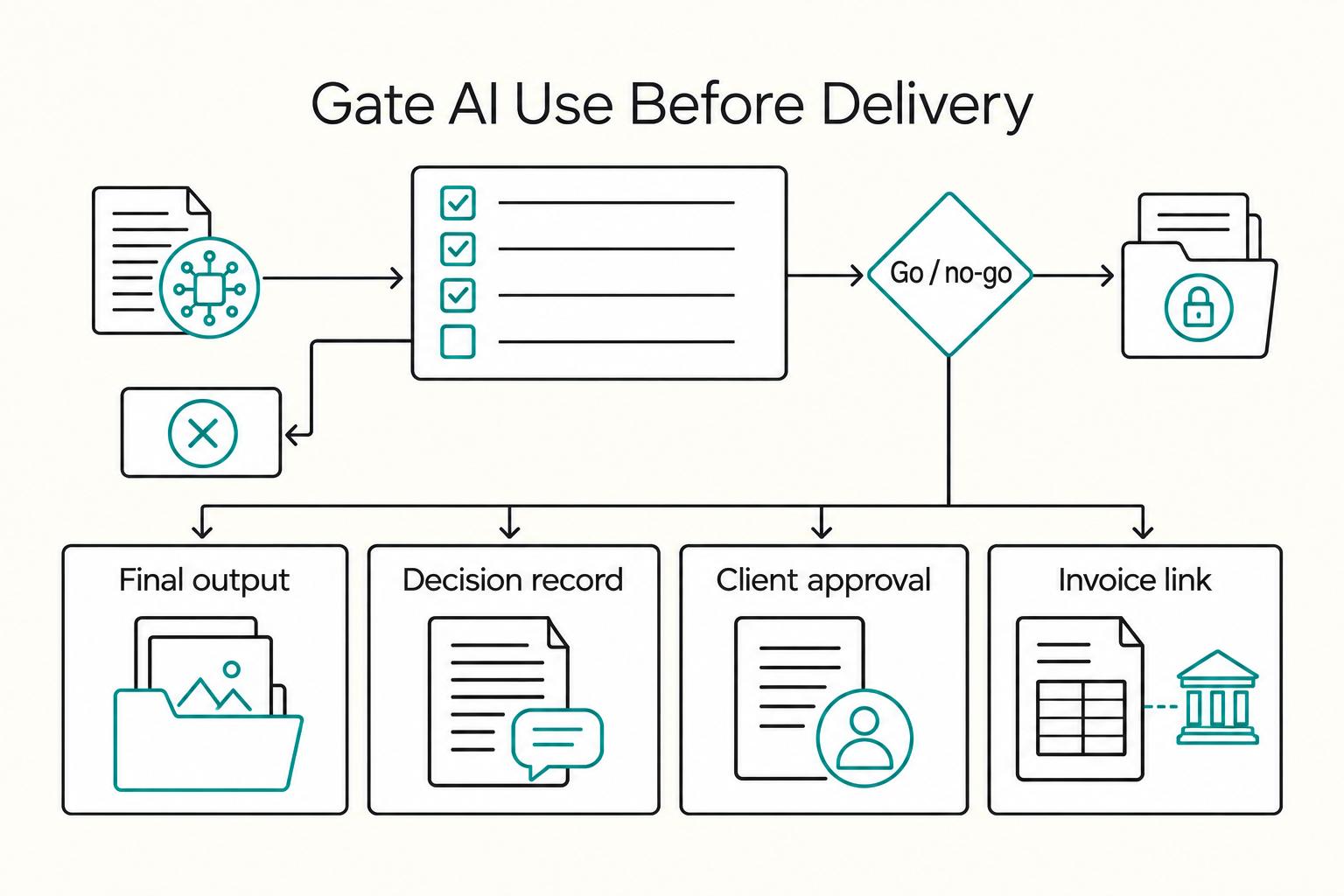
How Freelancers Use AI Without Scope, Compliance, or Payment Chaos
If you are hunting for more **AI tools for freelancers**, stop and put controls in place first. One practical setup is `Acquire -> Deliver -> Collect -> Close-out`, with each AI action checked through `Data`, `Client Policy`, `Quality`, and `Money`. If a tool has no named job, no clear data boundary, and no record you can retrieve later, it probably does not belong in your stack.
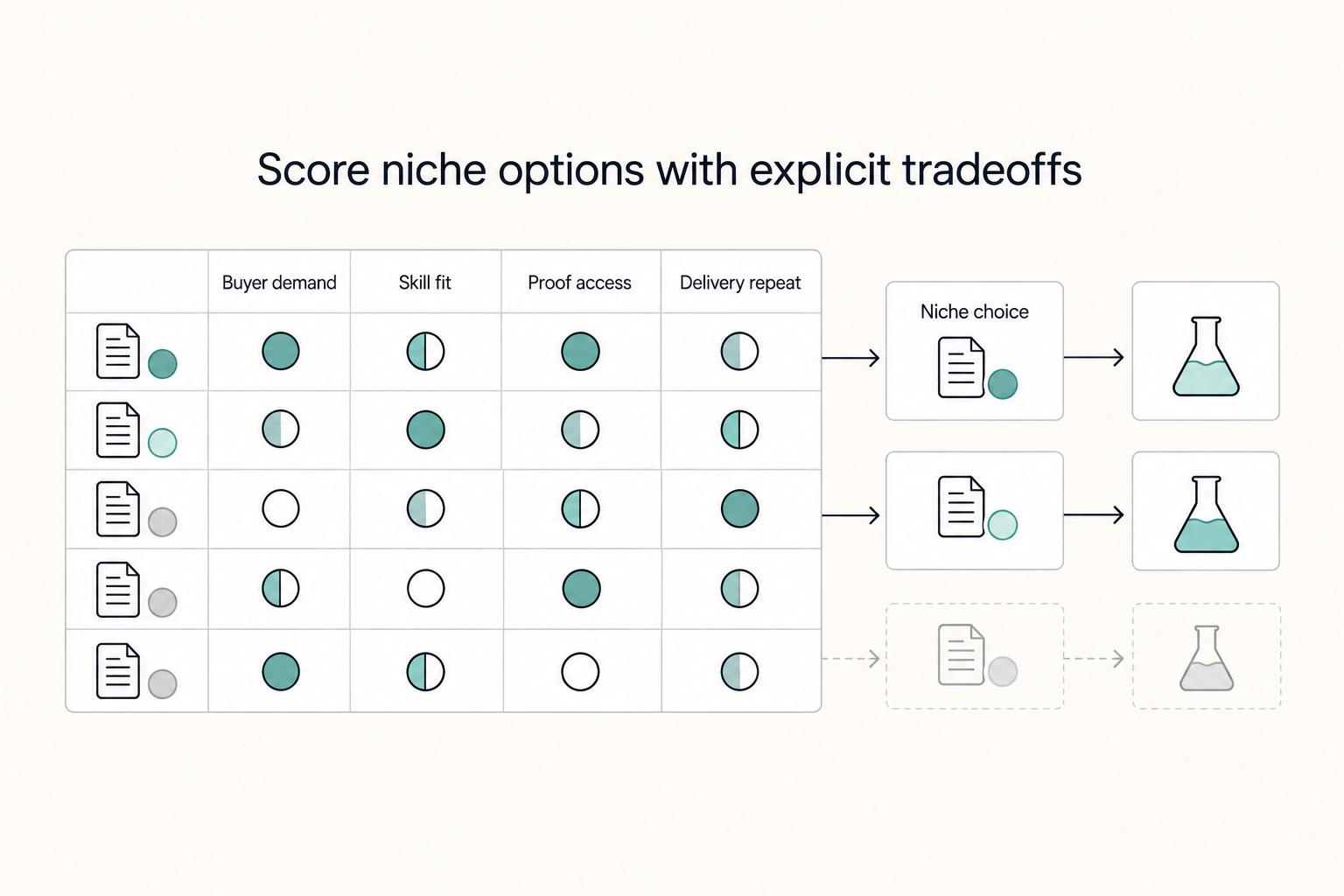
How to Choose a Niche for Your Freelance Business
Choosing a freelance niche is a decision about repeatable demand and repeatable delivery, not just personal interest. Passion helps you stay consistent, but durability comes from clear positioning and work you can execute without constant reinvention.
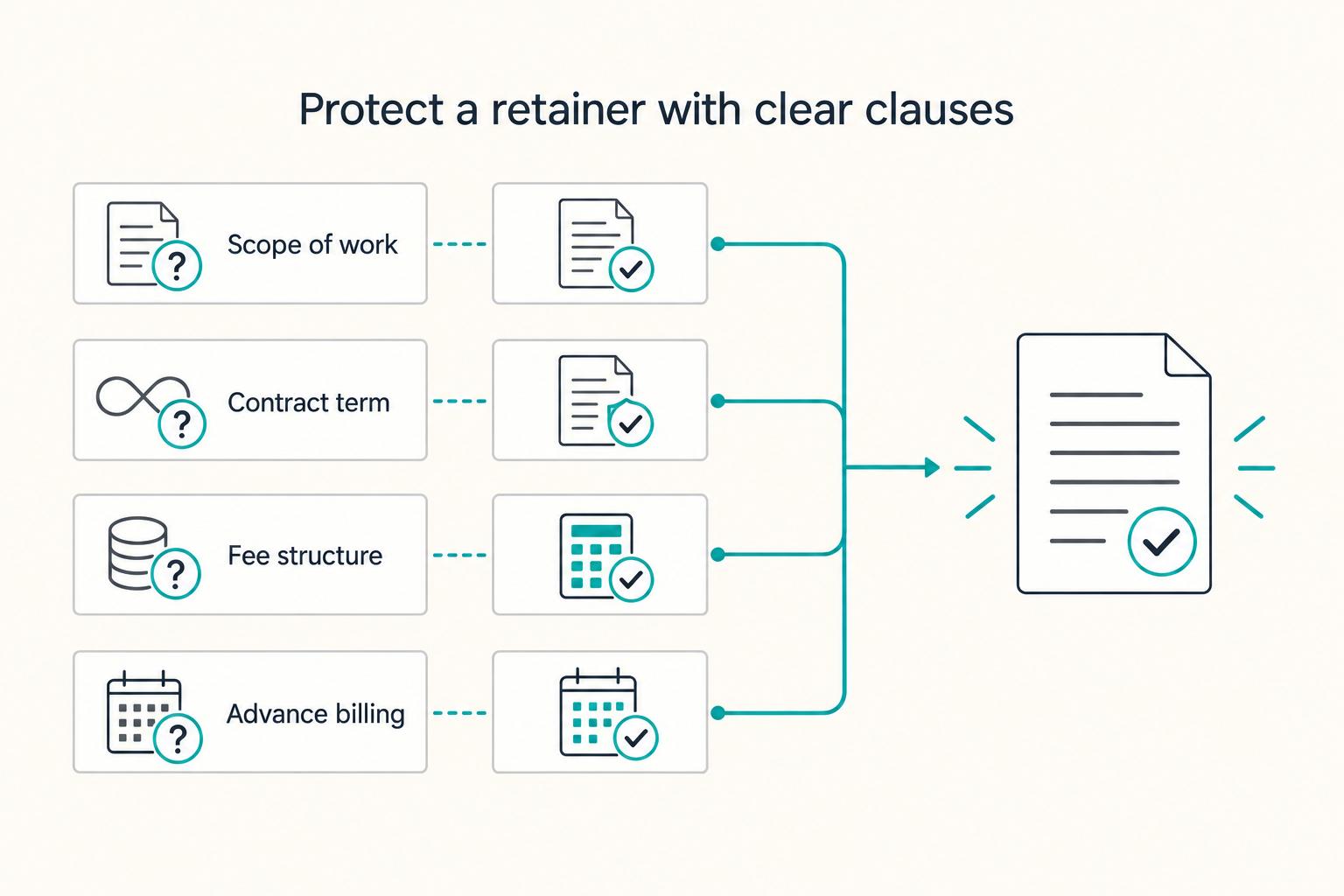
How to Set Up a Retainer Agreement with a Client
Set up retainer documents so they behave like a system: clear scope, clear boundaries, and operational steps that keep recurring revenue clean month after month. You're the CEO of a business-of-one, and the paperwork is part of the system, not an afterthought. Once you get the verbal yes, or the "send the paperwork," the next move decides whether this retainer becomes stable revenue or a slow leak of free work.