
Quick Answer
Yes - proceed only if the guarantee text states a calculable Maximum Obligation, a defined Guarantee Period, and obligations limited to this deal. Run a go/no-go screen first with the draft contract, any separate guarantee form, cash-flow data, and assets you will not risk. If the clause leaves default triggers, governing law, or dispute venue unclear, pause and get local legal review before signing.
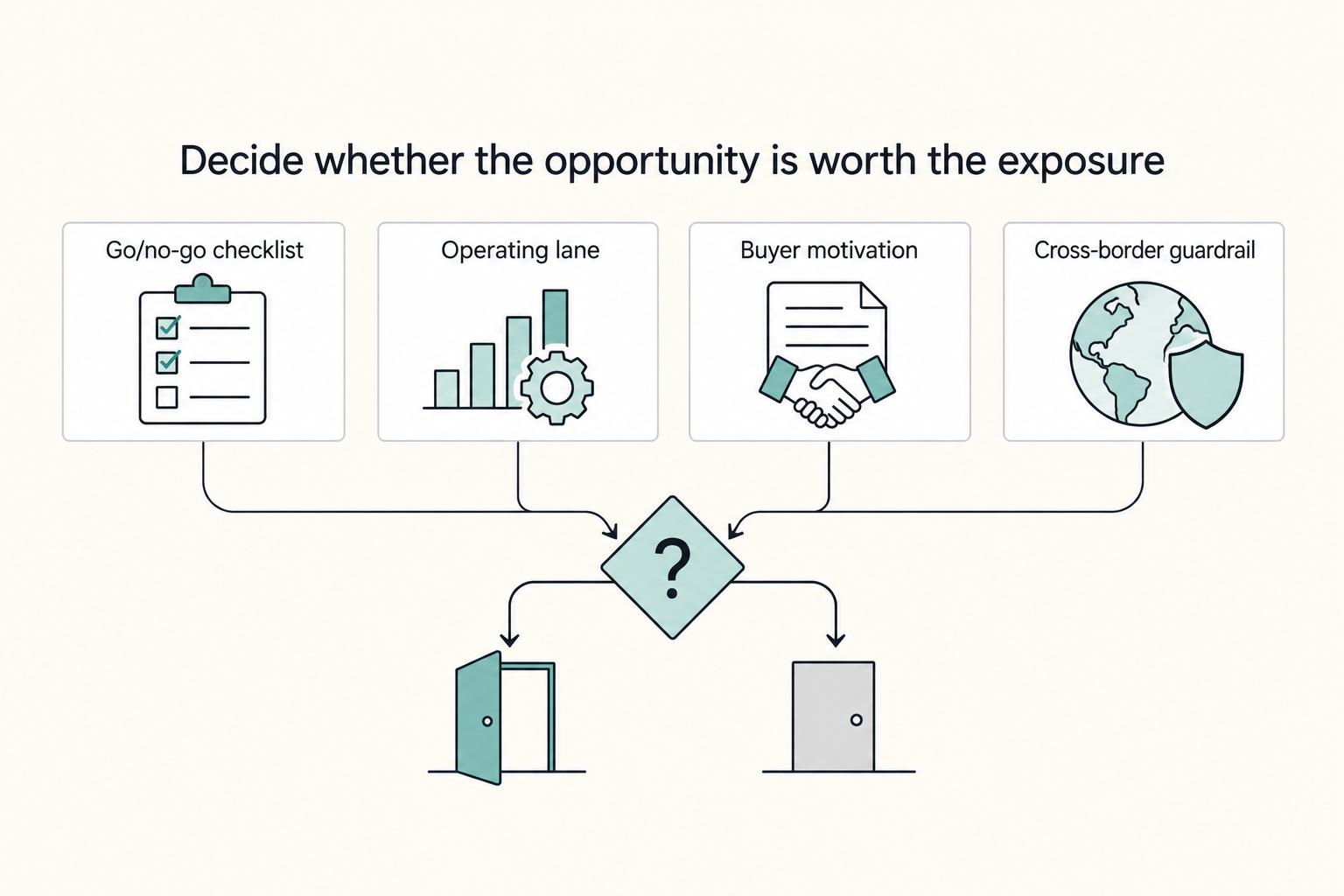
Phase 1: The Go/No-Go Decision - Is the Opportunity Worth the Exposure?#
If this deal can turn a business loss into a personal loss you cannot absorb, do not negotiate yet. First decide whether the exposure is survivable.
A personal guarantee is a legally binding promise that you, personally, will repay if your company does not. Limited liability usually means owners are not personally liable for company debts. A separate guarantee can create personal liability for the guaranteed obligation. For this screen, treat unlimited as no fixed cap stated in the guarantee document. Treat personal asset exposure as the risk that assets like your home, car, savings, or investments could be used to satisfy the debt.
Before you respond, pull together the draft contract, any separate guarantee form, recent cash-flow data, and a short list of assets you will not risk. Those four items are usually enough for an initial screen: is this a negotiation problem, or a deal you should decline?
Step 1. Complete a go/no-go checklist before negotiation#
Start with a one-page downside view. If you cannot explain the worst case in plain terms, or state a fallback path on one page, you are not ready to negotiate clause wording yet.
| Check | Question | Article detail |
|---|---|---|
| Maximum downside | What is the highest amount you could owe if the company defaults, based on the actual wording? | Highest amount you could owe if the company defaults |
| Business upside | Is the upside substantial beyond near-term revenue? | Strategic client value or market access |
| Cash-flow resilience | Under weaker-than-expected scenarios, can current and expected business cash flow still support core obligations? | Core obligations still supportable |
| Fallback options | If you decline this deal, do you have workable alternatives? | Other clients, reduced scope, different financing, or different terms |
Step 2. Decide the lane early#
Make the decision lane explicit before you start trading edits. That keeps you from drifting into open-ended risk because the deal feels important.
| Decision | Exposure level | Strategic value | Alternatives |
|---|---|---|---|
| Proceed as-is | Defined and survivable | High and time-sensitive | Limited |
| Proceed only if revised | Unclear, uncapped, or broader than needed | Real but not worth open-ended risk | At least one workable option |
| Walk away | Material personal asset exposure or unclear recoverability | Modest, speculative, or replaceable | Available now or soon |
Step 3. Diagnose why they want the guarantee#
Ask directly whether this is standard policy or a response to a specific concern about your company or this deal. You need that answer before you decide what to concede.
- Boilerplate requirement: May mean there is room to narrow scope in Phase 2, but do not assume limits will be accepted.
- Deal-specific risk concern: Expect more resistance and prepare targeted evidence on repayment capacity and risk controls.
Many counterparties ask for guarantees to reduce risk, especially with newer businesses or limited credit history. If they cannot explain the reason, treat that as a warning sign rather than a normal starting point.
Step 4. Apply the cross-border guardrail#
Cross-border exposure needs a separate check. Before you treat the deal as acceptable, verify the governing law, the dispute venue, including any forum selection clause, and where recovery would realistically happen. Recognition and enforcement can depend on local law and comity. Cross-border frameworks can improve predictability without making enforcement automatic in every case. If exposure is material, get independent legal advice before signing.
Move to Phase 2 only when your downside is clear and your cash flow is resilient enough for downside scenarios. The strategic value should be real, and the law and enforcement path should be clear enough for you to negotiate from a position of control.
Related: Germany Freelance Visa: A Step-by-Step Application Guide.
Phase 2: Negotiate the Guarantee in a Fixed Order#
If you proceed, negotiate in a fixed order: confirm the actual risk concern, set a capped limited guarantee, add a clear end point, then narrow scope and exclusions. Do not skip the cap. The point is to turn open exposure into a bounded promise you can price.
| Point | Accept | Counter | Pause for counsel |
|---|---|---|---|
| Actual risk concern | They identify a specific risk you can address | They cannot explain the risk but still want language broad enough to reach "any and all existing and future indebtedness and liabilities of every kind." | In cross-border deals where governing law, court clause, or arbitration clause is unsettled |
| Cap | The maximum is explicit and you can calculate it in one pass | The guarantee is called "limited" but the actual clause has no hard ceiling | The cap is buried in cross-references or mixed with indemnity language that obscures total exposure |
| Sunset or burn-off | End triggers are objective and verifiable from records | Expiry depends on unilateral discretion or no end point is stated | Trigger terms rely on foreign-law default or insolvency concepts you have not validated |
| Scope and carve-outs | Covered obligations are specific to this deal, and exclusions are explicit | The draft reaches past, present, and future debts or uses undefined catchalls | You are relying on carve-outs in a cross-border contract without clear governing-law and forum alignment |
Keep the contract, any separate guarantee form, and your fallback terms in one redline set. Also keep a short email trail stating why they want credit support. That record helps keep the negotiation tied to the original concern.
Step 1. Confirm the actual risk concern#
Do not offer concessions until they tell you what risk they are trying to cover. Ask whether the guarantee is standard policy or tied to a specific concern about your company, this project, or cross-border recovery.
- Accept: they identify a specific risk you can address.
- Counter: they cannot explain the risk but still want language broad enough to reach "any and all existing and future indebtedness and liabilities of every kind."
- Pause for counsel: in cross-border deals where governing law, court clause, or arbitration clause is unsettled.
If enforcement is cross-border, keep the dispute path clean. Exclusive court clauses and arbitration clauses are not interchangeable, and mixing them can complicate enforcement analysis.
Step 2. Propose a capped limited guarantee#
Your first counter should be a limited guarantee with a real ceiling in the text. If the document does not state a maximum obligation clearly, it is not giving you the control you need.
A cap is that maximum, whether stated as a fixed amount or a formula. One common drafting pattern is a "Maximum Obligation" formula, for example guarantor percentage multiplied by a cap amount, so the ceiling is calculable from the text itself.
- Accept: the maximum is explicit and you can calculate it in one pass.
- Counter: the guarantee is called "limited" but the actual clause has no hard ceiling.
- Pause for counsel: the cap is buried in cross-references or mixed with indemnity language that obscures total exposure.
Step 3. Add sunset or burn-off mechanics#
A guarantee without a clear end point can remain in force longer than expected, so add duration control next, not later.
A sunset or burn-off means the guarantee ends on a defined date or a defined trigger. Do not assume it disappears if the text is silent. You can also use defined activation triggers, for example springing recourse events, so the guarantee is not active for every routine dispute.
- Accept: end triggers are objective and verifiable from records.
- Counter: expiry depends on unilateral discretion or no end point is stated.
- Pause for counsel: trigger terms rely on foreign-law default or insolvency concepts you have not validated.
Step 4. Narrow scope, add carve-outs, and line up fallback structures#
Once the cap and end point are set, tighten what the guarantee actually covers. This is where broad drafting can quietly undo the protection you thought you negotiated.
A scope limitation ties the guarantee to named obligations under the identified agreement only. A carve-out is express exclusion language for named obligation categories. Do not assume cross-border enforceability is identical across jurisdictions.
- Accept: covered obligations are specific to this deal, and exclusions are explicit.
- Counter: the draft reaches past, present, and future debts or uses undefined catchalls.
- Pause for counsel: you are relying on carve-outs in a cross-border contract without clear governing-law and forum alignment.
If they reject those edits, move to substitute credit support instead of defaulting to personal exposure:
| Fallback option | Prefer it when | Main tradeoff |
|---|---|---|
| Standby letter of credit | They want contingent issuer-backed payment support | Fees, documentary conditions, and expiry management |
| Parent/company guarantee | A stronger entity can support the obligation | Works only if that entity is truly creditworthy |
Before signing, run one final clause-quality check against the actual documents. Do not rely on the business summary.
- Definitions are specific, including guaranteed obligations and excluded obligations.
- Liability is bounded by a stated maximum obligation or cap.
- Trigger events and termination mechanics are explicit and objective.
- Governing-law and forum or arbitration wording align with your enforcement risk position.
- The guarantee is in writing and signed by the charged party.
If they refuse a cap, refuse an end point, and refuse scope limits, go back to the walk-away lane from Phase 1.
You might also find this useful: How to structure a 'payment on termination' clause in a freelance contract.
Before you send redlines, draft your fallback language for scope, cap, sunset, and carve-outs with the freelance contract generator.
Phase 3: The Long Game - Building an Asset Shield Before You Sign#
Negotiation edits are not enough on their own. Proceed only when you can show three things on demand: real entity separation, active professional liability coverage that fits the work, and clean financial separation backed by records. A personal guaranty can be easier to refuse when your business is already structured, documented, and defensible.
| Setup | Exposure profile | What a counterparty sees | Your negotiation position |
|---|---|---|---|
| Sole proprietorship | No separate business entity, so business debts and obligations can be your own | One person, one balance sheet, little separation | Weakest; harder to push back on extra credit support |
| Incorporated entity with clean separation | Business and personal assets can remain distinct when formalities are respected | A separate contracting party with its own accounts and records | Better; you can point to entity separation instead of personal recourse |
| Incorporated entity plus active professional liability coverage | Separation plus an insurance backstop for covered claims up to policy limits | A business with structure and documented coverage for covered claims | Strongest of the three; you can offer documentation instead of personal exposure |
Step 1. Build real entity separation#
If the contracting party is not clearly your business, the rest of your protection story weakens fast. Build separation in law and in day-to-day operations.
Entity separation means your business and personal assets and liabilities are actually separate in law and in practice. The corporate veil is that limited-liability barrier, and it can be disregarded if the entity is abused or formalities are ignored.
Readiness checklist
- Put in place: a properly formed entity that signs the contract, invoices the client, and receives payment.
- Keep as evidence: formation documents, contract signature blocks in the entity name, business account records, and required internal records for your entity type.
- Warning signs: signing in your personal name, client money landing in personal accounts, or repeated mixing of personal and business assets.
Step 2. Verify professional liability coverage, not just a certificate#
A certificate alone may not be enough if the policy does not fit the work or the entity. Check the policy itself before you rely on it in a negotiation.
Professional liability, or E&O, coverage is specific protection, not a blanket promise. It covers legal defense and judgments up to policy limits, and it generally excludes intentional or dishonest acts and non-financial losses.
Readiness checklist
- Put in place: an active policy aligned to your actual services and the contracting entity.
- Keep as evidence: the declarations page, named insured, policy period, covered-services wording, territorial scope wording, and deductible amount.
- Warning signs: a policy in your personal name instead of the contracting entity, vague service descriptions, unclear territorial scope for cross-border work, or a deductible you cannot realistically absorb.
Step 3. Keep financial hygiene boring#
This is where otherwise good structures can fail. Clean separation only works if the records make it obvious. Financial hygiene means consistent formalities and no commingling. That is what helps preserve separation in practice.
| Area | Put in place | Keep as evidence | Warning signs |
|---|---|---|---|
| Entity separation | A properly formed entity that signs the contract, invoices the client, and receives payment | Formation documents, contract signature blocks in the entity name, business account records, and required internal records for your entity type | Signing in your personal name, client money landing in personal accounts, or repeated mixing of personal and business assets |
| Professional liability coverage | An active policy aligned to your actual services and the contracting entity | The declarations page, named insured, policy period, covered-services wording, territorial scope wording, and deductible amount | A policy in your personal name instead of the contracting entity, vague service descriptions, unclear territorial scope for cross-border work, or a deductible you cannot realistically absorb |
| Financial hygiene | Separate business accounts and cards, clean bookkeeping, and routine recordkeeping for corporate formalities | Recent business bank statements, bookkeeping reports, entity-issued invoices, and tax or accounting files showing business expenses paid from business funds | Personal spending through business accounts, frequent undocumented owner transfers, or books that make intermingling arguments easy |
Readiness checklist
- Put in place: separate business accounts and cards, clean bookkeeping, and routine recordkeeping for corporate formalities.
- Keep as evidence: recent business bank statements, bookkeeping reports, entity-issued invoices, and tax or accounting files showing business expenses paid from business funds.
- Warning signs: personal spending through business accounts, frequent undocumented owner transfers, or books that make intermingling arguments easy.
Step 4. Validate cross-border assumptions before relying on them#
Do not assume your structure, policy, or clause package works the same way everywhere. Cross-border deals require you to test those assumptions before you use them as a reason to accept risk.
- In
[home jurisdiction], is your entity type recognized and compliant for local use? - In
[client jurisdiction]and[expected enforcement location], do local rules change treatment of limited liability, guaranties, or dispute clauses? - Does your governing-law clause match your enforcement plan, knowing courts generally honor it but results can still differ across forums?
- Does your policy expressly cover work performed in
[territory]and claims brought in[territory]?
If any answer is unclear, get local validation before treating your structure as protection. The rule is strict: if you cannot demonstrate legal structure, coverage documents, and clean separation, do not use them as a reason to accept personal exposure.
If you want a deeper dive, read The Silent Profit Killer: How to Stop Margin Erosion in Your Freelance Business.
Conclusion: Assess the Exposure, Negotiate Limits, and Verify Before Signing#
Use a conservative signing gate: proceed only when the guarantee is limited in scope, has a clear end point, and leaves you with a downside you can absorb. If scope is broad, exit terms are unclear, or the clause allows direct demand on you after default, pause or walk away.
The sequence is simple: assess the exposure, negotiate written limits, then fortify with jurisdiction-specific checks in the documents you are relying on. If any one of those pieces is missing, you are taking more risk than the deal may justify.
Step 1. Assess#
Assess means identifying the exact obligation you are backing, what triggers liability, and the maximum amount you could personally owe. A guaranty is a promise to answer for another party's obligation, and exposure generally activates on borrower default. In standard SBA note language, a missed payment can trigger default, acceleration, and collection from a guarantor.
Step 2. Negotiate#
Negotiate means turning an open-ended promise into written limits you can price and accept. Push for a fixed maximum liability amount or percentage cap, explicit duration terms, and specific carve-outs in the signed text.
| Term | Unacceptable guarantee posture | Defensible guarantee posture |
|---|---|---|
| Scope | Covers past, present, and future indebtedness | Limited to the stated obligation with written limits |
| Cap | No dollar or percentage limit | Fixed maximum amount or stated percentage |
| Duration | No end date or release condition | Clear Guarantee Period with stated continuation or end terms |
| Carve-outs | No asset or property limitation language | Specific written carve-outs where permitted |
| Trigger events | Broad default wording with direct collection rights | Narrower triggers with clear cure terms and end conditions |
Step 3. Fortify#
Fortify means validating the exact form, jurisdiction rules, and signature requirements before signing. For SBA-linked documents, wording can vary because 7(a) lenders may use their own forms. Mirrored versions of revised Form 148L should be verified against the current official publication path. Spousal signature rules under Regulation B are conditional, not automatic.
Before you sign, verify all of the following in the actual documents:
- Final clause version
- For SBA-linked documents, any state-specific language required in
[jurisdiction] - Trigger events and cure language
- Cap amount or percentage
- Guarantee Period and continuation terms
- Any carve-outs
- Whether direct demand on the guarantor is allowed
- Whether spouse signatures may be required in
[jurisdiction] - Counsel notes for each country or state involved
Proceed only if Assess, Negotiate, and Fortify are all complete. Walk away if any core point remains unresolved after markup and counsel review.
For a step-by-step walkthrough, see How to Structure a US SaaS Consulting Contract for a German Enterprise Client.
If a client still pushes for personal liability, validate whether a different cross-border contracting setup is available for your case by talking with Gruv.
Frequently Asked Questions
1. What is the difference between a limited and unlimited guarantee?
Treat these as labels, not conclusions. Use the exact clause text and confirm the interpretation with local counsel before relying on either label.
2. What are the most important terms to review first?
If key terms are unclear, treat your risk as uncertain and get legal review of the final clause before signing.
3. What are the key risks of signing?
The risk path can be progressive, not one-time. Debt pressure can drain cash flow, stress can escalate into default, and severe distress can end in bankruptcy protection or liquidation. During 2008-2009, over $3.5 trillion of corporate debt was distressed or in default, and $1.8 trillion of public company assets entered Chapter 11 bankruptcy protection. If core clause assumptions are still unclear, pause and get legal advice before proceeding. | Risk | How it shows up | Immediate mitigation | |---|---|---| | Cash flow drain | Debt burden siphons off operating cash | Stress-test cash flow before signing and define a hard exposure limit | | Default escalation | Payment stress becomes formal default | Set early warning triggers and escalate for legal review at the first signs of distress | | Bankruptcy checkpoint | Distress reaches formal insolvency proceedings, for example Chapter 11 bankruptcy protection | Plan in advance for what you will do if formal insolvency proceedings begin | | Liquidation outcome | Debt cannot be shed and recovery options narrow | Do not rely on assumptions; get legal advice before proceeding |
4. How can I protect myself before signing?
Use only protections you can verify in writing. Treat unverified safeguards as uncertain until counsel confirms them. Build a signing file with the final clause text, your downside calculation, and legal review notes.
5. What happens if I refuse to sign?
Outcomes vary by counterparty. Refusal can still be the right decision when exposure is unclear or your downside is outside your limit. Give a clear, business-focused reason for your decision and strengthen your client-risk process with How to Vet a New Client for Financial Stability.
Try a related tool
Researched and edited by the Gruv editorial team. Gruv builds cross-border billing, payouts, and finance-operations software for global businesses.
Sources
Includes 1 external source outside the trusted-domain allowlist.
- irs.gov/taxtopics/tc407trusted
- publishedguides.ncua.gov/examiner/content/examinersguide/loans/commer...trusted
- sba.gov/document/sba-form-148-l-limited-guaranteetrusted
- sba.gov/business-guide/launch-your-business/choose-b...trusted
- travel.state.gov/content/travel/en/legal/travel-legal-conside...trusted
- gov.uk/guidance/personal-guaranteesexternal
Educational content only. Not legal, tax, or financial advice.
Related Posts

Stop Freelance Profit Margin Erosion Before It Hits Cashflow
Revenue can hold steady while the business underneath it gets weaker. What comes in matters, but what you keep after the work is delivered is the clearer signal of health.

Germany Freelance Visa Application Path for Freiberufler and Gewerbe
Choose your track before you collect documents. That first decision determines what your file needs to prove and which label should appear everywhere: `Freiberufler` for liberal-profession services, or `Selbständiger/Gewerbetreibender` for business and trade activity.
How to Vet a New Client for Financial Stability
For independent professionals, the biggest financial risk is rarely a lack of opportunity. It is taking on a new client whose payment process is shaky, slow, or hard to verify. Time spent chasing late invoices or untangling a messy accounts payable process cuts directly into margin.