
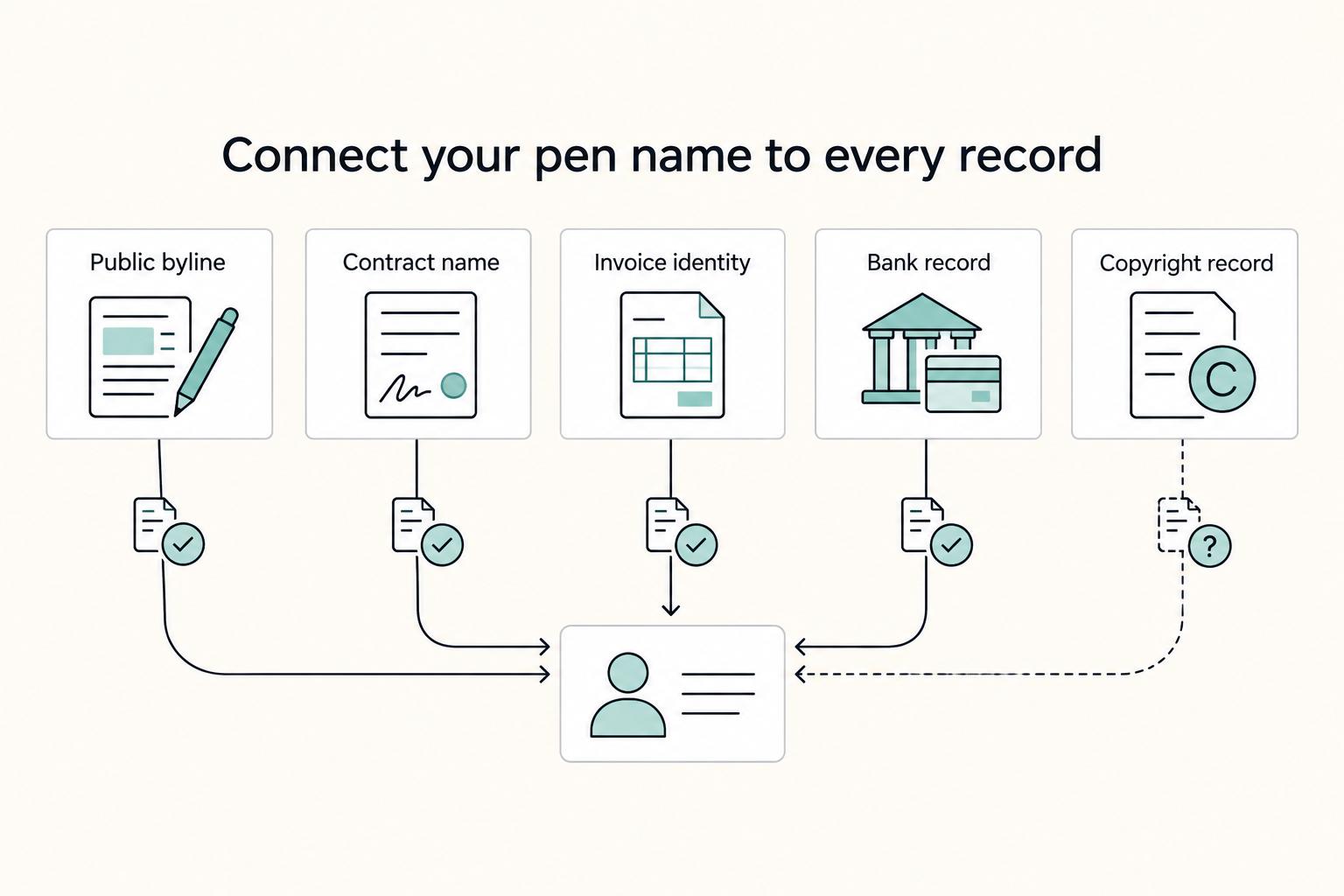
Quick Answer
A pen name can be your public byline while contracts and payments identify the actual person or business. Use field-specific names and a private link between them. Check local business-name rules and provider requirements before billing, and review U.S. copyright registration’s public identity and term effects before filing.
Use a pen name without breaking contracts, payments, or tax workflows#
Using a pen name safely is mainly a documentation task. The job is to keep your public name and your legal identity clearly linked anywhere enforceability, payment, or compliance could become relevant.
This article is about workflow for freelancers and consultants, not branding advice. You want one consistent trail from your public-facing name to the legal person or business behind it, so your records are easier to reconcile if questions come up later.
Start with the real constraint#
A pen name can be public-facing, but legal-identity requirements vary by context and jurisdiction. If you do not map those identities together on purpose, your documentation gets hard to reconcile.
Use a simple identity check when a client needs an agreement, invoice, or payout setup: can its reviewer connect the public name to the actual contracting party and payee? You can choose and test a byline while gathering those records; resolve required legal or payment fields before using them in the affected transaction.
Keep the scope narrow and verifiable#
For U.S. copyright, use the Copyright Office’s pseudonymous-work instructions. They address author fields, public disclosure, and copyright term. Those rules are specific to copyright registration, not a substitute for contract or bank requirements.
Keep copyright separate from contract, payment, and tax workflows. Local business-name rules and the exact client or provider fields determine the other steps. A public byline does not automatically become an approved business or bank-account name.
Know what you should leave with#
By the end, you should have a naming system that does three jobs:
- protects public privacy where that is your goal
- keeps contracts, invoices, and records internally consistent
- preserves a usable record trail if payment, authorship, or ownership is later disputed
The rest of the article follows that sequence. Build the identity map first, then test how names appear across contracts, payment workflows, and U.S. copyright choices.
Prepare your identity map alongside your public byline#
Start with the names and intended uses you know. Add the client, invoice, and payment records as those workflows become relevant, and resolve required fields before signing or billing.
Build a one-page identity pack#
Build a private one-page identity map using available records and labelled gaps:
- your chosen pseudonym
- your legal name
- a simple map of where each name appears
- proof of use you can produce later
If U.S. copyright registration may apply, add that workflow now. In the standard application, the Copyright Office generally asks for the creator's full name unless the work is anonymous or pseudonymous. For multiple creators, follow each author’s required fields and any applicable anonymous or pseudonymous treatment. For work made for hire, do not list the individual creators as the author.
Set up the core documents with one naming logic#
Use one naming logic across your core operational documents. Common steps include:
- contract template
- invoice template
- payment profile, for example PayPal
- mailing setup, including a P.O. Box if you choose one
Be explicit about which name is public-facing and which name is the legal payee.
Decide whether local name registration may apply#
Before you ask clients to pay the public name, check whether local business-name registration rules may apply. Do not assume it is always required, and do not assume it is never required. Check local rules and your payment provider or bank onboarding requirements.
Run one full verification pass#
Before using a payment path, put the applicable contract, invoice template, and payout fields side by side. Confirm that client finance can identify the intended payee. A draft profile or open question can support initial discussion; complete the provider’s required identity checks before receiving payments through it.
Select and pressure-test your pseudonym before client rollout#
Treat your pseudonym as an operations choice, not just a branding choice. The right name is one you can use publicly while keeping contracts, invoices, and payout records clear.
Choose a pseudonym you can actually operate under#
Choose a pseudonym that fits your privacy goal and keeps your records clear. Clean separation helps, but the real test is simpler: if someone sees your public name and legal payee name side by side, is the relationship clear without guesswork?
Add one line to your private identity map, for example: Public byline: X; legal contracting/payee name: Y. Use it to check how each name appears in the records you actually need.
Check your documentation before rollout#
Keep available documentation linking the pen name to you, such as a publishing contract or self-publishing account record. A new writer may initially have drafts and a private identity note; already-published work is not a universal prerequisite to choosing a byline or discussing a client engagement.
When the arrangement supports it, connect the legal party and public name explicitly. Legal Name, writing as Pen Name identifies attribution without implying a registered business name. Use doing business as when it accurately reflects your business-name setup, and retain the relevant records.
Set your disclosure boundary early#
Set your disclosure boundary before the first paperwork request. Public materials can use the pen name. Give the client the actual legal party and required payee details privately, and reference the byline separately. If a business name is used, check its applicable registration and bank requirements.
Make that boundary explicit from day one. The party paying you needs enough identity detail to process payment and keep records straight.
Build a name-use matrix for byline, contract, invoice, bank, and copyright#
Use one name-use matrix across every workflow. Public-facing surfaces can lead with your pen name, while records tied to payment, rights, or enforcement often need a reliable link back to your primary or legal identity record.
Lock the default name for each surface#
A common operational risk is inconsistency across records, not the pseudonym itself. If your contract, invoice, and payout records point to different identities, you create avoidable questions.
| Matrix row | Byline | Contract signature block | Invoice header | Payee account | copyright notice |
|---|---|---|---|---|---|
| Primary display name | Pen name | Primary/contracting name, with a controlled link to pen name if needed | Match contract-facing vendor identity closely | Name used in the institution's relevant account field(s) | Public attribution choice |
| Where legal name appears | Usually not public | Often in the signing identity for record clarity | In payee/remittance details as needed | In primary/legal identity field where used | Depends on your disclosure choice |
| Where pen name appears | Yes | Optional as linked identifier | Useful when clients know you by byline | Only if a separate preferred/business-facing field exists | Yes, if attribution is under the pseudonym |
| Verification check | Public profile matches published work | Signing identity can be tied to your internal identity record | AP can reconcile invoice to contract without guesswork | Profile fields are current and field-specific | Attribution is consistent with your public identity |
Do not treat every field labeled "name" as interchangeable. Some systems separate legal or primary names from preferred names, so your matrix should reflect how the field actually works.
Add field-specific linkage instead of one blanket rule#
A single "one true name" rule usually breaks down in practice. You need field-level mapping: which name belongs in which field, for which audience, and with what private proof.
Add these rows to your matrix:
- Internal identity link:
Public byline: X; contracting/payee identity: Y - Payment profile field labels, especially where primary/legal and preferred names are separated
- Filing-context name fields, if present, and how they map back to your internal identity link
Treat filing labels as record entries, not branding defaults. Do not copy your byline into each field by habit.
Verify the joins and protect the private link#
Compare the available contract or draft, invoice template, applicable payout fields, and a draft or published sample. Mark unresolved fields and ask the relevant client or provider. Complete required contracting and payment details before the affected signature or invoice; the comparison itself need not wait for a published sample.
Keep records of configured fields, such as relevant profile screenshots, and store the private identity link as confidential operational data. Share only what the client or institution needs, through its approved channel, rather than exposing that link in a public biography.
If you keep one rule, make it this: use the pseudonym for public attribution, and keep a consistent legal-name bridge anywhere money, rights, or enforcement records are involved.
Put the identity map into your contract language from day one#
Your contract should settle the identity question up front. Make the legally bound party your legal identity, or legal business name, and treat the pen name as public attribution.
Define the party with a clear legal-name bridge#
Start in the party definition and mirror it in the signature block. Use a clear bridge such as Legal Name, writing as Pen Name or Legal Name (public byline: Pen Name).
The wording can vary, but aim for one clear result: a reader should be able to see who is legally bound and which name is used publicly. If the agreement header, signature block, and invoice template do not point to one consistent identity trail, revise them before sending.
Keep labels distinct. For U.S. copyright registration, an author’s d.b.a. designation is not a pseudonym in the Name of Author field. The Copyright Office Compendium, section 615.2, places optional d.b.a. information in a note or cover letter, which can enter the public record. This is a filing-field rule, not a ban on accurately using a business name in contracts.
Review the core risk clauses before sending#
Identity confusion can show up in the risk clauses, not just in the intro. Before you send a first draft, review these sections for consistency with your identity bridge:
Governing LawJurisdictionDispute ResolutionTerminationLimitation of LiabilityIndemnification
These are not automatically required in every contract, but if they are included, they are good places to check for naming consistency. If the party is your legal name in one section, do not let later clauses switch to only the byline.
Separate enforceability from attribution if procurement pushes back#
If a client will not accept alternate names in vendor paperwork, keep the contracting party as your legal identity and handle byline use in a separate attribution sentence.
That can keep enforceability clear while preserving the publication name. Do not let byline language disappear entirely if attribution matters to you. Also avoid loose substitutions. A nickname is not the same as a pseudonym. Use one stable public name across the deal documents.
Redline one-sided risk terms before work starts#
If Termination or Indemnification terms are heavily one-sided, renegotiate before the first deliverable.
This is a risk decision, not a claim that those terms are always unenforceable. If a client will not move, decide deliberately whether to reprice, narrow scope, or decline the engagement.
Final check before signature: the party definition, signature block, byline language, and risk clauses should all tell the same story.
Want a clean starting draft before legal review? Build a first-pass agreement, then add clear legal-name and byline language with the Freelance Contract Generator.
Align invoices, payout rails, and compliance gates to prevent payment holds#
Payment issues are easier to resolve when identity records stay consistent. Keep one legal payee trail, and use your pen name for public attribution rather than as the core payee identity.
Mirror the contract name on every invoice#
Carry the same identity bridge from the agreement into the invoice header, payee line, and remittance details. If the contract uses Legal Name, writing as Pen Name, do not switch the invoice to only the byline.
This is a reconciliation control. Approvers should be able to match contract party and invoice payee without an exception. If onboarding includes legal-name or EIN fields, keep them aligned with the same payee identity shown on the invoice.
Keep DBA and payout profiles consistent#
If you use a DBA, keep the invoice payee, bank profile, and payment-platform profile aligned. Avoid mixed variants such as legal name in the contract, DBA-only on the invoice, and a different name in the payout account.
For a PayPal Business account, a business-name change requires documents verifying the legal change and triggers re-verification of linked bank accounts. To transfer money to a bank, the new business name must match the name registered on that bank account. A new business needs a new Business account rather than a name update to an existing one. Do not treat a public pen name as permission to bypass these identity requirements.
Expect compliance checks on cross-border payouts#
Cross-border payout processes vary by payer and jurisdiction, and this guide does not establish one universal checklist. Keep the payee identity consistent across the contract, invoice, and payout setup to reduce avoidable exceptions.
If you are asked to confirm payee details, respond with the same legal identity already used in those records, with the pen name positioned as attribution.
Run a first-payment checkpoint and keep records#
Before the first real invoice, confirm the required fields and intended payment path. Save the payment confirmation after the transaction succeeds. Check:
| Checkpoint | What to confirm |
|---|---|
| Name match | Contract party name and invoice payee match |
| Payout profile | Bank or PayPal payout profile matches what the client expects to pay |
| Remittance | Remittance details are correct and monitored |
| Payment terms | Confirm payment timing, who approves invoices, and the client’s applicable policy or contact |
| Vendor record | The client payment contact can find your vendor record without manual exception handling |
Retain the signed agreement, invoice, applicable vendor setup confirmation, and agreed payment terms. Add the successful payment confirmation after payment completes. Save only the identity evidence required for that engagement and restrict access to it.
Handle U.S. copyright registration with eyes open on privacy and term effects#
Treat U.S. registration as a public-record step with added legal benefits. If pseudonym treatment or term effects matter to you, confirm them in official Copyright Office guidance before you file.
Decide whether to register now, and why#
Your writing is protected once it is fixed in a tangible medium, meaning written down or typed. The U.S. Copyright Office still recommends registration to create a public record of ownership and for additional legal benefits, including the ability to bring an infringement claim for U.S. works.
If privacy matters, make that tradeoff explicit before filing. Registration creates a public record.
Confirm the filing path and publication status first#
For one literary work, the Standard Application is a common route. The Single Application is available only for an eligible single work created entirely by one individual who is also the sole owner, and not a work made for hire. Group registration options have their own conditions. A filing requires an application, fee, and deposit copy; select the route matching your work before submitting.
Use the Copyright Office meaning of "published," not the casual one. A work is published when distributed to the public by sale, rental, lease, lending, or other transfer of ownership. It is also published when offered to a group for further distribution, public performance, or public display.
Use official Copyright Office materials for pseudonym questions#
Use Circular 32 and the Copyright Office’s author-field help for pseudonymous works. The individual author’s fictitious name must identify the work, with the real name absent from its copies and copyright notice. Nicknames or abbreviated legal names do not automatically qualify, and an organization cannot author a pseudonymous work.
For works created on or after January 1, 1978, pseudonymous protection generally lasts 95 years from publication or 120 years from creation, whichever ends first. Identifying the author’s real name in Copyright Office records instead makes the term life plus 70 years. Providing that name is optional for a qualifying pseudonymous work, but it becomes public. Review every public application field and address before submitting: the Office will not remove the real name after the registration certificate is issued. Follow Circular 32 for appropriate pseudonym entries in author and other registration fields.
File deliberately and keep a complete record#
Once you are ready to file, slow down and keep the record complete. Save what you submitted, the deposit copy, fee confirmation, and your publication-status notes. Then verify that the submitted details match your own records while everything is still fresh.
Protect privacy in operations without creating legal blind spots#
Privacy controls help, but they do not create anonymity. The practical goal is to separate identities on purpose while assuming small operational details can still reconnect them.
Separate public channels early, then verify what is visible. Use dedicated pen-name email, site, and social accounts, and keep personal accounts and location details out of public bios and profile fields. Platforms may support pseudonymous identities, but personally identifiable data can still leak through routine profile and content choices. Checkpoint: review each public profile while logged out and remove anything that directly ties back to your legal identity.
Plan physical mail privacy where needed. A P.O. Box can separate a public contact address from your home address, but does not guarantee anonymity. Check what address a client, service, or public filing actually requires before using it, and review what will be visible.
If you keep a pen-name-to-legal-name record, keep it private and access-limited. Store only what you truly need, and restrict access to people with a real operational need. Treat this as sensitive data because pseudonymity can still fail when identifiable details are exposed.
Recheck privacy controls whenever your footprint changes. Do not treat setup as final. Each new platform, client workflow, or public profile update is another chance to expose identifying data, so run recurring checks and refresh your review notes as you go.
Decide when trademark matters and when it is unnecessary overhead#
Do not start with trademark reflexes. Start with business purpose. If you cannot clearly explain why the pen name exists, trademark work may be extra overhead at this stage.
A pseudonym already creates identity-management work, so add more legal process only when there is a concrete business reason. Practical publishing guidance points the same way. Using your real name is usually simpler, and a pseudonym should have a specific reason behind it.
Write the business purpose down#
Write a one-sentence purpose for the pen name and record where you use it now. If that purpose is vague, pause before adding more process.
Use that purpose to triage effort#
Use that purpose to triage effort. If the reason is still narrow or uncertain, consider deferring trademark action and focus on keeping your records clean. If the name is becoming important to how you run the business, move trademark review higher on your legal checklist.
Set a revisit trigger#
Set a revisit trigger so this decision does not disappear. Recheck when the business purpose for the name changes materially, and update your internal identity records at the same time.
Treat this section as an operational escalation filter, not a legal conclusion.
Add cross-border checkpoints before taking international clients#
When identity requirements are unclear, do not guess. Until they are confirmed, avoid mixing identities across legal documents, and keep your pen name for bylines or public branding.
Build a jurisdiction log before onboarding#
Build a jurisdiction log before onboarding. For each active country or client, track:
| Log field | What to record |
|---|---|
| Public name used | Public name used |
| Contract party name | Contract party name |
| Invoice/payee name | Invoice/payee name |
| Required onboarding or tax forms | Required onboarding or tax forms |
| Status | Confirmed, unclear, or needs local accountant/counsel confirmation |
Use the log to ask questions during onboarding. Resolve the client’s required contract, invoice, and tax-form fields before the affected agreement or payment is finalized; an unanswered question need not block the initial conversation.
Ask identity questions early and in writing#
Ask identity questions early and in writing with finance or procurement. Confirm which fields must use your legal name, whether aliases must be disclosed, and where exact name matching is required.
For example, Form W-9 is for U.S. persons, including resident aliens. A sole proprietor enters the individual name shown on the tax return on line 1 and the trade or d.b.a. name on line 2. A foreign person generally uses the appropriate different form, not W-9 merely because a U.S. client requests identity information. Complete the actual form’s instructions rather than copying the public byline into every field.
Treat signatures as legal controls, not branding space#
Treat signatures as legal controls, not branding space. If pseudonym enforceability is unclear, pause for local advice and reference your public name separately where appropriate.
Use the client’s signature instructions and identify the actual person or business bound by the agreement. Keep the public byline separately linked. If local rules or the proposed signature wording leave enforceability uncertain, resolve that issue before signing rather than borrowing rules from unrelated government filings.
Escalate unknowns before work starts#
Escalate material identity or enforceability questions before the affected agreement is signed or payment setup is used. Keep discussing scope and gathering the necessary records while the responsible client contact or adviser answers specific questions.
Keep the signed contract, invoice template, and written onboarding identity requirements together so contract and payment records stay consistent. Record unresolved questions and who is answering them.
Fix common failure modes quickly when identity mismatches appear#
When identity questions surface, fix the records that establish accountability first. Then clean up byline language and public presentation.
Reconcile the core name trail first#
Reconcile the core name trail before you resubmit anything: contract party, invoice payee, and payout account name where those fields apply. Keep those records aligned to the exact fields the client or platform requested.
Institutions often ask for a "Legal Name," but that label is not applied the same way everywhere, and there is not one universally correct legal name in every context. The practical check is whether a reviewer can connect your agreement and related records to one clearly documented identity without guesswork.
Start with a narrow contract edit#
If a client legal team objects to your pseudonym, start with a narrow edit request instead of reopening the full deal. Ask whether they will allow contracting records in your legal or primary name with separate wording for your public byline.
Ask for written confirmation on whether any alias disclosure is also required in onboarding records.
Treat post-registration privacy issues as records problems#
If you have a privacy concern after a public filing, treat it as a public-record risk that may not be fully reversible. Shift from branding fixes to records control: log what was filed, which name appears, and what you will change in future filings.
Use that log as a pre-submission check so you do not repeat the same exposure pattern.
Prepare dispute evidence before a dispute starts#
Prepare dispute evidence before a dispute starts. Keep the signed contract, amendments, and identity map together for each client.
If you use an alternate professional name, a private bridge note can link it to your legal identity for recordkeeping. An affidavit is not a universal requirement; provide additional evidence only when the actual client, institution, or applicable procedure requires it.
Copy-paste checklist for your first pen-name client#
Treat your first pen-name engagement as an identity-reconciliation task. Resolve the required contracting-party fields before signing, the invoice and payee fields before billing or payment setup, and any ownership or filing details when that rights workflow applies.
Finalize your identity map. Put in writing where your pen name appears and where your legal name appears. Keep public channels, such as bylines, bio, and social, separate where practical from legal and payment records, but linked clearly enough that you can answer, "Who is this?" with one document.
Review your contract’s name bridge and applicable risk terms. Identify the legal party and public byline clearly. Check any included governing-law, jurisdiction, dispute-resolution, termination, liability, and indemnification clauses for consistent identity and acceptable risk; these clauses are not all mandatory for every engagement.
Align invoice payee, payout profile, and any d/b/a records before billing. A d/b/a is a name designation, not a separate legal entity. Your contract name, invoice payee, and receiving account details should reconcile clearly and follow each platform or client program's stated requirements to reduce onboarding and payment friction.
Decide your U.S. copyright filing posture before you need it. If you plan to file U.S. copyright registration, decide your privacy versus disclosure position in advance. Then verify current U.S. Copyright Office filing instructions before you submit.
Set privacy controls and keep relevant proof private. Separate public channels where practical. Retain signed agreements and invoices as they are created, and add available authorship or publishing records when relevant. Share bank or identity documents only when the actual recipient requires them, through its approved channel; a full bank-statement or ISBN dossier is not required for every pen-name engagement.
Re-check local rules for each new country, platform, or client program. Ask which name belongs in required onboarding, tax, invoicing, and payout fields, and save the answer. Public use of a pen name does not automatically authorize pseudonymous court proceedings; a dispute requires the applicable court’s procedure.
Related reading: A Guide to Ghostwriting Contracts.
As your required client and payment details are confirmed, choose a payout flow you can track and reconcile for cross-border work with Gruv Payouts.
Frequently Asked Questions
Is it legal to use a pen name for freelance client work?
Using a pen name for bylines, portfolio credits, and client-facing branding can work. The practical risk is whether contracts, invoices, and payout records still map to a real legal person or business. Keep the pseudonym public-facing, and disclose your legal name where contract, tax, or compliance steps require it.
Can I sign contracts with a pen name only?
Do not assume a pen-name-only signature is enforceable in every jurisdiction. A safer format is [legal name] writing as [pen name]. That gives a clearer identity bridge if a client legal team, bank, or dispute reviewer asks who signed.
Can I register copyright under a pseudonym in the United States?
Yes, for a qualifying pseudonymous work by an individual. Use the Pseudonymous checkbox and Pseudonym field as instructed. The real name must appear nowhere on the work’s copies or copyright notice for that treatment. You may omit the real name from the registration where the instructions allow it; if included, it becomes public and affects the copyright term. Review all public fields before filing because the Office will not remove that name after issuing the certificate.
Is a pen name itself protected by copyright?
No. A pseudonym itself is not protected by copyright. Copyright protects the work, not the name.
Do I need a DBA to invoice and get paid under my pen name?
Sometimes, depending on local law and payment setup. In Missouri, conducting business in the state under a name other than the owner’s true name requires fictitious-name registration; merely choosing a public byline is not the same universal trigger. The filing does not grant exclusive name rights. For U.S. copyright author fields, a d.b.a. designation is not treated as a pseudonym. Before billing, reconcile the contract party, invoice payee, and required payout-account names.
What changes if I work with cross-border clients?
Treat cross-border setup as jurisdiction-specific. Country-specific contractor, tax, and payout rules vary, so ask in writing which name must appear in each required field. If local enforceability under a pseudonym is unclear, contract under your legal identity and keep the pen name for public bylines.
Researched and edited by the Gruv editorial team. Gruv builds cross-border billing, payouts, and finance-operations software for global businesses.
Sources
Educational content only. Not legal, tax, or financial advice.
Related Posts

Work for Hire vs Assignment of Rights for Freelancers
A freelance agreement is not just about price and scope. It decides who controls the rights in the work. If the ownership language is loose, rights can move earlier than you expect, cutting down your control once the work is delivered or used.

Germany Freelance Visa Application Path for Freiberufler and Gewerbe
Choose your track before you collect documents. That first decision determines what your file needs to prove and which label should appear everywhere: `Freiberufler` for liberal-profession services, or `Selbständiger/Gewerbetreibender` for business and trade activity.

How to Structure an LLC for a Freelance Writing Business
Start here when speed and simplicity matter more than entity admin. Keep setup light, focus on winning and serving clients, and use insurance with a clear view of what it can and cannot do.