
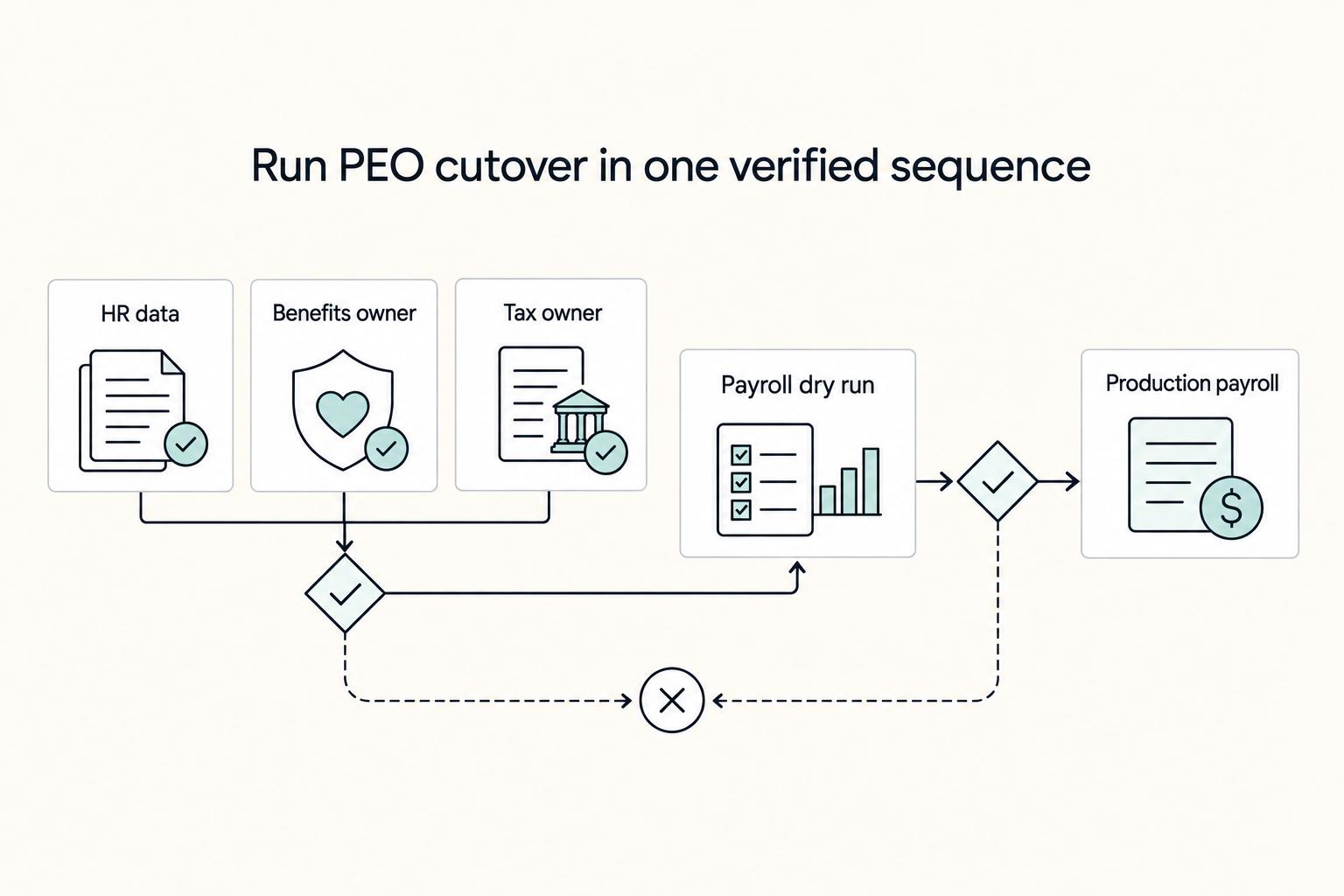
Quick Answer
Start with contract control, then execute the handoff in order. For how to switch peo providers, confirm the notice period and termination clause, pick a payroll cutover date that matches your payroll calendar, and do not send formal notice until a replacement can meet that timeline. Require a written offboarding schedule, validate HR data before benefits and payroll work, run a parallel payroll dry run, and pause launch if roster matching, deduction matching, or tax-filing ownership is unresolved.
Why a PEO switch needs contract control and a sequenced handoff, not a simple vendor replacement#
You can switch a Professional Employer Organization cleanly if you treat it as a contract exit and an operating handoff, not a simple vendor swap. To reduce payroll surprises, review your current agreement first, choose a timing window you can actually support, and verify key handoffs before the first live payroll.
A PEO is a third party that provides HR services under a co-employment relationship. In practice, that can include payroll, benefits administration, compliance, and risk management, while you still manage your people and their performance. That is why a switch takes real care. You are not just changing software. Depending on how the old and new providers work, you may also be changing legal structure details, HR access, payroll tools, and even benefits or 401(k) administration.
Before you start#
This guide is built for independent professionals and small operators who need a clean transition, not a theoretical overview. The focus is operational: current contract terms, transition timing, payroll coordination, benefits administration, and compliance-related handoffs. It also covers the documents and checkpoints that keep small issues from turning into employee-facing problems.
The main recommendation is simple: do not send formal termination notice until you have a clear replacement path that can meet your timeline. At minimum, you should be able to verify your current contract terms, your payroll calendar, and the data you will need to transfer. If one of those is still fuzzy, you are not ready to lock a cutover date.
What this guide will help you do#
The steps ahead follow a switch sequence. First assess the issues with your current PEO, then review the current contract and terms, prepare internal resources and data transfer, notify the current provider, and send a formal termination notice. That order helps keep offboarding tasks aligned with cancellation timing.
A common failure mode is assuming the new provider can "take it from here" without a detailed handoff. That can increase the risk of payroll mismatches, benefits gaps, or role confusion during the transition. A better checkpoint is written confirmation of who is doing what, by when, and what will be validated before the first production payroll.
This is not legal or tax advice, and it should not replace review by counsel or your tax advisor when contract language or filing responsibility is unclear. It is a practical operator's guide to reducing downstream surprises so you can make the switch with better control over payroll, benefits administration, and day-to-day operations.
Gather prerequisites before you notify your current provider#
Before you send notice, lock down documents, ownership, and timing so your exit is controlled from day one.
| Prerequisite | What to gather or set | Checkpoint |
|---|---|---|
| Starter evidence pack | Current PEO agreement; termination clause; notice period; auto-renewal date; early termination fees; data access rights; offboarding responsibilities | One owner can confirm when notice is due, what data must be returned, and who handled the latest filings |
| Payroll and filing records | Payroll calendar; benefits renewal date; recent tax filings | Add them in the same folder before notice |
| Transition owners | Contract/notice period; HR data transfer; benefits administration; employment taxes | Set one named owner for each transition lane |
| Non-negotiables | Service levels you will accept; cancellation-fee exposure you can tolerate; payroll cutover risk you will not accept | Treat unclear data rights or a rushed first payroll as a no |
| Living checklist | Track owner; due date; dependency; verification checkpoint | Flag Ohio renewal-related timing if you operate in Ohio |
- Build a starter evidence pack.
Gather your current PEO agreement and mark the terms that control your exit: termination clause, notice period, auto-renewal date, early termination fees, data access rights, and offboarding responsibilities. Add your payroll calendar, benefits renewal date, and recent tax filings in the same folder. Verification checkpoint: one owner can confirm, from documents, when notice is due, what data must be returned, and who handled the latest filings.
- Assign a named owner for each transition lane.
Set one owner for contract and notice period, one for HR data transfer, one for benefits administration, and one for employment taxes. When ownership is unclear, critical checks are easy to miss until the first live payroll.
- Set non-negotiables before vendor conversations drift.
Write down the service levels you will accept, the cancellation-fee exposure you can tolerate, and the payroll cutover risk you will not accept. If a proposed timeline depends on unclear data rights or a rushed first payroll, treat it as a no-go.
- Open a living PEO transition checklist.
Track every task with owner, due date, dependency, and verification checkpoint. If you operate in Ohio, flag renewal-related timing because cited premium-rate revisions can apply to renewals, reinstatements, and new coverage effective on or after July first each year.
Decide whether to switch providers or change operating model#
Make this decision in two passes: confirm whether the pain is provider execution, then confirm whether your current model still fits. If contract friction is manageable but service quality stays weak, switching providers is usually the cleaner move than renewing and hoping.
Step 1: Assess the failure pattern, not just the frustration#
Sort issues into four buckets: service levels, platform fit, benefits administration, and repeated payroll misses. This keeps isolated incidents from being treated like a full-model failure.
Use your PEO transition checklist and attach evidence to each issue. Separate one-off problems from patterns, especially around slow or unhelpful support, payroll errors, and benefits corrections. Note where you have outgrown current services or need more flexibility and control.
Verification checkpoint: each major complaint is documented and tagged as either a provider execution issue or a model-fit issue. Failure mode: treating everything as a vendor problem when your operating needs have changed.
Step 2: Compare paths side by side before re-signing#
Do a fit check before you run a full vendor process. A switch can affect payroll, benefits, and responsibility boundaries, so compare options directly.
| Path | Consider it when | Verify first |
|---|---|---|
| New Professional Employer Organization (PEO) | Your model still fits PEO, but delivery quality is consistently weak | Whether the replacement can meet your payroll cadence, benefits needs, and support expectations |
| Human Resources Outsourcing (HRO) | You want a different outsourcing setup for more flexibility or control | Which responsibilities remain with your team and how payroll and benefits will be handled |
| Employer of Record (EOR) | Your employment setup has changed enough to re-check model fit | Whether provider responsibilities match your hiring approach and growth stage |
If you need a refresher before vendor calls, read EOR vs. PEO: What's the Difference?.
Step 3: Apply one rule and document it#
Use a simple rule: if exit terms are workable but delivery quality is consistently poor, switch to another PEO. If your employment model changed, pause and reassess PEO vs. HRO vs. EOR before committing.
Write the decision in a short memo with root causes, chosen path, accepted risks, and supporting evidence. That memo keeps your termination and replacement process tied to business reasons rather than urgency or sales pressure.
You might also find this useful: How to Choose an Employer of Record (EOR) Provider.
Choose the timing window that minimizes tax and payroll risk#
Pick the switch window you can execute cleanly, not the date that only looks clean on paper. Before you commit, line up your contract timing, payroll run dates, tax filing responsibilities, and benefits milestones in one working plan.
Step 1 Map non-negotiable dates first#
Start with the dates that constrain you: contract notice and termination timing, payroll cycle deadlines, filing dates, and benefits deadlines. Build a shared calendar so everyone sees the same handoff path.
Do not lock a go-live date while key items are still unclear. If responsibilities or dates are still marked as uncertain, treat that as a planning gap, not a detail to solve at the last minute.
Step 2 Choose the most executable window#
When timing is tight, favor the window your team and both providers can actually deliver. A theoretically perfect date is still high risk if handoff tasks, data transfer, or approvals are not stable.
If payroll timing and benefits timing do not align neatly, make the sequencing explicit. What matters is a clear, agreed order of operations.
Step 3 Set cutover controls before launch#
Use a written cutover plan with clearly named owners, confirmed dates, and explicit stop conditions. Keep legal transition timing and operational payroll timing documented separately so there is no ambiguity during handoff.
Define no-go triggers in advance and pause if they are unresolved, including:
- missing payroll inputs for the first live cycle
- incomplete benefits setup for affected employees
- unclear filing responsibility during transition
Review the contract and send a termination package that prevents disputes#
Your best dispute-prevention move is to make your exit package contract-anchored and hard to misread. If notice terms or offboarding requests are vague, you leave room for fee conflicts, delayed HR data transfer, and handoff confusion.
| Termination item | What to capture | Written evidence |
|---|---|---|
| Termination mechanics | Notice period; whether notice must be written; when the notice clock starts | Signed agreement and exact clause text |
| Renewal and fee terms | Any auto-renewal window; cancellation-fee language; flat or prorated language where stated | Signed agreement and exact clause text |
| Delivery and offboarding terms | Required delivery method; post-termination offboarding requirements; co-employment relationship and division of responsibilities | Signed agreement and exact clause text |
| Termination letter | Exact contract section; notice date; requested termination effective date; contract-required delivery method; HR data transfer deliverables; request for written receipt confirmation and effective-date acknowledgment | Letter and receipt confirmation |
| Offboarding record | Written, dated offboarding schedule for payroll calendar handoff, benefits administration transition, and employment taxes responsibility boundaries | Notices; delivery receipts; acknowledgments; any fee objections |
Step 1 Read the termination clause line by line#
Start with the signed agreement and map the exact termination mechanics: notice period, whether notice must be written, when the notice clock starts, any auto-renewal window, cancellation-fee language, required delivery method, and post-termination offboarding requirements.
Many contracts require written notice. One switching guide says many use a 30 to 90 day range starting when the provider receives the formal termination letter. Treat that as context, not a rule, and follow your agreement. Also check where the contract defines the co-employment relationship and the division of responsibilities, since those terms often control handoff ownership.
Verification checkpoint: confirm the exact clause text for notice, auto-renewal, cancellation terms, including flat or prorated language where stated, and offboarding obligations.
Step 2 Send a termination letter tied to the contract#
A strong PEO termination letter should do one thing clearly: connect your request to the agreement and name deliverables. Include:
- the exact contract section governing termination
- the notice date and requested termination effective date
- the contract-required delivery method
- the HR data transfer deliverables you are requesting
- a request for written receipt confirmation and effective-date acknowledgment
Precision matters here. Clear, clause-based requests reduce back-and-forth and are easier to enforce if disputes appear later.
Step 3 Get a written offboarding schedule and keep evidence#
Ask for a written, dated offboarding schedule that covers payroll calendar handoff, benefits administration transition, and employment taxes responsibility boundaries during the changeover. Since the agreement should define responsibilities and liabilities between both parties, do not rely on a generic "we will coordinate" response.
Keep a complete evidence trail: notices, delivery receipts, acknowledgments, and any fee objections. If a fee is disputed, respond with contract language and your notice timeline in writing.
Select the replacement PEO using a weighted scorecard#
The right replacement is the one that can execute your transition inside your notice period and payroll calendar, with clear ownership for tax and benefits handoff work.
Step 1 Build a scorecard around execution, not sales polish#
Use a weighted scorecard before finalist calls so the decision stays tied to execution. Keep the same four categories: service-level expectations, payroll cutover support, benefits administration depth, and contract flexibility. If a provider cannot meet your cutover window, treat that as a no-go even if the demo is strong.
| Criteria | What to ask for | Red flag |
|---|---|---|
| Service-level expectations | Named support model, escalation path, response commitments in writing | Vague "dedicated team" language with no named owner |
| Payroll cutover support | Sample implementation timeline, first-payroll checklist, exception handling process | No documented cutover sequence or no dry-run discussion |
| Benefits administration depth | Benefit setup responsibilities, carrier or enrollment process, filing support details | They cannot explain who handles plan reporting tasks |
| Contract flexibility | Term length, notice language, offboarding obligations, renewal terms | The same contract friction you are trying to leave |
Verification checkpoint: your final score should show documented execution strength, not just price or rapport.
Step 2 Require proof artifacts for every critical promise#
Do not award based on verbal assurance. Require three artifacts from each finalist: a sample implementation timeline, named transition contacts, and a documented HR data transfer process.
Then test the timeline against your notice period and payroll window. You should see dates, dependencies, and clear owners for data import, deduction setup, payroll review, and benefits enrollment.
Step 3 Stress-test tax and benefits edge-case handling#
Ask how they handle corrections, not just initial setup. IRS Publication 15 covers payroll tax adjustment topics, including reporting adjustments to Forms 941, 943, or 944; require a written process showing how corrections are identified, owned, and communicated during transition.
For State Unemployment Insurance (SUI), ask for their documented transition process and which party validates account mapping and timing. On benefits, confirm who handles required reporting tasks: if your plan is subject to ERISA, annual plan information filing may apply, and Form 5500 is filed electronically through EFAST2, not paper. If a MEWA is involved, ask whether Form M-1 filing requirement topics are in scope and who owns that work.
Step 4 Confirm timing fit before final selection#
Make the final choice only after written confirmation that the provider can execute within your notice period and target payroll cutover window. If timing depends on records you have not received from your current provider, mark the start date as conditional and set a backup date.
For broader comparisons, see The Best PEO Services for Small Businesses.
Run cutover in sequence and verify every critical output#
Run cutover in order, not as overlapping work: validate HR data, confirm benefits and tax ownership, run a parallel payroll dry run, then move to production payroll.
| Cutover stage | What to verify | Stop/go rule |
|---|---|---|
| HR data transfer | Compare the outgoing roster against the import; check active and terminated employees, compensation, work location, hire dates, and payroll-critical identifiers | If roster gaps remain, stop here |
| Benefits and tax setup | Roster match completed; deduction match for medical, dental, vision, retirement, and recurring post-tax items; tax filings responsibility confirmed; employment taxes account mapping reviewed and approved | Lock the four checkpoints in writing before the dry run |
| Parallel payroll dry run | Compare gross pay, net pay, deductions, and employer-side employment taxes; confirm day-one reporting and access migration | If first-payroll reconciliation fails, hold noncritical changes and run a controlled correction cycle |
| Employee communication | Pre-go-live notice; cutover-day notice; first-payroll stabilization notice; clear support channel | Keep each message concrete on where pay stubs appear, whether any benefits action is needed, and who owns pay or benefits issue triage |
Step 1 Validate the HR data transfer before anything touches pay#
Do not start benefits enrollment or payroll work until roster data is validated. Compare the full employee roster from the outgoing provider against the import in the new PEO, and use clear ownership on both sides so one person signs off the source and one confirms the loaded result. Check active and terminated employees, compensation, work location, hire dates, and payroll-critical identifiers.
Checkpoint: the approved source roster and the new-platform roster match, with every exception logged and assigned. If roster gaps remain, stop here.
Step 2 Confirm benefits administration and tax responsibility in writing#
Before the dry run, lock four checkpoints in writing:
- employee roster match completed
- deduction match completed for medical, dental, vision, retirement, and recurring post-tax items
- tax filings responsibility confirmed between old and new providers
- employment taxes account mapping reviewed and approved
For benefits, verify carrier changes or policy transfers are coordinated to maintain coverage continuity, and keep evidence of what was submitted, when, and by whom. For tax, responsibility may shift to the new provider, so keep evidence continuity with recent filings, account references, and written ownership for final filings, corrections, and notices.
Step 3 Run a payroll cutover dry run, then decide if you are safe to launch#
Use a parallel run before go-live and reconcile it against the last clean payroll from the outgoing provider. Compare gross pay, net pay, deductions, and employer-side employment taxes, then confirm day-one reporting and access migration so HR and finance can see the same outputs immediately after launch.
Use this operating rule: if first-payroll reconciliation fails, hold noncritical changes and run a controlled correction cycle before expanding scope. Fix pay results first, rerun the comparison, then proceed.
Step 4 Communicate to employees in phases during stabilization#
Send phased communication so employees know what changes, when it changes, and where to report issues. A practical sequence is: pre-go-live notice, cutover-day notice, and first-payroll stabilization notice with a clear support channel.
Keep each message concrete: where pay stubs appear, whether any benefits action is needed, and who owns pay or benefits issue triage.
Recover quickly when the switch goes wrong#
When the switch goes wrong, recover in this order: payroll accuracy, coverage continuity, tax responsibility, then fees.
Step 1 Contain a payroll cutover mismatch#
If payroll output is off, pause noncritical changes and reconcile against the approved pre-cutover baseline. Log each exception, assign one owner and one deadline, then rerun controlled checks before the next cycle. Treat the cycle as contained only when each variance is corrected, explained, or intentionally held.
Step 2 Close benefits and coverage gaps fast#
For benefits issues, verify what was actually sent and accepted, then track affected employees to closure. Keep a single record of enrollment files, confirmations, employee impact, and effective-date notes so follow-up is clear. Treat possible coverage gaps as urgent, including workers' compensation gaps and cancellation-notice issues that can vary by arrangement.
Step 3 Lock tax responsibility to written evidence#
If tax ownership is unclear, confirm the split in writing immediately and make responsibility explicit for unemployment insurance taxes and related filings. Keep the provider and agency records together so you can resolve notices quickly. Use IRS publication guidance as context, but not as a replacement for the law.
Step 4 Resolve fee disputes from signed records, not memory#
If the dispute is about fees, rely on the signed agreement and your dated notice trail. Keep each challenge tied to documented terms and timeline evidence so the issue can be settled without reopening unrelated transition work.
Copy-paste checklist for your next 30 days#
Use this 30-day block to reduce handoff risk, not to force a full switch on a fixed date. A successful transition is often planned over 2-4 months, so this month is for locking decisions, contract terms, and handoff proof before notice and launch pressure increase.
- Confirm the switch decision and operating model.
Decide whether you are replacing your PEO within the same co-employment setup or moving to another model, such as HRO or EOR, based on your current hiring setup and internal compliance capacity. Put two dates in writing: the contract termination effective date and the target payroll cutover date. Checkpoint: those dates align with your payroll calendar, benefits timing, and contract notice period.
- Audit the contract before notice.
Review termination terms line by line and extract the notice period, cancellation-fee language, required delivery method, and offboarding requirements. Convert that into a one-page tracker with owner, due date, and exact contract language. Checkpoint: your team is aligned on what must be sent, when, and how.
- Send a formal termination package.
Send a termination letter that references the contract section, states the effective date, and requests explicit deliverables with deadlines. Ask for company and employee records, payroll history, benefits administration records, tax-filing information, and a written offboarding schedule with named owners. Checkpoint: you have dated proof of delivery and written acknowledgment.
- Finalize the replacement provider with written commitments.
Use a weighted scorecard and prioritize transition execution: responsiveness, payroll cutover support, benefits administration coverage, and compliance handling. Require written implementation commitments, named transition contacts, and a documented HR data-transfer process. Rule: if a provider cannot operate within your notice period and payroll window, do not finalize yet.
- Validate the handoff before launch.
Complete HR data transfer, then verify roster, pay rates, deductions, and benefits enrollments against an approved baseline. Confirm in writing who owns each tax filing during overlap, since PEOs commonly handle payroll, tax filings, benefits administration, required notices, and some HR compliance in co-employment arrangements. No-go trigger: hold launch until roster matching, deduction matching, and tax-filing ownership are fully resolved.
If you want to see what Gruv supports, browse Gruv tools or talk to Gruv.
Frequently Asked Questions
What are the first three things to do before switching a Professional Employer Organization (PEO)?
First, assess the real problems with your current provider. Next, build a transition plan using your current agreement details and your benefits renewal date as key timing inputs. Then compare potential new PEOs on transition capability and prepare employee communication before the change.
When is the best time to switch PEO providers if my payroll calendar and benefits renewal date do not align?
If you can, January 1 is a common choice because many businesses use it to reduce tax complications. If that does not fit your timeline, a quarter start such as April 1, July 1, or October 1 is a practical alternative. Pick the date that your transition plan can realistically support.
How do I avoid payroll disruption during a payroll cutover?
Use a structured transition plan, not an ad hoc handoff. The practical guardrails are to compare transition capability before selecting a provider and notify employees of the upcoming change.
Why do companies switch PEOs even when payroll is mostly working?
Provider quality varies, and not all PEOs are equal. That alone can be enough reason to reassess fit and consider a change, even if payroll itself is running.
What can go wrong if notice period or offboarding requirements are missed?
Confirm specific notice-period lengths, cancellation-fee amounts, and penalty formulas directly in your contract and use a documented transition plan with written change communications.
How should I compare PEO vs HRO vs EOR for a growing business?
Start with the reason you are changing: if provider quality is the issue, compare replacement PEO capabilities first; if your employment model has changed, run a separate model-level evaluation before re-signing. For a deeper side-by-side on one of those paths, see EOR vs. PEO: What's the Difference?.
Try a related tool
Researched and edited by the Gruv editorial team. Gruv builds cross-border billing, payouts, and finance-operations software for global businesses.
Sources
- app.leg.wa.gov/documents/laws/wsr/2025/09/25-09PROP.pdftrusted
- codes.ohio.gov/ohio-administrative-code/chapter-4123-17trusted
- congress.gov/118/chrg/CHRG-118hhrg53710/CHRG-118hhrg53710...trusted
- dol.gov/sites/dolgov/files/ebsa/employers-and-advise...trusted
- dol.gov/sites/dolgov/files/ebsa/about-ebsa/our-activ...trusted
- file.lacounty.gov/SDSInter/ceo/agendas/1189748_08.13.25Agenda-...trusted
- file.lacounty.gov/SDSInter/bos/supdocs/210039.pdftrusted
- gao.gov/assets/gao-20-195g.pdftrusted
Educational content only. Not legal, tax, or financial advice.
Related Posts

What to Do If You've Been Misclassified as an Independent Contractor
Treat this as a protection problem first, not a label debate. If your work was treated as an independent contractor arrangement even though the relationship functioned differently, your first goal is to protect pay, rights, and records while you choose the least risky escalation path. You can do that without making accusations on day one, which often keeps communication open while you document what happened.
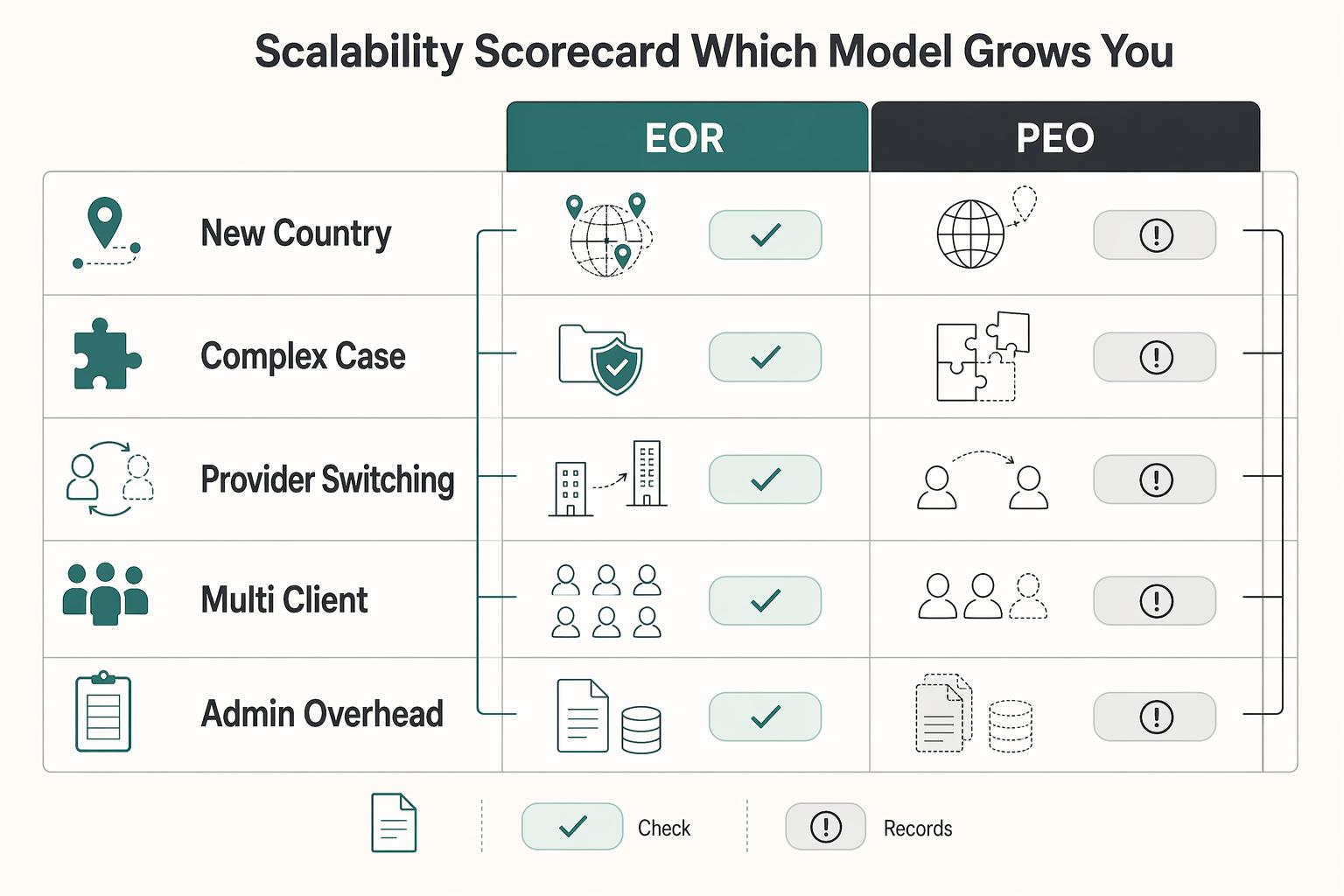
EOR vs. PEO: What's the Difference?
For a global independent professional, structure is a strategic choice, not just back-office admin. The question is not which HR label sounds better. It is which model protects your autonomy, allocates risk clearly, and lets you work across borders without unnecessary complexity.
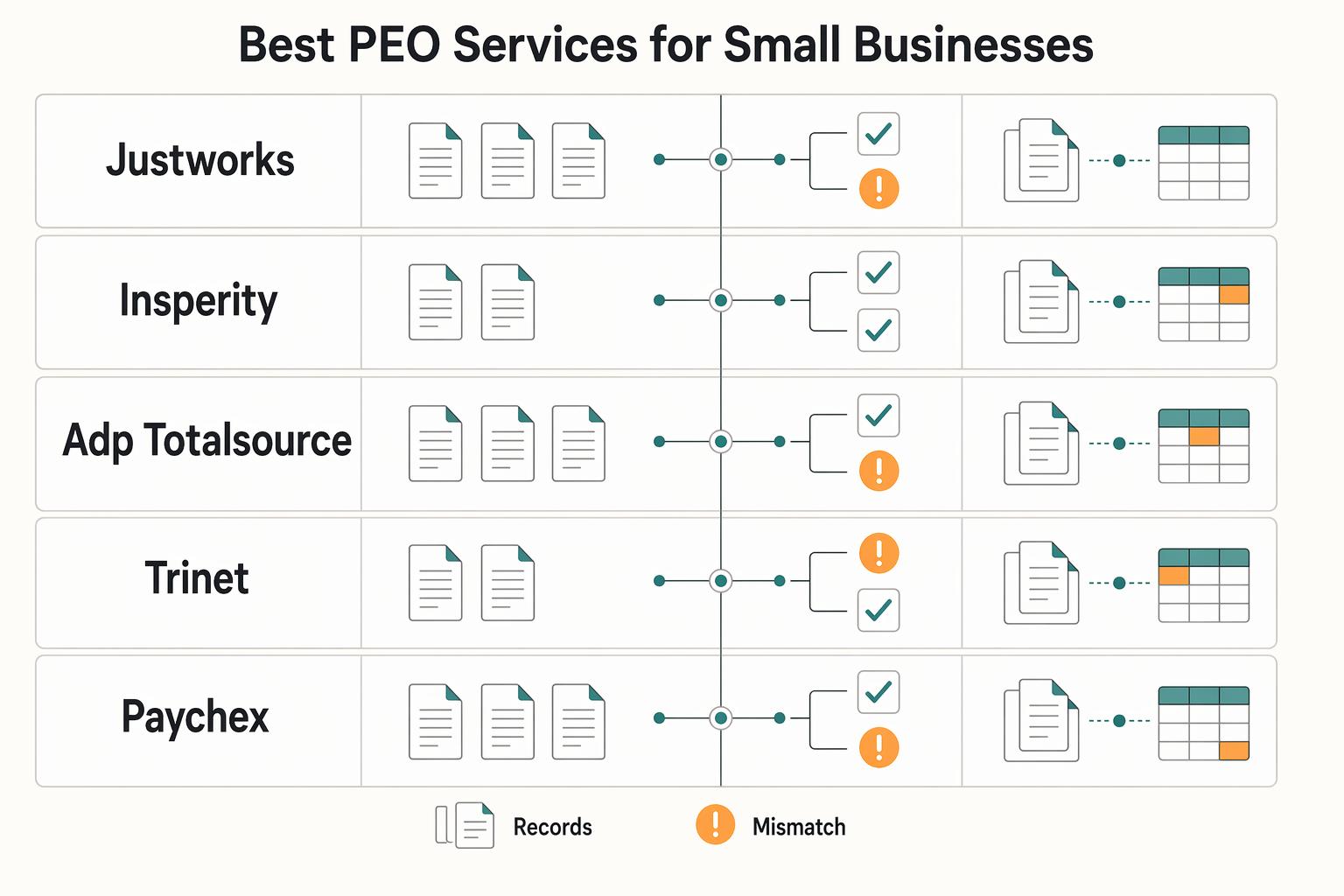
The Best PEO Services for Small Businesses
Many **best peo services** pages are just comparison lists. They help you spot names, but they usually do not answer which provider fits your hiring model, your risk tolerance, or how much HR admin your team can realistically absorb.