
Quick Answer
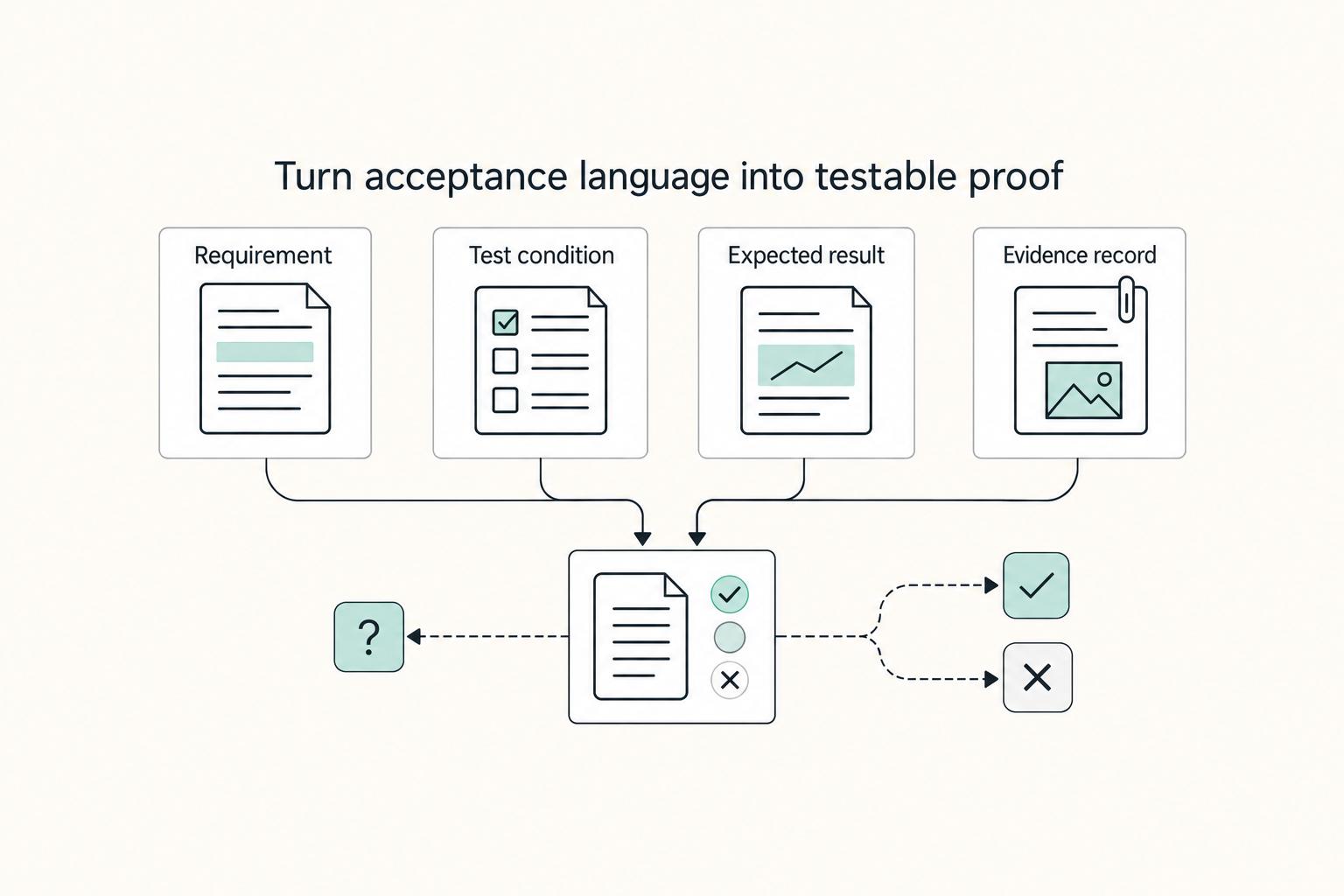
A strong testing and acceptance clause defines what is being accepted, when review starts and ends, how rejection must be submitted, and how re-testing and payment follow from that process. Use fixed review windows, one formal notice path, measurable acceptance criteria, and a payment trigger tied to a defined acceptance event so review stays traceable and scope stays controlled.
Scope creep usually gets blamed first, but a weak testing and acceptance clause is often what lets it happen. When that clause is vague, you lose control over the three things that decide whether a project stays profitable: what counts as done, what counts as extra work, and when final payment is due.
Those failures usually show up in three predictable ways:
- The Endless Revisions Trap: Without objective, pre-agreed acceptance criteria, the finish line turns into a moving target. Vague requirements invite subjective feedback like "make it more user-friendly" or "it just doesn't feel right," which traps you in a cycle of unpaid work. When "done" is not clearly defined, profitability erodes fast, and a two-week task can become four weeks of unbilled revisions.
- The Scope Creep Gateway: Acceptance criteria are the legal boundary of the project. When they are ambiguous, new requests can be argued into the original scope. A client may ask for an additional reporting feature and say it is necessary for the dashboard to be "complete." Without a specific written definition of what "complete" means, you are negotiating from a weak position. A strong clause lets you say, "That's a great idea for phase two. I'll write up a change order for it."
- The Payment Hostage Situation: This is often the most dangerous risk for a solo business. A weak clause often separates project acceptance from final payment. A client can be using the work while withholding formal sign-off, which effectively holds your final invoice hostage. That ambiguity gives them room to delay payment and forces you to chase money you already earned.
Define a review process both parties can follow#
Your acceptance clause should make completion a dated, traceable event, not a subjective discussion. If the process cannot be followed and verified in your normal records, it will be hard to defend when timing or scope is disputed.
Define Deliverable, Acceptance Testing Period, Notice of Rejection and Material Defect in the agreement. Use those terms consistently in the SOW, acceptance schedule, notice provisions and invoice terms; a definition borrowed from another contract does not automatically apply.
- Deliverable
- Acceptance Testing Period
- Notice of Rejection
- Material Defect
Step 1. Set a fixed testing period#
A fixed testing period is the first control point. Name when it starts, who is responsible for review, and what event triggers the clock.
- Require in contract text: Insert a fixed review window, the event that starts it (such as delivery notice), and the client role responsible for review.
- Why it protects you: Strict timeframes, named roles, and provable workflow steps are easier to run and easier to verify later.
- Risk if missing: Review can drift with no clear accountability or timeline.
Checkpoint: keep a delivery record that shows date, deliverable, access details, and reviewer role.
Step 2. Use one formal notice path#
Use one formal notice path for acceptance or rejection. Scattered feedback across calls, chat, and email is where disputes start, because it becomes hard to prove what was rejected and when.
- Require in contract text: Insert one approved notice channel, one destination (such as an email address or ticket address), and the required contents of a rejection.
- Why it protects you: The process is traceable only when the client uses a documented path you can verify.
- Risk if missing: Feedback fragments across channels, and you end up arguing about what was rejected and when.
Checkpoint: you should be able to determine quickly whether a rejection is valid under the clause.
Step 3. Keep the defect and re-test workflow bounded#
Bound the correction cycle to the failed criteria and proportionate regression tests for affected behavior. A fix can break a dependent feature, so excluding all regression testing would leave a gap. Distinguish those defects from new features, and preserve any agreed warranty or other surviving rights.
- Require in contract text: Define defect reporting, correction and re-test deadlines; cover corrected items and proportionate regression checks for affected behavior.
- Why it protects you: It keeps re-testing tied to specific defects and preserves a clean record of what was reported, fixed, and rechecked.
- Risk if missing: Re-test becomes repeated full review rounds, and new requests get mixed into defect handling.
Checkpoint: keep a simple evidence set for each cycle, such as the delivery notice, defect list, fix notice, and re-test response.
Step 4. Replace red-flag language before signature#
| Red-flag term | Why it puts you at risk | Use this fallback wording |
|---|---|---|
| "reasonable testing period" | No fixed boundary, so timing drifts. | "Client will complete acceptance testing within the agreed review window, starting on the agreed delivery trigger." |
| "to the client's satisfaction" | Subjective standard, not measurable criteria. | "Acceptance is measured against the acceptance criteria identified in the SOW or attached exhibit." |
| "feedback may be provided by email, chat, or verbal discussion" | Multi-channel input breaks traceability. | "Acceptance or rejection is valid only through the agreed written notice channel and destination." |
| "acceptance depends on third-party or internal approval" | Timing depends on actors outside your workflow. | "Client is responsible for internal approvals within the acceptance testing period." |
| "contractor will continue re-testing until all issues are resolved" | Open-ended obligation with no defect boundary. | Re-test the corrected criteria and affected behavior; new requirements follow change control, without waiving surviving defect remedies. |
Step 5. Do one consistency pass before you send the draft#
Before you send the draft, do one consistency pass so the clause works the same way across the contract set:
- Each defined term has one clear meaning and is used consistently.
- The testing period is fixed and tied to a named trigger.
- The clause names the reviewer role, notice channel, and notice destination.
- Valid rejection must identify unmet acceptance criteria.
- Re-test covers reported defects and affected behavior, without reopening unrelated scope.
- The full process is traceable in your normal workflow records.
For a step-by-step walkthrough, see How to Structure a Maintenance and Support Agreement for Software.
Writing Measurable Acceptance Criteria a Reviewer Can Verify#
Write acceptance criteria so review feedback points to a specific unmet requirement. If you cannot show what was not delivered (non-performance), the wording may still be too vague.
Step 1. Define clear responsibilities and failure handling in the clause#
Use plain contract language and apply it consistently in the SOW, acceptance schedule, and notice language:
- What is in scope for each deliverable.
- Who is responsible for review and what they must check.
- What observable result shows the requirement is met.
- What happens when milestones are missed, quality fails, or scope quietly expands.
This boundary helps prevent scope from quietly expanding during review and being relabeled as a defect.
Step 2. Choose a drafting format the reviewer can apply#
Choose the format based on how the reviewer will verify the work, not on what sounds more formal. If the reviewer can verify an item through a metric, checklist item, file, date, or yes/no condition, write that condition directly. If acceptance depends on behavior in context, write the trigger and expected outcome in clear steps.
You can mix formats in one SOW, but keep each criterion focused on one test idea.
Step 3. Rewrite vague requirements into measurable criteria#
Replace vague words before signing. Terms like "fast," "intuitive," "works," or "strong" create disputes because they hide the actual test.
| SOW Req ID | Vague wording | Illustrative measurable criterion; agree the actual values | Evidence method |
|---|---|---|---|
| SOW-01 | "Dashboard loads quickly" | In the agreed staging environment, dashboard renders all primary widgets within 3 seconds in at least 19 of 20 runs using the stated browser, network profile and 10,000-row dataset. | Test run log with browser/network/dataset/build versions and recorded render times |
| SOW-02 | "CSV export works" | "Given a logged-in user with reporting permission, when they click Export, then a CSV file downloads and includes the agreed column set." | Downloaded file attached to test record |
| SOW-03 | "Integration is reliable" | For each of 100 valid test orders, exactly one matching destination record appears within 60 seconds; retry the same request and verify no duplicate record. | Source and destination IDs, timestamps and duplicate-check results |
| SOW-04 | "Admins can manage users easily" | "Given an Admin user, when they deactivate a user account, then account status changes to inactive and an audit entry is created." | Test video plus audit log capture |
If metrics or references remain unresolved at signing, pause and finalize them. A contract with unresolved metrics is still vague.
Step 4. Map every criterion to scope and proof#
Once the criteria are measurable, tie each one to scope and proof. For each deliverable, keep a short acceptance schedule with SOW requirement ID, criterion text, evidence method, and reviewer role. That keeps responsibilities clear and can make dispute review faster.
Focus acceptance on agreed outcomes and any expressly required implementation constraints. Ask the reviewer to map an objection to a requirement and supporting evidence. Missing a requirement ID is a reason to clarify the report, not proof that a genuine defect is extra scope. New behavior outside the specification follows change control.
For a stronger requirements baseline, see A Guide to the Statement of Work for a SaaS Development Project. You can also use the SOW Generator to organize the acceptance schedule before review.
Link acceptance to invoicing and payment timing#
If acceptance and payment are not tied together in writing, you can end up relying on assumptions or goodwill when disputes arise. The clause should make it obvious when invoicing starts, what pauses it, and what does not.
Step 1. Define payment-control terms before drafting the clause#
Deliverable acceptance is a performance milestone, distinct from the legal acceptance of an offer that forms a contract. Define the milestone and its invoice consequence directly. It should not depend on unexplained terms such as completed or signed off, and a clear trigger still cannot guarantee that payment will arrive.
Use short definitions you can repeat across the SOW, acceptance schedule, notice clause, and invoice clause:
- Notice of Acceptance: the client's written confirmation that the named deliverable or milestone meets the acceptance criteria.
- Deemed Acceptance: if you include it, a contract-defined event where a deliverable is treated as accepted when the agreed deemed-acceptance condition occurs.
- Final Invoice Trigger: the event that authorizes you to issue the final invoice, such as Notice of Acceptance or another defined acceptance event.
- Payment Due Event: the event that starts the payment clock, stated as the agreed payment window after the agreed invoice event.
Verification check: use the same term everywhere. If your SOW, notice clause, and invoice clause use different labels for the same event, you create ambiguity and leave room for undocumented assumptions.
Step 2. Sequence the clause in dispute order#
Write the clause in the order events actually happen. Each step should point to a written action you can show later if there is a dispute.
Use this modular pattern:
- Delivery and testing start: you deliver the named milestone and send notice through the agreed notice channel.
- Client response options: the client sends either a Notice of Acceptance or a written rejection identifying unmet criteria and evidence.
- Correction path: after a valid rejection, correct defects, run affected regression checks and resubmit through the agreed review cycle.
- Invoice trigger: once the defined acceptance event occurs, you may issue the final invoice.
- Payment due event: payment is due within the agreed payment window after the agreed invoice event.
If a rejection does not identify the failed criterion, request clarification through the agreed process. State the response deadline and dispute path in advance. Do not assume an unclear rejection is invalid or that it permits invoicing unless the agreement and applicable law support that outcome.
Step 3. Pressure-test triggers before signing#
Before you sign, pressure-test the clause against the scenarios most likely to create an argument. A simple trigger matrix helps you confirm that invoicing, correction scope, and payment timing still work when the client accepts, stays silent, or rejects. It also shows whether expectations are clear enough to reduce scope-creep arguments.
| Acceptance scenario | Required writing | Invoicing outcome | Correction cycle | Payment clock |
|---|---|---|---|---|
| Written acceptance | Notice of Acceptance naming deliverable or milestone | Final invoice is issued | None for accepted items | Starts at defined Payment Due Event |
| Client silence | No response during stated review period; relevant only if your contract defines Deemed Acceptance | Invoice only if that defined event occurs; otherwise follow up in writing | No acceptance-cycle correction unless a qualifying rejection arrives; warranties and other surviving rights are separate | Starts only when acceptance event and invoice event both occur |
| Valid rejection | Written rejection tied to unmet criteria, evidence, and affected deliverable | Final invoice does not issue for rejected item yet | Reported defects and affected behavior, then resubmission; surviving remedies remain separate | Starts after later acceptance and invoicing |
Keep an evidence pack for each milestone: delivery notice, acceptance criteria, deadline and quality checkpoints, defect list if any, resubmission note, and final invoice. That keeps disputes tied to documented deliverables and milestones instead of memory.
Here is an illustrative process to adapt with counsel, not a default legal rule: the client has five business days after receiving a usable build, test access and delivery notice to accept or report a material failed criterion with reproduction steps. A corrected build receives a three-business-day review of the fix and affected behavior. Accepted milestone work may be invoiced, with payment due ten business days after receipt of a valid invoice. State whether silence triggers acceptance, which minor defects can remain open and what escalation applies after failed correction. Preserve agreed warranties and other surviving rights. US federal procurement clauses also distinguish acceptance from post-acceptance remedies, but their rules do not automatically govern a private software agreement.
Step 4. Route post-acceptance requests to change control#
After acceptance, route new features and changed requirements to a change order or a new SOW. A reported defect may instead fall under an agreed warranty, support commitment or surviving legal right. Acceptance should not silently convert those obligations into paid extra work.
Before replying to a new request, check:
- Is it tied to an existing SOW requirement?
- Did it fail an agreed acceptance criterion?
- Was it raised through the written notice path defined in the contract before acceptance?
- Does it ask for new behavior, output, or preference not already documented?
If the request is new behavior outside the agreed requirements, route it to change control. If it reports an existing defect, check warranty and support obligations before quoting a new fee. For drafting context, see How to Write a Warranty and Disclaimer Clause for a Software Product.
Agile Sprints vs. Waterfall Finishes: Tailoring Your Clause to the Project#
Do not force one acceptance model onto every project. The right clause depends on how the work is delivered and reviewed, and how billing is defined in your agreement.
Step 1. Define the acceptance mechanics before you choose a model#
Define the common mechanics before choosing milestone or sprint acceptance. Agile delivery provides frequent feedback, but its cadence alone does not determine contractual sign-off, payment or surviving defect obligations.
Use clear terms in the contract or SOW, and define them explicitly:
- Acceptance unit: what the client accepts, such as a full release, named milestone, or sprint-scoped stories/features.
- Test cycle: the review window you define after that acceptance unit is delivered.
- Re-test scope: what gets corrected and resubmitted after a valid rejection, as defined in the agreement.
- Payment trigger: the acceptance event tied to invoicing in your agreement, followed by the agreed billing trigger.
Verification check: use the same acceptance-unit label in delivery notices, acceptance schedules, and invoice terms.
Step 2. Use a decision table to select the clause pattern#
Once those mechanics are defined, choose the clause pattern that fits the project.
| Decision point | Waterfall finish | Agile sprints |
|---|---|---|
| When this model fits | Work is delivered in a linear sequence (requirements, design, coding, testing, deployment) | Work is delivered in iterative, time-boxed sprints with ongoing feedback |
| Acceptance unit | End release or milestone defined in the agreement | Sprint-scoped stories/features delivered in that sprint window |
| Main contract risk | Changes are harder once phases are closed, with less flexibility for iterative improvements | Frequent feedback can create scope ambiguity unless change routing is explicit |
| Clause controls to include | Define one final review/rejection/re-test path tied to agreed criteria | Define per-sprint review/rejection/re-test handling and change-control routing for new requests |
| Payment logic | Define payment timing in the agreement, then apply the agreed billing trigger | Define payment timing in the agreement, then apply the agreed billing trigger |
A project can use sprint delivery with a consolidated release-acceptance decision, or separately accepted increments. Choose and document the acceptance unit, integration tests and billing consequences; an Agile label does not require payment or acceptance every sprint.
Step 3. Add overlap controls for hybrid projects#
Hybrid projects are where acceptance language can get messy. If the work mixes phased milestones and iterative releases, set boundaries up front to reduce duplicate review loops:
- Assign one primary acceptance unit per work stream.
- State whether sprint acceptance is provisional or billable.
- Define which sprint items roll into milestone acceptance and which are already closed.
- Require each delivery notice to list sprint ID, milestone name if any, and version/build reference.
- State when a previously accepted item can be reopened, and route all other requests to change control.
Before sending the acceptance schedule#
You can reduce risk when your clause is explicit before work starts. Use this simple drafting check:
Keep the test conditions, review window, notice route, correction cycle and payment trigger in one consistent contract package.
Ask counsel to review deemed acceptance, rejection remedies and surviving warranty rights under the governing law. Sample wording is a drafting aid, not a guarantee of enforceability.
Check the clause against a successful review, a specific rejection, client silence and a late-discovered defect. Each case should have an owner, a record and a defined next step.
Before sending the draft, run this final check in the text itself:
- Do the delivery notice and usable test environment start a clearly defined review window?
- Do rejection and correction rules cover specific defects and affected behavior?
- Is client silence addressed expressly, with governing-law review?
- Do invoicing, payment and surviving warranty provisions agree across the contract and SOW?
If you adapt sample language online, do not send the draft until each critical path is explicit in your own terms.
Related: How to Write a Force Majeure Clause That Covers Pandemics, Quarantine, and Government Measures.
If you want contract sign-off and cross-border payment operations aligned in one workflow, review Merchant of Record for freelancers.
Frequently Asked Questions
How do you write measurable acceptance criteria for software?
Do not rely on a default definition here. Define acceptance criteria in your contract for each acceptance unit. Write each criterion so it can be checked with a stated method and concrete evidence. Keep that wording aligned across the contract and SOW unless a specific section explicitly overrides it.
What are the biggest red flags in an acceptance clause?
The biggest red flags are undefined terms and inconsistent wording. If you use approval standards, timing, or rejection steps, define them in writing and state any section-specific override explicitly.
How does an acceptance clause prevent scope creep?
Measurable criteria distinguish unmet agreed requirements from new requests. Re-test corrected defects and affected behavior without reopening unrelated scope. After acceptance, preserve agreed warranty and support obligations rather than treating every later defect as extra work.
What is the difference between an acceptance clause in Agile vs. Waterfall?
Waterfall often uses a release or milestone as the acceptance unit; iterative delivery can use stories, features or an integrated release. Define which decision is provisional, which permits invoicing and whether a later integration review can reopen an item. The delivery-method name does not decide those rights.
What happens if a client refuses to sign off after the criteria are met?
Follow the agreed notice and dispute process, preserve the test evidence and request a criterion-specific response. If a valid deemed-acceptance provision applies, document its conditions before invoicing. Otherwise, silence or use of the software alone should not be assumed to establish sign-off. Escalate unresolved disputes under the agreement rather than rewriting the clause after delivery.
Should you use a template for your clause?
Use a template as a starting point, not as final terms. Customize key definitions and process language so terms stay consistent across the clause and SOW, unless you intentionally override a term in a specific section.
Researched and edited by the Gruv editorial team. Gruv builds cross-border billing, payouts, and finance-operations software for global businesses.
Sources
Includes 1 external source outside the trusted-domain allowlist.
Educational content only. Not legal, tax, or financial advice.
Related Posts
A Guide to the Statement of Work (SOW) for a SaaS Development Project
Before coding starts, agree what the client will receive, how it will be tested and when you can invoice. Those decisions protect delivery time and cash flow more directly than a broad promise to implement the platform.

The Freelance Payment Penalty: A Modeled Audit of Platform Fees, FX Spreads, and Payout Delays
The money rarely disappears through a single, easy-to-spot fee. The real loss is stacked. A marketplace takes its commission, a processor adds a charge for international cards, a bank or payment company converts the currency at a spread, a platform holds the funds before release, and a wire sheds a little to intermediaries on the way in. Each layer looks defensible on its own, but the worker feels the combined result as a smaller deposit and a later payday.

How to Respond to a Subpoena for Business Records
Move fast, but do not produce records on instinct. If you need to **respond to a subpoena for business records**, your immediate job is to control deadlines, preserve records, and make any later production defensible.