
Quick Answer
Build your SOW as an execution file before setting dates. Put signed client authority, approved and excluded assets, operational contacts, and pending pre-start checks into one authorization packet. Pair it with written ROE instructions, and require a documented, dated change approval whenever a target, method, environment, or deadline shifts. Then map invoicing and final reporting to observable events so readiness delays and scope changes are recorded instead of handled informally.
What the SOW must answer before testing starts#
A solid SOW is not just a polished document. It is the control point that tells your team whether this exact test can start, what it can touch, who can make live decisions, and how changes get approved. If one reviewer cannot verify approval, in-scope targets, exclusions, and the change path in one place, do not start testing.
That framing matters because many engagement problems do not begin with a technical mistake. They begin with a file that looks complete until someone needs to act quickly. A tester sees a hostname that might be covered. A client asks for one more environment. Access is not ready at kickoff, but the calendar slot is already blocked. A report draft uses broader language than the signed scope. In each case, the issue is not writing quality. It is whether the SOW package gives the team a usable operating answer.
A good SOW therefore has to do two jobs at once. It has to read clearly enough for commercial and client review, and it has to function as an execution control for the delivery team. If it only satisfies the first job, the team ends up improvising under pressure. If it only satisfies the second, the client may not understand what was approved. The durable version is the one that lets a reviewer, scheduler, tester, and report owner all reach the same answer from the same record.
The practical test is simple: can a new reviewer open the engagement file and, without reconstructing intent from scattered messages, determine what is approved, what is excluded, what assumptions must hold, who can decide live issues, and what happens if anything changes? If not, the document set is still a draft in operational terms, even if everyone informally thinks the project is ready.
Before you start#
Use NIST SP 800-115 as technical planning guidance. Its rules-of-engagement template covers test boundaries, assumptions, risks, contacts, schedule, and data handling. The SOW should apply those topics to this engagement; a framework does not grant permission to test someone else’s systems.
That does not mean every business detail has to be elegant. It means the decisions that control delivery need to be settled before the team is asked to execute. If the engagement is "starting" while key approvals still sit in open threads, or while basic scope questions are being answered verbally, your team is already carrying risk that should have been removed upstream.
That baseline matters because the rest of the file should let your team move quickly without guessing.
A useful way to think about pre-start is that this is the last point where ambiguity is cheap. Before kickoff, you can still return a draft for clarification without disrupting delivery. After kickoff, the same ambiguity turns into a live call with schedule pressure attached. The discipline here is not bureaucratic. It is operational. You want the file to absorb uncertainty before people are on the clock.
In practice, "finish scoping decisions" means more than getting general agreement that testing will happen. It means the record is mature enough that the following questions all have direct answers:
- What exact assets or environments are approved?
- What is explicitly excluded?
- What assumptions must be true for testing to proceed as planned?
- Who can make a live decision if a dependency fails or a risk issue appears?
- What route applies if the client asks for a change after the engagement starts?
If any of those answers depends on memory, context, or a certain person being available to explain what everyone "meant," then the scoping stage is not actually finished.
This is also the point to separate momentum from readiness. A team may have calendar holds, internal staffing plans, and a client expecting a start date. None of that converts an incomplete record into an approved one. If the file does not prove the approval and operating rules, the right move is to pause the start decision, not to hope the missing detail can be sorted out after testing begins.
You might also find this useful: A Guide to the Statement of Work (SOW) for a SaaS Development Project.
Step 1: Assemble the authorization packet#
Start by building one engagement-specific record that shows this exact test is cleared to begin.
Keep signed authorization, approved targets, exclusions, escalation contacts, and unresolved dependencies together. Confirm that the authorizing client controls those assets or has obtained the necessary permission from third parties. A client signature does not authorize testing a supplier’s infrastructure merely because the client uses it.
Go or no-go rule: if a reviewer cannot confirm the approved targets and the decision-maker in one pass, pause start and scheduling.
The key phrase here is one engagement-specific record. Do not make the team reconstruct approval from a proposal attachment, a calendar invite, a few message fragments, and a separate note someone saved locally. If the evidence exists but is spread across too many places, it will fail exactly when you need speed and clarity.
A strong authorization packet usually works because it is assembled for use, not just storage. The reviewer should be able to open it and answer the core questions in a fixed sequence:
- What exact engagement is this file for?
- Who approved it?
- What exact targets or environments are approved?
- What is excluded?
- Who can make live decisions?
- Are any client-side dependencies still unresolved?
If those answers appear only after cross-referencing several versions or interpreting shorthand, the packet is not ready.
One practical way to keep the packet useful is to organize it around proof rather than convenience. That means the contents should exist because they support a start decision, not because they are traditional attachments. The packet should let a stranger verify the engagement without needing background explanation from the original drafter.
Keep the signed scope version with the authorization and technical target list so testers can see which approval applies to which asset.
- the current approval record
- the approved target list
- the exclusions
- the live decision contact
- unresolved client dependencies, if any
The emphasis on current matters. A record that was accurate two versions ago is not enough if later edits changed targets, timing, or assumptions. The packet has to reflect the state of the engagement you are actually about to run, not a prior working draft that happened to be approved earlier.
It also helps to make the packet internally coherent. Target names should be written the same way each time. Environments should not be shortened in one place and expanded in another if that creates doubt about whether they match. If an exclusion exists, it should not appear elsewhere as if it were merely deferred or optional. Tiny inconsistencies create large problems later because people read them as permission when time is tight.
When you assemble the packet, watch for four common failure modes.
First, approval exists but is not tied to this exact engagement. This often shows up when someone points to a general approval of "the test" without a record that clearly matches the current scope, environment, or timing. If the file cannot tie the approval to the exact work being scheduled, treat that as incomplete.
Second, target approval exists at a higher level than execution requires. A broad statement that a system is approved may not answer whether a specific asset, environment, or activity is approved. If the delivery team needs a more exact answer than the packet provides, the packet is not yet practical.
Third, live authority is assumed rather than recorded. Teams often think they know who to call if something changes. That is not enough. The packet should name the live decision path so the tester does not have to guess whether the right contact is commercial, technical, or procurement-side.
Fourth, unresolved client dependencies are hidden instead of surfaced. An unresolved dependency does not necessarily block the engagement forever, but it does need to be visible. If access, contact readiness, or another client-side condition is still open, the packet should show that clearly so nobody mistakes an assumption for a settled fact.
If you want the packet to survive handoff between teams, write it so it can support three moments: scheduling, kickoff, and audit after the fact. At scheduling, it tells you whether to commit the date. At kickoff, it tells the team how to proceed. After the engagement, it tells you what was actually approved and whether execution stayed inside that boundary.
That is why one-pass review matters so much. A one-pass review is not about speed for its own sake. It is about removing interpretation from the start decision. If one reviewer says "go" and another says "I think so," the packet still needs work.
When you review the packet, use direct questions:
- Can I identify the approved targets without inferring them?
- Can I identify exclusions without reading around them?
- Can I see who makes live decisions?
- Can I see whether any client dependency is still open?
- Can I tell whether the approval I am looking at is the current one?
If any answer is no, pause start and scheduling until the packet becomes self-explanatory.
Step 2: Write scope so live decisions are clear#
The test team needs scope language it can act on under time pressure. Use these working definitions:
| Category | Meaning | If issue appears |
|---|---|---|
| In scope | Only assets, environments, and activities explicitly approved for this engagement | Proceed only within the explicit approval |
| Out of scope | Anything explicitly excluded or not clearly approved | Treat it as out of scope until it is clarified in writing |
| Assumptions | Client-side conditions required for timing or coverage, such as access or contact availability | Pause, record it, and decide whether timing, coverage, or commercial terms need to change |
The operating rule is straightforward: if an item is unclear, treat it as out of scope until it is clarified in writing. If an assumption fails, pause, record it, and decide whether timing, coverage, or commercial terms need to change.
This is where many avoidable problems start. Vague scope forces live judgment calls that should have been settled before kickoff.
The point of scope drafting is not to sound complete. It is to give the delivery team an execution boundary they can trust. That means scope should answer the practical question the tester will face in the moment: Can I touch this, or not?
That answer gets harder when scope is written at the wrong level of detail. If it is too loose, the team has to interpret it. If it is too fragmented, the file becomes hard to read and maintain. The right balance matches how the work will actually be performed. You do not need decorative language. You need language that removes doubt.
A useful discipline is to separate three different things that are often blended together:
- what is approved
- what is excluded
- what must be true for the approved work to happen as planned
Those are not interchangeable. An exclusion is not the same as a failed assumption. A dependency issue is not the same as a permanent limit on scope. If the draft mixes them together, the team can easily misread a timing problem as permission to improvise or misread a narrow exclusion as a temporary blocker.
Write each assumption with its consequence. If credentials are unavailable, identify which tests pause and whether unaffected work can continue. If the emergency contact is unreachable, use the agreed stop condition rather than improvising a new approval path.
Scope language also needs to work under pressure. Imagine the most common live questions:
- A tester sees a related asset that was not clearly named.
- A client representative says a neighboring environment is "basically the same" and asks the team to include it.
- A dependency such as access is delayed partway through the planned window.
- A report owner wants to mention observations that touch systems outside the approved target list.
In every case, the SOW should push the team toward the same rule: if it is not clearly approved, it is out of scope until clarified in writing.
That rule matters because it stops good intentions from becoming unauthorized work. Most scope drift does not begin with misconduct. It begins with a plausible assumption made in the name of efficiency. "We are already here." "This looks related." "The client seems comfortable." None of those are substitutes for explicit approval.
When you write the scope, aim for language that lets the reader distinguish between named approval and contextual guesswork. You want the boundary to be visible. If an item is approved because it is explicitly named, say it that way. If something is excluded, make that visible too. If something depends on client readiness, write that as an assumption rather than letting it hide inside the schedule.
The phrase activities explicitly approved for this engagement also deserves attention. Scope is not only about targets. It is also about what the team is permitted to do with them. If the activity itself is not clearly approved, broad target language will not save you. The same asset can be in scope for one form of work and not for another. If the delivery team would need to infer the method from surrounding context, the scope language is not yet complete enough for live use.
A practical drafting method is to review scope from the point of view of the person least able to ask follow-up questions in real time. That person needs clear yes-or-no guidance. If the language would force them to stop and ask what someone intended, you have not finished translating the commercial agreement into operational instructions.
Treat assumptions as operating conditions. If access, backups, or the agreed contact is unavailable, record the impact and follow the agreed pause or reschedule process.
That sequence matters:
- Pause so execution does not drift past the approved conditions.
- Record what failed, when, and how it affects delivery.
- Decide whether the impact is schedule, coverage, or commercial.
If you skip the recording step, later teams will argue about what happened. If you skip the decision step, the engagement can continue on assumptions that are no longer true.
The phrase clarified in writing matters for the same reason. Verbal comfort is not a control. Written clarification creates a stable point the team can refer back to. It also supports reporting later, because the report owner can map what happened against the same record that governed live work.
When you review scope quality, ask a narrower set of questions than people usually do:
- Would two reviewers identify the same boundary from this language?
- Could the tester tell what to do if a similar but unnamed asset appears?
- Does the file distinguish exclusions from client-side assumptions?
- If an assumption fails, is there a clear path to pause and reassess?
- Can the report later mirror these exact boundaries without translation?
If the answer to any of those is no, the scope still needs work. The danger is not only misunderstanding at kickoff. It is that the team will create its own unwritten rule set during delivery, and that unwritten rule set will usually be broader and harder to defend than the signed one.
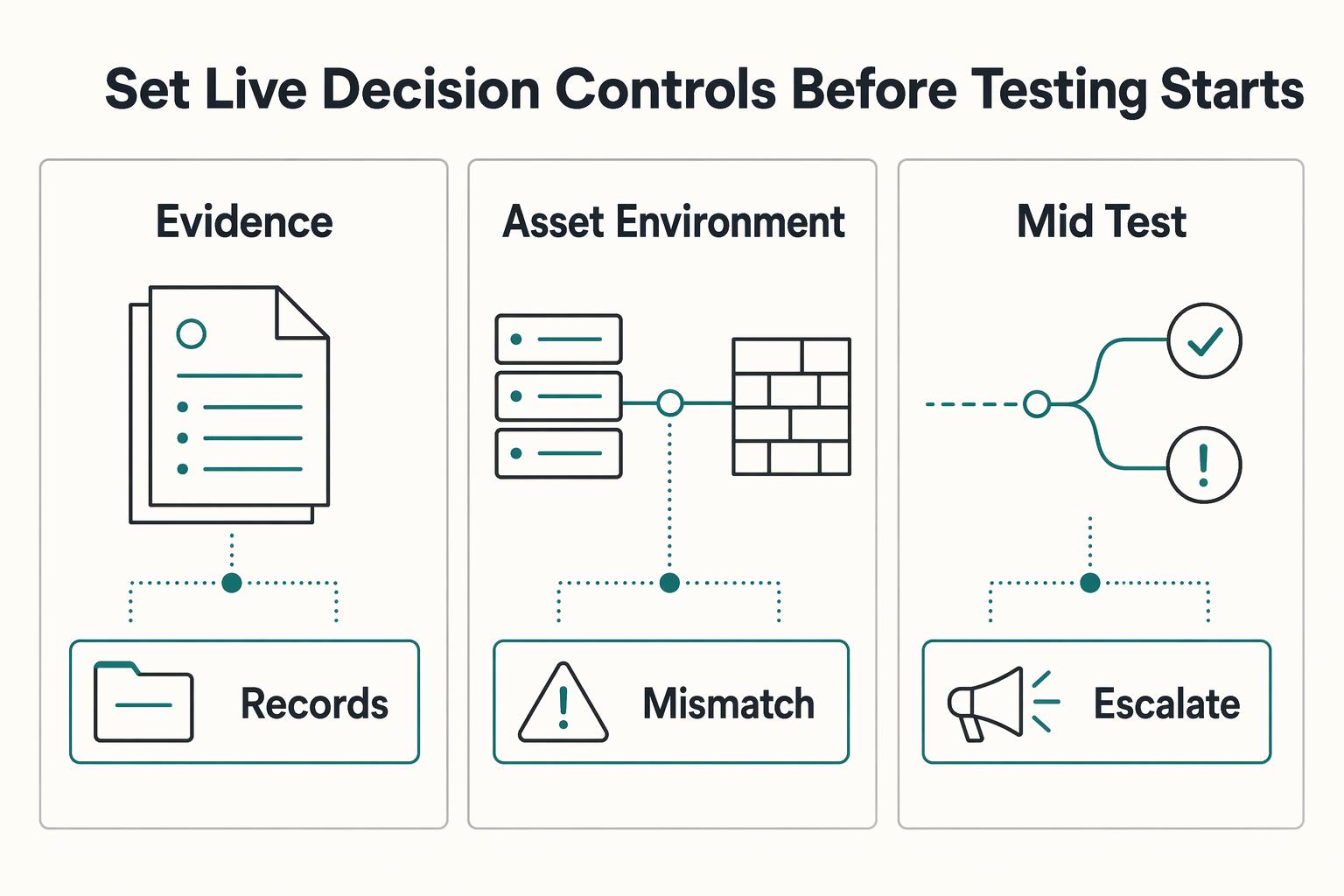
Step 3: Set live decision controls before testing starts#
Before testing begins, decide how live decisions will actually be handled.
Use amendment as the working term for a dated written change to scope, timing, environment, method, or commercial terms.
The rule here should be strict: review change requests, but do not perform expanded work until the amendment is signed.
| Trigger | Required proof | Next action | Record to retain |
|---|---|---|---|
| Approval authority is unclear before kickoff | Current written approval tied to this engagement | Pause start | Approval record in the engagement file |
| Asset or environment is not clearly named | Approved scope list that explicitly includes it | Decline and escalate for clarification | Scope question log and client response |
| Client dependency fails (for example, access/contact readiness) | Evidence of failed assumption | Pause or reschedule per recorded assumptions | Timestamped dependency note and client notification |
| Mid-test request changes targets, methods, timing, or environment | Dated written amendment | Stop expanded work until signed | Signed amendment and version history |
| Procurement-bound request appears to exceed existing buying approval | Buyer confirmation on routing/coverage | Escalate instead of assuming coverage | Buyer instruction and updated engagement record |
Treat informal "while you are in there" requests as potential scope creep and run them through the same change control.
The important thing about this step is that it turns the SOW from a static description into a living control system. Testing rarely goes exactly to plan. The value of the ROE is not that it predicts every event. It is that it tells the team how to handle the events that matter without improvising authority.
A good ROE answers process questions the SOW alone often leaves open:
- Who can pause the work?
- Who receives a scope question?
- Who reviews a requested change?
- What happens while that review is pending?
- Who communicates the outcome to the team?
- What record is retained once the issue is resolved?
Those answers should be available before testing starts, not developed during the first live escalation. If the team is waiting until a problem appears to decide who owns it, they are already behind.
It helps to think about live decision controls as protection against three kinds of drift.
Execution drift happens when the team keeps working while waiting for clarification, on the assumption that the issue is minor.
Authority drift happens when someone without recorded authority gives practical instructions the team feels pressure to follow.
Record drift happens when a live decision is made but the file is not updated in a way that later reviewers can verify.
The ROE should prevent all three.
To make these controls work, record the sequence of the decision, not just the outcome. A usable file should show:
- what triggered the question
- what proof was required
- what immediate action the team took
- what record was retained afterward
That structure mirrors the table and gives later reviewers confidence that the team did not merely arrive at a defensible result by luck. They followed a repeatable process.
Another useful discipline is to align the ROE with how the delivery team actually communicates. If the team will escalate through a defined internal channel and then await a written client answer, the ROE should reflect that path clearly enough that nobody invents a shortcut under pressure. If the client has a live decision contact, the team should know when that contact can clarify an issue and when the matter must be routed into amendment instead.
The underlying idea is simple: not every question requires a signed change, but every question requires a known path. The team should be able to distinguish between:
- a clarification that confirms the existing approved scope
- a failed assumption that affects timing or coverage
- a true change that requires amendment
If those categories are blurred, the team will either over-escalate ordinary clarifications or under-control actual scope changes. Both create friction. Clear live controls prevent that by giving each type of issue a defined route.
For a step-by-step walkthrough, see How Cloud Architects Structure an SOW for Multi-Cloud Migration.
Step 4: Reconcile execution, billing, and reporting in one record#
At this stage, the main job is consistency. Keep one traceable chain from approval through closeout.
| Record | Role in the file | Must stay aligned with |
|---|---|---|
| Authorization packet | Says what could start | Approved targets, exclusions, and approval |
| ROE | Says how live questions would be handled | Pauses, escalation path, and live controls |
| Change records | Say what moved | Signed amendments and version chain |
| Billing notes | Say what observable event supports the commercial trigger | Billing trigger and delivery record |
| Report | Says what was actually delivered and what affected delivery | Approved scope, exclusions, pauses, and signed changes |
The same target names, exclusions, assumption failures, pauses, and signed amendments should match across the authorization packet, ROE, change records, billing trigger notes, and final report language. If those records drift apart, you lose the ability to show what was approved, what changed, and what actually happened.
Closeout rule: if something was excluded, delayed by dependency failure, or changed by amendment, say that plainly in the report using the same wording as the signed records.
This is where document quality becomes operational credibility. A team can manage a live issue correctly and still create a weak engagement record if the downstream documents tell the story differently. The goal is not to make every line identical. The goal is to preserve a traceable chain from the original approval to the final report.
Think of the engagement file as one narrative told through several records. The authorization packet says what could start. The ROE says how live questions would be handled. The change records say what moved. Billing notes say what observable event supports the commercial trigger. The report says what was actually delivered and what affected delivery. Those records do not have to repeat each other word for word, but they do need to align.
Misalignment usually appears in small ways first:
- a target is abbreviated in the report but written differently in the approved scope
- a dependency failure is mentioned in internal notes but omitted from the client-facing closeout language
- a pause is reflected in scheduling records but not in reporting
- an amendment changes timing or environment, but billing still points to the original event
- an exclusion is clear in the SOW but written ambiguously in the report summary
Each of those gaps weakens your ability to show a clean engagement path. Later, when someone asks what was approved, what changed, or why coverage differed from the initial plan, you do not want the answer to depend on stitching together competing versions of the truth.
The easiest way to avoid that problem is to reconcile records deliberately before closeout. Review them in sequence and compare the operational anchors:
- approved targets
- exclusions
- assumptions that mattered
- any pauses
- any signed amendments
- the billing trigger
- the report structure that will reflect the above
If any item is described in different terms across those records, decide which wording matches the signed file and normalize the rest. Consistency is especially important for exclusions and changes. Those are the exact points most likely to be questioned later.
Describe exclusions, dependency delays, and approved changes plainly in the report. Use the signed target names and versions so the client can distinguish work performed from work originally proposed.
The billing connection matters for similar reasons. Billing should map to a defined, observable engagement event, and the note supporting it should align with the rest of the file. If billing depends on a description of delivery that the report or change log cannot support, you have created an avoidable dispute point. The fix is not to rewrite history at closeout. The fix is to make sure the billing trigger, change record, and report all describe the same engagement reality.
This step is also where version discipline pays off. If amendments were signed, the file should make it easy to see which state governed at which point in time. You do not want later reviewers to wonder whether the report follows the original scope or the amended one. A clear version chain prevents that confusion and makes closeout much easier to defend.
One practical review method is to compare the key nouns and events across documents. Are the target names the same? Are exclusions described the same way? Does the report mention the same assumption failure that triggered the pause record? Does the billing note point to an event the delivery record can actually verify? These are simple checks, but they catch most drift before signoff.
Do not underestimate the importance of plain reporting language here. When something changed, say so directly. When coverage was limited by a failed dependency, say so directly. When an item remained excluded, say so directly. Trying to smooth over those facts usually creates more confusion than candor does. Clear closeout language is not a confession of weakness. It is proof that the team stayed inside the approved controls.
This pairs well with our guide on How to Write a Scope of Work for a Mobile App Development Project.
A SOW generator can help organize an initial draft. Compare it manually with the signed scope and rules of engagement; it cannot verify asset ownership, testing permission, or delivery records.
Final pre-signoff checklist#
Before you sign or schedule, use this as the hard gate. Every control below should be a clear go. If any row is a hold, stop and fix the file first.
The checklist works best when you use it literally. Do not treat it as a soft review aid or a reminder list someone can satisfy mentally. It should convert broad confidence into specific proof. Every row should force the file to answer a narrow, verifiable question. If it cannot, the engagement is not ready.
Step 1: Verify records, not interpretations#
This is where you confirm the file can stand on its own. Each check should tie to one file-level proof point, not a chain of assumptions.
| Check | Go | Hold | Required evidence | Failure action |
|---|---|---|---|---|
| Authorization | You can confirm who approved this exact engagement and who can make live decisions | Approval authority is unclear, outdated, or split across threads | Approval record | Pause kickoff |
| Scope and cross-border readiness | Named targets are explicit, and jurisdiction, data-handling, and client-side approval conditions are documented before start | Targets are vague, or jurisdiction/handling approvals are assumed instead of documented | Scoped asset list | Return for redline |
| Rules of engagement | Operating instructions are signed and usable by the delivery team | The team would need to improvise pause, escalation, or test behavior decisions | Signed ROE | Return for redline |
| Change control | Any scope movement can be checked against a current signed change record | Expanded work would rely on informal approval | Amendment log | Route through amendment |
| Billing | Billing timing maps to a defined, observable engagement event | Billing depends on an event that cannot be verified later | Billing trigger record | Defer billing event |
| Reporting | Draft reporting structure maps to approved scope, exclusions, pauses, and signed changes | You cannot show how final reporting will mirror the signed record | Draft report mapping | Return for redline |
Do not accept unresolved links as evidence. Any link can return "Page Not Found," and older links or bookmarks may no longer point to the same place. If any approval, policy, or client record is link-based, reopen it before signoff. If the link fails, relocate it through homepage, search, or department paths, then update the engagement file.
A strong way to use this checklist is to insist that each row be reviewable by someone who was not part of the original drafting. If that reviewer can independently confirm the proof point, the file is probably in good shape. If they keep asking what the authors intended, the file still relies too much on interpretation.
One final discipline here: do not let a row pass because another row feels strong. Good scope does not compensate for weak approval. A strong ROE does not compensate for an unverifiable billing trigger. The checklist is a hard gate precisely because each control protects a different failure mode.
Step 2: Use tools only after the file passes#
Use drafting tools to organize terms, then review their output against the approved engagement file. The SOW generator and freelance contract generator do not validate testing authority or replace a signed approval.
They can stress-test wording, but they do not replace signed controls or a traceable engagement record.
That keeps the SOW in its proper role: not just a good-looking document, but a dependable mandate for the exact work your team is authorized to perform.
We covered this in detail in How to Structure an SOW for a Retainer-Based Consulting Engagement.
Once your checklist is complete, convert the approved scope into client-ready terms with the freelance contract generator.
Effort, Timeline, and Commercial Anchors#
Agree review and response windows that match the testing schedule. As a hypothetical planning example, reserve five business days for pre-start review and two business days for ordinary change review. Emergency stop-and-notify instructions need their own live contact path; a routine response target is not permission to continue risky work.
Planning windows and handoff gates#
Confirm authorization, technical readiness, and the reporting and billing milestones before testing. A provisional calendar hold can help planning, but it should not be treated as permission to execute while those conditions remain open.
Change-budget guardrails#
Any new target, environment, or method outside the approved scope needs written authorization before testing. Commercial review thresholds can separately govern extra effort or fees. For example, a team might require budget approval above a chosen amount, but a below-threshold price change does not authorize an unapproved target.
Record pack completeness standard#
Check required fields individually rather than scoring the packet by percentage. A missing permission, target boundary, stop condition, or emergency contact can block testing even when the rest of the file is complete.
Penetration Testing SOW FAQ#
Use these FAQ answers as operating checks during drafting and live delivery handoffs.
What should be signed before kickoff?#
Keep signed engagement authorization, the approved target and exclusion list, agreed rules of engagement, and named escalation contacts. Confirm any required third-party permissions before testing. A drafting tool can organize these records, but the client and tester must verify the authority and scope.
How do you handle a newly discovered asset mid-test?#
Treat it as out of scope until it is explicitly added in writing. Record the discovery, pause expansion, and escalate for written confirmation rather than relying on verbal comfort.
When does a scope clarification become an amendment?#
A clarification becomes an amendment when any approved baseline shifts: targets, methods, timing, environments, or commercial terms. If the change affects delivery boundaries, do not proceed until the amendment is signed.
What billing trigger works best for fixed-fee engagements?#
Use the milestone the parties actually agreed, such as delivery of the final report, documented acceptance, or a staged payment schedule. State what happens if client dependencies delay work. Link each invoice to that milestone record and any approved change; there is no single best trigger for every fixed-fee engagement.
How often should the delivery log be updated?#
Update the log each time a dependency fails, a scope question appears, or a client decision changes the run plan. For active engagements, daily updates during execution and immediate updates on major events are practical.
Which frameworks should inform terminology without overriding contract language?#
Use NIST SP 800-115 for technical assessment planning and rules-of-engagement topics. Framework terminology helps make the contract clearer; testing authority still comes from the authorized scope and applicable permissions. The SaaS SOW guide can help with the commercial document structure.
Frequently Asked Questions
What should be signed before kickoff?
Keep signed engagement authorization, the approved target and exclusion list, agreed rules of engagement, and named escalation contacts. Confirm any required third-party permissions before testing. A drafting tool can organize these records, but the client and tester must verify the authority and scope.
How do you handle a newly discovered asset mid-test?
Treat it as out of scope until it is explicitly added in writing. Record the discovery, pause expansion, and escalate for written confirmation rather than relying on verbal comfort.
When does a scope clarification become an amendment?
A clarification becomes an amendment when any approved baseline shifts: targets, methods, timing, environments, or commercial terms. If the change affects delivery boundaries, do not proceed until the amendment is signed.
What billing trigger works best for fixed-fee engagements?
Use the milestone the parties actually agreed, such as delivery of the final report, documented acceptance, or a staged payment schedule. State what happens if client dependencies delay work. Link each invoice to that milestone record and any approved change; there is no single best trigger for every fixed-fee engagement.
How often should the delivery log be updated?
Update the log each time a dependency fails, a scope question appears, or a client decision changes the run plan. For active engagements, daily updates during execution and immediate updates on major events are practical.
Which frameworks should inform terminology without overriding contract language?
Use NIST SP 800-115 for technical assessment planning and rules-of-engagement topics. Framework terminology helps make the contract clearer; testing authority still comes from the authorized scope and applicable permissions. The SaaS SOW guide can help with the commercial document structure.
Researched and edited by the Gruv editorial team. Gruv builds cross-border billing, payouts, and finance-operations software for global businesses.
Sources
- austintexas.gov/sites/default/files/files/Airport/Task%208.1...trusted
- cisa.gov/resources-tools/resources/cisa-services-catalogtrusted
- cms.gov/regulations-and-guidance/guidance/transmitta...trusted
- contracts.hhs.texas.gov/sites/default/files/documents/2024-Aug/HHS00...trusted
- csrc.nist.gov/pubs/sp/800/115/finaltrusted
- federalregister.gov/documents/2024/10/29/2024-24582/provisions-p...trusted
- galvestontx.gov/AgendaCenter/ViewFile/Item/17551trusted
- it.nc.gov/documents/files/918a-web-summary/opentrusted
Educational content only. Not legal, tax, or financial advice.
Related Posts
A Guide to the Statement of Work (SOW) for a SaaS Development Project
Before coding starts, agree what the client will receive, how it will be tested and when you can invoice. Those decisions protect delivery time and cash flow more directly than a broad promise to implement the platform.

The Freelance Payment Penalty: A Modeled Audit of Platform Fees, FX Spreads, and Payout Delays
The money rarely disappears through a single, easy-to-spot fee. The real loss is stacked. A marketplace takes its commission, a processor adds a charge for international cards, a bank or payment company converts the currency at a spread, a platform holds the funds before release, and a wire sheds a little to intermediaries on the way in. Each layer looks defensible on its own, but the worker feels the combined result as a smaller deposit and a later payday.

How to Respond to a Subpoena for Business Records
Move fast, but do not produce records on instinct. If you need to **respond to a subpoena for business records**, your immediate job is to control deadlines, preserve records, and make any later production defensible.