

Quick Answer
Define the fractional CMO’s included work, availability, client inputs and approval authority. Add a written change process, fee cadence, payment due dates and separately priced execution work. Agree how performance is measured, which IP rights the client receives, and how either side ends the engagement.
For a business-of-one, the retainer agreement is often where quiet anxiety shows up. Usually, it comes from experience: a client pays late, scope keeps expanding, or a workable relationship goes sideways because no one pinned down the basics. Those are not minor annoyances. They cut directly into your time, cash flow, and stability.
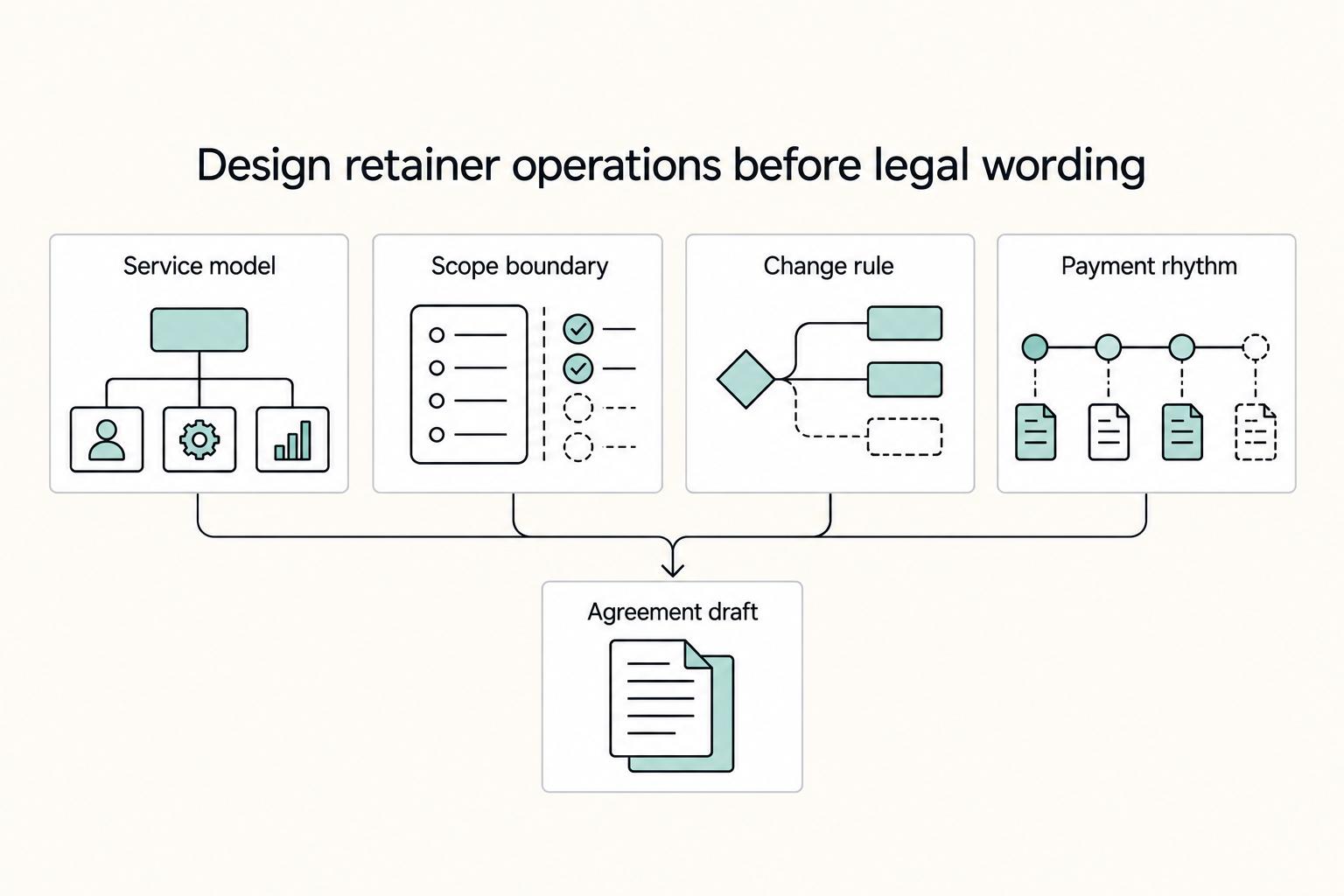
Use the agreement as a client-management tool: it sets the terms for how work, decisions and payment run throughout the engagement.
It is also one of the clearest early signals of how you operate. When you put a complete, professional agreement in front of the client - your agreement, not a vague thread of emails or their generic template - you define the relationship. You are not stepping in as an extra pair of hands. You are showing up as a strategic partner with a clear way of working.
This guide focuses on the parts that matter most. It covers the checks to run before you draft, the clauses that keep scope under control, the pricing structure that protects value and predictability, and the terms that cover IP, payment, and exit. The goal is simple: replace contract anxiety with clear control.
The Pre-Agreement Checklist: 4 Steps Before Drafting a Single Clause#
If you draft before you qualify the client, lock communication rules, confirm access, and define success, the contract can end up formalizing assumptions. Real risk control starts before clause drafting, not inside it.
In PMI's 2018 reporting, 52 percent of projects experienced scope creep or uncontrolled scope changes, up from 43 percent five years earlier. The practical takeaway is straightforward: scope problems often trace back to unclear authority, missing inputs, and vague goals. Later, they show up as contract conflict.
Step 1. Qualify the client before you qualify the work#
Start by qualifying the operating environment, not just the assignment. You need to know what role they expect you to play, whether budget is real, who can make decisions, and whether anyone can execute once decisions are made.
Ask direct discovery questions and listen for specific answers. "We'll figure it out" or "everyone approves" is not a good sign. Before drafting, confirm two names: one person with authority to approve and fund work, and one person or team responsible for execution.
- "What do you expect me to own versus advise on?"
- "Who can approve priorities and funding?"
- "What budget exists beyond my fee for programs, tools, or contractors?"
- "Who executes after decisions are made?"
Walk away if:
- they frame you as both strategist and full execution team without added resourcing
- no one clearly owns approval authority or budget
- they want growth outcomes but cannot name a working budget beyond the retainer
- they resist early sharing of data, access, or internal constraints
If expectations are blurred, reset them in plain language: "I can own strategy, prioritization, and reporting. If you also need daily execution, we need to define what stays with your team and what is out of scope or separately priced."
Step 2. Define the communication operating model in writing#
Document communication rules so both sides know who can approve work and where decisions are recorded. Confirm these five items before sending a draft:
| Item | Meaning |
|---|---|
| decision owner | the final approver with funding authority |
| escalation path | who removes blockers |
| approval workflow | what needs written approval versus discussion approval |
| reporting rhythm | cadence and format |
| channel rules | where decisions, requests, and approvals are recorded |
Use this discovery script: "Before I send terms, who is final approver, who is backup, what requires written approval, how often do you want reporting, and where are final decisions documented?"
Your checkpoint is a written recap by email or a one-page note with named roles, cadence, response expectations, and approval location. If it is not written down, do not treat it as settled. This is also the right moment to introduce change control: "Any request that changes priorities, deliverables, or timing is documented, impact-assessed against objectives, and approved before implementation."
Step 3. Audit access using least privilege#
Ask for the minimum access needed to do the job. That protects the client and keeps you from quietly inheriting admin responsibility that sits outside scope. At the same time, missing access is still a delivery risk, so map dependencies before kickoff and confirm the owner, permission level, and fallback plan for each one.
| Access area | When it may be needed | Client-side owner | Delivery risk if missing |
|---|---|---|---|
| Analytics/reporting source | When scope includes performance assessment or baselines | Marketing ops, analytics lead, or admin | Baselines and reporting may be hard to verify |
| CRM/pipeline visibility | When success criteria include lead quality, conversion, or funnel movement | Sales ops or revenue operations owner | Work may be hard to connect to pipeline outcomes |
| Website/CMS access | When scope includes site changes, conversion input, or publishing oversight | Web lead, product owner, or IT admin | Recommendations can stall because changes are delayed |
| Ad platform visibility | When paid media is in scope | Paid media owner or finance-approved admin | Budget and channel performance can remain unclear |
| Internal communication channel | When coordination and tracked approvals are required | Team lead or workspace admin | Decisions can slow down and rely on informal relays |
Step 4. Convert requests into outcomes and a draft success definition#
Do not write scope from a list of tactics. First translate requests into outcomes, then draft scope around those outcomes. That keeps the agreement tied to business intent instead of a pile of activities.
Use these prompts, then turn the answers into a scope anchor the client can edit:
- "What business problem is this solving?"
- "What should change first if this is working?"
- "What would make this worth renewing?"
"Objective: improve qualified pipeline creation from existing demand capture. Leading indicators: inquiry-to-qualified-opportunity conversion, lead follow-up speed, and reporting accuracy. Success definition for this initial term: documented channel plan, approved reporting cadence, and measurable movement in agreed leading indicators during the contract period."
This gives you a SMART direction without promising outcomes you do not fully control. It also gives you language you can move directly into scope, deliverables, and timing. Once you have worked through these four steps, the agreement is based on operating reality rather than guesswork.
Before you send your first draft, build a practical baseline scope and terms with the freelance contract generator.
Three clauses that define scope, changes, and extra-work pricing#
Once the pre-agreement work is done, the contract needs to carry that clarity through execution. Scope protection is practical: define what is included, define how changes are approved, and define what extra work costs before it starts. Miss any one of those, and ordinary requests can turn into unpaid work or disputed expectations.
For a fractional CMO retainer, treat these three clauses as one system: scope boundary, change control, and pre-agreed pricing escalation.
Clause 1: Scope = responsibilities, deliverables, and exclusions#
Your Scope of Services should make the boundary obvious. The cleanest way to do that is to separate three things the client often blends together:
- Responsibilities: the strategic functions you own or advise on
- Deliverables: specific outputs with frequency or deadlines
- Excluded services: work not included unless separately approved
Use this boundary test before accepting any new request: if it changes your role, adds a new deliverable, or increases delivery frequency, it is out of scope until approved in writing.
| Common task area | Include in scope | Treat as out of scope |
|---|---|---|
| Strategy and planning | Quarterly strategy, monthly roadmap, channel prioritization | Unlimited on-demand campaign brief drafting |
| Leadership and reporting | Monthly leadership report, team mentoring, budget review | Daily project management of all marketing execution |
| Channel oversight | Performance review and recommendations | Direct platform buildout, trafficking, daily optimization |
| Content oversight | Editorial direction, approval criteria, messaging guidance | Drafting every blog, email, or social asset |
| Vendor management | Agency evaluation and review-call participation | Managing every freelancer, invoice, and production schedule |
Clause 2: Written change path (request, impact, approval, record)#
Scope only holds if there is a clear path for changing it. Put that path directly into the agreement and keep it simple:
| Step | What happens |
|---|---|
| Request intake | client submits requested change in writing |
| Impact assessment | you assess impact on timing, priorities, dependencies, deliverables, and fees |
| Approval checkpoint | named approver accepts or rejects in writing |
| Documentation location | approved change is stored where the contract says it lives, for example a change appendix, signed addendum, or designated contract-referenced email thread |
If those four records are not visible together, arguments about what was "included" get more likely.
Clause 3: Pre-agreed pricing escalation for approved extra work#
Do not leave extra-work pricing to ad hoc messages. Put it inside Fees and Payment Terms, where it belongs. Use draft language only after confirming your current rate logic:
“Extra services require written approval of scope, fee and delivery dates before work begins. The approval will state whether the fee is fixed or calculated at the hourly rate in the fee schedule, when it will be invoiced, and its payment due date.”
If you propose late-payment interest or fees, specify the rate, start date and calculation method, and check that the terms are permitted under the applicable law.
What to avoid across all three clauses#
The usual failure mode is rarely one dramatic omission. It is a set of vague terms that leaves too much room for interpretation. Watch for these:
- vague verbs like "support," "manage," or "advise as needed" with no concrete output
- missing owners for approvals, delivery, or acceptance
- undefined acceptance criteria for key deliverables
- verbal-only approvals for scope, pricing, or timeline changes
For a step-by-step walkthrough, see How to Set Up a Retainer Agreement with a Client.
How to Price Your Retainer for Maximum Value and Predictability#
Pricing works best when it matches the role you are actually delivering. Set the fee around senior access, business context, and scope complexity. Then lock the measurement and payment mechanics so margin and cash flow stay predictable.
Step 1 Choose the pricing posture before you name a number#
Pick the model before you pick the number. In practice, the useful factors are required access and time, market context and urgency, and role complexity.
Convert the monthly fee into implied hours at your standard hourly rate as a capacity check. Include meetings, preparation, reporting and between-meeting support. A retainer is useful when the client needs recurring leadership within an agreed scope; there is no universal monthly-hour threshold at which it becomes cheaper or more profitable.
| Engagement type | Pricing posture | Expected involvement | Risk to your margin if underpriced |
|---|---|---|---|
| Hourly bank retainer | Set hours per month at an agreed rate | Limited advisory access or short review bursts | Margin pressure increases if the client expects outcomes and ongoing leadership beyond purchased hours |
| Monthly retainer | Fixed monthly fee for predefined scope and senior access | Ongoing strategy, execution oversight, coaching, and leadership participation | Margin pressure increases if scope expands quietly or priorities shift without reset |
| Project fee | One fee for a defined initiative | Time-bound audit, plan, or defined build | Margin pressure spikes if the client treats it like ongoing fractional leadership |
For an illustrative capacity check, a USD 6,000 monthly retainer divided by a USD 200 hourly planning rate represents 30 hours. If the scope regularly takes 40 hours, the effective rate is USD 150 before expenses. Narrow the scope, raise the fee or agree how additional work is priced. These figures are a worked example, not a market benchmark.
Step 2 Define success with contract-ready metrics#
A strong pricing model needs a matching success model. If the retainer pays for ongoing strategic leadership, the contract should measure what you can reasonably influence, not just lagging outcomes you do not control on your own.
Use three metric buckets in the agreement, and make the monthly reconciliation meeting a standing requirement so you review effort, deliverables, and results against scope.
- Controllable leading indicators: actions and progress signals you directly influence.
- Operational delivery indicators: agreed meetings, reporting cadence, strategy deliverables, and participation commitments completed to schedule.
- Excluded lagging outcomes: outcomes like total revenue, ARR, or closed-won pipeline can be reviewed for context but are not guaranteed performance obligations.
Step 3 Defend value pricing when the client asks for hourly#
When a client pushes for hourly pricing, keep the explanation short and consistent instead of arguing the philosophy of pricing.
Use this script:
"This role is priced as a monthly retainer because you are buying ongoing senior judgment and continuity, not just logged time. Hourly billing can fit narrow advisory support, but it can break down when you need cross-month leadership access and accountability."
If they still want hourly, give them a controlled alternative rather than cutting the price:
- Fallback 1: a capped hourly bank with defined access windows and explicit exclusions.
- Fallback 2: a narrower retainer with fewer deliverables and a review after an initial 90-day rolling contract, subject to local enforceability and your written terms.
Step 4 Lock the payment mechanics into the contract#
Payment terms are not back-office details. They are part of the risk structure of the deal, so put this checklist directly into the agreement:
| Payment term | What to specify |
|---|---|
| Invoice timing | state whether billing is in advance and set a fixed recurring invoice date |
| Due date | tie payment due date to invoice date in clear terms |
| Payment method and currency | state both explicitly |
| Excluded costs | confirm ad spend, third-party media, premium software purchased for the client, and large one-time out-of-scope projects are excluded from the retainer |
| Overdue handling | include interest, late-fee, or admin terms only after confirming the exact figures with legal |
| Pause-of-work trigger | define when work may pause for non-payment only after confirming the terms with legal |
If these terms are fuzzy, even a well-priced retainer can create avoidable margin pressure and cash-flow risk.
Make ownership, exit, and confidentiality explicit in the contract#
Once scope and pricing are clear, the remaining pressure points are ownership, confidentiality, and exit. These clauses help prevent avoidable disputes before they start. Your contract should make ownership, offboarding, and confidentiality explicit so neither side has to guess what happens if scope changes, payment stalls, or the relationship ends.
Step 1 Define IP boundaries in writing#
Agree whether the client receives an assignment of specified deliverables or a license to use them. If you negotiate transfer after payment, state the exact payment condition and any interim use rights. Payment alone does not create a copyright assignment, and a full-payment condition can conflict with work-made-for-hire language that gives the client initial ownership.
Separate client-specific deliverables from your existing templates, tools and know-how. If a deliverable embeds your existing material, give the client the license it needs to use the deliverable while reserving your ability to reuse the underlying material. A third party should be able to tell what is owned, what is licensed and when rights begin.
| Item to clarify | Use in your clause | Risk if unclear |
|---|---|---|
| Pre-existing materials | State who owns them and whether any use rights are granted during the engagement | Disputes about underlying methods or assets |
| Engagement deliverables | State when ownership or usage rights begin, including any full-payment condition | Conflict if payment is late or incomplete |
| Client-provided materials | State what rights you have to use them for the engagement | Permission and usage disputes |
| Any transfer terms | State the trigger and scope of any assignment or expanded rights | Vague "all work product" interpretations |
Step 2 Separate termination mechanics#
Termination language gets sloppy fast when convenience and cause are bundled together. Keep them separate.
For convenience, require written notice and state the period clearly, for example 30 days or more if it fits the deal. If you want a minimum commitment, say so directly, for example at least 90 days, and have qualified counsel confirm local fit. For cause, define the exit conditions and notice mechanics both parties agree to.
Also address practical failure modes. If the client stops responding while billing continues, state what happens next and how final billing is handled for unpaid fees and work completed during the notice period.
Step 3 Tighten confidentiality language#
Confidentiality should be mutual and specific, not broad and fuzzy. Define what is confidential and list permitted disclosures so obligations are clear for both sides.
Add survival language so confidentiality obligations continue after termination, then have qualified counsel review the final agreement before signature. These clauses only protect you if the wording fits your jurisdiction and the deal you actually sold.
We covered this in detail in What Is an 'Evergreen' Clause in a Retainer Agreement?.
Conclusion: Your Agreement is Your Authority#
Before signing, test the agreement against a normal month and an early exit. Both sides should be able to explain the included work, who approves changes, what is payable, and which materials and access will be handed over.
Step 1 Use the contract as a system, not a formality#
For example, suppose the retainer includes a monthly channel plan, two leadership meetings and one reporting review. A request to run daily campaigns changes the role. The agreement should identify the approver, how you quote the additional work and whether the original priorities continue while the change is considered.
Use a simple test: can you point to one clause for each key risk, or are you relying on implied intent? If responsibility is only implied, scope can expand when pressure hits.
| Area | Reactive freelancer posture | Authority-led retainer posture |
|---|---|---|
| Scope and changes | Accepts broad requests and clarifies later; wording stays vague; scope drifts. | Defines deliverables, out-of-scope work, and change approval in writing; execution stays cleaner with fewer disputes. |
| Payment | Uses generic invoice language and goodwill; payment timing and non-payment handling stay unclear. | Uses dedicated payment clauses with clear triggers and timing; payment operations are more predictable. |
| IP and exit | Assumes the relationship will end smoothly; IP and handoff terms become unclear. | Makes confidentiality and IP terms explicit, and states exit expectations in writing; transfer is cleaner with less argument. |
Step 2 Check failure points before signature#
Read the scope, payment, IP and termination clauses together. If notice runs into another billing period, specify the final fee and any advance-payment adjustment. If a client disputes an invoice, define how the undisputed amount is handled. If delivery depends on client data, explain how a delay affects the schedule.
Use templates as drafting aids, then check their fit to your engagement. Remove provisions that describe someone else’s transaction, and resolve conflicting terms between the main agreement, SOW and fee schedule.
Step 3 Complete a pre-sign control checklist#
Use one final pre-sign review to make sure the important terms are explicit in the draft:
- You can identify the payment clause, how payment timing works, and how non-payment is handled.
- You can identify where obligations are limited and how changes are approved.
- You can identify the notices and information-sharing clause that sets communication and access mechanics.
- You can identify the confidentiality and intellectual property clauses, plus any termination mechanics stated in the draft.
- You can identify who carries added-cost risk if legal or regulatory changes affect delivery.
If any clause weakens clarity, payment certainty, ownership, or exit control, revise it before signing. That is the decision standard.
You might also find this useful: A Strategic Consultant's Guide to Structuring a Retainer Agreement. Once your retainer terms are set, keep billing aligned with the contract using the free invoice generator.
Frequently Asked Questions
How do you stop scope creep in a fractional CMO retainer?
Stop scope creep by defining scope in the SOW, not in broad narrative language. List deliverables, timelines, responsibilities, and out-of-scope items, and require a written change order before any change to scope, cost, or schedule starts. If a request is not in the SOW or an approved change order, treat it as new scope and paid work.
What are fair KPIs for this kind of engagement?
Use KPIs that are clearly defined and tied to goals you can influence. In the contract, define each KPI's baseline (when available), data source, and measurement date so review is auditable. If KPI review depends on client-provided data, state that timing and data completeness affect KPI review.
How much should you charge for a retainer?
Start with the time and access the role requires, the complexity of the work and your costs. Compare genuinely similar current offers only after matching scope. A fee that buys two monthly meetings and strategic review should not silently include daily execution. State availability, included services and how extra work is priced.
When should you choose a retainer instead of a project fee?
Choose a retainer when the client needs ongoing access to your strategic judgment over a defined period, and choose project pricing when they need one bounded deliverable with a clear end. Then match contract protections to that model so ongoing advisory work is not handled like fixed-scope delivery.
What should your termination clause say?
Specify convenience and cause termination separately: notice period and method, any cure period, work during notice, final billing, treatment of advance fees, and the handover of materials and access. Check that those terms fit the applicable law and agree with the notices and IP clauses.
How do you protect your own frameworks, templates, and methods?
Reserve your existing materials and specify any license the client needs to use them within deliverables. Define assignments and their payment conditions separately. In the U.S., a commissioned work is made for hire only if it meets the statutory requirements; a label alone is insufficient. Copyright transfers generally require a writing signed by the rights owner or authorized agent.
Should you include a performance bonus?
Use a bonus only when the result can be measured reliably and your influence is clear. Specify the baseline, data source, review period and calculation. For example, a USD 1,000 bonus could be tied to an agreed improvement in a qualified-lead metric, with exclusions and attribution rules settled before the period begins. Do not guarantee revenue that depends on the client’s pricing, sales team or fulfillment.
What should you add for cross-border payment and signing mechanics?
Specify invoice currency, payment timing, governing law, dispute forum and who pays transfer fees. Ask AP which tax documentation applies to the payee’s status and the payment: a U.S. person may provide W-9, while applicable foreign-person documentation can differ for individuals and entities. For EU counterparties, check the relevant national invoicing rules. Confirm entity details, invoice format and the signing process before kickoff.
Try a related tool
Researched and edited by the Gruv editorial team. Gruv builds cross-border billing, payouts, and finance-operations software for global businesses.
Sources
Includes 1 external source outside the trusted-domain allowlist.
- copyright.gov/circs/circ30.pdftrusted
- csrc.nist.gov/glossary/term/least_privilegetrusted
- irs.gov/forms-pubs/about-form-w-9trusted
- irs.gov/individuals/international-taxpayers/forms-fo...trusted
- law.cornell.edu/uscode/text/17/204trusted
- samhsa.gov/sites/default/files/nc-smart-goals-fact-shee...trusted
- pmi.org/learning/library/scope-creep-rising-11308external
Educational content only. Not legal, tax, or financial advice.
Related Posts
A Strategic Consultant's Guide to Structuring a Retainer Agreement
A consulting retainer should give you recurring revenue and the client a clear service commitment. Define what the fee buys before agreeing to it: a set of deliverables, a block of time, reserved advisory access or a bounded combination. That choice keeps an extra request from quietly becoming unpaid work.

The Freelance Payment Penalty: A Modeled Audit of Platform Fees, FX Spreads, and Payout Delays
The money rarely disappears through a single, easy-to-spot fee. The real loss is stacked. A marketplace takes its commission, a processor adds a charge for international cards, a bank or payment company converts the currency at a spread, a platform holds the funds before release, and a wire sheds a little to intermediaries on the way in. Each layer looks defensible on its own, but the worker feels the combined result as a smaller deposit and a later payday.

How to Respond to a Subpoena for Business Records
Move fast, but do not produce records on instinct. If you need to **respond to a subpoena for business records**, your immediate job is to control deadlines, preserve records, and make any later production defensible.